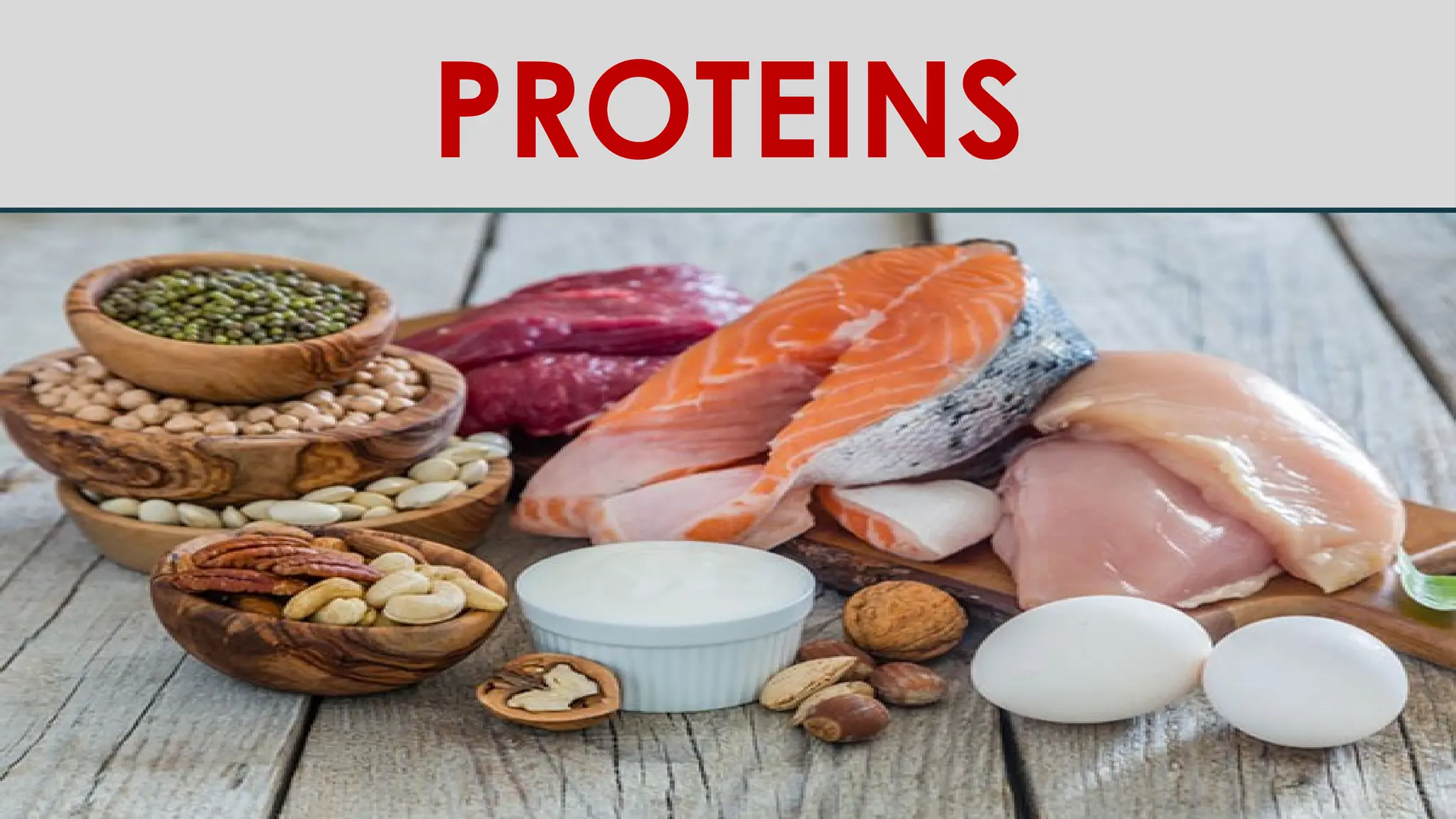
PROTEINS
INTRODUCTION & MEANING
 Proteins are essential nutrients for the human body.
 They are one of the constituents of body tissue and
also serve as a fuel source
 It accounts for approx16% of body weight.
 They are necessary for synthesis of body tissues.
DEFINITIONS
 Proteins are large, complex molecules made from
amino acids that are essential for the structure,
function, and regulation of the body's cells, tissues, and
organs.
 They are vital for numerous body processes, including
building and repairing tissues, catalyzing chemical
reactions, and transporting molecules.
Cont..
 Proteins are biopolymers, meaning they are large
molecules made up of repeating units i.e. amino
acids.
 These amino acids are linked together by peptide
bonds, forming polypeptide chains.
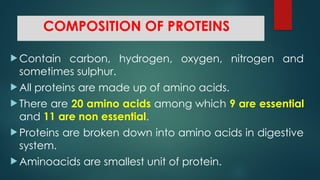
COMPOSITION OF PROTEINS
 Contain carbon, hydrogen, oxygen, nitrogen and
sometimes sulphur.
 All proteins are made up of amino acids.
 There are 20 amino acids among which 9 are essential
and 11 are non essential.
 Proteins are broken down into amino acids in digestive
system.
 Aminoacids are smallest unit of protein.
GENERAL CHARACTERISTICS OF
PROTEIN
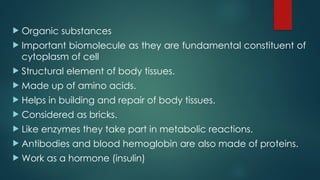
 Organic substances
 Important biomolecule as they are fundamental constituent of
cytoplasm of cell
 Structural element of body tissues.
 Made up of amino acids.
 Helps in building and repair of body tissues.
 Considered as bricks.
 Like enzymes they take part in metabolic reactions.
 Antibodies and blood hemoglobin are also made of proteins.
 Work as a hormone (insulin)
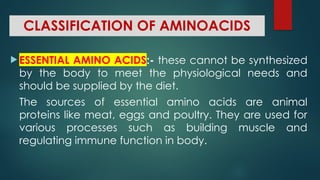
CLASSIFICATION OF AMINOACIDS
 ESSENTIAL AMINO ACIDS:- these cannot be synthesized
by the body to meet the physiological needs and
should be supplied by the diet.
The sources of essential amino acids are animal
proteins like meat, eggs and poultry. They are used for
various processes such as building muscle and
regulating immune function in body.
CLASSIFICATION OF AMINOACIDS
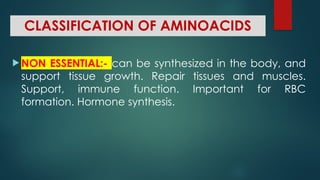
 NON ESSENTIAL:- can be synthesized in the body, and
support tissue growth. Repair tissues and muscles.
Support, immune function. Important for RBC
formation. Hormone synthesis.
CLASSIFICATION OF AMINO ACIDS
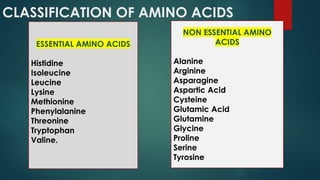
ESSENTIAL AMINO ACIDS
Histidine
Isoleucine
Leucine
Lysine
Methionine
Phenylalanine
Threonine
Tryptophan
Valine.
NON ESSENTIAL AMINO
ACIDS
Alanine
Arginine
Asparagine
Aspartic Acid
Cysteine
Glutamic Acid
Glutamine
Glycine
Proline
Serine
Tyrosine
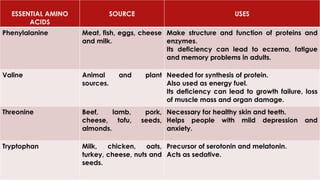
ESSENTIAL AMINO
ACIDS
SOURCE USES
Phenylalanine Meat, fish, eggs, cheese
and milk.
Make structure and function of proteins and
enzymes.
Its deficiency can lead to eczema, fatigue
and memory problems in adults.
Valine Animal and plant
sources.
Needed for synthesis of protein.
Also used as energy fuel.
Its deficiency can lead to growth failure, loss
of muscle mass and organ damage.
Threonine Beef, lamb, pork,
cheese, tofu, seeds,
almonds.
Necessary for healthy skin and teeth.
Helps people with mild depression and
anxiety.
Tryptophan Milk, chicken, oats,
turkey, cheese, nuts and
seeds.
Precursor of serotonin and melatonin.
Acts as sedative.
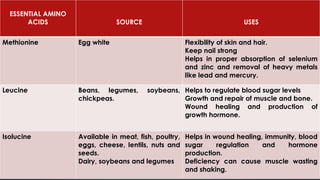
ESSENTIAL AMINO
ACIDS SOURCE USES
Methionine Egg white Flexibility of skin and hair.
Keep nail strong
Helps in proper absorption of selenium
and zinc and removal of heavy metals
like lead and mercury.
Leucine Beans, legumes, soybeans,
chickpeas.
Helps to regulate blood sugar levels
Growth and repair of muscle and bone.
Wound healing and production of
growth hormone.
Isolucine Available in meat, fish, poultry,
eggs, cheese, lentils, nuts and
seeds.
Dairy, soybeans and legumes
Helps in wound healing, immunity, blood
sugar regulation and hormone
production.
Deficiency can cause muscle wasting
and shaking.
ESSENTIAL AMINO
ACIDS
SOURCE USES
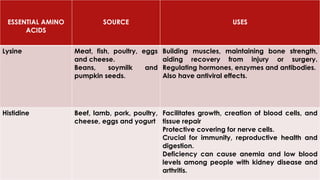
Lysine Meat, fish, poultry, eggs
and cheese.
Beans, soymilk and
pumpkin seeds.
Building muscles, maintaining bone strength,
aiding recovery from injury or surgery.
Regulating hormones, enzymes and antibodies.
Also have antiviral effects.
Histidine Beef, lamb, pork, poultry,
cheese, eggs and yogurt
Facilitates growth, creation of blood cells, and
tissue repair
Protective covering for nerve cells.
Crucial for immunity, reproductive health and
digestion.
Deficiency can cause anemia and low blood
levels among people with kidney disease and
arthritis.
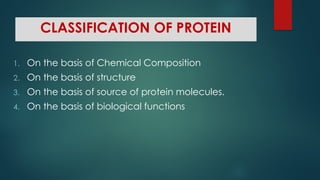
CLASSIFICATION OF PROTEIN
1. On the basis of Chemical Composition
2. On the basis of structure
3. On the basis of source of protein molecules.
4. On the basis of biological functions
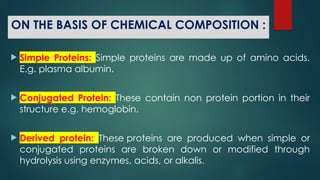
ON THE BASIS OF CHEMICAL COMPOSITION :
 Simple Proteins: Simple proteins are made up of amino acids.
E.g. plasma albumin.
 Conjugated Protein: These contain non protein portion in their
structure e.g. hemoglobin.
 Derived protein: These proteins are produced when simple or
conjugated proteins are broken down or modified through
hydrolysis using enzymes, acids, or alkalis.
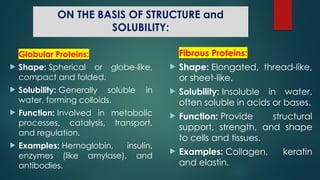
ON THE BASIS OF STRUCTURE and
SOLUBILITY:
Globular Proteins:
 Shape: Spherical or globe-like,
compact and folded.
 Solubility: Generally soluble in
water, forming colloids.
 Function: Involved in metabolic
processes, catalysis, transport,
and regulation.
 Examples: Hemoglobin, insulin,
enzymes (like amylase), and
antibodies.
Fibrous Proteins:
 Shape: Elongated, thread-like,
or sheet-like.
 Solubility: Insoluble in water,
often soluble in acids or bases.
 Function: Provide structural
support, strength, and shape
to cells and tissues.
 Examples: Collagen, keratin
and elastin.
BASED ON SOURCES OF PROTEIN
MOLECULE:
 Animal Proteins: These are the proteins derived from animal
sources such as eggs, milk, meat and fish. They are usually
called higher quality proteins because they contain
adequate amount of all essential amino acids.
 Plant Proteins: these are called lower quality proteins since
they have a low content of one or more of the essential
amino acids.
ON THE BASIS OF BIOLOGICAL
FUNCTIONS:
 Nutrient and Storage Proteins: These proteins store essential
nutrients, releasing them when needed by the organism. Ferritin
is a storage protein that stores iron.
 Transport and Carrier Protein: These proteins bind to specific
molecules and transport it through facilitated diffusion (passive
transport) or active transport. E.g. Hemoglobin transports
oxygen, while cytochromes participate in the electron transport
chain.
Cont..
 Enzymic Proteins: in living organisms, all reactions are catalyzed by
special proteins, called enzymes. E.g. urease, amylase etc.
 Defence proteins: Antibodies involved in the immune response are
defence proteins. Similarly, fibrinogen and thrombin are blood
clotting proteins that prevent loss of blood on injury.
 Contractile or motor proteins: These are the proteins that move itself
along a filament or polymer molecules using energy generated by
the hydrolysis of ATP e.g myosin protein present in muscles of animals.
Actin and myosin function in contractile systems of skeletal muscles.
Cont..
 Toxic Proteins: Toxic proteins are proteins that can cause harm
to living organisms, either by disrupting cellular processes,
damaging tissues, or triggering disease. E.g. bacterial toxins,
plant toxins, animal toxins.
 Structural Proteins: Structural proteins are proteins that living
organisms use to maintain their shape or structural integrity. E.g.
In connective tissue, such as skin, ligaments, and tendons, it
provides tensile strength and elasticity. In bones and teeth, it
mineralizes to form hard tissues and contributes to their load-
bearing capacity.

protein composition & amino acccids.pptx

  • 1.
  • 2.
    INTRODUCTION & MEANING Proteins are essential nutrients for the human body.  They are one of the constituents of body tissue and also serve as a fuel source  It accounts for approx16% of body weight.  They are necessary for synthesis of body tissues.
  • 3.
    DEFINITIONS  Proteins arelarge, complex molecules made from amino acids that are essential for the structure, function, and regulation of the body's cells, tissues, and organs.  They are vital for numerous body processes, including building and repairing tissues, catalyzing chemical reactions, and transporting molecules.
  • 4.
    Cont..  Proteins arebiopolymers, meaning they are large molecules made up of repeating units i.e. amino acids.  These amino acids are linked together by peptide bonds, forming polypeptide chains.
  • 5.
    COMPOSITION OF PROTEINS Contain carbon, hydrogen, oxygen, nitrogen and sometimes sulphur.  All proteins are made up of amino acids.  There are 20 amino acids among which 9 are essential and 11 are non essential.  Proteins are broken down into amino acids in digestive system.  Aminoacids are smallest unit of protein.
  • 6.
  • 7.
     Organic substances Important biomolecule as they are fundamental constituent of cytoplasm of cell  Structural element of body tissues.  Made up of amino acids.  Helps in building and repair of body tissues.  Considered as bricks.  Like enzymes they take part in metabolic reactions.  Antibodies and blood hemoglobin are also made of proteins.  Work as a hormone (insulin)
  • 8.
    CLASSIFICATION OF AMINOACIDS ESSENTIAL AMINO ACIDS:- these cannot be synthesized by the body to meet the physiological needs and should be supplied by the diet. The sources of essential amino acids are animal proteins like meat, eggs and poultry. They are used for various processes such as building muscle and regulating immune function in body.
  • 9.
    CLASSIFICATION OF AMINOACIDS NON ESSENTIAL:- can be synthesized in the body, and support tissue growth. Repair tissues and muscles. Support, immune function. Important for RBC formation. Hormone synthesis.
  • 10.
    CLASSIFICATION OF AMINOACIDS ESSENTIAL AMINO ACIDS Histidine Isoleucine Leucine Lysine Methionine Phenylalanine Threonine Tryptophan Valine. NON ESSENTIAL AMINO ACIDS Alanine Arginine Asparagine Aspartic Acid Cysteine Glutamic Acid Glutamine Glycine Proline Serine Tyrosine
  • 11.
    ESSENTIAL AMINO ACIDS SOURCE USES PhenylalanineMeat, fish, eggs, cheese and milk. Make structure and function of proteins and enzymes. Its deficiency can lead to eczema, fatigue and memory problems in adults. Valine Animal and plant sources. Needed for synthesis of protein. Also used as energy fuel. Its deficiency can lead to growth failure, loss of muscle mass and organ damage. Threonine Beef, lamb, pork, cheese, tofu, seeds, almonds. Necessary for healthy skin and teeth. Helps people with mild depression and anxiety. Tryptophan Milk, chicken, oats, turkey, cheese, nuts and seeds. Precursor of serotonin and melatonin. Acts as sedative.
  • 12.
    ESSENTIAL AMINO ACIDS SOURCEUSES Methionine Egg white Flexibility of skin and hair. Keep nail strong Helps in proper absorption of selenium and zinc and removal of heavy metals like lead and mercury. Leucine Beans, legumes, soybeans, chickpeas. Helps to regulate blood sugar levels Growth and repair of muscle and bone. Wound healing and production of growth hormone. Isolucine Available in meat, fish, poultry, eggs, cheese, lentils, nuts and seeds. Dairy, soybeans and legumes Helps in wound healing, immunity, blood sugar regulation and hormone production. Deficiency can cause muscle wasting and shaking.
  • 13.
    ESSENTIAL AMINO ACIDS SOURCE USES LysineMeat, fish, poultry, eggs and cheese. Beans, soymilk and pumpkin seeds. Building muscles, maintaining bone strength, aiding recovery from injury or surgery. Regulating hormones, enzymes and antibodies. Also have antiviral effects. Histidine Beef, lamb, pork, poultry, cheese, eggs and yogurt Facilitates growth, creation of blood cells, and tissue repair Protective covering for nerve cells. Crucial for immunity, reproductive health and digestion. Deficiency can cause anemia and low blood levels among people with kidney disease and arthritis.
  • 14.
    CLASSIFICATION OF PROTEIN 1.On the basis of Chemical Composition 2. On the basis of structure 3. On the basis of source of protein molecules. 4. On the basis of biological functions
  • 15.
    ON THE BASISOF CHEMICAL COMPOSITION :  Simple Proteins: Simple proteins are made up of amino acids. E.g. plasma albumin.  Conjugated Protein: These contain non protein portion in their structure e.g. hemoglobin.  Derived protein: These proteins are produced when simple or conjugated proteins are broken down or modified through hydrolysis using enzymes, acids, or alkalis.
  • 16.
    ON THE BASISOF STRUCTURE and SOLUBILITY: Globular Proteins:  Shape: Spherical or globe-like, compact and folded.  Solubility: Generally soluble in water, forming colloids.  Function: Involved in metabolic processes, catalysis, transport, and regulation.  Examples: Hemoglobin, insulin, enzymes (like amylase), and antibodies. Fibrous Proteins:  Shape: Elongated, thread-like, or sheet-like.  Solubility: Insoluble in water, often soluble in acids or bases.  Function: Provide structural support, strength, and shape to cells and tissues.  Examples: Collagen, keratin and elastin.
  • 17.
    BASED ON SOURCESOF PROTEIN MOLECULE:  Animal Proteins: These are the proteins derived from animal sources such as eggs, milk, meat and fish. They are usually called higher quality proteins because they contain adequate amount of all essential amino acids.  Plant Proteins: these are called lower quality proteins since they have a low content of one or more of the essential amino acids.
  • 18.
    ON THE BASISOF BIOLOGICAL FUNCTIONS:  Nutrient and Storage Proteins: These proteins store essential nutrients, releasing them when needed by the organism. Ferritin is a storage protein that stores iron.  Transport and Carrier Protein: These proteins bind to specific molecules and transport it through facilitated diffusion (passive transport) or active transport. E.g. Hemoglobin transports oxygen, while cytochromes participate in the electron transport chain.
  • 19.
    Cont..  Enzymic Proteins:in living organisms, all reactions are catalyzed by special proteins, called enzymes. E.g. urease, amylase etc.  Defence proteins: Antibodies involved in the immune response are defence proteins. Similarly, fibrinogen and thrombin are blood clotting proteins that prevent loss of blood on injury.  Contractile or motor proteins: These are the proteins that move itself along a filament or polymer molecules using energy generated by the hydrolysis of ATP e.g myosin protein present in muscles of animals. Actin and myosin function in contractile systems of skeletal muscles.
  • 20.
    Cont..  Toxic Proteins:Toxic proteins are proteins that can cause harm to living organisms, either by disrupting cellular processes, damaging tissues, or triggering disease. E.g. bacterial toxins, plant toxins, animal toxins.  Structural Proteins: Structural proteins are proteins that living organisms use to maintain their shape or structural integrity. E.g. In connective tissue, such as skin, ligaments, and tendons, it provides tensile strength and elasticity. In bones and teeth, it mineralizes to form hard tissues and contributes to their load- bearing capacity.