Student name: Vikramkadari
Reg num : NSM1347
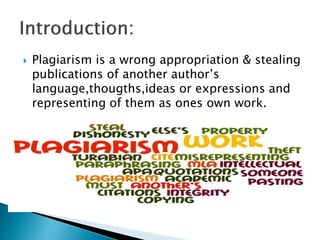
 Plagiarism is a wrong appropriation & stealing
publications of another author’s
language,thougths,ideas or expressions and
representing of them as ones own work.
 Although plagiarism in some contexts is considered theft or
stealing, the concept does not exist in a legal sense. "Plagiarism"
is not mentioned in any current statute, either criminal or civil.
Some cases may be treated as unfair competition or a violation
of the doctrine of moral rights
 Plagiarism is not the same as copyright infringement. While both
terms may apply to a particular act, they are different concepts
 Plagiarism is also considered a moral offense against anyone
who has provided the plagiarist with a benefit in exchange for
what is specifically supposed to be original content (for example,
the plagiarist's publisher, employer, or teacher). In such cases,
acts of plagiarism may sometimes also form part of a claim
for breach of the plagiarist's contract, or, if done knowingly, for
a civil wrong.
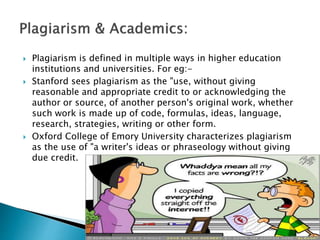
 Plagiarism is defined in multiple ways in higher education
institutions and universities. For eg:-
 Stanford sees plagiarism as the "use, without giving
reasonable and appropriate credit to or acknowledging the
author or source, of another person's original work, whether
such work is made up of code, formulas, ideas, language,
research, strategies, writing or other form.
 Oxford College of Emory University characterizes plagiarism
as the use of "a writer's ideas or phraseology without giving
due credit.
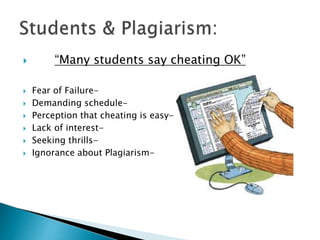
 “Many students say cheating OK”
 Fear of Failure-
 Demanding schedule-
 Perception that cheating is easy-
 Lack of interest-
 Seeking thrills-
 Ignorance about Plagiarism-
 Respecting intellectual property rights is a foundational
principle of the ACM‘s Codes of Ethics.
 Notifying ACM of Alleged Plagiarism-
 Investigation-
 Confidentiality-
 Results of an investigation-
 Penalties for Plagiarism-
 Third party claims against ACM
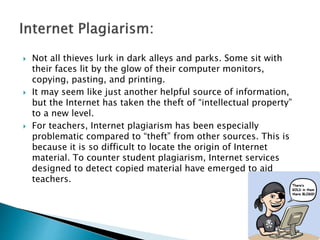
 Not all thieves lurk in dark alleys and parks. Some sit with
their faces lit by the glow of their computer monitors,
copying, pasting, and printing.
 It may seem like just another helpful source of information,
but the Internet has taken the theft of “intellectual property”
to a new level.
 For teachers, Internet plagiarism has been especially
problematic compared to “theft” from other sources. This is
because it is so difficult to locate the origin of Internet
material. To counter student plagiarism, Internet services
designed to detect copied material have emerged to aid
teachers.
Credits:
•GOOGLE
•WIKIPEDIA
•www.thewritesource.com/studentmodels/
wi-plagiarism.htm
•www.thewritesource.com
•www.acm.org
•tlt.psu.edu

Plagiarism

  • 1.
  • 2.
     Plagiarism isa wrong appropriation & stealing publications of another author’s language,thougths,ideas or expressions and representing of them as ones own work.
  • 3.
     Although plagiarismin some contexts is considered theft or stealing, the concept does not exist in a legal sense. "Plagiarism" is not mentioned in any current statute, either criminal or civil. Some cases may be treated as unfair competition or a violation of the doctrine of moral rights  Plagiarism is not the same as copyright infringement. While both terms may apply to a particular act, they are different concepts  Plagiarism is also considered a moral offense against anyone who has provided the plagiarist with a benefit in exchange for what is specifically supposed to be original content (for example, the plagiarist's publisher, employer, or teacher). In such cases, acts of plagiarism may sometimes also form part of a claim for breach of the plagiarist's contract, or, if done knowingly, for a civil wrong.
  • 4.
     Plagiarism isdefined in multiple ways in higher education institutions and universities. For eg:-  Stanford sees plagiarism as the "use, without giving reasonable and appropriate credit to or acknowledging the author or source, of another person's original work, whether such work is made up of code, formulas, ideas, language, research, strategies, writing or other form.  Oxford College of Emory University characterizes plagiarism as the use of "a writer's ideas or phraseology without giving due credit.
  • 5.
     “Many studentssay cheating OK”  Fear of Failure-  Demanding schedule-  Perception that cheating is easy-  Lack of interest-  Seeking thrills-  Ignorance about Plagiarism-
  • 6.
     Respecting intellectualproperty rights is a foundational principle of the ACM‘s Codes of Ethics.  Notifying ACM of Alleged Plagiarism-  Investigation-  Confidentiality-  Results of an investigation-  Penalties for Plagiarism-  Third party claims against ACM
  • 7.
     Not allthieves lurk in dark alleys and parks. Some sit with their faces lit by the glow of their computer monitors, copying, pasting, and printing.  It may seem like just another helpful source of information, but the Internet has taken the theft of “intellectual property” to a new level.  For teachers, Internet plagiarism has been especially problematic compared to “theft” from other sources. This is because it is so difficult to locate the origin of Internet material. To counter student plagiarism, Internet services designed to detect copied material have emerged to aid teachers.
  • 8.