GURU GHASIDAS VISHWAVIDYALAYA
BILASPUR, CHHATTISGARH, 495009
Session: 2024-25
SYSTEMATIC REVIEW
Presented by –
Cheshtarani Yadav
Ankit jangde
Rashmi sahu
Shivani singh
Tripti shahni
(M.Sc. I sem. Biotechnology)
Under the supervision of-
Dr. Naveen Vishwakarma
Professor
(Department of biotechnology)
SYSTEMATI
C REVIEW
Unit V : Experimental design
MSc. I sem. Biotechnology
• Introduction
• Types of review
• Characteristics of Systematic review
• Comparative study of Systematic review and Narrative review
• When to conduct systematic review
• Steps in Systematic review
• Pros and Cons
• Reference
CONTENTS
• SYSTEMATIC REVIEW is also called as Research Synthesis .
• It is defined as a technique that attempts to collect all empirical evidences in a particular field, to
assess it critically and to obtain conclusions that summarise the research.
• It is different from the other types of review.
• As it reduces bias.
• The methods are repeatable and the approach is formal and systematic.
INTRODUCTION
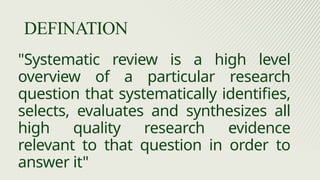
"Systematic review is a high level
overview of a particular research
question that systematically identifies,
selects, evaluates and synthesizes all
high quality research evidence
relevant to that question in order to
answer it"
DEFINATION
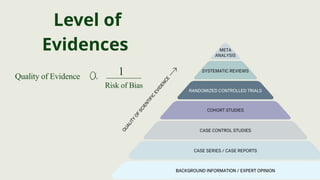
Level of
Evidences
Quality of Evidence _________
Risk of Bias
1
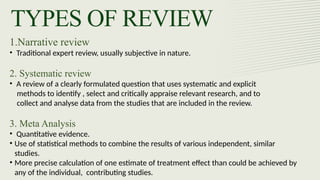
TYPES OF REVIEW
1.Narrative review
• Traditional expert review, usually subjective in nature.
2. Systematic review
• A review of a clearly formulated question that uses systematic and explicit
methods to identify , select and critically appraise relevant research, and to
collect and analyse data from the studies that are included in the review.
3. Meta Analysis
• Quantitative evidence.
• Use of statistical methods to combine the results of various independent, similar
studies.
• More precise calculation of one estimate of treatment effect than could be achieved by
any of the individual, contributing studies.
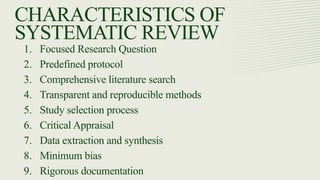
CHARACTERISTICS OF
SYSTEMATIC REVIEW
1. Focused Research Question
2. Predefined protocol
3. Comprehensive literature search
4. Transparent and reproducible methods
5. Study selection process
6. Critical Appraisal
7. Data extraction and synthesis
8. Minimum bias
9. Rigorous documentation
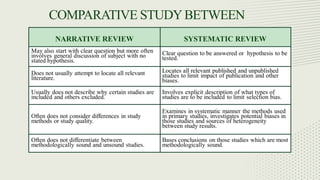
COMPARATIVE STUDYBETWEEN
A systematic review is a good choice of review if you want to answer a
question about the effectiveness of an intervention such as Medical treatment.
Needs to conduct a systematic review:
• A precise question
• Previous knowledge of the topic
• Appropriate measures to insure the validity and reliability.
• Access to data base
• Time, as it’s a time consuming process.
WHEN TO CONDUCT SYSTEMATIC REVIEW
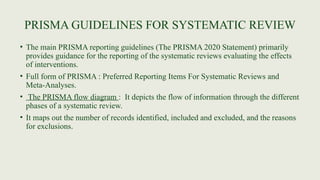
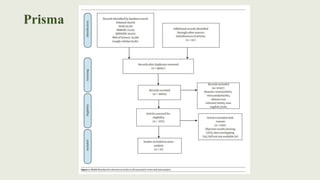
PRISMA GUIDELINES FOR SYSTEMATIC REVIEW
• The main PRISMA reporting guidelines (The PRISMA 2020 Statement) primarily
provides guidance for the reporting of the systematic reviews evaluating the effects
of interventions.
• Full form of PRISMA : Preferred Reporting Items For Systematic Reviews and
Meta-Analyses.
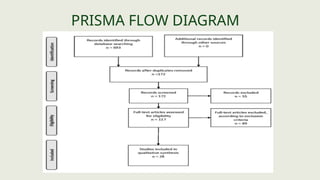
• The PRISMA flow diagram : It depicts the flow of information through the different
phases of a systematic review.
• It maps out the number of records identified, included and excluded, and the reasons
for exclusions.
PRISMA FLOW DIAGRAM
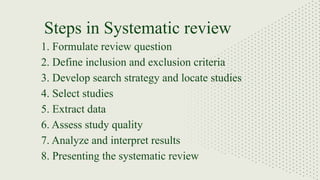
1. Formulate review question
2. Define inclusion and exclusion criteria
3. Develop search strategy and locate studies
4. Select studies
5. Extract data
6. Assess study quality
7. Analyze and interpret results
8. Presenting the systematic review
Steps in Systematic review
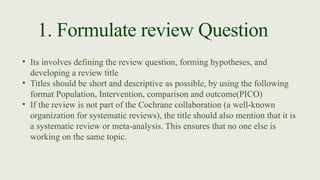
1. Formulate review Question
• Its involves defining the review question, forming hypotheses, and
developing a review title
• Titles should be short and descriptive as possible, by using the following
format Population, Intervention, comparison and outcome(PICO)
• If the review is not part of the Cochrane collaboration (a well-known
organization for systematic reviews), the title should also mention that it is
a systematic review or meta-analysis. This ensures that no one else is
working on the same topic.
Steps to define a review question:
1. Choose a broad topic
2. Conduct preliminary research
3. Narrow down your topic
4. Ensure your question is clear, concise and focused
5. Ensure your question is significant and adds value
Example :
a. Broad topic: “Health benefits of meditation.”
b. Narrow topic: “what is the impact of mindfulness meditation on
stress reduction.
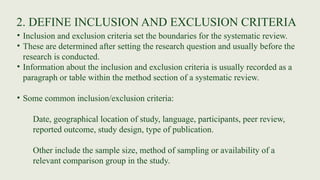
2. DEFINE INCLUSION AND EXCLUSION CRITERIA
• Inclusion and exclusion criteria set the boundaries for the systematic review.
• These are determined after setting the research question and usually before the
research is conducted.
• Information about the inclusion and exclusion criteria is usually recorded as a
paragraph or table within the method section of a systematic review.
• Some common inclusion/exclusion criteria:
Date, geographical location of study, language, participants, peer review,
reported outcome, study design, type of publication.
Other include the sample size, method of sampling or availability of a
relevant comparison group in the study.
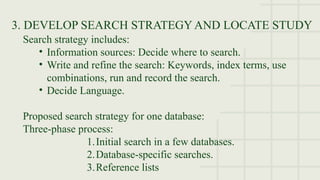
3. DEVELOP SEARCH STRATEGY AND LOCATE STUDY
Search strategy includes:
• Information sources: Decide where to search.
• Write and refine the search: Keywords, index terms, use
combinations, run and record the search.
• Decide Language.
Proposed search strategy for one database:
Three-phase process:
1.Initial search in a few databases.
2.Database-specific searches.
3.Reference lists
4. SELECT STUDIES
After defining Inclusion and Exclusion criteria, we need to develop a search
strategy:
• Create a detailed search strategy using relevant database (e.g., PubMed,
Cochrane Central resister of controlled Trial, Embase).
• Use a combination of free-text term and subject headings (e.g. Medical
subject headings, Mesh).
• Perform the search using the developed strategy and document the process
to ensure reproducibility.
• This includes recording the search term, databases searched and the date of
the search.
• This is usually done by two independent reviewers to reduce bias.
5.EXTRACT DATA
• Extraction of data means collecting information from the selected studies in a systematic way
• There are two type of information we need to collect from each study:
1. Information about the study’s method and result.
Extracted information depends on your research question, but it might include the year,
study design, sample size, context, research finding and conclusion.
2. Your judgement of the quality of the evidence, including risk of bias.
• Data should be collected in the forms .
• Sample forms can be found in the registry of methods and tools for Evidence-informed decision
making and the gradient of Recommendations, Assessment, development and evaluations
working group.
• Extracting data is a three person task.
• Two people should do this step, and the third person will resolve any disagreements.
• Use a standardized data extraction form for consistency and transparency.
• Extract key information, such as:
• Study characteristics: Example: Randomized controlled trial, published in
2020.
• Participant characteristics : Example: Adults with depression (N=100),
mean age 45 years .
• Intervention details: Example: 12-week exercise intervention, three times
per week.
• Outcome data: Example: Depressive symptoms (pre-intervention mean
score 18, post-intervention mean score 12).
6.ASSESS STUDY QUALITY AND BIAS RISK
• This includes evaluation of the articles you include in your review for quality and
bias.
• Evaluate potential bias in study design, conduct, and analysis.
• There are various types of bias, some of which are outline
• Common bias types to assess:
1. Selection bias: Adequacy of randomization.
2. Performance bias: Blinding of participants and personnel.
3. Detection bias: Blinding of outcome assessors.Attrition bias:
4. Adequacy of follow-up rates.
5. Reporting bias: Completeness of reported outcomes.
• You can use certain tools for the quality assessment, which includes :
1. Reporting of review with PRISMA
2. Managing your review with covidence
3. Librarian
7. ANALYZE AND INTERPRET
• Analyzing and interpreting data in a systematic review involves
systematically synthesizing result from included studies to answer the
research question.
• Do following for the same:
1. Relate findings to the research question and objectives.
2. Discuss the clinical and practical significance of the
results, not just statistical significance
3. Highlight strengths, limitations, and generalizability of
findings.
8.PRESENTING THE SYSTEMATIC REVIEW
• A systematic review typically includes the results, interpretation and conclusions of
the review.
• The result should be communicated to the public.
• The procedure followed should be stated.
• The presentation should also include a protocol that outlines the plan for carrying
out the review.
• The systematic review should not be longer than 5500 words.
• The systematic review should be titled in the style “Health benefits of meditation.”
Format of the Systematic Review
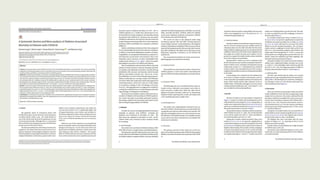
1. Title Page : include the title, the names of the authors, their affiliations.
2. Abstract : a brief summary of the review, including the research question, methods, result, and
conclusions.
3. Introduction: provide background information on the topic of the review, including the
description of the research question, the rationale for the review, and the objective of the study.
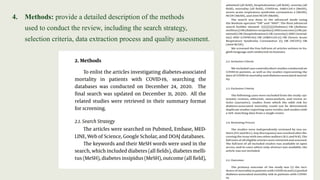
4. Methods: provide a detailed description of the methods used to conduct the review, including
the search strategy, selection criteria, data extraction process and quality assessment.
5. Results: provide a detailed summary of the findings of the reviews, including any meta-
analysis , narrative synthesis or thematic analyses conducted.
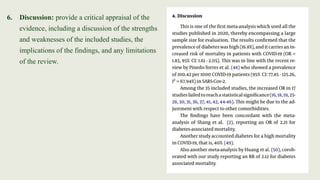
6. Discussion: provide a critical appraisal of the evidence, including a discussion of the strengths
and weaknesses of the included studies, the implications of the findings, and any limitations of
the review.
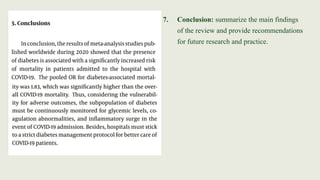
7. Conclusion: summarize the main findings of the review and provide recommendations for
future research and practice.
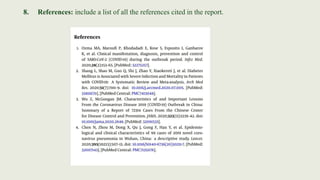
8. References: include a list of all the references cited in the report.
9. Appendices: include additional information, such as details of the search strategy, data
extraction form, or quality assessment tools used.
1. Title Page : It includes the title, the names of the authors, their affiliations.
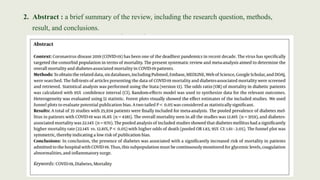
2. Abstract : a brief summary of the review, including the research question, methods,
result, and conclusions.
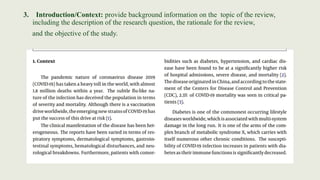
3. Introduction/Context: provide background information on the topic of the review,
including the description of the research question, the rationale for the review,
and the objective of the study.
4. Methods: provide a detailed description of the methods
used to conduct the review, including the search strategy,
selection criteria, data extraction process and quality assessment.
Prisma
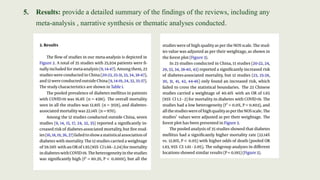
5. Results: provide a detailed summary of the findings of the reviews, including any
meta-analysis , narrative synthesis or thematic analyses conducted.
6. Discussion: provide a critical appraisal of the
evidence, including a discussion of the strengths
and weaknesses of the included studies, the
implications of the findings, and any limitations
of the review.
7. Conclusion: summarize the main findings
of the review and provide recommendations
for future research and practice.
8. References: include a list of all the references cited in the report.
PROS AND CONS
A systematic review has many pros:
• Minimizes research bias by considering all available evidence and evaluating each study for
bias.
• Their methods are transparent, so they can be scrutinized by others .
• They are thorough: they summarize all available evidence.
• They can be replicated and updated by others.
Systematic review also has some cons:
• They are time-consuming.
• They are narrow in scope: they only answer the precise research questions.
Thank you......

Systematic Reviews: A Comprehensive Guide

  • 1.
    GURU GHASIDAS VISHWAVIDYALAYA BILASPUR,CHHATTISGARH, 495009 Session: 2024-25 SYSTEMATIC REVIEW Presented by – Cheshtarani Yadav Ankit jangde Rashmi sahu Shivani singh Tripti shahni (M.Sc. I sem. Biotechnology) Under the supervision of- Dr. Naveen Vishwakarma Professor (Department of biotechnology)
  • 2.
    SYSTEMATI C REVIEW Unit V: Experimental design MSc. I sem. Biotechnology
  • 3.
    • Introduction • Typesof review • Characteristics of Systematic review • Comparative study of Systematic review and Narrative review • When to conduct systematic review • Steps in Systematic review • Pros and Cons • Reference CONTENTS
  • 4.
    • SYSTEMATIC REVIEWis also called as Research Synthesis . • It is defined as a technique that attempts to collect all empirical evidences in a particular field, to assess it critically and to obtain conclusions that summarise the research. • It is different from the other types of review. • As it reduces bias. • The methods are repeatable and the approach is formal and systematic. INTRODUCTION
  • 5.
    "Systematic review isa high level overview of a particular research question that systematically identifies, selects, evaluates and synthesizes all high quality research evidence relevant to that question in order to answer it" DEFINATION
  • 6.
    Level of Evidences Quality ofEvidence _________ Risk of Bias 1
  • 7.
    TYPES OF REVIEW 1.Narrativereview • Traditional expert review, usually subjective in nature. 2. Systematic review • A review of a clearly formulated question that uses systematic and explicit methods to identify , select and critically appraise relevant research, and to collect and analyse data from the studies that are included in the review. 3. Meta Analysis • Quantitative evidence. • Use of statistical methods to combine the results of various independent, similar studies. • More precise calculation of one estimate of treatment effect than could be achieved by any of the individual, contributing studies.
  • 8.
    CHARACTERISTICS OF SYSTEMATIC REVIEW 1.Focused Research Question 2. Predefined protocol 3. Comprehensive literature search 4. Transparent and reproducible methods 5. Study selection process 6. Critical Appraisal 7. Data extraction and synthesis 8. Minimum bias 9. Rigorous documentation
  • 9.
  • 10.
    A systematic reviewis a good choice of review if you want to answer a question about the effectiveness of an intervention such as Medical treatment. Needs to conduct a systematic review: • A precise question • Previous knowledge of the topic • Appropriate measures to insure the validity and reliability. • Access to data base • Time, as it’s a time consuming process. WHEN TO CONDUCT SYSTEMATIC REVIEW
  • 11.
    PRISMA GUIDELINES FORSYSTEMATIC REVIEW • The main PRISMA reporting guidelines (The PRISMA 2020 Statement) primarily provides guidance for the reporting of the systematic reviews evaluating the effects of interventions. • Full form of PRISMA : Preferred Reporting Items For Systematic Reviews and Meta-Analyses. • The PRISMA flow diagram : It depicts the flow of information through the different phases of a systematic review. • It maps out the number of records identified, included and excluded, and the reasons for exclusions.
  • 12.
  • 13.
    1. Formulate reviewquestion 2. Define inclusion and exclusion criteria 3. Develop search strategy and locate studies 4. Select studies 5. Extract data 6. Assess study quality 7. Analyze and interpret results 8. Presenting the systematic review Steps in Systematic review
  • 14.
    1. Formulate reviewQuestion • Its involves defining the review question, forming hypotheses, and developing a review title • Titles should be short and descriptive as possible, by using the following format Population, Intervention, comparison and outcome(PICO) • If the review is not part of the Cochrane collaboration (a well-known organization for systematic reviews), the title should also mention that it is a systematic review or meta-analysis. This ensures that no one else is working on the same topic.
  • 15.
    Steps to definea review question: 1. Choose a broad topic 2. Conduct preliminary research 3. Narrow down your topic 4. Ensure your question is clear, concise and focused 5. Ensure your question is significant and adds value Example : a. Broad topic: “Health benefits of meditation.” b. Narrow topic: “what is the impact of mindfulness meditation on stress reduction.
  • 16.
    2. DEFINE INCLUSIONAND EXCLUSION CRITERIA • Inclusion and exclusion criteria set the boundaries for the systematic review. • These are determined after setting the research question and usually before the research is conducted. • Information about the inclusion and exclusion criteria is usually recorded as a paragraph or table within the method section of a systematic review. • Some common inclusion/exclusion criteria: Date, geographical location of study, language, participants, peer review, reported outcome, study design, type of publication. Other include the sample size, method of sampling or availability of a relevant comparison group in the study.
  • 17.
    3. DEVELOP SEARCHSTRATEGY AND LOCATE STUDY Search strategy includes: • Information sources: Decide where to search. • Write and refine the search: Keywords, index terms, use combinations, run and record the search. • Decide Language. Proposed search strategy for one database: Three-phase process: 1.Initial search in a few databases. 2.Database-specific searches. 3.Reference lists
  • 18.
    4. SELECT STUDIES Afterdefining Inclusion and Exclusion criteria, we need to develop a search strategy: • Create a detailed search strategy using relevant database (e.g., PubMed, Cochrane Central resister of controlled Trial, Embase). • Use a combination of free-text term and subject headings (e.g. Medical subject headings, Mesh). • Perform the search using the developed strategy and document the process to ensure reproducibility. • This includes recording the search term, databases searched and the date of the search. • This is usually done by two independent reviewers to reduce bias.
  • 19.
    5.EXTRACT DATA • Extractionof data means collecting information from the selected studies in a systematic way • There are two type of information we need to collect from each study: 1. Information about the study’s method and result. Extracted information depends on your research question, but it might include the year, study design, sample size, context, research finding and conclusion. 2. Your judgement of the quality of the evidence, including risk of bias. • Data should be collected in the forms . • Sample forms can be found in the registry of methods and tools for Evidence-informed decision making and the gradient of Recommendations, Assessment, development and evaluations working group. • Extracting data is a three person task. • Two people should do this step, and the third person will resolve any disagreements.
  • 20.
    • Use astandardized data extraction form for consistency and transparency. • Extract key information, such as: • Study characteristics: Example: Randomized controlled trial, published in 2020. • Participant characteristics : Example: Adults with depression (N=100), mean age 45 years . • Intervention details: Example: 12-week exercise intervention, three times per week. • Outcome data: Example: Depressive symptoms (pre-intervention mean score 18, post-intervention mean score 12).
  • 21.
    6.ASSESS STUDY QUALITYAND BIAS RISK • This includes evaluation of the articles you include in your review for quality and bias. • Evaluate potential bias in study design, conduct, and analysis. • There are various types of bias, some of which are outline • Common bias types to assess: 1. Selection bias: Adequacy of randomization. 2. Performance bias: Blinding of participants and personnel. 3. Detection bias: Blinding of outcome assessors.Attrition bias: 4. Adequacy of follow-up rates. 5. Reporting bias: Completeness of reported outcomes. • You can use certain tools for the quality assessment, which includes : 1. Reporting of review with PRISMA 2. Managing your review with covidence 3. Librarian
  • 22.
    7. ANALYZE ANDINTERPRET • Analyzing and interpreting data in a systematic review involves systematically synthesizing result from included studies to answer the research question. • Do following for the same: 1. Relate findings to the research question and objectives. 2. Discuss the clinical and practical significance of the results, not just statistical significance 3. Highlight strengths, limitations, and generalizability of findings.
  • 23.
    8.PRESENTING THE SYSTEMATICREVIEW • A systematic review typically includes the results, interpretation and conclusions of the review. • The result should be communicated to the public. • The procedure followed should be stated. • The presentation should also include a protocol that outlines the plan for carrying out the review. • The systematic review should not be longer than 5500 words. • The systematic review should be titled in the style “Health benefits of meditation.”
  • 24.
    Format of theSystematic Review 1. Title Page : include the title, the names of the authors, their affiliations. 2. Abstract : a brief summary of the review, including the research question, methods, result, and conclusions. 3. Introduction: provide background information on the topic of the review, including the description of the research question, the rationale for the review, and the objective of the study. 4. Methods: provide a detailed description of the methods used to conduct the review, including the search strategy, selection criteria, data extraction process and quality assessment. 5. Results: provide a detailed summary of the findings of the reviews, including any meta- analysis , narrative synthesis or thematic analyses conducted. 6. Discussion: provide a critical appraisal of the evidence, including a discussion of the strengths and weaknesses of the included studies, the implications of the findings, and any limitations of the review. 7. Conclusion: summarize the main findings of the review and provide recommendations for future research and practice. 8. References: include a list of all the references cited in the report. 9. Appendices: include additional information, such as details of the search strategy, data extraction form, or quality assessment tools used.
  • 25.
    1. Title Page: It includes the title, the names of the authors, their affiliations.
  • 26.
    2. Abstract :a brief summary of the review, including the research question, methods, result, and conclusions.
  • 27.
    3. Introduction/Context: providebackground information on the topic of the review, including the description of the research question, the rationale for the review, and the objective of the study.
  • 28.
    4. Methods: providea detailed description of the methods used to conduct the review, including the search strategy, selection criteria, data extraction process and quality assessment.
  • 29.
  • 30.
    5. Results: providea detailed summary of the findings of the reviews, including any meta-analysis , narrative synthesis or thematic analyses conducted.
  • 31.
    6. Discussion: providea critical appraisal of the evidence, including a discussion of the strengths and weaknesses of the included studies, the implications of the findings, and any limitations of the review.
  • 32.
    7. Conclusion: summarizethe main findings of the review and provide recommendations for future research and practice.
  • 33.
    8. References: includea list of all the references cited in the report.
  • 35.
    PROS AND CONS Asystematic review has many pros: • Minimizes research bias by considering all available evidence and evaluating each study for bias. • Their methods are transparent, so they can be scrutinized by others . • They are thorough: they summarize all available evidence. • They can be replicated and updated by others. Systematic review also has some cons: • They are time-consuming. • They are narrow in scope: they only answer the precise research questions.
  • 36.