Advance Molecular Marker
& Its Application
Presented to:-
Dr. Ashish Kumar
(Department of Biotechnology)
GGV, Bilaspur (C.G.)
Presented by :-
Rashmi Sahu
Shweta Panday
Sakshi Bhardwaj
Roshni Dahariya
Rupali Sahu
INTRODUCTION
Advanced molecular markers are sophisticated techniques
used to detect genetic variations and analyze traits in
organisms.
They build upon traditional methods like RFLP, RAPD, and SSR,
combining their strengths to improve sensitivity and
resolution.
Notable advanced techniques include AFLP, which integrates
restriction enzyme digestion with PCR amplification, and
utilizes various DNA elements for broader genome coverage.
These markers are crucial in plant breeding for identifying
traits linked to diseases or desirable characteristics,
facilitating marker-assisted selection (MAS) and enhancing
CHARACTERISTICS
• High Polymorphism: They exhibit significant genetic
variation, useful for distinguishing between individuals.
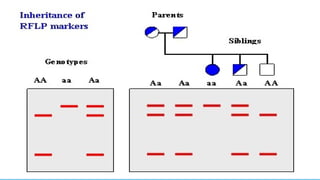
• Co-dominant Inheritance: Allow detection of both alleles in
heterozygotes, enhancing trait mapping.
• Locus Specificity: Target specific genomic locations for
precise genetic analysis.
• Reproducibility: Provide consistent results across multiple
experiments.
• PCR-Based Techniques: Many rely on polymerase chain
reaction for amplification.
• Versatility: Applicable across various species and research
fields.
• Quantitative Trait Loci (QTL) Mapping: Facilitate
identification of genes linked to quantitative traits.
• Genetic Stability Assessment: Help evaluate the stability of
traits over generations.
• Marker-Assisted Selection (MAS): Enable selection of
desired traits in breeding programs.
• Identification of Mutations: Detect small genetic changes
affecting phenotypes.
ADVANTAGES OF MASS BREEDING
OVER CONVENTIONAL BREEDING
• Efficiency: Mass breeding can be conducted at the seedling
stage, allowing for earlier identification of desirable traits,
unlike conventional methods that often require plants to
reach maturity before evaluation.
• Genetic Diversity: It retains considerable genetic variability,
which is crucial for adapting to changing environments and
diseases.
• Environmental Independence: It is less affected by
environmental variability, enabling consistent trait
assessment regardless of external conditions.
• Cost-Effectiveness: Mass breeding can be cheaper and
faster, especially for traits that are labor-intensive to
evaluate phenotypically.
• Genotype Identification: Traits can be assessed early in
development, enabling quicker decisions on breeding stock.
• Recessive Allele Detection: It can identify recessive alleles
that are otherwise masked in conventional breeding.
• Pyramiding Traits: Facilitates the combination of multiple
desirable traits into a single variety more effectively.
• Broader Adaptability: Varieties developed through mass
breeding often show greater stability and adaptability to
various conditions.
• Simplified Process: The method is straightforward, making
it accessible for many breeders without advanced
technology.
• Rapid Genetic Gains: Accelerates the overall genetic
improvement of crops, addressing food security challenges
more effectively.
Classification of Molecular Markers
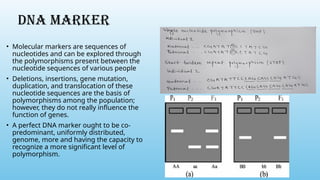
DNA MARKER
• Molecular markers are sequences of
nucleotides and can be explored through
the polymorphisms present between the
nucleotide sequences of various people
• Deletions, insertions, gene mutation,
duplication, and translocation of these
nucleotide sequences are the basis of
polymorphisms among the population;
however, they do not really influence the
function of genes.
• A perfect DNA marker ought to be co-
predominant, uniformly distributed,
genome, more and having the capacity to
recognize a more significant level of
polymorphism.
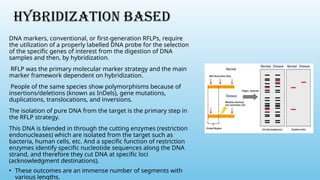
HYBRIDIZATION BASED
DNA markers, conventional, or first-generation RFLPs, require
the utilization of a properly labelled DNA probe for the selection
of the specific genes of interest from the digestion of DNA
samples and then, by hybridization.
RFLP was the primary molecular marker strategy and the main
marker framework dependent on hybridization.
People of the same species show polymorphisms because of
insertions/deletions (known as InDels), gene mutations,
duplications, translocations, and inversions.
The isolation of pure DNA from the target is the primary step in
the RFLP strategy.
This DNA is blended in through the cutting enzymes (restriction
endonucleases) which are isolated from the target such as
bacteria, human cells, etc. And a specific function of restriction
enzymes identify specific nucleotide sequences along the DNA
strand, and therefore they cut DNA at specific loci
(acknowledgment destinations).
• These outcomes are an immense number of segments with
various lengths.
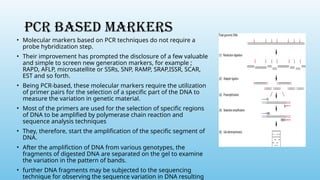
PCR BASED MARKERS
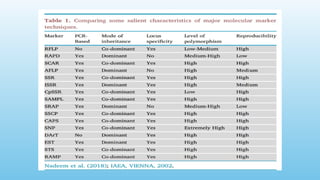
• Molecular markers based on PCR techniques do not require a
probe hybridization step.
• Their improvement has prompted the disclosure of a few valuable
and simple to screen new generation markers, for example ;
RAPD, AFLP, microsatellite or SSRs, SNP, RAMP, SRAP,ISSR, SCAR,
EST and so forth.
• Being PCR-based, these molecular markers require the utilization
of primer pairs for the selection of a specific part of the DNA to
measure the variation in genetic material.
• Most of the primers are used for the selection of specific regions
of DNA to be amplified by polymerase chain reaction and
sequence analysis techniques
• They, therefore, start the amplification of the specific segment of
DNA.
• After the amplifiction of DNA from various genotypes, the
fragments of digested DNA are separated on the gel to examine
the variation in the pattern of bands.
• further DNA fragments may be subjected to the sequencing
technique for observing the sequence variation in DNA resulting
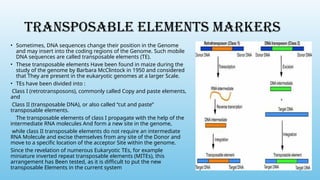
TRANSPOSABLE ELEMENTS MARKERS
• Sometimes, DNA sequences change their position in the Genome
and may insert into the coding regions of the Genome. Such mobile
DNA sequences are called transposable elements (TE).
• These transposable elements Have been found in maize during the
study of the genome by Barbara McClintock in 1950 and considered
that They are present in the eukaryotic genomes at a larger Scale.
• TEs have been divided into :
Class I (retrotransposons), commonly called Copy and paste elements,
and
Class II (transposable DNA), or also called “cut and paste”
transposable elements.
The transposable elements of class I propagate with the help of the
intermediate RNA molecules And form a new site in the genome,
while class II transposable elements do not require an intermediate
RNA Molecule and excise themselves from any site of the Donor and
move to a specific location of the acceptor Site within the genome.
Since the revelation of numerous Eukaryotic TEs, for example
miniature inverted repeat transposable elements (MITEs), this
arrangement has Been tested, as it is difficult to put the new
transposable Elements in the current system
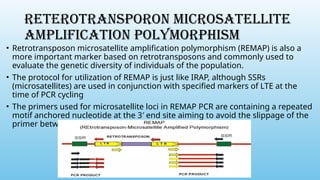
RETEROTRANSPORON MICROSATELLITE
AMPLIFICATION POLYMORPHISM
• Retrotransposon microsatellite amplification polymorphism (REMAP) is also a
more important marker based on retrotransposons and commonly used to
evaluate the genetic diversity of individuals of the population.
• The protocol for utilization of REMAP is just like IRAP, although SSRs
(microsatellites) are used in conjunction with specified markers of LTE at the
time of PCR cycling
• The primers used for microsatellite loci in REMAP PCR are containing a repeated
motif anchored nucleotide at the 3′ end site aiming to avoid the slippage of the
primer between individual SSR motif
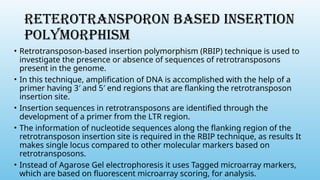
RETEROTRANSPORON BASED INSERTION
POLYMORPHISM
• Retrotransposon-based insertion polymorphism (RBIP) technique is used to
investigate the presence or absence of sequences of retrotransposons
present in the genome.
• In this technique, amplification of DNA is accomplished with the help of a
primer having 3′ and 5′ end regions that are flanking the retrotransposon
insertion site.
• Insertion sequences in retrotransposons are identified through the
development of a primer from the LTR region.
• The information of nucleotide sequences along the flanking region of the
retrotransposon insertion site is required in the RBIP technique, as results It
makes single locus compared to other molecular markers based on
retrotransposons.
• Instead of Agarose Gel electrophoresis it uses Tagged microarray markers,
which are based on fluorescent microarray scoring, for analysis.
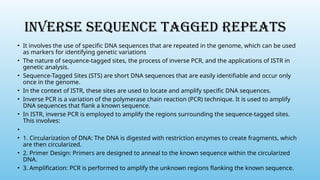
INVERSE SEQUENCE TAGGED REPEATS
• It involves the use of specific DNA sequences that are repeated in the genome, which can be used
as markers for identifying genetic variations
• The nature of sequence-tagged sites, the process of inverse PCR, and the applications of ISTR in
genetic analysis.
• Sequence-Tagged Sites (STS) are short DNA sequences that are easily identifiable and occur only
once in the genome.
• In the context of ISTR, these sites are used to locate and amplify specific DNA sequences.
• Inverse PCR is a variation of the polymerase chain reaction (PCR) technique. It is used to amplify
DNA sequences that flank a known sequence.
• In ISTR, inverse PCR is employed to amplify the regions surrounding the sequence-tagged sites.
This involves:
•
• 1. Circularization of DNA: The DNA is digested with restriction enzymes to create fragments, which
are then circularized.
• 2. Primer Design: Primers are designed to anneal to the known sequence within the circularized
DNA.
• 3. Amplification: PCR is performed to amplify the unknown regions flanking the known sequence.
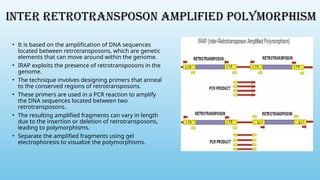
INTER RETROTRANSPOSON AMPLIFIED POLYMORPHISM
• It is based on the amplification of DNA sequences
located between retrotransposons, which are genetic
elements that can move around within the genome.
• IRAP exploits the presence of retrotransposons in the
genome.
• The technique involves designing primers that anneal
to the conserved regions of retrotransposons.
• These primers are used in a PCR reaction to amplify
the DNA sequences located between two
retrotransposons.
• The resulting amplified fragments can vary in length
due to the insertion or deletion of retrotransposons,
leading to polymorphisms.
• Separate the amplified fragments using gel
electrophoresis to visualize the polymorphisms.
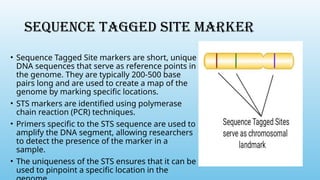
SEQUENCE TAGGED SITE MARKER
• Sequence Tagged Site markers are short, unique
DNA sequences that serve as reference points in
the genome. They are typically 200-500 base
pairs long and are used to create a map of the
genome by marking specific locations.
• STS markers are identified using polymerase
chain reaction (PCR) techniques.
• Primers specific to the STS sequence are used to
amplify the DNA segment, allowing researchers
to detect the presence of the marker in a
sample.
• The uniqueness of the STS ensures that it can be
used to pinpoint a specific location in the
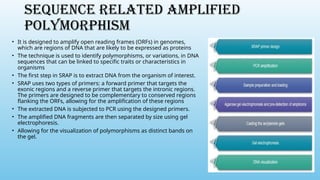
SEQUENCE RELATED AMPLIFIED
POLYMORPHISM
• It is designed to amplify open reading frames (ORFs) in genomes,
which are regions of DNA that are likely to be expressed as proteins
• The technique is used to identify polymorphisms, or variations, in DNA
sequences that can be linked to specific traits or characteristics in
organisms
• The first step in SRAP is to extract DNA from the organism of interest.
• SRAP uses two types of primers: a forward primer that targets the
exonic regions and a reverse primer that targets the intronic regions.
The primers are designed to be complementary to conserved regions
flanking the ORFs, allowing for the amplification of these regions
• The extracted DNA is subjected to PCR using the designed primers.
• The amplified DNA fragments are then separated by size using gel
electrophoresis.
• Allowing for the visualization of polymorphisms as distinct bands on
the gel.
SINGLE STRAND CONFORMATIONAL
POLYMORPHISM
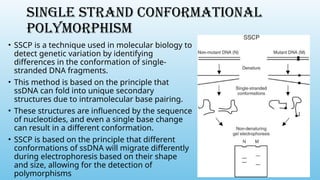
• SSCP is a technique used in molecular biology to
detect genetic variation by identifying
differences in the conformation of single-
stranded DNA fragments.
• This method is based on the principle that
ssDNA can fold into unique secondary
structures due to intramolecular base pairing.
• These structures are influenced by the sequence
of nucleotides, and even a single base change
can result in a different conformation.
• SSCP is based on the principle that different
conformations of ssDNA will migrate differently
during electrophoresis based on their shape
and size, allowing for the detection of
polymorphisms
DIVERSITY ARRAY TECHNOLOGY
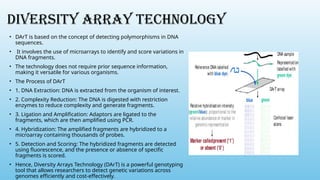
• DArT is based on the concept of detecting polymorphisms in DNA
sequences.
• It involves the use of microarrays to identify and score variations in
DNA fragments.
• The technology does not require prior sequence information,
making it versatile for various organisms.
• The Process of DArT
• 1. DNA Extraction: DNA is extracted from the organism of interest.
• 2. Complexity Reduction: The DNA is digested with restriction
enzymes to reduce complexity and generate fragments.
• 3. Ligation and Amplification: Adaptors are ligated to the
fragments, which are then amplified using PCR.
• 4. Hybridization: The amplified fragments are hybridized to a
microarray containing thousands of probes.
• 5. Detection and Scoring: The hybridized fragments are detected
using fluorescence, and the presence or absence of specific
fragments is scored.
• Hence, Diversity Arrays Technology (DArT) is a powerful genotyping
tool that allows researchers to detect genetic variations across
genomes efficiently and cost-effectively.
INTER SINE AMPLIFIED POLYMORPHISM
• It involves the amplification of DNA segments located between Short Interspersed
Nuclear Elements (SINEs), SINEs are short DNA sequences that are repeated many
times throughout the genome. They are a type of transposable element, meaning
they can move around within the genome. SINEs are typically 100-300 base pairs
long and are found in high copy numbers in the genomes of many eukaryotes.
• It Designed specifically for potato plant or species of plant family Solanaceae.
• ISAP markers are mostly based on genomic sequence amplification between
adjacent SINE elements In this technique, the primer annealed to a site other than
the SINE elements and either inwardly or outwardly.
• The DNA segments between these SINEs are then amplified.
• The length of the amplified products can vary between individuals due to
insertions, deletions, or other mutations in the inter-SINE regions.
• These variations are the polymorphisms that the technique aims to detect.
• However, the design of ISAP primers requires extensive prior genomic information
INTER SMALL RNA POLYMORPHISM
• Endogenous noncoding small RNAs consisting of 20–24 nucleotides are
ubiquitous in eukaryotic genomes, where they play important regulatory
roles.
• And they provide an excellent source for molecular marker development.
• The flanking sequences of small RNAs are conserved, allowing the design of
primers for use in PCR reactions and fingerprinting.
• The basic principle is to use primer pairs of flanking small RNAs to initiate a
PCR reaction and detect length polymorphisms that are due to InDels
present in the small RNA pool
• According to the authors, the technique is reproducible, representing a
high-throughput, non-coding, sequence-based marker system.
• It can be used for genome mapping and for genotyping.
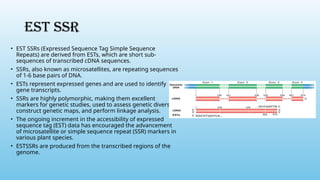
EST SSR
• EST SSRs (Expressed Sequence Tag Simple Sequence
Repeats) are derived from ESTs, which are short sub-
sequences of transcribed cDNA sequences.
• SSRs, also known as microsatellites, are repeating sequences
of 1-6 base pairs of DNA.
• ESTs represent expressed genes and are used to identify
gene transcripts.
• SSRs are highly polymorphic, making them excellent
markers for genetic studies, used to assess genetic diversity,
construct genetic maps, and perform linkage analysis.
• The ongoing increment in the accessibility of expressed
sequence tag (EST) data has encouraged the advancement
of microsatellite or simple sequence repeat (SSR) markers in
various plant species.
• ESTSSRs are produced from the transcribed regions of the
genome.
RESISTANCE GENE BASED MARKER
• Resistance gene-based markers are specific types of genetic markers that are linked to
resistance genes.
• They are used to identify and select individuals that carry resistance traits, facilitating the
breeding of resistant varieties.
• Many plants developed a very active and passive defence system to ensure themselves
against biotic and abiotic diseases.
• Innate immunity is more common in plants and animals and provides protection against
several a variety of pathogens due to the action of R protein and pathogen and pattern
resistance receptors
• Pathogens or microbes are associated with molecular patterns that are recognized by the
pathogen or pattern resistance receptors (PPRs) and these receptors are conserved among
the microorganisms having a place in a specific class
• (R proteins) induces signalling that produces the reactive oxygen species inside the cells
and is responsible to activate the process of deliberated suicide of the cells (programmed
cell death) resulting in hypersensitive reactions that kill the affected cells of the plant.
DIRECT AMPLIFICATION OF LENGTH
POLYMORPHISM
• It was designed to obtain nucleotide sequence information for
DNA fragments from any genome with no a priori sequence data.
• For PCR amplification, the universal sequencing primer “M13–40
USP” is incorporated in the oligonucleotide set as a core
• Selectivity is ensured by adding further bases to the 3′ end of the
primers, which are termed “selective primers”.
• The reverse primer is also common “M13” which is a standard
used in primer paired reactions.
• Primer sets with any desired length can be designed by varying
the composition of 3′ bases in the selective primer.
TARGETED REGION AMPLIFIED
POLYMORPHISM
• Based on a priori sequence information.
• It is designed to detect polymorphisms in specific genomic regions.
• The technique involves amplifying DNA segments that are flanked by
known sequences, allowing researchers to identify genetic variations
within targeted regions of the genome.
• The first step in TRAP is designing primers that target specific genomic
regions.
• In TRAP, one primer is designed to match a known sequence in the
genome, while the other is a random or semi-random primer that can bind
to multiple sites.
• The next step is to perform Polymerase Chain Reaction amplification.
• After PCR amplification, the amplified DNA fragments are separated using
gel electrophoresis.
• The presence or absence of specific bands on the gel indicates
polymorphisms in the targeted region.
START CODON TARGETED
• The SCoT technique is depending on the observation that a short
region of conserved sequences of the plant is mostly surrounded
by ATG start codons of translation
• A single primer is designed in the ScoT technique with annealing
the flanking region of the initiation codon on both sides of the
DNA strand.
• Amplified fragments are distributed within the gene having both
minus and plus strands of DNA
• These markers are more reproducible and the length of primers
and annealing temperature are not the factors that determine the
reproducibility of markers
CONSERVED REGION AMPLIFICATION
POLYMORPHISM
• It is a technique based on the utilization of an arbitrary and fixed primer.
• CoRAP is much like TRAP to the utilization of a fixed primer and this primer is
directly generated from the targeted ESTs.
• CoRAP and TRAP that both derived from ESTs and have specific binding sites on
the exon of targeted sequences; in spite of this, the arbitrary primers mostly
bind to other exon regions (TRAPS) or to most of the introns at the time of PCR
amplification.
• If these gene elements are accurately distributed to allow the successful PCR,
the banding patterns obtained from fingerprinting will be amplified.
• Indels in these regions will certainly generate different distributions of amplified
products.
• If two individuals are very close, the banding pattern resulting from the PCR
product will be more similar.
PROMOTER ANCHORED AMPLIFIED
POLYMORPHISM
• The promoter regions that facilitate the transcription of a gene are located too
close to a particular gene
• They can be utilized to be specify the profiling of the genome of the investigated
organism.
• The promoter element of genes determines the point of transcription initiation
and change and the specificity and rate of transcription
• The architecture of promoter sequences of a specific gene exhibits high diversity,
comprising of many short motifs that act as the recognition site for proteins
having great importance in transcription initiation
• Designed a few short oligonucleotide primers containing the degenerate
sequences of cotton promoter regions.
• This element of promoters makes them reasonable for labelling with degenerate
primers to create length polymorphisms, effectively noticeable by electrophoresis.
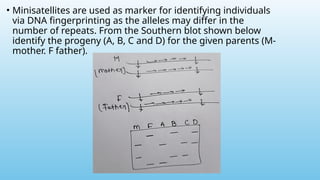
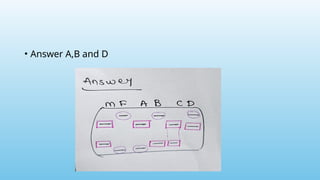
• Minisatellites are used as marker for identifying individuals
via DNA fingerprinting as the alleles may differ in the
number of repeats. From the Southern blot shown below
identify the progeny (A, B, C and D) for the given parents (M-
mother. F father).
• Answer A,B and D
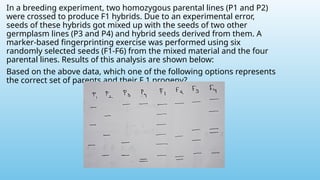
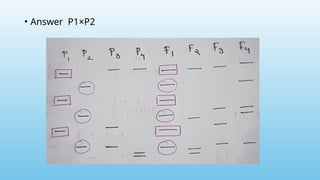
In a breeding experiment, two homozygous parental lines (P1 and P2)
were crossed to produce F1 hybrids. Due to an experimental error,
seeds of these hybrids got mixed up with the seeds of two other
germplasm lines (P3 and P4) and hybrid seeds derived from them. A
marker-based fingerprinting exercise was performed using six
randomly selected seeds (F1-F6) from the mixed material and the four
parental lines. Results of this analysis are shown below:
Based on the above data, which one of the following options represents
the correct set of parents and their F 1 progeny?
• Answer P1×P2
Application of MAS in Plant
Breeding
CULTIVAR IDENTITY/ASSESSMENT OF
PURITY
• Seeds from different strains are to be often mixed because
of difficulties in handling many seed samples that are
utilized between and within plant breeding programmers.
• Markers may be utilized in conferring the actual identity
of plant individuals.
• High-level genetic purity and their maintenance are more
important in the production of cereal hybrids to exploit
heterosis.
• In hybrid rice, SSR and STS markers were used to
confirm purity, which was considerably simpler than the
standard “grow-out tests” that involve growing the plant
to maturity and assessing morphological and floral
characteristics.
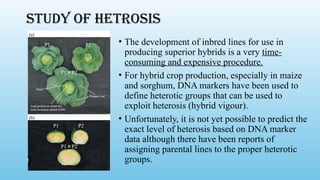
STUDY OF HETROSIS
• The development of inbred lines for use in
producing superior hybrids is a very time-
consuming and expensive procedure.
• For hybrid crop production, especially in maize
and sorghum, DNA markers have been used to
define heterotic groups that can be used to
exploit heterosis (hybrid vigour).
• Unfortunately, it is not yet possible to predict the
exact level of heterosis based on DNA marker
data although there have been reports of
assigning parental lines to the proper heterotic
groups.
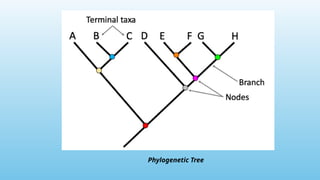
Evolution and phylogeny
• Some time ago,the primary study about the evolution of species or
characters was dependent completely on geographical conditions and
morphological variation among the populations.
• The development of various techniques in molecular biology offers
more information to the genetic makeup of an organism.
• Nowadays, a large number of molecular markers are required for
phylogeny to get information about evolution and used to reconstruct
the genetic map of an individual.
Phylogenetic Tree
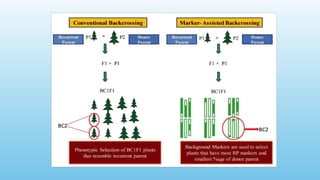
Marker-assisted backcross
breeding
• Markers can be used in backcross breeding at three phases of frontal
area, recombinant, and foundation determinations.
• At the main phase of forefront choice, markers are utilized to select
the desirable trait.
• The recombinant selection is the second stage which includes selecting
backcross off spring with the character and firmly connected flanking
markers, so linkage drag can be decreased.
• The third stage is referred to as the selection of background and it
includes selecting backcross descendants utilizing the background
markers.
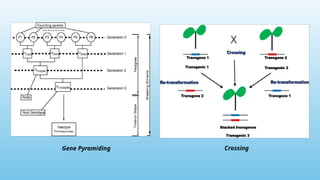
Marker-assisted pyramiding
• The procedure of integrating multiple genes at the same time or
quantitative trait loci into a single genotype is known as pyramiding or
Pyramiding is the process of combining several genes together into a
single genotype.
• The most widespread application for pyramiding has been for
combining multiple disease resistance genes.
• The motive for this has been the development of ‘durable’ or stable
disease resistance since pathogens frequently overcome single gene
host resistance over time due to the emergence of new plant pathogen
races.
Gene Pyramiding Crossing
1. Targeted induced local lesions in
genome
2. Virus induced gene silencing
3. Genome editing (crispr)
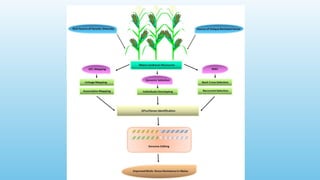
4. Role of MAS in crop improvement
5. RNA sequencing
Advancement In Marker Assisted
Selection
Targeted induced locallesions in
genome (tilling)
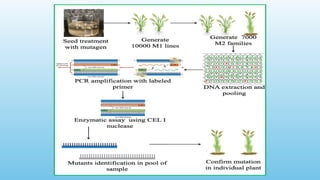
● Targeted Induced Local Lesions in Genomes (TILLING) is a non-
transgenic reverse genetics technique applicable to most crop plants.
● Developed by McCallum in 1990, it involves mutagenizing a population
using chemicals like methyl methanesulfonate (MMS).
● Mutations in target genes are identified, and the technique can be used
across different plant species regardless of ploidy or genome size.
● TILLING offers the advantage of efficiently identifying gene mutations
and new alleles at a lower cost, making it a time-saving method for
molecular genetics and plant breeding programs
Virus Induced Gene Silencing
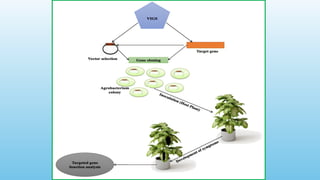
● Virus-induced gene silencing (VIGS) is a technique that utilizes a virus to
trigger RNA-mediated defense mechanisms in plants.
● It involves the synthesis of small interfering RNA (siRNA), which directs
RNase complexes to target specific single-stranded RNA sequences,
resembling double-stranded RNA.
● The viral genome is inserted into plant cells, where siRNA targets the
host mRNA, leading to gene silencing and loss of gene function, resulting
in observable symptoms.
● VIGS is a simple, cost-effective, and high-throughput method used
primarily for identifying the function of genes, particularly in response to
abiotic stress in various plant species.
● Although the review does not focus on model plants, it highlights the
application of VIGS in crop plants.
Genome Editing (CRISPR)
● The CRISPR genome editing technique has significantly improved various
crop plants.
● The Cas9 technology, a key advancement in genome editing, is gaining
popularity due to its ease of use, ability to cleave methylated loci, and
versatility.
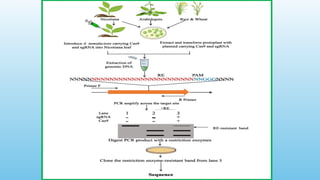
● CRISPR uses two main components: CRISPR RNA (crRNA) and trans-
encoded CRISPR RNA (tracrRNA), which guide the Cas9 endonuclease to
target specific DNA sequences.
● A single guide RNA (sgRNA) is formed by fusing tracrRNA and crRNA,
directing the Cas9 protein to cleave the target site.
● CRISPR-based genome editing has been successfully applied to model
plants like Nicotiana tabacum and Arabidopsis, as well as important
crops like maize and wheat.
RNA-sequencing
● RNA-sequencing (RNA-seq)-based genotyping extracts genotypes from
RNA-seq data, offering a cost-effective alternative to whole-genome
resequencing. While genome sizes vary among crops, the number and
size of genes remain relatively consistent. RNA-seq focuses on the
transcriptome, bypassing repetitive regions, making it efficient for SNP
identification and expression quantitative trait loci (eQTL) mapping.
● RNA sequencing (RNA-Seq) is a powerful tool used in crop research to
study gene expression and regulation.
● It allows researchers to analyze the entire transcriptome—the complete
set of RNA molecules transcribed from the genome—providing insights
into which genes are active under specific conditions, such as
during stress, growth, or disease.
● RNA sequencing hels in Gene Discovery Understanding Gene expression
trait Association functional Genomics.
Role of MAS in stress tolerance
● Overwintering crops require both vernalization and cold tolerance, which is
governed by complex quantitative traits, making marker-assisted selection
(MAS) challenging.
● However, progress has been made in barley, where two tightly linked QTL
(quantitative trait loci) for low-temperature tolerance were identified on
chromosome.
● These QTLs are associated with the expression of cold-regulated (COR) genes
and a cluster of transcription factor genes.
● CBF genes, known to regulate freezing tolerance by activating COR genes, are
strong candidates for the genes underlying these QTLs.
● Markers such as RAPD and STS derived from wheat RFLP sequences in the frost
tolerance QTL region have proven effective in distinguishing frost-tolerant and
frost-susceptible barley genotypes. Their application in breeding programs can
help evaluate the benefits of MAS compared to traditional phenotypic selection
under stress conditions.
Role of MAS In Crop
Improvement
● Marker-assisted selection (MAS) utilizes genetic markers linked to key
traits to support breeding efforts.
● The success of MAS depends on several factors, such as the genetic
foundation of traits, sample size, and the genetic background for gene
transfer.
● MAS has been especially beneficial for simply inherited traits like disease
resistance and product quality, making breeding faster and more
efficient.
● However, complex traits, such as yield and stress tolerance, face
significant challenges in MAS application, though there are some
successes.
● Advances in genotyping and genomics nowoffer valuable tools for
selecting high-performing genotypes and enhancing breeding outcomes.
LIMITATION IN MAS
• High Costs: Genotyping can be expensive, especially when
large populations need to be analyzed, making MAS less
accessible for some breeders.
• Limited QTL Detection: MAS relies on quantitative trait loci
(QTL) mapping, which may miss significant QTLs or
overestimate their effects, leading to inaccurate predictions.
• Environmental Variability: The effectiveness of identified
markers can vary across different environments, affecting
the reliability of MAS outcomes.
• Complex Traits: Many traits are influenced by multiple
genes and environmental factors, complicating the selection
process and reducing the effectiveness of MAS.
• Dependence on Prior Research: Successful MAS requires
prior identification of relevant markers, which may not
always be available or validated in different populations.
• Inconsistent Marker Performance: Markers may not
consistently predict traits across generations or populations
due to genetic interactions and environmental influences.
• Labor-Intensive: Despite technological advances, sample
collection and DNA extraction can still be labor-intensive
and time-consuming.
• Limited Trait Applications: MAS is less effective for traits
that are difficult or expensive to measure phenotypically,
limiting its applicability in some breeding programs.
• Potential for Overreliance: Breeders may become overly
reliant on marker data, neglecting phenotypic evaluations
that can provide critical insights into plant performance.
• Genetic Uniformity Risks: Focusing on specific markers
might reduce genetic diversity within breeding populations,
potentially increasing vulnerability to diseases and
environmental changes.
REFERENCES
• Pingali PL (2012) Green revolution: impacts, limits, and the path ahead. Proc Natl Acad
Sci 109(31):12302–12308. https://doi.org/10.1073/pnas.0912953109
• Tilman D, Cassman KG, Matson PA, Naylor R, Polasky S (2002) Agricultural sustainability
and intensive production practices. Nature 418(6898):671–677.
https://doi.org/10.1038/nature01014
• Bose J, Munns R, Shabala S, Gilliham M, Pogson B, Tyerman SD (2017) Chloroplast
function and ion regulation in plants growing on saline soils: lessons from halophytes. J
Exp Bot 68(12):3129–3143. https://doi.org/10.1 093/jxb/erx142
• Bailey-Serres J, Fukao T, Ronald P, Ismail A, Heuer S, Mackill D (2010) Submergence
tolerant rice: SUB1’s journey from landrace to modern cultivar. Rice 3(2):138–147.
https://doi.org/10.1007/s12284-010-9048-5
• Song WY, Wang GL, Chen LL, Kim HS, Pi LY, Holsten T, Gardner J, Wang B, Zhai WX, Zhu
LH, Fauquet C, Ronald P (1995) A receptor kinase-like protein encoded by the rice
disease resistance gene, Xa21. Science 270(5243):1804 1806.
https://doi.org/10.1126/science.270.5243.1804
• Adjebeng-Danquah, J., Manu-Aduening, J., Asante, I.K., Agyare, R.Y., Gracen, V., et
al., 2020. Genetic diversity and population structure analysis of Ghanaian and
exotic cassava accessions using simple sequence repeat (SSR) markers. Heliyon 6
(1), e03154.
• Akash, M.W., Shiyab, S.M., Saleh, M.I., 2013. Yield and AFLP analyses of inter-
landrace variability in okra (Abelmoschus esculentus L.). Life Sci. J. 10 (2), 2771–
2779.
• Alghamdi, S., Al-Faifi, S., Migdadi, H., Khan, M.E., El-Harty, M.A., 2012. Molecular
diversity assessment using sequence related amplified polymorphism (SRAP)
markers in Vicia faba L. Int. J. Mol. Sci. 13, 16457–16471.
• Ali, E.M., Tohidfar, M., Karimi, M., et al., 2015. Determination of genetic
uniformity in transgenic cotton plants using DNA markers (RAPD and ISSR) and
SDS-PAGE. J. Plant Mol. Breed. 3 (2), 36–43.
• Ali, F., Yılmaz, A., Nadeem, M.A., Habyarimana, E., Subas¸ı, I., Nawaz, M.A.,
Chaudhary, H.J., Shahid, M.Q., Ercis¸li, S., Zia, M., Chung, G., Baloch, F.S., 2019.
Mobile genomic element diversity in world collection of safflower (Carthamus
tinctorius L.) panel using _ IPBS retrotransposon markers. PloS One 14 (2),
e0211985.
• Alwala, S., Kimbeng, C.A., Williams, W., Kang, M.S., 2008. Molecular markers
THANK YOU
Questions? Comments?

Advanced Molecular Markers: Revolutionizing Genetic Research

  • 1.
    Advance Molecular Marker &Its Application Presented to:- Dr. Ashish Kumar (Department of Biotechnology) GGV, Bilaspur (C.G.) Presented by :- Rashmi Sahu Shweta Panday Sakshi Bhardwaj Roshni Dahariya Rupali Sahu
  • 2.
    INTRODUCTION Advanced molecular markersare sophisticated techniques used to detect genetic variations and analyze traits in organisms. They build upon traditional methods like RFLP, RAPD, and SSR, combining their strengths to improve sensitivity and resolution. Notable advanced techniques include AFLP, which integrates restriction enzyme digestion with PCR amplification, and utilizes various DNA elements for broader genome coverage. These markers are crucial in plant breeding for identifying traits linked to diseases or desirable characteristics, facilitating marker-assisted selection (MAS) and enhancing
  • 3.
    CHARACTERISTICS • High Polymorphism:They exhibit significant genetic variation, useful for distinguishing between individuals. • Co-dominant Inheritance: Allow detection of both alleles in heterozygotes, enhancing trait mapping. • Locus Specificity: Target specific genomic locations for precise genetic analysis. • Reproducibility: Provide consistent results across multiple experiments. • PCR-Based Techniques: Many rely on polymerase chain reaction for amplification.
  • 4.
    • Versatility: Applicableacross various species and research fields. • Quantitative Trait Loci (QTL) Mapping: Facilitate identification of genes linked to quantitative traits. • Genetic Stability Assessment: Help evaluate the stability of traits over generations. • Marker-Assisted Selection (MAS): Enable selection of desired traits in breeding programs. • Identification of Mutations: Detect small genetic changes affecting phenotypes.
  • 5.
    ADVANTAGES OF MASSBREEDING OVER CONVENTIONAL BREEDING • Efficiency: Mass breeding can be conducted at the seedling stage, allowing for earlier identification of desirable traits, unlike conventional methods that often require plants to reach maturity before evaluation. • Genetic Diversity: It retains considerable genetic variability, which is crucial for adapting to changing environments and diseases.
  • 6.
    • Environmental Independence:It is less affected by environmental variability, enabling consistent trait assessment regardless of external conditions. • Cost-Effectiveness: Mass breeding can be cheaper and faster, especially for traits that are labor-intensive to evaluate phenotypically. • Genotype Identification: Traits can be assessed early in development, enabling quicker decisions on breeding stock.
  • 7.
    • Recessive AlleleDetection: It can identify recessive alleles that are otherwise masked in conventional breeding. • Pyramiding Traits: Facilitates the combination of multiple desirable traits into a single variety more effectively. • Broader Adaptability: Varieties developed through mass breeding often show greater stability and adaptability to various conditions.
  • 8.
    • Simplified Process:The method is straightforward, making it accessible for many breeders without advanced technology. • Rapid Genetic Gains: Accelerates the overall genetic improvement of crops, addressing food security challenges more effectively.
  • 9.
  • 10.
    DNA MARKER • Molecularmarkers are sequences of nucleotides and can be explored through the polymorphisms present between the nucleotide sequences of various people • Deletions, insertions, gene mutation, duplication, and translocation of these nucleotide sequences are the basis of polymorphisms among the population; however, they do not really influence the function of genes. • A perfect DNA marker ought to be co- predominant, uniformly distributed, genome, more and having the capacity to recognize a more significant level of polymorphism.
  • 12.
    HYBRIDIZATION BASED DNA markers,conventional, or first-generation RFLPs, require the utilization of a properly labelled DNA probe for the selection of the specific genes of interest from the digestion of DNA samples and then, by hybridization. RFLP was the primary molecular marker strategy and the main marker framework dependent on hybridization. People of the same species show polymorphisms because of insertions/deletions (known as InDels), gene mutations, duplications, translocations, and inversions. The isolation of pure DNA from the target is the primary step in the RFLP strategy. This DNA is blended in through the cutting enzymes (restriction endonucleases) which are isolated from the target such as bacteria, human cells, etc. And a specific function of restriction enzymes identify specific nucleotide sequences along the DNA strand, and therefore they cut DNA at specific loci (acknowledgment destinations). • These outcomes are an immense number of segments with various lengths.
  • 14.
    PCR BASED MARKERS •Molecular markers based on PCR techniques do not require a probe hybridization step. • Their improvement has prompted the disclosure of a few valuable and simple to screen new generation markers, for example ; RAPD, AFLP, microsatellite or SSRs, SNP, RAMP, SRAP,ISSR, SCAR, EST and so forth. • Being PCR-based, these molecular markers require the utilization of primer pairs for the selection of a specific part of the DNA to measure the variation in genetic material. • Most of the primers are used for the selection of specific regions of DNA to be amplified by polymerase chain reaction and sequence analysis techniques • They, therefore, start the amplification of the specific segment of DNA. • After the amplifiction of DNA from various genotypes, the fragments of digested DNA are separated on the gel to examine the variation in the pattern of bands. • further DNA fragments may be subjected to the sequencing technique for observing the sequence variation in DNA resulting
  • 15.
    TRANSPOSABLE ELEMENTS MARKERS •Sometimes, DNA sequences change their position in the Genome and may insert into the coding regions of the Genome. Such mobile DNA sequences are called transposable elements (TE). • These transposable elements Have been found in maize during the study of the genome by Barbara McClintock in 1950 and considered that They are present in the eukaryotic genomes at a larger Scale. • TEs have been divided into : Class I (retrotransposons), commonly called Copy and paste elements, and Class II (transposable DNA), or also called “cut and paste” transposable elements. The transposable elements of class I propagate with the help of the intermediate RNA molecules And form a new site in the genome, while class II transposable elements do not require an intermediate RNA Molecule and excise themselves from any site of the Donor and move to a specific location of the acceptor Site within the genome. Since the revelation of numerous Eukaryotic TEs, for example miniature inverted repeat transposable elements (MITEs), this arrangement has Been tested, as it is difficult to put the new transposable Elements in the current system
  • 16.
    RETEROTRANSPORON MICROSATELLITE AMPLIFICATION POLYMORPHISM •Retrotransposon microsatellite amplification polymorphism (REMAP) is also a more important marker based on retrotransposons and commonly used to evaluate the genetic diversity of individuals of the population. • The protocol for utilization of REMAP is just like IRAP, although SSRs (microsatellites) are used in conjunction with specified markers of LTE at the time of PCR cycling • The primers used for microsatellite loci in REMAP PCR are containing a repeated motif anchored nucleotide at the 3′ end site aiming to avoid the slippage of the primer between individual SSR motif
  • 17.
    RETEROTRANSPORON BASED INSERTION POLYMORPHISM •Retrotransposon-based insertion polymorphism (RBIP) technique is used to investigate the presence or absence of sequences of retrotransposons present in the genome. • In this technique, amplification of DNA is accomplished with the help of a primer having 3′ and 5′ end regions that are flanking the retrotransposon insertion site. • Insertion sequences in retrotransposons are identified through the development of a primer from the LTR region. • The information of nucleotide sequences along the flanking region of the retrotransposon insertion site is required in the RBIP technique, as results It makes single locus compared to other molecular markers based on retrotransposons. • Instead of Agarose Gel electrophoresis it uses Tagged microarray markers, which are based on fluorescent microarray scoring, for analysis.
  • 18.
    INVERSE SEQUENCE TAGGEDREPEATS • It involves the use of specific DNA sequences that are repeated in the genome, which can be used as markers for identifying genetic variations • The nature of sequence-tagged sites, the process of inverse PCR, and the applications of ISTR in genetic analysis. • Sequence-Tagged Sites (STS) are short DNA sequences that are easily identifiable and occur only once in the genome. • In the context of ISTR, these sites are used to locate and amplify specific DNA sequences. • Inverse PCR is a variation of the polymerase chain reaction (PCR) technique. It is used to amplify DNA sequences that flank a known sequence. • In ISTR, inverse PCR is employed to amplify the regions surrounding the sequence-tagged sites. This involves: • • 1. Circularization of DNA: The DNA is digested with restriction enzymes to create fragments, which are then circularized. • 2. Primer Design: Primers are designed to anneal to the known sequence within the circularized DNA. • 3. Amplification: PCR is performed to amplify the unknown regions flanking the known sequence.
  • 19.
    INTER RETROTRANSPOSON AMPLIFIEDPOLYMORPHISM • It is based on the amplification of DNA sequences located between retrotransposons, which are genetic elements that can move around within the genome. • IRAP exploits the presence of retrotransposons in the genome. • The technique involves designing primers that anneal to the conserved regions of retrotransposons. • These primers are used in a PCR reaction to amplify the DNA sequences located between two retrotransposons. • The resulting amplified fragments can vary in length due to the insertion or deletion of retrotransposons, leading to polymorphisms. • Separate the amplified fragments using gel electrophoresis to visualize the polymorphisms.
  • 20.
    SEQUENCE TAGGED SITEMARKER • Sequence Tagged Site markers are short, unique DNA sequences that serve as reference points in the genome. They are typically 200-500 base pairs long and are used to create a map of the genome by marking specific locations. • STS markers are identified using polymerase chain reaction (PCR) techniques. • Primers specific to the STS sequence are used to amplify the DNA segment, allowing researchers to detect the presence of the marker in a sample. • The uniqueness of the STS ensures that it can be used to pinpoint a specific location in the
  • 21.
    SEQUENCE RELATED AMPLIFIED POLYMORPHISM •It is designed to amplify open reading frames (ORFs) in genomes, which are regions of DNA that are likely to be expressed as proteins • The technique is used to identify polymorphisms, or variations, in DNA sequences that can be linked to specific traits or characteristics in organisms • The first step in SRAP is to extract DNA from the organism of interest. • SRAP uses two types of primers: a forward primer that targets the exonic regions and a reverse primer that targets the intronic regions. The primers are designed to be complementary to conserved regions flanking the ORFs, allowing for the amplification of these regions • The extracted DNA is subjected to PCR using the designed primers. • The amplified DNA fragments are then separated by size using gel electrophoresis. • Allowing for the visualization of polymorphisms as distinct bands on the gel.
  • 22.
    SINGLE STRAND CONFORMATIONAL POLYMORPHISM •SSCP is a technique used in molecular biology to detect genetic variation by identifying differences in the conformation of single- stranded DNA fragments. • This method is based on the principle that ssDNA can fold into unique secondary structures due to intramolecular base pairing. • These structures are influenced by the sequence of nucleotides, and even a single base change can result in a different conformation. • SSCP is based on the principle that different conformations of ssDNA will migrate differently during electrophoresis based on their shape and size, allowing for the detection of polymorphisms
  • 23.
    DIVERSITY ARRAY TECHNOLOGY •DArT is based on the concept of detecting polymorphisms in DNA sequences. • It involves the use of microarrays to identify and score variations in DNA fragments. • The technology does not require prior sequence information, making it versatile for various organisms. • The Process of DArT • 1. DNA Extraction: DNA is extracted from the organism of interest. • 2. Complexity Reduction: The DNA is digested with restriction enzymes to reduce complexity and generate fragments. • 3. Ligation and Amplification: Adaptors are ligated to the fragments, which are then amplified using PCR. • 4. Hybridization: The amplified fragments are hybridized to a microarray containing thousands of probes. • 5. Detection and Scoring: The hybridized fragments are detected using fluorescence, and the presence or absence of specific fragments is scored. • Hence, Diversity Arrays Technology (DArT) is a powerful genotyping tool that allows researchers to detect genetic variations across genomes efficiently and cost-effectively.
  • 24.
    INTER SINE AMPLIFIEDPOLYMORPHISM • It involves the amplification of DNA segments located between Short Interspersed Nuclear Elements (SINEs), SINEs are short DNA sequences that are repeated many times throughout the genome. They are a type of transposable element, meaning they can move around within the genome. SINEs are typically 100-300 base pairs long and are found in high copy numbers in the genomes of many eukaryotes. • It Designed specifically for potato plant or species of plant family Solanaceae. • ISAP markers are mostly based on genomic sequence amplification between adjacent SINE elements In this technique, the primer annealed to a site other than the SINE elements and either inwardly or outwardly. • The DNA segments between these SINEs are then amplified. • The length of the amplified products can vary between individuals due to insertions, deletions, or other mutations in the inter-SINE regions. • These variations are the polymorphisms that the technique aims to detect. • However, the design of ISAP primers requires extensive prior genomic information
  • 25.
    INTER SMALL RNAPOLYMORPHISM • Endogenous noncoding small RNAs consisting of 20–24 nucleotides are ubiquitous in eukaryotic genomes, where they play important regulatory roles. • And they provide an excellent source for molecular marker development. • The flanking sequences of small RNAs are conserved, allowing the design of primers for use in PCR reactions and fingerprinting. • The basic principle is to use primer pairs of flanking small RNAs to initiate a PCR reaction and detect length polymorphisms that are due to InDels present in the small RNA pool • According to the authors, the technique is reproducible, representing a high-throughput, non-coding, sequence-based marker system. • It can be used for genome mapping and for genotyping.
  • 26.
    EST SSR • ESTSSRs (Expressed Sequence Tag Simple Sequence Repeats) are derived from ESTs, which are short sub- sequences of transcribed cDNA sequences. • SSRs, also known as microsatellites, are repeating sequences of 1-6 base pairs of DNA. • ESTs represent expressed genes and are used to identify gene transcripts. • SSRs are highly polymorphic, making them excellent markers for genetic studies, used to assess genetic diversity, construct genetic maps, and perform linkage analysis. • The ongoing increment in the accessibility of expressed sequence tag (EST) data has encouraged the advancement of microsatellite or simple sequence repeat (SSR) markers in various plant species. • ESTSSRs are produced from the transcribed regions of the genome.
  • 27.
    RESISTANCE GENE BASEDMARKER • Resistance gene-based markers are specific types of genetic markers that are linked to resistance genes. • They are used to identify and select individuals that carry resistance traits, facilitating the breeding of resistant varieties. • Many plants developed a very active and passive defence system to ensure themselves against biotic and abiotic diseases. • Innate immunity is more common in plants and animals and provides protection against several a variety of pathogens due to the action of R protein and pathogen and pattern resistance receptors • Pathogens or microbes are associated with molecular patterns that are recognized by the pathogen or pattern resistance receptors (PPRs) and these receptors are conserved among the microorganisms having a place in a specific class • (R proteins) induces signalling that produces the reactive oxygen species inside the cells and is responsible to activate the process of deliberated suicide of the cells (programmed cell death) resulting in hypersensitive reactions that kill the affected cells of the plant.
  • 28.
    DIRECT AMPLIFICATION OFLENGTH POLYMORPHISM • It was designed to obtain nucleotide sequence information for DNA fragments from any genome with no a priori sequence data. • For PCR amplification, the universal sequencing primer “M13–40 USP” is incorporated in the oligonucleotide set as a core • Selectivity is ensured by adding further bases to the 3′ end of the primers, which are termed “selective primers”. • The reverse primer is also common “M13” which is a standard used in primer paired reactions. • Primer sets with any desired length can be designed by varying the composition of 3′ bases in the selective primer.
  • 29.
    TARGETED REGION AMPLIFIED POLYMORPHISM •Based on a priori sequence information. • It is designed to detect polymorphisms in specific genomic regions. • The technique involves amplifying DNA segments that are flanked by known sequences, allowing researchers to identify genetic variations within targeted regions of the genome. • The first step in TRAP is designing primers that target specific genomic regions. • In TRAP, one primer is designed to match a known sequence in the genome, while the other is a random or semi-random primer that can bind to multiple sites. • The next step is to perform Polymerase Chain Reaction amplification. • After PCR amplification, the amplified DNA fragments are separated using gel electrophoresis. • The presence or absence of specific bands on the gel indicates polymorphisms in the targeted region.
  • 30.
    START CODON TARGETED •The SCoT technique is depending on the observation that a short region of conserved sequences of the plant is mostly surrounded by ATG start codons of translation • A single primer is designed in the ScoT technique with annealing the flanking region of the initiation codon on both sides of the DNA strand. • Amplified fragments are distributed within the gene having both minus and plus strands of DNA • These markers are more reproducible and the length of primers and annealing temperature are not the factors that determine the reproducibility of markers
  • 31.
    CONSERVED REGION AMPLIFICATION POLYMORPHISM •It is a technique based on the utilization of an arbitrary and fixed primer. • CoRAP is much like TRAP to the utilization of a fixed primer and this primer is directly generated from the targeted ESTs. • CoRAP and TRAP that both derived from ESTs and have specific binding sites on the exon of targeted sequences; in spite of this, the arbitrary primers mostly bind to other exon regions (TRAPS) or to most of the introns at the time of PCR amplification. • If these gene elements are accurately distributed to allow the successful PCR, the banding patterns obtained from fingerprinting will be amplified. • Indels in these regions will certainly generate different distributions of amplified products. • If two individuals are very close, the banding pattern resulting from the PCR product will be more similar.
  • 32.
    PROMOTER ANCHORED AMPLIFIED POLYMORPHISM •The promoter regions that facilitate the transcription of a gene are located too close to a particular gene • They can be utilized to be specify the profiling of the genome of the investigated organism. • The promoter element of genes determines the point of transcription initiation and change and the specificity and rate of transcription • The architecture of promoter sequences of a specific gene exhibits high diversity, comprising of many short motifs that act as the recognition site for proteins having great importance in transcription initiation • Designed a few short oligonucleotide primers containing the degenerate sequences of cotton promoter regions. • This element of promoters makes them reasonable for labelling with degenerate primers to create length polymorphisms, effectively noticeable by electrophoresis.
  • 33.
    • Minisatellites areused as marker for identifying individuals via DNA fingerprinting as the alleles may differ in the number of repeats. From the Southern blot shown below identify the progeny (A, B, C and D) for the given parents (M- mother. F father).
  • 34.
  • 35.
    In a breedingexperiment, two homozygous parental lines (P1 and P2) were crossed to produce F1 hybrids. Due to an experimental error, seeds of these hybrids got mixed up with the seeds of two other germplasm lines (P3 and P4) and hybrid seeds derived from them. A marker-based fingerprinting exercise was performed using six randomly selected seeds (F1-F6) from the mixed material and the four parental lines. Results of this analysis are shown below: Based on the above data, which one of the following options represents the correct set of parents and their F 1 progeny?
  • 36.
  • 37.
    Application of MASin Plant Breeding
  • 38.
    CULTIVAR IDENTITY/ASSESSMENT OF PURITY •Seeds from different strains are to be often mixed because of difficulties in handling many seed samples that are utilized between and within plant breeding programmers. • Markers may be utilized in conferring the actual identity of plant individuals. • High-level genetic purity and their maintenance are more important in the production of cereal hybrids to exploit heterosis. • In hybrid rice, SSR and STS markers were used to confirm purity, which was considerably simpler than the standard “grow-out tests” that involve growing the plant to maturity and assessing morphological and floral characteristics.
  • 39.
    STUDY OF HETROSIS •The development of inbred lines for use in producing superior hybrids is a very time- consuming and expensive procedure. • For hybrid crop production, especially in maize and sorghum, DNA markers have been used to define heterotic groups that can be used to exploit heterosis (hybrid vigour). • Unfortunately, it is not yet possible to predict the exact level of heterosis based on DNA marker data although there have been reports of assigning parental lines to the proper heterotic groups.
  • 40.
    Evolution and phylogeny •Some time ago,the primary study about the evolution of species or characters was dependent completely on geographical conditions and morphological variation among the populations. • The development of various techniques in molecular biology offers more information to the genetic makeup of an organism. • Nowadays, a large number of molecular markers are required for phylogeny to get information about evolution and used to reconstruct the genetic map of an individual.
  • 41.
  • 42.
    Marker-assisted backcross breeding • Markerscan be used in backcross breeding at three phases of frontal area, recombinant, and foundation determinations. • At the main phase of forefront choice, markers are utilized to select the desirable trait. • The recombinant selection is the second stage which includes selecting backcross off spring with the character and firmly connected flanking markers, so linkage drag can be decreased. • The third stage is referred to as the selection of background and it includes selecting backcross descendants utilizing the background markers.
  • 44.
    Marker-assisted pyramiding • Theprocedure of integrating multiple genes at the same time or quantitative trait loci into a single genotype is known as pyramiding or Pyramiding is the process of combining several genes together into a single genotype. • The most widespread application for pyramiding has been for combining multiple disease resistance genes. • The motive for this has been the development of ‘durable’ or stable disease resistance since pathogens frequently overcome single gene host resistance over time due to the emergence of new plant pathogen races.
  • 45.
  • 46.
    1. Targeted inducedlocal lesions in genome 2. Virus induced gene silencing 3. Genome editing (crispr) 4. Role of MAS in crop improvement 5. RNA sequencing Advancement In Marker Assisted Selection
  • 47.
    Targeted induced locallesionsin genome (tilling) ● Targeted Induced Local Lesions in Genomes (TILLING) is a non- transgenic reverse genetics technique applicable to most crop plants. ● Developed by McCallum in 1990, it involves mutagenizing a population using chemicals like methyl methanesulfonate (MMS). ● Mutations in target genes are identified, and the technique can be used across different plant species regardless of ploidy or genome size. ● TILLING offers the advantage of efficiently identifying gene mutations and new alleles at a lower cost, making it a time-saving method for molecular genetics and plant breeding programs
  • 49.
    Virus Induced GeneSilencing ● Virus-induced gene silencing (VIGS) is a technique that utilizes a virus to trigger RNA-mediated defense mechanisms in plants. ● It involves the synthesis of small interfering RNA (siRNA), which directs RNase complexes to target specific single-stranded RNA sequences, resembling double-stranded RNA. ● The viral genome is inserted into plant cells, where siRNA targets the host mRNA, leading to gene silencing and loss of gene function, resulting in observable symptoms. ● VIGS is a simple, cost-effective, and high-throughput method used primarily for identifying the function of genes, particularly in response to abiotic stress in various plant species. ● Although the review does not focus on model plants, it highlights the application of VIGS in crop plants.
  • 51.
    Genome Editing (CRISPR) ●The CRISPR genome editing technique has significantly improved various crop plants. ● The Cas9 technology, a key advancement in genome editing, is gaining popularity due to its ease of use, ability to cleave methylated loci, and versatility. ● CRISPR uses two main components: CRISPR RNA (crRNA) and trans- encoded CRISPR RNA (tracrRNA), which guide the Cas9 endonuclease to target specific DNA sequences. ● A single guide RNA (sgRNA) is formed by fusing tracrRNA and crRNA, directing the Cas9 protein to cleave the target site. ● CRISPR-based genome editing has been successfully applied to model plants like Nicotiana tabacum and Arabidopsis, as well as important crops like maize and wheat.
  • 53.
    RNA-sequencing ● RNA-sequencing (RNA-seq)-basedgenotyping extracts genotypes from RNA-seq data, offering a cost-effective alternative to whole-genome resequencing. While genome sizes vary among crops, the number and size of genes remain relatively consistent. RNA-seq focuses on the transcriptome, bypassing repetitive regions, making it efficient for SNP identification and expression quantitative trait loci (eQTL) mapping. ● RNA sequencing (RNA-Seq) is a powerful tool used in crop research to study gene expression and regulation. ● It allows researchers to analyze the entire transcriptome—the complete set of RNA molecules transcribed from the genome—providing insights into which genes are active under specific conditions, such as during stress, growth, or disease. ● RNA sequencing hels in Gene Discovery Understanding Gene expression trait Association functional Genomics.

  • 55.
    Role of MASin stress tolerance ● Overwintering crops require both vernalization and cold tolerance, which is governed by complex quantitative traits, making marker-assisted selection (MAS) challenging. ● However, progress has been made in barley, where two tightly linked QTL (quantitative trait loci) for low-temperature tolerance were identified on chromosome. ● These QTLs are associated with the expression of cold-regulated (COR) genes and a cluster of transcription factor genes. ● CBF genes, known to regulate freezing tolerance by activating COR genes, are strong candidates for the genes underlying these QTLs. ● Markers such as RAPD and STS derived from wheat RFLP sequences in the frost tolerance QTL region have proven effective in distinguishing frost-tolerant and frost-susceptible barley genotypes. Their application in breeding programs can help evaluate the benefits of MAS compared to traditional phenotypic selection under stress conditions.
  • 56.
    Role of MASIn Crop Improvement ● Marker-assisted selection (MAS) utilizes genetic markers linked to key traits to support breeding efforts. ● The success of MAS depends on several factors, such as the genetic foundation of traits, sample size, and the genetic background for gene transfer. ● MAS has been especially beneficial for simply inherited traits like disease resistance and product quality, making breeding faster and more efficient. ● However, complex traits, such as yield and stress tolerance, face significant challenges in MAS application, though there are some successes. ● Advances in genotyping and genomics nowoffer valuable tools for selecting high-performing genotypes and enhancing breeding outcomes.
  • 57.
    LIMITATION IN MAS •High Costs: Genotyping can be expensive, especially when large populations need to be analyzed, making MAS less accessible for some breeders. • Limited QTL Detection: MAS relies on quantitative trait loci (QTL) mapping, which may miss significant QTLs or overestimate their effects, leading to inaccurate predictions. • Environmental Variability: The effectiveness of identified markers can vary across different environments, affecting the reliability of MAS outcomes.
  • 58.
    • Complex Traits:Many traits are influenced by multiple genes and environmental factors, complicating the selection process and reducing the effectiveness of MAS. • Dependence on Prior Research: Successful MAS requires prior identification of relevant markers, which may not always be available or validated in different populations. • Inconsistent Marker Performance: Markers may not consistently predict traits across generations or populations due to genetic interactions and environmental influences.
  • 59.
    • Labor-Intensive: Despitetechnological advances, sample collection and DNA extraction can still be labor-intensive and time-consuming. • Limited Trait Applications: MAS is less effective for traits that are difficult or expensive to measure phenotypically, limiting its applicability in some breeding programs. • Potential for Overreliance: Breeders may become overly reliant on marker data, neglecting phenotypic evaluations that can provide critical insights into plant performance.
  • 60.
    • Genetic UniformityRisks: Focusing on specific markers might reduce genetic diversity within breeding populations, potentially increasing vulnerability to diseases and environmental changes.
  • 61.
    REFERENCES • Pingali PL(2012) Green revolution: impacts, limits, and the path ahead. Proc Natl Acad Sci 109(31):12302–12308. https://doi.org/10.1073/pnas.0912953109 • Tilman D, Cassman KG, Matson PA, Naylor R, Polasky S (2002) Agricultural sustainability and intensive production practices. Nature 418(6898):671–677. https://doi.org/10.1038/nature01014 • Bose J, Munns R, Shabala S, Gilliham M, Pogson B, Tyerman SD (2017) Chloroplast function and ion regulation in plants growing on saline soils: lessons from halophytes. J Exp Bot 68(12):3129–3143. https://doi.org/10.1 093/jxb/erx142 • Bailey-Serres J, Fukao T, Ronald P, Ismail A, Heuer S, Mackill D (2010) Submergence tolerant rice: SUB1’s journey from landrace to modern cultivar. Rice 3(2):138–147. https://doi.org/10.1007/s12284-010-9048-5 • Song WY, Wang GL, Chen LL, Kim HS, Pi LY, Holsten T, Gardner J, Wang B, Zhai WX, Zhu LH, Fauquet C, Ronald P (1995) A receptor kinase-like protein encoded by the rice disease resistance gene, Xa21. Science 270(5243):1804 1806. https://doi.org/10.1126/science.270.5243.1804
  • 62.
    • Adjebeng-Danquah, J.,Manu-Aduening, J., Asante, I.K., Agyare, R.Y., Gracen, V., et al., 2020. Genetic diversity and population structure analysis of Ghanaian and exotic cassava accessions using simple sequence repeat (SSR) markers. Heliyon 6 (1), e03154. • Akash, M.W., Shiyab, S.M., Saleh, M.I., 2013. Yield and AFLP analyses of inter- landrace variability in okra (Abelmoschus esculentus L.). Life Sci. J. 10 (2), 2771– 2779. • Alghamdi, S., Al-Faifi, S., Migdadi, H., Khan, M.E., El-Harty, M.A., 2012. Molecular diversity assessment using sequence related amplified polymorphism (SRAP) markers in Vicia faba L. Int. J. Mol. Sci. 13, 16457–16471. • Ali, E.M., Tohidfar, M., Karimi, M., et al., 2015. Determination of genetic uniformity in transgenic cotton plants using DNA markers (RAPD and ISSR) and SDS-PAGE. J. Plant Mol. Breed. 3 (2), 36–43. • Ali, F., Yılmaz, A., Nadeem, M.A., Habyarimana, E., Subas¸ı, I., Nawaz, M.A., Chaudhary, H.J., Shahid, M.Q., Ercis¸li, S., Zia, M., Chung, G., Baloch, F.S., 2019. Mobile genomic element diversity in world collection of safflower (Carthamus tinctorius L.) panel using _ IPBS retrotransposon markers. PloS One 14 (2), e0211985. • Alwala, S., Kimbeng, C.A., Williams, W., Kang, M.S., 2008. Molecular markers
  • 63.