Identification Methods
of Abused Drugs
By - Dharun Sao
M.Sc. Biotechnology
Department of Biotechnology
Guru Ghasidas Vishwavidyalaya, Bilaspur (C.G.)
Identification Methods
of Abused Drugs
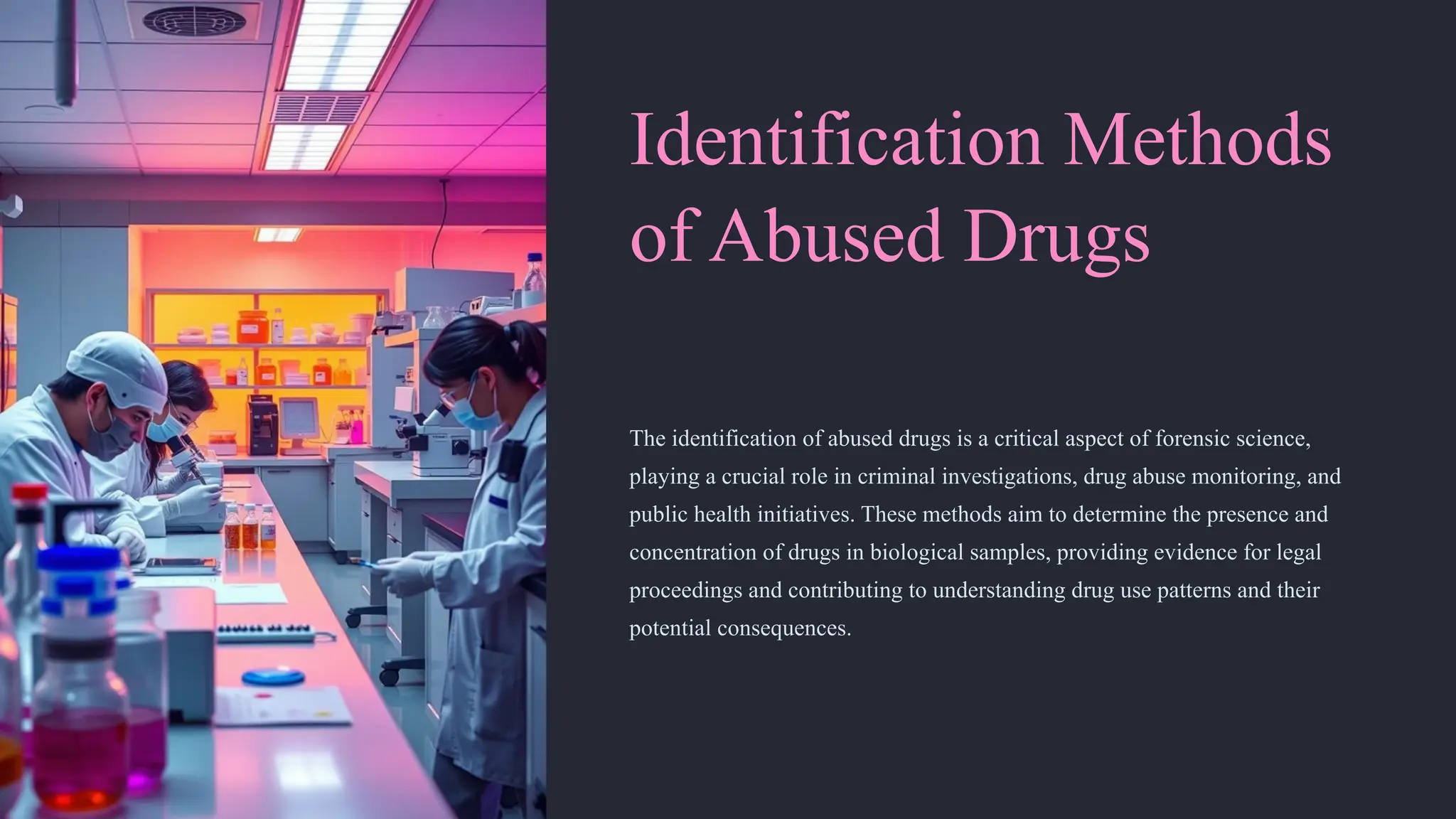
The identification of abused drugs is a critical aspect of forensic science,
playing a crucial role in criminal investigations, drug abuse monitoring, and
public health initiatives. These methods aim to determine the presence and
concentration of drugs in biological samples, providing evidence for legal
proceedings and contributing to understanding drug use patterns and their
potential consequences.
Sample Collection
1 Blood
Blood samples are widely used for
drug detection, offering a direct
measure of recent drug use. However,
they may be subject to rapid
metabolism, leading to false negatives
if collected too long after drug use.
2 Urine
Urine is a commonly used sample for
drug detection as it is readily available
and provides a relatively long
detection window, reflecting drug use
over a few days.
3 Saliva
Saliva samples are less invasive than
blood or urine and offer a shorter
detection window, primarily reflecting
recent drug use within hours or a few
days.
4 Hair
Hair analysis offers a longer detection window, spanning weeks
or even months, providing a historical perspective on drug use
and potential exposure.
5 Sweat, Breast Milk, Semen, and Nails
These samples are less commonly used but can provide
valuable insights into drug use and exposure, particularly in
specific circumstances. Their use is more targeted and often
involves specialized testing methods.
Presumptive Tests
Color Tests
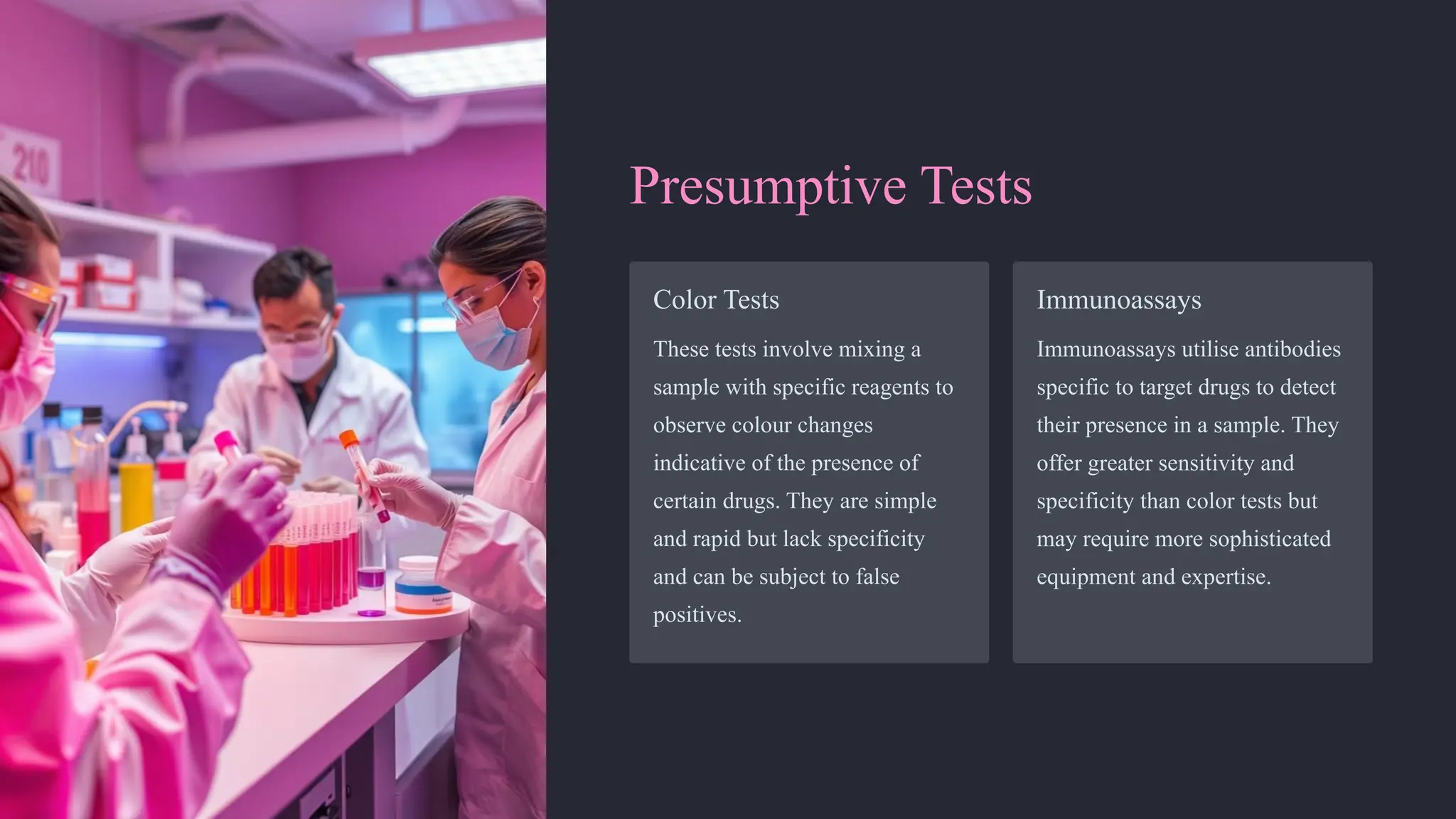
These tests involve mixing a
sample with specific reagents to
observe colour changes
indicative of the presence of
certain drugs. They are simple
and rapid but lack specificity
and can be subject to false
positives.
Immunoassays
Immunoassays utilise antibodies
specific to target drugs to detect
their presence in a sample. They
offer greater sensitivity and
specificity than color tests but
may require more sophisticated
equipment and expertise.
Enzyme Multiplied Immunoassay Technique (EMIT)
EMIT
This method utilises an enzyme-labelled
drug analogue that competes with the
drug in the sample for binding to
antibodies. The enzyme activity is
measured, which is inversely
proportional to the drug concentration in
the sample.
Advantages
EMIT is known for its speed, automation
potential, and sensitivity, making it
suitable for high-throughput screening
and routine testing.
Limitations
EMIT can be prone to cross-reactivity
with other drugs or substances,
potentially leading to false positives.
Fluorescence Polarization Immunoassay (FPIA)
FPIA
This technique relies on the principle of
fluorescence polarization. Antibodies
bind to a fluorescently labelled drug
analogue, altering the polarization of
emitted light. The degree of polarization
is inversely related to the drug
concentration.
Advantages
FPIA offers high sensitivity, specificity,
and can be automated, making it suitable
for a wide range of drug detection
applications.
Limitations
FPIA requires specialized equipment and
can be more expensive than other
immunoassays.
Cloned Enzyme Donor Assay (CEDA)
CEDA
This method involves the use of an
enzyme-linked drug analogue that
competes with the drug in the sample for
binding to antibodies. The enzyme
activity is measured, which is inversely
proportional to the drug concentration in
the sample.
Advantages
CEDA offers high sensitivity, specificity,
and can be automated, making it suitable
for a wide range of drug detection
applications.
Limitations
CEDA requires specialized equipment
and can be more expensive than other
immunoassays.
Radioimmunoassay (RIA)
RIA
RIA involves the use of a radioactively
labelled drug analogue that competes
with the drug in the sample for binding
to antibodies. The amount of
radioactivity bound to the antibodies is
measured, which is inversely
proportional to the drug concentration.
Advantages
RIA offers high sensitivity and
specificity, making it suitable for
detecting low levels of drugs in samples.
Limitations
RIA requires special handling and
disposal of radioactive materials,
involving safety precautions and
regulations.
Enzyme-Linked Immunosorbent Assay (ELISA)
ELISA
ELISA utilizes an enzyme-linked
antibody to detect the presence of a drug
in a sample. The enzyme activity is
measured, which is proportional to the
drug concentration.
Advantages
ELISA is known for its sensitivity,
specificity, versatility, and affordability,
making it suitable for a wide range of
applications.
Limitations
ELISA may require a longer processing
time than other immunoassays.
Lateral Flow Assay (LFA)
LFA
LFA, also known as a dipstick test, is a
rapid and convenient method for drug
detection. It involves a strip containing
antibodies that bind to the drug in the
sample, resulting in a visible line if the
drug is present.
Advantages
LFAs are simple to use, require minimal
training, and provide rapid results,
making them suitable for point-of-care
testing.
Limitations
LFAs generally have lower sensitivity
and specificity than other immunoassays,
potentially leading to false positives or
negatives.
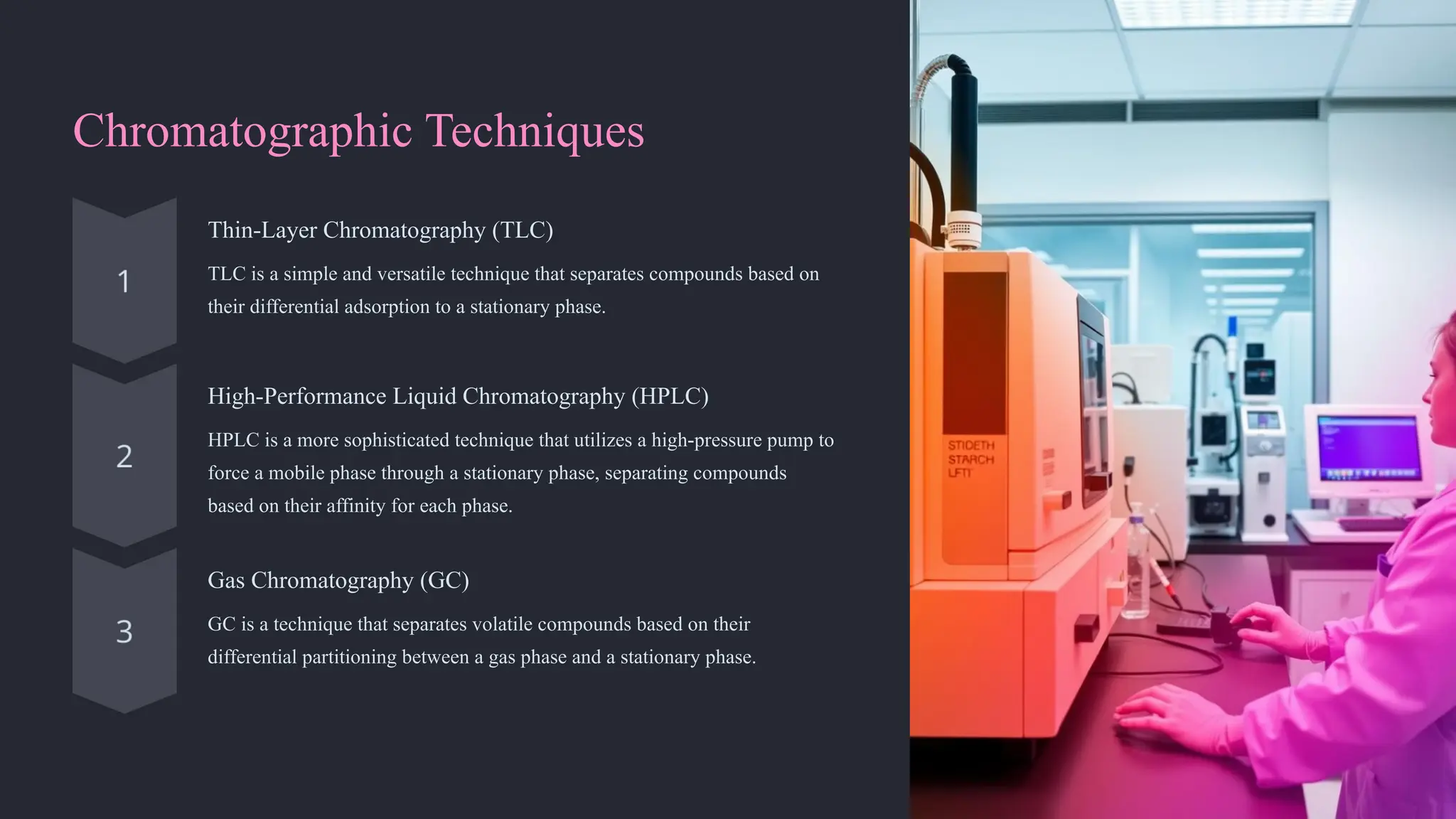
Chromatographic Techniques
Thin-Layer Chromatography (TLC)
TLC is a simple and versatile technique that separates compounds based on
their differential adsorption to a stationary phase.
High-Performance Liquid Chromatography (HPLC)
HPLC is a more sophisticated technique that utilizes a high-pressure pump to
force a mobile phase through a stationary phase, separating compounds
based on their affinity for each phase.
Gas Chromatography (GC)
GC is a technique that separates volatile compounds based on their
differential partitioning between a gas phase and a stationary phase.
Thank you!

Identification Methods of Abused Drugs: Techniques and Applications

  • 1.
    Identification Methods of AbusedDrugs By - Dharun Sao M.Sc. Biotechnology Department of Biotechnology Guru Ghasidas Vishwavidyalaya, Bilaspur (C.G.)
  • 2.
    Identification Methods of AbusedDrugs The identification of abused drugs is a critical aspect of forensic science, playing a crucial role in criminal investigations, drug abuse monitoring, and public health initiatives. These methods aim to determine the presence and concentration of drugs in biological samples, providing evidence for legal proceedings and contributing to understanding drug use patterns and their potential consequences.
  • 3.
    Sample Collection 1 Blood Bloodsamples are widely used for drug detection, offering a direct measure of recent drug use. However, they may be subject to rapid metabolism, leading to false negatives if collected too long after drug use. 2 Urine Urine is a commonly used sample for drug detection as it is readily available and provides a relatively long detection window, reflecting drug use over a few days. 3 Saliva Saliva samples are less invasive than blood or urine and offer a shorter detection window, primarily reflecting recent drug use within hours or a few days. 4 Hair Hair analysis offers a longer detection window, spanning weeks or even months, providing a historical perspective on drug use and potential exposure. 5 Sweat, Breast Milk, Semen, and Nails These samples are less commonly used but can provide valuable insights into drug use and exposure, particularly in specific circumstances. Their use is more targeted and often involves specialized testing methods.
  • 4.
    Presumptive Tests Color Tests Thesetests involve mixing a sample with specific reagents to observe colour changes indicative of the presence of certain drugs. They are simple and rapid but lack specificity and can be subject to false positives. Immunoassays Immunoassays utilise antibodies specific to target drugs to detect their presence in a sample. They offer greater sensitivity and specificity than color tests but may require more sophisticated equipment and expertise.
  • 5.
    Enzyme Multiplied ImmunoassayTechnique (EMIT) EMIT This method utilises an enzyme-labelled drug analogue that competes with the drug in the sample for binding to antibodies. The enzyme activity is measured, which is inversely proportional to the drug concentration in the sample. Advantages EMIT is known for its speed, automation potential, and sensitivity, making it suitable for high-throughput screening and routine testing. Limitations EMIT can be prone to cross-reactivity with other drugs or substances, potentially leading to false positives.
  • 6.
    Fluorescence Polarization Immunoassay(FPIA) FPIA This technique relies on the principle of fluorescence polarization. Antibodies bind to a fluorescently labelled drug analogue, altering the polarization of emitted light. The degree of polarization is inversely related to the drug concentration. Advantages FPIA offers high sensitivity, specificity, and can be automated, making it suitable for a wide range of drug detection applications. Limitations FPIA requires specialized equipment and can be more expensive than other immunoassays.
  • 7.
    Cloned Enzyme DonorAssay (CEDA) CEDA This method involves the use of an enzyme-linked drug analogue that competes with the drug in the sample for binding to antibodies. The enzyme activity is measured, which is inversely proportional to the drug concentration in the sample. Advantages CEDA offers high sensitivity, specificity, and can be automated, making it suitable for a wide range of drug detection applications. Limitations CEDA requires specialized equipment and can be more expensive than other immunoassays.
  • 8.
    Radioimmunoassay (RIA) RIA RIA involvesthe use of a radioactively labelled drug analogue that competes with the drug in the sample for binding to antibodies. The amount of radioactivity bound to the antibodies is measured, which is inversely proportional to the drug concentration. Advantages RIA offers high sensitivity and specificity, making it suitable for detecting low levels of drugs in samples. Limitations RIA requires special handling and disposal of radioactive materials, involving safety precautions and regulations.
  • 9.
    Enzyme-Linked Immunosorbent Assay(ELISA) ELISA ELISA utilizes an enzyme-linked antibody to detect the presence of a drug in a sample. The enzyme activity is measured, which is proportional to the drug concentration. Advantages ELISA is known for its sensitivity, specificity, versatility, and affordability, making it suitable for a wide range of applications. Limitations ELISA may require a longer processing time than other immunoassays.
  • 10.
    Lateral Flow Assay(LFA) LFA LFA, also known as a dipstick test, is a rapid and convenient method for drug detection. It involves a strip containing antibodies that bind to the drug in the sample, resulting in a visible line if the drug is present. Advantages LFAs are simple to use, require minimal training, and provide rapid results, making them suitable for point-of-care testing. Limitations LFAs generally have lower sensitivity and specificity than other immunoassays, potentially leading to false positives or negatives.
  • 11.
    Chromatographic Techniques Thin-Layer Chromatography(TLC) TLC is a simple and versatile technique that separates compounds based on their differential adsorption to a stationary phase. High-Performance Liquid Chromatography (HPLC) HPLC is a more sophisticated technique that utilizes a high-pressure pump to force a mobile phase through a stationary phase, separating compounds based on their affinity for each phase. Gas Chromatography (GC) GC is a technique that separates volatile compounds based on their differential partitioning between a gas phase and a stationary phase.
  • 12.