Session 2 of 10: Protocol Development for Operational Research
 Should you require assistance during this webinar, please contact Leandra@sun.ac.za
Training Facilitator: Operational Research
Centre for Evidence-based Health Care,
Stellenbosch University
“In my academic life I am passionate about
research and finding innovative ways to do
qualitative research, in my every day life I
love travelling and cute animal videos”
Ms Lynn Hendricks Ms Mweete Ngalzi
Researcher,
Centre for Evidence-based Health Care,
Stellenbosch University
“I enjoy learning new things and doing
quantitative data analysis. In my spare
time I enjoy spending time with family.
I can do all things through Christ who
strengthens me” (Philippians 4:13)
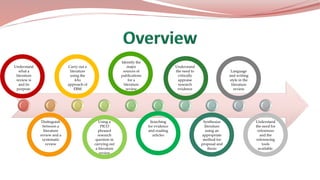
Understand
what a
literature
review is
and its
purpose.
Distinguish
between a
literature
review and a
systematic
review
Carry out a
literature
using the
4As
approach of
EBM
Using a
PICO
phrased
research
question in
carrying out
a literature
review
Identify the
major
sources of
publications
for a
literature
review
Searching
for evidence
and reading
articles
Understand
the need to
critically
appraise
research
evidence
Synthesize
literature
using an
appropriate
method for
proposal and
thesis
Language
and writing
style in the
literature
review
Understand
the need for
references
and the
referencing
tools
available.
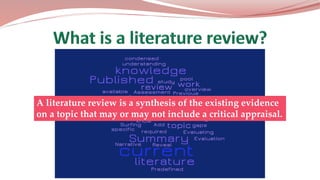
A literature review is a synthesis of the existing evidence
on a topic that may or may not include a critical appraisal.
be organized around and related directly to the thesis or
research question you are developing
synthesize results into a summary of what is and is not
known
identify areas of controversy in the literature
formulate questions that need further research
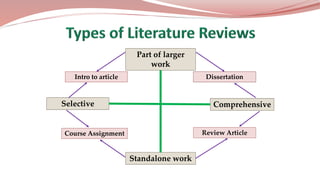
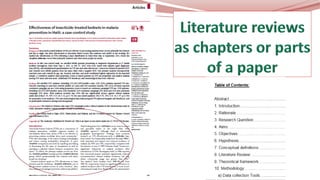
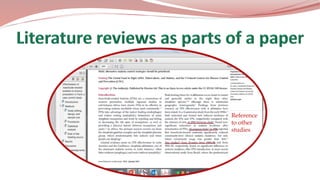
Part of larger
work
Selective Comprehensive
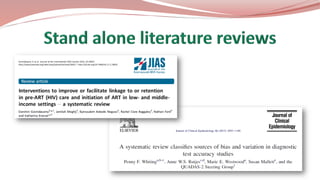
Standalone work
DissertationIntro to article
Course Assignment Review Article
Reference
to other
studies
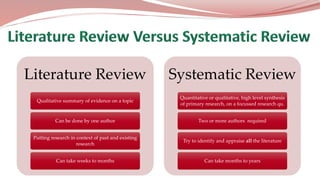
Literature Review
Qualitative summary of evidence on a topic
Can be done by one author
Putting research in context of past and existing
research
Can take weeks to months
Systematic Review
Quantitative or qualitative, high level synthesis
of primary research, on a focussed research qu.
Two or more authors required
Try to identify and appraise all the literature
Can take months to years
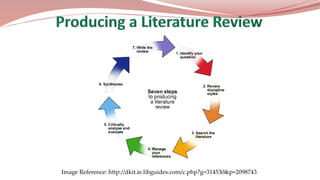
Image Reference: http://dkit.ie.libguides.com/c.php?g=314530&p=2098743
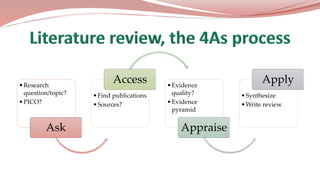
•Research
question/topic?
•PICO?
Ask
•Find publications
•Sources?
Access •Evidence
quality?
•Evidence
pyramid
Appraise
•Synthesize
•Write review
Apply
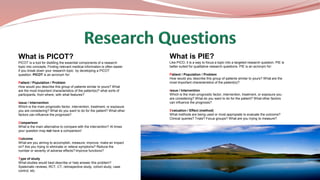
What is PICOT?
PICOT is a tool for distilling the essential components of a research
topic into concepts. Finding relevant medical information is often easier
if you break down your research topic by developing a PICOT
question. PICOT is an acronym for:
Patient / Population / Problem
How would you describe this group of patients similar to yours? What
are the most important characteristics of the patient(s)? what sorts of
participants, from where, with what features?
Issue / Intervention
Which is the main prognostic factor, intervention, treatment, or exposure
you are considering? What do you want to do for the patient? What other
factors can influence the prognosis?
Comparison
What is the main alternative to compare with the intervention? At times
your question may not have a comparison!
Outcome
What are you aiming to accomplish, measure, improve, make an impact
on? Are you trying to eliminate or relieve symptoms? Reduce the
number or severity of adverse effects? Improve functions?
Type of study
What studies would best describe or help answer this problem?
Systematic reviews, RCT, CT, retrospective study, cohort study, case
control, etc.
What is PIE?
Like PICO, it is a way to focus a topic into a targeted research question. PIE is
better suited for qualitative research questions. PIE is an acronym for:
Patient / Population / Problem
How would you describe this group of patients similar to yours? What are the
most important characteristics of the patient(s)?
Issue / Intervention
Which is the main prognostic factor, intervention, treatment, or exposure you
are considering? What do you want to do for the patient? What other factors
can influence the prognosis?
Evaluation / Effect (method)
What methods are being used or most appropiate to evaluate the outcome?
Clinical queries? Trials? Focus groups? What are you trying to measure?
Courtesy of M.Shelton, Health Sciences Library, UCT
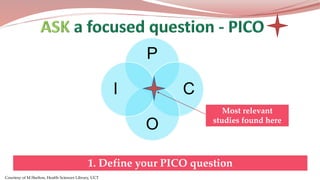
Most relevant
studies found here
1. Define your PICO question
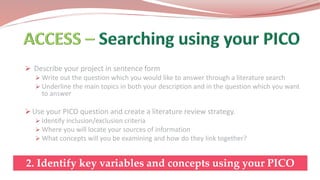
 Describe your project in sentence form
 Write out the question which you would like to answer through a literature search
 Underline the main topics in both your description and in the question which you want
to answer
 Use your PICO question and create a literature review strategy.
 Identify inclusion/exclusion criteria
 Where you will locate your sources of information
 What concepts will you be examining and how do they link together?
2. Identify key variables and concepts using your PICO
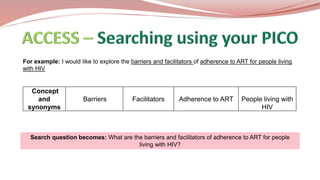
Concept
and
synonyms
Barriers Facilitators Adherence to ART People living with
HIV
For example: I would like to explore the barriers and facilitators of adherence to ART for people living
with HIV
Search question becomes: What are the barriers and facilitators of adherence to ART for people
living with HIV?
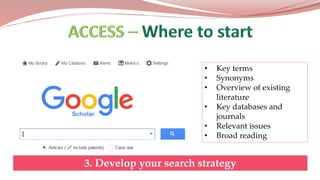
• Key terms
• Synonyms
• Overview of existing
literature
• Key databases and
journals
• Relevant issues
• Broad reading
3. Develop your search strategy
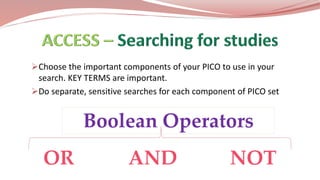
Choose the important components of your PICO to use in your
search. KEY TERMS are important.
Do separate, sensitive searches for each component of PICO set
OR AND NOT
Boolean Operators
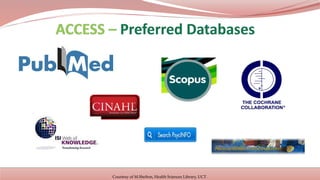
Courtesy of M.Shelton, Health Sciences Library, UCT
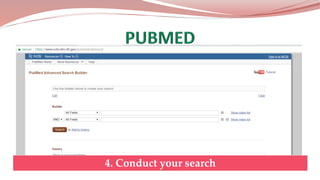
4. Conduct your search
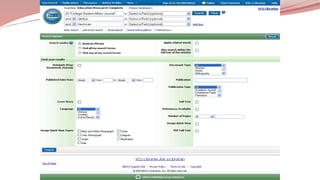
Some databases are subject specific eg. CINAHL for nursing articles while
others are multidisciplinary eg. Academic Search premier.
If you are searching a broad international database eg.one of the EbscoHost,
databases such as Academic Search Premier for South African information,
you will need to include South Africa as a keyword.
If you only want to look at articles that are peer reviewed and that have
the full text article attached you can limit the search to these items by ticking
the boxes.
Source Description URL
CINAHL Contains bibliographic references (books, dissertations, standards
of professional practice, and educational software) to nursing,
allied health, biomedical, emergency services, occupational
therapy, physical therapy, respiratory therapy, surgical technology,
physician's assistant and consumer health journals.
www.ebscohost.com/cinahl/
The Cochrane
Library
A collection of six databases that contain different types of high
quality, independent evidence to inform healthcare decision
making, and a seventh database that provides information about
groups in The Cochrane Collaboration
www.thecochranelibrary.com/
EMBASE A highly versatile, multipurpose and up-to-date database covering
the most important international biomedical literature from 1947
to the present day.
https://www.embase.com/
PubMed Comprises more than 21 million citations for biomedical literature
from MEDLINE, life science journals, and online books. Citations
may include links to full-text content from PubMed Central and
publisher web sites
www.pubmed.com
Trip database A clinical search tool designed to allow health professionals to
rapidly identify the clinical evidence for clinical practice
www.tripdatabase.com
 It is useful to create a conceptual framework for your search and review strategy
 Search Strategy
 Limiters
 Inclusion/Exclusion
 Time and Resources
 Types of Sources
 Review Strategy
 Time and Resources
 Summary Tables
 Electronic Filing Systems
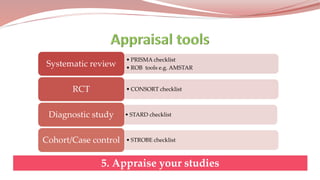
• PRISMA checklist
• ROB tools e.g. AMSTAR
Systematic review
• CONSORT checklistRCT
• STARD checklistDiagnostic study
• STROBE checklistCohort/Case control
5. Appraise your studies
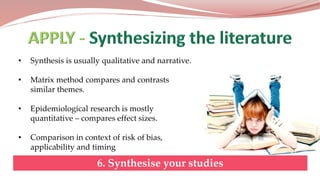
• Synthesis is usually qualitative and narrative.
• Matrix method compares and contrasts
similar themes.
• Epidemiological research is mostly
quantitative – compares effect sizes.
• Comparison in context of risk of bias,
applicability and timing
6. Synthesise your studies
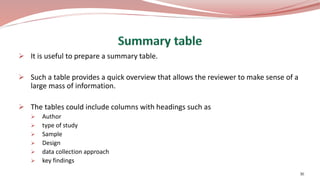
 It is useful to prepare a summary table.
 Such a table provides a quick overview that allows the reviewer to make sense of a
large mass of information.
 The tables could include columns with headings such as
 Author
 type of study
 Sample
 Design
 data collection approach
 key findings
30
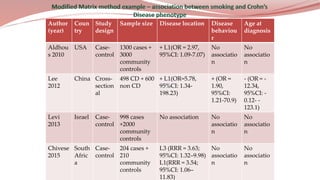
Author
(year)
Coun
try
Study
design
Sample size Disease location Disease
behaviou
r
Age at
diagnosis
Aldhou
s 2010
USA Case-
control
1300 cases +
3000
community
controls
+ L1(OR = 2.97,
95%CI: 1.09-7.07)
No
associatio
n
No
associatio
n
Lee
2012
China Cross-
section
al
498 CD + 600
non CD
+ L1(OR=5.78,
95%CI: 1.34-
198.23)
+ (OR =
1.90,
95%CI:
1.21-70.9)
- (OR = -
12.34,
95%CI: -
0.12- -
123.1)
Levi
2013
Israel Case-
control
998 cases
+2000
community
controls
No association No
associatio
n
No
associatio
n
Chivese
2015
South
Afric
a
Case-
control
204 cases +
210
community
controls
L3 (RRR = 3.63;
95%CI: 1.32–9.98)
L1(RRR = 3.54;
95%CI: 1.06–
11.83)
No
associatio
n
No
associatio
n
32
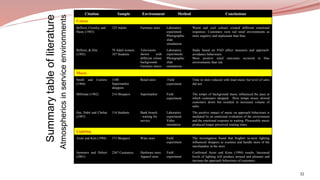
Citation Sample Environment Method Conclusions
Colour
Bellizzi, Crowley and
Hasty (1983)
125 Adults Furniture store Laboratory
experiment
Photographic
slide
simulations
Warm and cool colours created different emotional
responses. Customers view red retail environments as
more negative and unpleasant than blue.
Bellizzi, & Hite
(1992)
70 Adult women
107 Students
Televisions
shown with
different colour
backgrounds
Furniture stores
Laboratory
experiments
Photographic
slide
simulations
Study based on PAD affect measures and approach-
avoidance behaviours.
More positive retail outcomes occurred in blue
environments than red.
Music
Smith and Curnow
(1966)
1100
Supermarket
shoppers
Retail store Field
experiment
Time in store reduced with loud music but level of sales
did not.
Milliman (1982) 216 Shoppers Supermarket Field
experiment
The tempo of background music influenced the pace at
which customers shopped. Slow tempo music slowed
customers down but resulted in increased volume of
sales.
Hui, Dubé and Chebat
(1997)
116 Students Bank branch
- waiting for
service.
Laboratory
experiment
Video
simulation
The positive impact of music on approach behaviours is
mediated by an emotional evaluation of the environment
and the emotional response to waiting. Pleasurable music
produced longer perceived waiting times.
Lighting
Areni and Kim (1994) 171 Shoppers Wine store Field
experiment
The investigation found that brighter in-store lighting
influenced shoppers to examine and handle more of the
merchandise in the store
Summers and Hebert
(2001)
2367 Customers Hardware store
Apparel store
Field
experiment
Confirmed Areni and Kims (1994) results. Increased
levels of lighting will produce arousal and pleasure and
increase the approach behaviours of customers.
Summarytableofliterature
Atmosphericsinserviceenvironments
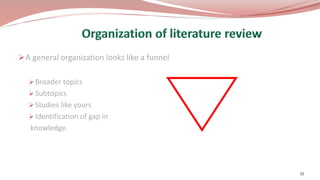
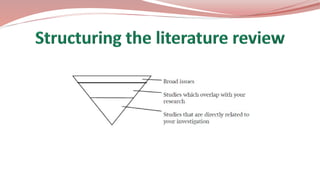
A general organization looks like a funnel
 Broader topics
 Subtopics
 Studies like yours
 Identification of gap in
knowledge.
33
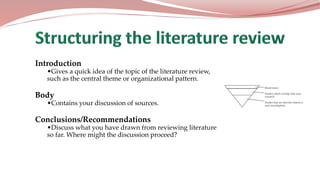
Introduction
•Gives a quick idea of the topic of the literature review,
such as the central theme or organizational pattern.
Body
•Contains your discussion of sources.
Conclusions/Recommendations
•Discuss what you have drawn from reviewing literature
so far. Where might the discussion proceed?
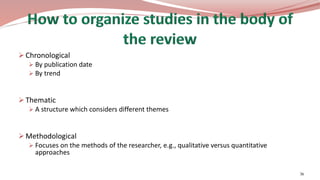
 Chronological
 By publication date
 By trend
 Thematic
 A structure which considers different themes
 Methodological
 Focuses on the methods of the researcher, e.g., qualitative versus quantitative
approaches
36
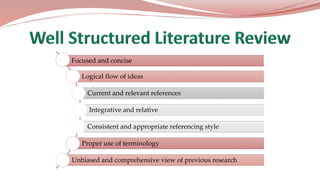
Focused and concise
Logical flow of ideas
Current and relevant references
Integrative and relative
Consistent and appropriate referencing style
Proper use of terminology
Unbiased and comprehensive view of previous research
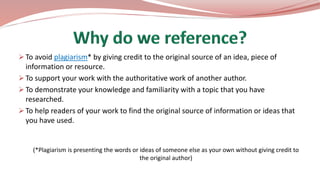
Referencing and reference
managers
Referencing/ citation is a system used in your written work to indicate,
where from evidence, ideas, theories, facts, or any other information, were
found by providing a description of the sources
 To avoid plagiarism* by giving credit to the original source of an idea, piece of
information or resource.
 To support your work with the authoritative work of another author.
 To demonstrate your knowledge and familiarity with a topic that you have
researched.
 To help readers of your work to find the original source of information or ideas that
you have used.
(*Plagiarism is presenting the words or ideas of someone else as your own without giving credit to
the original author)
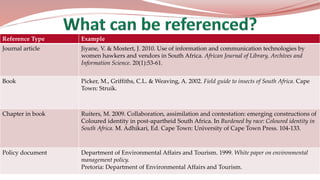
Reference Type Example
Journal article Jiyane, V. & Mostert, J. 2010. Use of information and communication technologies by
women hawkers and vendors in South Africa. African Journal of Library, Archives and
Information Science. 20(1):53-61.
Book Picker, M., Griffiths, C.L. & Weaving, A. 2002. Field guide to insects of South Africa. Cape
Town: Struik.
Chapter in book Ruiters, M. 2009. Collaboration, assimilation and contestation: emerging constructions of
Coloured identity in post-apartheid South Africa. In Burdened by race: Coloured identity in
South Africa. M. Adhikari, Ed. Cape Town: University of Cape Town Press. 104-133.
Policy document Department of Environmental Affairs and Tourism. 1999. White paper on environmental
management policy.
Pretoria: Department of Environmental Affairs and Tourism.
Reference Type Example
Report Von Schirnding, Y & Fuggle, R.F. 1986. Exposure to lead amongst urban school children in
Cape Town.
(Research report 9/86/13). Rondebosch, South Africa: Environmental Evaluation Unit,
University of Cape Town.
Unpublished document
(lecture or paper presented
at a meeting
Jansen, J. 2010. What school reform can learn from the rhythm method in sex [Lecture].
University of Cape Town. 2 February.
Website Organisation for Economic and Co-operation and Development. 2009. Composite leading
indicators (CLIs), OECD, August 2013. Available: http://www.oecd.org/std/leading-
indicators/compositeleadingindicatorsclisoecdaugust2013.htm [2014, December 10].
Blog Sevaan Franks. 2011. Egyptian rock art found [Blog, 6 July]. Available:
http://www.ablogabouthistory.com/2011/07/06/egyptian-rock-art-found/ [2012, March 8].
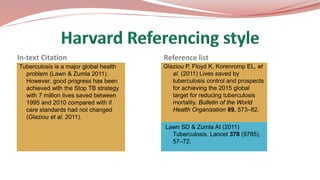
In-text Citation Reference list
Lawn SD & Zumla AI (2011)
Tuberculosis. Lancet 378 (9785),
57–72.
Tuberculosis is a major global health
problem (Lawn & Zumla 2011).
However, good progress has been
achieved with the Stop TB strategy
with 7 million lives saved between
1995 and 2010 compared with if
care standards had not changed
(Glaziou et al. 2011).
Glaziou P, Floyd K, Korenromp EL, et
al. (2011) Lives saved by
tuberculosis control and prospects
for achieving the 2015 global
target for reducing tuberculosis
mortality. Bulletin of the World
Health Organization 89, 573–82.
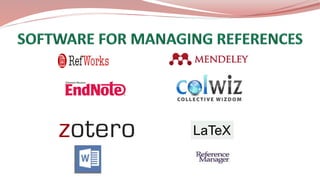
LaTeX
 Storing/consulting references
 Download entire reference from internet eg PubMed
 Assure quality of references
 Sort by author, date, type, keyword(s), journal etc.
 Search library any time and use Booleans (and/or/not..)
 Links to Word, PDF copies of article
 Ability to link to your notes on article
 Writing a research proposal
 Insert references into text from database
 Automatic update of reference numbers
 Automatic change of format of references
 Pautasso M (2013) Ten Simple Rules for Writing a Literature Review. PLOS
Computational Biology 9(7): e1003149.
https://doi.org/10.1371/journal.pcbi.1003149
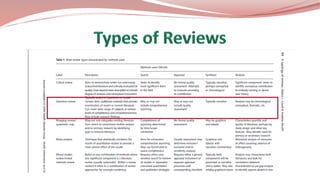
 Grant M and Booth A (2009). A typology of reviews: an analysis of 14 review types
and associated methodologies. Health Information and Libraries Journal 26: 91-108.
DOI: 10.1111/j.1471-1842.2009.00848
https://www.ncbi.nlm.nih.gov/pubmed/19490148
 Research Hero – Online Research Methods PoE:
http://researchambition.wixsite.com/research-hero/lit-review
Referencing styles
http://libguides.sun.ac.za/content.php?pid=344501&sid=5790967
Harvard style of referencing
https://www.youtube.com/watch?v=0AcoQ0bfdbk
How to use Mendeley
https://www.youtube.com/watch?v=xLtk6n8cFdk
How to use Zotero
https://www.youtube.com/watch?v=mP5AzJHXfIA
This project has been supported by SUCCEED funded through the President’s Emergency Plan for AIDS relief
(PEPFAR) through Centres for Disease Control (CDC) under the terms of GH15-1574
Formulating a literature review

Formulating a literature review

  • 1.
    Session 2 of10: Protocol Development for Operational Research
  • 2.
     Should yourequire assistance during this webinar, please contact Leandra@sun.ac.za Training Facilitator: Operational Research Centre for Evidence-based Health Care, Stellenbosch University “In my academic life I am passionate about research and finding innovative ways to do qualitative research, in my every day life I love travelling and cute animal videos” Ms Lynn Hendricks Ms Mweete Ngalzi Researcher, Centre for Evidence-based Health Care, Stellenbosch University “I enjoy learning new things and doing quantitative data analysis. In my spare time I enjoy spending time with family. I can do all things through Christ who strengthens me” (Philippians 4:13)
  • 3.
    Understand what a literature review is andits purpose. Distinguish between a literature review and a systematic review Carry out a literature using the 4As approach of EBM Using a PICO phrased research question in carrying out a literature review Identify the major sources of publications for a literature review Searching for evidence and reading articles Understand the need to critically appraise research evidence Synthesize literature using an appropriate method for proposal and thesis Language and writing style in the literature review Understand the need for references and the referencing tools available.
  • 4.
    A literature reviewis a synthesis of the existing evidence on a topic that may or may not include a critical appraisal.
  • 7.
    be organized aroundand related directly to the thesis or research question you are developing synthesize results into a summary of what is and is not known identify areas of controversy in the literature formulate questions that need further research
  • 9.
    Part of larger work SelectiveComprehensive Standalone work DissertationIntro to article Course Assignment Review Article
  • 12.
  • 13.
    Literature Review Qualitative summaryof evidence on a topic Can be done by one author Putting research in context of past and existing research Can take weeks to months Systematic Review Quantitative or qualitative, high level synthesis of primary research, on a focussed research qu. Two or more authors required Try to identify and appraise all the literature Can take months to years
  • 14.
  • 15.
  • 16.
    What is PICOT? PICOTis a tool for distilling the essential components of a research topic into concepts. Finding relevant medical information is often easier if you break down your research topic by developing a PICOT question. PICOT is an acronym for: Patient / Population / Problem How would you describe this group of patients similar to yours? What are the most important characteristics of the patient(s)? what sorts of participants, from where, with what features? Issue / Intervention Which is the main prognostic factor, intervention, treatment, or exposure you are considering? What do you want to do for the patient? What other factors can influence the prognosis? Comparison What is the main alternative to compare with the intervention? At times your question may not have a comparison! Outcome What are you aiming to accomplish, measure, improve, make an impact on? Are you trying to eliminate or relieve symptoms? Reduce the number or severity of adverse effects? Improve functions? Type of study What studies would best describe or help answer this problem? Systematic reviews, RCT, CT, retrospective study, cohort study, case control, etc. What is PIE? Like PICO, it is a way to focus a topic into a targeted research question. PIE is better suited for qualitative research questions. PIE is an acronym for: Patient / Population / Problem How would you describe this group of patients similar to yours? What are the most important characteristics of the patient(s)? Issue / Intervention Which is the main prognostic factor, intervention, treatment, or exposure you are considering? What do you want to do for the patient? What other factors can influence the prognosis? Evaluation / Effect (method) What methods are being used or most appropiate to evaluate the outcome? Clinical queries? Trials? Focus groups? What are you trying to measure?
  • 17.
    Courtesy of M.Shelton,Health Sciences Library, UCT Most relevant studies found here 1. Define your PICO question
  • 18.
     Describe yourproject in sentence form  Write out the question which you would like to answer through a literature search  Underline the main topics in both your description and in the question which you want to answer  Use your PICO question and create a literature review strategy.  Identify inclusion/exclusion criteria  Where you will locate your sources of information  What concepts will you be examining and how do they link together? 2. Identify key variables and concepts using your PICO
  • 19.
    Concept and synonyms Barriers Facilitators Adherenceto ART People living with HIV For example: I would like to explore the barriers and facilitators of adherence to ART for people living with HIV Search question becomes: What are the barriers and facilitators of adherence to ART for people living with HIV?
  • 20.
    • Key terms •Synonyms • Overview of existing literature • Key databases and journals • Relevant issues • Broad reading 3. Develop your search strategy
  • 21.
    Choose the importantcomponents of your PICO to use in your search. KEY TERMS are important. Do separate, sensitive searches for each component of PICO set OR AND NOT Boolean Operators
  • 22.
    Courtesy of M.Shelton,Health Sciences Library, UCT
  • 23.
  • 25.
    Some databases aresubject specific eg. CINAHL for nursing articles while others are multidisciplinary eg. Academic Search premier. If you are searching a broad international database eg.one of the EbscoHost, databases such as Academic Search Premier for South African information, you will need to include South Africa as a keyword. If you only want to look at articles that are peer reviewed and that have the full text article attached you can limit the search to these items by ticking the boxes.
  • 26.
    Source Description URL CINAHLContains bibliographic references (books, dissertations, standards of professional practice, and educational software) to nursing, allied health, biomedical, emergency services, occupational therapy, physical therapy, respiratory therapy, surgical technology, physician's assistant and consumer health journals. www.ebscohost.com/cinahl/ The Cochrane Library A collection of six databases that contain different types of high quality, independent evidence to inform healthcare decision making, and a seventh database that provides information about groups in The Cochrane Collaboration www.thecochranelibrary.com/ EMBASE A highly versatile, multipurpose and up-to-date database covering the most important international biomedical literature from 1947 to the present day. https://www.embase.com/ PubMed Comprises more than 21 million citations for biomedical literature from MEDLINE, life science journals, and online books. Citations may include links to full-text content from PubMed Central and publisher web sites www.pubmed.com Trip database A clinical search tool designed to allow health professionals to rapidly identify the clinical evidence for clinical practice www.tripdatabase.com
  • 27.
     It isuseful to create a conceptual framework for your search and review strategy  Search Strategy  Limiters  Inclusion/Exclusion  Time and Resources  Types of Sources  Review Strategy  Time and Resources  Summary Tables  Electronic Filing Systems
  • 28.
    • PRISMA checklist •ROB tools e.g. AMSTAR Systematic review • CONSORT checklistRCT • STARD checklistDiagnostic study • STROBE checklistCohort/Case control 5. Appraise your studies
  • 29.
    • Synthesis isusually qualitative and narrative. • Matrix method compares and contrasts similar themes. • Epidemiological research is mostly quantitative – compares effect sizes. • Comparison in context of risk of bias, applicability and timing 6. Synthesise your studies
  • 30.
     It isuseful to prepare a summary table.  Such a table provides a quick overview that allows the reviewer to make sense of a large mass of information.  The tables could include columns with headings such as  Author  type of study  Sample  Design  data collection approach  key findings 30
  • 31.
    Author (year) Coun try Study design Sample size Diseaselocation Disease behaviou r Age at diagnosis Aldhou s 2010 USA Case- control 1300 cases + 3000 community controls + L1(OR = 2.97, 95%CI: 1.09-7.07) No associatio n No associatio n Lee 2012 China Cross- section al 498 CD + 600 non CD + L1(OR=5.78, 95%CI: 1.34- 198.23) + (OR = 1.90, 95%CI: 1.21-70.9) - (OR = - 12.34, 95%CI: - 0.12- - 123.1) Levi 2013 Israel Case- control 998 cases +2000 community controls No association No associatio n No associatio n Chivese 2015 South Afric a Case- control 204 cases + 210 community controls L3 (RRR = 3.63; 95%CI: 1.32–9.98) L1(RRR = 3.54; 95%CI: 1.06– 11.83) No associatio n No associatio n
  • 32.
    32 Citation Sample EnvironmentMethod Conclusions Colour Bellizzi, Crowley and Hasty (1983) 125 Adults Furniture store Laboratory experiment Photographic slide simulations Warm and cool colours created different emotional responses. Customers view red retail environments as more negative and unpleasant than blue. Bellizzi, & Hite (1992) 70 Adult women 107 Students Televisions shown with different colour backgrounds Furniture stores Laboratory experiments Photographic slide simulations Study based on PAD affect measures and approach- avoidance behaviours. More positive retail outcomes occurred in blue environments than red. Music Smith and Curnow (1966) 1100 Supermarket shoppers Retail store Field experiment Time in store reduced with loud music but level of sales did not. Milliman (1982) 216 Shoppers Supermarket Field experiment The tempo of background music influenced the pace at which customers shopped. Slow tempo music slowed customers down but resulted in increased volume of sales. Hui, Dubé and Chebat (1997) 116 Students Bank branch - waiting for service. Laboratory experiment Video simulation The positive impact of music on approach behaviours is mediated by an emotional evaluation of the environment and the emotional response to waiting. Pleasurable music produced longer perceived waiting times. Lighting Areni and Kim (1994) 171 Shoppers Wine store Field experiment The investigation found that brighter in-store lighting influenced shoppers to examine and handle more of the merchandise in the store Summers and Hebert (2001) 2367 Customers Hardware store Apparel store Field experiment Confirmed Areni and Kims (1994) results. Increased levels of lighting will produce arousal and pleasure and increase the approach behaviours of customers. Summarytableofliterature Atmosphericsinserviceenvironments
  • 33.
    A general organizationlooks like a funnel  Broader topics  Subtopics  Studies like yours  Identification of gap in knowledge. 33
  • 35.
    Introduction •Gives a quickidea of the topic of the literature review, such as the central theme or organizational pattern. Body •Contains your discussion of sources. Conclusions/Recommendations •Discuss what you have drawn from reviewing literature so far. Where might the discussion proceed?
  • 36.
     Chronological  Bypublication date  By trend  Thematic  A structure which considers different themes  Methodological  Focuses on the methods of the researcher, e.g., qualitative versus quantitative approaches 36
  • 37.
    Focused and concise Logicalflow of ideas Current and relevant references Integrative and relative Consistent and appropriate referencing style Proper use of terminology Unbiased and comprehensive view of previous research
  • 38.
  • 39.
    Referencing/ citation isa system used in your written work to indicate, where from evidence, ideas, theories, facts, or any other information, were found by providing a description of the sources
  • 40.
     To avoidplagiarism* by giving credit to the original source of an idea, piece of information or resource.  To support your work with the authoritative work of another author.  To demonstrate your knowledge and familiarity with a topic that you have researched.  To help readers of your work to find the original source of information or ideas that you have used. (*Plagiarism is presenting the words or ideas of someone else as your own without giving credit to the original author)
  • 41.
    Reference Type Example Journalarticle Jiyane, V. & Mostert, J. 2010. Use of information and communication technologies by women hawkers and vendors in South Africa. African Journal of Library, Archives and Information Science. 20(1):53-61. Book Picker, M., Griffiths, C.L. & Weaving, A. 2002. Field guide to insects of South Africa. Cape Town: Struik. Chapter in book Ruiters, M. 2009. Collaboration, assimilation and contestation: emerging constructions of Coloured identity in post-apartheid South Africa. In Burdened by race: Coloured identity in South Africa. M. Adhikari, Ed. Cape Town: University of Cape Town Press. 104-133. Policy document Department of Environmental Affairs and Tourism. 1999. White paper on environmental management policy. Pretoria: Department of Environmental Affairs and Tourism.
  • 42.
    Reference Type Example ReportVon Schirnding, Y & Fuggle, R.F. 1986. Exposure to lead amongst urban school children in Cape Town. (Research report 9/86/13). Rondebosch, South Africa: Environmental Evaluation Unit, University of Cape Town. Unpublished document (lecture or paper presented at a meeting Jansen, J. 2010. What school reform can learn from the rhythm method in sex [Lecture]. University of Cape Town. 2 February. Website Organisation for Economic and Co-operation and Development. 2009. Composite leading indicators (CLIs), OECD, August 2013. Available: http://www.oecd.org/std/leading- indicators/compositeleadingindicatorsclisoecdaugust2013.htm [2014, December 10]. Blog Sevaan Franks. 2011. Egyptian rock art found [Blog, 6 July]. Available: http://www.ablogabouthistory.com/2011/07/06/egyptian-rock-art-found/ [2012, March 8].
  • 43.
    In-text Citation Referencelist Lawn SD & Zumla AI (2011) Tuberculosis. Lancet 378 (9785), 57–72. Tuberculosis is a major global health problem (Lawn & Zumla 2011). However, good progress has been achieved with the Stop TB strategy with 7 million lives saved between 1995 and 2010 compared with if care standards had not changed (Glaziou et al. 2011). Glaziou P, Floyd K, Korenromp EL, et al. (2011) Lives saved by tuberculosis control and prospects for achieving the 2015 global target for reducing tuberculosis mortality. Bulletin of the World Health Organization 89, 573–82.
  • 44.
  • 45.
     Storing/consulting references Download entire reference from internet eg PubMed  Assure quality of references  Sort by author, date, type, keyword(s), journal etc.  Search library any time and use Booleans (and/or/not..)  Links to Word, PDF copies of article  Ability to link to your notes on article  Writing a research proposal  Insert references into text from database  Automatic update of reference numbers  Automatic change of format of references
  • 46.
     Pautasso M(2013) Ten Simple Rules for Writing a Literature Review. PLOS Computational Biology 9(7): e1003149. https://doi.org/10.1371/journal.pcbi.1003149  Grant M and Booth A (2009). A typology of reviews: an analysis of 14 review types and associated methodologies. Health Information and Libraries Journal 26: 91-108. DOI: 10.1111/j.1471-1842.2009.00848 https://www.ncbi.nlm.nih.gov/pubmed/19490148  Research Hero – Online Research Methods PoE: http://researchambition.wixsite.com/research-hero/lit-review
  • 47.
    Referencing styles http://libguides.sun.ac.za/content.php?pid=344501&sid=5790967 Harvard styleof referencing https://www.youtube.com/watch?v=0AcoQ0bfdbk How to use Mendeley https://www.youtube.com/watch?v=xLtk6n8cFdk How to use Zotero https://www.youtube.com/watch?v=mP5AzJHXfIA
  • 48.
    This project hasbeen supported by SUCCEED funded through the President’s Emergency Plan for AIDS relief (PEPFAR) through Centres for Disease Control (CDC) under the terms of GH15-1574