Where to Publish
UCT Bibliometrics Working Group
15 June 2017
Where to Publish
• What are the factors you would look at when
considering publishing a paper?
– Discipline
– Scope
– Author guidelines
– Supervisor
– Journal metrics
2
Journal Metrics
Journal metrics are quantitative methods used to
determine citation patterns of a journal to provide
insight into the journal’s performance within a
particular subject field.
What are journal metrics?
(University of Iowa Libraries, 2017)
Journal metrics can be used to:
• track citation patterns within journals
• complement accreditation/evaluation applications,
e.g. NRF
• select highly-cited journals for manuscript
submission
• assist in determining an author's impact
What are journal metrics used for?
(University of Iowa Libraries, 2017)
• 1955 – Eugene Garfield developed various metrics
including ways to determine the impact of a
particular journal in a given field of research
• 1976 - Garfield published the first Journal Citation
Reports
• Journal Impact Factor (InCites) was the first metric
created for academic journals
• More database vendors gathered statistics & other
metrics were created, e.g. SJR and SNIP (Scopus)
How were journal metrics developed?
(Johns Hopkins University. Sheridan Libraries [JHU], 2017)
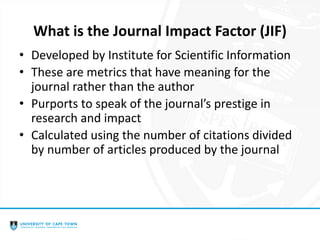
What is the Journal Impact Factor (JIF)
• Developed by Institute for Scientific Information
• These are metrics that have meaning for the
journal rather than the author
• Purports to speak of the journal’s prestige in
research and impact
• Calculated using the number of citations divided
by number of articles produced by the journal
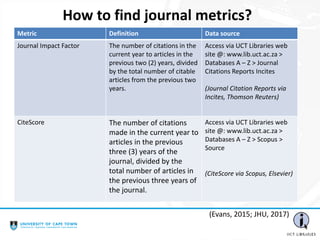
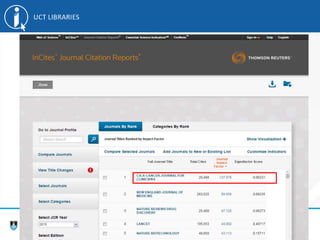
How to find journal metrics?
Metric Definition Data source
Journal Impact Factor The number of citations in the
current year to articles in the
previous two (2) years, divided
by the total number of citable
articles from the previous two
years.
Access via UCT Libraries web
site @: www.lib.uct.ac.za >
Databases A – Z > Journal
Citations Reports Incites
(Journal Citation Reports via
Incites, Thomson Reuters)
CiteScore The number of citations
made in the current year to
articles in the previous
three (3) years of the
journal, divided by the
total number of articles in
the previous three years of
the journal.
Access via UCT Libraries web
site @: www.lib.uct.ac.za >
Databases A – Z > Scopus >
Source
(CiteScore via Scopus, Elsevier)
(Evans, 2015; JHU, 2017)
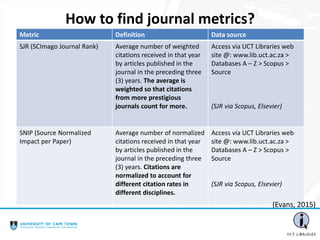
How to find journal metrics?
Metric Definition Data source
SJR (SCImago Journal Rank) Average number of weighted
citations received in that year
by articles published in the
journal in the preceding three
(3) years. The average is
weighted so that citations
from more prestigious
journals count for more.
Access via UCT Libraries web
site @: www.lib.uct.ac.za >
Databases A – Z > Scopus >
Source
(SJR via Scopus, Elsevier)
SNIP (Source Normalized
Impact per Paper)
Average number of normalized
citations received in that year
by articles published in the
journal in the preceding three
(3) years. Citations are
normalized to account for
different citation rates in
different disciplines.
Access via UCT Libraries web
site @: www.lib.uct.ac.za >
Databases A – Z > Scopus >
Source
(SJR via Scopus, Elsevier)
(Evans, 2015)
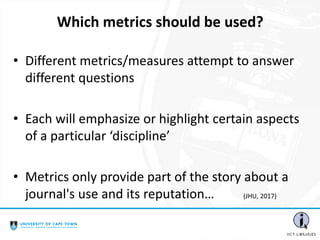
• Different metrics/measures attempt to answer
different questions
• Each will emphasize or highlight certain aspects
of a particular ‘discipline’
• Metrics only provide part of the story about a
journal's use and its reputation… (JHU, 2017)
Which metrics should be used?
InCites - Journal Impact
Factor
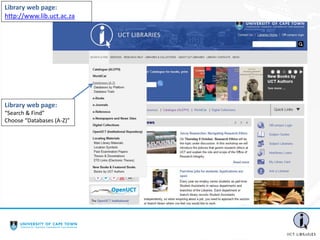
Library web page:
“Search & Find”
Choose “Databases (A-Z)”
Library web page:
http://www.lib.uct.ac.za
Scopus - CiteScore, SJR &
SNIP
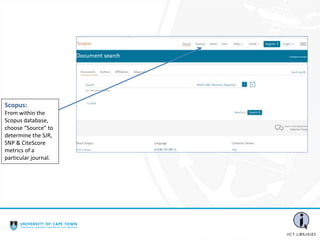
Scopus:
From within the
Scopus database,
choose “Source” to
determine the SJR,
SNP & CiteScore
metrics of a
particular journal.
Scopus:
Hover over a
particular metric to
learn more about
its scope &
purpose.
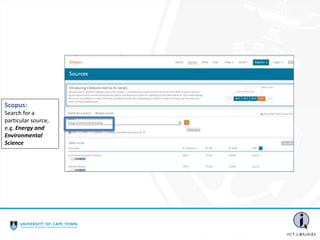
Scopus:
Search for a
particular source,
e.g. Energy and
Environmental
Science
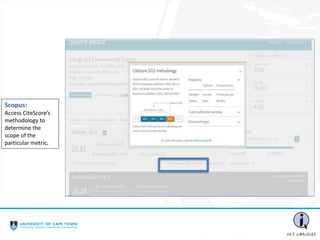
Scopus:
Access CiteScore’s
methodology to
determine the
scope of the
particular metric.
DHET Accredited Journals
Why DHET accredited journals?
• The DHET allocates government subsidy to
universities each year
• A research article published in an approved
journal will be subsidized as a single unit if all
the authors are affiliated to the institution
(University of Cape Town, 2017)
Which journals are DHET accredited?
DHET-accredited journals:
• Web of Science's three sub-indices
o Arts and Humanities Citation Index
o Science Citation Index Expanded
o Social Sciences Citation Index
o List of approved South African journals as maintained by DHET
(pdf)
• International Bibliography of the Social Sciences (IBSS) (click on full
title list)
• Scopus
• SciELO SA, and
• Norwegian list
Where can one access the DHET list?
• UCT Research Support Hub @ Publication
Count
• Accredited journal list @ UCT Libraries Quick
links
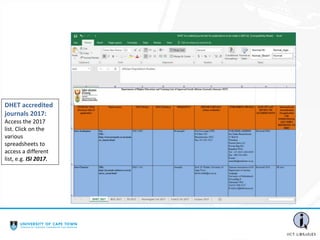
DHET accredited
journals 2017:
Access the 2017
list. Click on the
various
spreadsheets to
access a different
list, e.g. ISI 2017.
NRF Statement on Predatory Journals
& Deceptive Publishers
• The National Research Foundation (NRF) of South Africa’s peer review and adjudication system has
identified a number of instances where applications for research grants, scholarships and NRF rating
include publications in predatory journals or cite invitations by deceptive publishers to serve on editorial
boards of journals.
• This practice is neither supported nor encouraged by the NRF as it challenges the integrity of the NRF’s
scientific peer review process. The use of predatory journals and deceptive publishers compromises the
creation and dissemination of rigorous scientific and scholarly work within the Digital and Open Access
movement.
• In order to protect the integrity of the NRF’s processes and reputation from these unethical and
unscholarly practices, the NRF reserves the right to not consider applications where this practice is
evident.
• The NRF encourages its stakeholder community, including the NRF’s Business Units and its National
Research Facilities (NFs), to:
o Ensure that its researchers and students adhere to the principles of research integrity and are aware
of predatory journals and deceptive publishers; and
o Avoid publishing in journals that do not have a rigorous peer review system or scholarly publishing
practices. (National Research Foundation, 2017)
Who to contact for information on ‘predatory
journals’?
OpenUCT (openuct@uct.ac.za)
Contact person Mrs. Jill Claassen
Email: jill.claassen@uct.ac.za
References:
Evans. K. 2015. Journal rankings and journal metrics. Available:
http://www.bath.ac.uk/library/services/researchanalytics/journalrankings.pdf [2017,
April 19].
Johns Hopkins University. Sheridan Libraries. 2017. Scholarly metrics. Available:
http://guides.library.jhu.edu/c.php?g=202558&p=1334626 [2017, April 19].
National Research Foundation. 2017. NRF statement on predatory journals & deceptive
publishers Available: http://www.nrf.ac.za/media-room/news/nrf-statement-predatory-
journals-deceptive-publishers [2017, April 19].
University of Cape Town. 2017. Publication count.
Available: http://www.researchsupport.uct.ac.za/publications-29 [2017, April 19].
University of Iowa Libraries. 2017. Scholarly impact: journal metrics.
Available: http://guides.lib.uiowa.edu/scholarlyimpact/journalmetrics [2017, April 19].
Thank you!

Where to publish

  • 1.
    Where to Publish UCTBibliometrics Working Group 15 June 2017
  • 2.
    Where to Publish •What are the factors you would look at when considering publishing a paper? – Discipline – Scope – Author guidelines – Supervisor – Journal metrics 2
  • 3.
  • 4.
    Journal metrics arequantitative methods used to determine citation patterns of a journal to provide insight into the journal’s performance within a particular subject field. What are journal metrics? (University of Iowa Libraries, 2017)
  • 5.
    Journal metrics canbe used to: • track citation patterns within journals • complement accreditation/evaluation applications, e.g. NRF • select highly-cited journals for manuscript submission • assist in determining an author's impact What are journal metrics used for? (University of Iowa Libraries, 2017)
  • 6.
    • 1955 –Eugene Garfield developed various metrics including ways to determine the impact of a particular journal in a given field of research • 1976 - Garfield published the first Journal Citation Reports • Journal Impact Factor (InCites) was the first metric created for academic journals • More database vendors gathered statistics & other metrics were created, e.g. SJR and SNIP (Scopus) How were journal metrics developed? (Johns Hopkins University. Sheridan Libraries [JHU], 2017)
  • 7.
    What is theJournal Impact Factor (JIF) • Developed by Institute for Scientific Information • These are metrics that have meaning for the journal rather than the author • Purports to speak of the journal’s prestige in research and impact • Calculated using the number of citations divided by number of articles produced by the journal
  • 8.
    How to findjournal metrics? Metric Definition Data source Journal Impact Factor The number of citations in the current year to articles in the previous two (2) years, divided by the total number of citable articles from the previous two years. Access via UCT Libraries web site @: www.lib.uct.ac.za > Databases A – Z > Journal Citations Reports Incites (Journal Citation Reports via Incites, Thomson Reuters) CiteScore The number of citations made in the current year to articles in the previous three (3) years of the journal, divided by the total number of articles in the previous three years of the journal. Access via UCT Libraries web site @: www.lib.uct.ac.za > Databases A – Z > Scopus > Source (CiteScore via Scopus, Elsevier) (Evans, 2015; JHU, 2017)
  • 9.
    How to findjournal metrics? Metric Definition Data source SJR (SCImago Journal Rank) Average number of weighted citations received in that year by articles published in the journal in the preceding three (3) years. The average is weighted so that citations from more prestigious journals count for more. Access via UCT Libraries web site @: www.lib.uct.ac.za > Databases A – Z > Scopus > Source (SJR via Scopus, Elsevier) SNIP (Source Normalized Impact per Paper) Average number of normalized citations received in that year by articles published in the journal in the preceding three (3) years. Citations are normalized to account for different citation rates in different disciplines. Access via UCT Libraries web site @: www.lib.uct.ac.za > Databases A – Z > Scopus > Source (SJR via Scopus, Elsevier) (Evans, 2015)
  • 10.
    • Different metrics/measuresattempt to answer different questions • Each will emphasize or highlight certain aspects of a particular ‘discipline’ • Metrics only provide part of the story about a journal's use and its reputation… (JHU, 2017) Which metrics should be used?
  • 11.
    InCites - JournalImpact Factor
  • 12.
    Library web page: “Search& Find” Choose “Databases (A-Z)” Library web page: http://www.lib.uct.ac.za
  • 14.
  • 15.
    Scopus: From within the Scopusdatabase, choose “Source” to determine the SJR, SNP & CiteScore metrics of a particular journal.
  • 16.
    Scopus: Hover over a particularmetric to learn more about its scope & purpose.
  • 17.
    Scopus: Search for a particularsource, e.g. Energy and Environmental Science
  • 18.
    Scopus: Access CiteScore’s methodology to determinethe scope of the particular metric.
  • 19.
  • 20.
    Why DHET accreditedjournals? • The DHET allocates government subsidy to universities each year • A research article published in an approved journal will be subsidized as a single unit if all the authors are affiliated to the institution (University of Cape Town, 2017)
  • 21.
    Which journals areDHET accredited? DHET-accredited journals: • Web of Science's three sub-indices o Arts and Humanities Citation Index o Science Citation Index Expanded o Social Sciences Citation Index o List of approved South African journals as maintained by DHET (pdf) • International Bibliography of the Social Sciences (IBSS) (click on full title list) • Scopus • SciELO SA, and • Norwegian list
  • 22.
    Where can oneaccess the DHET list? • UCT Research Support Hub @ Publication Count • Accredited journal list @ UCT Libraries Quick links
  • 23.
    DHET accredited journals 2017: Accessthe 2017 list. Click on the various spreadsheets to access a different list, e.g. ISI 2017.
  • 24.
    NRF Statement onPredatory Journals & Deceptive Publishers • The National Research Foundation (NRF) of South Africa’s peer review and adjudication system has identified a number of instances where applications for research grants, scholarships and NRF rating include publications in predatory journals or cite invitations by deceptive publishers to serve on editorial boards of journals. • This practice is neither supported nor encouraged by the NRF as it challenges the integrity of the NRF’s scientific peer review process. The use of predatory journals and deceptive publishers compromises the creation and dissemination of rigorous scientific and scholarly work within the Digital and Open Access movement. • In order to protect the integrity of the NRF’s processes and reputation from these unethical and unscholarly practices, the NRF reserves the right to not consider applications where this practice is evident. • The NRF encourages its stakeholder community, including the NRF’s Business Units and its National Research Facilities (NFs), to: o Ensure that its researchers and students adhere to the principles of research integrity and are aware of predatory journals and deceptive publishers; and o Avoid publishing in journals that do not have a rigorous peer review system or scholarly publishing practices. (National Research Foundation, 2017)
  • 25.
    Who to contactfor information on ‘predatory journals’? OpenUCT (openuct@uct.ac.za) Contact person Mrs. Jill Claassen Email: jill.claassen@uct.ac.za
  • 26.
    References: Evans. K. 2015.Journal rankings and journal metrics. Available: http://www.bath.ac.uk/library/services/researchanalytics/journalrankings.pdf [2017, April 19]. Johns Hopkins University. Sheridan Libraries. 2017. Scholarly metrics. Available: http://guides.library.jhu.edu/c.php?g=202558&p=1334626 [2017, April 19]. National Research Foundation. 2017. NRF statement on predatory journals & deceptive publishers Available: http://www.nrf.ac.za/media-room/news/nrf-statement-predatory- journals-deceptive-publishers [2017, April 19]. University of Cape Town. 2017. Publication count. Available: http://www.researchsupport.uct.ac.za/publications-29 [2017, April 19]. University of Iowa Libraries. 2017. Scholarly impact: journal metrics. Available: http://guides.lib.uiowa.edu/scholarlyimpact/journalmetrics [2017, April 19].
  • 27.