Coherence and Cohesion
Monique Henry
UCTWriting Centre
2017
Your thesis needs to tell a story
The Generic story
A typical Science story
A typical Humanities story
• Certain departments and disciplines have their own writing
criteria which they adhere to. So before you start in the writing
process familiarise yourself with how your peers are writing in
your field of study.
What is your story?
Once upon a time ……….
Then I thought ………………..
So I conducted some research
…………
I found out that ………….
Now we know that ………
How to tell your story so that
your reader will follow you
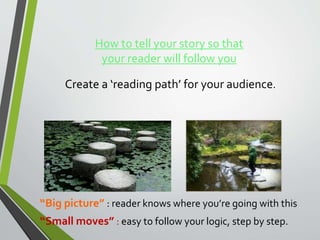
Create a ‘reading path’ for your audience.
“Big picture” : reader knows where you’re going with this
“Small moves” : easy to follow your logic, step by step.
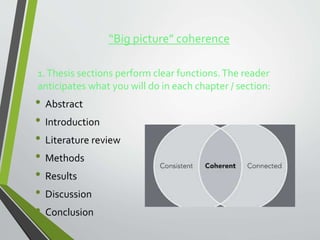
“Big picture” coherence
1.Thesis sections perform clear functions.The reader
anticipates what you will do in each chapter / section:
• Abstract
• Introduction
• Literature review
• Methods
• Results
• Discussion
• Conclusion
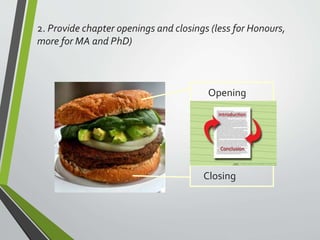
2. Provide chapter openings and closings (less for Honours,
more for MA and PhD)
Opening
Closing
3. Use headings and subheadings
These help the reader to stay on track.
Headings & subheadings should correspond with what you
said you would do in the chapter (i.e. your opening / chapter
intro).
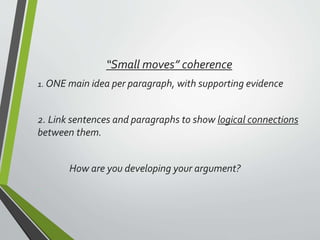
“Small moves” coherence
1. ONE main idea per paragraph, with supporting evidence
2. Link sentences and paragraphs to show logical connections
between them.
How are you developing your argument?
.
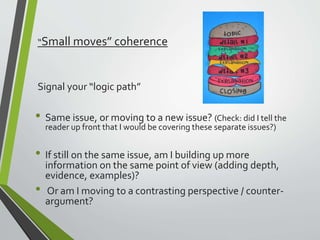
“Small moves” coherence
Signal your “logic path”
• Same issue, or moving to a new issue? (Check: did I tell the
reader up front that I would be covering these separate issues?)
• If still on the same issue, am I building up more
information on the same point of view (adding depth,
evidence, examples)?
• Or am I moving to a contrasting perspective / counter-
argument?
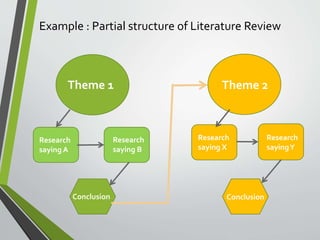
Theme 1
Research
saying A
Research
saying B
Conclusion
Theme 2
Research
saying X
Research
sayingY
Conclusion
Example : Partial structure of Literature Review
When the reader unravels your
argument…are you able to neatly piece it
back together again?
STATEYOUR RESEARCHTOPIC IN
ONE SENTENCE

Coherence

  • 1.
    Coherence and Cohesion MoniqueHenry UCTWriting Centre 2017
  • 2.
    Your thesis needsto tell a story The Generic story A typical Science story A typical Humanities story • Certain departments and disciplines have their own writing criteria which they adhere to. So before you start in the writing process familiarise yourself with how your peers are writing in your field of study.
  • 3.
    What is yourstory? Once upon a time ………. Then I thought ……………….. So I conducted some research ………… I found out that …………. Now we know that ………
  • 4.
    How to tellyour story so that your reader will follow you Create a ‘reading path’ for your audience. “Big picture” : reader knows where you’re going with this “Small moves” : easy to follow your logic, step by step.
  • 5.
    “Big picture” coherence 1.Thesissections perform clear functions.The reader anticipates what you will do in each chapter / section: • Abstract • Introduction • Literature review • Methods • Results • Discussion • Conclusion
  • 6.
    2. Provide chapteropenings and closings (less for Honours, more for MA and PhD) Opening Closing
  • 7.
    3. Use headingsand subheadings These help the reader to stay on track. Headings & subheadings should correspond with what you said you would do in the chapter (i.e. your opening / chapter intro).
  • 8.
    “Small moves” coherence 1.ONE main idea per paragraph, with supporting evidence 2. Link sentences and paragraphs to show logical connections between them. How are you developing your argument? .
  • 9.
    “Small moves” coherence Signalyour “logic path” • Same issue, or moving to a new issue? (Check: did I tell the reader up front that I would be covering these separate issues?) • If still on the same issue, am I building up more information on the same point of view (adding depth, evidence, examples)? • Or am I moving to a contrasting perspective / counter- argument?
  • 10.
    Theme 1 Research saying A Research sayingB Conclusion Theme 2 Research saying X Research sayingY Conclusion Example : Partial structure of Literature Review
  • 11.
    When the readerunravels your argument…are you able to neatly piece it back together again?
  • 12.

Editor's Notes

  • #3 The generic story Once upon a time we believed x. Then I thought, maybe this is not correct / not the whole truth? So I conducted some research. I found out that…... So now we know that …………. A typical Science story Once upon a time scientists believed that z was caused by x. Then I thought, maybe x does not cause z directly? So I conducted some research on what causes z. I found out that actually x causes y, and y causes z. So now we know that x does not directly cause z – it is actually y that causes z. A typical Humanities story Once upon a time we told ourselves a story about how event X happened. Then I thought….Y is also part of this story. We need to know more about the role that Y played. So I conducted some research about event X, looking at the involvement of Y. I found out that the old story underestimated the role played by Y. My evidence shows that Y was very important in event X. So now we have a better understanding about event X, and we can tell the story better.
  • #6 “Big picture” coherence Abstract tells the story in brief Introduction sets up the context – why do we need to study this issue? Literature review explains what we already know, and sets up your research questions: what don’t we know that you hope to find out? Methods tells what you did, why you did it that way Results and Discussion shows what you found and how this answers your questions. Conclusion sums up what it all means. What do we know now that we did not know before? What can we do with this knowledge? What next?
  • #7 Chapter introduction: Bit of background (e.g. What have your already covered / Where are we now in the dissertation?) What you’ll be doing in this chapter. Key points to be raised / arguments to be made Chapter closing: Recap key points, summarise their significance for your research. Explain how you will be going forward in the next chapter.