Interconnects
Pavan Balaji
Computer	Scientist	and	Group	Lead
Programming	Models	and	Runtime	Systems	Group
Mathematics	and	Computer	Science	Division
Argonne	National	Laboratory
Pavan	Balaji,	Argonne	National	Laboratory
U.S. DOE Potential System Architecture Targets
ATPESC	Workshop	(07/31/2017)
System	attributes 2010 2017-2018 2021-2022
System peak 2	Peta 150-200	Petaflop/sec 1	Exaflop/sec
Power 6	MW 15	MW 20	MW
System	memory 0.3 PB 5	PB 32-64 PB
Node	performance 125	GF 3	TF 30	TF 10	TF 100	TF
Node	memory	BW 25 GB/s 0.1TB/sec 1	TB/sec 0.4TB/sec 4	TB/sec
Node	concurrency 12 O(100) O(1,000) O(1,000) O(10,000)
System	size	(nodes) 18,700 50,000 5,000 100,000 10,000
Total Node	
Interconnect	BW
1.5	GB/s 20	GB/sec 200GB/sec
MTTI days O(1day) O(1	day)
Current	
production
Planned	
Upgrades	
(e.g.,	CORAL)
Exascale
Goals
[Includes	some	modifications	to	the	DOE	Exascale report]
Pavan	Balaji,	Argonne	National	Laboratory
General Trends in System Architecture
§ Number	of	nodes	is	increasing,	but	at	a	moderate	pace
§ Number	of	cores/threads	on	a	node	is	increasing	rapidly
§ Each	core	is	not	increasing	in	speed	(clock	frequency)
§ Chip	logic	complexity	decreasing	(in-order	instructions,	no	
pipelining,	no	branch	prediction)
§ What	does	this	mean	for	networks?
– More	cores	will	drive	the	network
– More	sharing	of	the	network	infrastructure
– The	aggregate	amount	of	communication	from	each	node	will	
increase	moderately,	but	will	be	divided	into	many	smaller	messages
– A	single	core	will	not	be	able	to	drive	the	network	fully
ATPESC	Workshop	(07/31/2017)
Pavan	Balaji,	Argonne	National	Laboratory
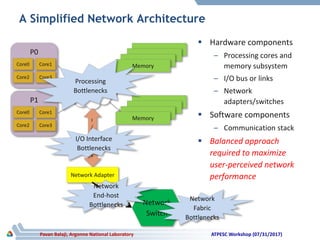
A Simplified Network Architecture
§ Hardware	components
– Processing	cores	and	
memory	subsystem
– I/O	bus	or	links
– Network	
adapters/switches
§ Software	components
– Communication	stack
§ Balanced	approach	
required	to	maximize	
user-perceived	network	
performance
ATPESC	Workshop	(07/31/2017)
P0
Core0 Core1
Core2 Core3
P1
Core0 Core1
Core2 Core3
Memory
MemoryI
/
O
B
u
s
Network	Adapter
Network	
Switch
Processing	
Bottlenecks
I/O	Interface	
Bottlenecks
Network	
End-host	
Bottlenecks
Network	
Fabric	
Bottlenecks
Pavan	Balaji,	Argonne	National	Laboratory
Agenda
ATPESC	Workshop	(07/31/2017)
Network	Adapters
Network	Topologies
Network/Processor/Memory	
Interactions
Pavan	Balaji,	Argonne	National	Laboratory
Bottlenecks on Traditional Network Adapters
§ Network	speeds	saturated	at	
around	1Gbps
– Features	provided	were	limited
– Commodity	networks	were	not	
considered	scalable	enough	for	
very	large-scale	systems
ATPESC	Workshop	(07/31/2017)
P0
Core0 Core1
Core2 Core3
P1
Core0 Core1
Core2 Core3
Memory
MemoryI
/
O
B
u
s
Network	Adapter
Network	
Switch
Network	
Bottlenecks
Ethernet (1979 - ) 10 Mbit/sec
Fast Ethernet (1993 -) 100 Mbit/sec
Gigabit Ethernet (1995 -) 1000 Mbit /sec
ATM (1995 -) 155/622/1024 Mbit/sec
Myrinet (1993 -) 1 Gbit/sec
Fibre Channel (1994 -) 1 Gbit/sec
Pavan	Balaji,	Argonne	National	Laboratory
End-host Network Interface Speeds
§ Recent	network	technologies	provide	high	bandwidth	links
– InfiniBand	EDR	gives	100	Gbps per	network	link
• Upcoming	networks	expected	to	increase	that	by	several	fold
– Multiple	network	links	becoming	a	common	place
• ORNL	Summit	and	LLNL	Sierra	machines,	Japanese	Post	T2K	machine
• Torus	style	or	other	multi-dimensional	networks
§ End-host	peak	network	bandwidth	is	“mostly”	no	longer	
considered	a	major	technological	limitation
§ Network	latency	is	still	an	issue
– That’s	a	harder	problem	to	solve	– limited	by	physics,	not	technology
• There	is	some	room	to	improve	it	in	current	technology	(trimming	the	fat)
• Significant	effort	in	making	systems	denser	so	as	to	reduce	network	latency
§ Other	important	metrics:	message	rate,	congestion,	…
ATPESC	Workshop	(07/31/2017)
Pavan	Balaji,	Argonne	National	Laboratory
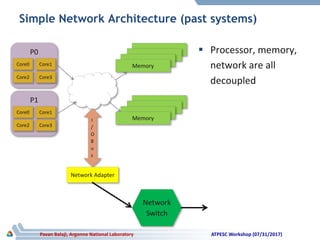
Simple Network Architecture (past systems)
§ Processor,	memory,	
network	are	all	
decoupled
ATPESC	Workshop	(07/31/2017)
P0
Core0 Core1
Core2 Core3
P1
Core0 Core1
Core2 Core3
Memory
MemoryI
/
O
B
u
s
Network	Adapter
Network	
Switch
Pavan	Balaji,	Argonne	National	Laboratory
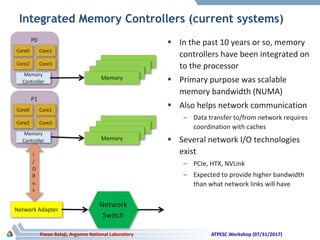
Integrated Memory Controllers (current systems)
§ In	the	past	10	years	or	so,	memory	
controllers	have	been	integrated	on	
to	the	processor
§ Primary	purpose	was	scalable	
memory	bandwidth	(NUMA)
§ Also	helps	network	communication
– Data	transfer	to/from	network	requires	
coordination	with	caches
§ Several	network	I/O	technologies	
exist
– PCIe,	HTX,	NVLink
– Expected	to	provide	higher	bandwidth	
than	what	network	links	will	have
ATPESC	Workshop	(07/31/2017)
P1
Core0 Core1
Core2 Core3
Memory
Memory
I
/
O
B
u
s
Network	Adapter
Network	
Switch
Memory	
Controller
P0
Core0 Core1
Core2 Core3
Memory	
Controller
Pavan	Balaji,	Argonne	National	Laboratory
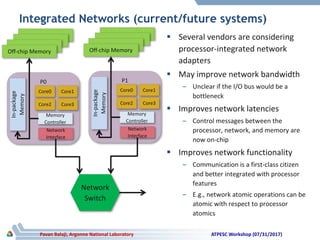
Integrated Networks (current/future systems)
ATPESC	Workshop	(07/31/2017)
Network	
Switch
P0
Core0 Core1
Core2 Core3
Memory	
Controller
Network	
Interface
Off-chip	Memory
§ Several	vendors	are	considering	
processor-integrated	network	
adapters
§ May	improve	network	bandwidth
– Unclear	if	the	I/O	bus	would	be	a	
bottleneck
§ Improves	network	latencies
– Control	messages	between	the	
processor,	network,	and	memory	are	
now	on-chip
§ Improves	network	functionality
– Communication	is	a	first-class	citizen	
and	better	integrated	with	processor	
features
– E.g.,	network	atomic	operations	can	be	
atomic	with	respect	to	processor	
atomics
In-package	
Memory
P1
Core0 Core1
Core2 Core3
Memory	
Controller
Network	
Interface
Off-chip	Memory
In-package	
Memory
Pavan	Balaji,	Argonne	National	Laboratory
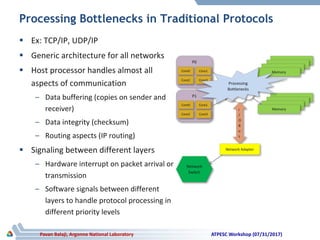
Processing Bottlenecks in Traditional Protocols
§ Ex:	TCP/IP,	UDP/IP
§ Generic	architecture	for	all	networks
§ Host	processor	handles	almost	all	
aspects	of	communication
– Data	buffering	(copies	on	sender	and	
receiver)
– Data	integrity	(checksum)
– Routing	aspects	(IP	routing)
§ Signaling	between	different	layers
– Hardware	interrupt	on	packet	arrival	or	
transmission
– Software	signals	between	different	
layers	to	handle	protocol	processing	in	
different	priority	levels
ATPESC	Workshop	(07/31/2017)
P0
Core0 Core1
Core2 Core3
P1
Core0 Core1
Core2 Core3
Memory
MemoryI
/
O
B
u
s
Network	Adapter
Network	
Switch
Processing	
Bottlenecks
Pavan	Balaji,	Argonne	National	Laboratory
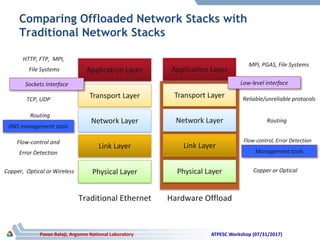
Network Protocol Stacks: The Offload Era
§ Modern	networks	are	spending	more	and	more	network	real-estate	on	
offloading	various	communication	features	on	hardware
§ Network	and	transport	layers	are	hardware	offloaded	for	most	modern	
networks
– Reliability	(retransmissions,	CRC	checks),	packetization
– OS-based	memory	registration,	and	user-level	data	transmission
ATPESC	Workshop	(07/31/2017)
Pavan	Balaji,	Argonne	National	Laboratory
Comparing Offloaded Network Stacks with
Traditional Network Stacks
ATPESC	Workshop	(07/31/2017)
Application	Layer
MPI, PGAS,	File	Systems
Transport	Layer
Low-level	interface
Reliable/unreliable	protocols
Link	Layer
Flow-control,	Error	Detection
Physical	Layer
Hardware	Offload
Copper	or	Optical
HTTP,	FTP,		MPI,	
File	Systems
Routing
Physical	Layer
Link	Layer
Network	Layer
Transport	Layer
Application	Layer
Traditional	Ethernet
Sockets	Interface
TCP,	UDP
Flow-control	and
Error	Detection
Copper,		Optical	or	Wireless
Network	Layer Routing
Management	tools
DNS	management	tools
Pavan	Balaji,	Argonne	National	Laboratory
Current State for Network APIs
§ A	large	number	of	network	vendor	specific	APIs
– InfiniBand verbs,	Mellanox MXM,	IBM	PAMI,	Cray	Gemini/DMAPP,	…
§ Recent	efforts	to	standardize	these	low-level	communication	
APIs
– Open	Fabrics	Interface	(OFI)
• Effort	from	Intel,	CISCO,	etc.,	to	provide	a	unified	low-level	communication	
layer	that	exposes	features	provided	by	each	network
– Unified	Communication	X	(UCX)
• Effort	from	Mellanox,	IBM,	ORNL,	etc.,	to	provide	a	unified	low-level	
communication	layer	that	allows	for	efficient	MPI	and	PGAS	communication
– Portals-4
• Effort	from	Sandia	National	Laboratory	to	provide	a	network	hardware	
capability	centric	API
ATPESC	Workshop	(07/31/2017)
Pavan	Balaji,	Argonne	National	Laboratory
User-level Communication: Memory Registration
ATPESC	Workshop	(07/31/2017)
1. Registration	Request	
• Send	virtual	address	and	length
2. Kernel	handles	virtual->physical	
mapping	and	pins	region	into	
physical	memory
• Process	cannot	map	memory	
that	it	does	not	own	(security	!)
3. Network	adapter	caches	the	
virtual	to	physical	mapping	and	
issues	a	handle
4. Handle	is	returned	to	application
Before	we	do	any	communication:
All	memory	used	for	communication	must	
be	registered
1
3
4
Process
Kernel
Network
2
Pavan	Balaji,	Argonne	National	Laboratory
Send/Receive Communication
ATPESC	Workshop	(07/31/2017)
Network Interface
Memory Memory
Network Interface
Send Recv
Memory
Segment
Send	entry	contains	information	about	the	
send	buffer	(multiple	non-contiguous	
segments)
Processor Processor
Send Recv
Memory
Segment
Receive	entry	contains	information	on	the	receive	
buffer	(multiple	non-contiguous	segments);	
Incoming	messages	have	to	be	matched	to	a	
receive	entry	to	know	where	to	place
Hardware ACK
Memory
Segment
Memory
Segment
Memory
Segment
Pavan	Balaji,	Argonne	National	Laboratory
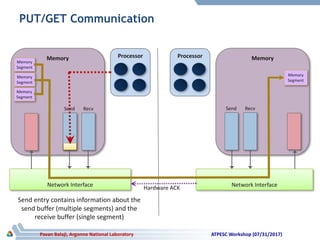
PUT/GET Communication
ATPESC	Workshop	(07/31/2017)
Network	Interface
Memory Memory
Network	Interface
Send Recv
Memory
Segment
Send	entry	contains	information	about	the	
send	buffer	(multiple	segments)	and	the	
receive	buffer	(single	segment)
Processor Processor
Send Recv
Memory
Segment
Hardware	ACK
Memory
Segment
Memory
Segment
Pavan	Balaji,	Argonne	National	Laboratory
Atomic Operations
ATPESC	Workshop	(07/31/2017)
Network	Interface
Memory Memory
Network	Interface
Send Recv
Memory
Segment
Send	entry	contains	information	about	the	
send	buffer	and	the	receive	buffer
Processor Processor
Send Recv
Source
Memory
Segment
OP
Destination
Memory
Segment
Pavan	Balaji,	Argonne	National	Laboratory
Network Protocol Stacks: Specialization
§ Increasing	network	specialization	is	the	focus	today
– The	next	generation	of	networks	plan	to	have	further	support	for	
noncontiguous	data	movement,	and	multiple	contexts	for	multithreaded	
architectures
§ Some	networks,	such	as	the	Blue	Gene	network,	Cray	network	and	
InfiniBand,	are	also	offloading	some	MPI	and	PGAS	features	on	to	
hardware
– E.g.,	PUT/GET	communication	has	hardware	support
– Increasing	number	of	atomic	operations	being	offloaded	to	hardware
• Compare-and-swap,	fetch-and-add,	swap
– Collective	operations
– Portals-based	networks	also	had	support	for	hardware	matching	for	MPI	
send/recv
• Cray	Seastar,	Bull	BMI
ATPESC	Workshop	(07/31/2017)
Pavan	Balaji,	Argonne	National	Laboratory
Agenda
ATPESC	Workshop	(07/31/2017)
Network	Adapters
Network	Topologies
Network/Processor/Memory	
Interactions
Pavan	Balaji,	Argonne	National	Laboratory
Traditional Network Topologies: Crossbar
§ A	network	topology	describes	how	different	network	
adapters	and	switches	are	interconnected	with	each	other
§ The	ideal	network	topology	(for	performance)	is	a	crossbar
– Alltoall connection	between	network	adapters
– Typically	done	on	a	single	network	ASIC
– Current	network	crossbar	ASICs	go	up	to	64	ports;	too	expensive	to	
scale	to	higher	port	counts
– All	communication	is	nonblocking
ATPESC	Workshop	(07/31/2017)
Pavan	Balaji,	Argonne	National	Laboratory
Traditional Network Topologies: Fat-tree
§ The	most	common	topology	for	small	and	medium	scale	
systems	is	a	fat-tree
– Nonblocking fat-tree	switches	available	in	abundance
• Allows	for	pseudo	nonblocking communication
• Between	all	pairs	of	processes,	there	exists	a	completely	nonblocking
path,	but	not	all	paths	are	nonblocking
– More	scalable	than	crossbars,	but	the	number	of	network	links	still	
increases	super-linearly	with	node	count
• Can	get	very	expensive	with	scale
ATPESC	Workshop	(07/31/2017)
Pavan	Balaji,	Argonne	National	Laboratory
Network Topology Trends
§ Modern	topologies	are	moving	towards	
more	“scalability”	(with	respect	to	cost,	not	
performance)
§ Blue	Gene,	Cray	XE/XK,	and	K	
supercomputers	use	a	torus-network;	Cray	
XC	uses	dragonfly
– Linear	increase	in	the	number	of	
links/routers	with	system	size
– Any	communication	that	is	more	than	one	
hop	away	has	a	possibility	of	interference	–
congestion	is	not	just	possible,	but	common
– Even	when	there	is	no	congestion,	such	
topologies	increase	the	network	diameter	
causing	performance	loss
§ Take-away:	topological	locality	is	important	
and	its	not	going	to	get	better
ATPESC	Workshop	(07/31/2017)
Pavan	Balaji,	Argonne	National	Laboratory
Network Congestion Behavior: IBM BG/P
0
500
1000
1500
2000
2500
3000
3500
Bandwidth	(Mbps)
Message	Size	(bytes)
P2-P5
P3-P4
No	overlap
ATPESC	Workshop	(07/31/2017)
P0 P1 P2 P3 P4 P5 P6 P7
Pavan	Balaji,	Argonne	National	Laboratory
2D Nearest Neighbor: Process Mapping (XYZ)
X-Axis
Z-Axis
Y-Axis
ATPESC	Workshop	(07/31/2017)
Pavan	Balaji,	Argonne	National	Laboratory
Nearest Neighbor Performance: IBM BG/P
ATPESC	Workshop	(07/31/2017)
0
100
200
300
400
500
600
700
800
900
2 4 8 16 32 64 128 256 512 1K
Execution	Time	(us)
Grid	Partition	(bytes)
System	Size	:	16K	Cores
XYZT
TXYZ
ZYXT
TZYX
0
500
1000
1500
2000
2500
2 4 8 16 32 64 128 256 512 1K
Execution	Time	(us)
Grid	Partition	(bytes)
System	Size	:	128K	Cores
XYZT
TXYZ
ZYXT
TZYX
2D	Halo	Exchange
Pavan	Balaji,	Argonne	National	Laboratory
Agenda
ATPESC	Workshop	(07/31/2017)
Network	Adapters
Network	Topologies
Network/Processor/Memory	
Interactions
Pavan	Balaji,	Argonne	National	Laboratory
Network Interactions with Memory/Cache
§ Most	network	interfaces	understand	and	work	with	the	cache	
coherence	protocols	available	on	modern	systems
– Users	do	not	have	to	ensure	that	data	is	flushed	from	cache	before	
communication
– Network	and	memory	controller	hardware	understand	what	state	the	
data	is	in	and	communicate	appropriately
ATPESC	Workshop	(07/31/2017)
Pavan	Balaji,	Argonne	National	Laboratory
Send-side Network Communication
ATPESC	Workshop	(07/31/2017)
North	BridgeCPU
NIC
FSB Memory	Bus
I/O	Bus
Appln.
Buffer
L3	$ Memory
Appln.
Buffer
Pavan	Balaji,	Argonne	National	Laboratory
Receive-side Network Communication
ATPESC	Workshop	(07/31/2017)
North	BridgeCPU
NIC
FSB Memory	Bus
I/O	Bus
Appln.
Buffer
L3	$ Memory
Appln.
Buffer
Pavan	Balaji,	Argonne	National	Laboratory
Network/Processor Interoperation Trends
§ Direct	cache	injection
– Most	current	networks	inject	data	into	memory
• If	data	is	in	cache,	they	flush	cache	and	then	inject	to	memory
– Some	networks	are	investigating	direct	cache	injection
• Data	can	be	injected	directly	into	the	last-level	cache
• Can	be	tricky	since	it	can	cause	cache	pollution	if	the	incoming	data	is	not	
used	immediately
§ Atomic	operations
– Current	network	atomic	operations	are	only	atomic	with	respect	to	
other	network	operations	and	not	with	respect	to	processor	atomics
• E.g.,	network	fetch-and-add	and	processor	fetch-and-add	might	corrupt	
each	other’s	data
– With	network/processor	integration,	this	is	expected	to	be	fixed
ATPESC	Workshop	(07/31/2017)
Pavan	Balaji,	Argonne	National	Laboratory
Summary
§ These	are	interesting	times	for	all	components	in	the	overall	
system	architecture:	processor,	memory,	interconnect
– And	interesting	times	for	computational	science	on	these	systems
§ Interconnect	technology	is	rapidly	advancing
– More	hardware	integration	is	the	key	to	removing	bottlenecks	and	
improve	functionality
• Processor/memory/network	integration	is	already	in	progress	and	will	
continue	for	the	foreseeable	future
– Offload	technologies	continue	to	evolve	as	we	move	more	
functionality	to	the	network	hardware
– Network	topologies	are	becoming	more	“shared”	(cost	saving)
ATPESC	Workshop	(07/31/2017)
Thank You!
Email:	balaji@anl.gov
Web:	http://www.mcs.anl.gov/~balaji

System Interconnects for HPC

  • 1.
  • 2.
    Pavan Balaji, Argonne National Laboratory U.S. DOE PotentialSystem Architecture Targets ATPESC Workshop (07/31/2017) System attributes 2010 2017-2018 2021-2022 System peak 2 Peta 150-200 Petaflop/sec 1 Exaflop/sec Power 6 MW 15 MW 20 MW System memory 0.3 PB 5 PB 32-64 PB Node performance 125 GF 3 TF 30 TF 10 TF 100 TF Node memory BW 25 GB/s 0.1TB/sec 1 TB/sec 0.4TB/sec 4 TB/sec Node concurrency 12 O(100) O(1,000) O(1,000) O(10,000) System size (nodes) 18,700 50,000 5,000 100,000 10,000 Total Node Interconnect BW 1.5 GB/s 20 GB/sec 200GB/sec MTTI days O(1day) O(1 day) Current production Planned Upgrades (e.g., CORAL) Exascale Goals [Includes some modifications to the DOE Exascale report]
  • 3.
    Pavan Balaji, Argonne National Laboratory General Trends inSystem Architecture § Number of nodes is increasing, but at a moderate pace § Number of cores/threads on a node is increasing rapidly § Each core is not increasing in speed (clock frequency) § Chip logic complexity decreasing (in-order instructions, no pipelining, no branch prediction) § What does this mean for networks? – More cores will drive the network – More sharing of the network infrastructure – The aggregate amount of communication from each node will increase moderately, but will be divided into many smaller messages – A single core will not be able to drive the network fully ATPESC Workshop (07/31/2017)
  • 4.
    Pavan Balaji, Argonne National Laboratory A Simplified NetworkArchitecture § Hardware components – Processing cores and memory subsystem – I/O bus or links – Network adapters/switches § Software components – Communication stack § Balanced approach required to maximize user-perceived network performance ATPESC Workshop (07/31/2017) P0 Core0 Core1 Core2 Core3 P1 Core0 Core1 Core2 Core3 Memory MemoryI / O B u s Network Adapter Network Switch Processing Bottlenecks I/O Interface Bottlenecks Network End-host Bottlenecks Network Fabric Bottlenecks
  • 5.
  • 6.
    Pavan Balaji, Argonne National Laboratory Bottlenecks on TraditionalNetwork Adapters § Network speeds saturated at around 1Gbps – Features provided were limited – Commodity networks were not considered scalable enough for very large-scale systems ATPESC Workshop (07/31/2017) P0 Core0 Core1 Core2 Core3 P1 Core0 Core1 Core2 Core3 Memory MemoryI / O B u s Network Adapter Network Switch Network Bottlenecks Ethernet (1979 - ) 10 Mbit/sec Fast Ethernet (1993 -) 100 Mbit/sec Gigabit Ethernet (1995 -) 1000 Mbit /sec ATM (1995 -) 155/622/1024 Mbit/sec Myrinet (1993 -) 1 Gbit/sec Fibre Channel (1994 -) 1 Gbit/sec
  • 7.
    Pavan Balaji, Argonne National Laboratory End-host Network InterfaceSpeeds § Recent network technologies provide high bandwidth links – InfiniBand EDR gives 100 Gbps per network link • Upcoming networks expected to increase that by several fold – Multiple network links becoming a common place • ORNL Summit and LLNL Sierra machines, Japanese Post T2K machine • Torus style or other multi-dimensional networks § End-host peak network bandwidth is “mostly” no longer considered a major technological limitation § Network latency is still an issue – That’s a harder problem to solve – limited by physics, not technology • There is some room to improve it in current technology (trimming the fat) • Significant effort in making systems denser so as to reduce network latency § Other important metrics: message rate, congestion, … ATPESC Workshop (07/31/2017)
  • 8.
    Pavan Balaji, Argonne National Laboratory Simple Network Architecture(past systems) § Processor, memory, network are all decoupled ATPESC Workshop (07/31/2017) P0 Core0 Core1 Core2 Core3 P1 Core0 Core1 Core2 Core3 Memory MemoryI / O B u s Network Adapter Network Switch
  • 9.
    Pavan Balaji, Argonne National Laboratory Integrated Memory Controllers(current systems) § In the past 10 years or so, memory controllers have been integrated on to the processor § Primary purpose was scalable memory bandwidth (NUMA) § Also helps network communication – Data transfer to/from network requires coordination with caches § Several network I/O technologies exist – PCIe, HTX, NVLink – Expected to provide higher bandwidth than what network links will have ATPESC Workshop (07/31/2017) P1 Core0 Core1 Core2 Core3 Memory Memory I / O B u s Network Adapter Network Switch Memory Controller P0 Core0 Core1 Core2 Core3 Memory Controller
  • 10.
    Pavan Balaji, Argonne National Laboratory Integrated Networks (current/futuresystems) ATPESC Workshop (07/31/2017) Network Switch P0 Core0 Core1 Core2 Core3 Memory Controller Network Interface Off-chip Memory § Several vendors are considering processor-integrated network adapters § May improve network bandwidth – Unclear if the I/O bus would be a bottleneck § Improves network latencies – Control messages between the processor, network, and memory are now on-chip § Improves network functionality – Communication is a first-class citizen and better integrated with processor features – E.g., network atomic operations can be atomic with respect to processor atomics In-package Memory P1 Core0 Core1 Core2 Core3 Memory Controller Network Interface Off-chip Memory In-package Memory
  • 11.
    Pavan Balaji, Argonne National Laboratory Processing Bottlenecks inTraditional Protocols § Ex: TCP/IP, UDP/IP § Generic architecture for all networks § Host processor handles almost all aspects of communication – Data buffering (copies on sender and receiver) – Data integrity (checksum) – Routing aspects (IP routing) § Signaling between different layers – Hardware interrupt on packet arrival or transmission – Software signals between different layers to handle protocol processing in different priority levels ATPESC Workshop (07/31/2017) P0 Core0 Core1 Core2 Core3 P1 Core0 Core1 Core2 Core3 Memory MemoryI / O B u s Network Adapter Network Switch Processing Bottlenecks
  • 12.
    Pavan Balaji, Argonne National Laboratory Network Protocol Stacks:The Offload Era § Modern networks are spending more and more network real-estate on offloading various communication features on hardware § Network and transport layers are hardware offloaded for most modern networks – Reliability (retransmissions, CRC checks), packetization – OS-based memory registration, and user-level data transmission ATPESC Workshop (07/31/2017)
  • 13.
    Pavan Balaji, Argonne National Laboratory Comparing Offloaded NetworkStacks with Traditional Network Stacks ATPESC Workshop (07/31/2017) Application Layer MPI, PGAS, File Systems Transport Layer Low-level interface Reliable/unreliable protocols Link Layer Flow-control, Error Detection Physical Layer Hardware Offload Copper or Optical HTTP, FTP, MPI, File Systems Routing Physical Layer Link Layer Network Layer Transport Layer Application Layer Traditional Ethernet Sockets Interface TCP, UDP Flow-control and Error Detection Copper, Optical or Wireless Network Layer Routing Management tools DNS management tools
  • 14.
    Pavan Balaji, Argonne National Laboratory Current State forNetwork APIs § A large number of network vendor specific APIs – InfiniBand verbs, Mellanox MXM, IBM PAMI, Cray Gemini/DMAPP, … § Recent efforts to standardize these low-level communication APIs – Open Fabrics Interface (OFI) • Effort from Intel, CISCO, etc., to provide a unified low-level communication layer that exposes features provided by each network – Unified Communication X (UCX) • Effort from Mellanox, IBM, ORNL, etc., to provide a unified low-level communication layer that allows for efficient MPI and PGAS communication – Portals-4 • Effort from Sandia National Laboratory to provide a network hardware capability centric API ATPESC Workshop (07/31/2017)
  • 15.
    Pavan Balaji, Argonne National Laboratory User-level Communication: MemoryRegistration ATPESC Workshop (07/31/2017) 1. Registration Request • Send virtual address and length 2. Kernel handles virtual->physical mapping and pins region into physical memory • Process cannot map memory that it does not own (security !) 3. Network adapter caches the virtual to physical mapping and issues a handle 4. Handle is returned to application Before we do any communication: All memory used for communication must be registered 1 3 4 Process Kernel Network 2
  • 16.
    Pavan Balaji, Argonne National Laboratory Send/Receive Communication ATPESC Workshop (07/31/2017) Network Interface MemoryMemory Network Interface Send Recv Memory Segment Send entry contains information about the send buffer (multiple non-contiguous segments) Processor Processor Send Recv Memory Segment Receive entry contains information on the receive buffer (multiple non-contiguous segments); Incoming messages have to be matched to a receive entry to know where to place Hardware ACK Memory Segment Memory Segment Memory Segment
  • 17.
    Pavan Balaji, Argonne National Laboratory PUT/GET Communication ATPESC Workshop (07/31/2017) Network Interface Memory Memory Network Interface SendRecv Memory Segment Send entry contains information about the send buffer (multiple segments) and the receive buffer (single segment) Processor Processor Send Recv Memory Segment Hardware ACK Memory Segment Memory Segment
  • 18.
    Pavan Balaji, Argonne National Laboratory Atomic Operations ATPESC Workshop (07/31/2017) Network Interface Memory Memory Network Interface SendRecv Memory Segment Send entry contains information about the send buffer and the receive buffer Processor Processor Send Recv Source Memory Segment OP Destination Memory Segment
  • 19.
    Pavan Balaji, Argonne National Laboratory Network Protocol Stacks:Specialization § Increasing network specialization is the focus today – The next generation of networks plan to have further support for noncontiguous data movement, and multiple contexts for multithreaded architectures § Some networks, such as the Blue Gene network, Cray network and InfiniBand, are also offloading some MPI and PGAS features on to hardware – E.g., PUT/GET communication has hardware support – Increasing number of atomic operations being offloaded to hardware • Compare-and-swap, fetch-and-add, swap – Collective operations – Portals-based networks also had support for hardware matching for MPI send/recv • Cray Seastar, Bull BMI ATPESC Workshop (07/31/2017)
  • 20.
  • 21.
    Pavan Balaji, Argonne National Laboratory Traditional Network Topologies:Crossbar § A network topology describes how different network adapters and switches are interconnected with each other § The ideal network topology (for performance) is a crossbar – Alltoall connection between network adapters – Typically done on a single network ASIC – Current network crossbar ASICs go up to 64 ports; too expensive to scale to higher port counts – All communication is nonblocking ATPESC Workshop (07/31/2017)
  • 22.
    Pavan Balaji, Argonne National Laboratory Traditional Network Topologies:Fat-tree § The most common topology for small and medium scale systems is a fat-tree – Nonblocking fat-tree switches available in abundance • Allows for pseudo nonblocking communication • Between all pairs of processes, there exists a completely nonblocking path, but not all paths are nonblocking – More scalable than crossbars, but the number of network links still increases super-linearly with node count • Can get very expensive with scale ATPESC Workshop (07/31/2017)
  • 23.
    Pavan Balaji, Argonne National Laboratory Network Topology Trends §Modern topologies are moving towards more “scalability” (with respect to cost, not performance) § Blue Gene, Cray XE/XK, and K supercomputers use a torus-network; Cray XC uses dragonfly – Linear increase in the number of links/routers with system size – Any communication that is more than one hop away has a possibility of interference – congestion is not just possible, but common – Even when there is no congestion, such topologies increase the network diameter causing performance loss § Take-away: topological locality is important and its not going to get better ATPESC Workshop (07/31/2017)
  • 24.
    Pavan Balaji, Argonne National Laboratory Network Congestion Behavior:IBM BG/P 0 500 1000 1500 2000 2500 3000 3500 Bandwidth (Mbps) Message Size (bytes) P2-P5 P3-P4 No overlap ATPESC Workshop (07/31/2017) P0 P1 P2 P3 P4 P5 P6 P7
  • 25.
    Pavan Balaji, Argonne National Laboratory 2D Nearest Neighbor:Process Mapping (XYZ) X-Axis Z-Axis Y-Axis ATPESC Workshop (07/31/2017)
  • 26.
    Pavan Balaji, Argonne National Laboratory Nearest Neighbor Performance:IBM BG/P ATPESC Workshop (07/31/2017) 0 100 200 300 400 500 600 700 800 900 2 4 8 16 32 64 128 256 512 1K Execution Time (us) Grid Partition (bytes) System Size : 16K Cores XYZT TXYZ ZYXT TZYX 0 500 1000 1500 2000 2500 2 4 8 16 32 64 128 256 512 1K Execution Time (us) Grid Partition (bytes) System Size : 128K Cores XYZT TXYZ ZYXT TZYX 2D Halo Exchange
  • 27.
  • 28.
    Pavan Balaji, Argonne National Laboratory Network Interactions withMemory/Cache § Most network interfaces understand and work with the cache coherence protocols available on modern systems – Users do not have to ensure that data is flushed from cache before communication – Network and memory controller hardware understand what state the data is in and communicate appropriately ATPESC Workshop (07/31/2017)
  • 29.
  • 30.
  • 31.
    Pavan Balaji, Argonne National Laboratory Network/Processor Interoperation Trends §Direct cache injection – Most current networks inject data into memory • If data is in cache, they flush cache and then inject to memory – Some networks are investigating direct cache injection • Data can be injected directly into the last-level cache • Can be tricky since it can cause cache pollution if the incoming data is not used immediately § Atomic operations – Current network atomic operations are only atomic with respect to other network operations and not with respect to processor atomics • E.g., network fetch-and-add and processor fetch-and-add might corrupt each other’s data – With network/processor integration, this is expected to be fixed ATPESC Workshop (07/31/2017)
  • 32.
    Pavan Balaji, Argonne National Laboratory Summary § These are interesting times for all components in the overall system architecture: processor, memory, interconnect – And interesting times for computational science on these systems §Interconnect technology is rapidly advancing – More hardware integration is the key to removing bottlenecks and improve functionality • Processor/memory/network integration is already in progress and will continue for the foreseeable future – Offload technologies continue to evolve as we move more functionality to the network hardware – Network topologies are becoming more “shared” (cost saving) ATPESC Workshop (07/31/2017)
  • 33.