LAB LECTURE 1:
INTRODUCTION TO ROS
INSTRUCTOR:
GIANNI A. DI CARO
16-311-Q INTRODUCTION TO ROBOTICS
2
PROBLEM(S) IN ROBOTICS DEVELOPMENT
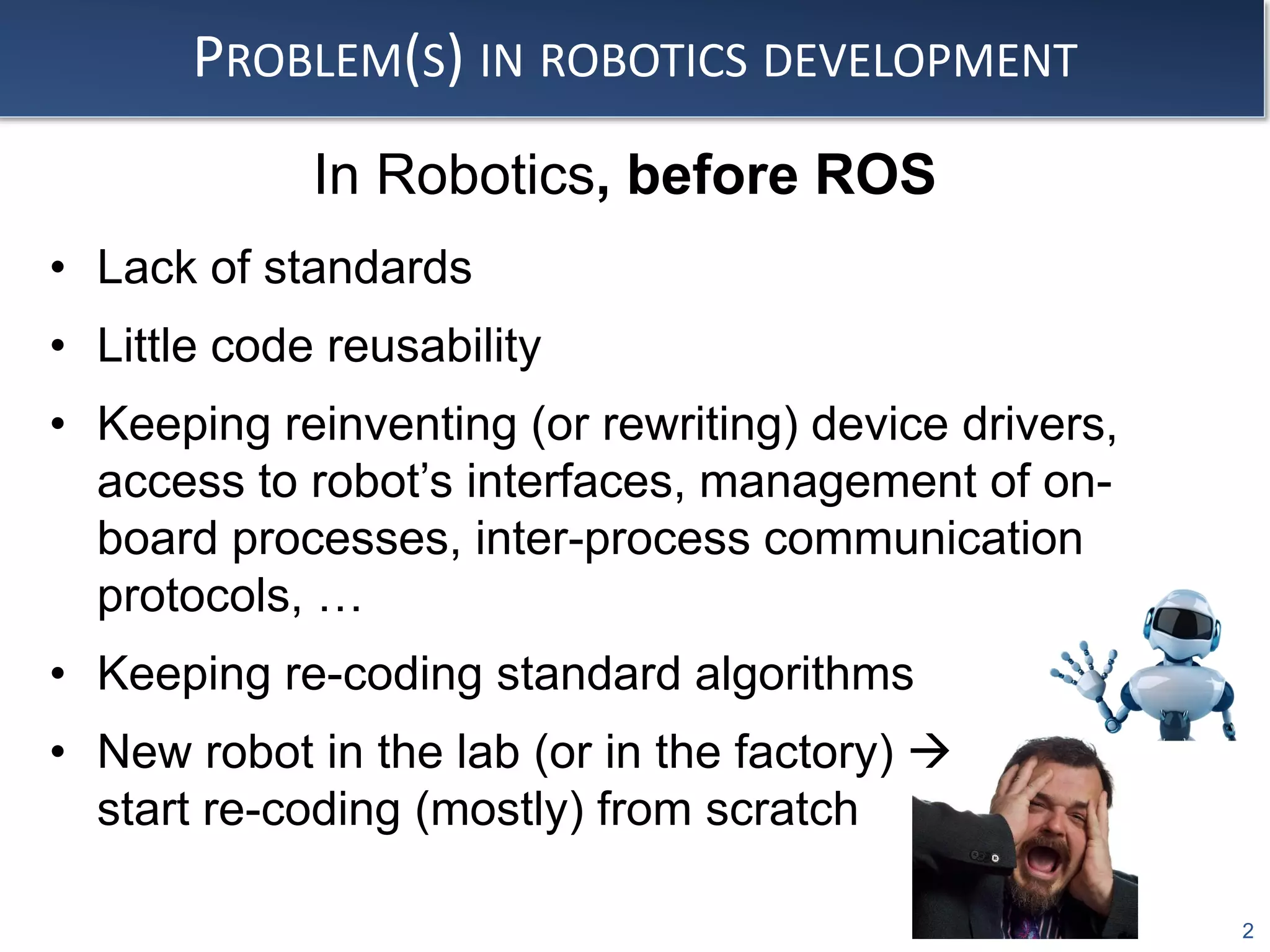
• Lack of standards
• Little code reusability
• Keeping reinventing (or rewriting) device drivers,
access to robot’s interfaces, management of on-
board processes, inter-process communication
protocols, …
• Keeping re-coding standard algorithms
• New robot in the lab (or in the factory) 
start re-coding (mostly) from scratch
In Robotics, before ROS
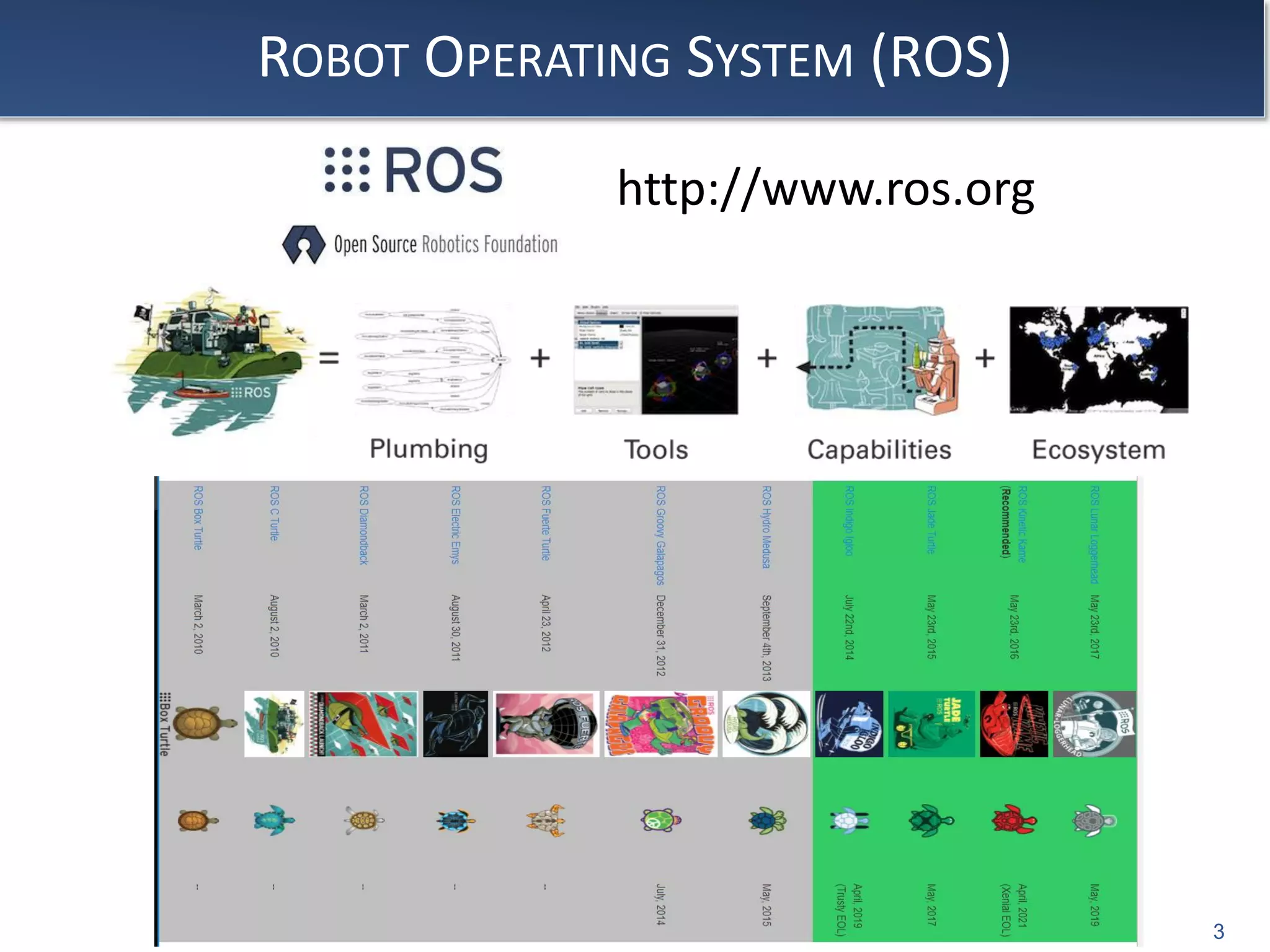
ROBOT OPERATING SYSTEM (ROS)
3
http://www.ros.org
WHAT IS ROS?
 ROS is an open-source robot operating system
 A set of software libraries and tools that help you build
robot applications that work across a wide variety of
robotic platforms
 Originally developed in 2007 at the Stanford Artificial
Intelligence Laboratory and development continued at
Willow Garage
 Since 2013 managed by OSRF (Open Source
Robotics Foundation)
4
Note: Some of the following slides are adapted from
Roi Yehoshua
ROS MAIN FEATURES
ROS has two "sides"
 The operating system side, which provides standard
operating system services such as:
o hardware abstraction
o low-level device control
o implementation of commonly used functionality
o message-passing between processes
o package management
 A suite of user contributed packages that implement
common robot functionality such as SLAM, planning,
perception, vision, manipulation, etc.
5
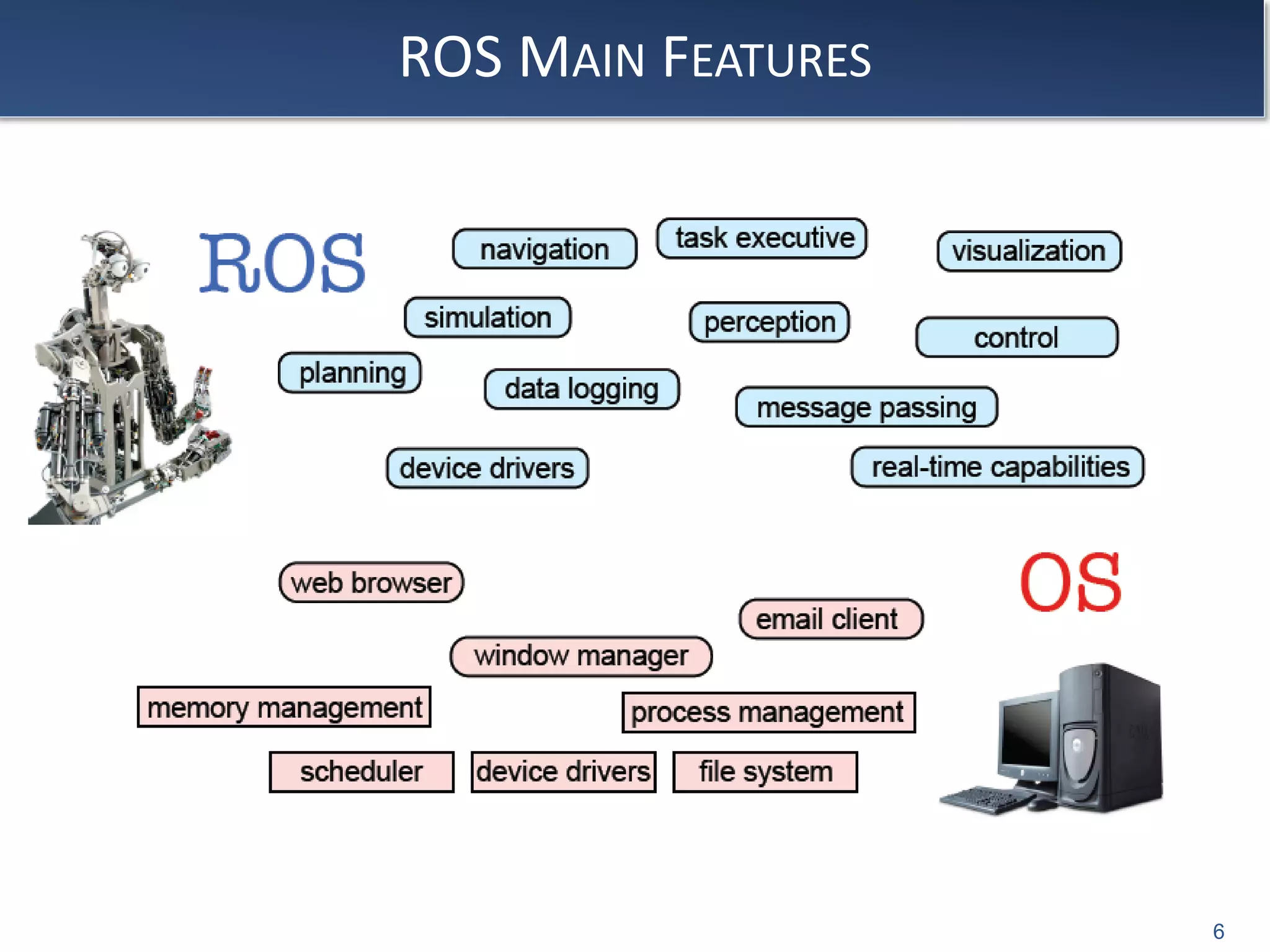
ROS MAIN FEATURES
6
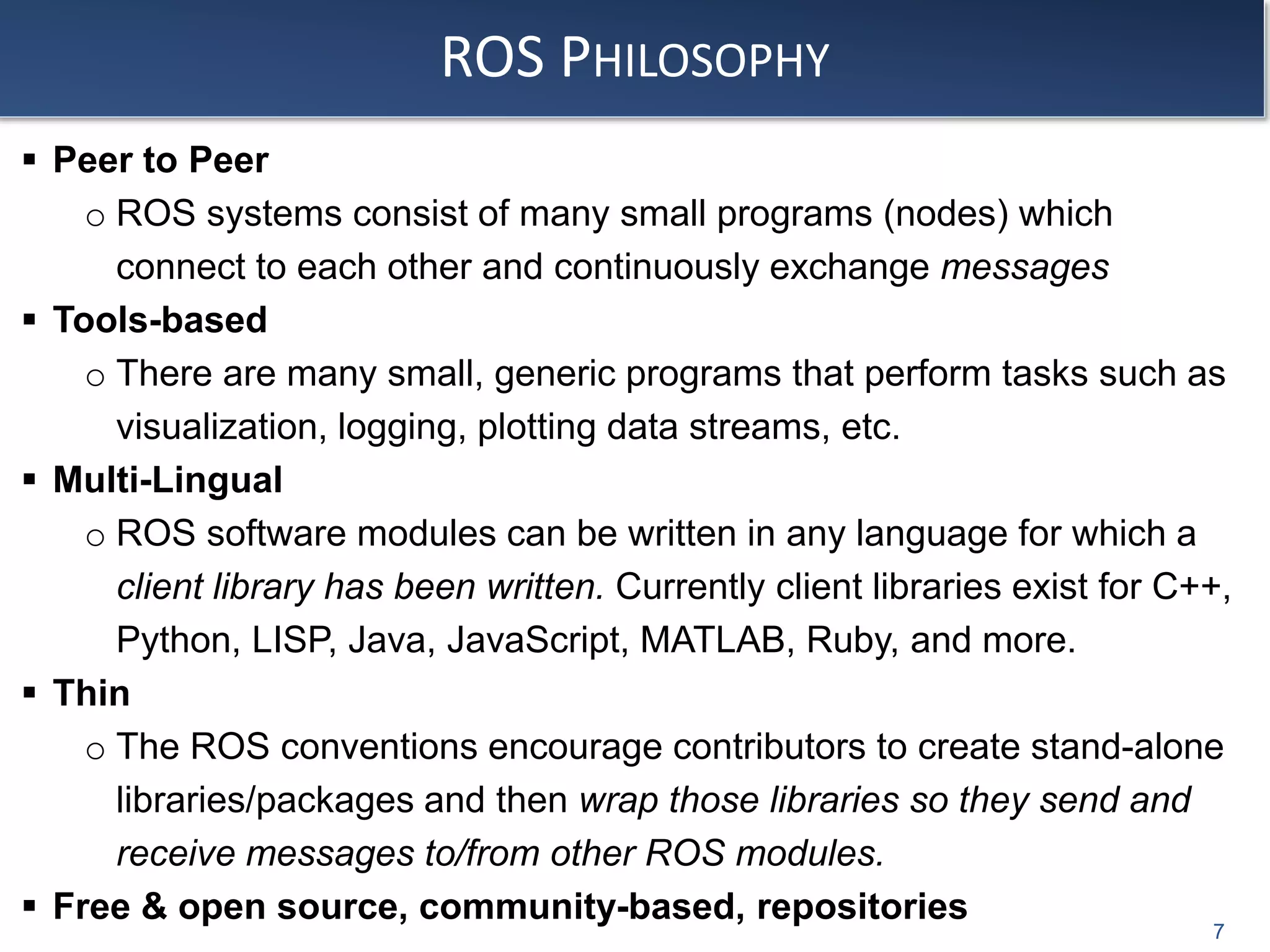
ROS PHILOSOPHY
 Peer to Peer
o ROS systems consist of many small programs (nodes) which
connect to each other and continuously exchange messages
 Tools-based
o There are many small, generic programs that perform tasks such as
visualization, logging, plotting data streams, etc.
 Multi-Lingual
o ROS software modules can be written in any language for which a
client library has been written. Currently client libraries exist for C++,
Python, LISP, Java, JavaScript, MATLAB, Ruby, and more.
 Thin
o The ROS conventions encourage contributors to create stand-alone
libraries/packages and then wrap those libraries so they send and
receive messages to/from other ROS modules.
 Free & open source, community-based, repositories
7
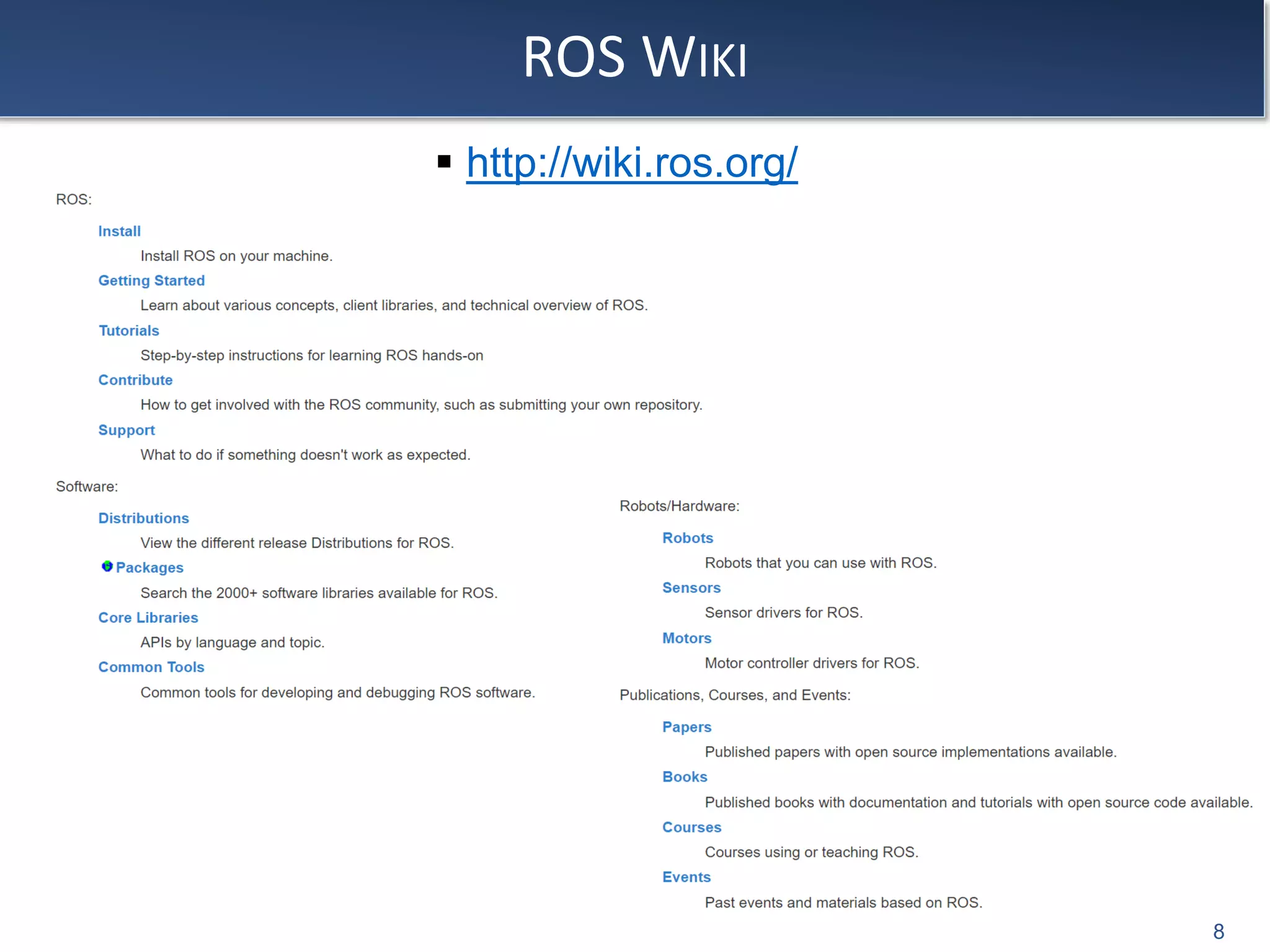
ROS WIKI
 http://wiki.ros.org/
8
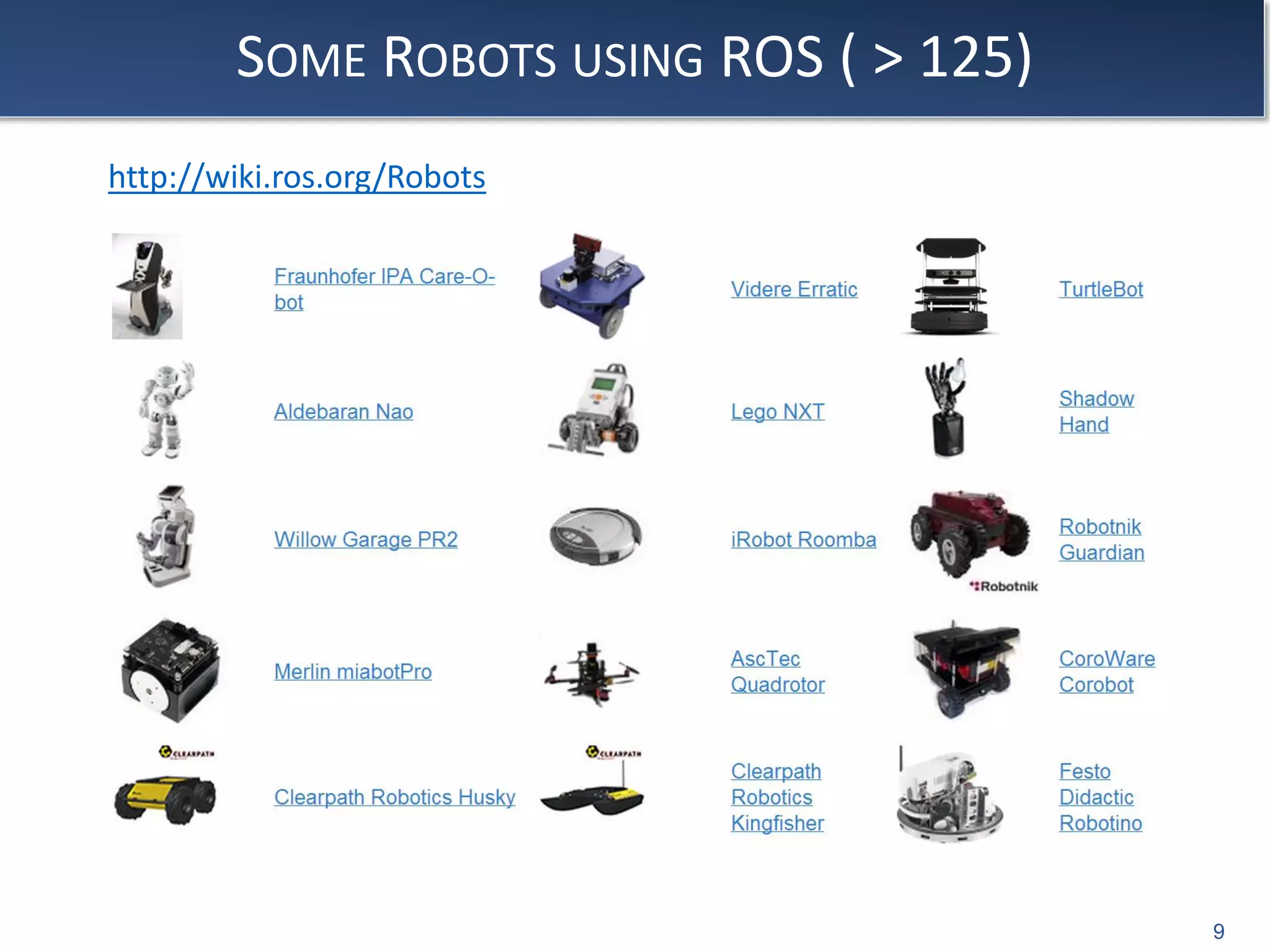
SOME ROBOTS USING ROS ( > 125)
http://wiki.ros.org/Robots
9
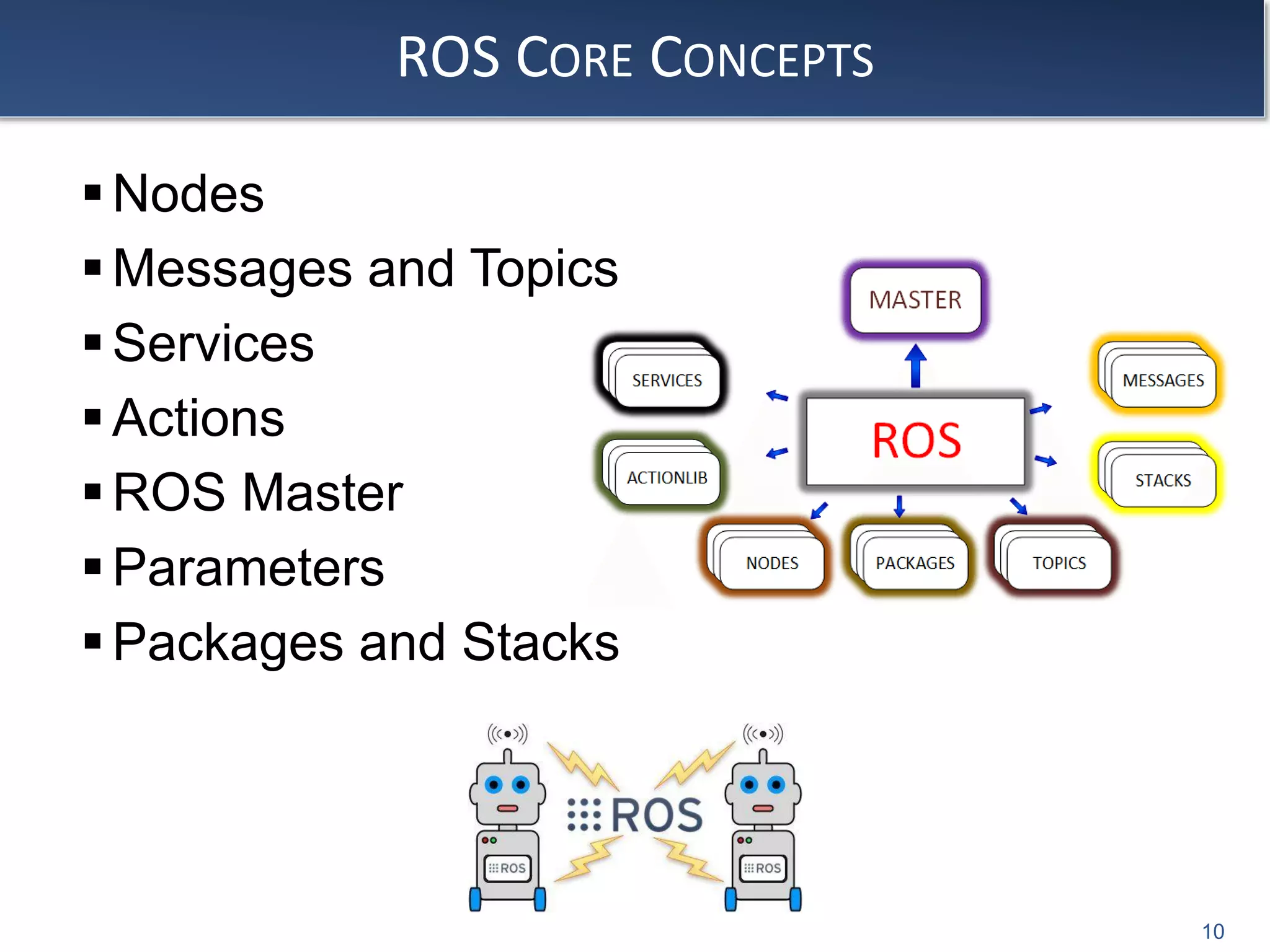
ROS CORE CONCEPTS
Nodes
Messages and Topics
Services
Actions
ROS Master
Parameters
Packages and Stacks
10
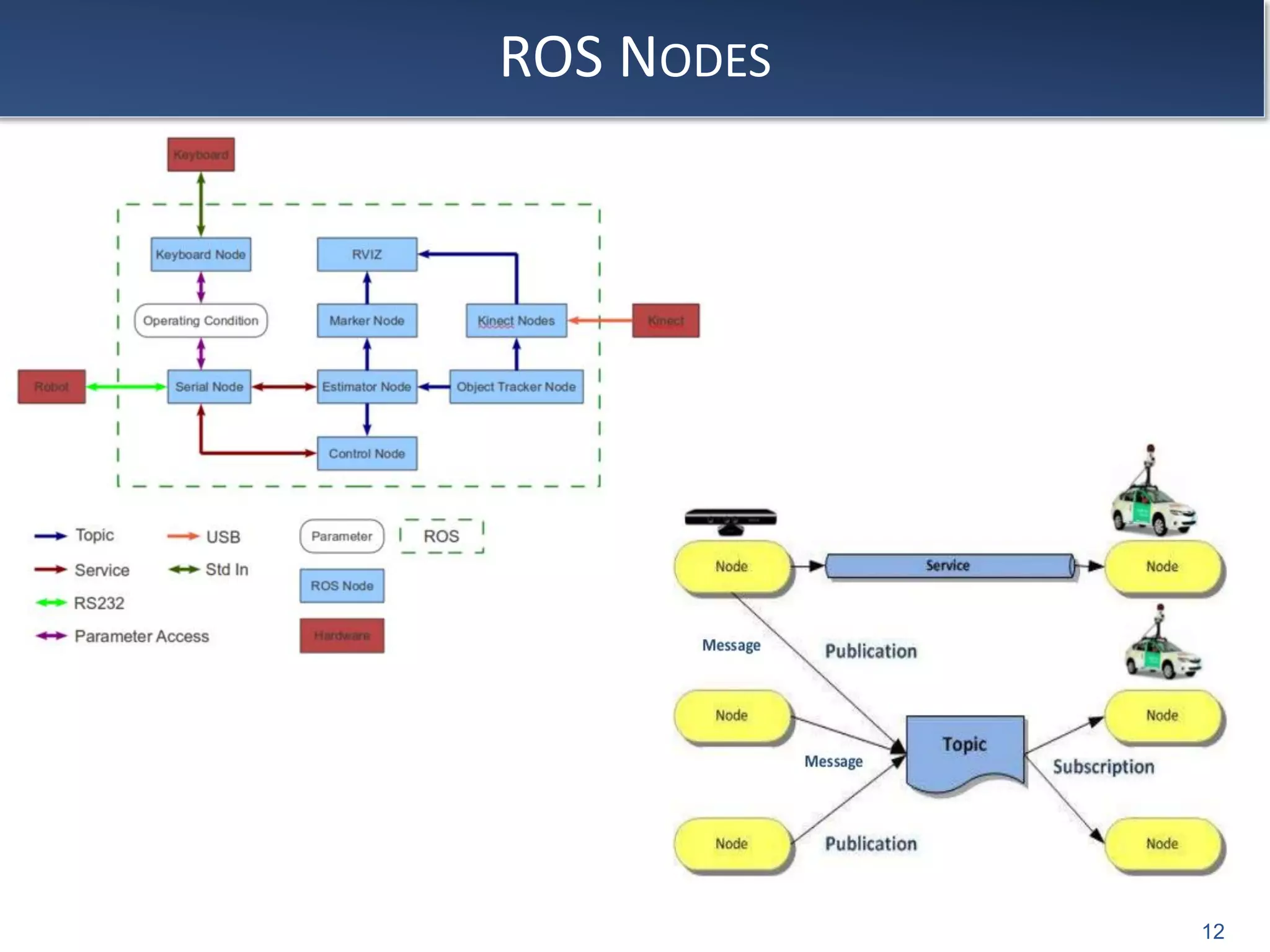
ROS NODES
 Single-purposed executable programs
oe.g. sensor driver(s), actuator driver(s),
map building, planner, UI, etc.
 Individually compiled, executed, and managed
 Nodes are written using a ROS client library
o roscpp – C++ client library
o rospy – python client library
 Nodes can publish or subscribe to a Topic
 Nodes can also provide or use a Service or
an Action
11
ROS NODES
12
ROS TOPICS AND ROS MESSAGES
 Topic: named stream of messages with a defined type
o Data from a range-finder might be sent on a topic
called scan, with a message of type LaserScan
 Nodes communicate with each other by
publishing messages to topics
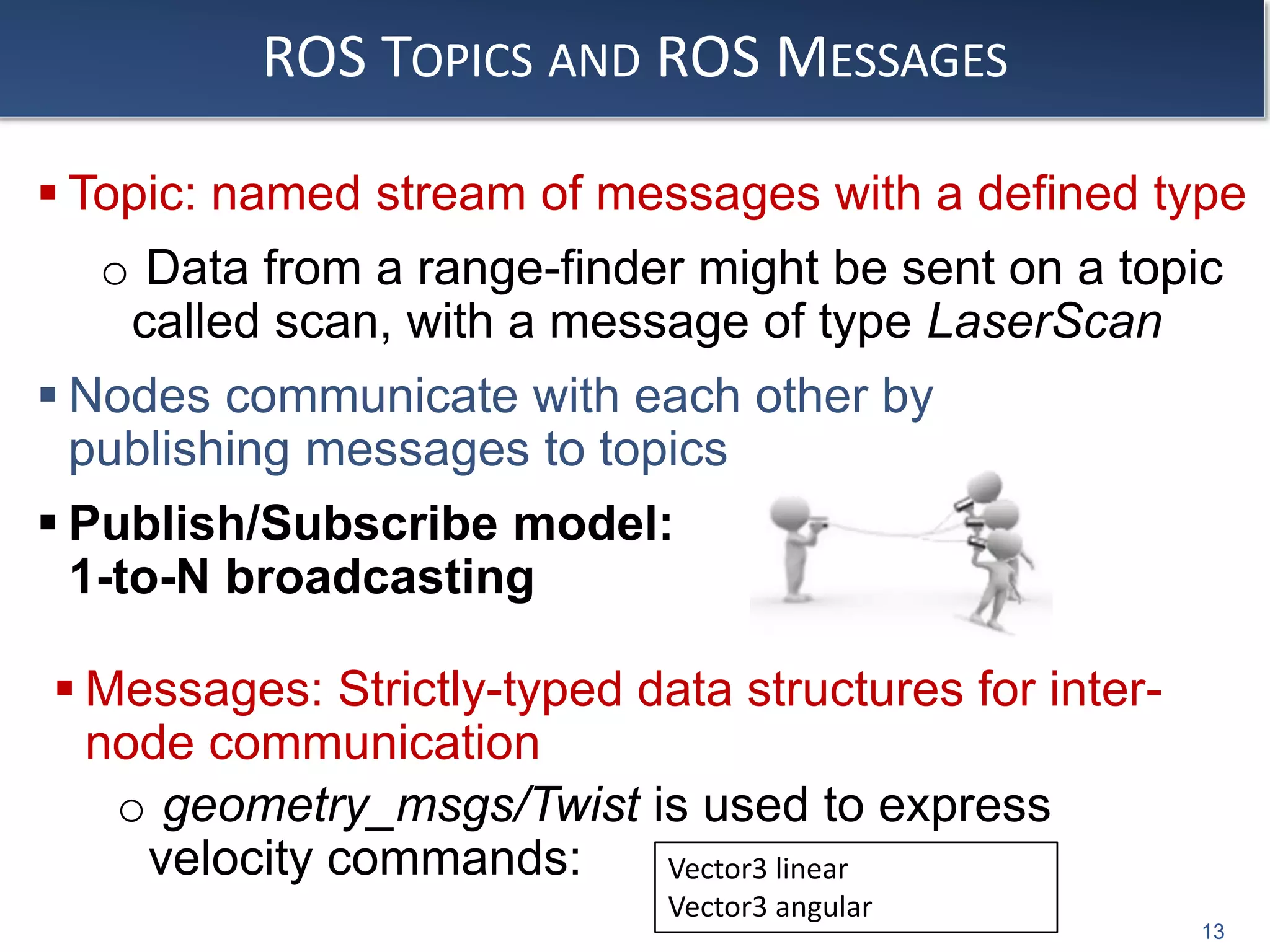
 Publish/Subscribe model:
1-to-N broadcasting
13
 Messages: Strictly-typed data structures for inter-
node communication
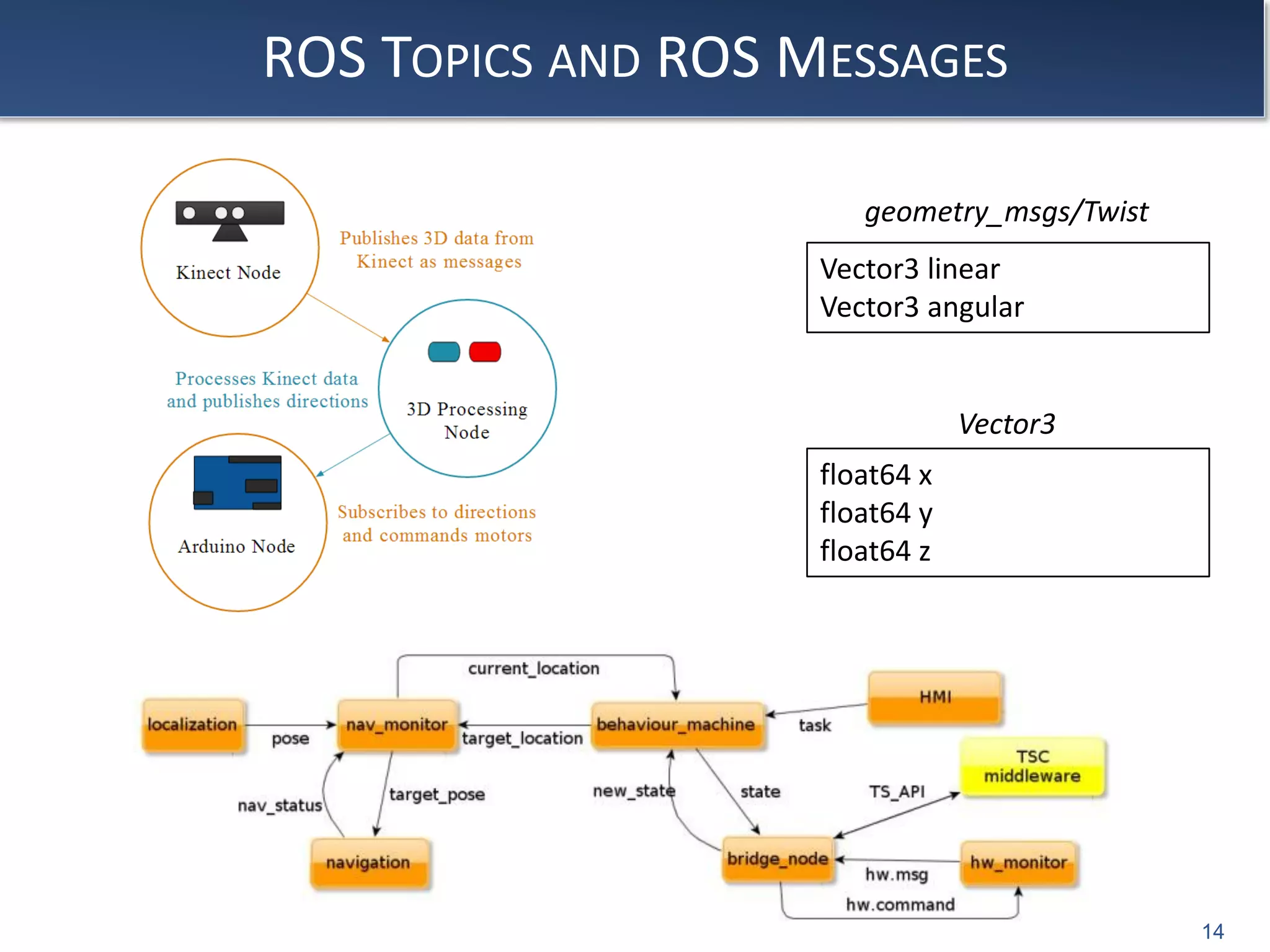
o geometry_msgs/Twist is used to express
velocity commands: Vector3 linear
Vector3 angular
ROS TOPICS AND ROS MESSAGES
14
Vector3 linear
Vector3 angular
float64 x
float64 y
float64 z
geometry_msgs/Twist
Vector3
ROS SERVICES
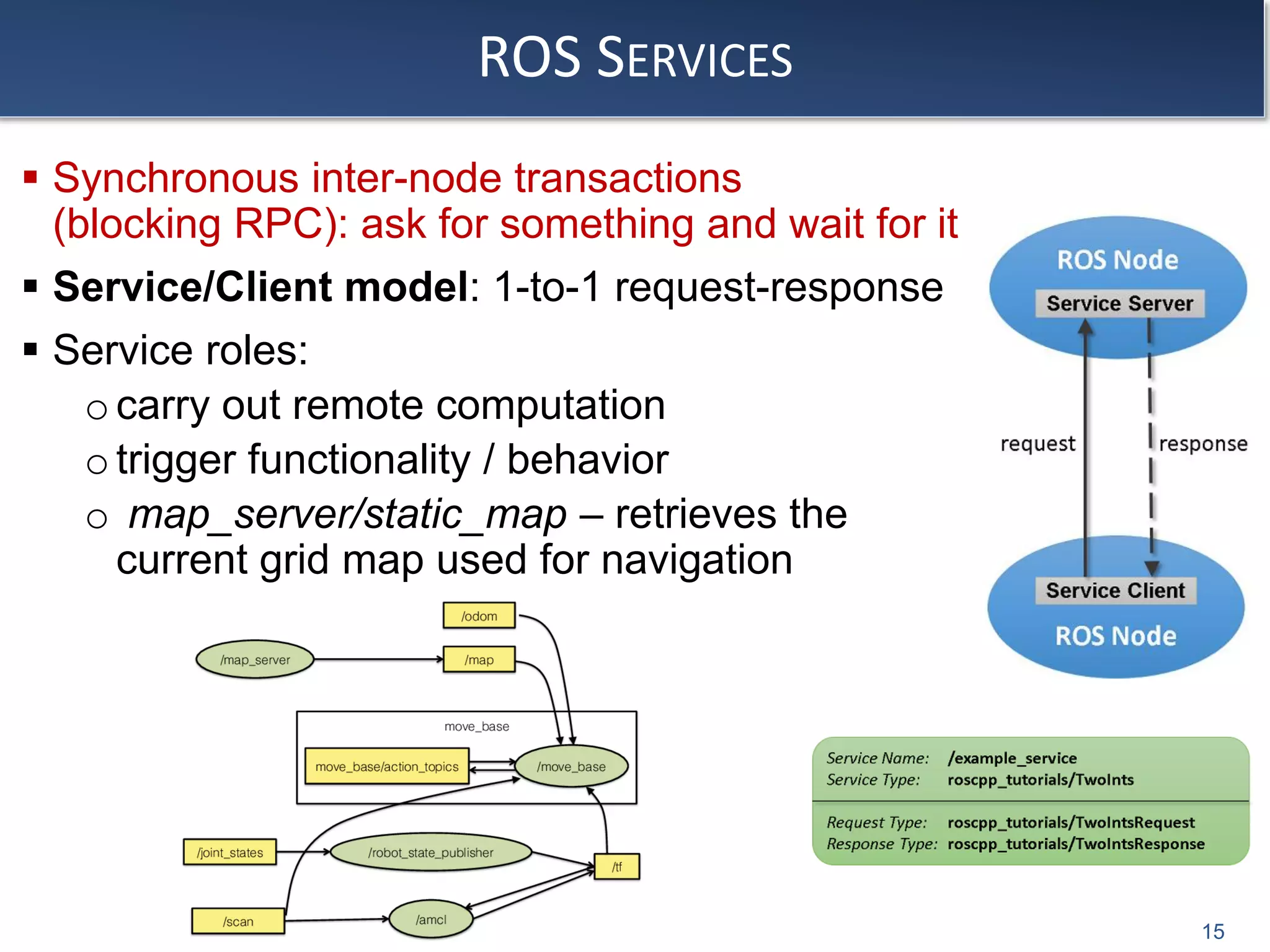
 Synchronous inter-node transactions
(blocking RPC): ask for something and wait for it
 Service/Client model: 1-to-1 request-response
 Service roles:
o carry out remote computation
o trigger functionality / behavior
o map_server/static_map – retrieves the
current grid map used for navigation
15
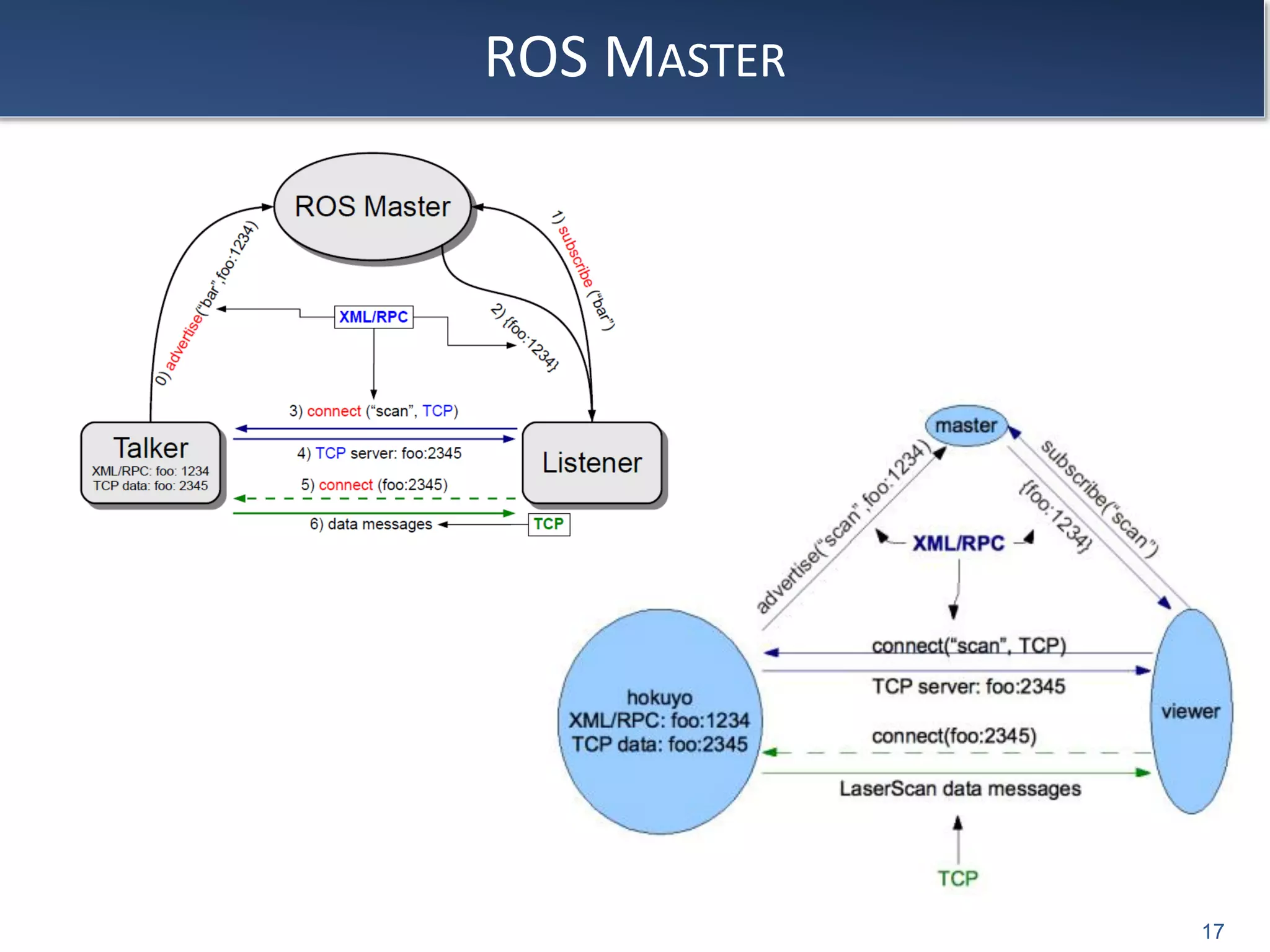
ROS MASTER
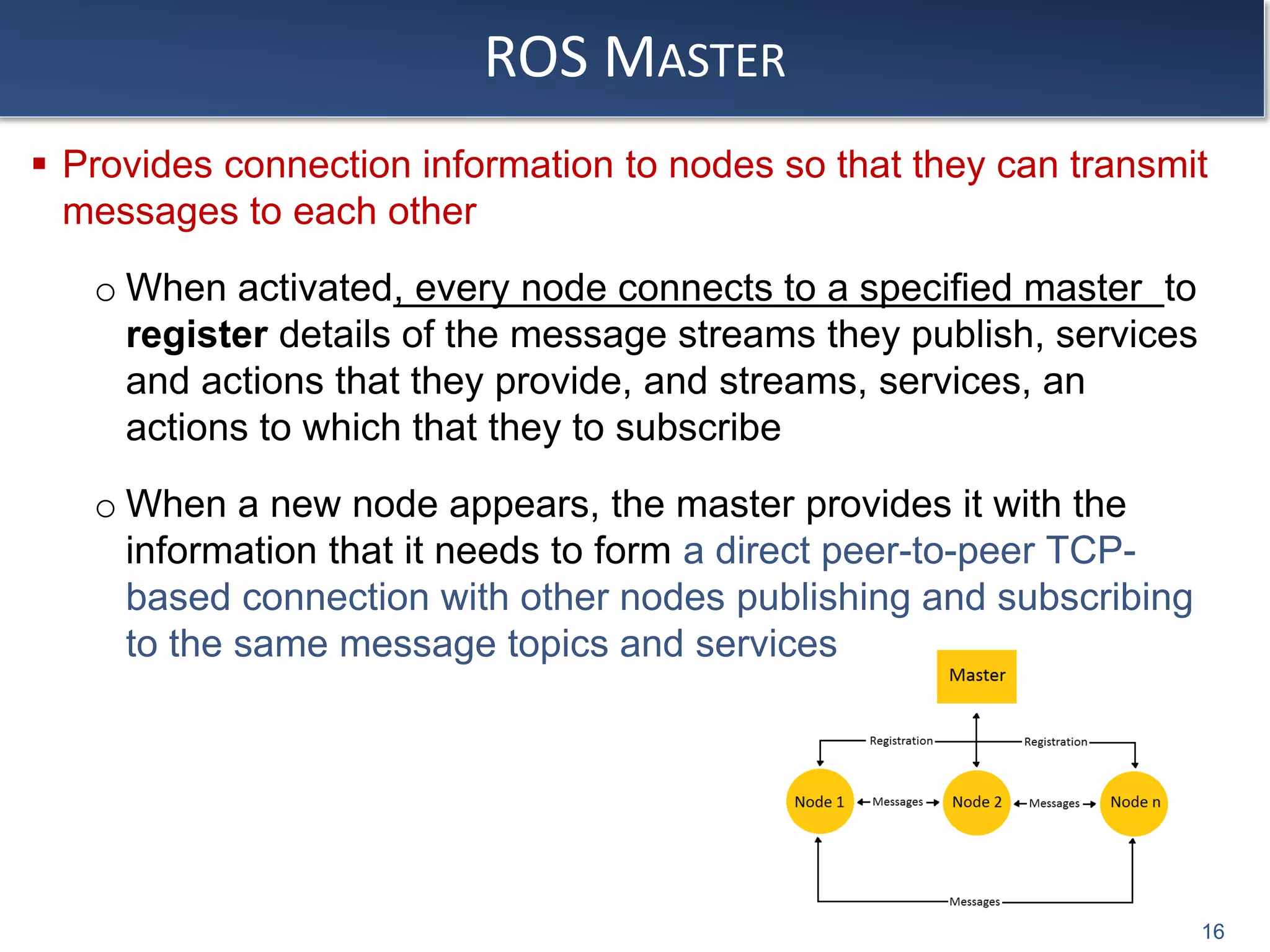
 Provides connection information to nodes so that they can transmit
messages to each other
o When activated, every node connects to a specified master to
register details of the message streams they publish, services
and actions that they provide, and streams, services, an
actions to which that they to subscribe
o When a new node appears, the master provides it with the
information that it needs to form a direct peer-to-peer TCP-
based connection with other nodes publishing and subscribing
to the same message topics and services
16
ROS MASTER
17
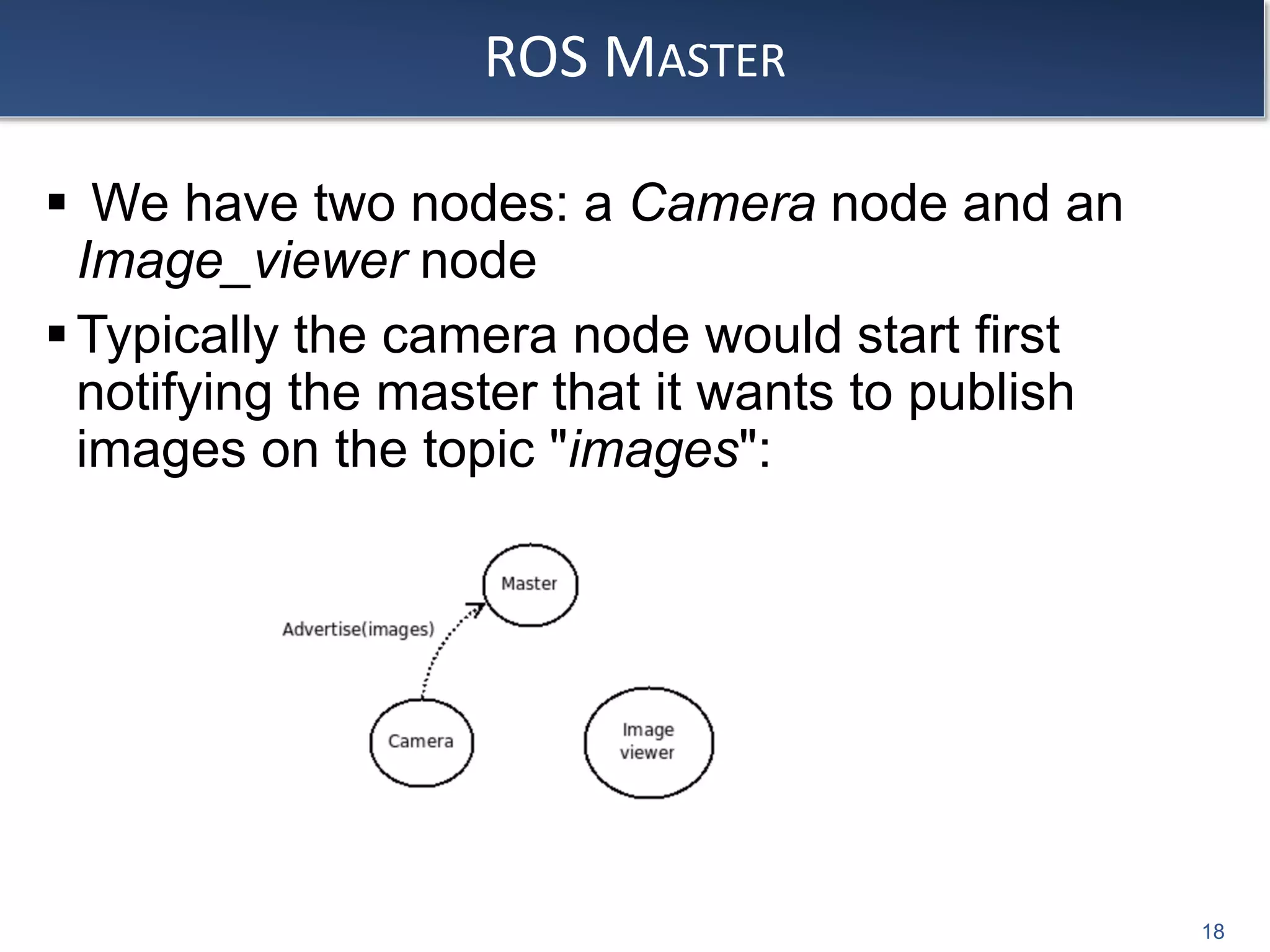
ROS MASTER
 We have two nodes: a Camera node and an
Image_viewer node
Typically the camera node would start first
notifying the master that it wants to publish
images on the topic "images":
18
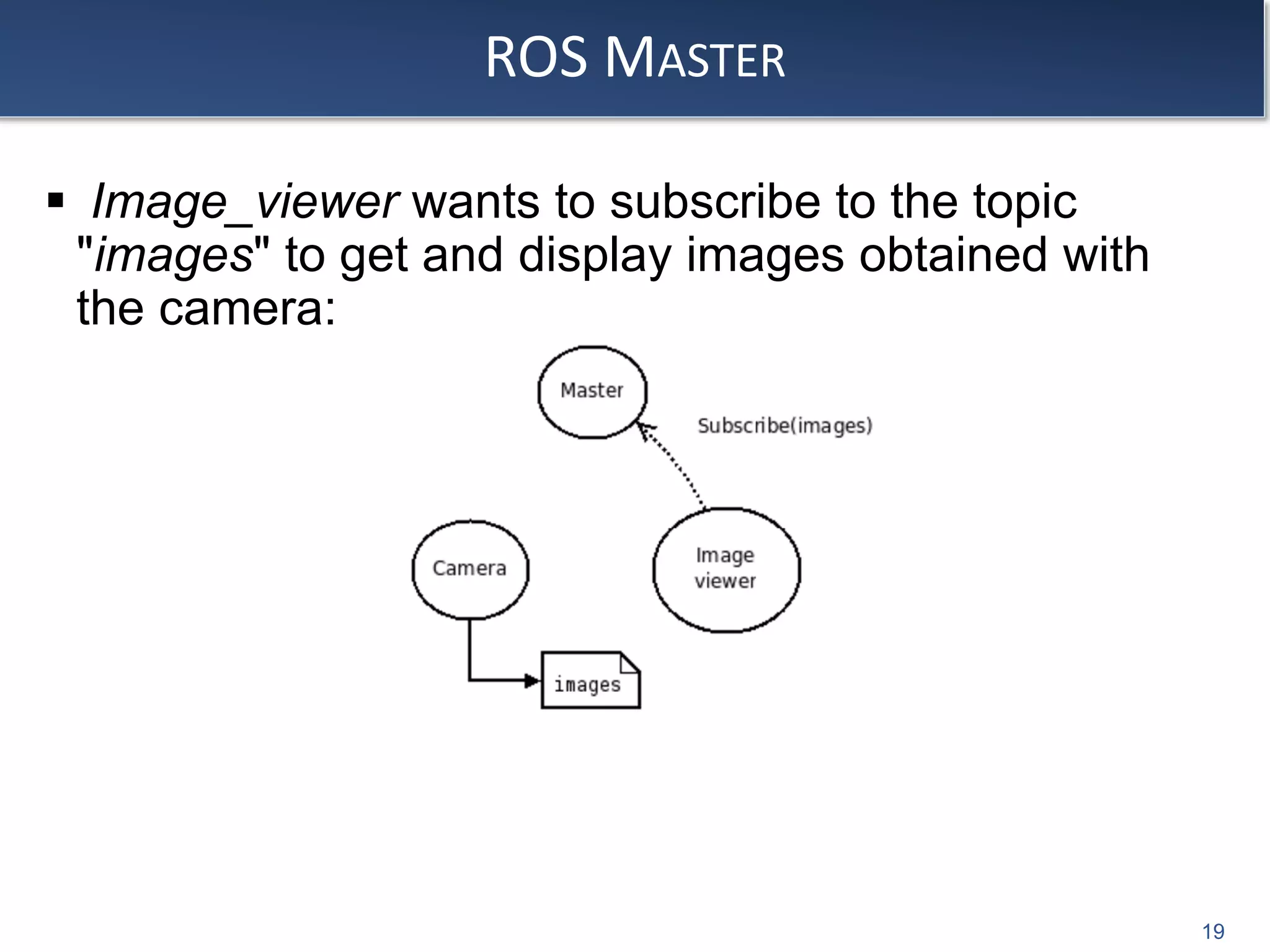
ROS MASTER
 Image_viewer wants to subscribe to the topic
"images" to get and display images obtained with
the camera:
19
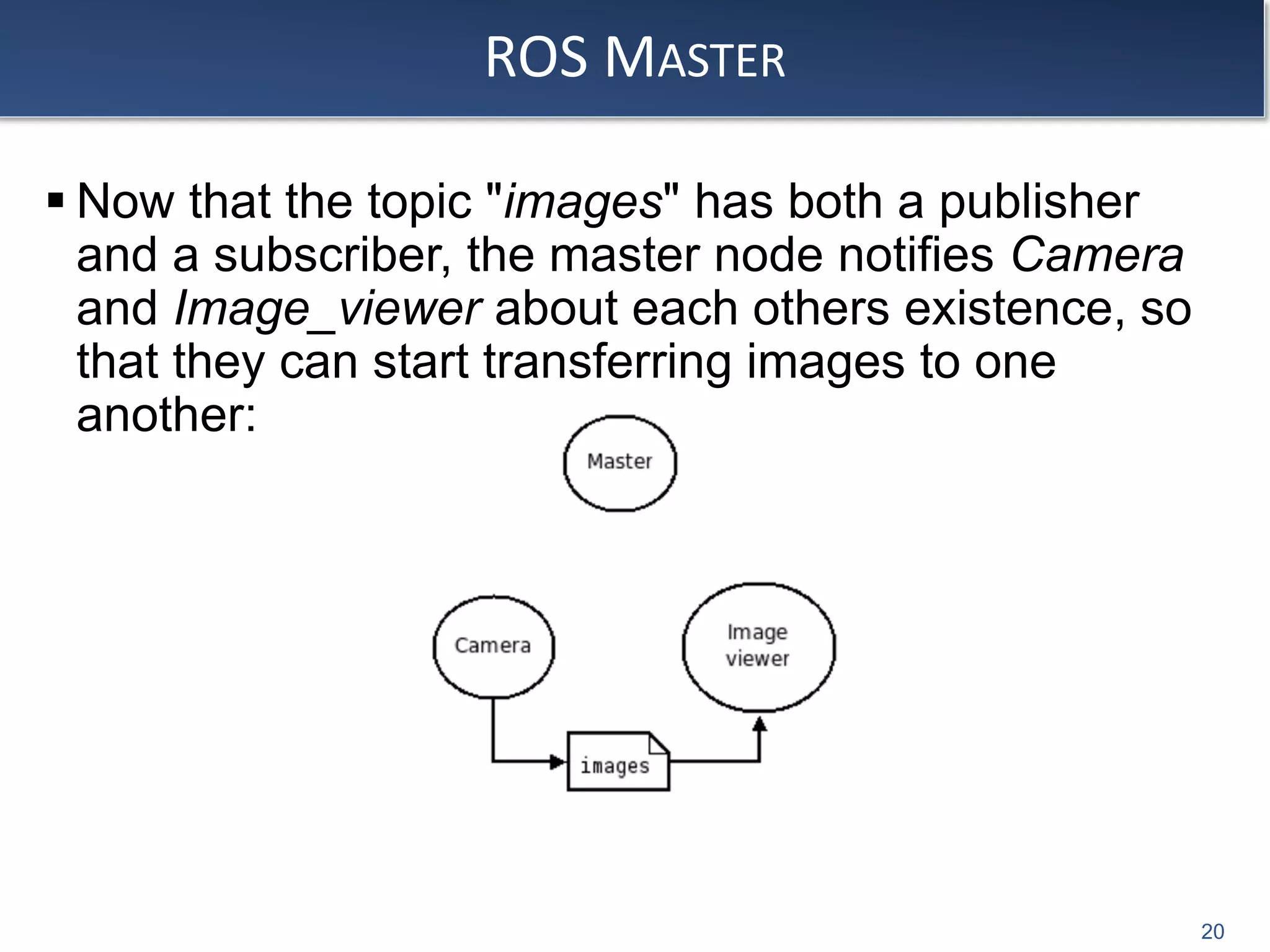
ROS MASTER
 Now that the topic "images" has both a publisher
and a subscriber, the master node notifies Camera
and Image_viewer about each others existence, so
that they can start transferring images to one
another:
20
21
ROS MASTER
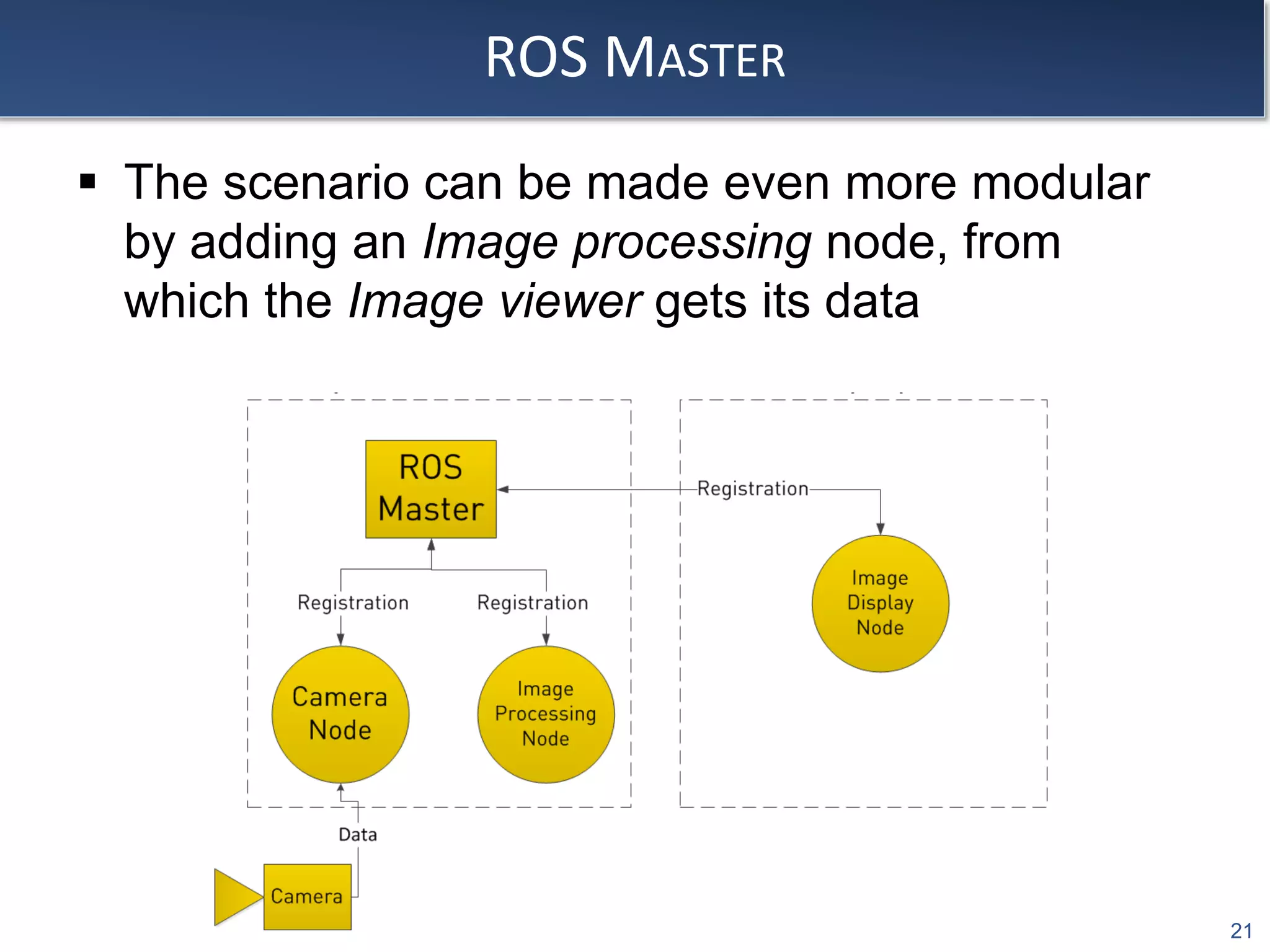
 The scenario can be made even more modular
by adding an Image processing node, from
which the Image viewer gets its data
PARAMETER SERVER
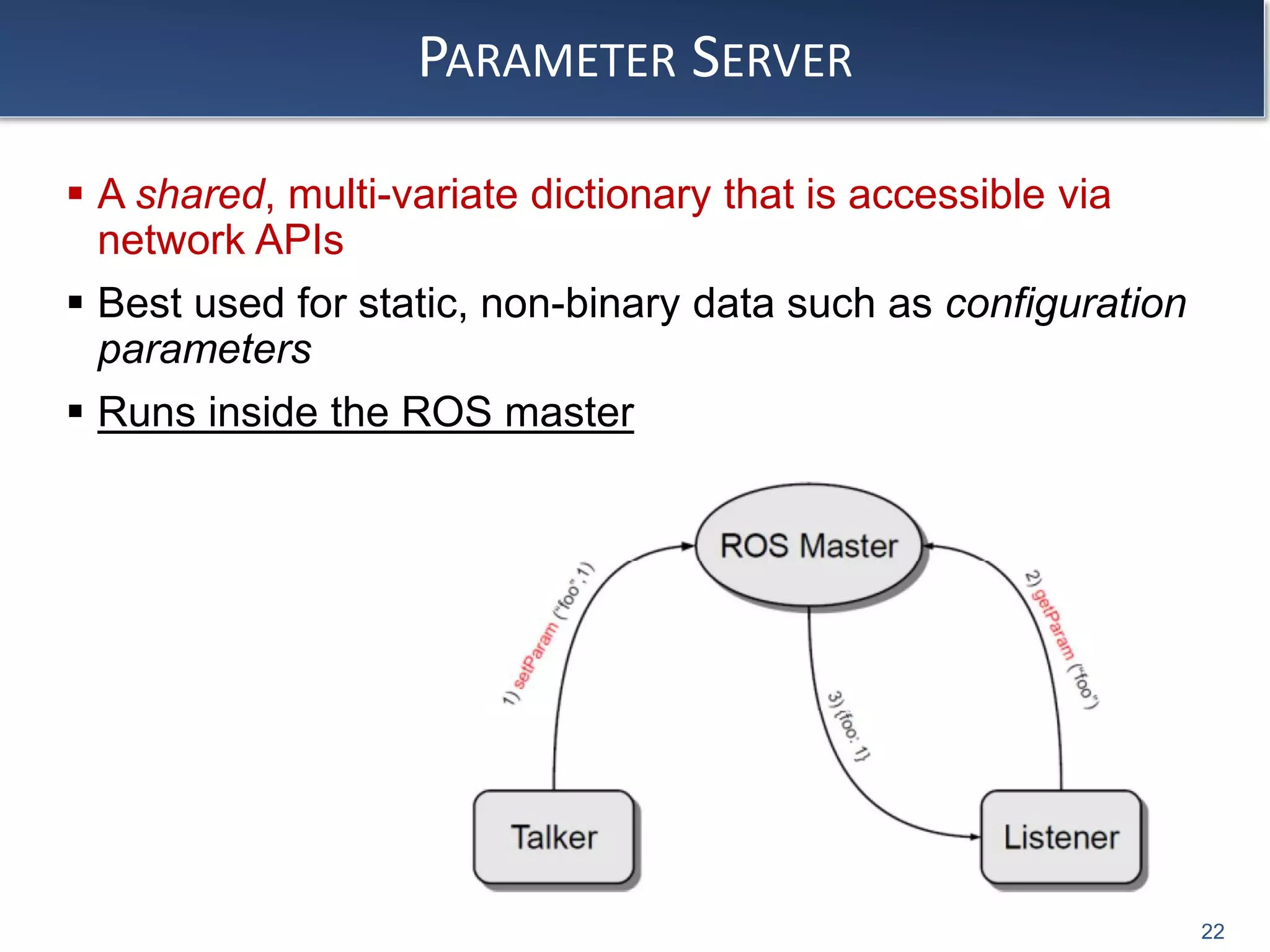
 A shared, multi-variate dictionary that is accessible via
network APIs
 Best used for static, non-binary data such as configuration
parameters
 Runs inside the ROS master
22
ROS BAGS
 Bags are the primary mechanism in ROS for
data logging
 Bags subscribe to one or more ROS topics,
and store the serialized message data in a file
as it is received.
 Bag files can also be played back in ROS to
the same topics they were recorded from, or
even remapped to new topics.
23
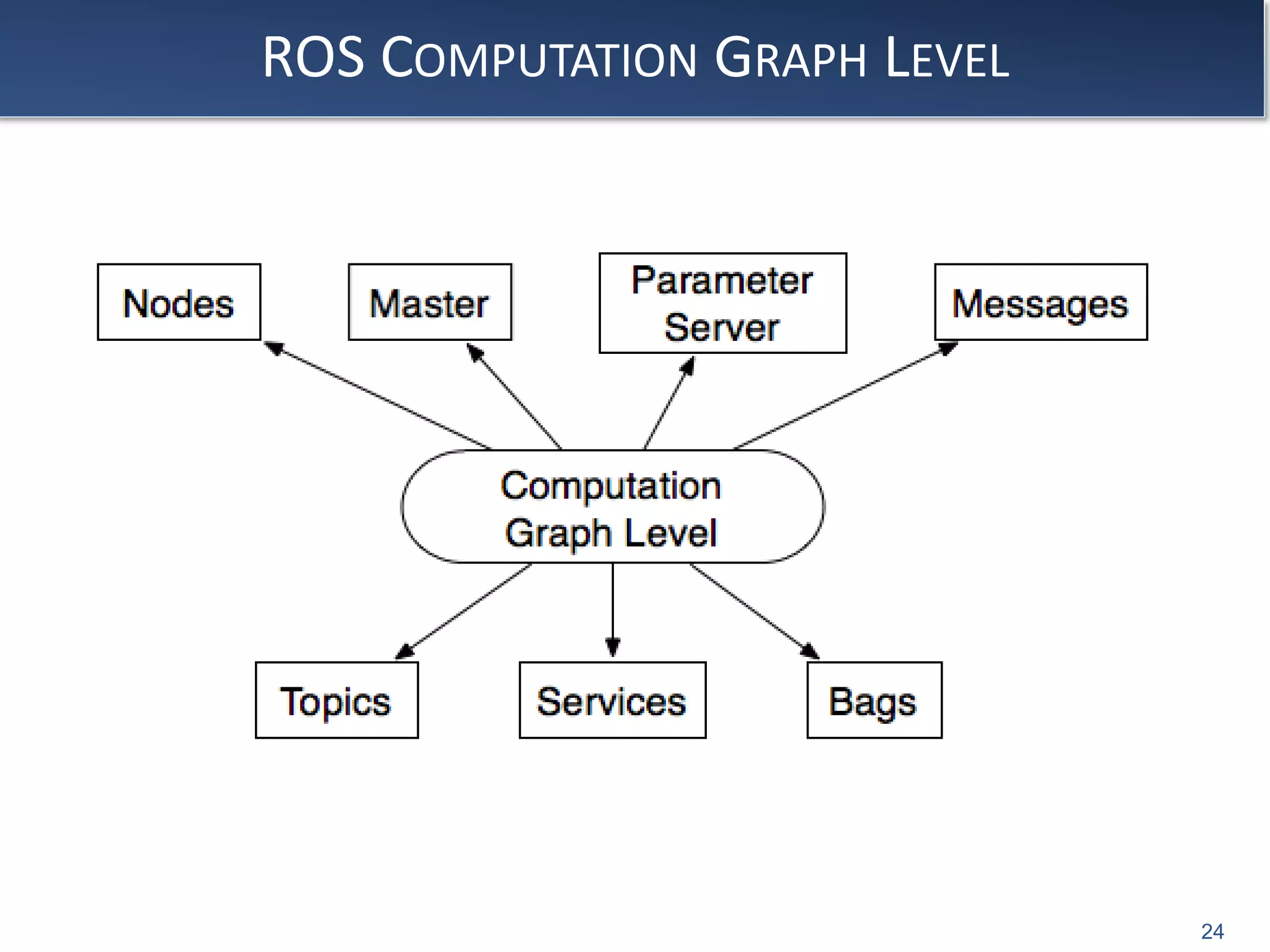
ROS COMPUTATION GRAPH LEVEL
24
ROS SUPPORTED PLATFORMS
 ROS is currently supported only on Ubuntu
o other variants such as Windows, Mac OS X, and
Android are considered experimental
 Current ROS Kinetic Kame runs on Ubuntu 16.04
(Xenial) and will support Ubuntu 15.10 (Willy)
25
ROS ENVIRONMENT
 ROS is fully integrated in the Linux environment: the
rosbash package contains useful bash functions and
adds tab-completion to a large number of ROS utilities
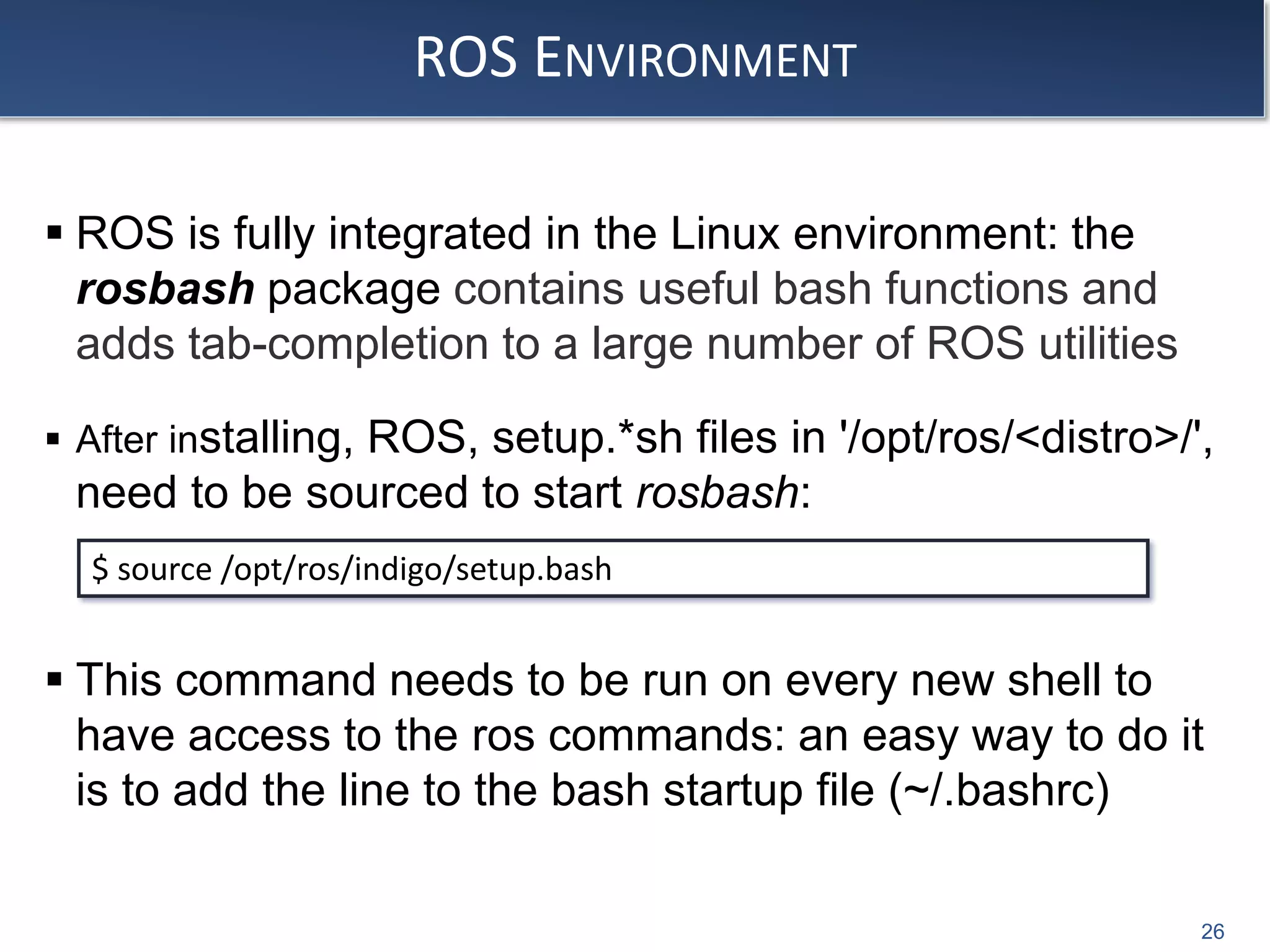
 After installing, ROS, setup.*sh files in '/opt/ros/<distro>/',
need to be sourced to start rosbash:
 This command needs to be run on every new shell to
have access to the ros commands: an easy way to do it
is to add the line to the bash startup file (~/.bashrc)
$ source /opt/ros/indigo/setup.bash
26
ROS PACKAGES
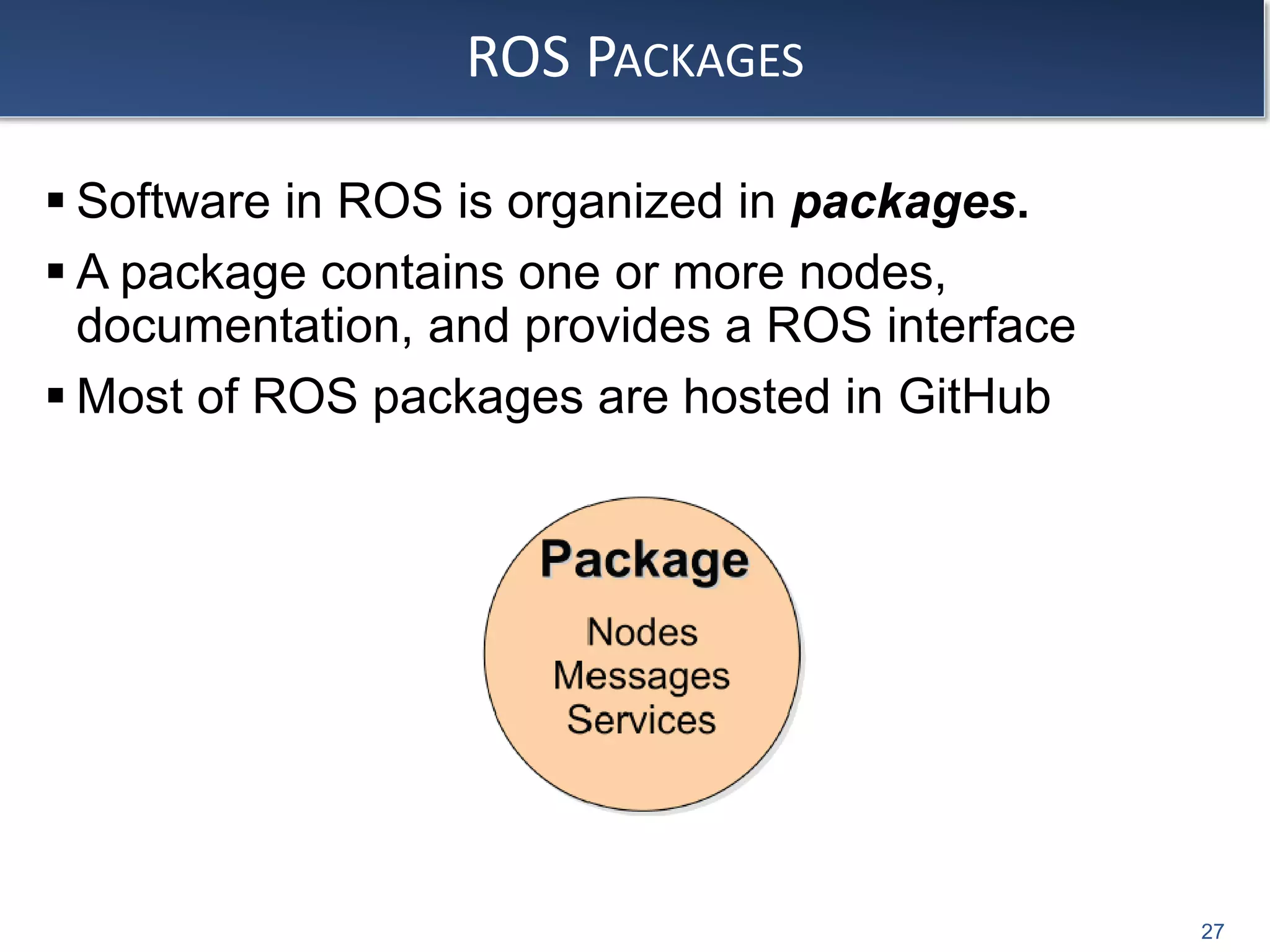
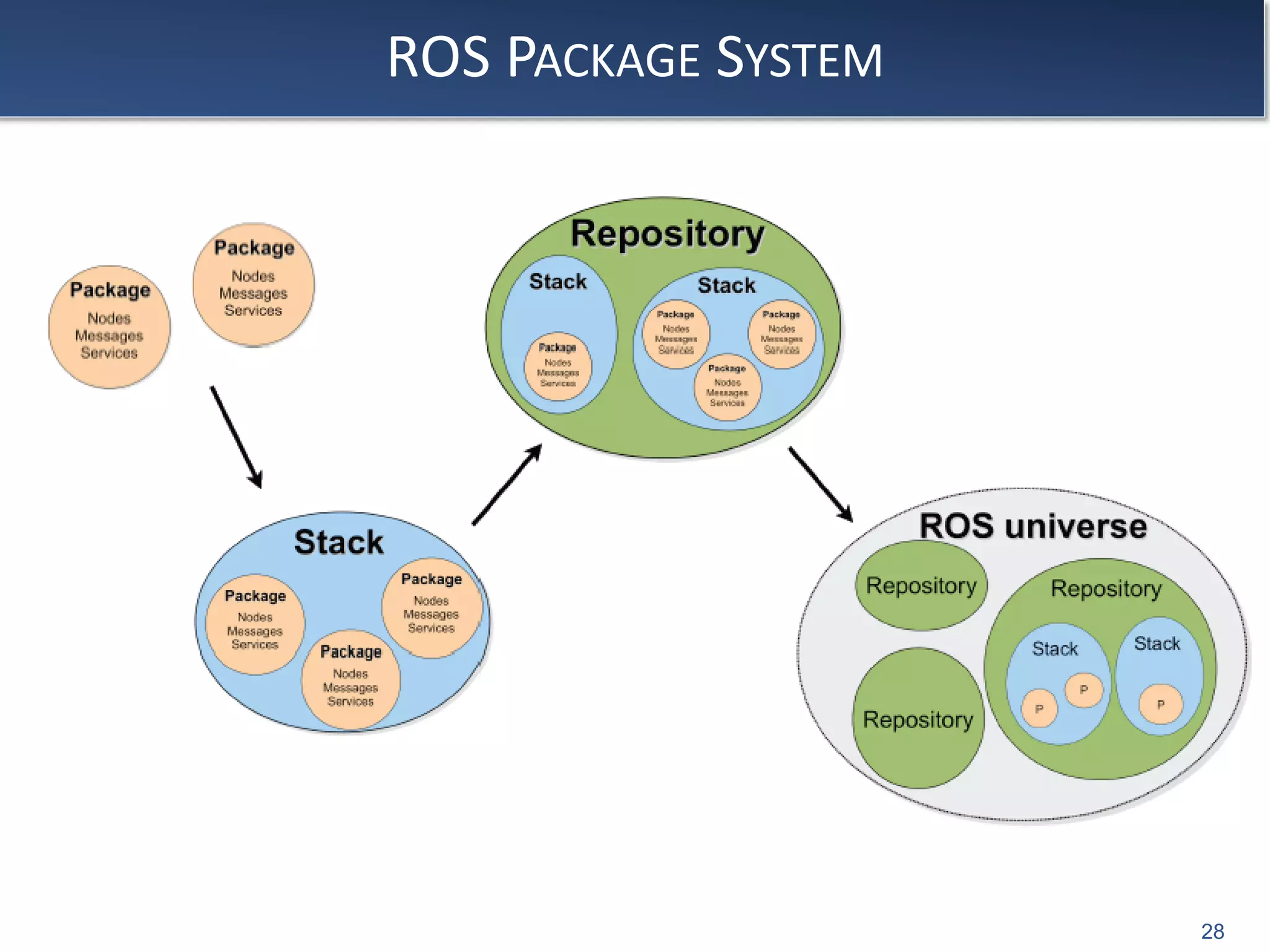
 Software in ROS is organized in packages.
 A package contains one or more nodes,
documentation, and provides a ROS interface
 Most of ROS packages are hosted in GitHub
27
ROS PACKAGE SYSTEM
28
29
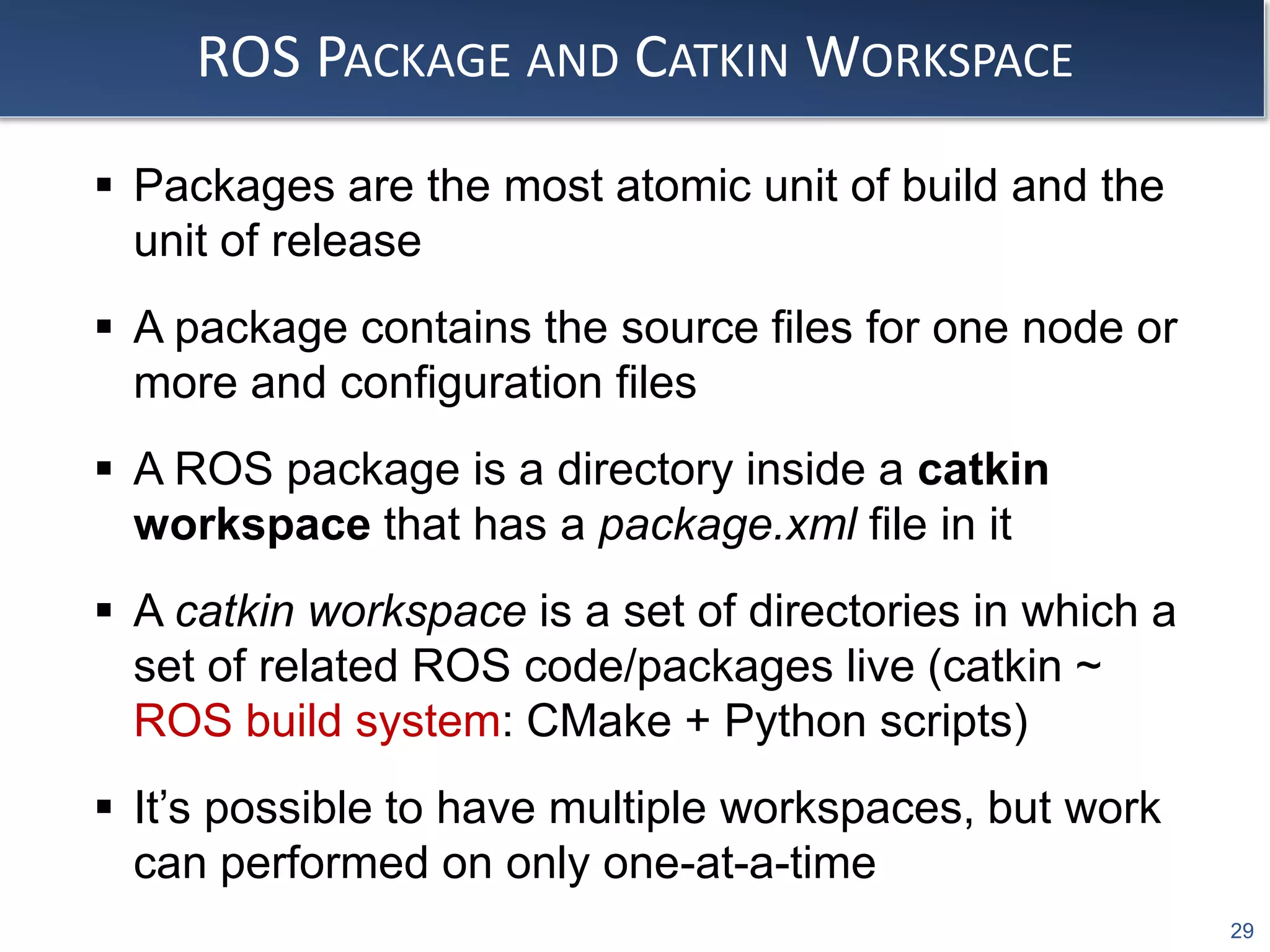
ROS PACKAGE AND CATKIN WORKSPACE
 Packages are the most atomic unit of build and the
unit of release
 A package contains the source files for one node or
more and configuration files
 A ROS package is a directory inside a catkin
workspace that has a package.xml file in it
 A catkin workspace is a set of directories in which a
set of related ROS code/packages live (catkin ~
ROS build system: CMake + Python scripts)
 It’s possible to have multiple workspaces, but work
can performed on only one-at-a-time
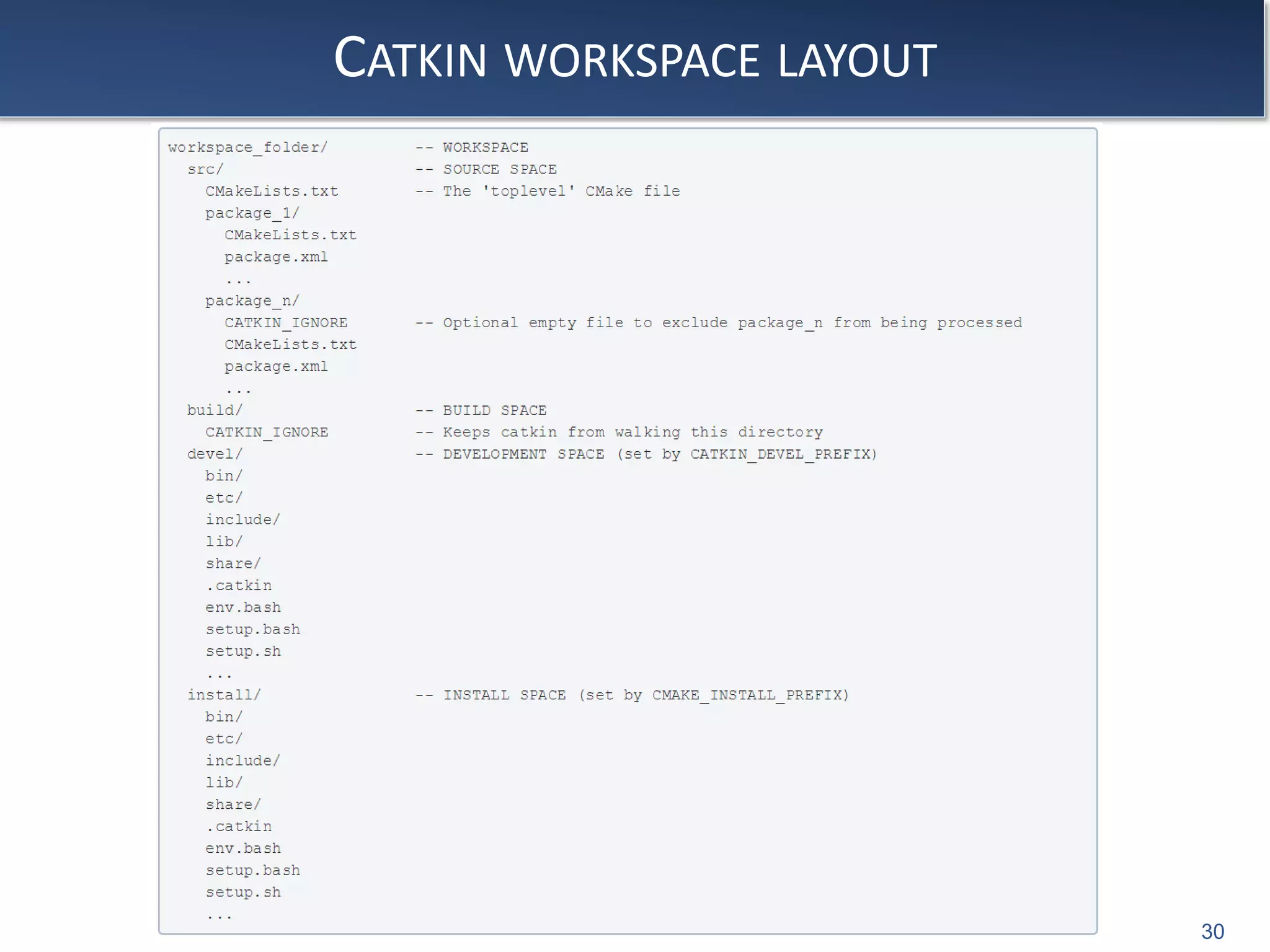
CATKIN WORKSPACE LAYOUT
30
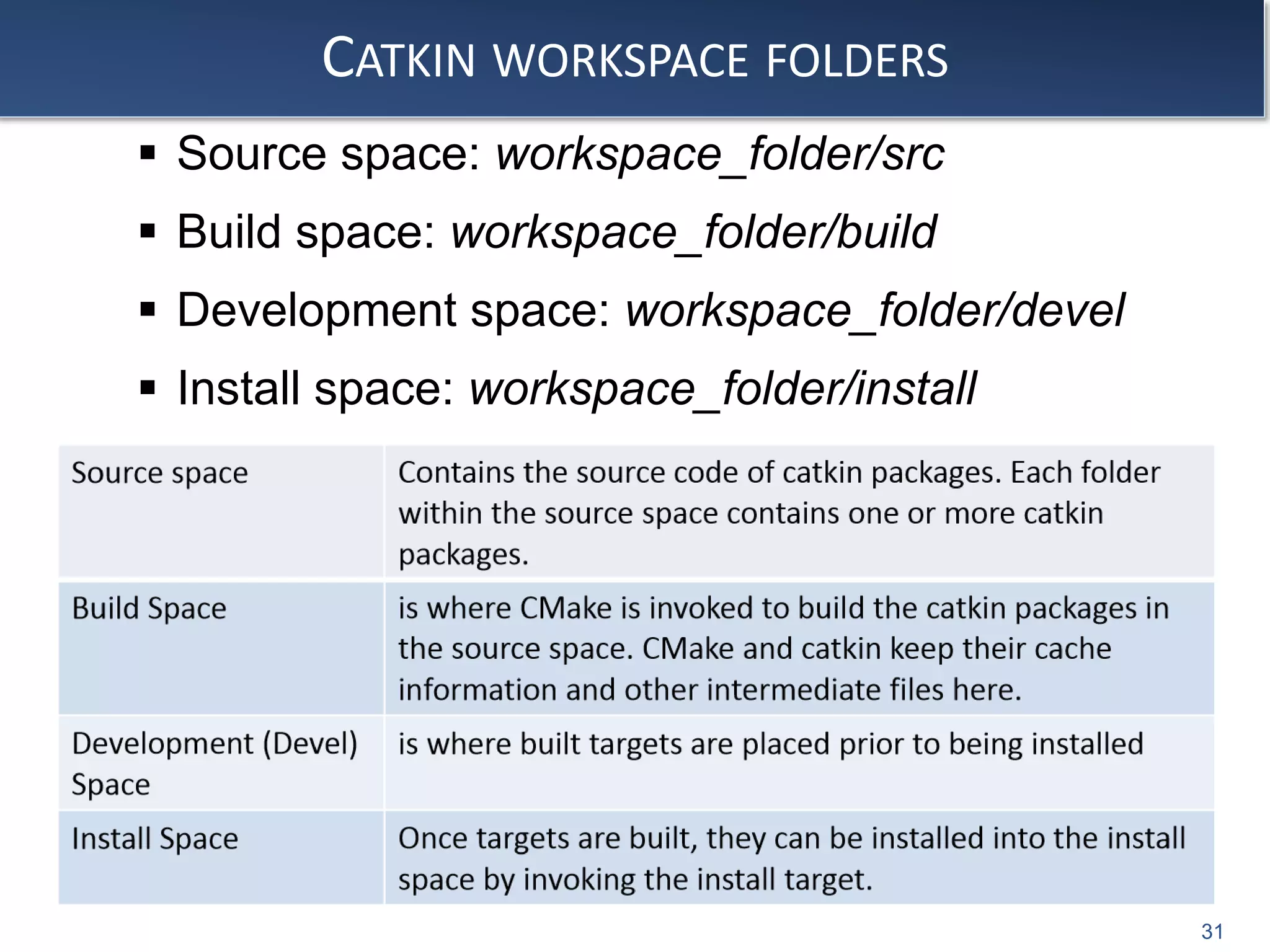
CATKIN WORKSPACE FOLDERS
31
 Source space: workspace_folder/src
 Build space: workspace_folder/build
 Development space: workspace_folder/devel
 Install space: workspace_folder/install
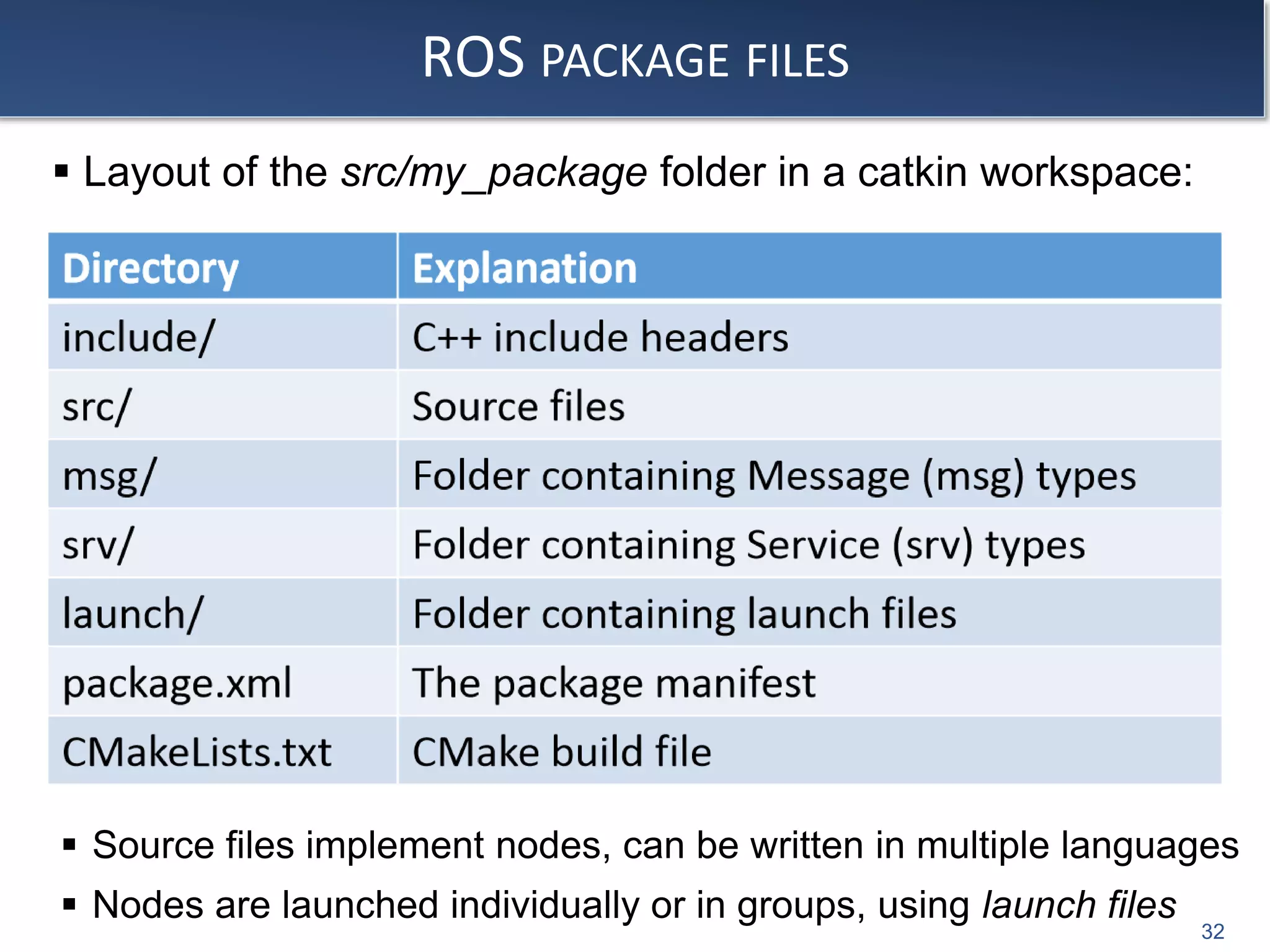
ROS PACKAGE FILES
 Source files implement nodes, can be written in multiple languages
 Nodes are launched individually or in groups, using launch files
32
 Layout of the src/my_package folder in a catkin workspace:
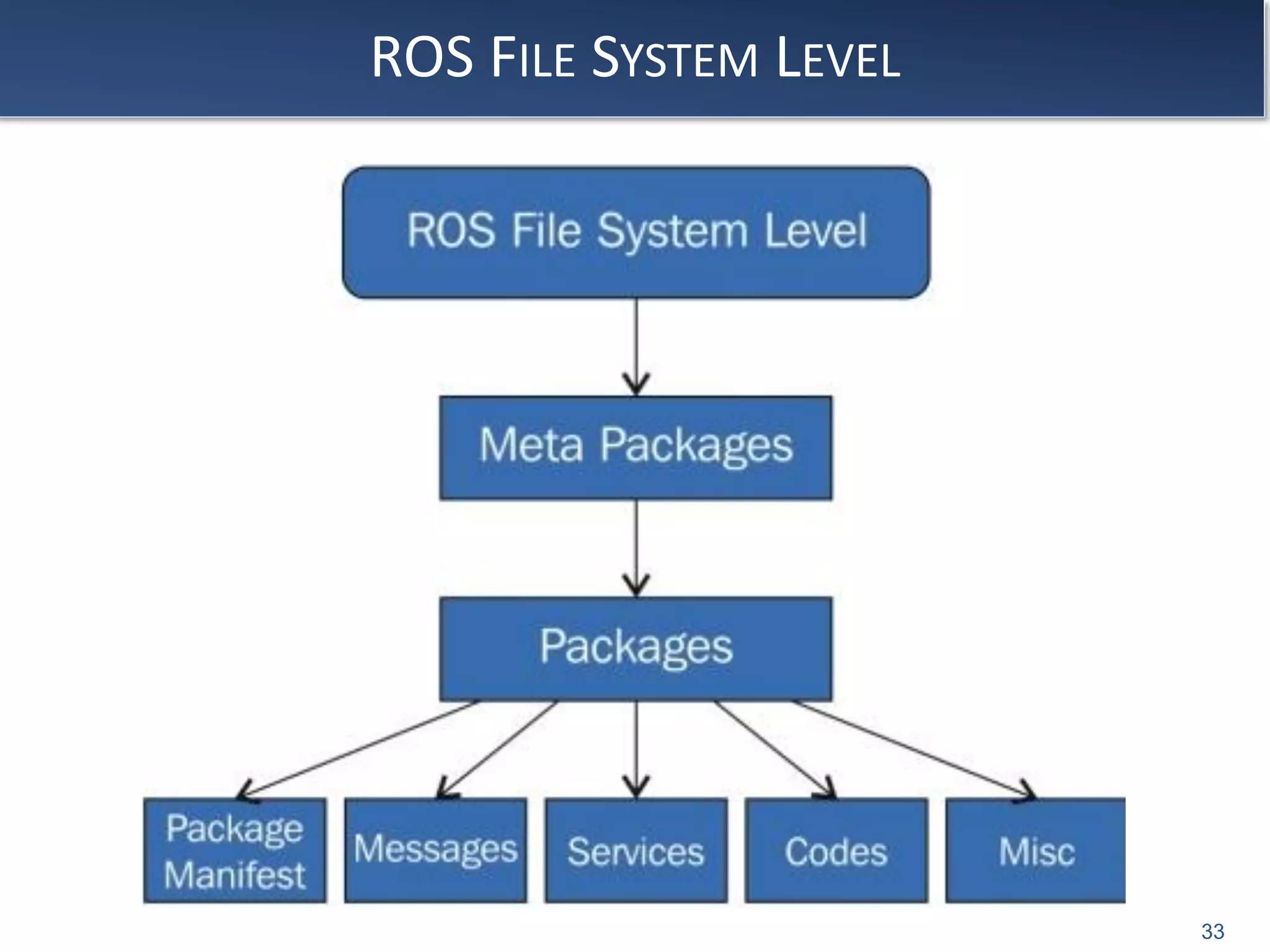
ROS FILE SYSTEM LEVEL
33
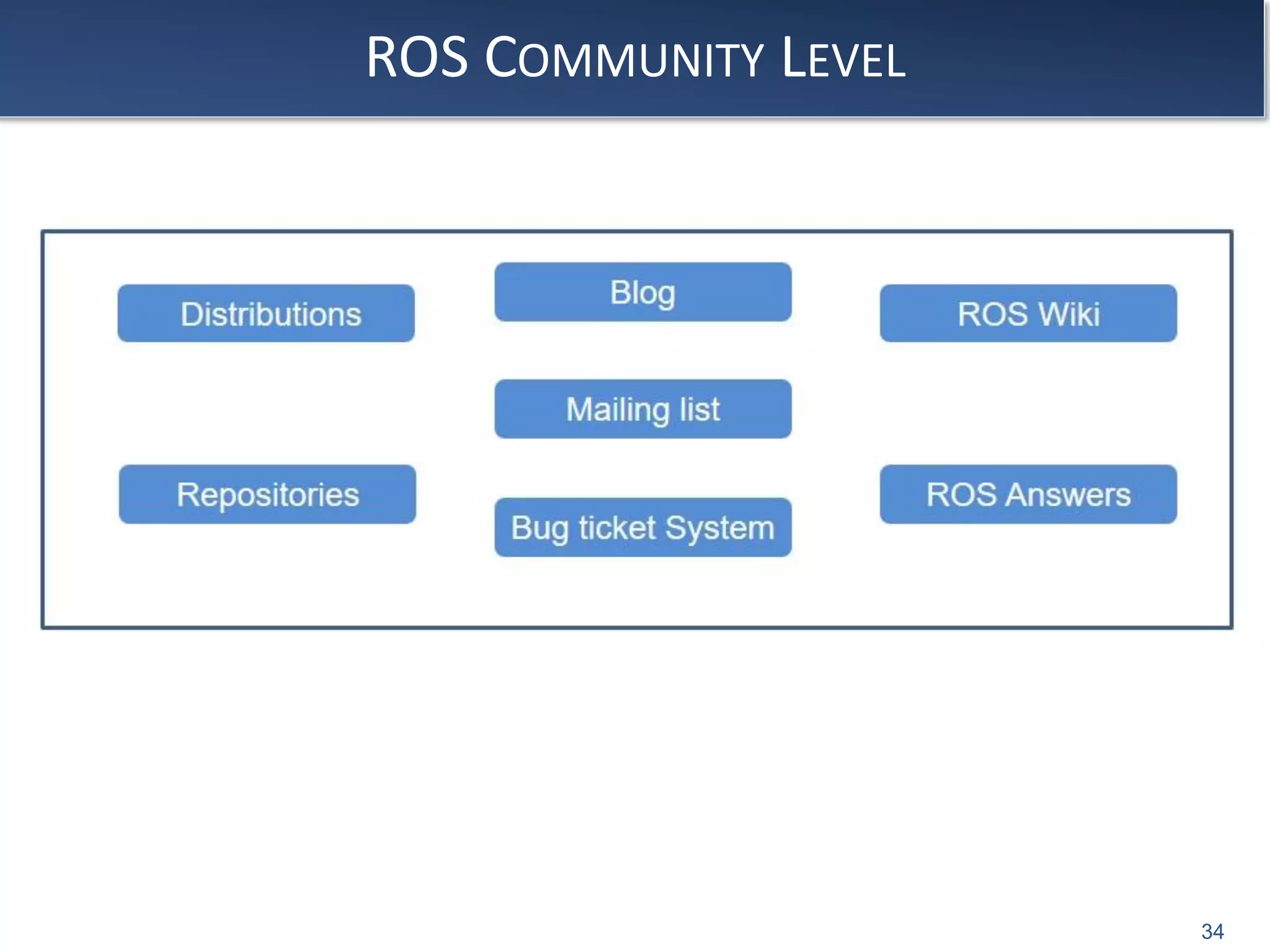
ROS COMMUNITY LEVEL
34

Lab-1-ROS-Intro.pdf

  • 1.
    LAB LECTURE 1: INTRODUCTIONTO ROS INSTRUCTOR: GIANNI A. DI CARO 16-311-Q INTRODUCTION TO ROBOTICS
  • 2.
    2 PROBLEM(S) IN ROBOTICSDEVELOPMENT • Lack of standards • Little code reusability • Keeping reinventing (or rewriting) device drivers, access to robot’s interfaces, management of on- board processes, inter-process communication protocols, … • Keeping re-coding standard algorithms • New robot in the lab (or in the factory)  start re-coding (mostly) from scratch In Robotics, before ROS
  • 3.
    ROBOT OPERATING SYSTEM(ROS) 3 http://www.ros.org
  • 4.
    WHAT IS ROS? ROS is an open-source robot operating system  A set of software libraries and tools that help you build robot applications that work across a wide variety of robotic platforms  Originally developed in 2007 at the Stanford Artificial Intelligence Laboratory and development continued at Willow Garage  Since 2013 managed by OSRF (Open Source Robotics Foundation) 4 Note: Some of the following slides are adapted from Roi Yehoshua
  • 5.
    ROS MAIN FEATURES ROShas two "sides"  The operating system side, which provides standard operating system services such as: o hardware abstraction o low-level device control o implementation of commonly used functionality o message-passing between processes o package management  A suite of user contributed packages that implement common robot functionality such as SLAM, planning, perception, vision, manipulation, etc. 5
  • 6.
  • 7.
    ROS PHILOSOPHY  Peerto Peer o ROS systems consist of many small programs (nodes) which connect to each other and continuously exchange messages  Tools-based o There are many small, generic programs that perform tasks such as visualization, logging, plotting data streams, etc.  Multi-Lingual o ROS software modules can be written in any language for which a client library has been written. Currently client libraries exist for C++, Python, LISP, Java, JavaScript, MATLAB, Ruby, and more.  Thin o The ROS conventions encourage contributors to create stand-alone libraries/packages and then wrap those libraries so they send and receive messages to/from other ROS modules.  Free & open source, community-based, repositories 7
  • 8.
  • 9.
    SOME ROBOTS USINGROS ( > 125) http://wiki.ros.org/Robots 9
  • 10.
    ROS CORE CONCEPTS Nodes Messagesand Topics Services Actions ROS Master Parameters Packages and Stacks 10
  • 11.
    ROS NODES  Single-purposedexecutable programs oe.g. sensor driver(s), actuator driver(s), map building, planner, UI, etc.  Individually compiled, executed, and managed  Nodes are written using a ROS client library o roscpp – C++ client library o rospy – python client library  Nodes can publish or subscribe to a Topic  Nodes can also provide or use a Service or an Action 11
  • 12.
  • 13.
    ROS TOPICS ANDROS MESSAGES  Topic: named stream of messages with a defined type o Data from a range-finder might be sent on a topic called scan, with a message of type LaserScan  Nodes communicate with each other by publishing messages to topics  Publish/Subscribe model: 1-to-N broadcasting 13  Messages: Strictly-typed data structures for inter- node communication o geometry_msgs/Twist is used to express velocity commands: Vector3 linear Vector3 angular
  • 14.
    ROS TOPICS ANDROS MESSAGES 14 Vector3 linear Vector3 angular float64 x float64 y float64 z geometry_msgs/Twist Vector3
  • 15.
    ROS SERVICES  Synchronousinter-node transactions (blocking RPC): ask for something and wait for it  Service/Client model: 1-to-1 request-response  Service roles: o carry out remote computation o trigger functionality / behavior o map_server/static_map – retrieves the current grid map used for navigation 15
  • 16.
    ROS MASTER  Providesconnection information to nodes so that they can transmit messages to each other o When activated, every node connects to a specified master to register details of the message streams they publish, services and actions that they provide, and streams, services, an actions to which that they to subscribe o When a new node appears, the master provides it with the information that it needs to form a direct peer-to-peer TCP- based connection with other nodes publishing and subscribing to the same message topics and services 16
  • 17.
  • 18.
    ROS MASTER  Wehave two nodes: a Camera node and an Image_viewer node Typically the camera node would start first notifying the master that it wants to publish images on the topic "images": 18
  • 19.
    ROS MASTER  Image_viewerwants to subscribe to the topic "images" to get and display images obtained with the camera: 19
  • 20.
    ROS MASTER  Nowthat the topic "images" has both a publisher and a subscriber, the master node notifies Camera and Image_viewer about each others existence, so that they can start transferring images to one another: 20
  • 21.
    21 ROS MASTER  Thescenario can be made even more modular by adding an Image processing node, from which the Image viewer gets its data
  • 22.
    PARAMETER SERVER  Ashared, multi-variate dictionary that is accessible via network APIs  Best used for static, non-binary data such as configuration parameters  Runs inside the ROS master 22
  • 23.
    ROS BAGS  Bagsare the primary mechanism in ROS for data logging  Bags subscribe to one or more ROS topics, and store the serialized message data in a file as it is received.  Bag files can also be played back in ROS to the same topics they were recorded from, or even remapped to new topics. 23
  • 24.
  • 25.
    ROS SUPPORTED PLATFORMS ROS is currently supported only on Ubuntu o other variants such as Windows, Mac OS X, and Android are considered experimental  Current ROS Kinetic Kame runs on Ubuntu 16.04 (Xenial) and will support Ubuntu 15.10 (Willy) 25
  • 26.
    ROS ENVIRONMENT  ROSis fully integrated in the Linux environment: the rosbash package contains useful bash functions and adds tab-completion to a large number of ROS utilities  After installing, ROS, setup.*sh files in '/opt/ros/<distro>/', need to be sourced to start rosbash:  This command needs to be run on every new shell to have access to the ros commands: an easy way to do it is to add the line to the bash startup file (~/.bashrc) $ source /opt/ros/indigo/setup.bash 26
  • 27.
    ROS PACKAGES  Softwarein ROS is organized in packages.  A package contains one or more nodes, documentation, and provides a ROS interface  Most of ROS packages are hosted in GitHub 27
  • 28.
  • 29.
    29 ROS PACKAGE ANDCATKIN WORKSPACE  Packages are the most atomic unit of build and the unit of release  A package contains the source files for one node or more and configuration files  A ROS package is a directory inside a catkin workspace that has a package.xml file in it  A catkin workspace is a set of directories in which a set of related ROS code/packages live (catkin ~ ROS build system: CMake + Python scripts)  It’s possible to have multiple workspaces, but work can performed on only one-at-a-time
  • 30.
  • 31.
    CATKIN WORKSPACE FOLDERS 31 Source space: workspace_folder/src  Build space: workspace_folder/build  Development space: workspace_folder/devel  Install space: workspace_folder/install
  • 32.
    ROS PACKAGE FILES Source files implement nodes, can be written in multiple languages  Nodes are launched individually or in groups, using launch files 32  Layout of the src/my_package folder in a catkin workspace:
  • 33.
  • 34.