

By
Balasudharsanakrishnan.B BE(CSE)
Shahanas Banu.T BE(CSE)
Pre –Final Year
INTRODUCTION
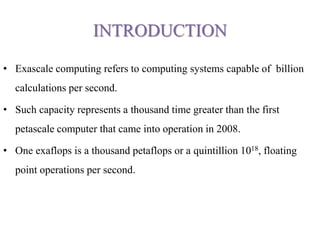
• Exascale computing refers to computing systems capable of billion
calculations per second.
• Such capacity represents a thousand time greater than the first
petascale computer that came into operation in 2008.
• One exaflops is a thousand petaflops or a quintillion 1018, floating
point operations per second.
ORIGIN
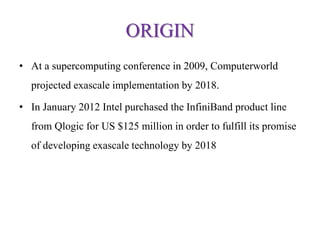
• At a supercomputing conference in 2009, Computerworld
projected exascale implementation by 2018.
• In January 2012 Intel purchased the InfiniBand product line
from Qlogic for US $125 million in order to fulfill its promise
of developing exascale technology by 2018
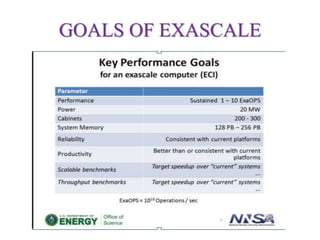
GOALS OF EXASCALE
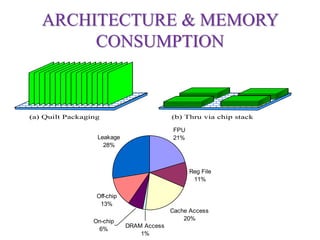
ARCHITECTURE & MEMORY
CONSUMPTION
(a) Quilt Packaging (b) Thru via chip stack
Reg File
11%
Cache Access
20%
Off-chip
13%
Leakage
28%
On-chip
6%
DRAM Access
1%
FPU
21%
ARCHITECTURE CONTD
• Intel neo is a processor that is used in exascale computing.
• Its size in 0.1mm.
• 256 processors are embedded in a circuit around circuit
important components are connected.
• DRAM (Dynamic Random Access Memory) is used for
exascale systems.
• It has a very efficient process.
GPU
• A graphics processor unit (GPU), also occasionally called visual
processor unit (VPU), is a specialized electronic circuit designed
to rapidly manipulate and alter memory to accelerate the creation
of images in a frame buffer intended for output to a display
• modern GPUs use most of their transistors to do calculations
related to 3D computer graphics.
GETTING TO EXASCALE
• Before 2020, exascale systems will be able to compute a quintillion
operations per second!
• Scientific simulation will continue to push on system requirements:
– To increase the precision of the result
– To get to an answer sooner (e.g., climate modeling, disaster modeling)
• The U.S. will continue to acquire systems of increasing scale
– For the above reasons
– And to maintain competitiveness
• A similar phenomenon in commodity machines
– More, faster, cheaper
ADVANTAGES
• GPU interface
• Low time consumption
• It is used in LCF (Leadership Computing Facillity)
• It has high processing speed
• Sustained petascale and Exascale
• High network performance
CHALLENGES
• Exascale architectures will be fundamentally different
• Power management becomes fundamental
• Reliability (h/w and s/w) increasingly a concern
• Memory reduction to .01 bytes/flop
• Complex to design
• Need large area
SOLUTIONS
• We need to create a new software/architecture to reduce
power consumption
• Express and manage locality and parallelism for billion threads
• Create/support applications that are prepared for new hardware
• If nanotechnology integrated into this we can made this system
to small
FUTURE DEVELOPMENT
• In 2018 USA going to launch their first exascale system.
• In Europe Manchester university started their research.
• Japan government launch their exascale system in 2020 with
30 megawatt consumption.
• Intel and DEEP also started their research towards exascale
computing.
APPLICATIONS
• Space research
• Biology
• Medicine
• Scientific calculations
• Metallurgy
• Weather
• Material science …etc
CONCLUSION
• It’s a emerging technology
• Exascale is a new computing technique is used for processing many
calculations at a second.
• It has a new architectures better than super computing..
• GPU gives very much graphical properties than supercomputing.
• In future the computing are ruled by exascale.
EXASXALE COMPUTING
EXASXALE COMPUTING

EXASXALE COMPUTING

  • 1.
  • 2.
    INTRODUCTION • Exascale computingrefers to computing systems capable of billion calculations per second. • Such capacity represents a thousand time greater than the first petascale computer that came into operation in 2008. • One exaflops is a thousand petaflops or a quintillion 1018, floating point operations per second.
  • 3.
    ORIGIN • At asupercomputing conference in 2009, Computerworld projected exascale implementation by 2018. • In January 2012 Intel purchased the InfiniBand product line from Qlogic for US $125 million in order to fulfill its promise of developing exascale technology by 2018
  • 4.
  • 5.
    ARCHITECTURE & MEMORY CONSUMPTION (a)Quilt Packaging (b) Thru via chip stack Reg File 11% Cache Access 20% Off-chip 13% Leakage 28% On-chip 6% DRAM Access 1% FPU 21%
  • 6.
    ARCHITECTURE CONTD • Intelneo is a processor that is used in exascale computing. • Its size in 0.1mm. • 256 processors are embedded in a circuit around circuit important components are connected. • DRAM (Dynamic Random Access Memory) is used for exascale systems. • It has a very efficient process.
  • 7.
    GPU • A graphicsprocessor unit (GPU), also occasionally called visual processor unit (VPU), is a specialized electronic circuit designed to rapidly manipulate and alter memory to accelerate the creation of images in a frame buffer intended for output to a display • modern GPUs use most of their transistors to do calculations related to 3D computer graphics.
  • 8.
    GETTING TO EXASCALE •Before 2020, exascale systems will be able to compute a quintillion operations per second! • Scientific simulation will continue to push on system requirements: – To increase the precision of the result – To get to an answer sooner (e.g., climate modeling, disaster modeling) • The U.S. will continue to acquire systems of increasing scale – For the above reasons – And to maintain competitiveness • A similar phenomenon in commodity machines – More, faster, cheaper
  • 9.
    ADVANTAGES • GPU interface •Low time consumption • It is used in LCF (Leadership Computing Facillity) • It has high processing speed • Sustained petascale and Exascale • High network performance
  • 10.
    CHALLENGES • Exascale architectureswill be fundamentally different • Power management becomes fundamental • Reliability (h/w and s/w) increasingly a concern • Memory reduction to .01 bytes/flop • Complex to design • Need large area
  • 11.
    SOLUTIONS • We needto create a new software/architecture to reduce power consumption • Express and manage locality and parallelism for billion threads • Create/support applications that are prepared for new hardware • If nanotechnology integrated into this we can made this system to small
  • 12.
    FUTURE DEVELOPMENT • In2018 USA going to launch their first exascale system. • In Europe Manchester university started their research. • Japan government launch their exascale system in 2020 with 30 megawatt consumption. • Intel and DEEP also started their research towards exascale computing.
  • 13.
    APPLICATIONS • Space research •Biology • Medicine • Scientific calculations • Metallurgy • Weather • Material science …etc
  • 14.
    CONCLUSION • It’s aemerging technology • Exascale is a new computing technique is used for processing many calculations at a second. • It has a new architectures better than super computing.. • GPU gives very much graphical properties than supercomputing. • In future the computing are ruled by exascale.