Interconnection Network
Topologies
A physical connection between the different components of
a parallel system is provided by an interconnection network
Similar to control flow and data flow, or memory
organization, the interconnection network can also be used
for a classification of Parallel/Distributed systems.
In multicomputer systems, the interconnection network is
used to connect the processors or nodes with each other.
In multiprocessor systems, the interconnection network is
used to connect the processors with the memory modules.
Introduction
The main task of the interconnection network is to transfer
a message from a specific processor to a specific destination.
The requirement for the interconnection network is to
perform the message transfer correctly as fast as possible.
Even if several messages have to be transferred at the same
time.
Introduction
The topology describing the interconnection structure
used to connect different processors or processors and
memory modules.
The routing technique describing the exact message
transmission used within the network between
processors or processors and memory modules.
Introduction
The routing technique determines how and along
which path messages are transferred in the network
from a sender to a receiver.
Important aspects of the routing technique are the
routing algorithm which determines the path to be
used for the transmission.
The switching strategy which determines:
Whether and how messages are cut into pieces,
How a routing path is assigned to a message,
How a message is forwarded along the processors
or switches on the routing path.
Routing Techniques
The geometric structure can be described as a graph in
which switches, processors, or memory modules are
represented as vertices and physical links are
represented as edges.
Interconnection networks can be: static or dynamic.
Static interconnection networks connect nodes
(processors or memory modules) directly with each
other by fixed physical links.
They are also called direct networks or point-to-point
networks
Types of Interconnection networks
Static networks are often used for systems with a
distributed address space where a node comprises a
processor and the corresponding memory module.
Dynamic interconnection networks connect nodes
indirectly via switches, sometimes routers and links.
They are also called indirect networks.
Dynamic networks are used for both parallel systems
with distributed and shared address space.
Often, hybrid strategies are used.
Types of Interconnection networks
Properties of Interconnection Networks
Static interconnection networks can be described by a
connection graph G = (V, E).
V is a set of nodes to be connected and E is a set of
direct connection links between the nodes.
For most parallel/distributed systems, the interconnection
network is bidirectional.
Static networks can be characterized by specific
properties of the connection graph:
Number of nodes.
Diameter of the network.
Degree of the nodes.
Bisection bandwidth.
Node and edge connectivity of the network.
Flexibility of embeddings into other networks as
well as the embedding of other networks.
Properties of Interconnection Networks
The diameter δ(G) of a network G is defined as the
minimum distance between the most distant pair of
nodes. The diameter of a network determines the length of
the paths to be used for message transmission between any
pair of nodes.
The degree g(G) of a network G is the maximum degree of
a node of the network where the degree of a node n is the
number of direct neighbor nodes of n.
Properties of Interconnection Networks
The bisection bandwidth B(G) of a network G is defined
as the minimum number of edges that must be removed
to partition the network into two parts of equal size without
any connection between the two parts.
B(G)+1 messages can saturate a network G, if these
messages must be transferred at the same time over the
corresponding edges.
Thus, bisection bandwidth is a measure for the capacity
of a network when transmitting messages
simultaneously.
The node and edge connectivity of a network
measure the number of nodes or edges that must fail to
disconnect the network.
A high connectivity value indicates a high reliability
of the network and is therefore desirable.
Formally, the node connectivity of a network is defined
as the minimum number of nodes that must be
deleted to disconnect the network.
Properties of Interconnection Networks
The edge connectivity of a network is defined as the
minimum number of edges that must be deleted to
disconnect the network.
The flexibility of a network can be captured by the
notion of embedding.
Properties of Interconnection Networks
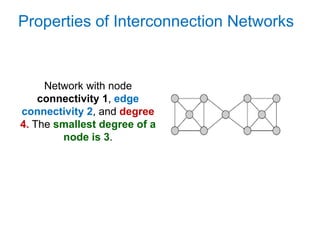
Network with node
connectivity 1, edge
connectivity 2, and degree
4. The smallest degree of a
node is 3.
Network with node
connectivity 1, edge
connectivity 2, and degree
4. The smallest degree of a
node is 3.
Properties of Interconnection Networks
Generally, the following topological properties are
desirable:
A small diameter to ensure small distances for
message transmission
A small node degree to reduce the hardware
overhead for the nodes
A large bisection bandwidth to obtain large data
throughputs.
Properties of Interconnection Networks
A large connectivity to ensure reliability of the
network
Embedding into a large number of networks to
ensure flexibility
Easy extendibility to a larger number of nodes
Properties of Interconnection Networks
Some of these properties are conflicting and there is
no network that meets all demands in an optimal way.
Let us start with static networks
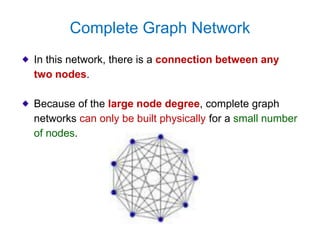
Complete Graph Network
In this network, there is a connection between any
two nodes.
Because of the large node degree, complete graph
networks can only be built physically for a small number
of nodes.
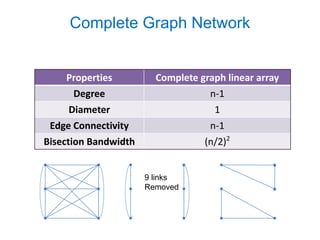
Complete Graph Network
Properties Complete graph linear array
Degree n-1
Diameter 1
Edge Connectivity n-1
Bisection Bandwidth (n/2)2
9 links
Removed
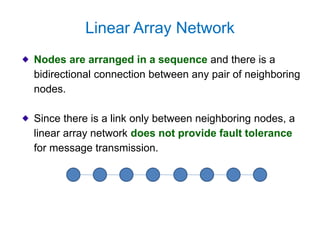
Linear Array Network
Nodes are arranged in a sequence and there is a
bidirectional connection between any pair of neighboring
nodes.
Since there is a link only between neighboring nodes, a
linear array network does not provide fault tolerance
for message transmission.
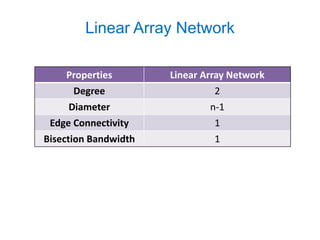
Linear Array Network
Properties Linear Array Network
Degree 2
Diameter n-1
Edge Connectivity 1
Bisection Bandwidth 1
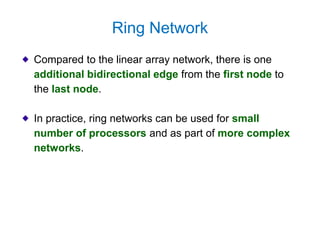
Ring Network
Compared to the linear array network, there is one
additional bidirectional edge from the first node to
the last node.
In practice, ring networks can be used for small
number of processors and as part of more complex
networks.
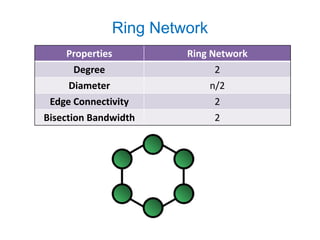
Ring Network
Properties Ring Network
Degree 2
Diameter n/2
Edge Connectivity 2
Bisection Bandwidth 2
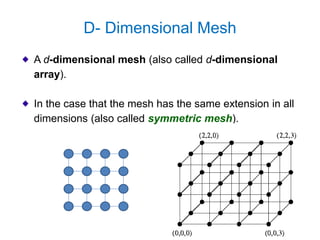
D- Dimensional Mesh
A d-dimensional mesh (also called d-dimensional
array).
In the case that the mesh has the same extension in all
dimensions (also called symmetric mesh).
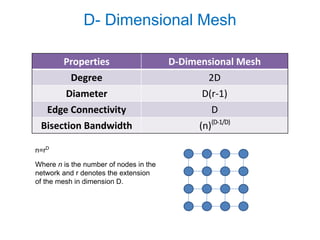
D- Dimensional Mesh
Properties D-Dimensional Mesh
Degree 2D
Diameter D(r-1)
Edge Connectivity D
Bisection Bandwidth (n)(D-1/D)
n=rD
Where n is the number of nodes in the
network and r denotes the extension
of the mesh in dimension D.
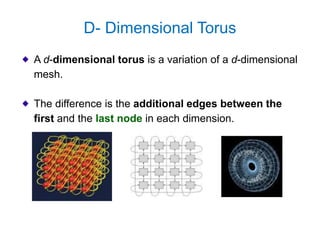
D- Dimensional Torus
A d-dimensional torus is a variation of a d-dimensional
mesh.
The difference is the additional edges between the
first and the last node in each dimension.
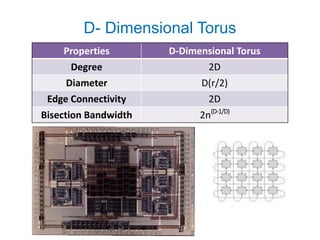
D- Dimensional Torus
Properties D-Dimensional Torus
Degree 2D
Diameter D(r/2)
Edge Connectivity 2D
Bisection Bandwidth 2n(D-1/D)
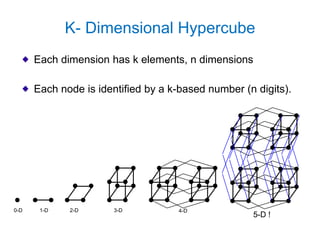
K- Dimensional Hypercube
Each dimension has k elements, n dimensions
Each node is identified by a k-based number (n digits).
0-D 1-D 2-D 3-D 4-D
5-D !
K- Dimensional Hypercube
Properties K-Dimensional hypercube
Degree log n
Diameter log n
Edge Connectivity log n
Bisection Bandwidth (n/2)
n=2K
Example: A 12-dimensional hypercube graph. The
information pathways of the 4096 nodes of twelve-
dimensional hypercube. Each node (symbolically
represented by a point) has twelve communication
channels (represented by a line) emanating from it.
K- Dimensional Hypercube
Thank you

Static networks

  • 1.
  • 2.
    A physical connectionbetween the different components of a parallel system is provided by an interconnection network Similar to control flow and data flow, or memory organization, the interconnection network can also be used for a classification of Parallel/Distributed systems. In multicomputer systems, the interconnection network is used to connect the processors or nodes with each other. In multiprocessor systems, the interconnection network is used to connect the processors with the memory modules. Introduction
  • 3.
    The main taskof the interconnection network is to transfer a message from a specific processor to a specific destination. The requirement for the interconnection network is to perform the message transfer correctly as fast as possible. Even if several messages have to be transferred at the same time. Introduction
  • 4.
    The topology describingthe interconnection structure used to connect different processors or processors and memory modules. The routing technique describing the exact message transmission used within the network between processors or processors and memory modules. Introduction
  • 5.
    The routing techniquedetermines how and along which path messages are transferred in the network from a sender to a receiver. Important aspects of the routing technique are the routing algorithm which determines the path to be used for the transmission. The switching strategy which determines: Whether and how messages are cut into pieces, How a routing path is assigned to a message, How a message is forwarded along the processors or switches on the routing path. Routing Techniques
  • 6.
    The geometric structurecan be described as a graph in which switches, processors, or memory modules are represented as vertices and physical links are represented as edges. Interconnection networks can be: static or dynamic. Static interconnection networks connect nodes (processors or memory modules) directly with each other by fixed physical links. They are also called direct networks or point-to-point networks Types of Interconnection networks
  • 7.
    Static networks areoften used for systems with a distributed address space where a node comprises a processor and the corresponding memory module. Dynamic interconnection networks connect nodes indirectly via switches, sometimes routers and links. They are also called indirect networks. Dynamic networks are used for both parallel systems with distributed and shared address space. Often, hybrid strategies are used. Types of Interconnection networks
  • 8.
    Properties of InterconnectionNetworks Static interconnection networks can be described by a connection graph G = (V, E). V is a set of nodes to be connected and E is a set of direct connection links between the nodes. For most parallel/distributed systems, the interconnection network is bidirectional.
  • 9.
    Static networks canbe characterized by specific properties of the connection graph: Number of nodes. Diameter of the network. Degree of the nodes. Bisection bandwidth. Node and edge connectivity of the network. Flexibility of embeddings into other networks as well as the embedding of other networks. Properties of Interconnection Networks
  • 10.
    Properties of InterconnectionNetworks The diameter δ(G) of a network G is defined as the minimum distance between the most distant pair of nodes. The diameter of a network determines the length of the paths to be used for message transmission between any pair of nodes. The degree g(G) of a network G is the maximum degree of a node of the network where the degree of a node n is the number of direct neighbor nodes of n.
  • 11.
    Properties of InterconnectionNetworks The bisection bandwidth B(G) of a network G is defined as the minimum number of edges that must be removed to partition the network into two parts of equal size without any connection between the two parts. B(G)+1 messages can saturate a network G, if these messages must be transferred at the same time over the corresponding edges. Thus, bisection bandwidth is a measure for the capacity of a network when transmitting messages simultaneously.
  • 12.
    The node andedge connectivity of a network measure the number of nodes or edges that must fail to disconnect the network. A high connectivity value indicates a high reliability of the network and is therefore desirable. Formally, the node connectivity of a network is defined as the minimum number of nodes that must be deleted to disconnect the network. Properties of Interconnection Networks
  • 13.
    The edge connectivityof a network is defined as the minimum number of edges that must be deleted to disconnect the network. The flexibility of a network can be captured by the notion of embedding. Properties of Interconnection Networks
  • 14.
    Properties of InterconnectionNetworks Network with node connectivity 1, edge connectivity 2, and degree 4. The smallest degree of a node is 3. Network with node connectivity 1, edge connectivity 2, and degree 4. The smallest degree of a node is 3.
  • 15.
    Properties of InterconnectionNetworks Generally, the following topological properties are desirable: A small diameter to ensure small distances for message transmission A small node degree to reduce the hardware overhead for the nodes A large bisection bandwidth to obtain large data throughputs.
  • 16.
    Properties of InterconnectionNetworks A large connectivity to ensure reliability of the network Embedding into a large number of networks to ensure flexibility Easy extendibility to a larger number of nodes
  • 17.
    Properties of InterconnectionNetworks Some of these properties are conflicting and there is no network that meets all demands in an optimal way. Let us start with static networks
  • 18.
    Complete Graph Network Inthis network, there is a connection between any two nodes. Because of the large node degree, complete graph networks can only be built physically for a small number of nodes.
  • 19.
    Complete Graph Network PropertiesComplete graph linear array Degree n-1 Diameter 1 Edge Connectivity n-1 Bisection Bandwidth (n/2)2 9 links Removed
  • 20.
    Linear Array Network Nodesare arranged in a sequence and there is a bidirectional connection between any pair of neighboring nodes. Since there is a link only between neighboring nodes, a linear array network does not provide fault tolerance for message transmission.
  • 21.
    Linear Array Network PropertiesLinear Array Network Degree 2 Diameter n-1 Edge Connectivity 1 Bisection Bandwidth 1
  • 22.
    Ring Network Compared tothe linear array network, there is one additional bidirectional edge from the first node to the last node. In practice, ring networks can be used for small number of processors and as part of more complex networks.
  • 23.
    Ring Network Properties RingNetwork Degree 2 Diameter n/2 Edge Connectivity 2 Bisection Bandwidth 2
  • 24.
    D- Dimensional Mesh Ad-dimensional mesh (also called d-dimensional array). In the case that the mesh has the same extension in all dimensions (also called symmetric mesh).
  • 25.
    D- Dimensional Mesh PropertiesD-Dimensional Mesh Degree 2D Diameter D(r-1) Edge Connectivity D Bisection Bandwidth (n)(D-1/D) n=rD Where n is the number of nodes in the network and r denotes the extension of the mesh in dimension D.
  • 26.
    D- Dimensional Torus Ad-dimensional torus is a variation of a d-dimensional mesh. The difference is the additional edges between the first and the last node in each dimension.
  • 27.
    D- Dimensional Torus PropertiesD-Dimensional Torus Degree 2D Diameter D(r/2) Edge Connectivity 2D Bisection Bandwidth 2n(D-1/D)
  • 28.
    K- Dimensional Hypercube Eachdimension has k elements, n dimensions Each node is identified by a k-based number (n digits). 0-D 1-D 2-D 3-D 4-D 5-D !
  • 29.
    K- Dimensional Hypercube PropertiesK-Dimensional hypercube Degree log n Diameter log n Edge Connectivity log n Bisection Bandwidth (n/2) n=2K Example: A 12-dimensional hypercube graph. The information pathways of the 4096 nodes of twelve- dimensional hypercube. Each node (symbolically represented by a point) has twelve communication channels (represented by a line) emanating from it.
  • 30.
  • 31.