Supriya Golla
Security Penetration tester
Penetration Testing Overview
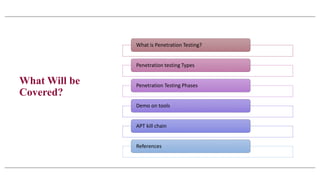
What Will be
Covered?
What is Penetration Testing?
Penetration testing Types
Penetration Testing Phases
Demo on tools
APT kill chain
References
What is Penetration Testing?
Penetration testing is a method of evaluating the security of a computer system or
network by simulating an attack from a malicious source.
A penetration test can help to determine whether a system is vulnerable to attack, if the
defenses were sufficient and which defenses were defeated in the penetration test.
Penetration testers use same skills and tactics as a hacker, but with permission from the
system owner.
Simply Penetration Testing is hacking with the permission from the system owner.
Penetration Testing Types
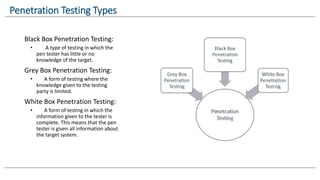
Black Box Penetration Testing:
• A type of testing in which the
pen tester has little or no
knowledge of the target.
Grey Box Penetration Testing:
• A form of testing where the
knowledge given to the testing
party is limited.
White Box Penetration Testing:
• A form of testing in which the
information given to the tester is
complete. This means that the pen
tester is given all information about
the target system.
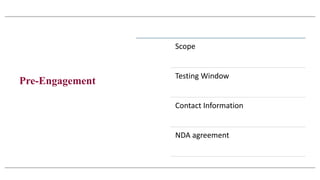
Pre-Engagement
Scope
Testing Window
Contact Information
NDA agreement
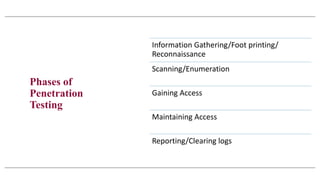
Phases of
Penetration
Testing
Information Gathering/Foot printing/
Reconnaissance
Scanning/Enumeration
Gaining Access
Maintaining Access
Reporting/Clearing logs
Information
Gathering
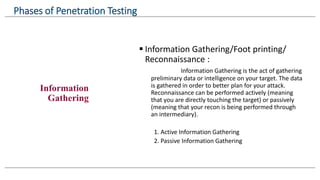
 Information Gathering/Foot printing/
Reconnaissance :
Information Gathering is the act of gathering
preliminary data or intelligence on your target. The data
is gathered in order to better plan for your attack.
Reconnaissance can be performed actively (meaning
that you are directly touching the target) or passively
(meaning that your recon is being performed through
an intermediary).
1. Active Information Gathering
2. Passive Information Gathering
Phases of Penetration Testing
Information Gathering
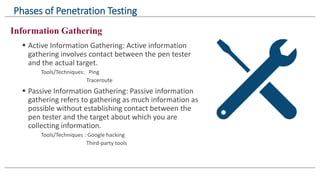
 Active Information Gathering: Active information
gathering involves contact between the pen tester
and the actual target.
Tools/Techniques: Ping
Traceroute
 Passive Information Gathering: Passive information
gathering refers to gathering as much information as
possible without establishing contact between the
pen tester and the target about which you are
collecting information.
Tools/Techniques : Google hacking
Third-party tools
Phases of Penetration Testing
 Scanning/ Enumeration:
Scanning is the process of finding system is alive, ports and
vulnerability of the target. Penetration tester use tools to
determine open ports and services presence of known
weaknesses on the target system.
 A good example would be the use of a vulnerability scanner on
a target network.
Tools/Techniques: Automated scanners(Nessus, Qualys,
BurpSuite, IBM Appscan e.t.c)
Lightweight tools(Netcat, Nmap e.t.c)
Phases of Penetration Testing
Gaining Access
 Gaining Access:
Gaining access requires taking
control of one or more network devices
in order to either extract data from the
target, or to use that device to then
launch attacks on other targets.
Tools/Techniques: Metasploit
Brute forcing
Phases of Penetration Testing
Maintaining access
 Maintaining access:
Maintaining access requires taking
the steps involved in being able to be
persistently within the target environment
in order to gather as much data as
possible. The attacker must remain
stealthy in this phase, so as to not get
caught while using the host environment.
Tools/Techniques: Keyloggers
Phases of Penetration Testing
Reporting/Clearin
g logs:
 Reporting/Clearing logs:
Report the identified vulnerabilities to
system owners. Propose the solutions to
them to improve their security measures
to protect against future attacks.
The final phase of the attacker is
covering their tracks. It is important that
the attacker either manipulate or delete
logs in order to avoid detection and more
importantly prosecution.
Phases of Penetration Testing
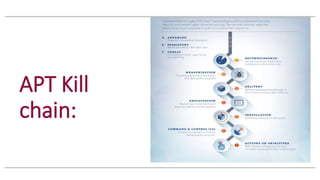
APT Kill
chain:
Thank You!!!

Penetration testing overview

  • 1.
    Supriya Golla Security Penetrationtester Penetration Testing Overview
  • 2.
    What Will be Covered? Whatis Penetration Testing? Penetration testing Types Penetration Testing Phases Demo on tools APT kill chain References
  • 3.
    What is PenetrationTesting? Penetration testing is a method of evaluating the security of a computer system or network by simulating an attack from a malicious source. A penetration test can help to determine whether a system is vulnerable to attack, if the defenses were sufficient and which defenses were defeated in the penetration test. Penetration testers use same skills and tactics as a hacker, but with permission from the system owner. Simply Penetration Testing is hacking with the permission from the system owner.
  • 4.
    Penetration Testing Types BlackBox Penetration Testing: • A type of testing in which the pen tester has little or no knowledge of the target. Grey Box Penetration Testing: • A form of testing where the knowledge given to the testing party is limited. White Box Penetration Testing: • A form of testing in which the information given to the tester is complete. This means that the pen tester is given all information about the target system.
  • 5.
  • 6.
    Phases of Penetration Testing Information Gathering/Footprinting/ Reconnaissance Scanning/Enumeration Gaining Access Maintaining Access Reporting/Clearing logs
  • 7.
    Information Gathering  Information Gathering/Footprinting/ Reconnaissance : Information Gathering is the act of gathering preliminary data or intelligence on your target. The data is gathered in order to better plan for your attack. Reconnaissance can be performed actively (meaning that you are directly touching the target) or passively (meaning that your recon is being performed through an intermediary). 1. Active Information Gathering 2. Passive Information Gathering Phases of Penetration Testing
  • 8.
    Information Gathering  ActiveInformation Gathering: Active information gathering involves contact between the pen tester and the actual target. Tools/Techniques: Ping Traceroute  Passive Information Gathering: Passive information gathering refers to gathering as much information as possible without establishing contact between the pen tester and the target about which you are collecting information. Tools/Techniques : Google hacking Third-party tools Phases of Penetration Testing
  • 9.
     Scanning/ Enumeration: Scanningis the process of finding system is alive, ports and vulnerability of the target. Penetration tester use tools to determine open ports and services presence of known weaknesses on the target system.  A good example would be the use of a vulnerability scanner on a target network. Tools/Techniques: Automated scanners(Nessus, Qualys, BurpSuite, IBM Appscan e.t.c) Lightweight tools(Netcat, Nmap e.t.c) Phases of Penetration Testing
  • 10.
    Gaining Access  GainingAccess: Gaining access requires taking control of one or more network devices in order to either extract data from the target, or to use that device to then launch attacks on other targets. Tools/Techniques: Metasploit Brute forcing Phases of Penetration Testing
  • 11.
    Maintaining access  Maintainingaccess: Maintaining access requires taking the steps involved in being able to be persistently within the target environment in order to gather as much data as possible. The attacker must remain stealthy in this phase, so as to not get caught while using the host environment. Tools/Techniques: Keyloggers Phases of Penetration Testing
  • 12.
    Reporting/Clearin g logs:  Reporting/Clearinglogs: Report the identified vulnerabilities to system owners. Propose the solutions to them to improve their security measures to protect against future attacks. The final phase of the attacker is covering their tracks. It is important that the attacker either manipulate or delete logs in order to avoid detection and more importantly prosecution. Phases of Penetration Testing
  • 13.
  • 14.