CONTENT
 INTRODUCTION        METHODOLOGY

 HISTORY             REPORTING

 TYPES OF HACKERS    CONCLUSION

 ETHICAL HACKING     ADVANTAGES AND
                       DISADVANTAGES
 HACKING
                      CONCLUSION
 ETHICAL HACKING
  COMMANDMENTS        REFERENCE
INTRODUCTION

 Ethical hacking also known as penetration testing
  or White-hat hacking, involves the same tools,
  tricks and techniques that hackers use, but with
  one major difference that ethical hacking is legal.

 Ethical hacking can also ensure that vendors
  claims about the security of their products
  legitimate.
SECURITY
 Security is the condition of being protect against
  danger or loss. In the general sense, security is a
  concept similar to safety.
 Information security means protecting information
  and information systems from unauthorized access,
  use, disclosure, disruption, modification or destruc-
  tion.

                    Need for security
  There may be several forms of damages which are obviously
  interrelated which are produced by the intruders.
HISTORY HIGHLIGHTS

 In one early ethical hack, the United States Air Force
  conducted a “security evaluation” of the Multiuse
  operating systems for “potential use as a two-level
  (secret/top secret) systems.”


 Most notable of these was the work by Farmer and
  Venom, which was originally posted to Usenet in
  December of 1993.
HACKING

 Eric Raymond, compiler of “The New Hacker’s Dictionary”,
  defines a hacker as a clever programmer.


 A “Good hack” is a clever solution to a programming
  problem and “hacking” is the act of doing it.
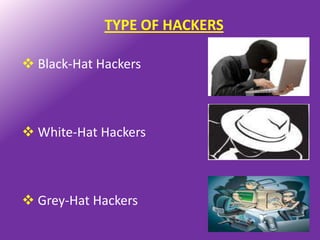
TYPE OF HACKERS

 Black-Hat Hackers


 White-Hat Hackers


 Grey-Hat Hackers
ETHICAL HACKING

 A methodology adopted by ethical hackers to discover
  the vulnerabilities existing in information systems
  operating environments.

 With the growth of the internet, computer security has
  become a Major concern for businesses and govern-
  ments.

 Evaluate the intruder threat to their interests would be
  to have independent computer security professionals
  attempt to break into their computer systems.
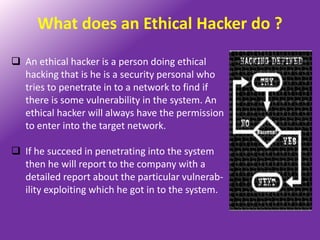
What does an Ethical Hacker do ?

 An ethical hacker is a person doing ethical
  hacking that is he is a security personal who
  tries to penetrate in to a network to find if
  there is some vulnerability in the system. An
  ethical hacker will always have the permission
  to enter into the target network.

 If he succeed in penetrating into the system
  then he will report to the company with a
  detailed report about the particular vulnerab-
  ility exploiting which he got in to the system.
Required Skills of an Ethical Hacker :


 Microsoft :
 Linux :
 Firewalls :
 Routers :
 Network Protocols :
 Project Management :
ETHICAL HACKING COMMANDMENTS


 Working ethically


 Respecting privacy


 Not crashing your systems:
METHODOLOGY OF HACKING

Reconnaissance

Scanning & Enumeration

Gaining access

 Maintaining access

Clearing tracks
 Reconnaissance:
  This literal meaning of the Word reconnaissance means a
  preliminary survey to gain the information . This is also known as
  foot-printing. As given in the analogy, this is the stage in which the
  hacker collects information about the company which the personal
  is going to hack. This is one of the pre-attacking phases.


 Scanning:
   The hacker tries to make a blue print of the target network. The
  blue print includes the IP addresses of the target network which
  are live, the services which are running on those systems and so
  on Modern port scanning uses TCP protocol to do scanning and
  they could even detect the operating systems running on the
  particular hosts.
Enumeration:
Enumeration is the ability of a hacker to convince some servers to
give them information that is vital to them to make an attack. By
doing this the hacker aims to find what resources and shares can
be found in the system, what valid user account and user groups
are there in the network, what applications will be there etc.

Gaining access
This is the actual hacking phase in which the hacker gains access
to the system. The hacker will make use of all the information he
collected in the pre-attacking phases. Usually the main hindrance
to gaining access to a system is the passwords. In the System
hacking first the hacker will try to get in to the system.
 Password Cracking:
 There are many methods for cracking the password and then
 get in to the system. The simplest method is to guess the
 password. But this is a tedious work. But in order to make this
 work easier there are many automated tools for password
 guessing like legion.


 Privilege escalation
 Privilege escalation is the process of raising the privileges once
 the hacker gets in to the system The privilege escalation
 process usually uses the vulnerabilities present in the host
 operating system or the software. There are many tools like
 hk.exe, metasploit etc. One such community of hackers is the
 metasploit
 Maintaining Access:
  Now the hacker is inside the system . This means that he is now
  in a position to upload some files and download some of them.
  The next aim will be to make an easier path to get in when he
  comes the next time. This is analogous to making a small hidden
  door in the building so that he can directly enter in to the
  building through the door easily
 Clearing Tracks:
   Whenever a hacker downloads some file or installs some
   software, its log will be stored in the server logs. So in order to
   erase the hacker uses man tools. One such tool is windows
   resource kit’s auditpol.exe. Another tool which eliminates any
   physical evidence is the evidence eliminator.. The Evidence
   Eliminator deletes all such evidences.
Ethical hacking tools:


Ethical hackers utilize and have developed variety of tools
intrude into different kinds of systems and to evaluate the
security levels. The nature of these tools differs widely.
Samspade:

Samspade is a simple tool which provides us
information about a particular host. This tool is
very much helpful in finding the addresses, phone
number etc
Email Tracker and Visual Route:


 Email tracker is a software which help us to find from
which server the mail does actually came from. Every
message we receive will have a header associated with
It . The email tracker uses this header information for find
location.

Visual route is a tool which displays the location a
particular server with the help of IP addresses. When we
connect this with the email tracker we can find the
server which actually sends the mail .
Advantages and disadvantages:
Ethical hacking nowadays is a backbone of network
security .Each day its relevance is increasing ,the
major pros & cons of ethical hacking

 Advantages
  “To catch a thief you have to think like a thief”
  Help in closing the open holes in the network
  Provides security to banking and financial
   establishments
  Prevents website defacements
  An evolving technique
Disadvantages
 All depend upon the trustworthiness of the
 ethical hacker

 Hiring professionals is expensive
Future enhancements:

 As it an evolving branch the scope of
enhancement in technology is       immense. No
ethical hacker can ensure the system security by
using the same technique repeatedly. He would
He would have to improve , develop and explore
new avenues repeatedly.

 More enhanced software’s should be used for
optimum protection . Tools used , need to be
updated regularly and more efficient ones need to
be developed
Conclusion
One of the main aim of the seminar is to make
others understand that there are so many tools
through which a hacker can get into a system. Its
various perspectives.

Student
  A student should understand that no software is
made with zero Vulnerability. So while they are
studying they should study the various possibilities
and should study how to prevent that because they
are the professionals of tomorrow
Professionals
    Professionals should understand that business is
directly related to security. So they should make
new software with vulnerabilities as less as
possible. if they are not aware of these then they
won’t be cautions enough in security matters

 In the preceding sections we saw the
methodology of hacking, why should we aware of
hacking and tools and some tools which a hacker
may use . Now we can see what we can do against
hacking or to protect ourselves from hacking .

 the first thing is we should keep ourselves
updated about those          software's us and using
for official and reliable sources .
Educate employees and the users against black
hacking.

Use every possible security measures

 Every time make our password strong by making it
harder and longer to be cracked.
REFERENCE

 www.scribd.com

 www.wikipedia/seminartopics/ethical haching.org

 www. Seminarsonly/ethical hacking.com
Ethical Hacking

Ethical Hacking

  • 3.
    CONTENT  INTRODUCTION  METHODOLOGY  HISTORY  REPORTING  TYPES OF HACKERS  CONCLUSION  ETHICAL HACKING  ADVANTAGES AND DISADVANTAGES  HACKING  CONCLUSION  ETHICAL HACKING COMMANDMENTS  REFERENCE
  • 4.
    INTRODUCTION  Ethical hackingalso known as penetration testing or White-hat hacking, involves the same tools, tricks and techniques that hackers use, but with one major difference that ethical hacking is legal.  Ethical hacking can also ensure that vendors claims about the security of their products legitimate.
  • 5.
    SECURITY  Security isthe condition of being protect against danger or loss. In the general sense, security is a concept similar to safety.  Information security means protecting information and information systems from unauthorized access, use, disclosure, disruption, modification or destruc- tion. Need for security There may be several forms of damages which are obviously interrelated which are produced by the intruders.
  • 6.
    HISTORY HIGHLIGHTS  Inone early ethical hack, the United States Air Force conducted a “security evaluation” of the Multiuse operating systems for “potential use as a two-level (secret/top secret) systems.”  Most notable of these was the work by Farmer and Venom, which was originally posted to Usenet in December of 1993.
  • 7.
    HACKING  Eric Raymond,compiler of “The New Hacker’s Dictionary”, defines a hacker as a clever programmer.  A “Good hack” is a clever solution to a programming problem and “hacking” is the act of doing it.
  • 8.
    TYPE OF HACKERS Black-Hat Hackers  White-Hat Hackers  Grey-Hat Hackers
  • 9.
    ETHICAL HACKING  Amethodology adopted by ethical hackers to discover the vulnerabilities existing in information systems operating environments.  With the growth of the internet, computer security has become a Major concern for businesses and govern- ments.  Evaluate the intruder threat to their interests would be to have independent computer security professionals attempt to break into their computer systems.
  • 10.
    What does anEthical Hacker do ?  An ethical hacker is a person doing ethical hacking that is he is a security personal who tries to penetrate in to a network to find if there is some vulnerability in the system. An ethical hacker will always have the permission to enter into the target network.  If he succeed in penetrating into the system then he will report to the company with a detailed report about the particular vulnerab- ility exploiting which he got in to the system.
  • 11.
    Required Skills ofan Ethical Hacker :  Microsoft :  Linux :  Firewalls :  Routers :  Network Protocols :  Project Management :
  • 12.
    ETHICAL HACKING COMMANDMENTS Working ethically  Respecting privacy  Not crashing your systems:
  • 13.
    METHODOLOGY OF HACKING Reconnaissance Scanning& Enumeration Gaining access  Maintaining access Clearing tracks
  • 14.
     Reconnaissance: This literal meaning of the Word reconnaissance means a preliminary survey to gain the information . This is also known as foot-printing. As given in the analogy, this is the stage in which the hacker collects information about the company which the personal is going to hack. This is one of the pre-attacking phases.  Scanning: The hacker tries to make a blue print of the target network. The blue print includes the IP addresses of the target network which are live, the services which are running on those systems and so on Modern port scanning uses TCP protocol to do scanning and they could even detect the operating systems running on the particular hosts.
  • 15.
    Enumeration: Enumeration is theability of a hacker to convince some servers to give them information that is vital to them to make an attack. By doing this the hacker aims to find what resources and shares can be found in the system, what valid user account and user groups are there in the network, what applications will be there etc. Gaining access This is the actual hacking phase in which the hacker gains access to the system. The hacker will make use of all the information he collected in the pre-attacking phases. Usually the main hindrance to gaining access to a system is the passwords. In the System hacking first the hacker will try to get in to the system.
  • 16.
     Password Cracking: There are many methods for cracking the password and then get in to the system. The simplest method is to guess the password. But this is a tedious work. But in order to make this work easier there are many automated tools for password guessing like legion.  Privilege escalation Privilege escalation is the process of raising the privileges once the hacker gets in to the system The privilege escalation process usually uses the vulnerabilities present in the host operating system or the software. There are many tools like hk.exe, metasploit etc. One such community of hackers is the metasploit
  • 17.
     Maintaining Access: Now the hacker is inside the system . This means that he is now in a position to upload some files and download some of them. The next aim will be to make an easier path to get in when he comes the next time. This is analogous to making a small hidden door in the building so that he can directly enter in to the building through the door easily  Clearing Tracks: Whenever a hacker downloads some file or installs some software, its log will be stored in the server logs. So in order to erase the hacker uses man tools. One such tool is windows resource kit’s auditpol.exe. Another tool which eliminates any physical evidence is the evidence eliminator.. The Evidence Eliminator deletes all such evidences.
  • 18.
    Ethical hacking tools: Ethicalhackers utilize and have developed variety of tools intrude into different kinds of systems and to evaluate the security levels. The nature of these tools differs widely.
  • 19.
    Samspade: Samspade is asimple tool which provides us information about a particular host. This tool is very much helpful in finding the addresses, phone number etc
  • 20.
    Email Tracker andVisual Route:  Email tracker is a software which help us to find from which server the mail does actually came from. Every message we receive will have a header associated with It . The email tracker uses this header information for find location. Visual route is a tool which displays the location a particular server with the help of IP addresses. When we connect this with the email tracker we can find the server which actually sends the mail .
  • 21.
    Advantages and disadvantages: Ethicalhacking nowadays is a backbone of network security .Each day its relevance is increasing ,the major pros & cons of ethical hacking Advantages  “To catch a thief you have to think like a thief”  Help in closing the open holes in the network  Provides security to banking and financial establishments  Prevents website defacements  An evolving technique
  • 22.
    Disadvantages  All dependupon the trustworthiness of the ethical hacker  Hiring professionals is expensive
  • 23.
    Future enhancements:  Asit an evolving branch the scope of enhancement in technology is immense. No ethical hacker can ensure the system security by using the same technique repeatedly. He would He would have to improve , develop and explore new avenues repeatedly.  More enhanced software’s should be used for optimum protection . Tools used , need to be updated regularly and more efficient ones need to be developed
  • 24.
    Conclusion One of themain aim of the seminar is to make others understand that there are so many tools through which a hacker can get into a system. Its various perspectives. Student A student should understand that no software is made with zero Vulnerability. So while they are studying they should study the various possibilities and should study how to prevent that because they are the professionals of tomorrow
  • 25.
    Professionals Professionals should understand that business is directly related to security. So they should make new software with vulnerabilities as less as possible. if they are not aware of these then they won’t be cautions enough in security matters  In the preceding sections we saw the methodology of hacking, why should we aware of hacking and tools and some tools which a hacker may use . Now we can see what we can do against hacking or to protect ourselves from hacking .  the first thing is we should keep ourselves updated about those software's us and using for official and reliable sources .
  • 26.
    Educate employees andthe users against black hacking. Use every possible security measures  Every time make our password strong by making it harder and longer to be cracked.
  • 27.
    REFERENCE  www.scribd.com  www.wikipedia/seminartopics/ethicalhaching.org  www. Seminarsonly/ethical hacking.com