SEMANTIC ROLES
Professor Dr Salah Mohammed
Introduction
In linguistics, semantic roles, (thematic relations
or theta roles), are the various roles that a noun
phrase may play with respect to the action or
state described by the sentence's main verb. For
example, in the sentence "Susan ate an apple",
Susan is the doer of the eating, so she is
an agent;the apple is the item that is eaten, so it
is affected.
Definition
A semantic role is the relationship that a
participant has with the main verb in a clause.
Semantic role is the actual role a participant
plays in some real or imagined situation, apart
from the linguistic encoding of those situations.
Semantic Roles of the Subject
While the subject seems to represent ‘the door of the action’, it
can represent a good number of other semantic roles.
• Agentive: this is the typical semantic role assigned to the
subject. The animate participant instigates or causes the
action denoted by the verb.
John broke the window.
• External Causer: the inanimate cause of an event
The storm destroyed several houses.
• Instrument: the inanimate entity used by an agent.
This knife cuts meat easily.
• Affected: Jack fell down.
The pencil was lying on the table
• Recipient: The students benefited from the class.
• Experiencer: I can taste the pepper in my soup.
• Positioner: John is staying at a hotel.
• Locative: London is foggy.
• Temporal: Yesterday was a holiday.
• Eventive: The Norman invasion took place in 1066.
• Prop “It”: It is ten o’clock now.
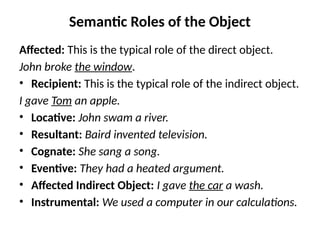
Semantic Roles of the Object
Affected: This is the typical role of the direct object.
John broke the window.
• Recipient: This is the typical role of the indirect object.
I gave Tom an apple.
• Locative: John swam a river.
• Resultant: Baird invented television.
• Cognate: She sang a song.
• Eventive: They had a heated argument.
• Affected Indirect Object: I gave the car a wash.
• Instrumental: We used a computer in our calculations.


2.Semantic-Roles_.pptx and the study pdf

  • 1.
  • 2.
    Introduction In linguistics, semanticroles, (thematic relations or theta roles), are the various roles that a noun phrase may play with respect to the action or state described by the sentence's main verb. For example, in the sentence "Susan ate an apple", Susan is the doer of the eating, so she is an agent;the apple is the item that is eaten, so it is affected.
  • 3.
    Definition A semantic roleis the relationship that a participant has with the main verb in a clause. Semantic role is the actual role a participant plays in some real or imagined situation, apart from the linguistic encoding of those situations.
  • 4.
    Semantic Roles ofthe Subject While the subject seems to represent ‘the door of the action’, it can represent a good number of other semantic roles. • Agentive: this is the typical semantic role assigned to the subject. The animate participant instigates or causes the action denoted by the verb. John broke the window. • External Causer: the inanimate cause of an event The storm destroyed several houses. • Instrument: the inanimate entity used by an agent. This knife cuts meat easily. • Affected: Jack fell down. The pencil was lying on the table
  • 5.
    • Recipient: Thestudents benefited from the class. • Experiencer: I can taste the pepper in my soup. • Positioner: John is staying at a hotel. • Locative: London is foggy. • Temporal: Yesterday was a holiday. • Eventive: The Norman invasion took place in 1066. • Prop “It”: It is ten o’clock now.
  • 6.
    Semantic Roles ofthe Object Affected: This is the typical role of the direct object. John broke the window. • Recipient: This is the typical role of the indirect object. I gave Tom an apple. • Locative: John swam a river. • Resultant: Baird invented television. • Cognate: She sang a song. • Eventive: They had a heated argument. • Affected Indirect Object: I gave the car a wash. • Instrumental: We used a computer in our calculations.