ISBN 0-321-49362-1
Chapter 3
Describing Syntax
and Semantics
Copyright © 2007 Addison-
Wesley. All rights reserved. 1-2
Chapter 3 Topics
• Introduction
• The General Problem of Describing Syntax
• Formal Methods of Describing Syntax
• Attribute Grammars
Copyright © 2007 Addison-
Wesley. All rights reserved. 1-3
Introduction
• Syntax: the form or structure of the
expressions, statements, and program units
• Semantics: the meaning of the expressions,
statements, and program units
• Syntax and semantics provide a language’s
definition
– Users of a language definition
• Other language designers
• Implementers
• Programmers (the users of the language)
Copyright © 2007 Addison-
Wesley. All rights reserved. 1-4
The General Problem of Describing Syntax:
Terminology
• A sentence is a string of characters over some
alphabet
• A language is a set of sentences
• A lexeme is the lowest level syntactic unit of a
language (e.g., *, sum, begin)
• A token is a category of lexemes (e.g., identifier)
Copyright © 2007 Addison-
Wesley. All rights reserved. 1-5
Formal Definition of Languages
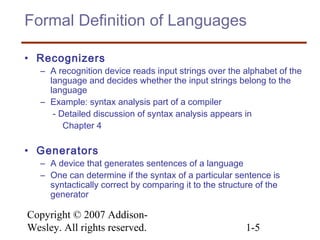
• Recognizers
– A recognition device reads input strings over the alphabet of the
language and decides whether the input strings belong to the
language
– Example: syntax analysis part of a compiler
- Detailed discussion of syntax analysis appears in
Chapter 4
• Generators
– A device that generates sentences of a language
– One can determine if the syntax of a particular sentence is
syntactically correct by comparing it to the structure of the
generator
Copyright © 2007 Addison-
Wesley. All rights reserved. 1-6
BNF and Context-Free Grammars
• Context-Free Grammars
– Developed by Noam Chomsky in the mid-1950s
– Language generators, meant to describe the syntax
of natural languages
– Define a class of languages called context-free
languages
• Backus-Naur Form (1959)
– Invented by John Backus to describe Algol 58
– BNF is equivalent to context-free grammars
Copyright © 2007 Addison-
Wesley. All rights reserved. 1-7
BNF Fundamentals
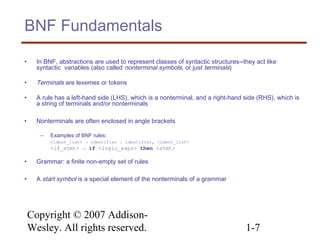
• In BNF, abstractions are used to represent classes of syntactic structures--they act like
syntactic variables (also called nonterminal symbols, or just terminals)
• Terminals are lexemes or tokens
• A rule has a left-hand side (LHS), which is a nonterminal, and a right-hand side (RHS), which is
a string of terminals and/or nonterminals
• Nonterminals are often enclosed in angle brackets
– Examples of BNF rules:
<ident_list> → identifier | identifier, <ident_list>
<if_stmt> → if <logic_expr> then <stmt>
• Grammar: a finite non-empty set of rules
• A start symbol is a special element of the nonterminals of a grammar
Copyright © 2007 Addison-
Wesley. All rights reserved. 1-8
BNF Rules
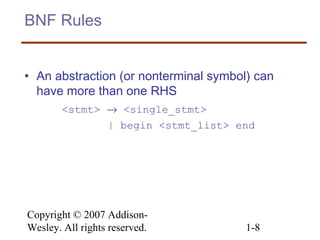
• An abstraction (or nonterminal symbol) can
have more than one RHS
<stmt> → <single_stmt>
| begin <stmt_list> end
Copyright © 2007 Addison-
Wesley. All rights reserved. 1-9
Describing Lists
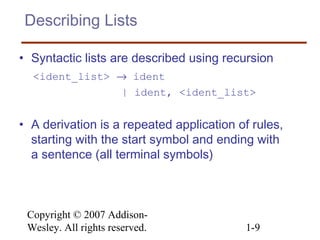
• Syntactic lists are described using recursion
<ident_list> → ident
| ident, <ident_list>
• A derivation is a repeated application of rules,
starting with the start symbol and ending with
a sentence (all terminal symbols)
Copyright © 2007 Addison-
Wesley. All rights reserved. 1-10
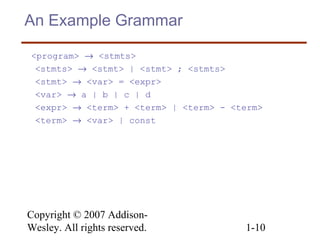
An Example Grammar
<program> → <stmts>
<stmts> → <stmt> | <stmt> ; <stmts>
<stmt> → <var> = <expr>
<var> → a | b | c | d
<expr> → <term> + <term> | <term> - <term>
<term> → <var> | const
Copyright © 2007 Addison-
Wesley. All rights reserved. 1-11
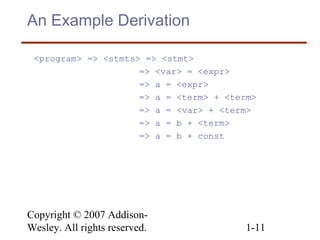
An Example Derivation
<program> => <stmts> => <stmt>
=> <var> = <expr>
=> a = <expr>
=> a = <term> + <term>
=> a = <var> + <term>
=> a = b + <term>
=> a = b + const
Copyright © 2007 Addison-
Wesley. All rights reserved. 1-12
Derivations
• Every string of symbols in a derivation is a
sentential form
• A sentence is a sentential form that has only
terminal symbols
• A leftmost derivation is one in which the leftmost
nonterminal in each sentential form is the one
that is expanded
• A derivation may be neither leftmost nor
rightmost
Copyright © 2007 Addison-
Wesley. All rights reserved. 1-13
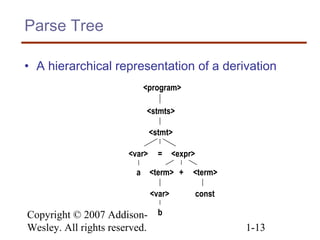
Parse Tree
• A hierarchical representation of a derivation
<program>
<stmts>
<stmt>
const
a
<var> = <expr>
<var>
b
<term> + <term>
Copyright © 2007 Addison-
Wesley. All rights reserved. 1-14
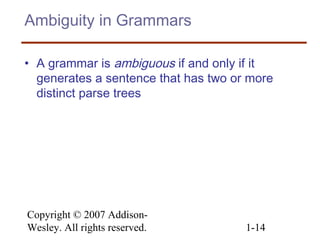
Ambiguity in Grammars
• A grammar is ambiguous if and only if it
generates a sentence that has two or more
distinct parse trees
Copyright © 2007 Addison-
Wesley. All rights reserved. 1-15
An Ambiguous Expression Grammar
<expr> → <expr> <op> <expr> | const
<op> → / | -
<expr>
<expr> <expr>
<expr> <expr>
<expr>
<expr> <expr>
<expr> <expr>
<op>
<op>
<op>
<op>
const const const const const const- -/ /
<op>
Copyright © 2007 Addison-
Wesley. All rights reserved. 1-16
An Unambiguous Expression Grammar
• If we use the parse tree to indicate precedence
levels of the operators, we cannot have
ambiguity
<expr> → <expr> - <term> | <term>
<term> → <term> / const| const
<expr>
<expr> <term>
<term> <term>
const const
const/
-
Copyright © 2007 Addison-
Wesley. All rights reserved. 1-17
Associativity of Operators
• Operator associativity can also be indicated by a
grammar
<expr> -> <expr> + <expr> | const (ambiguous)
<expr> -> <expr> + const | const (unambiguous)
<expr><expr>
<expr>
<expr> const
const
const
+
+
Copyright © 2007 Addison-
Wesley. All rights reserved. 1-18
Extended BNF
• Optional parts are placed in brackets [ ]
<proc_call> -> ident [(<expr_list>)]
• Alternative parts of RHSs are placed inside
parentheses and separated via vertical bars
<term> → <term> (+|-) const
• Repetitions (0 or more) are placed inside
braces { }
<ident> → letter {letter|digit}
Copyright © 2007 Addison-
Wesley. All rights reserved. 1-19
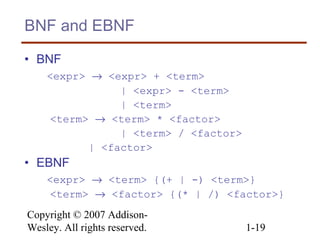
BNF and EBNF
• BNF
<expr> → <expr> + <term>
| <expr> - <term>
| <term>
<term> → <term> * <factor>
| <term> / <factor>
| <factor>
• EBNF
<expr> → <term> {(+ | -) <term>}
<term> → <factor> {(* | /) <factor>}
Copyright © 2007 Addison-
Wesley. All rights reserved. 1-20
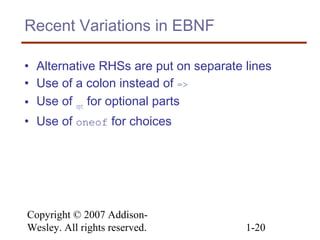
Recent Variations in EBNF
• Alternative RHSs are put on separate lines
• Use of a colon instead of =>
• Use of opt for optional parts
• Use of oneof for choices
Copyright © 2007 Addison-
Wesley. All rights reserved. 1-21
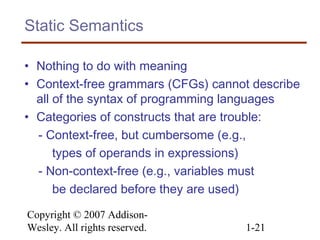
Static Semantics
• Nothing to do with meaning
• Context-free grammars (CFGs) cannot describe
all of the syntax of programming languages
• Categories of constructs that are trouble:
- Context-free, but cumbersome (e.g.,
types of operands in expressions)
- Non-context-free (e.g., variables must
be declared before they are used)
ATTRIBUTE GRAMMARS
Note. The textbook, pp.135-140, has a better
description of this topic than the slides following
Copyright © 2007 Addison-
Wesley. All rights reserved. 1-23
Attribute Grammars
• Attribute grammars (AGs) have additions to
CFGs to carry some semantic info on parse
tree nodes
• Primary value of AGs:
– Static semantics specification
– Compiler design (static semantics checking)
Copyright © 2007 Addison-
Wesley. All rights reserved. 1-24
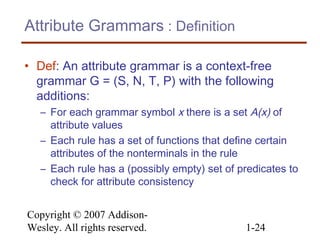
Attribute Grammars : Definition
• Def: An attribute grammar is a context-free
grammar G = (S, N, T, P) with the following
additions:
– For each grammar symbol x there is a set A(x) of
attribute values
– Each rule has a set of functions that define certain
attributes of the nonterminals in the rule
– Each rule has a (possibly empty) set of predicates to
check for attribute consistency
Copyright © 2007 Addison-
Wesley. All rights reserved. 1-25
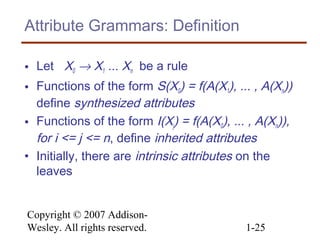
Attribute Grammars: Definition
• Let X0 → X1 ... Xn be a rule
• Functions of the form S(X0) = f(A(X1), ... , A(Xn))
define synthesized attributes
• Functions of the form I(Xj) = f(A(X0), ... , A(Xn)),
for i <= j <= n, define inherited attributes
• Initially, there are intrinsic attributes on the
leaves
Copyright © 2007 Addison-
Wesley. All rights reserved. 1-26
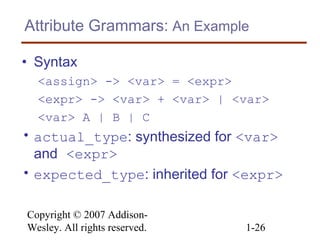
Attribute Grammars: An Example
• Syntax
<assign> -> <var> = <expr>
<expr> -> <var> + <var> | <var>
<var> A | B | C
• actual_type: synthesized for <var>
and <expr>
• expected_type: inherited for <expr>
Copyright © 2007 Addison-
Wesley. All rights reserved. 1-27
Attribute Grammar (continued)
• Syntax rule: <expr> → <var>[1] + <var>[2]
Semantic rules:
<expr>.actual_type ← <var>[1].actual_type
Predicate:
<var>[1].actual_type == <var>[2].actual_type
<expr>.expected_type == <expr>.actual_type
• Syntax rule: <var> → id
Semantic rule:
<var>.actual_type ← lookup (<var>.string)
Copyright © 2007 Addison-
Wesley. All rights reserved. 1-28
Attribute Grammars (continued)
• How are attribute values computed?
– If all attributes were inherited, the tree could be
decorated in top-down order.
– If all attributes were synthesized, the tree could be
decorated in bottom-up order.
– In many cases, both kinds of attributes are used, and
it is some combination of top-down and bottom-up
that must be used.
Copyright © 2007 Addison-
Wesley. All rights reserved. 1-29
Attribute Grammars (continued)
<expr>.expected_type ← inherited from parent
<var>[1].actual_type ← lookup (A)
<var>[2].actual_type ← lookup (B)
<var>[1].actual_type =? <var>[2].actual_type
<expr>.actual_type ← <var>[1].actual_type
<expr>.actual_type =? <expr>.expected_type

3 describing syntax

  • 1.
  • 2.
    Copyright © 2007Addison- Wesley. All rights reserved. 1-2 Chapter 3 Topics • Introduction • The General Problem of Describing Syntax • Formal Methods of Describing Syntax • Attribute Grammars
  • 3.
    Copyright © 2007Addison- Wesley. All rights reserved. 1-3 Introduction • Syntax: the form or structure of the expressions, statements, and program units • Semantics: the meaning of the expressions, statements, and program units • Syntax and semantics provide a language’s definition – Users of a language definition • Other language designers • Implementers • Programmers (the users of the language)
  • 4.
    Copyright © 2007Addison- Wesley. All rights reserved. 1-4 The General Problem of Describing Syntax: Terminology • A sentence is a string of characters over some alphabet • A language is a set of sentences • A lexeme is the lowest level syntactic unit of a language (e.g., *, sum, begin) • A token is a category of lexemes (e.g., identifier)
  • 5.
    Copyright © 2007Addison- Wesley. All rights reserved. 1-5 Formal Definition of Languages • Recognizers – A recognition device reads input strings over the alphabet of the language and decides whether the input strings belong to the language – Example: syntax analysis part of a compiler - Detailed discussion of syntax analysis appears in Chapter 4 • Generators – A device that generates sentences of a language – One can determine if the syntax of a particular sentence is syntactically correct by comparing it to the structure of the generator
  • 6.
    Copyright © 2007Addison- Wesley. All rights reserved. 1-6 BNF and Context-Free Grammars • Context-Free Grammars – Developed by Noam Chomsky in the mid-1950s – Language generators, meant to describe the syntax of natural languages – Define a class of languages called context-free languages • Backus-Naur Form (1959) – Invented by John Backus to describe Algol 58 – BNF is equivalent to context-free grammars
  • 7.
    Copyright © 2007Addison- Wesley. All rights reserved. 1-7 BNF Fundamentals • In BNF, abstractions are used to represent classes of syntactic structures--they act like syntactic variables (also called nonterminal symbols, or just terminals) • Terminals are lexemes or tokens • A rule has a left-hand side (LHS), which is a nonterminal, and a right-hand side (RHS), which is a string of terminals and/or nonterminals • Nonterminals are often enclosed in angle brackets – Examples of BNF rules: <ident_list> → identifier | identifier, <ident_list> <if_stmt> → if <logic_expr> then <stmt> • Grammar: a finite non-empty set of rules • A start symbol is a special element of the nonterminals of a grammar
  • 8.
    Copyright © 2007Addison- Wesley. All rights reserved. 1-8 BNF Rules • An abstraction (or nonterminal symbol) can have more than one RHS <stmt> → <single_stmt> | begin <stmt_list> end
  • 9.
    Copyright © 2007Addison- Wesley. All rights reserved. 1-9 Describing Lists • Syntactic lists are described using recursion <ident_list> → ident | ident, <ident_list> • A derivation is a repeated application of rules, starting with the start symbol and ending with a sentence (all terminal symbols)
  • 10.
    Copyright © 2007Addison- Wesley. All rights reserved. 1-10 An Example Grammar <program> → <stmts> <stmts> → <stmt> | <stmt> ; <stmts> <stmt> → <var> = <expr> <var> → a | b | c | d <expr> → <term> + <term> | <term> - <term> <term> → <var> | const
  • 11.
    Copyright © 2007Addison- Wesley. All rights reserved. 1-11 An Example Derivation <program> => <stmts> => <stmt> => <var> = <expr> => a = <expr> => a = <term> + <term> => a = <var> + <term> => a = b + <term> => a = b + const
  • 12.
    Copyright © 2007Addison- Wesley. All rights reserved. 1-12 Derivations • Every string of symbols in a derivation is a sentential form • A sentence is a sentential form that has only terminal symbols • A leftmost derivation is one in which the leftmost nonterminal in each sentential form is the one that is expanded • A derivation may be neither leftmost nor rightmost
  • 13.
    Copyright © 2007Addison- Wesley. All rights reserved. 1-13 Parse Tree • A hierarchical representation of a derivation <program> <stmts> <stmt> const a <var> = <expr> <var> b <term> + <term>
  • 14.
    Copyright © 2007Addison- Wesley. All rights reserved. 1-14 Ambiguity in Grammars • A grammar is ambiguous if and only if it generates a sentence that has two or more distinct parse trees
  • 15.
    Copyright © 2007Addison- Wesley. All rights reserved. 1-15 An Ambiguous Expression Grammar <expr> → <expr> <op> <expr> | const <op> → / | - <expr> <expr> <expr> <expr> <expr> <expr> <expr> <expr> <expr> <expr> <op> <op> <op> <op> const const const const const const- -/ / <op>
  • 16.
    Copyright © 2007Addison- Wesley. All rights reserved. 1-16 An Unambiguous Expression Grammar • If we use the parse tree to indicate precedence levels of the operators, we cannot have ambiguity <expr> → <expr> - <term> | <term> <term> → <term> / const| const <expr> <expr> <term> <term> <term> const const const/ -
  • 17.
    Copyright © 2007Addison- Wesley. All rights reserved. 1-17 Associativity of Operators • Operator associativity can also be indicated by a grammar <expr> -> <expr> + <expr> | const (ambiguous) <expr> -> <expr> + const | const (unambiguous) <expr><expr> <expr> <expr> const const const + +
  • 18.
    Copyright © 2007Addison- Wesley. All rights reserved. 1-18 Extended BNF • Optional parts are placed in brackets [ ] <proc_call> -> ident [(<expr_list>)] • Alternative parts of RHSs are placed inside parentheses and separated via vertical bars <term> → <term> (+|-) const • Repetitions (0 or more) are placed inside braces { } <ident> → letter {letter|digit}
  • 19.
    Copyright © 2007Addison- Wesley. All rights reserved. 1-19 BNF and EBNF • BNF <expr> → <expr> + <term> | <expr> - <term> | <term> <term> → <term> * <factor> | <term> / <factor> | <factor> • EBNF <expr> → <term> {(+ | -) <term>} <term> → <factor> {(* | /) <factor>}
  • 20.
    Copyright © 2007Addison- Wesley. All rights reserved. 1-20 Recent Variations in EBNF • Alternative RHSs are put on separate lines • Use of a colon instead of => • Use of opt for optional parts • Use of oneof for choices
  • 21.
    Copyright © 2007Addison- Wesley. All rights reserved. 1-21 Static Semantics • Nothing to do with meaning • Context-free grammars (CFGs) cannot describe all of the syntax of programming languages • Categories of constructs that are trouble: - Context-free, but cumbersome (e.g., types of operands in expressions) - Non-context-free (e.g., variables must be declared before they are used)
  • 22.
    ATTRIBUTE GRAMMARS Note. Thetextbook, pp.135-140, has a better description of this topic than the slides following
  • 23.
    Copyright © 2007Addison- Wesley. All rights reserved. 1-23 Attribute Grammars • Attribute grammars (AGs) have additions to CFGs to carry some semantic info on parse tree nodes • Primary value of AGs: – Static semantics specification – Compiler design (static semantics checking)
  • 24.
    Copyright © 2007Addison- Wesley. All rights reserved. 1-24 Attribute Grammars : Definition • Def: An attribute grammar is a context-free grammar G = (S, N, T, P) with the following additions: – For each grammar symbol x there is a set A(x) of attribute values – Each rule has a set of functions that define certain attributes of the nonterminals in the rule – Each rule has a (possibly empty) set of predicates to check for attribute consistency
  • 25.
    Copyright © 2007Addison- Wesley. All rights reserved. 1-25 Attribute Grammars: Definition • Let X0 → X1 ... Xn be a rule • Functions of the form S(X0) = f(A(X1), ... , A(Xn)) define synthesized attributes • Functions of the form I(Xj) = f(A(X0), ... , A(Xn)), for i <= j <= n, define inherited attributes • Initially, there are intrinsic attributes on the leaves
  • 26.
    Copyright © 2007Addison- Wesley. All rights reserved. 1-26 Attribute Grammars: An Example • Syntax <assign> -> <var> = <expr> <expr> -> <var> + <var> | <var> <var> A | B | C • actual_type: synthesized for <var> and <expr> • expected_type: inherited for <expr>
  • 27.
    Copyright © 2007Addison- Wesley. All rights reserved. 1-27 Attribute Grammar (continued) • Syntax rule: <expr> → <var>[1] + <var>[2] Semantic rules: <expr>.actual_type ← <var>[1].actual_type Predicate: <var>[1].actual_type == <var>[2].actual_type <expr>.expected_type == <expr>.actual_type • Syntax rule: <var> → id Semantic rule: <var>.actual_type ← lookup (<var>.string)
  • 28.
    Copyright © 2007Addison- Wesley. All rights reserved. 1-28 Attribute Grammars (continued) • How are attribute values computed? – If all attributes were inherited, the tree could be decorated in top-down order. – If all attributes were synthesized, the tree could be decorated in bottom-up order. – In many cases, both kinds of attributes are used, and it is some combination of top-down and bottom-up that must be used.
  • 29.
    Copyright © 2007Addison- Wesley. All rights reserved. 1-29 Attribute Grammars (continued) <expr>.expected_type ← inherited from parent <var>[1].actual_type ← lookup (A) <var>[2].actual_type ← lookup (B) <var>[1].actual_type =? <var>[2].actual_type <expr>.actual_type ← <var>[1].actual_type <expr>.actual_type =? <expr>.expected_type