Chapter 3
1-1
Describing Syntax and
Semantics
Chapter 3 Topics
1-2
 Introduction
 The General Problem of Describing Syntax
 Formal Methods of Describing Syntax
 Attribute Grammars
 Describing the Meanings of Programs:
Dynamic Semantics
Introduction
1-3
 Syntax: the form or structure of the expressions,
statements, and program units
 Semantics: the meaning of the expressions,
statements, and program units
 Syntax and semantics provide a language’s
definition
 Users of a language definition
 Other language designers
 Implementers
 Programmers (the users of the language)
The General Problem of Describing Syntax:
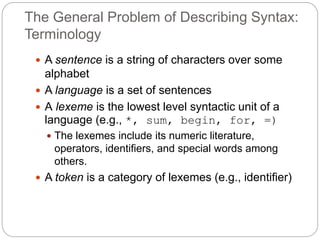
Terminology
1-4
 A sentence is a string of characters over some
alphabet
 A language is a set of sentences
 A lexeme is the lowest level syntactic unit of a
language (e.g., *, sum, begin, for, =)
 The lexemes include its numeric literature,
operators, identifiers, and special words among
others.
 A token is a category of lexemes (e.g., identifier)
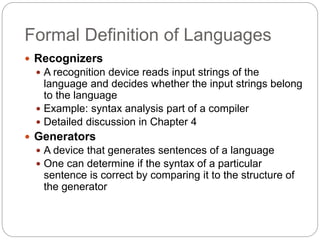
Formal Definition of Languages
1-5
 Recognizers
 A recognition device reads input strings of the
language and decides whether the input strings belong
to the language
 Example: syntax analysis part of a compiler
 Detailed discussion in Chapter 4
 Generators
 A device that generates sentences of a language
 One can determine if the syntax of a particular
sentence is correct by comparing it to the structure of
the generator
Formal Methods of Describing
Syntax
1-6
 Backus-Naur Form and Context-Free Grammars
 Most widely known method for describing
programming language syntax
 Extended BNF
 Improves readability and writability of BNF
 Grammars and Recognizers
BNF and Context-Free
Grammars
1-7
 Context-Free Grammars
 Developed by Noam Chomsky in the mid-1950s
 Language generators, meant to describe the syntax
of natural languages
 Define a class of languages called context-free
languages
Backus-Naur Form (BNF)
1-8
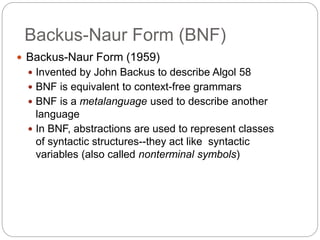
 Backus-Naur Form (1959)
 Invented by John Backus to describe Algol 58
 BNF is equivalent to context-free grammars
 BNF is a metalanguage used to describe another
language
 In BNF, abstractions are used to represent classes
of syntactic structures--they act like syntactic
variables (also called nonterminal symbols)
BNF Fundamentals
1-9
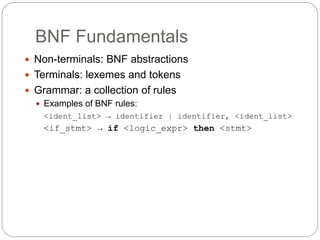
 Non-terminals: BNF abstractions
 Terminals: lexemes and tokens
 Grammar: a collection of rules
 Examples of BNF rules:
<ident_list> → identifier | identifier, <ident_list>
<if_stmt> → if <logic_expr> then <stmt>
BNF Rules
1-10
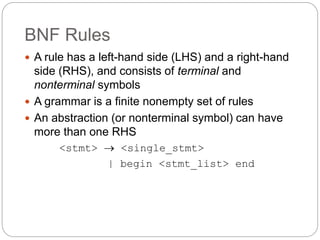
 A rule has a left-hand side (LHS) and a right-hand
side (RHS), and consists of terminal and
nonterminal symbols
 A grammar is a finite nonempty set of rules
 An abstraction (or nonterminal symbol) can have
more than one RHS
<stmt>  <single_stmt>
| begin <stmt_list> end
Describing Lists
1-11
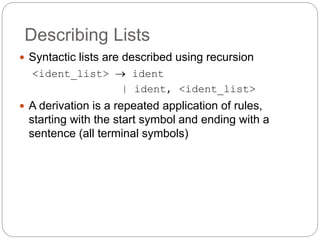
 Syntactic lists are described using recursion
<ident_list>  ident
| ident, <ident_list>
 A derivation is a repeated application of rules,
starting with the start symbol and ending with a
sentence (all terminal symbols)
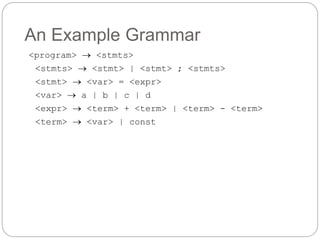
An Example Grammar
1-12
<program>  <stmts>
<stmts>  <stmt> | <stmt> ; <stmts>
<stmt>  <var> = <expr>
<var>  a | b | c | d
<expr>  <term> + <term> | <term> - <term>
<term>  <var> | const
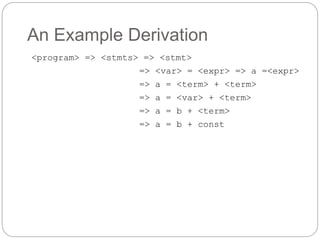
An Example Derivation
1-13
<program> => <stmts> => <stmt>
=> <var> = <expr> => a =<expr>
=> a = <term> + <term>
=> a = <var> + <term>
=> a = b + <term>
=> a = b + const
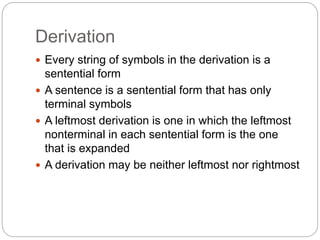
Derivation
1-14
 Every string of symbols in the derivation is a
sentential form
 A sentence is a sentential form that has only
terminal symbols
 A leftmost derivation is one in which the leftmost
nonterminal in each sentential form is the one
that is expanded
 A derivation may be neither leftmost nor rightmost
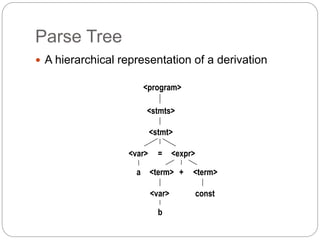
Parse Tree
1-15
 A hierarchical representation of a derivation
<program>
<stmts>
<stmt>
const
a
<var> = <expr>
<var>
b
<term> + <term>
Ambiguity in Grammars
1-16
 A grammar is ambiguous if and only if it
generates a sentential form that has two or more
distinct parse trees
 In many cases, an ambiguous grammar can be
rewritten to be unambiguous and still generate
the desired language.
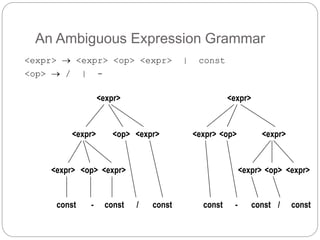
An Ambiguous Expression Grammar
1-17
<expr>  <expr> <op> <expr> | const
<op>  / | -
<expr>
<expr> <expr>
<expr> <expr>
<expr>
<expr> <expr>
<expr> <expr>
<op>
<op>
<op>
<op>
const const const const const const
- -
/ /
<op>
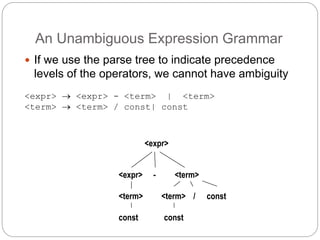
An Unambiguous Expression Grammar
1-18
 If we use the parse tree to indicate precedence
levels of the operators, we cannot have ambiguity
<expr>  <expr> - <term> | <term>
<term>  <term> / const| const
<expr>
<expr> <term>
<term> <term>
const const
const
/
-
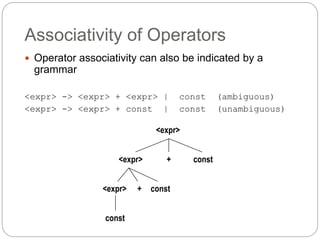
Associativity of Operators
1-19
 Operator associativity can also be indicated by a
grammar
<expr> -> <expr> + <expr> | const (ambiguous)
<expr> -> <expr> + const | const (unambiguous)
<expr>
<expr>
<expr>
<expr> const
const
const
+
+
Extended BNF
1-20
 Optional parts are placed in brackets [ ]
<proc_call> -> ident [(<expr_list>)]
 Alternative parts of RHSs are placed inside
parentheses and separated via vertical bars
<term> → <term> (+|-) const
 Repetitions (0 or more) are placed inside braces {
}
<ident> → letter {letter|digit}
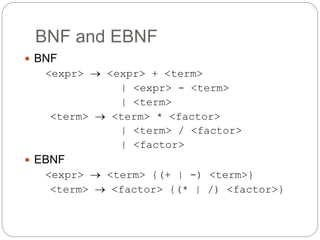
BNF and EBNF
1-21
 BNF
<expr>  <expr> + <term>
| <expr> - <term>
| <term>
<term>  <term> * <factor>
| <term> / <factor>
| <factor>
 EBNF
<expr>  <term> {(+ | -) <term>}
<term>  <factor> {(* | /) <factor>}
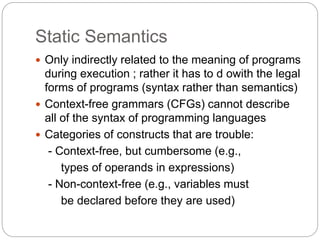
Static Semantics
1-22
 Only indirectly related to the meaning of programs
during execution ; rather it has to d owith the legal
forms of programs (syntax rather than semantics)
 Context-free grammars (CFGs) cannot describe
all of the syntax of programming languages
 Categories of constructs that are trouble:
- Context-free, but cumbersome (e.g.,
types of operands in expressions)
- Non-context-free (e.g., variables must
be declared before they are used)
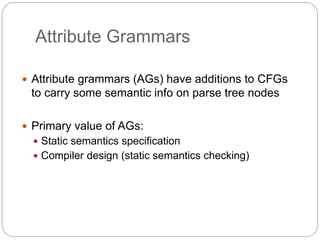
Attribute Grammars
1-23
 Attribute grammars (AGs) have additions to CFGs
to carry some semantic info on parse tree nodes
 Primary value of AGs:
 Static semantics specification
 Compiler design (static semantics checking)
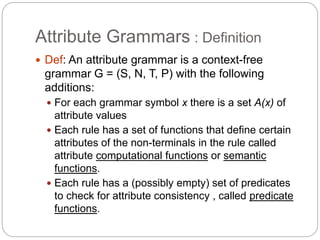
Attribute Grammars : Definition
1-24
 Def: An attribute grammar is a context-free
grammar G = (S, N, T, P) with the following
additions:
 For each grammar symbol x there is a set A(x) of
attribute values
 Each rule has a set of functions that define certain
attributes of the non-terminals in the rule called
attribute computational functions or semantic
functions.
 Each rule has a (possibly empty) set of predicates
to check for attribute consistency , called predicate
functions.
Attribute Grammars: Definition
1-25
 Let X0  X1 ... Xn be a rule
 Functions of the form S(X0) = f(A(X1), ... , A(Xn))
define synthesized attributes
 Functions of the form I(Xj) = f(A(X0), ... , A(Xn)),
for i <= j <= n, define inherited attributes
 Initially, there are intrinsic attributes on the leaves
Attribute Grammars: An Example
1-26
 Syntax
<assign> -> <var> = <expr>
<expr> -> <var> + <var> | <var>
<var> A | B | C
 actual_type: synthesized for <var>
and <expr>
 expected_type: inherited for <expr>
Attribute Grammar (continued)
1-27
 Syntax rule: <expr>  <var>[1] + <var>[2]
Semantic rules:
<expr>.actual_type 
<var>[1].actual_type
Predicate:
<var>[1].actual_type == <var>[2].actual_type
<expr>.expected_type == <expr>.actual_type
 Syntax rule: <var>  id
Semantic rule:
<var>.actual_type  lookup
(<var>.string)
Attribute Grammars (continued)
1-28
 How are attribute values computed?
 If all attributes were inherited, the tree could be
decorated in top-down order.
 If all attributes were synthesized, the tree could be
decorated in bottom-up order.
 In many cases, both kinds of attributes are used,
and it is some combination of top-down and bottom-
up that must be used.
Attribute Grammars (continued)
1-29
<expr>.expected_type  inherited from parent
<var>[1].actual_type  lookup (A)
<var>[2].actual_type  lookup (B)
<var>[1].actual_type =? <var>[2].actual_type
<expr>.actual_type  <var>[1].actual_type
<expr>.actual_type =? <expr>.expected_type
Semantics
1-30
 There is no single widely acceptable notation or
formalism for describing semantics
 Several needs for a methodology and notation for
semantics:
 Programmers need to know what statements mean
 Compiler writers must know exactly what language constructs do
 Correctness proofs would be possible
 Compiler generators would be possible
 Designers could detect ambiguities and inconsistencies
Operational Semantics
1-31
 Operational Semantics
 Describe the meaning of a program by executing its
statements on a machine, either simulated or
actual. The change in the state of the machine
(memory, registers, etc.) defines the meaning of the
statement
 To use operational semantics for a high-level
language, an intermediate language could be
intoduced which should be easy to understand
and self descriptive.
 a virtual machine could be implemented for the
intermediate language as well.
Operational Semantics
1-32
 There are different levels of uses of operational
semantics:
 At the highest level, the final result of the program
execution is of interest: Natural Operational
Semantics
 At the lowest level, the complete sequence of state
changes (caused by execution of each instruction)
is of interest: Natural Operational Semantics
 See the example in page 142
Operational Semantics
(continued)
1-33
 Uses of operational semantics:
- Language manuals and textbooks
- Teaching programming languages
 Two different levels of uses of operational semantics:
- Natural operational semantics
- Structural operational semantics
 Evaluation
- Good if used informally (language manuals, etc.)
- Extremely complex if used formally (e.g.,VDL)
Denotational Semantics
1-34
 Based on recursive function theory
 The most abstract semantics description method
 Originally developed by Scott and Strachey
(1970)
Denotational Semantics (continued)
1-35
 The process of building a denotational
specification for a language Define a
mathematical object for each language entity
 Define a function that maps instances of the
language entities onto instances of the
corresponding mathematical objects
 The meaning of language constructs are defined
by only the values of the program's variables
Denotation Semantics vs Operational
Semantics
1-36
 In operational semantics, the state changes are
defined by coded algorithms
 In denotational semantics, the state changes are
defined by rigorous mathematical functions
Denotational Semantics: Program State
1-37
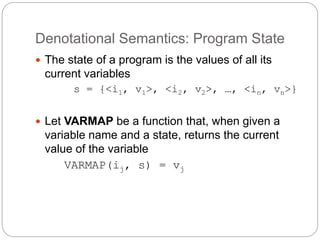
 The state of a program is the values of all its
current variables
s = {<i1, v1>, <i2, v2>, …, <in, vn>}
 Let VARMAP be a function that, when given a
variable name and a state, returns the current
value of the variable
VARMAP(ij, s) = vj
Decimal Numbers
1-38
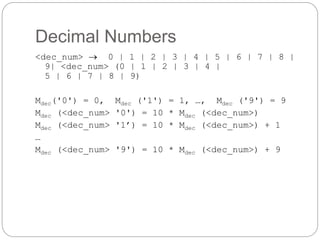
<dec_num>  0 | 1 | 2 | 3 | 4 | 5 | 6 | 7 | 8 |
9| <dec_num> (0 | 1 | 2 | 3 | 4 |
5 | 6 | 7 | 8 | 9)
Mdec('0') = 0, Mdec ('1') = 1, …, Mdec ('9') = 9
Mdec (<dec_num> '0') = 10 * Mdec (<dec_num>)
Mdec (<dec_num> '1’) = 10 * Mdec (<dec_num>) + 1
…
Mdec (<dec_num> '9') = 10 * Mdec (<dec_num>) + 9
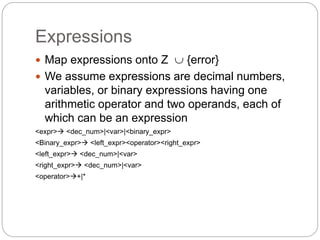
Expressions
1-39
 Map expressions onto Z  {error}
 We assume expressions are decimal numbers,
variables, or binary expressions having one
arithmetic operator and two operands, each of
which can be an expression
<expr> <dec_num>|<var>|<binary_expr>
<Binary_expr> <left_expr><operator><right_expr>
<left_expr> <dec_num>|<var>
<right_expr> <dec_num>|<var>
<operator>+|*
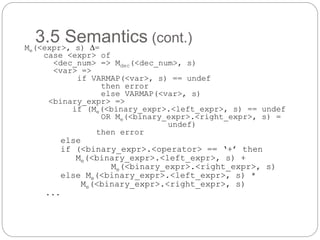
3.5 Semantics (cont.)
1-40
Me(<expr>, s) =
case <expr> of
<dec_num> => Mdec(<dec_num>, s)
<var> =>
if VARMAP(<var>, s) == undef
then error
else VARMAP(<var>, s)
<binary_expr> =>
if (Me(<binary_expr>.<left_expr>, s) == undef
OR Me(<binary_expr>.<right_expr>, s) =
undef)
then error
else
if (<binary_expr>.<operator> == ‘+’ then
Me(<binary_expr>.<left_expr>, s) +
Me(<binary_expr>.<right_expr>, s)
else Me(<binary_expr>.<left_expr>, s) *
Me(<binary_expr>.<right_expr>, s)
...
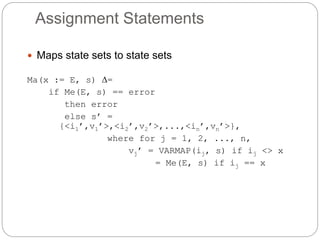
Assignment Statements
1-41
 Maps state sets to state sets
Ma(x := E, s) =
if Me(E, s) == error
then error
else s’ =
{<i1’,v1’>,<i2’,v2’>,...,<in’,vn’>},
where for j = 1, 2, ..., n,
vj’ = VARMAP(ij, s) if ij <> x
= Me(E, s) if ij == x
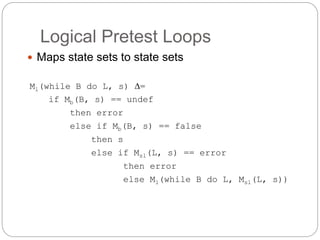
Logical Pretest Loops
1-42
 Maps state sets to state sets
Ml(while B do L, s) =
if Mb(B, s) == undef
then error
else if Mb(B, s) == false
then s
else if Msl(L, s) == error
then error
else Ml(while B do L, Msl(L, s))
Loop Meaning
1-43
 The meaning of the loop is the value of the program
variables after the statements in the loop have been
executed the prescribed number of times, assuming
there have been no errors
 In essence, the loop has been converted from
iteration to recursion, where the recursive control is
mathematically defined by other recursive state
mapping functions
 Recursion, when compared to iteration, is easier to
describe with mathematical rigor
Evaluation of Denotational Semantics
1-44
 Can be used to prove the correctness of
programs
 Provides a rigorous way to think about programs
 Can be an aid to language design
 Has been used in compiler generation systems
 Because of its complexity, they are of little use to
language users
Axiomatic Semantics
1-45
 Based on formal logic (predicate calculus)
 Original purpose: formal program verification
 Axioms or inference rules are defined for each
statement type in the language (to allow
transformations of expressions to other
expressions)
 The expressions are called assertions
Axiomatic Semantics (continued)
1-46
 An assertion before a statement (a precondition)
states the relationships and constraints among
variables that are true at that point in execution
 An assertion following a statement is a
postcondition
 A weakest precondition is the least restrictive
precondition that will guarantee the postcondition
Axiomatic Semantics Form
1-47
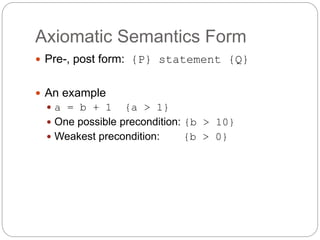
 Pre-, post form: {P} statement {Q}
 An example
 a = b + 1 {a > 1}
 One possible precondition: {b > 10}
 Weakest precondition: {b > 0}
Program Proof Process
1-48
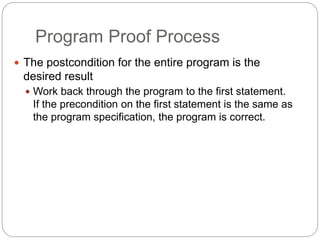
 The postcondition for the entire program is the
desired result
 Work back through the program to the first statement.
If the precondition on the first statement is the same as
the program specification, the program is correct.
Axiomatic Semantics: Axioms
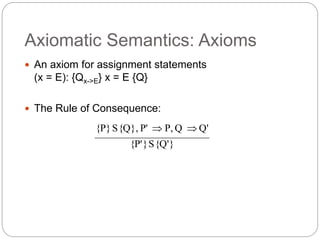
 An axiom for assignment statements
(x = E): {Qx->E} x = E {Q}
 The Rule of Consequence:
}
{Q'
S
}
{P'
Q'
Q
P,
P'
{Q},
S
{P} 

1-49
Axiomatic Semantics: Axioms
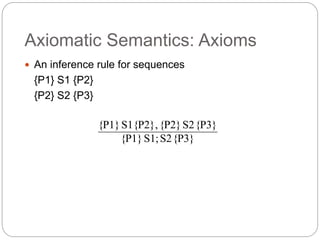
 An inference rule for sequences
{P1} S1 {P2}
{P2} S2 {P3}
{P3}
S2
S1;
{P1}
{P3}
S2
{P2}
{P2},
S1
{P1}
1-50
Axiomatic Semantics: Axioms
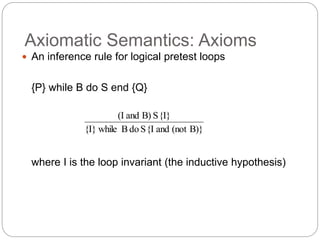
 An inference rule for logical pretest loops
{P} while B do S end {Q}
where I is the loop invariant (the inductive hypothesis)
B)}
(not
and
{I
S
do
B
while
{I}
{I}
S
B)
and
(I
1-51
Induction vs. Deduction
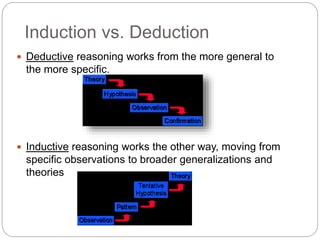
 Deductive reasoning works from the more general to
the more specific.
 Inductive reasoning works the other way, moving from
specific observations to broader generalizations and
theories
1-52
Axiomatic Semantics: Axioms
1-53
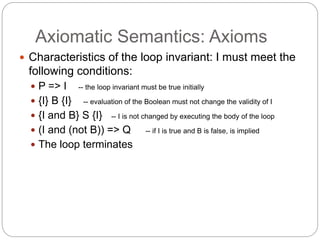
 Characteristics of the loop invariant: I must meet the
following conditions:
 P => I -- the loop invariant must be true initially
 {I} B {I} -- evaluation of the Boolean must not change the validity of I
 {I and B} S {I} -- I is not changed by executing the body of the loop
 (I and (not B)) => Q -- if I is true and B is false, is implied
 The loop terminates
Loop Invariant
1-54
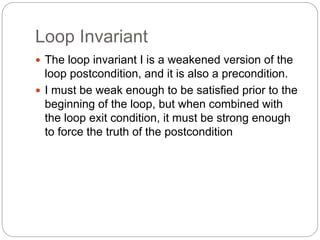
 The loop invariant I is a weakened version of the
loop postcondition, and it is also a precondition.
 I must be weak enough to be satisfied prior to the
beginning of the loop, but when combined with
the loop exit condition, it must be strong enough
to force the truth of the postcondition
Evaluation of Axiomatic
Semantics
1-55
 Developing axioms or inference rules for all of the
statements in a language is difficult
 It is a good tool for correctness proofs, and an
excellent framework for reasoning about
programs, but it is not as useful for language
users and compiler writers
 Its usefulness in describing the meaning of a
programming language is limited for language
users or compiler writers
Summary
1-56
 BNF and context-free grammars are equivalent
meta-languages
 Well-suited for describing the syntax of
programming languages
 An attribute grammar is a descriptive formalism
that can describe both the syntax and the
semantics of a language
 Three primary methods of semantics description
 Operation, axiomatic, denotational

Describing syntax and semantics66666.ppt

  • 1.
  • 2.
    Chapter 3 Topics 1-2 Introduction  The General Problem of Describing Syntax  Formal Methods of Describing Syntax  Attribute Grammars  Describing the Meanings of Programs: Dynamic Semantics
  • 3.
    Introduction 1-3  Syntax: theform or structure of the expressions, statements, and program units  Semantics: the meaning of the expressions, statements, and program units  Syntax and semantics provide a language’s definition  Users of a language definition  Other language designers  Implementers  Programmers (the users of the language)
  • 4.
    The General Problemof Describing Syntax: Terminology 1-4  A sentence is a string of characters over some alphabet  A language is a set of sentences  A lexeme is the lowest level syntactic unit of a language (e.g., *, sum, begin, for, =)  The lexemes include its numeric literature, operators, identifiers, and special words among others.  A token is a category of lexemes (e.g., identifier)
  • 5.
    Formal Definition ofLanguages 1-5  Recognizers  A recognition device reads input strings of the language and decides whether the input strings belong to the language  Example: syntax analysis part of a compiler  Detailed discussion in Chapter 4  Generators  A device that generates sentences of a language  One can determine if the syntax of a particular sentence is correct by comparing it to the structure of the generator
  • 6.
    Formal Methods ofDescribing Syntax 1-6  Backus-Naur Form and Context-Free Grammars  Most widely known method for describing programming language syntax  Extended BNF  Improves readability and writability of BNF  Grammars and Recognizers
  • 7.
    BNF and Context-Free Grammars 1-7 Context-Free Grammars  Developed by Noam Chomsky in the mid-1950s  Language generators, meant to describe the syntax of natural languages  Define a class of languages called context-free languages
  • 8.
    Backus-Naur Form (BNF) 1-8 Backus-Naur Form (1959)  Invented by John Backus to describe Algol 58  BNF is equivalent to context-free grammars  BNF is a metalanguage used to describe another language  In BNF, abstractions are used to represent classes of syntactic structures--they act like syntactic variables (also called nonterminal symbols)
  • 9.
    BNF Fundamentals 1-9  Non-terminals:BNF abstractions  Terminals: lexemes and tokens  Grammar: a collection of rules  Examples of BNF rules: <ident_list> → identifier | identifier, <ident_list> <if_stmt> → if <logic_expr> then <stmt>
  • 10.
    BNF Rules 1-10  Arule has a left-hand side (LHS) and a right-hand side (RHS), and consists of terminal and nonterminal symbols  A grammar is a finite nonempty set of rules  An abstraction (or nonterminal symbol) can have more than one RHS <stmt>  <single_stmt> | begin <stmt_list> end
  • 11.
    Describing Lists 1-11  Syntacticlists are described using recursion <ident_list>  ident | ident, <ident_list>  A derivation is a repeated application of rules, starting with the start symbol and ending with a sentence (all terminal symbols)
  • 12.
    An Example Grammar 1-12 <program> <stmts> <stmts>  <stmt> | <stmt> ; <stmts> <stmt>  <var> = <expr> <var>  a | b | c | d <expr>  <term> + <term> | <term> - <term> <term>  <var> | const
  • 13.
    An Example Derivation 1-13 <program>=> <stmts> => <stmt> => <var> = <expr> => a =<expr> => a = <term> + <term> => a = <var> + <term> => a = b + <term> => a = b + const
  • 14.
    Derivation 1-14  Every stringof symbols in the derivation is a sentential form  A sentence is a sentential form that has only terminal symbols  A leftmost derivation is one in which the leftmost nonterminal in each sentential form is the one that is expanded  A derivation may be neither leftmost nor rightmost
  • 15.
    Parse Tree 1-15  Ahierarchical representation of a derivation <program> <stmts> <stmt> const a <var> = <expr> <var> b <term> + <term>
  • 16.
    Ambiguity in Grammars 1-16 A grammar is ambiguous if and only if it generates a sentential form that has two or more distinct parse trees  In many cases, an ambiguous grammar can be rewritten to be unambiguous and still generate the desired language.
  • 17.
    An Ambiguous ExpressionGrammar 1-17 <expr>  <expr> <op> <expr> | const <op>  / | - <expr> <expr> <expr> <expr> <expr> <expr> <expr> <expr> <expr> <expr> <op> <op> <op> <op> const const const const const const - - / / <op>
  • 18.
    An Unambiguous ExpressionGrammar 1-18  If we use the parse tree to indicate precedence levels of the operators, we cannot have ambiguity <expr>  <expr> - <term> | <term> <term>  <term> / const| const <expr> <expr> <term> <term> <term> const const const / -
  • 19.
    Associativity of Operators 1-19 Operator associativity can also be indicated by a grammar <expr> -> <expr> + <expr> | const (ambiguous) <expr> -> <expr> + const | const (unambiguous) <expr> <expr> <expr> <expr> const const const + +
  • 20.
    Extended BNF 1-20  Optionalparts are placed in brackets [ ] <proc_call> -> ident [(<expr_list>)]  Alternative parts of RHSs are placed inside parentheses and separated via vertical bars <term> → <term> (+|-) const  Repetitions (0 or more) are placed inside braces { } <ident> → letter {letter|digit}
  • 21.
    BNF and EBNF 1-21 BNF <expr>  <expr> + <term> | <expr> - <term> | <term> <term>  <term> * <factor> | <term> / <factor> | <factor>  EBNF <expr>  <term> {(+ | -) <term>} <term>  <factor> {(* | /) <factor>}
  • 22.
    Static Semantics 1-22  Onlyindirectly related to the meaning of programs during execution ; rather it has to d owith the legal forms of programs (syntax rather than semantics)  Context-free grammars (CFGs) cannot describe all of the syntax of programming languages  Categories of constructs that are trouble: - Context-free, but cumbersome (e.g., types of operands in expressions) - Non-context-free (e.g., variables must be declared before they are used)
  • 23.
    Attribute Grammars 1-23  Attributegrammars (AGs) have additions to CFGs to carry some semantic info on parse tree nodes  Primary value of AGs:  Static semantics specification  Compiler design (static semantics checking)
  • 24.
    Attribute Grammars :Definition 1-24  Def: An attribute grammar is a context-free grammar G = (S, N, T, P) with the following additions:  For each grammar symbol x there is a set A(x) of attribute values  Each rule has a set of functions that define certain attributes of the non-terminals in the rule called attribute computational functions or semantic functions.  Each rule has a (possibly empty) set of predicates to check for attribute consistency , called predicate functions.
  • 25.
    Attribute Grammars: Definition 1-25 Let X0  X1 ... Xn be a rule  Functions of the form S(X0) = f(A(X1), ... , A(Xn)) define synthesized attributes  Functions of the form I(Xj) = f(A(X0), ... , A(Xn)), for i <= j <= n, define inherited attributes  Initially, there are intrinsic attributes on the leaves
  • 26.
    Attribute Grammars: AnExample 1-26  Syntax <assign> -> <var> = <expr> <expr> -> <var> + <var> | <var> <var> A | B | C  actual_type: synthesized for <var> and <expr>  expected_type: inherited for <expr>
  • 27.
    Attribute Grammar (continued) 1-27 Syntax rule: <expr>  <var>[1] + <var>[2] Semantic rules: <expr>.actual_type  <var>[1].actual_type Predicate: <var>[1].actual_type == <var>[2].actual_type <expr>.expected_type == <expr>.actual_type  Syntax rule: <var>  id Semantic rule: <var>.actual_type  lookup (<var>.string)
  • 28.
    Attribute Grammars (continued) 1-28 How are attribute values computed?  If all attributes were inherited, the tree could be decorated in top-down order.  If all attributes were synthesized, the tree could be decorated in bottom-up order.  In many cases, both kinds of attributes are used, and it is some combination of top-down and bottom- up that must be used.
  • 29.
    Attribute Grammars (continued) 1-29 <expr>.expected_type inherited from parent <var>[1].actual_type  lookup (A) <var>[2].actual_type  lookup (B) <var>[1].actual_type =? <var>[2].actual_type <expr>.actual_type  <var>[1].actual_type <expr>.actual_type =? <expr>.expected_type
  • 30.
    Semantics 1-30  There isno single widely acceptable notation or formalism for describing semantics  Several needs for a methodology and notation for semantics:  Programmers need to know what statements mean  Compiler writers must know exactly what language constructs do  Correctness proofs would be possible  Compiler generators would be possible  Designers could detect ambiguities and inconsistencies
  • 31.
    Operational Semantics 1-31  OperationalSemantics  Describe the meaning of a program by executing its statements on a machine, either simulated or actual. The change in the state of the machine (memory, registers, etc.) defines the meaning of the statement  To use operational semantics for a high-level language, an intermediate language could be intoduced which should be easy to understand and self descriptive.  a virtual machine could be implemented for the intermediate language as well.
  • 32.
    Operational Semantics 1-32  Thereare different levels of uses of operational semantics:  At the highest level, the final result of the program execution is of interest: Natural Operational Semantics  At the lowest level, the complete sequence of state changes (caused by execution of each instruction) is of interest: Natural Operational Semantics  See the example in page 142
  • 33.
    Operational Semantics (continued) 1-33  Usesof operational semantics: - Language manuals and textbooks - Teaching programming languages  Two different levels of uses of operational semantics: - Natural operational semantics - Structural operational semantics  Evaluation - Good if used informally (language manuals, etc.) - Extremely complex if used formally (e.g.,VDL)
  • 34.
    Denotational Semantics 1-34  Basedon recursive function theory  The most abstract semantics description method  Originally developed by Scott and Strachey (1970)
  • 35.
    Denotational Semantics (continued) 1-35 The process of building a denotational specification for a language Define a mathematical object for each language entity  Define a function that maps instances of the language entities onto instances of the corresponding mathematical objects  The meaning of language constructs are defined by only the values of the program's variables
  • 36.
    Denotation Semantics vsOperational Semantics 1-36  In operational semantics, the state changes are defined by coded algorithms  In denotational semantics, the state changes are defined by rigorous mathematical functions
  • 37.
    Denotational Semantics: ProgramState 1-37  The state of a program is the values of all its current variables s = {<i1, v1>, <i2, v2>, …, <in, vn>}  Let VARMAP be a function that, when given a variable name and a state, returns the current value of the variable VARMAP(ij, s) = vj
  • 38.
    Decimal Numbers 1-38 <dec_num> 0 | 1 | 2 | 3 | 4 | 5 | 6 | 7 | 8 | 9| <dec_num> (0 | 1 | 2 | 3 | 4 | 5 | 6 | 7 | 8 | 9) Mdec('0') = 0, Mdec ('1') = 1, …, Mdec ('9') = 9 Mdec (<dec_num> '0') = 10 * Mdec (<dec_num>) Mdec (<dec_num> '1’) = 10 * Mdec (<dec_num>) + 1 … Mdec (<dec_num> '9') = 10 * Mdec (<dec_num>) + 9
  • 39.
    Expressions 1-39  Map expressionsonto Z  {error}  We assume expressions are decimal numbers, variables, or binary expressions having one arithmetic operator and two operands, each of which can be an expression <expr> <dec_num>|<var>|<binary_expr> <Binary_expr> <left_expr><operator><right_expr> <left_expr> <dec_num>|<var> <right_expr> <dec_num>|<var> <operator>+|*
  • 40.
    3.5 Semantics (cont.) 1-40 Me(<expr>,s) = case <expr> of <dec_num> => Mdec(<dec_num>, s) <var> => if VARMAP(<var>, s) == undef then error else VARMAP(<var>, s) <binary_expr> => if (Me(<binary_expr>.<left_expr>, s) == undef OR Me(<binary_expr>.<right_expr>, s) = undef) then error else if (<binary_expr>.<operator> == ‘+’ then Me(<binary_expr>.<left_expr>, s) + Me(<binary_expr>.<right_expr>, s) else Me(<binary_expr>.<left_expr>, s) * Me(<binary_expr>.<right_expr>, s) ...
  • 41.
    Assignment Statements 1-41  Mapsstate sets to state sets Ma(x := E, s) = if Me(E, s) == error then error else s’ = {<i1’,v1’>,<i2’,v2’>,...,<in’,vn’>}, where for j = 1, 2, ..., n, vj’ = VARMAP(ij, s) if ij <> x = Me(E, s) if ij == x
  • 42.
    Logical Pretest Loops 1-42 Maps state sets to state sets Ml(while B do L, s) = if Mb(B, s) == undef then error else if Mb(B, s) == false then s else if Msl(L, s) == error then error else Ml(while B do L, Msl(L, s))
  • 43.
    Loop Meaning 1-43  Themeaning of the loop is the value of the program variables after the statements in the loop have been executed the prescribed number of times, assuming there have been no errors  In essence, the loop has been converted from iteration to recursion, where the recursive control is mathematically defined by other recursive state mapping functions  Recursion, when compared to iteration, is easier to describe with mathematical rigor
  • 44.
    Evaluation of DenotationalSemantics 1-44  Can be used to prove the correctness of programs  Provides a rigorous way to think about programs  Can be an aid to language design  Has been used in compiler generation systems  Because of its complexity, they are of little use to language users
  • 45.
    Axiomatic Semantics 1-45  Basedon formal logic (predicate calculus)  Original purpose: formal program verification  Axioms or inference rules are defined for each statement type in the language (to allow transformations of expressions to other expressions)  The expressions are called assertions
  • 46.
    Axiomatic Semantics (continued) 1-46 An assertion before a statement (a precondition) states the relationships and constraints among variables that are true at that point in execution  An assertion following a statement is a postcondition  A weakest precondition is the least restrictive precondition that will guarantee the postcondition
  • 47.
    Axiomatic Semantics Form 1-47 Pre-, post form: {P} statement {Q}  An example  a = b + 1 {a > 1}  One possible precondition: {b > 10}  Weakest precondition: {b > 0}
  • 48.
    Program Proof Process 1-48 The postcondition for the entire program is the desired result  Work back through the program to the first statement. If the precondition on the first statement is the same as the program specification, the program is correct.
  • 49.
    Axiomatic Semantics: Axioms An axiom for assignment statements (x = E): {Qx->E} x = E {Q}  The Rule of Consequence: } {Q' S } {P' Q' Q P, P' {Q}, S {P}   1-49
  • 50.
    Axiomatic Semantics: Axioms An inference rule for sequences {P1} S1 {P2} {P2} S2 {P3} {P3} S2 S1; {P1} {P3} S2 {P2} {P2}, S1 {P1} 1-50
  • 51.
    Axiomatic Semantics: Axioms An inference rule for logical pretest loops {P} while B do S end {Q} where I is the loop invariant (the inductive hypothesis) B)} (not and {I S do B while {I} {I} S B) and (I 1-51
  • 52.
    Induction vs. Deduction Deductive reasoning works from the more general to the more specific.  Inductive reasoning works the other way, moving from specific observations to broader generalizations and theories 1-52
  • 53.
    Axiomatic Semantics: Axioms 1-53 Characteristics of the loop invariant: I must meet the following conditions:  P => I -- the loop invariant must be true initially  {I} B {I} -- evaluation of the Boolean must not change the validity of I  {I and B} S {I} -- I is not changed by executing the body of the loop  (I and (not B)) => Q -- if I is true and B is false, is implied  The loop terminates
  • 54.
    Loop Invariant 1-54  Theloop invariant I is a weakened version of the loop postcondition, and it is also a precondition.  I must be weak enough to be satisfied prior to the beginning of the loop, but when combined with the loop exit condition, it must be strong enough to force the truth of the postcondition
  • 55.
    Evaluation of Axiomatic Semantics 1-55 Developing axioms or inference rules for all of the statements in a language is difficult  It is a good tool for correctness proofs, and an excellent framework for reasoning about programs, but it is not as useful for language users and compiler writers  Its usefulness in describing the meaning of a programming language is limited for language users or compiler writers
  • 56.
    Summary 1-56  BNF andcontext-free grammars are equivalent meta-languages  Well-suited for describing the syntax of programming languages  An attribute grammar is a descriptive formalism that can describe both the syntax and the semantics of a language  Three primary methods of semantics description  Operation, axiomatic, denotational