Animal Production (SWINE) NCII |
wynnierondon4@gmail.com
Republic of the Philippines
Province of Ilocos Sur
ILOCOS SUR COMMUNITY COLLEGE DEMOFARM
Km 429 Manila North Road
San Juan, Ilocos Sur
Animal Production
(SWINE) NCII
Raise Weanlings
and
Produce Finishers
Subjects
WYNNIE U. RONDON
Trainer
wynnierondon4@gmail.com
Animal Production (SWINE) NCII 2 |
wynnierondon4@gmail.com
Republic of the Philippines
Province of Ilocos Sur
ILOCOS SUR COMMUNITY COLLEGE DEMOFARM
Km 429 Manila North Road
San Juan, Ilocos Sur
LESSON 1. BREEDS OF SWINE
 THE FOLLOWING ARE COMMON NAMES AND TERMS USED IN DESCRIBING
SWINE.
 1. Swine are porcine animals, which are members of the genus Sus.
 2. A mature swine animal is a hog.
 3. A mature male is a boar.
 4. A mature female is a sow.
 5. A young male is a shoat or young boar.
 6. A young female is a gilt.
 7. A castrated male is a barrow.
 8. A newborn is a piglet.
 9. A group of swine is a drove or herd.
 A meat-type hog is a hog that produces the greatest amount of high-value meat
cuts.
 Conformation is the type and shape of an animal.
 Artificial insemination (AI)is a method of placing semen collected from a male
into the reproductive tract of a female.
 Sus scrofa scientific name of swine
 Weaning is the separation of piglets from the sow
 Weanlings this term used to call to weaned piglets
Learning Objective:
After reading this module, you should be able to:
1. Determine the breeds of swine
2. Determine the physical characteristics and traits of breed of swine
Animal Production (SWINE) NCII 3 |
wynnierondon4@gmail.com
LESSON 1.1 – LESSON 1.2 DIFFERENT BREEDS OF SWINE AND THEIR
PHYSICAL CHARACTERISTICS AND TRAITS
BREEDS OF SWINE
1. DUROC
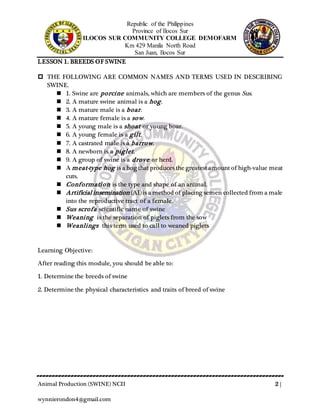
1. The Duroc breed originated in the eastern United States from red hogs raised
before 1865.
 Originally, Duroc hogs were known as Duroc-Jersey hogs, but Jersey has
been removed from the name.
 All Duroc hogs are red, although the color can vary from very light to dark.
 They have ears that droop forward over the eyes.
 The breed is popular because of good mothering ability, efficient feed
conversion, fast growth rate, and prolificacy.
 Prolificacy is the ability to produce large numbers of offspring.
 The Duroc is known as a meat-type hog.
Animal Production (SWINE) NCII 4 |
wynnierondon4@gmail.com
2. HAMPSHIRE
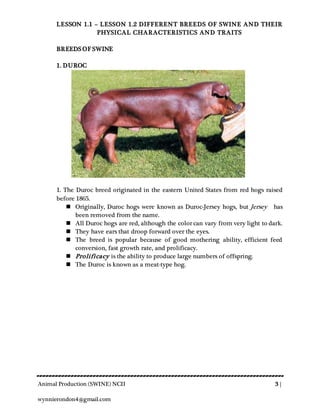
 The Hampshire breed originated in England and was brought to the United
States between 1825 and 1835.
 The Hampshire is a black hog with a white belt that encircles the forepart
of the body, starting behind the head and neck.
 It has ears that stand erect.
 Some of the characteristics for which the breed is known are foraging
ability, leanness of carcass, and muscling.
 Hampshire hogs are commonly used as show animals and in various
crossbreeding programs.
3. YORKSHIRE OR LARGE WHITE
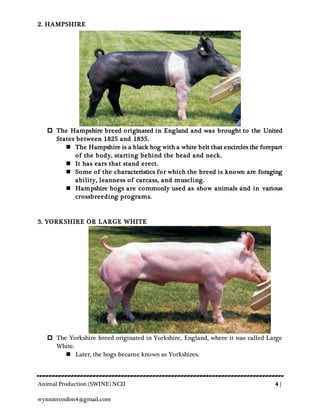
 The Yorkshire breed originated in Yorkshire, England, where it was called Large
White.
 Later, the hogs became known as Yorkshires.
Animal Production (SWINE) NCII 5 |
wynnierondon4@gmail.com
 As their original name depicts, they are large white hogs.
 They have long bodies.
 Black spots sometimes appear on their skin. These undesirable spots are
called freckles.
 Yorkshires have erect ears and are known for their large litters, good
mothering ability, good feed efficiency, and rapid growth.
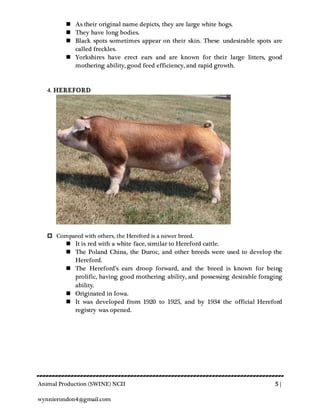
4. HEREFORD
 Compared with others, the Hereford is a newer breed.
 It is red with a white face, similar to Hereford cattle.
 The Poland China, the Duroc, and other breeds were used to develop the
Hereford.
 The Hereford’s ears droop forward, and the breed is known for being
prolific, having good mothering ability, and possessing desirable foraging
ability.
 Originated in Iowa.
 It was developed from 1920 to 1925, and by 1934 the official Hereford
registry was opened.
Animal Production (SWINE) NCII 6 |
wynnierondon4@gmail.com
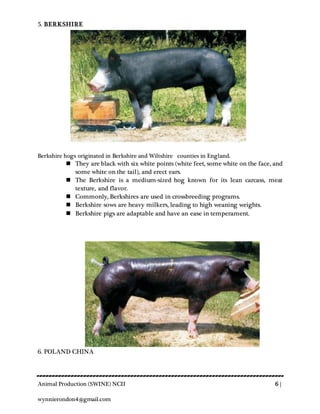
5. BERKSHIRE
Berkshire hogs originated in Berkshire and Wiltshire counties in England.
 They are black with six white points (white feet, some white on the face, and
some white on the tail), and erect ears.
 The Berkshire is a medium-sized hog known for its lean carcass, meat
texture, and flavor.
 Commonly, Berkshires are used in crossbreeding programs.
 Berkshire sows are heavy milkers, leading to high weaning weights.
 Berkshire pigs are adaptable and have an ease in temperament.
6. POLAND CHINA
Animal Production (SWINE) NCII 7 |
wynnierondon4@gmail.com
 Poland China hogs originated in Ohio between 1800 and 1850 using several
different bloodlines.
 Originally called Warren County hogs, Poland China hogs are black with
white markings on the feet, the face, and the tip of the tail.
 This large breed has forward-drooping ears and produces carcasses with
large loin eyes and very little back fat.
 Because of their desirable traits, Poland China hogs are commonly used in
crossbreeding programs.
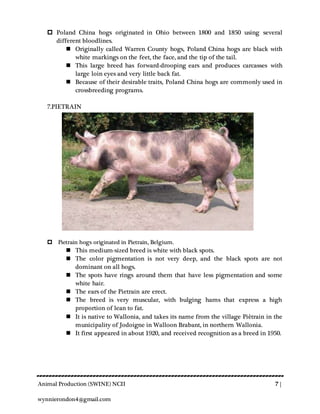
7.PIETRAIN
 Pietrain hogs originated in Pietrain, Belgium.
 This medium-sized breed is white with black spots.
 The color pigmentation is not very deep, and the black spots are not
dominant on all hogs.
 The spots have rings around them that have less pigmentation and some
white hair.
 The ears of the Pietrain are erect.
 The breed is very muscular, with bulging hams that express a high
proportion of lean to fat.
 It is native to Wallonia, and takes its name from the village Piètrain in the
municipality of Jodoigne in Walloon Brabant, in northern Wallonia.
 It first appeared in about 1920, and received recognition as a breed in 1950.
Animal Production (SWINE) NCII 8 |
wynnierondon4@gmail.com
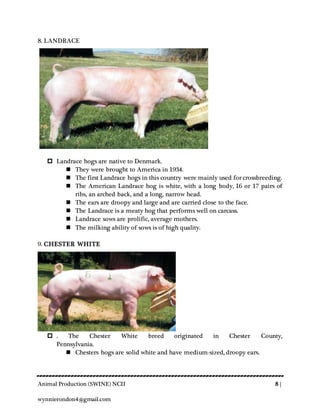
8. LANDRACE
 Landrace hogs are native to Denmark.
 They were brought to America in 1934.
 The first Landrace hogs in this country were mainly used for crossbreeding.
 The American Landrace hog is white, with a long body, 16 or 17 pairs of
ribs, an arched back, and a long, narrow head.
 The ears are droopy and large and are carried close to the face.
 The Landrace is a meaty hog that performs well on carcass.
 Landrace sows are prolific, average mothers.
 The milking ability of sows is of high quality.
9. CHESTER WHITE
 . The Chester White breed originated in Chester County,
Pennsylvania.
 Chesters hogs are solid white and have medium-sized, droopy ears.
Animal Production (SWINE) NCII 9 |
wynnierondon4@gmail.com
 Although boars of this breed are usually aggressive, sows are valued for
their mothering ability and typically have large litters.
 Because of their mothering ability, durability, and soundness, Chesters have
kept their popularity with thousands of pork producers.
 Producers prefer them, and packers prefer animals with white skin.
 Many Chesters are used in commercial or non-purebred operations.
SELF-CHECK!!
Please avoid copying the work or answers of your classmates or extracting your answers
from the google or internet. This assessment intended to evaluate your learning.
There is no big difference between LIAR and CHEATER. Cheat and you will not just
insult your own knowledge but you will also be committing a crime. You are TOO FAR
HONORABLE TO CHEAT. – (ctto)
Name:________________________________________ Course: ____________________
1. Why is it important to know the breeds of swine and their characteristics when putting
up a piggery farm?
Animal Production (SWINE) NCII 10
|
wynnierondon4@gmail.com
2. You are putting up a piggery farm (growing-finishing type), what will you choose
among the breeds of swine to be your stock? Support your answer.
Republic of the Philippines
Province of Ilocos Sur
ILOCOS SUR COMMUNITY COLLEGE DEMOFARM
Km 429 Manila North Road
San Juan, Ilocos Sur
LESSON 2. CLEANING AND DISINFECTING
Definitions of Terms
 Abnormal behavior – refers to any changes developed as a response to poor or wrong
management.
 Fomites – refers to any non-living object or substance capable of carrying infectious
organisms or parasites which may be transferred from one individual to another
 Pig farm – refers to any establishment where pigs are raised
 Vector – refers to the animal or insect that can transmit pathogenic agents to pig
 Pathogens – disease causing organisms
 Swill feeding – feeding of food scraps/food waste/ leftover to pigs
 Vermin – believed to be harmful to farm animals or which carry disease such as not limited
to rats and insects, and does not include those worms produced for natural feeding.
Animal Production (SWINE) NCII 11
|
wynnierondon4@gmail.com
 Backyard piggery – refers to the raising of less than 20 sow, they are usually dependent
on commercial feed mills for feeds
 Caretaker – refers to the person or persons assigned to take care of the pigs
 Chill factor – refers to the environmental temperature of 25°C or below that is injuriously
cold causing piglets to shiver
 Cold stress – refers to stress/suffering caused by exposure to cold temperature
 Commercial piggery – refers to the farm raising more than 20 sows
 Disinfectant – refers to substance to destroy bacteria or other infective microorganisms
 Distress – refers to the non-specific response to the animal caused by deprivation of food,
rough handling, exhaustion due to long transport, mixing of animals reared separately etc.
 Slaughter – refers to the killing of food animals in accredited slaughterhouse/abattoir in
relation to meat inspection and animal welfare
 Stocking density – refers to the rate or number of animals per given area
 Tail/ear biting – refers to the vice of animals consisting of biting the eras/tails of other
animals due to mineral deficiency/overcrowding, etc.
 The Animal Welfare Act of 1998 (RA 8485) – aims to protect and promote the welfare of
all animals in the Phils.
 Good husbandry is essential for good welfare, modern breeding, feeding, housing and
management systems.
5 Consideration of the RA 8485 to basic freedom of animals:
1. Freedom from thirst, hunger and malnutrition
2. Freedom from physical discomfort and pain
3. Freedom from injury and disease
4. Freedom to comfort to essential behavior patterns
5. Freedom from fear and distress
HOW TO CLEAN AND DISINFECT
Cleaning and disinfecting – are critical parts of all biosecurity programs. The goal is not to
completely sterilize the environment; but rather to decrease the pathogen load significantly to a
point where disease transmission does not occur.
 Cleaning to the removal of gross contamination, organic material, and debris from the premises
or respective structures via chemical means like sweeping (dry cleaning) and for the use of water
and soap or detergent (wet cleaning)
- Its goal is to minimize organic material so disinfection can be effective
 Disinfection – methods used in surface to destroy or eliminate a specific species of infectious
microorganisms through physical (e.g heat) or chemical (e.g. disinfectant) means.
 Goals of Cleaning and Disinfection
1. Remove, inactive, reduce or destroy viruses on premises
Animal Production (SWINE) NCII 12
|
wynnierondon4@gmail.com
2. Conduct cleaning and disinfection is the most cost effective manner possible
3. Choose appropriate C&D elimination methods based on the characteristics of the pen; premises
and temperature
4. Conduct timely and effective initial C&D on all areas of the premises that do not have
contaminated material (includes vehicles and equipment) prior to final virus elimination activities
on the entire premises.
 Cleaning and Disinfection of Equipment and Supplies
1. Pressure washing – using a power sprayer
2. Scrubbing – using of brushes and extension handles
3. Brushing – using of brooms, brushes and dustpans and shovel.
 CLASSIFICATIONS OF DISINFECTANTS
1. Acids (Acetic acid, citric acid) – acids are used to precipitate proteins. They can be caustic and
toxin if they reach concentration in the air. They have limited used in most swine cleaning and
disinfecting programs.
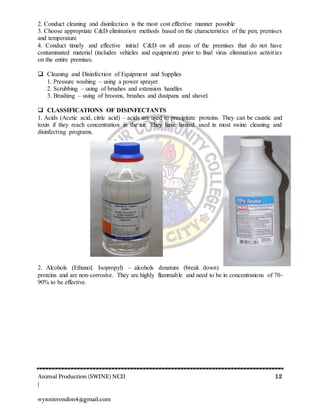
2. Alcohols (Ethanol, Isopropyl) – alcohols denature (break down)
proteins and are non-corrosive. They are highly flammable and need to be in concentrations of 70-
90% to be effective.
Animal Production (SWINE) NCII 13
|
wynnierondon4@gmail.com
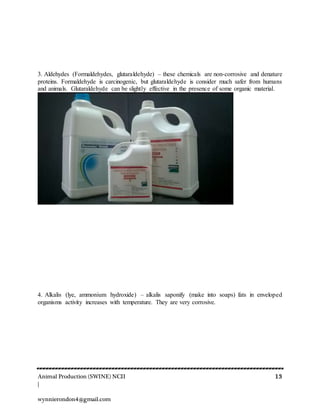
3. Aldehydes (Formaldehydes, glutaraldehyde) – these chemicals are non-corrosive and denature
proteins. Formaldehyde is carcinogenic, but glutaraldehyde is consider much safer from humans
and animals. Glutaraldehyde can be slightly effective in the presence of some organic material.
4. Alkalis (lye, ammonium hydroxide) – alkalis saponify (make into soaps) fats in enveloped
organisms activity increases with temperature. They are very corrosive.
Animal Production (SWINE) NCII 14
|
wynnierondon4@gmail.com
Household alkalis
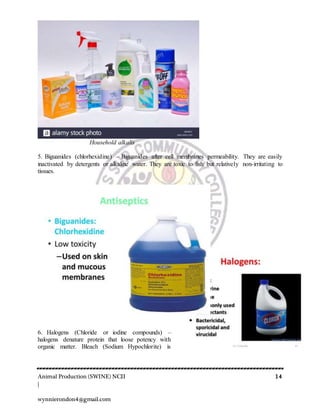
5. Biguanides (chlorhexidine) – Biguanides after cell membranes permeability. They are easily
inactivated by detergents or alkaline water. They are toxic to fish but relatively non-irritating to
tissues.
6. Halogens (Chloride or iodine compounds) –
halogens denature protein that loose potency with
organic matter. Bleach (Sodium Hypochlorite) is
Animal Production (SWINE) NCII 15
|
wynnierondon4@gmail.com
probably one of the cheapest and most common disinfectant used. Iodine compounds can be
irritating to skin at higher concentrations both iodine and chlorine are readily inactivated by
organic material.
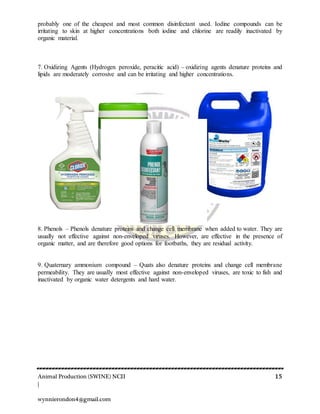
7. Oxidizing Agents (Hydrogen peroxide, peracitic acid) – oxidizing agents denature proteins and
lipids are moderately corrosive and can be irritating and higher concentrations.
8. Phenols – Phenols denature proteins and change cell membrane when added to water. They are
usually not effective against non-enveloped viruses. However, are effective in the presence of
organic matter, and are therefore good options for footbaths, they are residual activity.
9. Quaternary ammonium compound – Quats also denature proteins and change cell membrane
permeability. They are usually most effective against non-enveloped viruses, are toxic to fish and
inactivated by organic water detergents and hard water.
Animal Production (SWINE) NCII 16
|
wynnierondon4@gmail.com
 STEPS IN CLEANING AND DISINFECTING
1. Cleaning – the first step is to remove all organic material. This is the best-achieved using
broom, shovel or scraper. Remove as much as solid as possible to minimize the use of water
in the next step.
2. Washing – this step is the most time-consuming of the entire process but it is also the most
important. When done correctly, washing will remove all remaining organic matter (manure,
feed, etc) this is usually done with a high pressure washer.
STEPS in WASHING
a. Soaking – Soaking surfaces before washing will cut down on the amount of time needed to
do a more complete job. Soaking can be achieved by placing a sprinkler systems in the rooms
to be washed. When soaking a trailer, you may want to just wet the entire trailer first with a
moderate amount of water, then start through washing at one end while other surfaces have
one-more time to soak.
b. Detergents – another excellent way to maximize the cleaning and minimize spent out the
chore is to use special detergents to help breakdown manure and other organic matter. This is
the equipment of using soap to wash your hands with plain water, but it is much quicker to use
soap.
Animal Production (SWINE) NCII 17
|
wynnierondon4@gmail.com
c. Hot water – can also be speed up the washing process. The one disadvantage of hot water is
that it can produce steam, particularly in winter. The goal is to have water hot enough to
facilitate cleaning without putting employees at risk.
3. DISINFECTING – this is the critical step in the cleaning process that requires some use of
science unless surfaces are completely cleaned (none to minimal organic matter) disinfection
will not be effective. Are defined as chemicals used to control, prevent or destroy animals.
4. Drying Time – one of the challenges with most cleaning and disinfection program is
allowing ample time for extended drying. The purpose of thus drying time is so that all
moisture can evaporate from the building and all it surfaces.
Water is critical for the survival of all living organisms, including virus and bacteria.
Allow weanlings/finishing rooms/pens/stall rooms to overnight before moving
weanligs/finishing into the room.
If overnight is not possible, then try to use scrapers to remove all puddles of water as a
means to speed up the drying process before moving weanlings/finishing into the rooms
Two or three times year, plan enough time for the rooms to completely dry in order to
break disease cycles
Drying is especially critical for livestock trailers, which have implicated as a major risk
for disease transmission. This is usually not the fault of the driver, but rather due to the
high risks areas. These vehicles travels to and from trailers usually end up in areas
where animals are concentrated, and therefore the potential to pick up new diseases,
thus pathogens drastically increases.
References:
www.thepigsite.com
www.porkgateway.org
https://www.google.com/search?q=quaternary+ammonium+disinfectant&tbm=isch&ved=2ahU
KEwi_rL24947vAhVQAKYKHaPQCA8Q2-
cCegQIABAA&oq=quaternary+disinfectant&gs_lcp=CgNpbWcQARgBMgIIADIGCAAQBxA
eMgYIABAHEB4yBggAEAcQHjIGCAAQBxAeMgYIABAFEB4yBggAEAgQHjIECAAQGDI
ECAAQGDIECAAQGDoICAAQBxAFEB5QqM4HWNXZB2C77gdoAHAAeACAAdoBiAGO
DJIBBTAuOS4xmAEAoAEBqgELZ3dzLXdpei1pbWfAAQE&sclient=img&ei=SMg8YL_oCt
CAmAWjoaN4&bih=625&biw=1349&hl=en#imgrc=zoBYbKIsMxIG0M
https://www.google.com/search?q=phenols+disinfectant&tbm=isch&ved=2ahUKEwiAu8fg9o7v
AhXJEKYKHRtJD2gQ2-
cCegQIABAA&oq=phenols+disinfectant&gs_lcp=CgNpbWcQAzICCAA6BggAEAcQHjoICA
AQBxAFEB5QiPsKWKGKC2DpkQtoAHAAeACAAbkBiAG7B5IBAzEuNpgBAKABAaoBC
2d3cy13aXotaW1nwAEB&sclient=img&ei=j8c8YMC3MMmhmAWbkr3ABg&bih=625&biw=
1349&hl=en#imgrc=wYK1rLBxFhvTRM
Animal Production (SWINE) NCII 18
|
wynnierondon4@gmail.com
SELF-CHECK!!
Please avoid copying the work or answers of your classmates or extracting your answers
from the google or internet. This assessment intended to evaluate your learning.
There is no big difference between LIAR and CHEATER. Cheat and you will not just
insult your own knowledge but you will also be committing a crime. You are TOO FAR
HONORABLE TO CHEAT. – ctto
Name: ________________________________________ Course: ____________________
1. Why is it important to clean and disinfect the piggery pen/stall including truck/trailers used in
transporting animals? What are the advantages of C&D in your farm? Support your answer.
Animal Production (SWINE) NCII 19
|
wynnierondon4@gmail.com
2. Why do we need to conduct a timely C&D in our farm?
3. Why do we need to completely dry the entire farm at least semi-annually or thrice a year?
Republic of the Philippines
Province of Ilocos Sur
ILOCOS SUR COMMUNITY COLLEGE DEMOFARM
Km 429 Manila North Road
San Juan, Ilocos Sur
Lesson 3. MAINTAINING CONDUCIVE ATMOSPHERE
Learning Objective:
After reading this module, the trainee must be able to:
1. Know how to reduce cold and heat stress.
Animal Production (SWINE) NCII 20
|
wynnierondon4@gmail.com
2. Determine the heat and cold stress
3. Determine the Temperature limit for pig.
Information Sheet
A. Environmental Management
- There is an optimal range of temperature in which the pig does not have the
use heat conserving or heat dissipating machineries (such as shivering,
huddling or panting) to conserve or dissipate body heat. Keeping pigs above the
or below their critical temperature cannot only negatively influence thermal
comfort, but also feed intake, growth, feed efficiency and health.
- Regardless of whether pigs are kept indoors or outdoors it may be necessary
to provide supplemental heating or cooling for pigs when temperature are
outside the pigs critical temperature.
 Examples of supplement heating include using heat lamps or brooders for
zone heating, gas or electric heaters or bedding.
 Examples of supplemental cooling can include misters, evaporative cooling
cells, fans, drip coolers, shelters, shade trees or wallows.
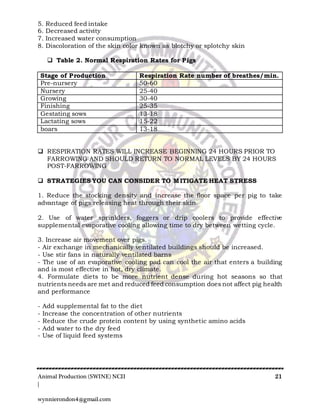
Table. Recommended Temperature limit for pigs
Stage of Production Lower Critical
Limit (°F)
Upper Critical
Limit (°F)
Optimum Range
for Health and
Production (°F)
10-30 lbs 60 95 80-90
30-75 40 95 65-80
75-150 market
weight
25 95 60-75
Gestating sows 5 90 60-75
Lactating sows and
litters
5 for sow 90 for sow -60-80 for sows
- 90-95 for
piglets
Boar 5 90 65-75
 SIGN OF HEAT STRESS
1. Increased rates of respiration or panting
2. Increased in body and skin temperature
3. Increased body contact with cooler surfaces
4. Spreading out
Animal Production (SWINE) NCII 21
|
wynnierondon4@gmail.com
5. Reduced feed intake
6. Decreased activity
7. Increased water consumption
8. Discoloration of the skin color known as blotchy or splotchy skin
 Table 2. Normal Respiration Rates for Pigs
Stage of Production Respiration Rate number of breathes/min.
Pre-nursery 50-60
Nursery 25-40
Growing 30-40
Finishing 25-35
Gestating sows 13-18
Lactating sows 15-22
boars 13-18
 RESPIRATION RATES WILL INCREASE BEGINNING 24 HOURS PRIOR TO
FARROWING AND SHOULD RETURN TO NORMAL LEVELS BY 24 HOURS
POST-FARROWING
 STRATEGIES YOU CAN CONSIDER TO MITIGATE HEAT STRESS
1. Reduce the stocking density and increase the floor space per pig to take
advantage of pigs releasing heat through their skin.
2. Use of water sprinklers, foggers or drip coolers to provide effective
supplemental evaporative cooling allowing time to dry between wetting cycle.
3. Increase air movement over pigs.
- Air exchange in mechanically ventilated buildings should be increased.
- Use stir fans in naturally ventilated barns
- The use of an evaporative cooling pad can cool the air that enters a building
and is most effective in hot, dry climate.
4. Formulate diets to be more nutrient dense during hot seasons so that
nutrients needs are met and reduced feed consumption does not affect pig health
and performance
- Add supplemental fat to the diet
- Increase the concentration of other nutrients
- Reduce the crude protein content by using synthetic amino acids
- Add water to the dry feed
- Use of liquid feed systems
Animal Production (SWINE) NCII 22
|
wynnierondon4@gmail.com
- When free choice access to feed is not provided, the ration should be supplied
during the coolest period of the day (early morning, late afternoon or at night)
5. Provide pigs with access to fresh, quality water.
- Waterers should be adjusted and functioning properly with enough waterers
available to allow adequate access (pigs can drink up to 6 times more water when
heat stressed.)
- Increased water intake may lead to increase urination and loss of important
minerals. Dietary adjustments may help replace mineral losses and restore
electrolyte and metabolism balance.
6. Provide shade for pigs housed outdoors.
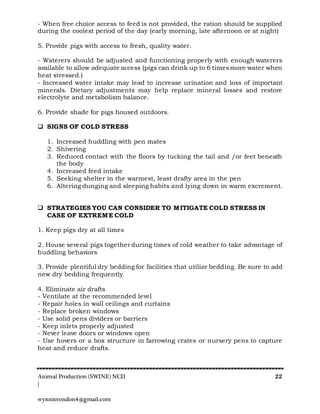
 SIGNS OF COLD STRESS
1. Increased huddling with pen mates
2. Shivering
3. Reduced contact with the floors by tucking the tail and /or feet beneath
the body
4. Increased feed intake
5. Seeking shelter in the warmest, least drafty area in the pen
6. Altering dunging and sleeping habits and lying down in warm excrement.
 STRATEGIES YOU CAN CONSIDER TO MITIGATE COLD STRESS IN
CASE OF EXTREME COLD
1. Keep pigs dry at all times
2. House several pigs together during times of cold weather to take advantage of
huddling behaviors
3. Provide plentiful dry bedding for facilities that utilize bedding. Be sure to add
new dry bedding frequently
4. Eliminate air drafts
- Ventilate at the recommended level
- Repair holes in wall ceilings and curtains
- Replace broken windows
- Use solid pens dividers or barriers
- Keep inlets properly adjusted
- Never leave doors or windows open
- Use hovers or a box structure in farrowing crates or nursery pens to capture
heat and reduce drafts.
Animal Production (SWINE) NCII 23
|
wynnierondon4@gmail.com
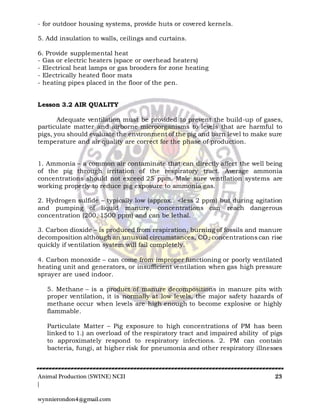
- for outdoor housing systems, provide huts or covered kernels.
5. Add insulation to walls, ceilings and curtains.
6. Provide supplemental heat
- Gas or electric heaters (space or overhead heaters)
- Electrical heat lamps or gas brooders for zone heating
- Electrically heated floor mats
- heating pipes placed in the floor of the pen.
Lesson 3.2 AIR QUALITY
Adequate ventilation must be provided to prevent the build-up of gases,
particulate matter and airborne microorganisms to levels that are harmful to
pigs, you should evaluate the environment of the pig and barn level to make sure
temperature and air quality are correct for the phase of production.
1. Ammonia – a common air contaminate that can directly affect the well being
of the pig through irritation of the respiratory tract. Average ammonia
concentrations should not exceed 25 ppm. Male sure ventilation systems are
working properly to reduce pig exposure to ammonia gas.
2. Hydrogen sulfide – typically low (approx.. <less 2 ppm) but during agitation
and pumping of liquid manure, concentrations can reach dangerous
concentration (200, 1500 ppm) and can be lethal.
3. Carbon dioxide – is produced from respiration, burning of fossils and manure
decomposition although an unusual circumstances, CO2 concentrations can rise
quickly if ventilation system will fail completely.
4. Carbon monoxide – can come from improper functioning or poorly ventilated
heating unit and generators, or insufficient ventilation when gas high pressure
sprayer are used indoor.
5. Methane – is a product of manure decompositions in manure pits with
proper ventilation, it is normally at low levels, the major safety hazards of
methane occur when levels are high enough to become explosive or highly
flammable.
Particulate Matter – Pig exposure to high concentrations of PM has been
linked to 1.) an overload of the respiratory tract and impaired ability of pigs
to approximately respond to respiratory infections. 2. PM can contain
bacteria, fungi, at higher risk for pneumonia and other respiratory illnesses
Animal Production (SWINE) NCII 24
|
wynnierondon4@gmail.com
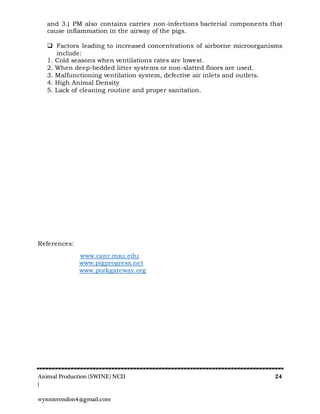
and 3.) PM also contains carries non-infections bacterial components that
cause inflammation in the airway of the pigs.
 Factors leading to increased concentrations of airborne microorganisms
include:
1. Cold seasons when ventilations rates are lowest.
2. When deep-bedded litter systems or non-slatted floors are used.
3. Malfunctioning ventilation system, defective air inlets and outlets.
4. High Animal Density
5. Lack of cleaning routine and proper sanitation.
References:
www.canr.msu.edu
www.pigprogress.net
www.porkgateway.org
Animal Production (SWINE) NCII 25
|
wynnierondon4@gmail.com
SELF-CHECK!!
Please avoid copying the work or answers of your classmates or extracting your answers
from the google or internet. This assessment is intended to evaluate your learning.
There is no big difference between LIAR and CHEATER. Cheat and you will not just
insult your own knowledge but you will also be committing a crime. You are TOO FAR
HONORABLE TO CHEAT. – ctto
Name: ________________________________________ Course: ____________________
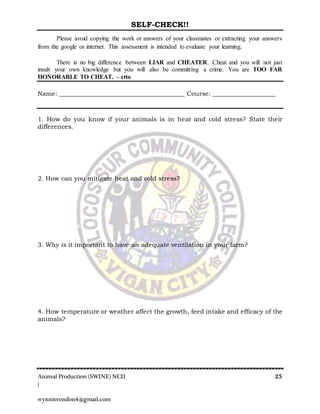
1. How do you know if your animals is in heat and cold stress? State their
differences.
2. How can you mitigate heat and cold stress?
3. Why is it important to have an adequate ventilation in your farm?
4. How temperature or weather affect the growth, feed intake and efficacy of the
animals?
Animal Production (SWINE) NCII 26
|
wynnierondon4@gmail.com
LESSON 4. FLOOR AND BEDDING MANAGEMENT
Learning Objective:
After reading this module, the learner should be able to:
1. Know the recommended floor areas to growing pigs
2. Know the important reminders when making or building floor for pigs
3. Determine the recommended types of flooring on pig pen
4. Know the associated problems on poorly maintained flooring
Confinement production of swine is not necessarily suited to all producers, and
in part, may in certain instances be undesirable. It does, however, offer the
advantage of greater production potential per unit of labor expanded through
maximum use of mechanization and automation. In addition, confinement
protects the animals from the environmental extremes which cause wide
variations in level of performance.
Deterrents to confinement, swine production have largely involved disease build-
up and the difficulties associated with manure disposal. Since their introduction
in the early 1950’s, antibiotics have been a valuable aid in preventing disease
build-up, but handling and disposal of the large volumes of hog wastes have
frequently continued to be major obstacles. Mechanical means of cleaning—
scraping (by hand or equipment scraper), water pressure, gutter-cleaner
equipment, and various combination of these – reduced total manual labor but
in many cases accentuated the inadequacy many producers from changing from
pasture program and their “built-in manure disposal system.”
 Growing- finishing unit – designed for pigs from weaning at six to eight
weeks (30 to 40 lbs.) or from a nursery unit, to market weight. Building is
usually enclosed, partially or completely insulated. Number of pigs per pen
varies with size of animals.
Thus, a management system may involve from one to three different units
during the period from birth up to market weight.
 Pen should be designed to accommodate growth up to a point when all or part
of the group of pigs in the pen are removed. Each pig must be able to easily
lie down fully on its side without having to lie on another pig and without the
head having to rest on a raised feeder.
Animal Production (SWINE) NCII 27
|
wynnierondon4@gmail.com

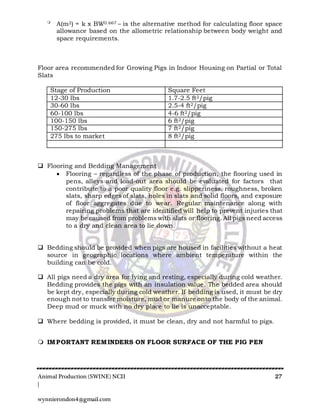
A(m2) = k x BW0.667 – is the alternative method for calculating floor space
allowance based on the allometric relationship between body weight and
space requirements.
Floor area recommended for Growing Pigs in Indoor Housing on Partial or Total
Slats
Stage of Production Square Feet
12-30 lbs 1.7-2.5 ft2/pig
30-60 lbs 2.5-4 ft2/pig
60-100 lbs 4-6 ft2/pig
100-150 lbs 6 ft2/pig
150-275 lbs 7 ft2/pig
275 lbs to market 8 ft2/pig
 Flooring and Bedding Management
 Flooring – regardless of the phase of production, the flooring used in
pens, alleys and load-out area should be evaluated for factors that
contribute to a poor quality floor e.g. slipperiness, roughness, broken
slats, sharp edges of slats, holes in slats and solid floors, and exposure
of floor aggregates due to wear. Regular maintenance along with
repairing problems that are identified will help to prevent injuries that
may be caused from problems with slats or flooring. All pigs need access
to a dry and clean area to lie down.
 Bedding should be provided when pigs are housed in facilities without a heat
source in geographic locations where ambient temperature within the
building can be cold.
 All pigs need a dry area for lying and resting, especially during cold weather.
Bedding provides the pigs with an insulation value. The bedded area should
be kept dry, especially during cold weather. If bedding is used, it must be dry
enough not to transfer moisture, mud or manure onto the body of the animal.
Deep mud or muck with no dry place to lie is unacceptable.
 Where bedding is provided, it must be clean, dry and not harmful to pigs.
 IMPORTANT REMINDERS ON FLOOR SURFACE OF THE PIG PEN
Animal Production (SWINE) NCII 28
|
wynnierondon4@gmail.com
 There are no floors too slick to cause feet and leg problems.
 There are no floors too rough to cause feet and leg problems.
 No bolts placed in the floor or attached to slats to cause injury.
 There are no bolts without a nut that could cause injuries.
 There are no broken slats that could cause injuries to pigs.
 There are no holes in the solid concrete floors that could injure pigs.
 There are no sharp edges between slats and solid concrete portion of floor.
It has been shown that there is less lameness in pigs housed on solid floors with
bedding than in those housed on slatted floors. However, fully slatted
accommodation does offer benefits to pig health, hygiene and a reduction in
cleaning time.
 Problems Associated with Poorly Maintained Flooring:
 General lameness
 Torn claws
 Abrasions
 Septic arthritis
 Abscesses
 Vice
 Greasy pig disease
 Reproductive issues/mating injuries
 Teat and udder damage
 Overlaid piglets
 Splay leg in piglets
 Joint ill ( through scuffed knees in piglets)
 Assess the situation on your unit and try to reach a balance with optimal
conditions for pigs:
 Ensure the floor type is suitable for the age and weight of the pigs.
Animal Production (SWINE) NCII 29
|
wynnierondon4@gmail.com
 Assess the location, size and suitability of the sleeping area. It should be
dry and draught free.
 Check pens for sharp and projecting edges, especially at the bottom of
doors and gates
 Examine the flooring for rough areas. Pay particular attention under
drinkers and feeders. Corrosion is common in areas where different floor
materials meet. (e.g. metal and concrete)
 Check the condition of the slats, particularly the edges and note the width
of the solid and void sections
 Examine the condition of steps and gate separations
 Check gates are hung correctly
 Examine building supports for any damage by the pigs
 Examine the hygiene of pens, note the location of the area used by the pigs
for dunging
 Review the slurry system and cleaning and disinfection programmes in
place on farm
 Routinely inspect all areas and note scheduled repairs
 Piglets are prone to abrasions on all floor types, so regardless of the type
used in the farrowing house, check and maintain it regularly.
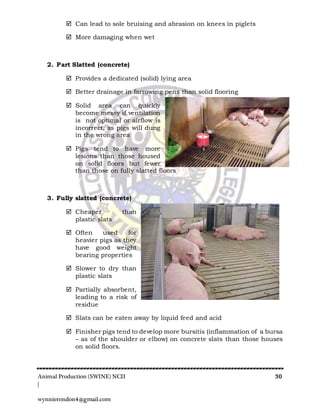
FLOOR TYPES
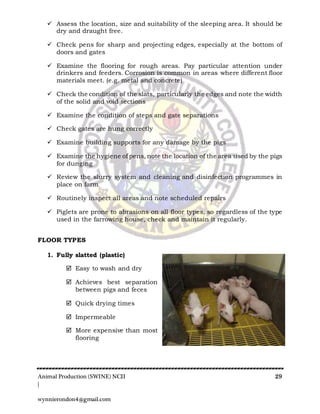
1. Fully slatted (plastic)
 Easy to wash and dry
 Achieves best separation
between pigs and feces
 Quick drying times
 Impermeable
 More expensive than most
flooring
Animal Production (SWINE) NCII 30
|
wynnierondon4@gmail.com
 Can lead to sole bruising and abrasion on knees in piglets
 More damaging when wet
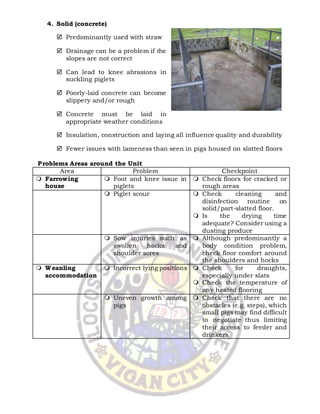
2. Part Slatted (concrete)
 Provides a dedicated (solid) lying area
 Better drainage in farrowing pens than solid flooring
 Solid area can quickly
become messy if ventilation
is not optimal or airflow is
incorrect, as pigs will dung
in the wrong area
 Pigs tend to have more
lesions than those housed
on solid floors but fewer
than those on fully slatted floors
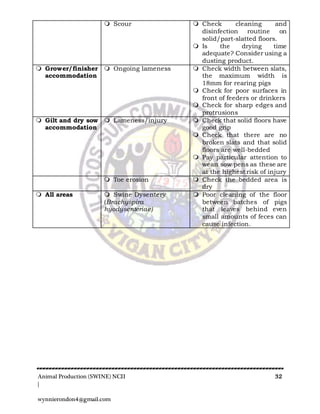
3. Fully slatted (concrete)
 Cheaper than
plastic slats
 Often used for
heavier pigs as they
have good weight
bearing properties
 Slower to dry than
plastic slats
 Partially absorbent,
leading to a risk of
residue
 Slats can be eaten away by liquid feed and acid
 Finisher pigs tend to develop more bursitis (inflammation of a bursa
– as of the shoulder or elbow) on concrete slats than those houses
on solid floors.
Animal Production (SWINE) NCII 31
|
wynnierondon4@gmail.com
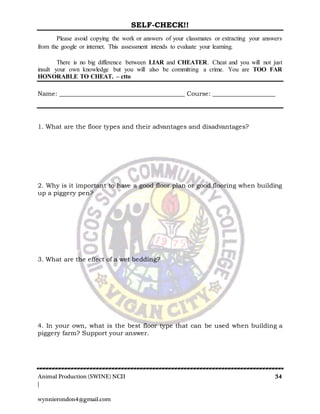
4. Solid (concrete)
 Predominantly used with straw
 Drainage can be a problem if the
slopes are not correct
 Can lead to knee abrasions in
suckling piglets
 Poorly-laid concrete can become
slippery and/or rough
 Concrete must be laid in
appropriate weather conditions
 Insulation, construction and laying all influence quality and durability
 Fewer issues with lameness than seen in pigs housed on slatted floors
Problems Areas around the Unit
Area Problem Checkpoint
 Farrowing
house
 Foot and knee issue in
piglets
 Check floors for cracked or
rough areas
 Piglet scour  Check cleaning and
disinfection routine on
solid/part-slatted floor.
 Is the drying time
adequate? Consider using a
dusting produce
 Sow injuries such as
swollen hocks and
shoulder sores
 Although predominantly a
body condition problem,
check floor comfort around
the shoulders and hocks
 Weanling
accommodation
 Incorrect lying positions  Check for draughts,
especially under slats
 Check the temperature of
any heated flooring
 Uneven growth among
pigs
 Check that there are no
obstacles (e.g. steps), which
small pigs may find difficult
to negotiate thus limiting
their access to feeder and
drinkers
Animal Production (SWINE) NCII 32
|
wynnierondon4@gmail.com
 Scour  Check cleaning and
disinfection routine on
solid/part-slatted floors.
 Is the drying time
adequate? Consider using a
dusting product.
 Grower/finisher
accommodation
 Ongoing lameness  Check width between slats,
the maximum width is
18mm for rearing pigs
 Check for poor surfaces in
front of feeders or drinkers
 Check for sharp edges and
protrusions
 Gilt and dry sow
accommodation
 Lameness/injury  Check that solid floors have
good grip
 Check that there are no
broken slats and that solid
floors are well-bedded
 Pay particular attention to
wean sow pens as these are
at the highest risk of injury
 Toe erosion  Check the bedded area is
dry
 All areas  Swine Dysentery
(Brachyspira
hyodysenteriae)
 Poor cleaning of the floor
between batches of pigs
that leaves behind even
small amounts of feces can
cause infection.
Animal Production (SWINE) NCII 33
|
wynnierondon4@gmail.com
References:
www.thepigsite.com
www.canr.msu.edu
www.pigprogress.com
Animal Production (SWINE) NCII 34
|
wynnierondon4@gmail.com
SELF-CHECK!!
Please avoid copying the work or answers of your classmates or extracting your answers
from the google or internet. This assessment intends to evaluate your learning.
There is no big difference between LIAR and CHEATER. Cheat and you will not just
insult your own knowledge but you will also be committing a crime. You are TOO FAR
HONORABLE TO CHEAT. – ctto
Name: ________________________________________ Course: ____________________
1. What are the floor types and their advantages and disadvantages?
2. Why is it important to have a good floor plan or good flooring when building
up a piggery pen?
3. What are the effect of a wet bedding?
4. In your own, what is the best floor type that can be used when building a
piggery farm? Support your answer.
Animal Production (SWINE) NCII 35
|
wynnierondon4@gmail.com
Republic of the Philippines
Province of Ilocos Sur
ILOCOS SUR COMMUNITY COLLEGE DEMOFARM
Km 429 Manila North Road
San Juan, Ilocos Sur
LESSON 5. WEANING/ WEANING MANAGEMENT
Learning Objective:
At the end of this module, the trainee must be able to:
1. Determine the types of weaning.
2. Know the problems associated with weaning
3. Know the weaning stress
A.) Information Sheet
Weaning is the act of separating the suckling piglets from its mother.
- Weaning age is 28-30 days.
Weaning Pigs
Where good management is practiced, pigs are consistently weaned successfully
when three to six weeks old. Time of weaning depends somewhat on care,
facilities and production schedules. Weaning under five weeks of age requires
more skill and attention. Warm, dry facilities free from draft are essential.
Pigs weighing 15 pounds or more generally can be weaned successfully
regardless of age if they are eating well. It is extremely important to have a dry,
heated, well-ventilated, well-insulated available for pigs weaned early,
particularly in bad weather.
Don’t start in pigs in large groups. Small groups of 20-25 head per pen do best.
Allow 3 to 4 square feet of space for each pig. Sort pigs according to size and
weight.
Animal Production (SWINE) NCII 36
|
wynnierondon4@gmail.com
TYPES of WEANING
Weaning is usually undertaken in one of the following categories:
1. Conventional Weaning – 3-5 weeks of age.
2. Early weaning: 10 days of age to 3 weeks.
3. Specialized weaning: segregated early weaning (SEW) and medicated early
weaning (MEW).
1. Conventional Weaning (5-10 kg) Live weight (LW)
- At this age, pigs are of a size and age to fend for themselves under average
farm conditions. It must be remembered that age of weaning is an integral part
of the breeding program and to reduce weaning age will involve changes in the
mating and farrowing programs. The sow’s milk production has fallen
dramatically by 5 weeks, therefore it is uneconomic to feed the piglets via the
sow’s milk beyond this stage.
-However, in order to maintain piglet growth rates, they must receive additional
feed. Fortunately, by this age and weight, pigs are becoming accustomed to dry
feed and can better adjust to temperature changes and stress. However, a high
standard of hygiene must still be maintained, where a suitable environment can
be maintained and producers have the expertise, they can progressively reduce
the weaning age to a point where they feel they can still gain the necessary benefit
of the pigs undergoing an earlier weaning.
2. Early Weaning ; 10 days of age to 3 weeks
3. Specialized weaning
- Segregated early weaning (SEW). This is weaning pigs at an ‘early’ age, usually
less than 18 days-old and removing them from the breeding herd immediately
after weaning as a means of eliminating, or at least reducing, the disease load in
pigs entering weaner facilities.
- Medicated early weaning (MEW). This technique is used to obtain pigs
free from some of the pathogens endemic in the herd. Sows are dosed with
high levels of antibiotics when they enter the farrowing house until their
Animal Production (SWINE) NCII 37
|
wynnierondon4@gmail.com
piglets are weaned. The piglets are weaned at 5 days of age and moved to
an isolated early-weaning unit. Piglets are dosed from birth until about 10
days of age, with similar drugs to those given to the sows.
 Problems associated with weaning:
Problems can take various forms:
 The development of stressful behaviors, (e.g. cannibalism)
 Bad toilet habits
 Depressed growth rates
 Scouring
 Weaning Stress:
The description of what the piglet goes through at weaning is a clear indication
of the enormous stress involved. The following are changes that the piglet
experiences:
 Loss of maternal protection
 Change of living space and environment.
 Mixing with groups of larger sized piglets (normally from different litters)
 Change of diet and nutritional behavior:
 Change from warm liquid diet to normally solid and dry
 There is a substantial change in the nutritive quality and composition
(generally sudden contact with vegetal protein)
 There is no collective communication at feeding.
 The piglet stops suckling every 40-60 minutes.
A critical factor is the amount of creep feed consumed prior to weaning. Apart
from getting piglets familiar to dry feed, feeding creep diets accelerates the
maturity of the digestive system. The use of sugar and flavorings can be
advantageous.
 Post-Weaning Diarrhea (PWD)
- Due to Escherichia coli is an economically important disease in pig
production worldwide, affecting pigs during the first 2 weeks after weaning
and characterized by sudden death or diarrhea, dehydration, and growth
retardation in surviving piglets. Furthermore, many stress factors
Animal Production (SWINE) NCII 38
|
wynnierondon4@gmail.com
associated with the weaning period, such as removal of sow, dietary
changes, adapting to a new environment, mixing of pigs from different
farms and histological changes in the small intestine may negatively affect
the response of immune system and lead to an intestinal gut dysfunction
in pigs.
 Sick Pig Symptoms
Here are some common symptoms that may indicate a pig is ill or in pain:
 Loss of appetite
 Change in mood
 Lethargy
 Coughing or nasal discharge
 Absence of or difficulty while urinating or defecating
 Very dark, concentrated urine
 Discolored vaginal discharge
 Hemorrhage from the eyes, ears, nose, rectum or vulva
 High temperature
 Elevated respiration or respiratory issues
 Constipation
 Standing with his back hunched
 Trouble walking, limping or difficulty as it starts walking
Diseases of the Pre-weaning Period
Disease Major Signs Treatment
Collibacillosis (E.Coli) Diarrhea (scours):
sudden death
Fluid therapy;
antibiotics
Coccidiosis Diarrhea at 10-21 days
of age
Fluid therapy;
coccidiostats
Overlay/trauma Sudden death None
Starvation
(Hypoglycaemia)
Weakness death Dextrose solutions;
supplementary feeding
Stillbirths Born dead None
Infection Lameness; sudden death Antibiotics
Epidermitis (greasy pig) Skin lesions; death Antibiotics; skin
protectant; vitamins
Animal Production (SWINE) NCII 39
|
wynnierondon4@gmail.com
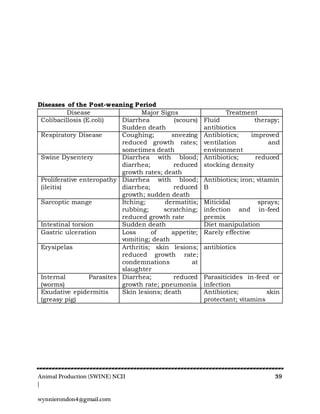
Diseases of the Post-weaning Period
Disease Major Signs Treatment
Colibacillosis (E.coli) Diarrhea (scours)
Sudden death
Fluid therapy;
antibiotics
Respiratory Disease Coughing; sneezing
reduced growth rates;
sometimes death
Antibiotics; improved
ventilation and
environment
Swine Dysentery Diarrhea with blood;
diarrhea; reduced
growth rates; death
Antibiotics; reduced
stocking density
Proliferative enteropathy
(ileitis)
Diarrhea with blood;
diarrhea; reduced
growth; sudden death
Antibiotics; iron; vitamin
B
Sarcoptic mange Itching; dermatitis;
rubbing; scratching;
reduced growth rate
Miticidal sprays;
infection and in-feed
premix
Intestinal torsion Sudden death Diet manipulation
Gastric ulceration Loss of appetite;
vomiting; death
Rarely effective
Erysipelas Arthritis; skin lesions;
reduced growth rate;
condemnations at
slaughter
antibiotics
Internal Parasites
(worms)
Diarrhea; reduced
growth rate; pneumonia
Parasiticides in-feed or
infection
Exudative epidermitis
(greasy pig)
Skin lesions; death Antibiotics; skin
protectant; vitamins