Sustainable Development for Rural Communities: Social, Health, Economic, and Environmental Advances (SustR) Cecilio Ortiz Garcia (PI)Marla Perez-Lugo (Co-PI)Department of Social Sciences-UPRM
What is SustR? SustR is consortium of universities and colleges in Mexico, Canada and U.S. that tackle critical issues in rural sustainability by educating a new generation of students and creating collaborative ties among researchers
What is Sustainability?“Sustainable development is a term that everyone likes, but nobody is sure of what it means” (Daly, 1996).
CURRENT MOVEMENTS IN SUSTAINABILITYUrban Ecology  - Interaction of Human and Ecological SystemsBio- Complexity Modeling – Urban Heat Island and Water DemandCommunity Resilience – Disaster Planning and Capacity EnhancementEnvironmental Justice --  Distributional Equity Sustainability Indicators – Quality of Life FactorsRisk Reduction Strategies – Brownfield RedevelopmentCollaborative Design – Community Based Approaches Green Building – Rating/ Performance CriteriaSustainability Education --  Curricula, Facilities, ProcurementPlace Enhancement – Culture, History, CommunityUrban Health  --  Urban FormGovernance and Sustainability – Participatory / neighborhood LevelVulnerability and ResilienceSustainableLivelihoods
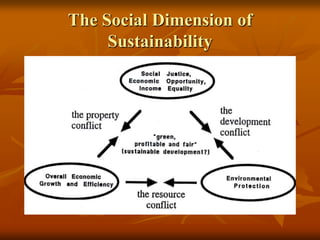
The Social Dimension of Sustainability
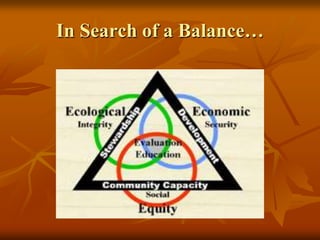
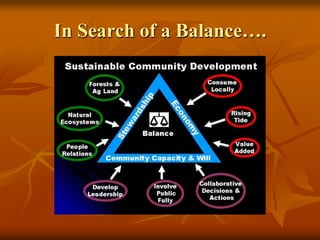
In Search of a Balance….Sustainability implies balance and permanence: a balance between people living in a community and the jobs available there; a balance between renewable resources continuously available locally and local consumption patterns; a balance between maintaining the natural environment in good health and the needs of the human community that lives within it.  Like an individual in balance a sustainable community will be healthy: socially, economically and biologically. Calthorpe, 1986
In Search of a Balance…
In Search of a Balance….
The key is broad participation!“One of the fundamental prerequisites for the achievement of sustainable development is broad public participation in decision-making. Furthermore, in the more specific context of environment and development, the need for new forms of participation has emerged. This includes the need of individuals, groups and organizations to participate in environmental impact assessment procedures and to know about and participate in decisions, particularly those which potentially affect the communities in which they live and work. Individuals, groups and organizations should have access to information relevant to environment and development held by national authorities, including information on products and activities that have or are likely to have a significant impact on the environment, and information on environmental protection measures.”	Chapter 23, Section III of the Agenda 21 ,1992 in Rio de Janeiro
It is the Law of the Land…“La estrategia de desarrollo sostenible de Puerto Rico debe reconocer la necesidad de una nueva visión que tome en consideración el ambiente y los recursos naturales que le sirven de base: en particular, en lo relacionado al uso de tierras y el recurso agua, la transportación, la producción de energía; el manejo de los desperdicios sólidos y líquidos; y el manejo de nuestra zona costera.” LEY DE DESARROLLO SOSTENIBLE DE PUERTO RICO(Ley núm. 267 del 10 de Septiembre de 2004)
SustR goals are:To create a North American dimension for rural sustainability in university curricula.To broaden students’ understanding of the problems facing rural communities with respect to sustainable development, with a particular focus on the sustainable development of North American communities. To build capacity at the local level by providing students with the tools and information they need to participate in rural sustainability projects in their own communities and regions, once they graduate.
SustR objectives are:Train a total of at least 46 students among the participating universitiesDevelop a three-phase program, where each student will participate in (1) intensive language coursework, (2) coursework in rural communities and sustainable development, and (3) a field experience;Integrate the perspectives of the many disciplines involved in the project
SustR objectives are:Develop a new web-based course (in English and Spanish)Compile a collection of web-based case studies in rural sustainabilityProvide an international perspective for relevant courses and enhance the education at the host institutionAttain inter-institutional transparencyTo develop alternative funding sources to sustain the programbeyond its 4 year lifespan
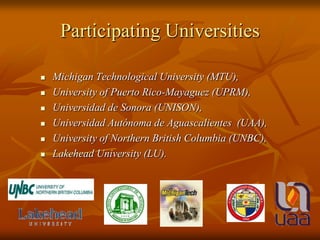
Participating UniversitiesMichigan Technological University (MTU), University of Puerto Rico-Mayaguez (UPRM), Universidad de Sonora(UNISON), Universidad Autónoma de Aguascalientes  (UAA), University of Northern British Columbia (UNBC), Lakehead University (LU).
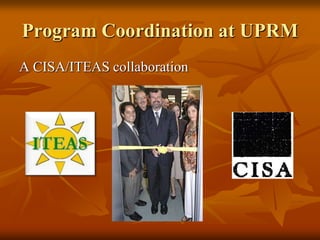
ProgramCoordination at UPRMA CISA/ITEAS collaboration
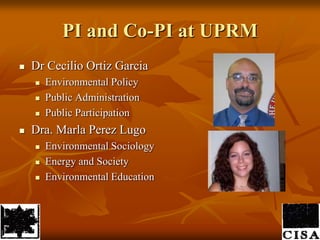
PI and Co-PI at UPRMDr Cecilio Ortiz GarciaEnvironmental PolicyPublic AdministrationPublic ParticipationDra. Marla Perez LugoEnvironmental SociologyEnergy and SocietyEnvironmental Education
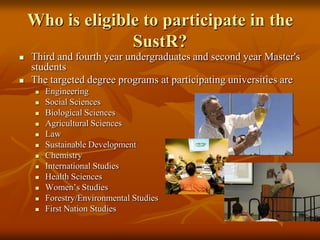
Who is eligible to participate in the SustR?Third and fourth year undergraduates and second year Master's students The targeted degree programs at participating universities are EngineeringSocial Sciences Biological SciencesAgricultural SciencesLawSustainable DevelopmentChemistryInternational StudiesHealth SciencesWomen’s StudiesForestry/Environmental StudiesFirst Nation Studies
Four primary components of SustR curricula: New modules to be integrated into existing coursework A new web-based course on rural sustainability Short-term intensive field studies Semester-long student internships
Academic Credits, Tuition and Fees, and Student StipendsStudent work performed abroad will be accorded full credit recognition through approval prior to departure. Students will pay home campus tuition and fees and then travel to a host campus for a period of study. Student stipends for U.S. students will cover airfare plus subsistence fees up to about $2,000 to $3,000 per semester, depending on the cost of travel to/from and cost of living at the host university.
UPRM’s responsibilities Identify the courses covering issues related rural sustainability , and to identify a “core course”Recruitment International programs coordination (visas, health insurance and suitable housing) To welcome each visiting student by bringing the students from the airport to their housing and providing a campus orientation To assist in the development of a new undergraduate web-based course Create short-term, intensive field courses To identify during the first year and to coordinate semester-long student internships at public agencies, consulting companies, non-governmental organizations, or the host universities.
Institutional Synergies…AgriculturalExtensionServiceAspenall/RUM PartnershipBio-RefineryLabInstituto Para El Desarrollo de ComunidadesEstudiosHispanicosMany more!

Sustainable Development For Rural Communities

  • 1.
    Sustainable Development forRural Communities: Social, Health, Economic, and Environmental Advances (SustR) Cecilio Ortiz Garcia (PI)Marla Perez-Lugo (Co-PI)Department of Social Sciences-UPRM
  • 2.
    What is SustR?SustR is consortium of universities and colleges in Mexico, Canada and U.S. that tackle critical issues in rural sustainability by educating a new generation of students and creating collaborative ties among researchers
  • 3.
    What is Sustainability?“Sustainabledevelopment is a term that everyone likes, but nobody is sure of what it means” (Daly, 1996).
  • 4.
    CURRENT MOVEMENTS INSUSTAINABILITYUrban Ecology - Interaction of Human and Ecological SystemsBio- Complexity Modeling – Urban Heat Island and Water DemandCommunity Resilience – Disaster Planning and Capacity EnhancementEnvironmental Justice -- Distributional Equity Sustainability Indicators – Quality of Life FactorsRisk Reduction Strategies – Brownfield RedevelopmentCollaborative Design – Community Based Approaches Green Building – Rating/ Performance CriteriaSustainability Education -- Curricula, Facilities, ProcurementPlace Enhancement – Culture, History, CommunityUrban Health -- Urban FormGovernance and Sustainability – Participatory / neighborhood LevelVulnerability and ResilienceSustainableLivelihoods
  • 5.
    The Social Dimensionof Sustainability
  • 6.
    In Search ofa Balance….Sustainability implies balance and permanence: a balance between people living in a community and the jobs available there; a balance between renewable resources continuously available locally and local consumption patterns; a balance between maintaining the natural environment in good health and the needs of the human community that lives within it. Like an individual in balance a sustainable community will be healthy: socially, economically and biologically. Calthorpe, 1986
  • 7.
    In Search ofa Balance…
  • 8.
    In Search ofa Balance….
  • 9.
    The key isbroad participation!“One of the fundamental prerequisites for the achievement of sustainable development is broad public participation in decision-making. Furthermore, in the more specific context of environment and development, the need for new forms of participation has emerged. This includes the need of individuals, groups and organizations to participate in environmental impact assessment procedures and to know about and participate in decisions, particularly those which potentially affect the communities in which they live and work. Individuals, groups and organizations should have access to information relevant to environment and development held by national authorities, including information on products and activities that have or are likely to have a significant impact on the environment, and information on environmental protection measures.” Chapter 23, Section III of the Agenda 21 ,1992 in Rio de Janeiro
  • 10.
    It is theLaw of the Land…“La estrategia de desarrollo sostenible de Puerto Rico debe reconocer la necesidad de una nueva visión que tome en consideración el ambiente y los recursos naturales que le sirven de base: en particular, en lo relacionado al uso de tierras y el recurso agua, la transportación, la producción de energía; el manejo de los desperdicios sólidos y líquidos; y el manejo de nuestra zona costera.” LEY DE DESARROLLO SOSTENIBLE DE PUERTO RICO(Ley núm. 267 del 10 de Septiembre de 2004)
  • 11.
    SustR goals are:Tocreate a North American dimension for rural sustainability in university curricula.To broaden students’ understanding of the problems facing rural communities with respect to sustainable development, with a particular focus on the sustainable development of North American communities. To build capacity at the local level by providing students with the tools and information they need to participate in rural sustainability projects in their own communities and regions, once they graduate.
  • 12.
    SustR objectives are:Traina total of at least 46 students among the participating universitiesDevelop a three-phase program, where each student will participate in (1) intensive language coursework, (2) coursework in rural communities and sustainable development, and (3) a field experience;Integrate the perspectives of the many disciplines involved in the project
  • 13.
    SustR objectives are:Developa new web-based course (in English and Spanish)Compile a collection of web-based case studies in rural sustainabilityProvide an international perspective for relevant courses and enhance the education at the host institutionAttain inter-institutional transparencyTo develop alternative funding sources to sustain the programbeyond its 4 year lifespan
  • 14.
    Participating UniversitiesMichigan TechnologicalUniversity (MTU), University of Puerto Rico-Mayaguez (UPRM), Universidad de Sonora(UNISON), Universidad Autónoma de Aguascalientes (UAA), University of Northern British Columbia (UNBC), Lakehead University (LU).
  • 15.
    ProgramCoordination at UPRMACISA/ITEAS collaboration
  • 16.
    PI and Co-PIat UPRMDr Cecilio Ortiz GarciaEnvironmental PolicyPublic AdministrationPublic ParticipationDra. Marla Perez LugoEnvironmental SociologyEnergy and SocietyEnvironmental Education
  • 17.
    Who is eligibleto participate in the SustR?Third and fourth year undergraduates and second year Master's students The targeted degree programs at participating universities are EngineeringSocial Sciences Biological SciencesAgricultural SciencesLawSustainable DevelopmentChemistryInternational StudiesHealth SciencesWomen’s StudiesForestry/Environmental StudiesFirst Nation Studies
  • 18.
    Four primary componentsof SustR curricula: New modules to be integrated into existing coursework A new web-based course on rural sustainability Short-term intensive field studies Semester-long student internships
  • 19.
    Academic Credits, Tuitionand Fees, and Student StipendsStudent work performed abroad will be accorded full credit recognition through approval prior to departure. Students will pay home campus tuition and fees and then travel to a host campus for a period of study. Student stipends for U.S. students will cover airfare plus subsistence fees up to about $2,000 to $3,000 per semester, depending on the cost of travel to/from and cost of living at the host university.
  • 20.
    UPRM’s responsibilities Identifythe courses covering issues related rural sustainability , and to identify a “core course”Recruitment International programs coordination (visas, health insurance and suitable housing) To welcome each visiting student by bringing the students from the airport to their housing and providing a campus orientation To assist in the development of a new undergraduate web-based course Create short-term, intensive field courses To identify during the first year and to coordinate semester-long student internships at public agencies, consulting companies, non-governmental organizations, or the host universities.
  • 21.