Sustainable Models
Sachin Sebastian – 122
Shamin Babu - 135
Shanmuga Sundaram - 136
Introduction
• Growth and Development
• Requirements
• Systems Analysis
• Minimize resource depletion , environmental damage and social
instability
• Concerns for protecting environment, avoiding depletion of non-
renewable resources and equity
Sustainable development affects
Community
• ESG principles
• Commercial businesses are attracted to market opportunities,
provide incentives for individuals, families and businesses to grow
roots in the community
• Environment , Housing & Place
• Health & Social Care
• Tackling Poverty
• Children, Young People & Education
• Enterprise & Skill
• Access & Transport
• Community Safety
• Efficient & Effective Service
• Communities through ESG design-Promotes better quality of life with economic,
social and
physical health
Eco City Project
Electricity Access for Poverty
Reduction
Nutri-gardens to
address rural
malnutrition
teri established in 1974
independent, not-for-profit, research
institute focused on energy, environment
and sustainable development
Efficient utilization of energy and
sustainable use of natural resources
would propel the process of
development.
R K Pachauri – awarded Nobel peace prize
in 2007
Vision Creating Innovative Solutions for a Sustainable Future
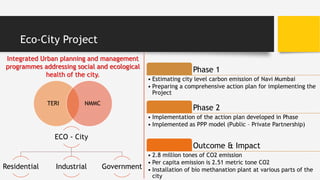
Eco-City Project
Integrated Urban planning and management
programmes addressing social and ecological
health of the city.
TERI NMMC
ECO - City
Residential Industrial Government
Phase 1
• Estimating city level carbon emission of Navi Mumbai
• Preparing a comprehensive action plan for implementing the
Project
Phase 2
• Implementation of the action plan developed in Phase
• Implemented as PPP model (Public – Private Partnership)
Outcome & Impact
• 2.8 million tones of CO2 emission
• Per capita emission is 2.51 metric tone CO2
• Installation of bio methanation plant at various parts of the
city
Electricity Access for Poverty Reduction
1
• What level of electricity access
is required to enable and
sustain poverty escape?
2
• What constraints, despite
increased access to electricity,
mean that people are not able
to use that electricity
productively and how can they
be removed?
Indian cases
Rajiv Gandhi Grameen Vidyutikaran Yojana
Remote Village Electrification Programme
Village Energy Security Programme
Lessons learned and best practice
• Delivery Models
• Designing for productive uses
• Technologies
• Addressing unreliability of supply
• The programme was launched on 15 August 2007 in
Champaran district of Bihar.
• Six plants based on the technology of Biomass Gasification
were in operation by the year 2009
• Husk is procured at very low cost for conversion to
electricity
Energy
delivery
model
Burning of biomass
in a restricted
supply of air.
Overhead supply
line
Prgm
Scale and
Costs
Installed 84 mini
power plants
Electricity to
over 200,000
people spread
across 300
villages
Impacts
More employment
& income
opportunities to
farmers and
entrepreneurs
Additional income
for women
Husk Power
Systems
Madhubani
Bihar
Scaling the
franchise model
Subsidy &
longer
administrative
process
Uncertainty
• creates a self-sustaining ecosystem in the villages it
serves
• A business of rural electrification that transcends the
conventional ideas around delivery of electrical energy
to masses
Husk Power
Systems
Madhubani
Bihar
Key Lessons of the
programme
Lighting a
Billion Lives
Thakurmunda
Orissa
Energy
delivery
model
entrepreneur-based
model
providing solar
lanterns through
micro solar
enterprises
Prgm
Scale and
Costs
reached 2,549
villages
34 Technical
Partners, 114
Partner
Organizations and
131 energy
enterprises
Impacts
More employment
& income
opportunities to
farmers and
entrepreneurs
Additional income
for women
Fee for service
model &
loan finance
model
Each solar lantern in its life of 10 years replaces about 500-600 ltr of
kerosene, mitigating about 1.5 tones of CO2.
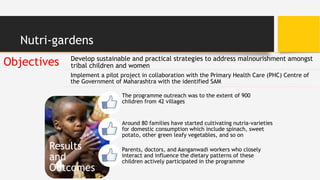
Nutri-gardens
Objectives Develop sustainable and practical strategies to address malnourishment amongst
tribal children and women
Implement a pilot project in collaboration with the Primary Health Care (PHC) Centre of
the Government of Maharashtra with the identified SAM
Results
and
Outcomes
The programme outreach was to the extent of 900
children from 42 villages
Around 80 families have started cultivating nutria-varieties
for domestic consumption which include spinach, sweet
potato, other green leafy vegetables, and so on
Parents, doctors, and Aanganwadi workers who closely
interact and influence the dietary patterns of these
children actively participated in the programme
Overview
Drishtee has strong presence in 3 states of India
namely, Assam, Bihar and Uttar Pradesh.
caters to a minimum of 20 – 25 villages
Drishtee is building a rural distribution network
providing an effective channel for enterprises to
sell products and services
Number of ‘milkman routes’ in a given district
• Computer Education
• English Courses
• Rural BPO
• Government Services
• Health
• Insurance
• E-commerce
• Microfinance
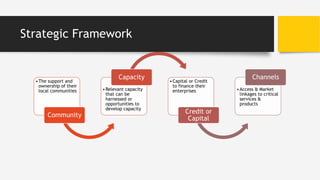
Strategic Framework
•The support and
ownership of their
local communities
Community
•Relevant capacity
that can be
harnessed or
opportunities to
develop capacity
Capacity
•Capital or Credit
to finance their
enterprises
Credit or
Capital
•Access & Market
linkages to critical
services &
products
Channels
Strengths
Enterprise Development
•create appropriate institutional framework to
support entrepreneurial development
Enabling Access
•Drishtee provides access to critical products and
services to the rural population
•products and services include, Education, Health,
Finance, Retail products, Agricultural and non-
agricultural products.
Women Empowerment
Unequal access to economic opportunities
Reviving Rural Economy
•innovative business model
•Financial support for individual entrepreneurs
Strategic Solutions : Supply Chain
Challenges1
• No active marketing or distribution
• Accessibility
• Intermediaries
Opportunity2
• Huge market in rural India
• Increased outlay for rural development
• National Rural Employment Guarantee Scheme
Value Proposition1
• First mover advantage
• Unique distribution model
Current & Future Network2
• Existing network of over 3,000 RRPs
• Largest organized rural distribution
Strategic Solutions
Education &
Livelihood
• To substantially expand its basic computer and spoken English
courses.
• To introduce new courses which enable the students to find
employment opportunities within the village
• Rural outsourcing center (BPO)
Products
Distribution
• Drishtee Rural Retail Points
• saves the opportunity cost involved in the form of wage loss, business
hours, time and transportation cost.
1975
• This same village
was caught In a web
of poverty and illicit
liquor trade.
Anna Hazarae
• Watershed
development
Programme
Present Situation
• So far, 48 nulla
bunds, 5 cement
check dams and
16 Gabion
structures
• The per capita income of the villagers has increased from Rs. 225 to Rs. 2500
• After the success of watershed development programme in Ralegan Siddhi, Hazare replicated it in
the neighboring four villages.
• Training institute to impart training in watershed development was established.
Jal Bhagirathi
Foundation
Optimize the management of scarce water resources in desert communities
Community mobilization through mass contact programs, such as “Jal Chetna
Yatra,”
JBF also provides workshops, conferences, and public meetings, hoping to engage
local and state government in a discussion about water rights.
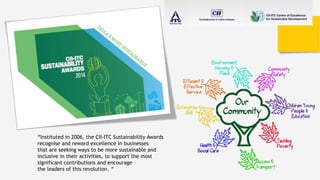
“Instituted in 2006, the CII-ITC Sustainability Awards
recognise and reward excellence in businesses
that are seeking ways to be more sustainable and
inclusive in their activities, to support the most
significant contributions and encourage
the leaders of this revolution. “
“
”
Every Company has a special continuing
responsibility towards the people of the area in
which it is located. The company should spare its
doctors, managers to advice the people of the
village and supervise near development
undertaken by co-operative effort between them
and the company" -JRD Tata(1969)
Tata Steel is guided by the approach that wealth created must be continuously returned to society.
The responsibility of combining the three elements of society - social, environmental and economic
– is of utmost importance to the way of life at Tata Steel. It is the combination of these three
elements that ensures that business is sustainable for all stakeholders.
"
Environmental Initiatives beyond compliance
Development of Roads from
waste plastic
Rainwater harvesting
Water foot printing
3000+ villages illuminated
using solar lamp
Community Development
Benefit sharing
Local Infrastructure
Development
Impact the lives of
communities around our area
of operations & ensure
compliance to statutory
conditions
Projects
Tata Steel Rural
Development Society
(TSRDS)
Tribal Cultural Society (TCS)
Tata Steel Family Initiatives
Foundation (TSFIF)
Tata Steel Skill
Development Society
(TSSDS)
Education
Medical Services
Development
Agriculture Development
Under the National
Wasteland Development
Mission converted 13000
acres into productive land
Infrastructure Development
Skill Development
Education
What makes Tata Steel a Sustainability
Leader
Community Development
National Jharkhand Odisha Chhattisgarh
Literacy Rate 74 67.9 73.5 71
Per Capital
Income
60972 31982 46150 46573
HDI 0.519 0.464 0.442 0.449
Rural
Population
77%
26.2%(SC/ST)
85%
22.8%(SC/ST)
Education on Human Rights- Empowering Panchayat Raj Institutions
Safeguarding the right of child to attend school
- Mid day meal kitchen with association with Govt, ISKCON
- Fellowship programs
-Infrastructure support
- ‘1000 school Projects ‘ plan in Odisha
Financial Inclusion
-Self Help Groups, Skill Development Training
“
”
Bade Bade Deshon Mein
Aisi Choti Choti Baatein Hoti
Rehti Hai
THANK YOU

Sustainable community development model

  • 1.
    Sustainable Models Sachin Sebastian– 122 Shamin Babu - 135 Shanmuga Sundaram - 136
  • 2.
    Introduction • Growth andDevelopment • Requirements • Systems Analysis • Minimize resource depletion , environmental damage and social instability • Concerns for protecting environment, avoiding depletion of non- renewable resources and equity
  • 3.
    Sustainable development affects Community •ESG principles • Commercial businesses are attracted to market opportunities, provide incentives for individuals, families and businesses to grow roots in the community • Environment , Housing & Place • Health & Social Care • Tackling Poverty
  • 4.
    • Children, YoungPeople & Education • Enterprise & Skill • Access & Transport • Community Safety • Efficient & Effective Service • Communities through ESG design-Promotes better quality of life with economic, social and physical health
  • 5.
    Eco City Project ElectricityAccess for Poverty Reduction Nutri-gardens to address rural malnutrition teri established in 1974 independent, not-for-profit, research institute focused on energy, environment and sustainable development Efficient utilization of energy and sustainable use of natural resources would propel the process of development. R K Pachauri – awarded Nobel peace prize in 2007 Vision Creating Innovative Solutions for a Sustainable Future
  • 6.
    Eco-City Project Integrated Urbanplanning and management programmes addressing social and ecological health of the city. TERI NMMC ECO - City Residential Industrial Government Phase 1 • Estimating city level carbon emission of Navi Mumbai • Preparing a comprehensive action plan for implementing the Project Phase 2 • Implementation of the action plan developed in Phase • Implemented as PPP model (Public – Private Partnership) Outcome & Impact • 2.8 million tones of CO2 emission • Per capita emission is 2.51 metric tone CO2 • Installation of bio methanation plant at various parts of the city
  • 7.
    Electricity Access forPoverty Reduction 1 • What level of electricity access is required to enable and sustain poverty escape? 2 • What constraints, despite increased access to electricity, mean that people are not able to use that electricity productively and how can they be removed? Indian cases Rajiv Gandhi Grameen Vidyutikaran Yojana Remote Village Electrification Programme Village Energy Security Programme Lessons learned and best practice • Delivery Models • Designing for productive uses • Technologies • Addressing unreliability of supply
  • 8.
    • The programmewas launched on 15 August 2007 in Champaran district of Bihar. • Six plants based on the technology of Biomass Gasification were in operation by the year 2009 • Husk is procured at very low cost for conversion to electricity Energy delivery model Burning of biomass in a restricted supply of air. Overhead supply line Prgm Scale and Costs Installed 84 mini power plants Electricity to over 200,000 people spread across 300 villages Impacts More employment & income opportunities to farmers and entrepreneurs Additional income for women Husk Power Systems Madhubani Bihar
  • 9.
    Scaling the franchise model Subsidy& longer administrative process Uncertainty • creates a self-sustaining ecosystem in the villages it serves • A business of rural electrification that transcends the conventional ideas around delivery of electrical energy to masses Husk Power Systems Madhubani Bihar Key Lessons of the programme
  • 10.
    Lighting a Billion Lives Thakurmunda Orissa Energy delivery model entrepreneur-based model providingsolar lanterns through micro solar enterprises Prgm Scale and Costs reached 2,549 villages 34 Technical Partners, 114 Partner Organizations and 131 energy enterprises Impacts More employment & income opportunities to farmers and entrepreneurs Additional income for women Fee for service model & loan finance model Each solar lantern in its life of 10 years replaces about 500-600 ltr of kerosene, mitigating about 1.5 tones of CO2.
  • 11.
    Nutri-gardens Objectives Develop sustainableand practical strategies to address malnourishment amongst tribal children and women Implement a pilot project in collaboration with the Primary Health Care (PHC) Centre of the Government of Maharashtra with the identified SAM Results and Outcomes The programme outreach was to the extent of 900 children from 42 villages Around 80 families have started cultivating nutria-varieties for domestic consumption which include spinach, sweet potato, other green leafy vegetables, and so on Parents, doctors, and Aanganwadi workers who closely interact and influence the dietary patterns of these children actively participated in the programme
  • 12.
    Overview Drishtee has strongpresence in 3 states of India namely, Assam, Bihar and Uttar Pradesh. caters to a minimum of 20 – 25 villages Drishtee is building a rural distribution network providing an effective channel for enterprises to sell products and services Number of ‘milkman routes’ in a given district • Computer Education • English Courses • Rural BPO • Government Services • Health • Insurance • E-commerce • Microfinance
  • 13.
    Strategic Framework •The supportand ownership of their local communities Community •Relevant capacity that can be harnessed or opportunities to develop capacity Capacity •Capital or Credit to finance their enterprises Credit or Capital •Access & Market linkages to critical services & products Channels
  • 14.
    Strengths Enterprise Development •create appropriateinstitutional framework to support entrepreneurial development Enabling Access •Drishtee provides access to critical products and services to the rural population •products and services include, Education, Health, Finance, Retail products, Agricultural and non- agricultural products. Women Empowerment Unequal access to economic opportunities Reviving Rural Economy •innovative business model •Financial support for individual entrepreneurs
  • 15.
    Strategic Solutions :Supply Chain Challenges1 • No active marketing or distribution • Accessibility • Intermediaries Opportunity2 • Huge market in rural India • Increased outlay for rural development • National Rural Employment Guarantee Scheme Value Proposition1 • First mover advantage • Unique distribution model Current & Future Network2 • Existing network of over 3,000 RRPs • Largest organized rural distribution
  • 16.
    Strategic Solutions Education & Livelihood •To substantially expand its basic computer and spoken English courses. • To introduce new courses which enable the students to find employment opportunities within the village • Rural outsourcing center (BPO) Products Distribution • Drishtee Rural Retail Points • saves the opportunity cost involved in the form of wage loss, business hours, time and transportation cost.
  • 17.
    1975 • This samevillage was caught In a web of poverty and illicit liquor trade. Anna Hazarae • Watershed development Programme Present Situation • So far, 48 nulla bunds, 5 cement check dams and 16 Gabion structures • The per capita income of the villagers has increased from Rs. 225 to Rs. 2500 • After the success of watershed development programme in Ralegan Siddhi, Hazare replicated it in the neighboring four villages. • Training institute to impart training in watershed development was established.
  • 19.
    Jal Bhagirathi Foundation Optimize themanagement of scarce water resources in desert communities Community mobilization through mass contact programs, such as “Jal Chetna Yatra,” JBF also provides workshops, conferences, and public meetings, hoping to engage local and state government in a discussion about water rights.
  • 20.
    “Instituted in 2006,the CII-ITC Sustainability Awards recognise and reward excellence in businesses that are seeking ways to be more sustainable and inclusive in their activities, to support the most significant contributions and encourage the leaders of this revolution. “
  • 21.
    “ ” Every Company hasa special continuing responsibility towards the people of the area in which it is located. The company should spare its doctors, managers to advice the people of the village and supervise near development undertaken by co-operative effort between them and the company" -JRD Tata(1969) Tata Steel is guided by the approach that wealth created must be continuously returned to society. The responsibility of combining the three elements of society - social, environmental and economic – is of utmost importance to the way of life at Tata Steel. It is the combination of these three elements that ensures that business is sustainable for all stakeholders. "
  • 22.
    Environmental Initiatives beyondcompliance Development of Roads from waste plastic Rainwater harvesting Water foot printing 3000+ villages illuminated using solar lamp Community Development Benefit sharing Local Infrastructure Development Impact the lives of communities around our area of operations & ensure compliance to statutory conditions Projects Tata Steel Rural Development Society (TSRDS) Tribal Cultural Society (TCS) Tata Steel Family Initiatives Foundation (TSFIF) Tata Steel Skill Development Society (TSSDS) Education Medical Services Development Agriculture Development Under the National Wasteland Development Mission converted 13000 acres into productive land Infrastructure Development Skill Development Education What makes Tata Steel a Sustainability Leader
  • 24.
    Community Development National JharkhandOdisha Chhattisgarh Literacy Rate 74 67.9 73.5 71 Per Capital Income 60972 31982 46150 46573 HDI 0.519 0.464 0.442 0.449 Rural Population 77% 26.2%(SC/ST) 85% 22.8%(SC/ST) Education on Human Rights- Empowering Panchayat Raj Institutions Safeguarding the right of child to attend school - Mid day meal kitchen with association with Govt, ISKCON - Fellowship programs -Infrastructure support - ‘1000 school Projects ‘ plan in Odisha Financial Inclusion -Self Help Groups, Skill Development Training
  • 25.
    “ ” Bade Bade DeshonMein Aisi Choti Choti Baatein Hoti Rehti Hai THANK YOU

Editor's Notes

  • #21 With this changing attitude towards business and greater expectations from it, the Confederation of Indian Industry (CII) set up the centre. CII, founded over 117 years ago is India’s premier business association and has played a proactive role in the country’s development process. A non-government and a not-for-profit organization, it is both managed and let by the industry. CII set up the Environmental Management Division in 1992, which was rechristened the centre in 2006.