


Business, Society & Environment A Course Introduction Business, Society & Environment Professor Hector R Rodriguez School of Business Mount Ida College
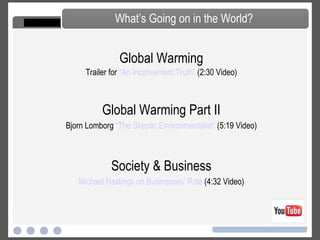
Global Warming Trailer for   “An Inconvenient Truth”  (2:30 Video) What’s Going on in the World? Global Warming Part II Bjorn Lomborg  “The Skeptic Environmentalist”  (5:19 Video) Society & Business Michael Hastings on Businesses’ Role  (4:32 Video)
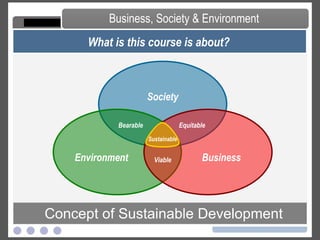
What is this course is about? Business, Society & Environment Business Society Environment Bearable Equitable Viable Sustainable Concept of Sustainable Development
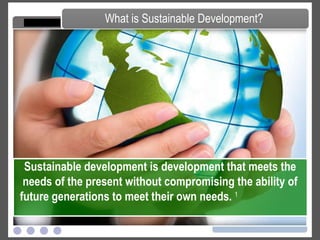
What is Sustainable Development? Sustainable development is development that meets the needs of the present without compromising the ability of future generations to meet their own needs.   1
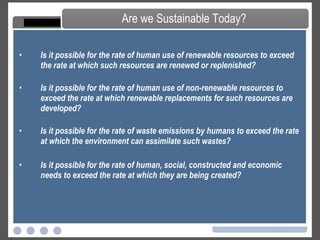
Is it possible for the rate of human use of renewable resources to exceed the rate at which such resources are renewed or replenished?  Is it possible for the rate of human use of non-renewable resources to exceed the rate at which renewable replacements for such resources are developed?  Is it possible for the rate of waste emissions by humans to exceed the rate at which the environment can assimilate such wastes? Is it possible for the rate of human, social, constructed and economic needs to exceed the rate at which they are being created? Are we Sustainable Today?
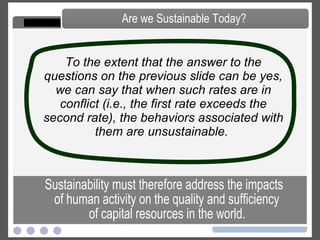
To the extent that the answer to the questions on the previous slide can be yes, we can say that when such rates are in conflict (i.e., the first rate exceeds the second rate), the behaviors associated with them are unsustainable.   Are we Sustainable Today? Sustainability must therefore address the impacts of human activity on the quality and sufficiency of capital resources in the world.
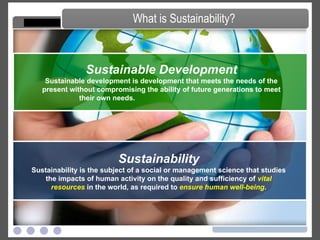
Sustainability Sustainability is the subject of a social or management science that studies the impacts of human activity on the quality and sufficiency of  vital resources  in the world, as required to  ensure human well-being . What is Sustainability? Sustainable Development Sustainable development is development that meets the needs of the present without compromising the ability of future generations to meet their own needs.
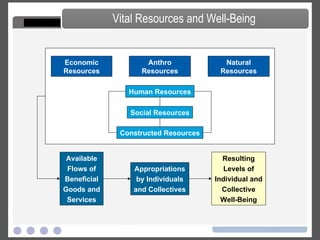
Available Flows of Beneficial Goods and Services Appropriations by Individuals and Collectives Resulting Levels of Individual and Collective Well-Being Vital Resources and Well-Being Natural Resources Anthro Resources Human Resources Social Resources Constructed Resources Economic Resources
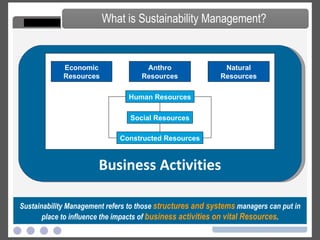
Business Activities What is Sustainability Management? Sustainability Management refers to those  structures and systems  managers can put in place to influence the impacts of  business activities on vital Resources . Natural Resources Anthro Resources Human Resources Social Resources Constructed Resources Economic Resources
Study the impacts of business activity on the quality and sufficiency of  vital resources  in the world as required to  ensure  human well-being   and describe the structures and systems managers can put in place to   influence these impacts. Course Objective
Society The Corporation and Its Stakeholders People for the Ethical Treatment of Animals Corporate Citizenship The Social Responsibility of Business The Shareholder Primacy Norm CSR, Citizenship and Sustainability Reporting Responsible Investing The Community and the Corporation Taxation and Corporate Citizenship Corporate Philanthropy Programs Employees and the Corporation Managing a Diverse Workforce Environment A Balanced Look at Climate Change Non-anthropogenic Causes of Climate Change Sulfates, Urban Warming and Permafrost Conventional Energy The Kyoto Protocol Green Building Green Information Technology Transportation, Electric Vehicles and the Environment Geo-Engineering Carbon Capture and Storage Renewable Energy Solid, Toxic and Hazardous Waste Forests, Paper and Carbon Sinks Life Cycle Analysis Green Chemistry Water Use and Management Water Pollution Management Systems Course Map – Topics Covered in Course
Sustainability Corporate Social Responsibility (CSR) Corporate Citizenship (CC) These terms mean different things to different people, sometimes they mean the same thing. For purposes of this course  Sustainability encompasses business, society and the environment, while CSR / CC the more narrow societal aspects, without addressing environmental concerns.  A Word on Terminology
Introductions Introductions
Name Major Expected graduation Job you would like to have after graduating Why are you taking this course? Who Are You?
Course Set Up?  Let’s Review the Syllabus…
Group Term Project –  We will form teams (3-4 students each) which will research and present on one of the four cases included in the book.  Kimpton Hotels EarthCare Program J&J and the Human Life International Shareholder Proposal Nike’s Dispute with the University of Oregon The transformation of Shell The presentation (in power point format) should be designed for a duration of approximately 20 minutes and 5-10 minutes for questions and answers.  Group will also turn in a 2-3 page paper summarizing the main conclusions of the work. Assessment of Student Learning Objectives
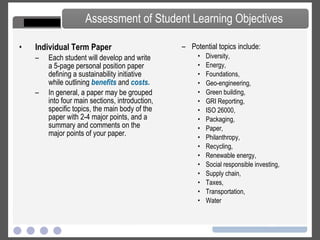
Individual Term Paper  Each student will develop and write a 5-page personal position paper defining a sustainability initiative while outlining  benefits  and  costs .   In general, a paper may be grouped into four main sections, introduction, specific topics, the main body of the paper with 2-4 major points, and a summary and comments on the major points of your paper.  Potential topics include:   Diversity,  Energy,  Foundations, Geo-engineering,  Green building,  GRI Reporting,  ISO 26000,  Packaging,  Paper,  Philanthropy,  Recycling,  Renewable energy,  Social responsible investing,  Supply chain,  Taxes,  Transportation,  Water Assessment of Student Learning Objectives
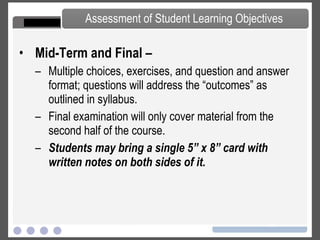
Mid-Term and Final –  Multiple choices, exercises, and question and answer format; questions will address the “outcomes” as outlined in syllabus.  Final examination will only cover material from the second half of the course.  Students may bring a single 5” x 8” card with written notes on both sides of it.   Assessment of Student Learning Objectives
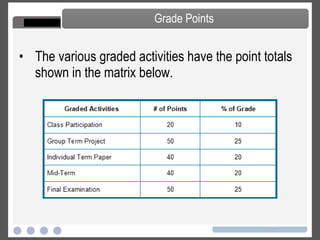
The various graded activities have the point totals shown in the matrix below. Grade Points
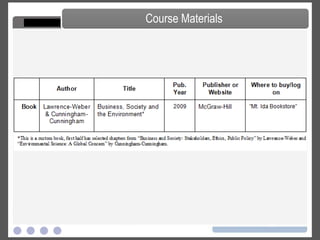
Course Materials

Course Introduction

  • 1.
    Business, Society &Environment A Course Introduction Business, Society & Environment Professor Hector R Rodriguez School of Business Mount Ida College
  • 2.
    Global Warming Trailerfor “An Inconvenient Truth” (2:30 Video) What’s Going on in the World? Global Warming Part II Bjorn Lomborg “The Skeptic Environmentalist” (5:19 Video) Society & Business Michael Hastings on Businesses’ Role (4:32 Video)
  • 3.
    What is thiscourse is about? Business, Society & Environment Business Society Environment Bearable Equitable Viable Sustainable Concept of Sustainable Development
  • 4.
    What is SustainableDevelopment? Sustainable development is development that meets the needs of the present without compromising the ability of future generations to meet their own needs. 1
  • 5.
    Is it possiblefor the rate of human use of renewable resources to exceed the rate at which such resources are renewed or replenished? Is it possible for the rate of human use of non-renewable resources to exceed the rate at which renewable replacements for such resources are developed? Is it possible for the rate of waste emissions by humans to exceed the rate at which the environment can assimilate such wastes? Is it possible for the rate of human, social, constructed and economic needs to exceed the rate at which they are being created? Are we Sustainable Today?
  • 6.
    To the extentthat the answer to the questions on the previous slide can be yes, we can say that when such rates are in conflict (i.e., the first rate exceeds the second rate), the behaviors associated with them are unsustainable. Are we Sustainable Today? Sustainability must therefore address the impacts of human activity on the quality and sufficiency of capital resources in the world.
  • 7.
    Sustainability Sustainability isthe subject of a social or management science that studies the impacts of human activity on the quality and sufficiency of vital resources in the world, as required to ensure human well-being . What is Sustainability? Sustainable Development Sustainable development is development that meets the needs of the present without compromising the ability of future generations to meet their own needs.
  • 8.
    Available Flows ofBeneficial Goods and Services Appropriations by Individuals and Collectives Resulting Levels of Individual and Collective Well-Being Vital Resources and Well-Being Natural Resources Anthro Resources Human Resources Social Resources Constructed Resources Economic Resources
  • 9.
    Business Activities Whatis Sustainability Management? Sustainability Management refers to those structures and systems managers can put in place to influence the impacts of business activities on vital Resources . Natural Resources Anthro Resources Human Resources Social Resources Constructed Resources Economic Resources
  • 10.
    Study the impactsof business activity on the quality and sufficiency of vital resources in the world as required to ensure human well-being and describe the structures and systems managers can put in place to influence these impacts. Course Objective
  • 11.
    Society The Corporationand Its Stakeholders People for the Ethical Treatment of Animals Corporate Citizenship The Social Responsibility of Business The Shareholder Primacy Norm CSR, Citizenship and Sustainability Reporting Responsible Investing The Community and the Corporation Taxation and Corporate Citizenship Corporate Philanthropy Programs Employees and the Corporation Managing a Diverse Workforce Environment A Balanced Look at Climate Change Non-anthropogenic Causes of Climate Change Sulfates, Urban Warming and Permafrost Conventional Energy The Kyoto Protocol Green Building Green Information Technology Transportation, Electric Vehicles and the Environment Geo-Engineering Carbon Capture and Storage Renewable Energy Solid, Toxic and Hazardous Waste Forests, Paper and Carbon Sinks Life Cycle Analysis Green Chemistry Water Use and Management Water Pollution Management Systems Course Map – Topics Covered in Course
  • 12.
    Sustainability Corporate SocialResponsibility (CSR) Corporate Citizenship (CC) These terms mean different things to different people, sometimes they mean the same thing. For purposes of this course Sustainability encompasses business, society and the environment, while CSR / CC the more narrow societal aspects, without addressing environmental concerns. A Word on Terminology
  • 13.
  • 14.
    Name Major Expectedgraduation Job you would like to have after graduating Why are you taking this course? Who Are You?
  • 15.
    Course Set Up? Let’s Review the Syllabus…
  • 16.
    Group Term Project– We will form teams (3-4 students each) which will research and present on one of the four cases included in the book. Kimpton Hotels EarthCare Program J&J and the Human Life International Shareholder Proposal Nike’s Dispute with the University of Oregon The transformation of Shell The presentation (in power point format) should be designed for a duration of approximately 20 minutes and 5-10 minutes for questions and answers. Group will also turn in a 2-3 page paper summarizing the main conclusions of the work. Assessment of Student Learning Objectives
  • 17.
    Individual Term Paper Each student will develop and write a 5-page personal position paper defining a sustainability initiative while outlining benefits and costs . In general, a paper may be grouped into four main sections, introduction, specific topics, the main body of the paper with 2-4 major points, and a summary and comments on the major points of your paper. Potential topics include: Diversity, Energy, Foundations, Geo-engineering, Green building, GRI Reporting, ISO 26000, Packaging, Paper, Philanthropy, Recycling, Renewable energy, Social responsible investing, Supply chain, Taxes, Transportation, Water Assessment of Student Learning Objectives
  • 18.
    Mid-Term and Final– Multiple choices, exercises, and question and answer format; questions will address the “outcomes” as outlined in syllabus. Final examination will only cover material from the second half of the course. Students may bring a single 5” x 8” card with written notes on both sides of it. Assessment of Student Learning Objectives
  • 19.
    The various gradedactivities have the point totals shown in the matrix below. Grade Points
  • 20.