ANNUAL
REPORTING
FORM
ORGANIZATION or PARTNERSHIP NAME:
CONTACT NAME:
CONTACT E-MAIL:
INITIATIVE or PROGRAM NAME:
INITIATIVE or PROGRAM DESCRIPTION (100 word maximum):
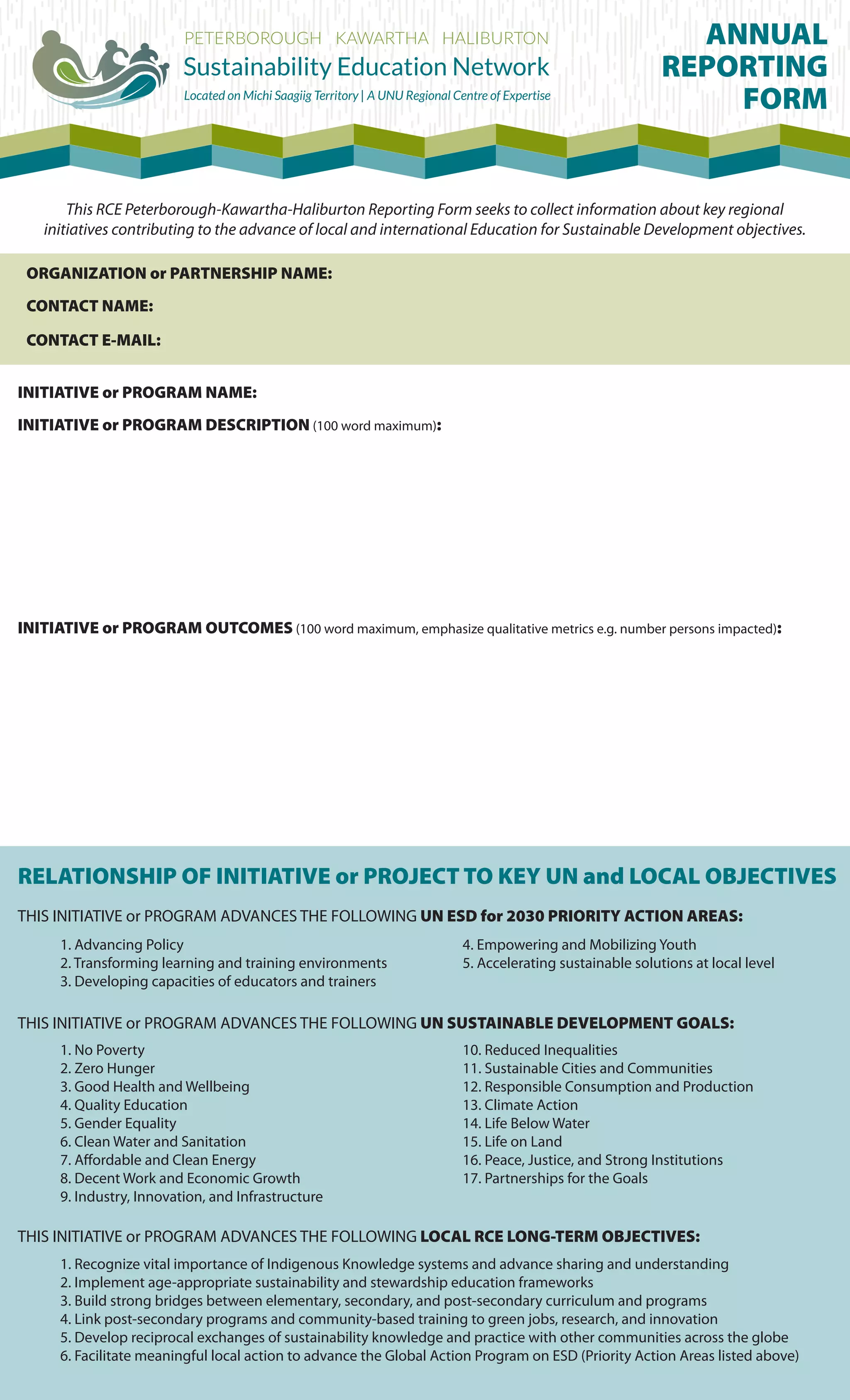
This RCE Peterborough-Kawartha-Haliburton Reporting Form seeks to collect information about key regional
initiatives contributing to the advance of local and international Education for Sustainable Development objectives.
INITIATIVE or PROGRAM OUTCOMES (100 word maximum, emphasize qualitative metrics e.g. number persons impacted):
RELATIONSHIP OF INITIATIVE or PROJECT TO KEY UN and LOCAL OBJECTIVES
THIS INITIATIVE or PROGRAM ADVANCES THE FOLLOWING UN ESD for 2030 PRIORITY ACTION AREAS:
1. Advancing Policy
2. Transforming learning and training environments
3. Developing capacities of educators and trainers
4. Empowering and Mobilizing Youth
5. Accelerating sustainable solutions at local level
THIS INITIATIVE or PROGRAM ADVANCES THE FOLLOWING UN SUSTAINABLE DEVELOPMENT GOALS:
1. No Poverty
2. Zero Hunger
3. Good Health and Wellbeing
4. Quality Education
5. Gender Equality
6. Clean Water and Sanitation
7. Affordable and Clean Energy
8. Decent Work and Economic Growth
9. Industry, Innovation, and Infrastructure
10. Reduced Inequalities
11. Sustainable Cities and Communities
12. Responsible Consumption and Production
13. Climate Action
14. Life Below Water
15. Life on Land
16. Peace, Justice, and Strong Institutions
17. Partnerships for the Goals
THIS INITIATIVE or PROGRAM ADVANCES THE FOLLOWING LOCAL RCE LONG-TERM OBJECTIVES:
1. Recognize vital importance of Indigenous Knowledge systems and advance sharing and understanding
2. Implement age-appropriate sustainability and stewardship education frameworks
3. Build strong bridges between elementary, secondary, and post-secondary curriculum and programs
4. Link post-secondary programs and community-based training to green jobs, research, and innovation
5. Develop reciprocal exchanges of sustainability knowledge and practice with other communities across the globe
6. Facilitate meaningful local action to advance the Global Action Program on ESD (Priority Action Areas listed above)
Peterborough- Kawartha-Haliburton
Jane Gray and Ashley Safar
janegray@trentu.ca ashley.safar@flemingcollege.ca
UNESCO Indigenous Education Research Project
This research was conducted as a contribution to a global research project on Indigenous Education in support of the United
Nations Sustainable Development Goal to “Ensure inclusive and equitable quality education and promote lifelong learning
opportunities for all.” (United Nations, 2015) and is guided by the principles of UNDRIP. The specific goal of the global project is: “to
develop policy recommendations on how to improve the quality of education for Indigenous youth” The first phase of the research
provides descriptions of Indigenous academic and student service programming at Trent University and Fleming College and
highlighted the links between Indigenous education and pedagogies and the U.N. Sustainable Development goals as well as the
importance of culturally based experiential education.The second phase of the project highlights the Bishkaa Peer Mentorship
program at Fleming College and The First Nations Technical Institutes’ Braided Healing with Learning. This practice involves having
an Instructor, an Elder and Student Success worker present in all classes, weaving western curriculum and Indigenous Knowledges
Systems together with personal growth.
Bishkaa Program- Key Elements:
Orientation before classes begin.Group Activities throughout the year. Well trained staff who have cultural knowledge.A welcoming
space for students. Cultural Teachings and Student Supports- The availability of Elders, Traditional Knowledge Holders and Health
and Counselling Services. 100% retention rates.100% graduation rates. Higher employability and leadership skills.
First Nations Technical Institute- Braided Healing with Learning- Key Elements- Works directly with communities to identify
employment needs. Programs are offered within the community so that students can maintain family, work and community
responsibilities. An Instructor, an Elder (or Cultural Advisor) and a Student Success worker support the personal growth and
academic success of all students. Elders or Cultural Advisors work alongside Instructors to bring cultural relevance to western
curriculum and are there to help students on their personal journeys. *94.5 % - 96 % Graduation rates. Engagement with
Indigenous teachings were also translated into deeper relationships with Mother Earth and understandings of sustainability issues.


UNESCO Indigenous Education Research Project

  • 1.
    ANNUAL REPORTING FORM ORGANIZATION or PARTNERSHIPNAME: CONTACT NAME: CONTACT E-MAIL: INITIATIVE or PROGRAM NAME: INITIATIVE or PROGRAM DESCRIPTION (100 word maximum): This RCE Peterborough-Kawartha-Haliburton Reporting Form seeks to collect information about key regional initiatives contributing to the advance of local and international Education for Sustainable Development objectives. INITIATIVE or PROGRAM OUTCOMES (100 word maximum, emphasize qualitative metrics e.g. number persons impacted): RELATIONSHIP OF INITIATIVE or PROJECT TO KEY UN and LOCAL OBJECTIVES THIS INITIATIVE or PROGRAM ADVANCES THE FOLLOWING UN ESD for 2030 PRIORITY ACTION AREAS: 1. Advancing Policy 2. Transforming learning and training environments 3. Developing capacities of educators and trainers 4. Empowering and Mobilizing Youth 5. Accelerating sustainable solutions at local level THIS INITIATIVE or PROGRAM ADVANCES THE FOLLOWING UN SUSTAINABLE DEVELOPMENT GOALS: 1. No Poverty 2. Zero Hunger 3. Good Health and Wellbeing 4. Quality Education 5. Gender Equality 6. Clean Water and Sanitation 7. Affordable and Clean Energy 8. Decent Work and Economic Growth 9. Industry, Innovation, and Infrastructure 10. Reduced Inequalities 11. Sustainable Cities and Communities 12. Responsible Consumption and Production 13. Climate Action 14. Life Below Water 15. Life on Land 16. Peace, Justice, and Strong Institutions 17. Partnerships for the Goals THIS INITIATIVE or PROGRAM ADVANCES THE FOLLOWING LOCAL RCE LONG-TERM OBJECTIVES: 1. Recognize vital importance of Indigenous Knowledge systems and advance sharing and understanding 2. Implement age-appropriate sustainability and stewardship education frameworks 3. Build strong bridges between elementary, secondary, and post-secondary curriculum and programs 4. Link post-secondary programs and community-based training to green jobs, research, and innovation 5. Develop reciprocal exchanges of sustainability knowledge and practice with other communities across the globe 6. Facilitate meaningful local action to advance the Global Action Program on ESD (Priority Action Areas listed above) Peterborough- Kawartha-Haliburton Jane Gray and Ashley Safar janegray@trentu.ca ashley.safar@flemingcollege.ca UNESCO Indigenous Education Research Project This research was conducted as a contribution to a global research project on Indigenous Education in support of the United Nations Sustainable Development Goal to “Ensure inclusive and equitable quality education and promote lifelong learning opportunities for all.” (United Nations, 2015) and is guided by the principles of UNDRIP. The specific goal of the global project is: “to develop policy recommendations on how to improve the quality of education for Indigenous youth” The first phase of the research provides descriptions of Indigenous academic and student service programming at Trent University and Fleming College and highlighted the links between Indigenous education and pedagogies and the U.N. Sustainable Development goals as well as the importance of culturally based experiential education.The second phase of the project highlights the Bishkaa Peer Mentorship program at Fleming College and The First Nations Technical Institutes’ Braided Healing with Learning. This practice involves having an Instructor, an Elder and Student Success worker present in all classes, weaving western curriculum and Indigenous Knowledges Systems together with personal growth. Bishkaa Program- Key Elements: Orientation before classes begin.Group Activities throughout the year. Well trained staff who have cultural knowledge.A welcoming space for students. Cultural Teachings and Student Supports- The availability of Elders, Traditional Knowledge Holders and Health and Counselling Services. 100% retention rates.100% graduation rates. Higher employability and leadership skills. First Nations Technical Institute- Braided Healing with Learning- Key Elements- Works directly with communities to identify employment needs. Programs are offered within the community so that students can maintain family, work and community responsibilities. An Instructor, an Elder (or Cultural Advisor) and a Student Success worker support the personal growth and academic success of all students. Elders or Cultural Advisors work alongside Instructors to bring cultural relevance to western curriculum and are there to help students on their personal journeys. *94.5 % - 96 % Graduation rates. Engagement with Indigenous teachings were also translated into deeper relationships with Mother Earth and understandings of sustainability issues. 