The Brundtland Commission’s brief
definition of sustainable development as
the
“ability to make development sustainable—
to ensure that it meets the needs
of the present without compromising the
ability of future generations to meet their
own needs”.
Based from
 World Commission on Environment
and Development was initiated by the General
  Assembly of the United Nations in 1982, and
  its report, Our Common Future, was published
  in 1987.7 It was chaired by then–Prime
  Minister of Norway Gro Harlem Brundtland,
  thus earning the name the “Brundtland
  Commission.”
   An environmentally sustainable society
    satisfies the basic needs of its people without
    depleting or degrading its natural resources
    and thereby preventing current and future
    generations of humans from meeting their
    basic needs.
   Living sustainably means living off the
    natural income replenished by soils, plants,
    air and water and not depleting the natural
    capital that supplies this income.
   Do not kill the goose that lays the golden egg
    or protect your capital.
   The living planet report by WWF and other
    orgs. Mentioned that between 1970 and 1999
    we lost 1/3rd of our natural capital.
   Due to exponential growth and use of earth’s
    natural resources.
   Encourages environmentally sustainable
    forms of economic growth that meet the
    basic needs of the current generations of
    humans and other species without preventing
    generations of humans and other species
    from meeting their basic needs.
   Discourages environmentally harmful and
    unsustainable forms of economic growth.
   Is the economic component of
    environmentally sustainable societies.
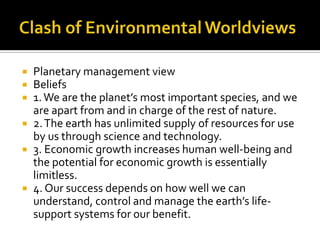
 Planetary management view
 Beliefs
 1. We are the planet’s most important species, and we
  are apart from and in charge of the rest of nature.
 2. The earth has unlimited supply of resources for use
  by us through science and technology.
 3. Economic growth increases human well-being and
  the potential for economic growth is essentially
  limitless.
 4. Our success depends on how well we can
  understand, control and manage the earth’s life-
  support systems for our benefit.
 Environmental wisdom worldview
 Beliefs
 1. We are part of nature and nature does not exist for us.
 2. The earth’s resources are limited, should not be wasted,
  and should be used efficiently and sustainably for us and
  other species.
 3. Some forms of technology and economic growth are
  environmentally beneficial and should be encouraged but
  some are harmful and should be discouraged.
 4. Our success depends on learning how the earth sustains
  itself and adapts to ever-changing environmental
  conditions and integrating such scientific lessons from
  nature into ways we think and act.
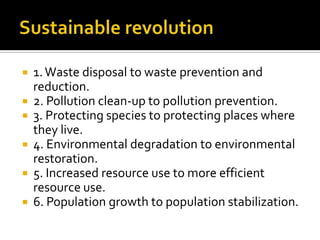
   1. Waste disposal to waste prevention and
    reduction.
   2. Pollution clean-up to pollution prevention.
   3. Protecting species to protecting places where
    they live.
   4. Environmental degradation to environmental
    restoration.
   5. Increased resource use to more efficient
    resource use.
   6. Population growth to population stabilization.

Sustainable development

  • 2.
    The Brundtland Commission’sbrief definition of sustainable development as the “ability to make development sustainable— to ensure that it meets the needs of the present without compromising the ability of future generations to meet their own needs”. Based from
  • 3.
     World Commissionon Environment and Development was initiated by the General Assembly of the United Nations in 1982, and its report, Our Common Future, was published in 1987.7 It was chaired by then–Prime Minister of Norway Gro Harlem Brundtland, thus earning the name the “Brundtland Commission.”
  • 7.
    An environmentally sustainable society satisfies the basic needs of its people without depleting or degrading its natural resources and thereby preventing current and future generations of humans from meeting their basic needs.
  • 8.
    Living sustainably means living off the natural income replenished by soils, plants, air and water and not depleting the natural capital that supplies this income.  Do not kill the goose that lays the golden egg or protect your capital.
  • 9.
    The living planet report by WWF and other orgs. Mentioned that between 1970 and 1999 we lost 1/3rd of our natural capital.  Due to exponential growth and use of earth’s natural resources.
  • 10.
    Encourages environmentally sustainable forms of economic growth that meet the basic needs of the current generations of humans and other species without preventing generations of humans and other species from meeting their basic needs.  Discourages environmentally harmful and unsustainable forms of economic growth.
  • 11.
    Is the economic component of environmentally sustainable societies.
  • 12.
     Planetary managementview  Beliefs  1. We are the planet’s most important species, and we are apart from and in charge of the rest of nature.  2. The earth has unlimited supply of resources for use by us through science and technology.  3. Economic growth increases human well-being and the potential for economic growth is essentially limitless.  4. Our success depends on how well we can understand, control and manage the earth’s life- support systems for our benefit.
  • 13.
     Environmental wisdomworldview  Beliefs  1. We are part of nature and nature does not exist for us.  2. The earth’s resources are limited, should not be wasted, and should be used efficiently and sustainably for us and other species.  3. Some forms of technology and economic growth are environmentally beneficial and should be encouraged but some are harmful and should be discouraged.  4. Our success depends on learning how the earth sustains itself and adapts to ever-changing environmental conditions and integrating such scientific lessons from nature into ways we think and act.
  • 14.
    1. Waste disposal to waste prevention and reduction.  2. Pollution clean-up to pollution prevention.  3. Protecting species to protecting places where they live.  4. Environmental degradation to environmental restoration.  5. Increased resource use to more efficient resource use.  6. Population growth to population stabilization.