© 2016 Cengage Learning. All Rights Reserved.
MILLER/SPOOLMAN
Environmental Science, 15e
G. TYLER MILLER | SCOTT E. SPOOLMAN
© 2016 Cengage Learning. All Rights Reserved.
1
Environmental Problems,
Their Causes, and
Sustainability
© 2016 Cengage Learning. All Rights Reserved.
• Colleges across the United States are
taking sustainability seriously
– Green building designs and reuse
– Environmental science curriculums
• What does the term sustainability mean to
you?
• How does your campus community
approach sustainability?
Core Case Study: The Greening of
American Campuses
© 2016 Cengage Learning. All Rights Reserved.
• The ability of ecosystems and human
cultural systems to survive, flourish, and
adapt together to constantly changing
environments over long periods of time
Sustainability Defined
© 2016 Cengage Learning. All Rights Reserved.
• Life on the earth:
– Has been sustained for billions of years by
solar energy, biodiversity, and chemical
cycling
– Depends on energy from the sun and natural
capital provided by the earth
– Can been preserved by shifting towards full-
cost pricing and win-win solutions
1.1 What Are Some Principles of
Sustainability?
© 2016 Cengage Learning. All Rights Reserved.
• What is the environment?
– Everything around us, living and nonliving
• Ecosystem:
– Group of organisms in a defined geographic
area (terrestrial or marine) that interact with
each other and their environment
• Environmentalism:
– A social movement dedicated to sustaining
the earth’s life-support system
Environmental Science Is a Study of Our
Interactions With the World
© 2016 Cengage Learning. All Rights Reserved.
• To learn how life on the earth has survived
and thrived
• To understand how we interact with the
environment
• To find ways to deal with environmental
problems and live more sustainably
What Are the Goals of Environmental
Science?
© 2016 Cengage Learning. All Rights Reserved.
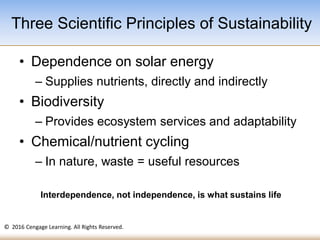
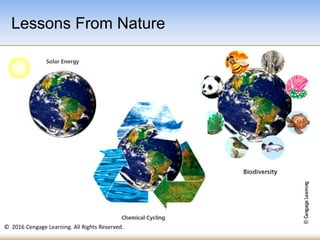
• Dependence on solar energy
– Supplies nutrients, directly and indirectly
• Biodiversity
– Provides ecosystem services and adaptability
• Chemical/nutrient cycling
– In nature, waste = useful resources
Interdependence, not independence, is what sustains life
Three Scientific Principles of Sustainability
© 2016 Cengage Learning. All Rights Reserved.
Lessons From Nature
© 2016 Cengage Learning. All Rights Reserved.
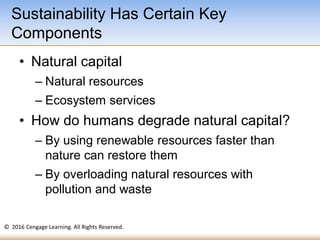
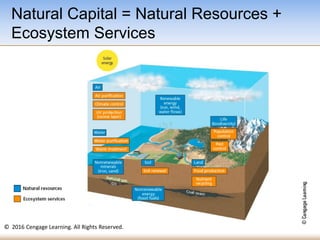
• Natural capital
– Natural resources
– Ecosystem services
• How do humans degrade natural capital?
– By using renewable resources faster than
nature can restore them
– By overloading natural resources with
pollution and waste
Sustainability Has Certain Key
Components
© 2016 Cengage Learning. All Rights Reserved.
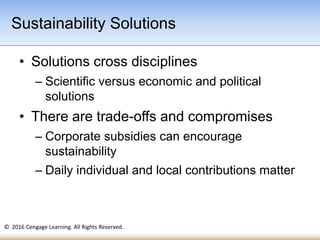
• Solutions cross disciplines
– Scientific versus economic and political
solutions
• There are trade-offs and compromises
– Corporate subsidies can encourage
sustainability
– Daily individual and local contributions matter
Sustainability Solutions
© 2016 Cengage Learning. All Rights Reserved.
Natural Capital = Natural Resources +
Ecosystem Services
© 2016 Cengage Learning. All Rights Reserved.
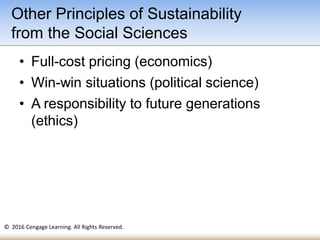
• Full-cost pricing (economics)
• Win-win situations (political science)
• A responsibility to future generations
(ethics)
Other Principles of Sustainability
from the Social Sciences
© 2016 Cengage Learning. All Rights Reserved.
• A resource is anything we obtain from the
environment
– Can be readily available for use
– Or – can require technology to acquire
• Sustainable solutions for resource use
– Reduce
– Reuse
– Recycle
What is a Resource?
© 2016 Cengage Learning. All Rights Reserved.
• Inexhaustible resources
– Perpetually available and expected to last
• Renewable resources
– Replenished by natural processes within their
sustainable yield
• Nonrenewable/exhaustible resources
– Available in fixed quantities that can be
renewed, but only through long-term geologic
processes
Resources Are Inexhaustible, Renewable,
and Nonrenewable
© 2016 Cengage Learning. All Rights Reserved.
• Industrialized countries
– 17% of world’s population (United States,
Canada, Western Europe)
• Developing countries
– 83% of world’s population
• Middle income, moderately developed countries
(China, India, Brazil)
• Low income, least developed countries (Nigeria,
Bangladesh, Haiti)
Countries Differ in Resource Use and
Environmental Impact
© 2016 Cengage Learning. All Rights Reserved.
• Over time, growth of ecological footprints
depletes and degrades earth’s natural
capital (natural resources and ecosystem
services)
– Environmental degradation
• Is there any good news?
1.2 How Are Our Ecological Footprints
Affecting the Earth?
© 2016 Cengage Learning. All Rights Reserved.
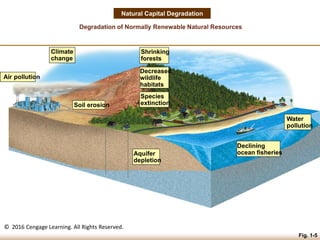
Fig. 1-5
Natural Capital Degradation
Degradation of Normally Renewable Natural Resources
Climate
change
Shrinking
forests
Air pollution
Decreased
wildlife
habitats
Species
extinction
Soil erosion
Water
pollution
Declining
ocean fisheries
Aquifer
depletion
© 2016 Cengage Learning. All Rights Reserved.
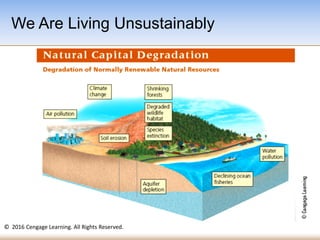
We Are Living Unsustainably
© 2016 Cengage Learning. All Rights Reserved.
• Pollution: contamination of the
environment by polluting substances
(pollutants) such as chemicals, noise, and
heat
– Naturally occurring (volcanoes)
– Contributed by humans (burning of fossil
fuels)
Pollution Comes From a Number of
Sources
© 2016 Cengage Learning. All Rights Reserved.
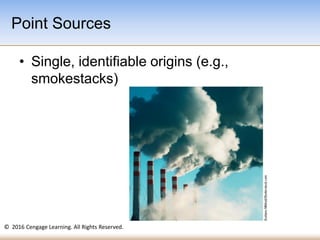
• Single, identifiable origins (e.g.,
smokestacks)
Point Sources
© 2016 Cengage Learning. All Rights Reserved.
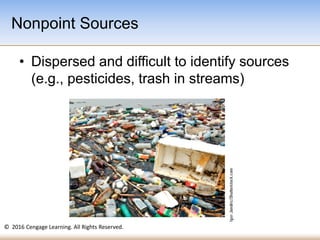
• Dispersed and difficult to identify sources
(e.g., pesticides, trash in streams)
Nonpoint Sources
© 2016 Cengage Learning. All Rights Reserved.
• Pollution cleanup (post-production)
– Cleanup: dilution/reduction of pollutants
• Pollution prevention (before pollution
occurs)
– Reduces or eliminates the production of
pollutants
How Are We Dealing With Pollution?
© 2016 Cengage Learning. All Rights Reserved.
• The tragedy of the commons
– Cumulative degradation due to the overuse
of:
• Open access, renewable resources (atmosphere,
open ocean, fish)
• Shared resources (grasslands, forests, streams)
– The individual (incorrectly) believes that:
• “The little bit that I use or pollute is not enough to
matter, and anyway, it’s a renewable resource”
We Are Degrading Commonly Shared
Renewable Resources
© 2016 Cengage Learning. All Rights Reserved.
• An ecological footprint
– The amount of land and water needed to
supply a population or geographic area with
renewable resources, as well as the ability to
absorb/recycle wastes and pollution produced
by resource usage
• The growth of ecological footprints
– Leads to degradation of natural capital
– Results in the creation of pollution and waste
What is an Ecological Footprint?
© 2016 Cengage Learning. All Rights Reserved.
• An ecological deficit:
– Occurs when the ecological footprint is larger
than the biological capacity to replenish
resources and absorb wastes/pollution
• In an ecological deficit, people are living
unsustainably
– This creates adverse environmental impacts,
which can be mitigated by upcycling
Our Ecological Footprints Are Growing
© 2016 Cengage Learning. All Rights Reserved.
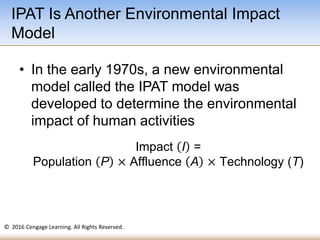
Impact I =
Population P × Affluence A × Technology (T)
• In the early 1970s, a new environmental
model called the IPAT model was
developed to determine the environmental
impact of human activities
IPAT Is Another Environmental Impact
Model
© 2016 Cengage Learning. All Rights Reserved.
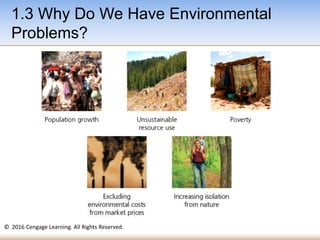
1.3 Why Do We Have Environmental
Problems?
© 2016 Cengage Learning. All Rights Reserved.
• For each of these causes, what are two
environmental problems that result?
• Our own worldview determines whether
we live sustainably or unsustainably
Our Environmental Worldview
© 2016 Cengage Learning. All Rights Reserved.
• Unchecked population/ecological footprint
growth results in natural capital
degradation
• Can we slow down this degradation by
reducing the rate of population growth?
The Human Population Is Growing at a
Rapid Rate
© 2016 Cengage Learning. All Rights Reserved.
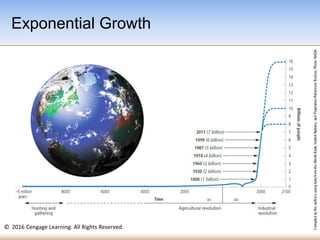
Exponential Growth
© 2016 Cengage Learning. All Rights Reserved.
• High levels of consumption and waste of
resources
• More air pollution, water pollution, and
land degradation
• Acquisition of resources without regard for
the environmental effects of their
consumption
Affluence Has Harmful Environmental
Effects
© 2016 Cengage Learning. All Rights Reserved.
• Better education
• Scientific research
• Technological solutions resulting in
improvements in environmental quality
(e.g., safe drinking water)
Affluence Has Beneficial Environmental
Effects
© 2016 Cengage Learning. All Rights Reserved.
• Harmful effects
– Short term requirements for survival can lead
to degraded forests, topsoil, grasslands,
fisheries, and wildlife populations
• Health effects
– Malnutrition, limited access to sanitation/clean
drinking water, outdoor and indoor air
pollution
Poverty Can Have Harmful Environmental
and Health Effects
© 2016 Cengage Learning. All Rights Reserved.
• Consumers are unaware of the damage
caused by their consumption
• Current government subsidies often
increase environmental degradation
– To live sustainably, government subsidies must
become beneficial to the environment by:
• Taxing pollution and waste
• Shifting from environmentally harmful to
environmentally beneficial subsidies
Prices of Goods/Services Rarely Include
Their Harmful Environmental/Health Costs
© 2016 Cengage Learning. All Rights Reserved.
• More than half the world’s population lives
in urban environments technological
isolated from nature
• We are unaware of:
– The origins of our food, water and other
goods
– The pollution and waste generated by the
production of these goods and services
We Are Increasingly Isolated From Nature
© 2016 Cengage Learning. All Rights Reserved.
• Each individual has his or her own
environmental worldview
– A set of assumptions and values reflecting
how one thinks the world works and what
one’s role in it should be
What is Your Environmental Worldview?
© 2016 Cengage Learning. All Rights Reserved.
• Three major types of world views:
– Human-centered
• Planetary management world view
• Stewardship world view
– Life-centered
– Earth-centered
People Have Different Views About
Environmental Problems/Solutions
© 2016 Cengage Learning. All Rights Reserved.
• The preservationist school (John Muir)
– Leave wilderness areas on some public lands
untouched
• The conservationist school (Theodore
Roosevelt, Gifford Pinchot)
– Manage all public lands wisely and
scientifically, primarily to provide resources for
people
The Rise of Environmental Conservation
and Protection in the United States
© 2016 Cengage Learning. All Rights Reserved.
• In order to live sustainably, one must live
off the natural resources without depleting
or degrading the natural capital that
supplies these natural resources
1.4 What Is an Environmentally
Sustainable Society?
© 2016 Cengage Learning. All Rights Reserved.
• Earth’s natural capital provides natural
income
– Renewable resources such as plants,
animals, soil, and clean water and air
• By living only on the natural income and
not depleting the natural capital, society
moves from an unsustainable lifestyle to a
sustainable one
We Must Protect Our Natural Capital and
Live Off of Its Income
© 2016 Cengage Learning. All Rights Reserved.
• Given enough time, most degraded
environments can recover – but many will
take hundreds and even thousands of
years to recover
– Time is our most scarce resource
– However, 5-10% of a population that changes
can make a difference
– Changes can occur in a shorter time than
previously thought
A More Sustainable Future Is Possible
© 2016 Cengage Learning. All Rights Reserved.
• Tianjin, China is a real-life entirely
sustainable community developed on non-
arable land located in an area facing a
water shortage in one of the fastest
growing regions of China
– How does Tianjin reduce, reuse, and recycle
its resources?
– Do you think you could live in this city? Why
or why not?
Additional Case Study:
An Eco-City – Tianjin, China
© 2016 Cengage Learning. All Rights Reserved.
• Create a more sustainable future
– Use natural capital and natural resources
– Reduce, reuse, and recycle
• Utilize full-cost pricing
– Be aware of ecological footprints – and
address cleanup and prevention
• Find win-win solutions
– Apply these solutions to other societies
Tiajin and the Three Big Ideas

Environmental Problems, Their Causes and Sustainability

  • 1.
    © 2016 CengageLearning. All Rights Reserved. MILLER/SPOOLMAN Environmental Science, 15e G. TYLER MILLER | SCOTT E. SPOOLMAN © 2016 Cengage Learning. All Rights Reserved. 1 Environmental Problems, Their Causes, and Sustainability
  • 2.
    © 2016 CengageLearning. All Rights Reserved. • Colleges across the United States are taking sustainability seriously – Green building designs and reuse – Environmental science curriculums • What does the term sustainability mean to you? • How does your campus community approach sustainability? Core Case Study: The Greening of American Campuses
  • 3.
    © 2016 CengageLearning. All Rights Reserved. • The ability of ecosystems and human cultural systems to survive, flourish, and adapt together to constantly changing environments over long periods of time Sustainability Defined
  • 4.
    © 2016 CengageLearning. All Rights Reserved. • Life on the earth: – Has been sustained for billions of years by solar energy, biodiversity, and chemical cycling – Depends on energy from the sun and natural capital provided by the earth – Can been preserved by shifting towards full- cost pricing and win-win solutions 1.1 What Are Some Principles of Sustainability?
  • 5.
    © 2016 CengageLearning. All Rights Reserved. • What is the environment? – Everything around us, living and nonliving • Ecosystem: – Group of organisms in a defined geographic area (terrestrial or marine) that interact with each other and their environment • Environmentalism: – A social movement dedicated to sustaining the earth’s life-support system Environmental Science Is a Study of Our Interactions With the World
  • 6.
    © 2016 CengageLearning. All Rights Reserved. • To learn how life on the earth has survived and thrived • To understand how we interact with the environment • To find ways to deal with environmental problems and live more sustainably What Are the Goals of Environmental Science?
  • 7.
    © 2016 CengageLearning. All Rights Reserved. • Dependence on solar energy – Supplies nutrients, directly and indirectly • Biodiversity – Provides ecosystem services and adaptability • Chemical/nutrient cycling – In nature, waste = useful resources Interdependence, not independence, is what sustains life Three Scientific Principles of Sustainability
  • 8.
    © 2016 CengageLearning. All Rights Reserved. Lessons From Nature
  • 9.
    © 2016 CengageLearning. All Rights Reserved. • Natural capital – Natural resources – Ecosystem services • How do humans degrade natural capital? – By using renewable resources faster than nature can restore them – By overloading natural resources with pollution and waste Sustainability Has Certain Key Components
  • 10.
    © 2016 CengageLearning. All Rights Reserved. • Solutions cross disciplines – Scientific versus economic and political solutions • There are trade-offs and compromises – Corporate subsidies can encourage sustainability – Daily individual and local contributions matter Sustainability Solutions
  • 11.
    © 2016 CengageLearning. All Rights Reserved. Natural Capital = Natural Resources + Ecosystem Services
  • 12.
    © 2016 CengageLearning. All Rights Reserved. • Full-cost pricing (economics) • Win-win situations (political science) • A responsibility to future generations (ethics) Other Principles of Sustainability from the Social Sciences
  • 13.
    © 2016 CengageLearning. All Rights Reserved. • A resource is anything we obtain from the environment – Can be readily available for use – Or – can require technology to acquire • Sustainable solutions for resource use – Reduce – Reuse – Recycle What is a Resource?
  • 14.
    © 2016 CengageLearning. All Rights Reserved. • Inexhaustible resources – Perpetually available and expected to last • Renewable resources – Replenished by natural processes within their sustainable yield • Nonrenewable/exhaustible resources – Available in fixed quantities that can be renewed, but only through long-term geologic processes Resources Are Inexhaustible, Renewable, and Nonrenewable
  • 15.
    © 2016 CengageLearning. All Rights Reserved. • Industrialized countries – 17% of world’s population (United States, Canada, Western Europe) • Developing countries – 83% of world’s population • Middle income, moderately developed countries (China, India, Brazil) • Low income, least developed countries (Nigeria, Bangladesh, Haiti) Countries Differ in Resource Use and Environmental Impact
  • 16.
    © 2016 CengageLearning. All Rights Reserved. • Over time, growth of ecological footprints depletes and degrades earth’s natural capital (natural resources and ecosystem services) – Environmental degradation • Is there any good news? 1.2 How Are Our Ecological Footprints Affecting the Earth?
  • 17.
    © 2016 CengageLearning. All Rights Reserved. Fig. 1-5 Natural Capital Degradation Degradation of Normally Renewable Natural Resources Climate change Shrinking forests Air pollution Decreased wildlife habitats Species extinction Soil erosion Water pollution Declining ocean fisheries Aquifer depletion
  • 18.
    © 2016 CengageLearning. All Rights Reserved. We Are Living Unsustainably
  • 19.
    © 2016 CengageLearning. All Rights Reserved. • Pollution: contamination of the environment by polluting substances (pollutants) such as chemicals, noise, and heat – Naturally occurring (volcanoes) – Contributed by humans (burning of fossil fuels) Pollution Comes From a Number of Sources
  • 20.
    © 2016 CengageLearning. All Rights Reserved. • Single, identifiable origins (e.g., smokestacks) Point Sources
  • 21.
    © 2016 CengageLearning. All Rights Reserved. • Dispersed and difficult to identify sources (e.g., pesticides, trash in streams) Nonpoint Sources
  • 22.
    © 2016 CengageLearning. All Rights Reserved. • Pollution cleanup (post-production) – Cleanup: dilution/reduction of pollutants • Pollution prevention (before pollution occurs) – Reduces or eliminates the production of pollutants How Are We Dealing With Pollution?
  • 23.
    © 2016 CengageLearning. All Rights Reserved. • The tragedy of the commons – Cumulative degradation due to the overuse of: • Open access, renewable resources (atmosphere, open ocean, fish) • Shared resources (grasslands, forests, streams) – The individual (incorrectly) believes that: • “The little bit that I use or pollute is not enough to matter, and anyway, it’s a renewable resource” We Are Degrading Commonly Shared Renewable Resources
  • 24.
    © 2016 CengageLearning. All Rights Reserved. • An ecological footprint – The amount of land and water needed to supply a population or geographic area with renewable resources, as well as the ability to absorb/recycle wastes and pollution produced by resource usage • The growth of ecological footprints – Leads to degradation of natural capital – Results in the creation of pollution and waste What is an Ecological Footprint?
  • 25.
    © 2016 CengageLearning. All Rights Reserved. • An ecological deficit: – Occurs when the ecological footprint is larger than the biological capacity to replenish resources and absorb wastes/pollution • In an ecological deficit, people are living unsustainably – This creates adverse environmental impacts, which can be mitigated by upcycling Our Ecological Footprints Are Growing
  • 26.
    © 2016 CengageLearning. All Rights Reserved. Impact I = Population P × Affluence A × Technology (T) • In the early 1970s, a new environmental model called the IPAT model was developed to determine the environmental impact of human activities IPAT Is Another Environmental Impact Model
  • 27.
    © 2016 CengageLearning. All Rights Reserved. 1.3 Why Do We Have Environmental Problems?
  • 28.
    © 2016 CengageLearning. All Rights Reserved. • For each of these causes, what are two environmental problems that result? • Our own worldview determines whether we live sustainably or unsustainably Our Environmental Worldview
  • 29.
    © 2016 CengageLearning. All Rights Reserved. • Unchecked population/ecological footprint growth results in natural capital degradation • Can we slow down this degradation by reducing the rate of population growth? The Human Population Is Growing at a Rapid Rate
  • 30.
    © 2016 CengageLearning. All Rights Reserved. Exponential Growth
  • 31.
    © 2016 CengageLearning. All Rights Reserved. • High levels of consumption and waste of resources • More air pollution, water pollution, and land degradation • Acquisition of resources without regard for the environmental effects of their consumption Affluence Has Harmful Environmental Effects
  • 32.
    © 2016 CengageLearning. All Rights Reserved. • Better education • Scientific research • Technological solutions resulting in improvements in environmental quality (e.g., safe drinking water) Affluence Has Beneficial Environmental Effects
  • 33.
    © 2016 CengageLearning. All Rights Reserved. • Harmful effects – Short term requirements for survival can lead to degraded forests, topsoil, grasslands, fisheries, and wildlife populations • Health effects – Malnutrition, limited access to sanitation/clean drinking water, outdoor and indoor air pollution Poverty Can Have Harmful Environmental and Health Effects
  • 34.
    © 2016 CengageLearning. All Rights Reserved. • Consumers are unaware of the damage caused by their consumption • Current government subsidies often increase environmental degradation – To live sustainably, government subsidies must become beneficial to the environment by: • Taxing pollution and waste • Shifting from environmentally harmful to environmentally beneficial subsidies Prices of Goods/Services Rarely Include Their Harmful Environmental/Health Costs
  • 35.
    © 2016 CengageLearning. All Rights Reserved. • More than half the world’s population lives in urban environments technological isolated from nature • We are unaware of: – The origins of our food, water and other goods – The pollution and waste generated by the production of these goods and services We Are Increasingly Isolated From Nature
  • 36.
    © 2016 CengageLearning. All Rights Reserved. • Each individual has his or her own environmental worldview – A set of assumptions and values reflecting how one thinks the world works and what one’s role in it should be What is Your Environmental Worldview?
  • 37.
    © 2016 CengageLearning. All Rights Reserved. • Three major types of world views: – Human-centered • Planetary management world view • Stewardship world view – Life-centered – Earth-centered People Have Different Views About Environmental Problems/Solutions
  • 38.
    © 2016 CengageLearning. All Rights Reserved. • The preservationist school (John Muir) – Leave wilderness areas on some public lands untouched • The conservationist school (Theodore Roosevelt, Gifford Pinchot) – Manage all public lands wisely and scientifically, primarily to provide resources for people The Rise of Environmental Conservation and Protection in the United States
  • 39.
    © 2016 CengageLearning. All Rights Reserved. • In order to live sustainably, one must live off the natural resources without depleting or degrading the natural capital that supplies these natural resources 1.4 What Is an Environmentally Sustainable Society?
  • 40.
    © 2016 CengageLearning. All Rights Reserved. • Earth’s natural capital provides natural income – Renewable resources such as plants, animals, soil, and clean water and air • By living only on the natural income and not depleting the natural capital, society moves from an unsustainable lifestyle to a sustainable one We Must Protect Our Natural Capital and Live Off of Its Income
  • 41.
    © 2016 CengageLearning. All Rights Reserved. • Given enough time, most degraded environments can recover – but many will take hundreds and even thousands of years to recover – Time is our most scarce resource – However, 5-10% of a population that changes can make a difference – Changes can occur in a shorter time than previously thought A More Sustainable Future Is Possible
  • 42.
    © 2016 CengageLearning. All Rights Reserved. • Tianjin, China is a real-life entirely sustainable community developed on non- arable land located in an area facing a water shortage in one of the fastest growing regions of China – How does Tianjin reduce, reuse, and recycle its resources? – Do you think you could live in this city? Why or why not? Additional Case Study: An Eco-City – Tianjin, China
  • 43.
    © 2016 CengageLearning. All Rights Reserved. • Create a more sustainable future – Use natural capital and natural resources – Reduce, reuse, and recycle • Utilize full-cost pricing – Be aware of ecological footprints – and address cleanup and prevention • Find win-win solutions – Apply these solutions to other societies Tiajin and the Three Big Ideas