

World Environment Day 2017
Federal Ministry of Environment, Surulere, Lagos, Nigeria
CONNECTING PEOPLE TO NATURE
Abiodun A. Denloye, PhD
Associate Professor & Head, Dept of Zoology and Environmental Biology
Lagos State University, Ojo, Lagos
www.denloye.com
twitter@AbiodunDenloye
F O R T R U T H A N D S E R V IC E
CONNECTING PEOPLE WITH NATURE
• What is nature?
• Who are we?
• Why Connecting?
• Who are we connecting?
• Why are we connecting?
• How are we connecting?
• When are we connecting people with nature?
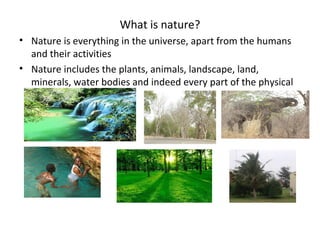
What is nature?
• Nature is everything in the universe, apart from the humans
and their activities
• Nature includes the plants, animals, landscape, land,
minerals, water bodies and indeed every part of the physical
world.
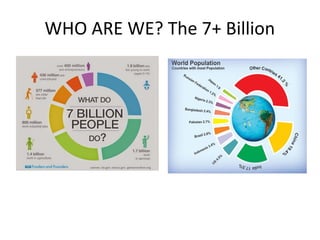
WHO ARE WE? The 7+ Billion
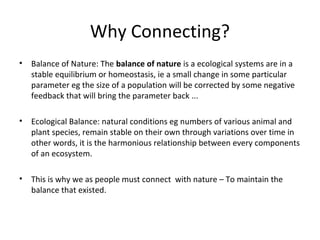
Why Connecting?
• Balance of Nature: The balance of nature is a ecological systems are in a
stable equilibrium or homeostasis, ie a small change in some particular
parameter eg the size of a population will be corrected by some negative
feedback that will bring the parameter back ...
• Ecological Balance: natural conditions eg numbers of various animal and
plant species, remain stable on their own through variations over time in
other words, it is the harmonious relationship between every components
of an ecosystem.
• This is why we as people must connect with nature – To maintain the
balance that existed.
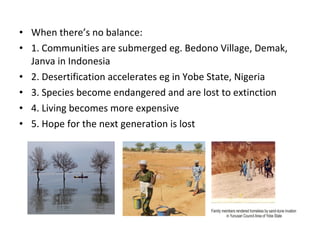
• When there’s no balance:
• 1. Communities are submerged eg. Bedono Village, Demak,
Janva in Indonesia
• 2. Desertification accelerates eg in Yobe State, Nigeria
• 3. Species become endangered and are lost to extinction
• 4. Living becomes more expensive
• 5. Hope for the next generation is lost
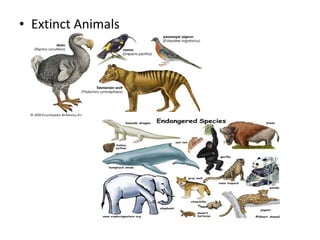
• Extinct Animals
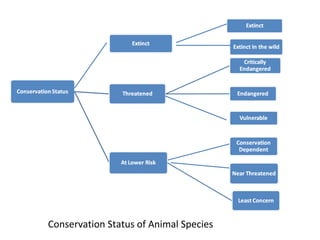
Conservation Status of Animal Species
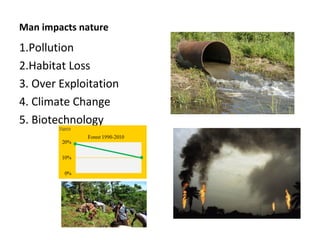
Man impacts nature
1.Pollution
2.Habitat Loss
3. Over Exploitation
4. Climate Change
5. Biotechnology
Donald Trump (Up) pulled US out of Paris
Climate Agreement and Trump Tower (Left).
• The Trump Tower is 202 m high
• 721 Fifth Avenue, New York USA
• Built 1979 – 1983 at a cost of $847 million (US)
• Has 58 floors, Covers 240 m2
• Office, Hotel, Residential.
• What is Climate and Why Climate Change?
• Climate is the "average weather condition" in a
place over a long period of time.
• It includes patterns of temperature, precipitation
(rain or snow), humidity, wind and seasons.
• Climate plays important role in shaping natural
ecosystems, and human economies including
those dependent on water generally and sea in
particular (Awmack et al., 1997).
• WHAT IS CLIMATE CHANGE?
Climate change is the statistical change in
weather patterns especially in terms of
temperature and rainfall over a prolonged
period of time which could be up to a decade
or span through millennia.
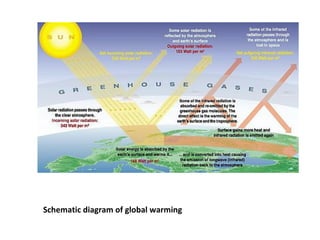
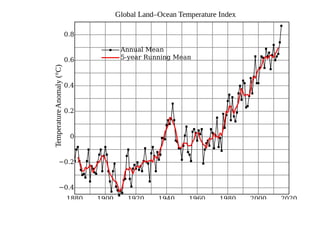
 Climate change is occurring due
to the increased presence of
carbon dioxide, methane, and
nitrous oxide which are the most
recognized “green house” gases.
 Global warming
 Unusual rainfall patterns
Schematic diagram of global warming
Effects of Climate Change on Port Environments
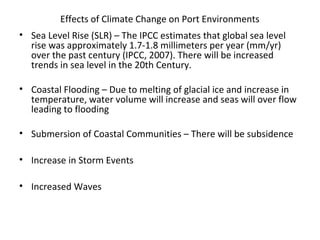
• Sea Level Rise (SLR) – The IPCC estimates that global sea level
rise was approximately 1.7-1.8 millimeters per year (mm/yr)
over the past century (IPCC, 2007). There will be increased
trends in sea level in the 20th Century.
• Coastal Flooding – Due to melting of glacial ice and increase in
temperature, water volume will increase and seas will over flow
leading to flooding
• Submersion of Coastal Communities – There will be subsidence
• Increase in Storm Events
• Increased Waves
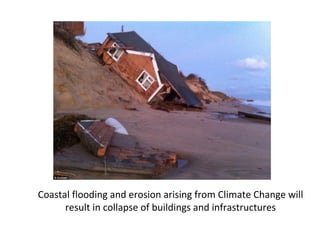
Coastal flooding and erosion arising from Climate Change will
result in collapse of buildings and infrastructures
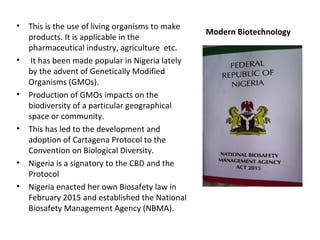
Modern Biotechnology
• This is the use of living organisms to make
products. It is applicable in the
pharmaceutical industry, agriculture etc.
• It has been made popular in Nigeria lately
by the advent of Genetically Modified
Organisms (GMOs).
• Production of GMOs impacts on the
biodiversity of a particular geographical
space or community.
• This has led to the development and
adoption of Cartagena Protocol to the
Convention on Biological Diversity.
• Nigeria is a signatory to the CBD and the
Protocol
• Nigeria enacted her own Biosafety law in
February 2015 and established the National
Biosafety Management Agency (NBMA).
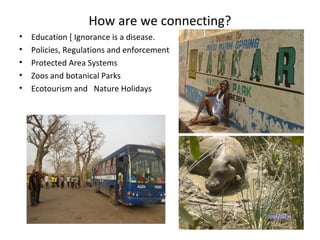
How are we connecting?
• Education [ Ignorance is a disease.
• Policies, Regulations and enforcement
• Protected Area Systems
• Zoos and botanical Parks
• Ecotourism and Nature Holidays
•THANK YOU

World environment day 2017

  • 1.
    World Environment Day2017 Federal Ministry of Environment, Surulere, Lagos, Nigeria CONNECTING PEOPLE TO NATURE Abiodun A. Denloye, PhD Associate Professor & Head, Dept of Zoology and Environmental Biology Lagos State University, Ojo, Lagos www.denloye.com twitter@AbiodunDenloye F O R T R U T H A N D S E R V IC E
  • 2.
    CONNECTING PEOPLE WITHNATURE • What is nature? • Who are we? • Why Connecting? • Who are we connecting? • Why are we connecting? • How are we connecting? • When are we connecting people with nature?
  • 3.
    What is nature? •Nature is everything in the universe, apart from the humans and their activities • Nature includes the plants, animals, landscape, land, minerals, water bodies and indeed every part of the physical world.
  • 4.
    WHO ARE WE?The 7+ Billion
  • 5.
    Why Connecting? • Balanceof Nature: The balance of nature is a ecological systems are in a stable equilibrium or homeostasis, ie a small change in some particular parameter eg the size of a population will be corrected by some negative feedback that will bring the parameter back ... • Ecological Balance: natural conditions eg numbers of various animal and plant species, remain stable on their own through variations over time in other words, it is the harmonious relationship between every components of an ecosystem. • This is why we as people must connect with nature – To maintain the balance that existed.
  • 6.
    • When there’sno balance: • 1. Communities are submerged eg. Bedono Village, Demak, Janva in Indonesia • 2. Desertification accelerates eg in Yobe State, Nigeria • 3. Species become endangered and are lost to extinction • 4. Living becomes more expensive • 5. Hope for the next generation is lost
  • 7.
  • 8.
    Conservation Status ofAnimal Species
  • 9.
    Man impacts nature 1.Pollution 2.HabitatLoss 3. Over Exploitation 4. Climate Change 5. Biotechnology
  • 10.
    Donald Trump (Up)pulled US out of Paris Climate Agreement and Trump Tower (Left). • The Trump Tower is 202 m high • 721 Fifth Avenue, New York USA • Built 1979 – 1983 at a cost of $847 million (US) • Has 58 floors, Covers 240 m2 • Office, Hotel, Residential.
  • 11.
    • What isClimate and Why Climate Change? • Climate is the "average weather condition" in a place over a long period of time. • It includes patterns of temperature, precipitation (rain or snow), humidity, wind and seasons. • Climate plays important role in shaping natural ecosystems, and human economies including those dependent on water generally and sea in particular (Awmack et al., 1997).
  • 12.
    • WHAT ISCLIMATE CHANGE? Climate change is the statistical change in weather patterns especially in terms of temperature and rainfall over a prolonged period of time which could be up to a decade or span through millennia.
  • 13.
     Climate changeis occurring due to the increased presence of carbon dioxide, methane, and nitrous oxide which are the most recognized “green house” gases.  Global warming  Unusual rainfall patterns
  • 14.
    Schematic diagram ofglobal warming
  • 16.
    Effects of ClimateChange on Port Environments • Sea Level Rise (SLR) – The IPCC estimates that global sea level rise was approximately 1.7-1.8 millimeters per year (mm/yr) over the past century (IPCC, 2007). There will be increased trends in sea level in the 20th Century. • Coastal Flooding – Due to melting of glacial ice and increase in temperature, water volume will increase and seas will over flow leading to flooding • Submersion of Coastal Communities – There will be subsidence • Increase in Storm Events • Increased Waves
  • 17.
    Coastal flooding anderosion arising from Climate Change will result in collapse of buildings and infrastructures
  • 18.
    Modern Biotechnology • Thisis the use of living organisms to make products. It is applicable in the pharmaceutical industry, agriculture etc. • It has been made popular in Nigeria lately by the advent of Genetically Modified Organisms (GMOs). • Production of GMOs impacts on the biodiversity of a particular geographical space or community. • This has led to the development and adoption of Cartagena Protocol to the Convention on Biological Diversity. • Nigeria is a signatory to the CBD and the Protocol • Nigeria enacted her own Biosafety law in February 2015 and established the National Biosafety Management Agency (NBMA).
  • 19.
    How are weconnecting? • Education [ Ignorance is a disease. • Policies, Regulations and enforcement • Protected Area Systems • Zoos and botanical Parks • Ecotourism and Nature Holidays
  • 20.