Environmental Problems
and Their Causes
Population, Resources,
Environmental Degradation,
and Pollution
What is The
“Environment”?
 Environment - all external
conditions and factors (living and
non-living) that affects all
organisms
What is The
“Environment”?
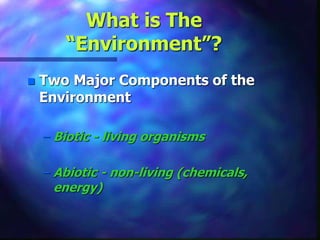
 Two Major Components of the
Environment
– Biotic - living organisms
– Abiotic - non-living (chemicals,
energy)
What is “Environmental
Science”?
 Environmental Science - the study
of how we and other species
interact with one another and with
the abiotic environment of matter
and energy
Sustainable Living
 All life on earth depends on two
forms of capital:
– Solar Capital - energy from sun
– Earth Capital - air, water, soil wildlife,
minerals, natural recycling
Sustainable Living
 The “Environment” is comprised of
solar and earth capital
 Sustainability - the ability of a
system to survive for some
specified (finite) time
Sustainable Living
 Sustainable Society - a society that
manages its economy and
population size without depleting
earth capital and thereby
jeopardizing the prospects of
current and future generations of
humans and other species
Sustainable Living
 Sustainable Living - living off the
income without depleting the
capital that supplies the income
– $1 million capital @ 10% annual
interest = $100,000 annual income
Growth and Wealth Gap
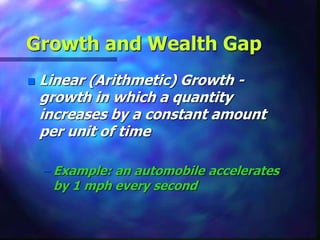
 Linear (Arithmetic) Growth -
growth in which a quantity
increases by a constant amount
per unit of time
– Example: an automobile accelerates
by 1 mph every second
Growth and Wealth Gap
 Exponential (Geometric) Growth -
growth in which a quantity
increases by a fixed percentage of
the whole per unit of time
– Example: an automobile doubles its
speed very second (1, 2, 4, 8, 16, …)
Growth and Wealth Gap
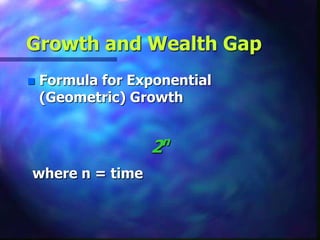
 Formula for Exponential
(Geometric) Growth
2n
where n = time
Growth and Wealth Gap
 Doubling Time - the time it takes
for a quantity growing
exponentially to double
– Rule of 70
– Doubling Time = 70 ÷ percentage
growth rate
Growth and Wealth Gap
 Example of Doubling Time
– Annual global population growth rate
= 1.47%
– 70/1.47 = 48 years
– Population will double in 48 years
Growth and Wealth Gap
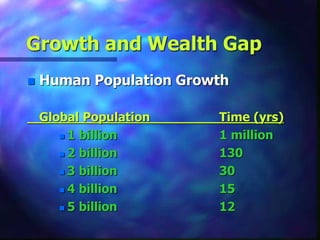
 Human Population Growth
Global Population Time (yrs)
 1 billion 1 million
 2 billion 130
 3 billion 30
 4 billion 15
 5 billion 12
Growth and Wealth Gap
 Environmental Impacts of
Exponential Human Population
Growth
– 73% of the habitable area of the
earth has been altered by human
activities
Growth and Wealth Gap
 Economic Growth
– An increase in the ability of an
economy to provide goods and
services
– The increase in the real value of all
final goods and services produced by
an economy
Growth and Wealth Gap
 Gross National Product - market
value in current dollars of all goods
and services produced by an
economy for final use during a year
– Increasing GNP indicates economic
growth
Growth and Wealth Gap
 Economic growth achieved by
increasing throughput of matter
and energy resources used to
produced goods and services
 Increased throughput achieved
through population growth and/or
increased consumption per person
Growth and Wealth Gap
 Per Capita GNP - GNP divided by
total population
 United Nations Classification of
World’s Countries
– Developed (MDCs)
– Developing (LDCs)
Growth and Wealth Gap
 MDCs
– 20% world’s population
– Highly industrialized
– High per capita GNP (>$4,000)
– 85% of world’s wealth
– Consume 88% of world’s natural
resources
Growth and Wealth Gap
 MDCs
– Generate 75% of world’s pollution
– U.S., Germany, Japan account for >
50% of world’s economic output
Growth and Wealth Gap
 LDCs
– 80% world’s population
– Low to moderately industrialized
– Low to moderate per capita GNP
– 15 to 20% of world’s wealth
– Consume 12% of world’s natural
resources
Growth and Wealth Gap
 LDCs
– Account for 9 of every 10 babies born
– Account for 98% of all infant and
childhood deaths
– 1 million people added every 4 days
– 35% of population is under age 15
Growth and Wealth Gap
 Development - change from a
society that is rural, agricultural,
illiterate, and poor with a rapidly
growing urban population to one
that is mostly urban, industrial,
educated, and wealthy
Growth and Wealth Gap
 The Wealth Gap
– Widening gap since 1960
– Environmental Impacts
 High population growth rates
 Widespread urbanization
 Resource depletion
 Famine (~20 million people annually)
Resources and Environmental
Degradation
 Resource - anything we get from
our environment to meet our needs
and wants
 Classification of Resources
– Renewable
– Potentially Renewable
– Nonrenewable
Resources and Environmental
Degradation
 Renewable Resource - a resource
that is virtually inexhaustible on a
human time scale
Resources and Environmental
Degradation
 Potentially Renewable Resource - a
resource that can be replenished
fairly rapidly (hours to decades)
through natural processes
– Sustainable Yield - the highest rate at
which a potentially renewable resource
can be used without reducing its
available supply
Resources and Environmental
Degradation
 Potentially Renewable Resource - a
resource that can be replenished
fairly rapidly (hours to decades)
through natural processes
– Environmental Degradation - depletion
or destruction of a potentially
renewable resource by using it faster
than it is naturally replenished
Use Renewal
Sustainable Yield
 The Sustainable Yield “Teeter-
Totter”
Environmental
Degradation
Renewal
Use
Resources and Environmental
Degradation
 Nonrenewable Resource - a
resource that exists in a fixed
amount in various places in the
earth’s crust and has the potential
for renewal only by geological,
physical, and chemical processes
taking place over hundreds of
millions to billions of years
Resources and Environmental
Degradation
 Nonrenewable Resource
– Economical Depletion - occurs when
the cost of exploiting the resource
exceeds it economic value
Resources and Environmental
Degradation
 Nonrenewable Resource
– Options to deal with economical
depletion
 Recycling
 Reuse
 Waste less
 Use less
 Develop a substitute
Resources and Environmental
Degradation
 Nonrenewable Resource
– Recycling - collecting and processing a
resource into new products
– Reuse - using a resource over and over
in the same form
Pollution
 Pollution - an undesirable change in
the characteristics of air, water,
soil, food that can adversely affect
health, survival, and activities of
living organisms
Pollution
 Sources of Pollution
– Point Sources
– Non-point Sources
Pollution
 Factors Determining the
Harmfulness of Pollutants
– Chemical Nature
– Concentration
– Persistence
Pollution
 Solutions to Pollution
– Input Pollution Control
 Pollution prevention strategy based on:
– Reduce
– Reuse
– Recycle
Pollution
 Solutions to Pollution
– Output Pollution Control
 Pollution cleanup strategy
 Problems:
– Often a temporary bandage
– Removes pollutant from one area and transfers
it to another area
– Often too expensive to reduce pollutants to
acceptable levels

Environmental problems and there cause

  • 1.
    Environmental Problems and TheirCauses Population, Resources, Environmental Degradation, and Pollution
  • 2.
    What is The “Environment”? Environment - all external conditions and factors (living and non-living) that affects all organisms
  • 3.
    What is The “Environment”? Two Major Components of the Environment – Biotic - living organisms – Abiotic - non-living (chemicals, energy)
  • 4.
    What is “Environmental Science”? Environmental Science - the study of how we and other species interact with one another and with the abiotic environment of matter and energy
  • 5.
    Sustainable Living  Alllife on earth depends on two forms of capital: – Solar Capital - energy from sun – Earth Capital - air, water, soil wildlife, minerals, natural recycling
  • 6.
    Sustainable Living  The“Environment” is comprised of solar and earth capital  Sustainability - the ability of a system to survive for some specified (finite) time
  • 7.
    Sustainable Living  SustainableSociety - a society that manages its economy and population size without depleting earth capital and thereby jeopardizing the prospects of current and future generations of humans and other species
  • 8.
    Sustainable Living  SustainableLiving - living off the income without depleting the capital that supplies the income – $1 million capital @ 10% annual interest = $100,000 annual income
  • 9.
    Growth and WealthGap  Linear (Arithmetic) Growth - growth in which a quantity increases by a constant amount per unit of time – Example: an automobile accelerates by 1 mph every second
  • 10.
    Growth and WealthGap  Exponential (Geometric) Growth - growth in which a quantity increases by a fixed percentage of the whole per unit of time – Example: an automobile doubles its speed very second (1, 2, 4, 8, 16, …)
  • 11.
    Growth and WealthGap  Formula for Exponential (Geometric) Growth 2n where n = time
  • 12.
    Growth and WealthGap  Doubling Time - the time it takes for a quantity growing exponentially to double – Rule of 70 – Doubling Time = 70 ÷ percentage growth rate
  • 13.
    Growth and WealthGap  Example of Doubling Time – Annual global population growth rate = 1.47% – 70/1.47 = 48 years – Population will double in 48 years
  • 14.
    Growth and WealthGap  Human Population Growth Global Population Time (yrs)  1 billion 1 million  2 billion 130  3 billion 30  4 billion 15  5 billion 12
  • 15.
    Growth and WealthGap  Environmental Impacts of Exponential Human Population Growth – 73% of the habitable area of the earth has been altered by human activities
  • 16.
    Growth and WealthGap  Economic Growth – An increase in the ability of an economy to provide goods and services – The increase in the real value of all final goods and services produced by an economy
  • 17.
    Growth and WealthGap  Gross National Product - market value in current dollars of all goods and services produced by an economy for final use during a year – Increasing GNP indicates economic growth
  • 18.
    Growth and WealthGap  Economic growth achieved by increasing throughput of matter and energy resources used to produced goods and services  Increased throughput achieved through population growth and/or increased consumption per person
  • 19.
    Growth and WealthGap  Per Capita GNP - GNP divided by total population  United Nations Classification of World’s Countries – Developed (MDCs) – Developing (LDCs)
  • 20.
    Growth and WealthGap  MDCs – 20% world’s population – Highly industrialized – High per capita GNP (>$4,000) – 85% of world’s wealth – Consume 88% of world’s natural resources
  • 21.
    Growth and WealthGap  MDCs – Generate 75% of world’s pollution – U.S., Germany, Japan account for > 50% of world’s economic output
  • 22.
    Growth and WealthGap  LDCs – 80% world’s population – Low to moderately industrialized – Low to moderate per capita GNP – 15 to 20% of world’s wealth – Consume 12% of world’s natural resources
  • 23.
    Growth and WealthGap  LDCs – Account for 9 of every 10 babies born – Account for 98% of all infant and childhood deaths – 1 million people added every 4 days – 35% of population is under age 15
  • 24.
    Growth and WealthGap  Development - change from a society that is rural, agricultural, illiterate, and poor with a rapidly growing urban population to one that is mostly urban, industrial, educated, and wealthy
  • 25.
    Growth and WealthGap  The Wealth Gap – Widening gap since 1960 – Environmental Impacts  High population growth rates  Widespread urbanization  Resource depletion  Famine (~20 million people annually)
  • 26.
    Resources and Environmental Degradation Resource - anything we get from our environment to meet our needs and wants  Classification of Resources – Renewable – Potentially Renewable – Nonrenewable
  • 27.
    Resources and Environmental Degradation Renewable Resource - a resource that is virtually inexhaustible on a human time scale
  • 28.
    Resources and Environmental Degradation Potentially Renewable Resource - a resource that can be replenished fairly rapidly (hours to decades) through natural processes – Sustainable Yield - the highest rate at which a potentially renewable resource can be used without reducing its available supply
  • 29.
    Resources and Environmental Degradation Potentially Renewable Resource - a resource that can be replenished fairly rapidly (hours to decades) through natural processes – Environmental Degradation - depletion or destruction of a potentially renewable resource by using it faster than it is naturally replenished
  • 30.
    Use Renewal Sustainable Yield The Sustainable Yield “Teeter- Totter”
  • 31.
  • 32.
    Resources and Environmental Degradation Nonrenewable Resource - a resource that exists in a fixed amount in various places in the earth’s crust and has the potential for renewal only by geological, physical, and chemical processes taking place over hundreds of millions to billions of years
  • 33.
    Resources and Environmental Degradation Nonrenewable Resource – Economical Depletion - occurs when the cost of exploiting the resource exceeds it economic value
  • 34.
    Resources and Environmental Degradation Nonrenewable Resource – Options to deal with economical depletion  Recycling  Reuse  Waste less  Use less  Develop a substitute
  • 35.
    Resources and Environmental Degradation Nonrenewable Resource – Recycling - collecting and processing a resource into new products – Reuse - using a resource over and over in the same form
  • 36.
    Pollution  Pollution -an undesirable change in the characteristics of air, water, soil, food that can adversely affect health, survival, and activities of living organisms
  • 37.
    Pollution  Sources ofPollution – Point Sources – Non-point Sources
  • 38.
    Pollution  Factors Determiningthe Harmfulness of Pollutants – Chemical Nature – Concentration – Persistence
  • 39.
    Pollution  Solutions toPollution – Input Pollution Control  Pollution prevention strategy based on: – Reduce – Reuse – Recycle
  • 40.
    Pollution  Solutions toPollution – Output Pollution Control  Pollution cleanup strategy  Problems: – Often a temporary bandage – Removes pollutant from one area and transfers it to another area – Often too expensive to reduce pollutants to acceptable levels