The Multidisciplinary Nature
Of Environmental Studies
Environment science
Unit-1
What is Environment?
Environment is sum total of water, air and land interrelationships
among themselves and also with the human being, other living
organisms and property”.
Scope of Environmental Science
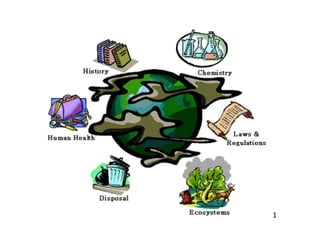
Environmental science is a multidisciplinary science whose basic aspects
have a direct relevance to every section of the society. Its main aspects
are:
• Conservation of nature and natural resources.
• Conservation of biological diversity.
• Control of environmental pollution.
• Stabilization of human population and environment.
• Social issues in relation to development and environment.
• Development of non-polluting renewable energy system and providing
new
dimension to nation’s security.
1
Importance of Environment Science
Environment belongs to all the living beings and
thus is, important for all.
Issues in ES:
• Global warming,
• Depletion of ozone layer,
• Dwindling forest,
• Energy resources,
• Loss of global biodiversity
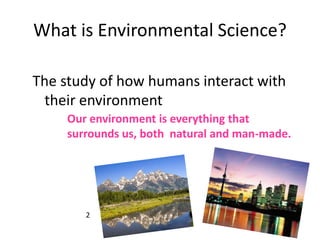
What is Environmental Science?
The study of how humans interact with
their environment
Our environment is everything that
surrounds us, both natural and man-made.
2
Environment: the total of our
surroundings
• All the things around us with which
we interact:
• Living things
• Animals, plants, forests, fungi, etc.
• Nonliving things
• Continents, oceans, clouds, soil, rocks
• Our built environment
• Buildings, human-created living centers
• Social relationships and institutions
3
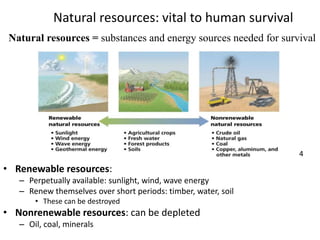
Natural resources: vital to human survival
• Renewable resources:
– Perpetually available: sunlight, wind, wave energy
– Renew themselves over short periods: timber, water, soil
• These can be destroyed
• Nonrenewable resources: can be depleted
– Oil, coal, minerals
Natural resources = substances and energy sources needed for survival
4
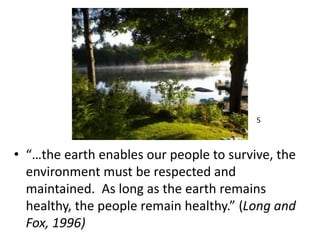
• “…the earth enables our people to survive, the
environment must be respected and
maintained. As long as the earth remains
healthy, the people remain healthy.” (Long and
Fox, 1996)
5
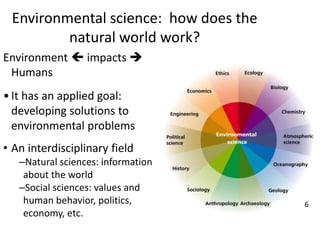
Environmental science: how does the
natural world work?
Environment  impacts 
Humans
•It has an applied goal:
developing solutions to
environmental problems
• An interdisciplinary field
–Natural sciences: information
about the world
–Social sciences: values and
human behavior, politics,
economy, etc.
6
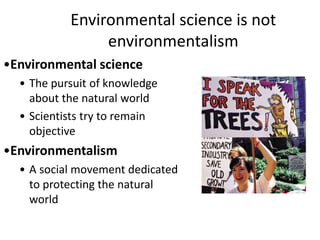
Environmental science is not
environmentalism
•Environmental science
• The pursuit of knowledge
about the natural world
• Scientists try to remain
objective
•Environmentalism
• A social movement dedicated
to protecting the natural
world
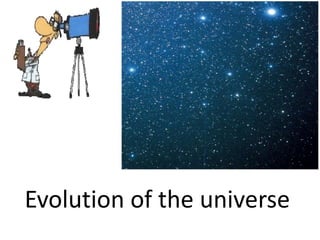
Evolution of the universe
Cosmology
• Cosmology: The study of the origin, present
structure, evolution, and destiny of the
universe
• Two basic models
– Steady state
– Evolutionary
Three Theories about the Origin of the
Universe
• Big Bang Theory – Edwin Hubble
• Steady State Theory – Herman Bondi,
Fred Hoyle and Thomas Gold
• Oscillating Universe Theory – Fred Hoyle
1. The Big Bang Theory
• The universe started from very hot and dense fire
ball also known as YLEM that explodes. Bringing
streams of gases containing proton, neutron, and
electron to immerse in the vast ocean of
radiation. After the explosion, the ylem cooled
and contract giving birth to the universe.
• The universe that exist today is a product of
continuous expansion and contraction. The
expansion still continues and the distance
between galaxies continue to increase.
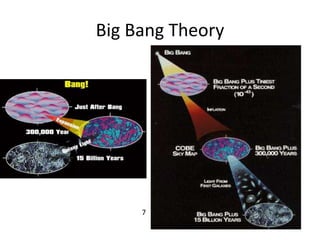
Big Bang Image
• Just released-2008: Scientists have
revealed image showing earliest
moments of infant universe (next
slide)…
Big Bang Theory
7
Two Evidences Supporting the BBT
• 1. The Law of
Conservation of
Matter and Energy
• Matter or energy is
neither created nor
destroyed it can
only be
transformed into
another form.
• 2. The Law of the Expanding
Universe.
• Edwin Hubble and Milton
Humason were able to
determine at which galaxies
are moving away from each
other.
• 55 km per million parsec =
the rate by which galaxies
are moving.
Big Bang Events
• The infant universe rapidly expanded (inflation)
• One-millionth of a second: Four forces emerge (gravity,
electromagnetism, strong and weak)
• In the first few seconds electrons, protons, and neutrons
formed
• Within minutes, the first hydrogen formed. Hydrogen was the
original element. Some helium and other trace elements were
also created
• 300,000 years: Cosmic Background Radiation emerges
• 300 million years later, matter sprung from energy
(decoupled) forming stars and galaxies
• The universe has been expanding ever since
• The universe consists of 74% hydrogen, 24% helium, and 2%
trace elements
• The velocity of the universe’s expansion is increasing due to
dark energy
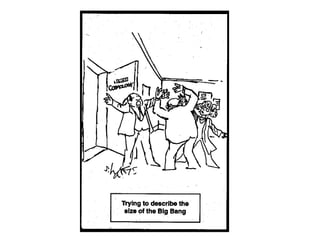
Cartoon
Open or Closed Universe
• Two variations of the Big Bang exist, the open
and closed universe
• The determinant for closure is the amount of
matter in the universe
• The gravity exerted by matter can halt the
universe’s expansion
• This is one reason why dark matter is an
important topic
Open Universe?
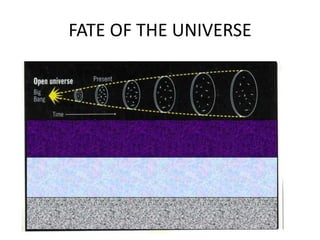
• Open Universe: The universe will expand
outward forever. Eventually the universe will
fade away into a cold, dark void
– Flat Universe: Universe will neither expand forever
or collapse. Eventually expansion will stop (critical
density)
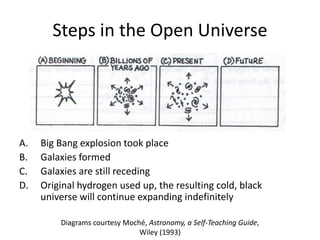
Steps in the Open Universe
A. Big Bang explosion took place
B. Galaxies formed
C. Galaxies are still receding
D. Original hydrogen used up, the resulting cold, black
universe will continue expanding indefinitely
Diagrams courtesy Moché, Astronomy, a Self-Teaching Guide,
Wiley (1993)
Closed Universe?
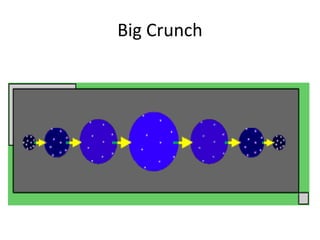
• Closed Universe: In the closed universe, the
universe will eventually stop expanding and
begin to contract. The universe will fall back
together into a Big Crunch
– Oscillating Universe: Idea that a new universe is
created after each Big Bang and Crunch. The
universe may expand and contract eternally
creating new universes each time
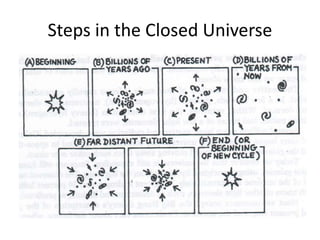
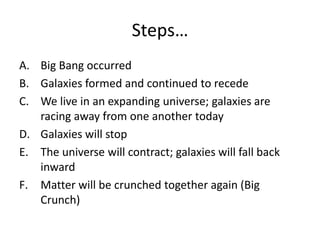
Steps in the Closed Universe
Steps…
A. Big Bang occurred
B. Galaxies formed and continued to recede
C. We live in an expanding universe; galaxies are
racing away from one another today
D. Galaxies will stop
E. The universe will contract; galaxies will fall back
inward
F. Matter will be crunched together again (Big
Crunch)
Our Universe is Expanding
• In the 1920’s, Edwin Hubble discovered that galaxies
were moving away from us when he observed the red
shift in light wavelengths emitted by galaxies.
• This is known as Hubble’s law which states that the
further away a galaxy is, the greater it’s red shift and the
faster it is moving away from us. This led to the
calculation of the point where the Big Bang started.
• Today with the Hubble Space Telescope scientists have
observed that most of the galaxies are moving away from
us and this means that our universe must be moving
outwards and expanding.
• Vesto Slipher = He studied the spectrum
of light emitted by 15 nearby galaxies
and noticed that the wavelength of the
spectrum shifted to the red indicating
that it is moving away.
2. Steady State Theory
• This theory proposes that the Universe is the same
everywhere and for all time, both in the past and in
the future. But calculations suggest that the
universe is still expanding, so in order to maintain
this constant state, matter must constantly be
created out of nothing.
• A steady-state universe has no beginning or end in
time; and from any point within it the view on the
grand scale--i.e., the average density and
arrangement of galaxies--is the same
Evidence Supporting the SST
• Robert Dicke – the sky is filled with
radiation that was formed during the
birth of the universe.
• Wilson and Penzias – detected the
presence of radiation in the form of radio
sounds.
3. Oscillating Universe Theory
• Most astronomers agree that the Universe
is expanding.
• Some believe that at some stage in the
future, the Universe will stop expanding
and begin to contract.
• This is what is meant by oscillating which is
the forward and backwards motion of the
expansion and contraction of the Universe.
Big Crunch
Theories About the Possible Fate of the
Universe
• 1. Open Universe
• 2. Close Universe
• 3. Flat Universe
Theories About the Possible Fate of the
Universe
• 1. Open Universe
• 2. Close Universe
• 3. Flat Universe
• Big Bang theory
• Oscillating
Universe
• Steady State
FATE OF THE UNIVERSE
Design of the Universe
• Galaxy - basic unit
the universe is made
of.
• Galaxy is made up of
billions of stars.
Evolution of the universe
• The very earliest universe was so hot, or energetic, that
initially no (matter) particles existed or could exist (except
perhaps in the most fleeting sense), and the forces we see
around us today were believed to be merged into
one unified force. Space-time itself expanded during an
inflationary epoch due to the immensity of the energies
involved. Gradually the immense energies cooled – still to a
temperature inconceivably hot compared to any we see
around us now, but sufficiently to allow forces to gradually
undergo symmetry breaking, a kind of repeated
condensation from one status quo to another, leading
finally to the separation of the strong force from
the electroweak force and the first particles.
Expanding Universe
• Any model of the universe must explain its
expansion
• The universe appears to be expanding
• The light from distant galaxies appears to be
red shifted due to this expansion
• Hubble’s Law: The further away a galaxy is, the
greater its redshift is and the faster it is flying
away from us
We are not the center
• Galaxies appear to be flying away from our
position
• Observers in other parts of the universe would
make similar observations
• Our corner of space isn’t special, and the laws
of nature are the same everywhere in the
universe
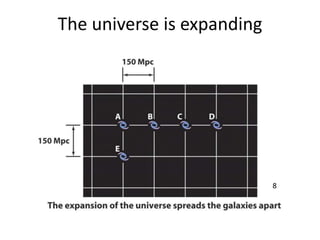
The universe is expanding
8
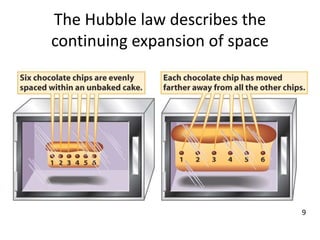
The Hubble law describes the
continuing expansion of space
9
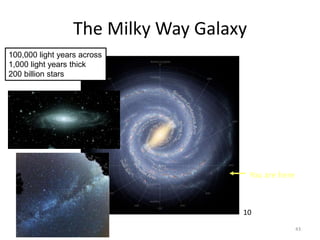
The Milky Way Galaxy
43
100,000 light years across
1,000 light years thick
200 billion stars
You are here
10
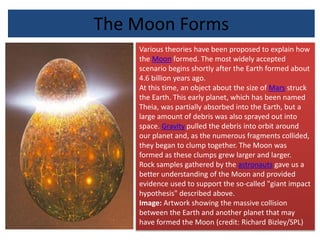
The Moon Forms
Various theories have been proposed to explain how
the Moon formed. The most widely accepted
scenario begins shortly after the Earth formed about
4.6 billion years ago.
At this time, an object about the size of Mars struck
the Earth. This early planet, which has been named
Theia, was partially absorbed into the Earth, but a
large amount of debris was also sprayed out into
space. Gravity pulled the debris into orbit around
our planet and, as the numerous fragments collided,
they began to clump together. The Moon was
formed as these clumps grew larger and larger.
Rock samples gathered by the astronauts gave us a
better understanding of the Moon and provided
evidence used to support the so-called "giant impact
hypothesis" described above.
Image: Artwork showing the massive collision
between the Earth and another planet that may
have formed the Moon (credit: Richard Bizley/SPL)
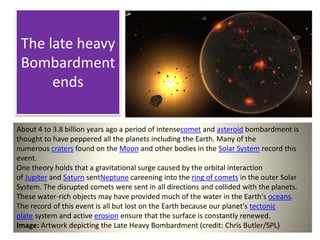
The late heavy
Bombardment
ends
About 4 to 3.8 billion years ago a period of intensecomet and asteroid bombardment is
thought to have peppered all the planets including the Earth. Many of the
numerous craters found on the Moon and other bodies in the Solar System record this
event.
One theory holds that a gravitational surge caused by the orbital interaction
of Jupiter and Saturn sentNeptune careening into the ring of comets in the outer Solar
System. The disrupted comets were sent in all directions and collided with the planets.
These water-rich objects may have provided much of the water in the Earth's oceans.
The record of this event is all but lost on the Earth because our planet's tectonic
plate system and active erosion ensure that the surface is constantly renewed.
Image: Artwork depicting the Late Heavy Bombardment (credit: Chris Butler/SPL)
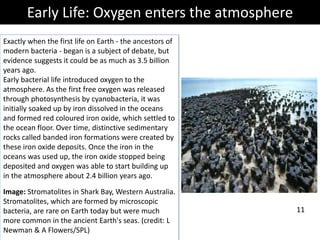
Early Life: Oxygen enters the atmosphere
Exactly when the first life on Earth - the ancestors of
modern bacteria - began is a subject of debate, but
evidence suggests it could be as much as 3.5 billion
years ago.
Early bacterial life introduced oxygen to the
atmosphere. As the first free oxygen was released
through photosynthesis by cyanobacteria, it was
initially soaked up by iron dissolved in the oceans
and formed red coloured iron oxide, which settled to
the ocean floor. Over time, distinctive sedimentary
rocks called banded iron formations were created by
these iron oxide deposits. Once the iron in the
oceans was used up, the iron oxide stopped being
deposited and oxygen was able to start building up
in the atmosphere about 2.4 billion years ago.
Image: Stromatolites in Shark Bay, Western Australia.
Stromatolites, which are formed by microscopic
bacteria, are rare on Earth today but were much
more common in the ancient Earth's seas. (credit: L
Newman & A Flowers/SPL)
11
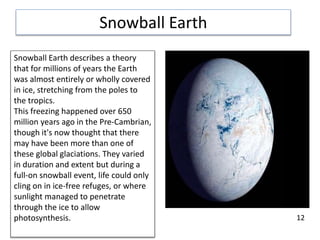
Snowball Earth
Snowball Earth describes a theory
that for millions of years the Earth
was almost entirely or wholly covered
in ice, stretching from the poles to
the tropics.
This freezing happened over 650
million years ago in the Pre-Cambrian,
though it's now thought that there
may have been more than one of
these global glaciations. They varied
in duration and extent but during a
full-on snowball event, life could only
cling on in ice-free refuges, or where
sunlight managed to penetrate
through the ice to allow
photosynthesis. 12
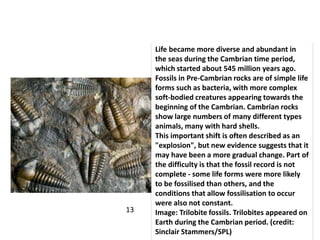
Life became more diverse and abundant in
the seas during the Cambrian time period,
which started about 545 million years ago.
Fossils in Pre-Cambrian rocks are of simple life
forms such as bacteria, with more complex
soft-bodied creatures appearing towards the
beginning of the Cambrian. Cambrian rocks
show large numbers of many different types
animals, many with hard shells.
This important shift is often described as an
"explosion", but new evidence suggests that it
may have been a more gradual change. Part of
the difficulty is that the fossil record is not
complete - some life forms were more likely
to be fossilised than others, and the
conditions that allow fossilisation to occur
were also not constant.
Image: Trilobite fossils. Trilobites appeared on
Earth during the Cambrian period. (credit:
Sinclair Stammers/SPL)
13
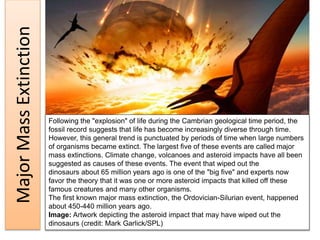
MajorMassExtinction
Following the "explosion" of life during the Cambrian geological time period, the
fossil record suggests that life has become increasingly diverse through time.
However, this general trend is punctuated by periods of time when large numbers
of organisms became extinct. The largest five of these events are called major
mass extinctions. Climate change, volcanoes and asteroid impacts have all been
suggested as causes of these events. The event that wiped out the
dinosaurs about 65 million years ago is one of the "big five" and experts now
favor the theory that it was one or more asteroid impacts that killed off these
famous creatures and many other organisms.
The first known major mass extinction, the Ordovician-Silurian event, happened
about 450-440 million years ago.
Image: Artwork depicting the asteroid impact that may have wiped out the
dinosaurs (credit: Mark Garlick/SPL)
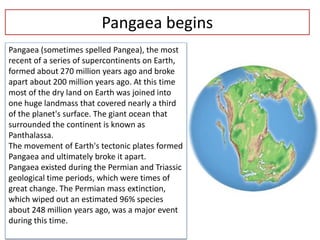
Pangaea begins
Pangaea (sometimes spelled Pangea), the most
recent of a series of supercontinents on Earth,
formed about 270 million years ago and broke
apart about 200 million years ago. At this time
most of the dry land on Earth was joined into
one huge landmass that covered nearly a third
of the planet's surface. The giant ocean that
surrounded the continent is known as
Panthalassa.
The movement of Earth's tectonic plates formed
Pangaea and ultimately broke it apart.
Pangaea existed during the Permian and Triassic
geological time periods, which were times of
great change. The Permian mass extinction,
which wiped out an estimated 96% species
about 248 million years ago, was a major event
during this time.
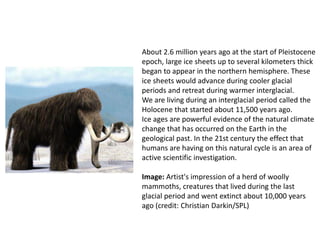
About 2.6 million years ago at the start of Pleistocene
epoch, large ice sheets up to several kilometers thick
began to appear in the northern hemisphere. These
ice sheets would advance during cooler glacial
periods and retreat during warmer interglacial.
We are living during an interglacial period called the
Holocene that started about 11,500 years ago.
Ice ages are powerful evidence of the natural climate
change that has occurred on the Earth in the
geological past. In the 21st century the effect that
humans are having on this natural cycle is an area of
active scientific investigation.
Image: Artist's impression of a herd of woolly
mammoths, creatures that lived during the last
glacial period and went extinct about 10,000 years
ago (credit: Christian Darkin/SPL)
Future Earth
What will happen to the Earth? We tend to worry about issues like climate change that can have
an impact over periods of time comparable to an average human lifetime.
For the Earth, however, the biggest changes generally happen over hundreds of millions or
billions of years. Supercontinents come and go, mass extinction wipe out almost all life, and
changes in the surrounding Solar System have an impact.
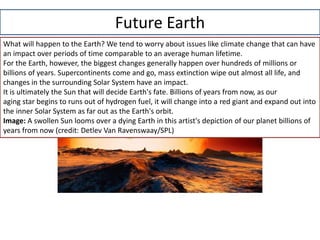
It is ultimately the Sun that will decide Earth's fate. Billions of years from now, as our
aging star begins to runs out of hydrogen fuel, it will change into a red giant and expand out into
the inner Solar System as far out as the Earth's orbit.
Image: A swollen Sun looms over a dying Earth in this artist's depiction of our planet billions of
years from now (credit: Detlev Van Ravenswaay/SPL)
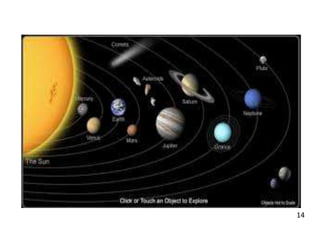
The
Solar System
Our solar system
• Most of the material in the cloud that formed our sun
ended up in the sun
– Chemical elements in sun similar to elements in universe
• Some material ended up in the nebular disk around
the sun
– Formed planets, moon, asteroids, comets
• This material was different in chemical composition
– Elements that were contained in dust and ice formed
planets
• Gasses not retained by sun were largely lost
– Exception is some of the large, gassy outer planets
14
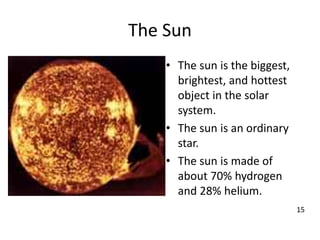
The Sun
• The sun is the biggest,
brightest, and hottest
object in the solar
system.
• The sun is an ordinary
star.
• The sun is made of
about 70% hydrogen
and 28% helium.
15
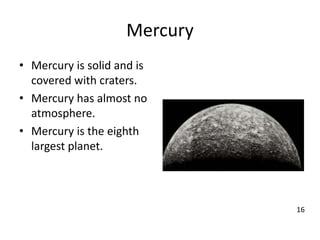
Mercury
• Mercury is solid and is
covered with craters.
• Mercury has almost no
atmosphere.
• Mercury is the eighth
largest planet.
16
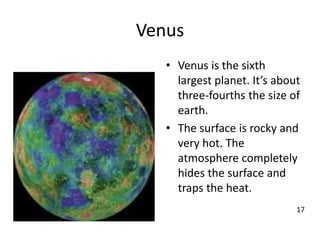
Venus
• Venus is the sixth
largest planet. It’s about
three-fourths the size of
earth.
• The surface is rocky and
very hot. The
atmosphere completely
hides the surface and
traps the heat.
17
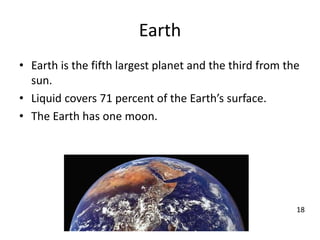
Earth
• Earth is the fifth largest planet and the third from the
sun.
• Liquid covers 71 percent of the Earth’s surface.
• The Earth has one moon.
18
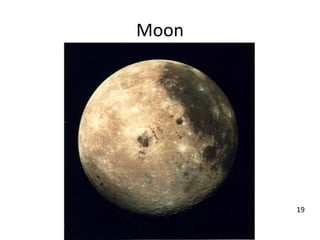
Moon
19
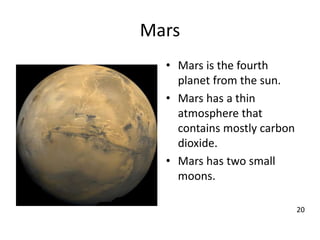
Mars
• Mars is the fourth
planet from the sun.
• Mars has a thin
atmosphere that
contains mostly carbon
dioxide.
• Mars has two small
moons.
20
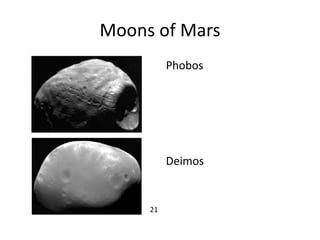
Moons of Mars
Phobos
Deimos
21
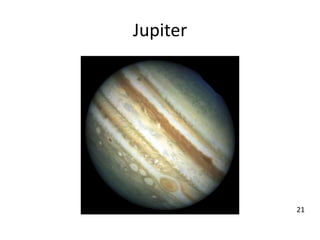
Jupiter
21
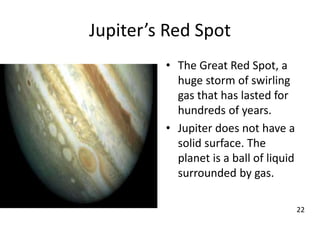
Jupiter’s Red Spot
• The Great Red Spot, a
huge storm of swirling
gas that has lasted for
hundreds of years.
• Jupiter does not have a
solid surface. The
planet is a ball of liquid
surrounded by gas.
22
Moons of Jupiter
Jupiter has four large Galilean moons, twelve
smaller named moons and twenty-three more
recently discovered but not named moons.
We’ll take a look at the four large Galilean
moons which were first observed by Galileo in
1610.
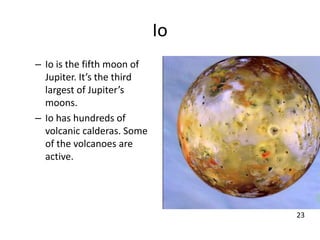
Io
– Io is the fifth moon of
Jupiter. It’s the third
largest of Jupiter’s
moons.
– Io has hundreds of
volcanic calderas. Some
of the volcanoes are
active.
23
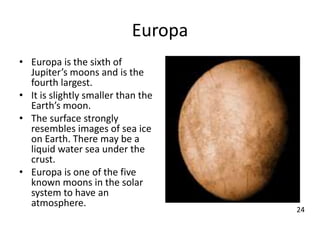
Europa
• Europa is the sixth of
Jupiter’s moons and is the
fourth largest.
• It is slightly smaller than the
Earth’s moon.
• The surface strongly
resembles images of sea ice
on Earth. There may be a
liquid water sea under the
crust.
• Europa is one of the five
known moons in the solar
system to have an
atmosphere.
24
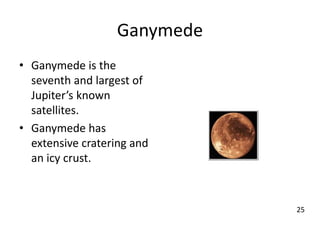
Ganymede
• Ganymede is the
seventh and largest of
Jupiter’s known
satellites.
• Ganymede has
extensive cratering and
an icy crust.
25
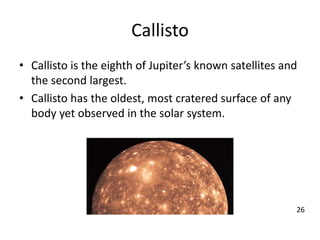
Callisto
• Callisto is the eighth of Jupiter’s known satellites and
the second largest.
• Callisto has the oldest, most cratered surface of any
body yet observed in the solar system.
26
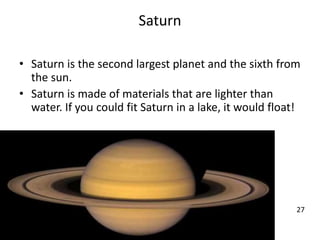
Saturn
• Saturn is the second largest planet and the sixth from
the sun.
• Saturn is made of materials that are lighter than
water. If you could fit Saturn in a lake, it would float!
27
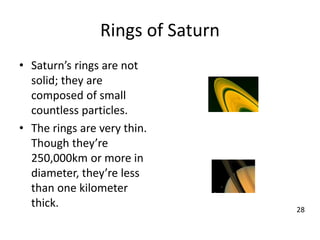
Rings of Saturn
• Saturn’s rings are not
solid; they are
composed of small
countless particles.
• The rings are very thin.
Though they’re
250,000km or more in
diameter, they’re less
than one kilometer
thick. 28
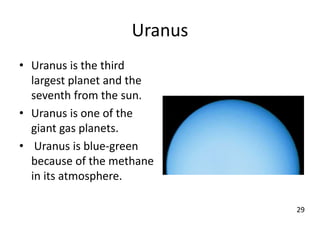
Uranus
• Uranus is the third
largest planet and the
seventh from the sun.
• Uranus is one of the
giant gas planets.
• Uranus is blue-green
because of the methane
in its atmosphere.
29
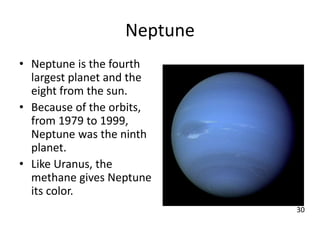
Neptune
• Neptune is the fourth
largest planet and the
eight from the sun.
• Because of the orbits,
from 1979 to 1999,
Neptune was the ninth
planet.
• Like Uranus, the
methane gives Neptune
its color.
30
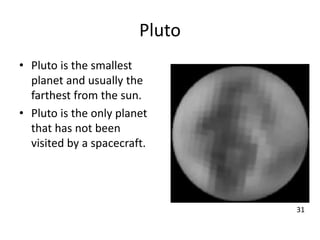
Pluto
• Pluto is the smallest
planet and usually the
farthest from the sun.
• Pluto is the only planet
that has not been
visited by a spacecraft.
31
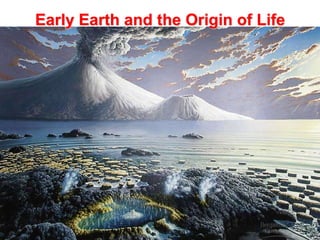
Early Earth and the Origin of Life
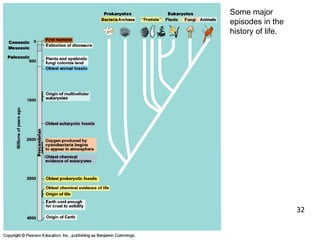
Some major
episodes in the
history of life.
32
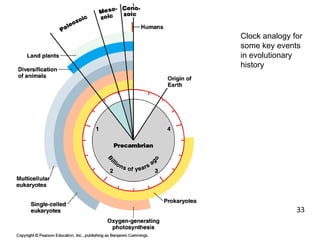
Clock analogy for
some key events
in evolutionary
history
33
1. The earth was formed ~4.5 billion years ago
2. It took ~500 million years for the crust to solidify.
3. The oldest fossils of microorganisms
• 3.5 billion years old,
• embedded in rocks in western Australia
Prokaryotes dominated from 3.5 to 2 billion years ago.
- During this time, the first divergence occurred:
Bacteria and Archae
The Nature of Life
• Life
– During last 4 by adapted to many environments and physico-
chemical conditions
– Most organisms live at 1 atm and 0-40oC; Some Bacteria can
live up to 1400 atm or -18 to 104oC
– Unicellular Organisms vs Non Living Molecules (Amino acids,
RNA (ribonucleic acid)
• reproduction
• growth via nutrients and energy
• responds to outside stimuli
• Share same genetic code
• chemical uniformity
– C, O, H, N, P >> nucleic acids, proteins, carbohydrates, fats
The Nature of Life
• Prokaryote vs. Eukaryote
– small (1-10 um) vs large (10-100um)
– No nucleus vs Nucleus
– DNA in nucleoid vs Membrane bounded nucleus
containing chromosomes made of DNA, RNA
– Cell division direct (binary fission) vs mitosis and
miosis
– Rare multicellular forms vs Multicellular organism
with extensive development of tissues
Building Blocks: Pattern shared by all life
• All Life: DNA => RNA => Protein
• DNA architect plans for building (instructions to build
proteins in the ribosome) transcribes information into
RNA (Blueprint)
• RNA messenger translates blueprint into proteins in the
ribosomes
• Genes code for specific proteins (enzymes)
• Enzymes are proteins that control all chemical reactions
• Order of nitrogenous bases (read in groups of 3) {A, T, C,
G} determines the type of proteins made
• Each group of 3 codes for a specific amino acid
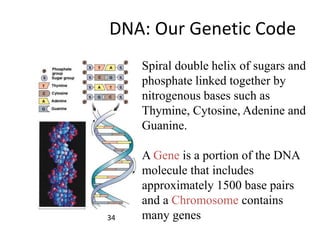
DNA: Our Genetic Code
Spiral double helix of sugars and
phosphate linked together by
nitrogenous bases such as
Thymine, Cytosine, Adenine and
Guanine.
A Gene is a portion of the DNA
molecule that includes
approximately 1500 base pairs
and a Chromosome contains
many genes34
The Origin of Life
• 19th Century Ideas
– life created supernaturally
• cannot be proven scientifically
– continually being formed by spontaneous
generation of nonliving matter
• untenable by numerous experiments
• 20th Century
– life generated spontaneously and evolved
through different steps
The Origin of Life
• Origin of life is NOT an event
• Origin of life is a continuous process
• Stages
– inorganic production of key simple organic molecules
– production of more complex molecules that can synthesize more
of the same molecule
– development of a genetic code of self-replicating molecules
(RNA,DNA,proteins)
– production of the first cell by separation of these codes from the
outer world by a membrane
• Ocean environment by 4.0 by- fossils evident at 3.8by
The Origin of Life
• Many complex organic molecules must have
formed before an organism produced
• The process of life took many steps over the first
600 my
• Probability theory would dictate that at least one
random event would have produced a result
• This process cannot occur on Earth today because
the simple organism would be destroyed by
oxidation or predation
Steps in the Origin of Life
• Aerobic vs. Anaerobic
– oxygen poisons living cells so early life was anaerobic
• Lack of free Oxygen >> No Ozone layer
– UV radiation kills cells so life had to originate at depth
– Water depths of 10m or more
• Models
– non-oxidizing secondary atmosphere rich in the
constituent chemicals for life--H2O, CO2, N
– Energy in the form of UV radiation & Hot springs
Steps in Origin of Life
• Before the first cell>>Chemical Evolution
– production of significant molecules necessary for life
• Phosphoric acid crucial to cell chemistry>> phosphoric acid
can bond molecules and promote long chain molecule
formation
• Amino acids formed first since they do not form if oxygen
present
– probably formed on clay surfaces since they are attractive and
absorptive, also protection from UV
• Larger Molecules
– amino acids are linked together by dehydration synthesis (water
loss), clays have potential to absorb water, thus amino acids could
be linked on clay surfaces
The origin of life
• First cells may have originated by chemical evolution involving
4 steps:
a. Abiotic (Non-biological) synthesis of small organic molecules
(monomers)  C + H = organic molecule
b. Monomers joined together to form polymers (proteins, nucleic
acids)
c. Origin of self-replicating molecules (inheritance of traits) 
proteins and polynucleic acids
d. Packaging of these organic molecules into protobionts. 
Aggregates of abiotically produced molecules that maintain an
internal chemical environment and exhibit some of the
properties associated with life (i.e. metabolism, excitability).
2. Evidence that supports the four-stage hypothesis for the
origin of life
a. Oparin and Haldane in the 1920s  Abiotic synthesis of
organic molecules is testable in the laboratory
Hypothesis: Conditions on primitive earth favored chemical
reactions that synthesized organic compounds from inorganic
precursors. These conditions were different from what is now
present and include:
- Reducing environment (no oxygen, but instead H2O, CH4,
NH4, and H2) = lots of free electrons that could be used to
reduce carbon and produce organic molecules.
- Energy from lots of lightning, UV radiation (no O2 to block
UV rays from the sun) and volcanic activity (heat).
Experimental Studies
• A. I. Oparin- 1930s
– Produced sugars and fatty acids from the constituents of an
early atmosphere
• Urey and Miller- 1953
– Production of cyanide, formaldehyde and 4 different amino
acids from water vapor, methane, hydrogen and ammonia and
electrical sparks
• Subsequent Experiments
– Production of 18 of the 20 known amino acids and extremely
simple forms of DNA from gases rich in water vapor, CO2, and
nitrogen and UV radiation
– S.W. Fox (1959) produced protein-like (protenoids) chains from
a mixture of 18 amino acids at 70oC in the presence of
phosphoric acid
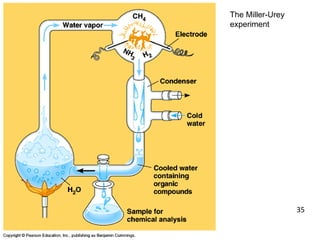
Miller and Urey in 1953
Tested the Oparin-Haldane hypothesis by creating
conditions in which there was an
- Atmosphere above warmed sea water that
contained H2O, H2, CH4, and NH3 and
- Electrodes that simulated lightning.
- From this setup, they obtained organic
compounds such as amino acids that were
collected in cooled water.
The Miller-Urey
experiment
35
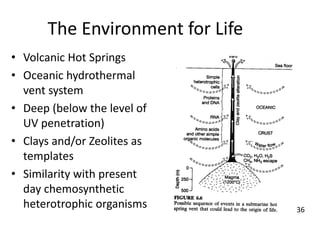
The Environment for Life
• Volcanic Hot Springs
• Oceanic hydrothermal
vent system
• Deep (below the level of
UV penetration)
• Clays and/or Zeolites as
templates
• Similarity with present
day chemosynthetic
heterotrophic organisms 36
The First Cells
• All cells use the same genetic code
• Archaeobacteria- most primitive
– Heterotrophs: obtain energy from surroundings by some
chemical reaction
– Obtain energy by converting CO2 and H2 to CH4 or by the
reduction of sulfur compounds
• Eubacteria
– 10 Phyla, including cyanobacteria (Autotrophs: manufacture
their own food source)
• First Cells poorly developed metabolic systems
– absorbed nutrients directly
– fermentation
Life
• Prokaryota
– Appear 3.8-3.6 by
– no nucleus
– single loop chromosome with all genes
– reproduction-binary fission
• Eukaryota
– Single cell appear 2 by
– Multicellular appear as trace fossils 1by and as body fossils
700my
– Nucleus with 2 pairs of chromosomes (2 copies of all genes)
– Asexual and SEXUAL reproduction>> more combinations
RNA was probably the first hereditary material
Today, genetic information is usually stored as
DNA, but some organisms such as viruses use
RNA to store info.
Atmosphere Of The Primitive Earth
• First Atmosphere
• Composition - Probably H2, He
• These gases are relatively rare on Earth compared to
other places in the universe and were probably lost to
space early in Earth's history because
– Earth's gravity is not strong enough to hold lighter gases
– Earth still did not have a differentiated core (solid
inner/liquid outer core) which creates Earth's magnetic
field (magnetosphere = Van Allen Belt) which deflects solar
winds.
• Once the core differentiated the heavier gases could be
retained
Second Atmosphere
• Produced by volcanic out gassing. Gases produced
were probably similar to those created by modern
volcanoes (H2O, CO2, SO2, CO, S2, Cl2, N2, H2) and
NH3 (ammonia) and CH4 (methane)
• No free O2 at this time (not found in volcanic gases).
• Ocean Formation - As the Earth cooled, H2O produced
by out gassing could exist as liquid in the Early Archean,
allowing oceans to form.
– Evidence - pillow basalts, deep marine seds in greenstone
belts.
37
Addition of O2 to the Atmosphere
• Today, the atmosphere is ~21% free oxygen. How did oxygen
reach these levels in the atmosphere? Revisit the oxygen
cycle: Oxygen Production
– Photochemical dissociation - breakup of water molecules by
ultraviolet
• Produced O2 levels approx. 1-2% current levels
• At these levels O3 (Ozone) can form to shield Earth surface from UV
– Photosynthesis - CO2 + H2O + sunlight = organic compounds + O2 -
produced by cyanobacteria, and eventually higher plants -
supplied the rest of O2 to atmosphere.
• Oxygen Consumers
– Chemical Weathering - through oxidation of surface materials
(early consumer)
– Animal Respiration (much later)
– Burning of Fossil Fuels (much, much later)
Abiotic component
• In ecology and biology, abiotic
components or abiotic factors are those non-
living chemical and physical parts of
the environment that affect ecosystems.
• In biology, abiotic factors can include water, light,
radiation, temperature, humidity, atmosphere,
and soil. The macroscopic climate often
influences each of the above. Pressure and sound
waves may also be considered in the context of
marine or sub-terrestrial environments
• Light
• Light energy (sunlight) is the primary source of energy
in nearly all ecosystems. It is the energy that is used by
green plants (which contain chlorophyll) during the
process of photosynthesis; a process during which
plants manufacture organic substances by combining
inorganic substances. Visible light is of the greatest
importance to plants because it is necessary for
photosynthesis.
• Water
• Plant and animal habitats vary from entirely aquatic
environments to very dry deserts. Water is essential for
life and all organisms depend on it to survive
• Atmospheric gases:
• The most important gases used by plants and
animals are oxygen, carbon dioxide and
nitrogen.
• Oxygen: Oxygen is used by all living organisms
during respiration.
• Carbon Dioxide: Carbon dioxide is used by
green plants during photosynthesis.
• Nitrogen: Nitrogen is made available to plants
by certain bacteria and through the action of
lightning.
An Environmental Balance
Environmental balance
• The balance of nature is a theory that proposes
that ecological systems are usually in a stable
equilibrium (homeostasis), which is to say that a
small change in some particular parameter (the
size of a particular population, for example) will
be corrected by some negative feedback that will
bring the parameter back to its original "point of
balance" with the rest of the system.
• It may apply where populations depend on each
other, for example in predator/prey systems.
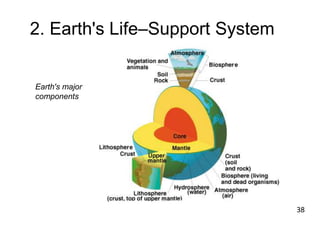
Earth's major
components
2. Earth's Life–Support System
38
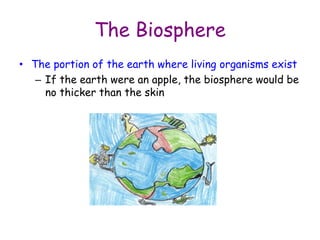
The Biosphere
• The portion of the earth where living organisms exist
– If the earth were an apple, the biosphere would be
no thicker than the skin
The Biosphere
• Ecosystem: a place where plants and animals
are dependent upon one another for survival
– Destroying one portion upsets the system
Atmosphere
• The troposphere
– Surface to 17 km (11 miles) up
– Contains most of the oxygen and
nitrogen
• The stratosphere
– 17 to 48 km up
– Contains most of the O3
– Screens out all UV-C
– Screens out most UV-B
– Screens out some UV-A
The Atmosphere
• Effects of air pollution
– Difficulty breathing
– Global warming
– Ozone depletion
– Acid rain chemicals in air pollution mix with
precipitation
Hydrosphere
• All the water on the earth
– Liquid water
• Surface
• underground
– Ice
• Polar ice
• Icebergs
• Ice in frozen soil
– Water vapor in the atmosphere
The Hydrosphere
• Water management
– Conservation: careful use of resources so they are
not wasted
– Irrigation: collecting water and distributing it to
crops
– Avoid polluting water supply
Lithosphere
• Crust and upper mantle
– Contains all fossil fuels
– Contains all usable minerals
– Contains all nutrients for plant life
The Lithosphere
• Topsoil
– Carried away by wind
– Erosion
– Deforestation
– Water washes away soil
• Can be avoided by terracing
• Crop rotation
• fertilizers
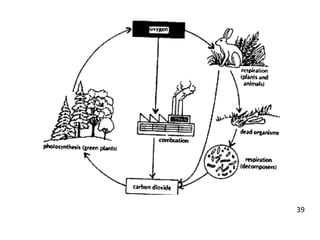
Balance in oxygen and carbon dioxide in air
Carbon-Oxygen Cycle
• Involves the processes of respiration and
photosynthesis.
• In respiration, oxygen and glucose are combined
releasing energy and producing water and carbon
dioxide.
• In photosynthesis water and carbon dioxide along with
the energy from the sun are combined to produce
glucose (containing energy) and oxygen.
• Each process compliments the other and the ecosystem
maintains its balanced communities.
39
THERMAL: HEAT BALANCE OF EARTH
• Thermal balance occurs when the sum of all
the different types of heat flow into and out of
a building is zero. That is, the building is losing
as much heat as it gains so it can be said to be
in equilibrium.
• Here the building is the earth.
The Heat Budget
• Incoming heat being absorbed by the Earth, and
outgoing heat escaping the Earth in the form of
radiation are both perfectly balanced. If they were not
balanced, then Earth would be getting either
progressively warmer or progressively cooler with each
passing year. This balance between incoming and
outgoing heat is known as Earth’s heat budget.
• While on average, Earth’s heat budget is balanced, the
interactions that take place as heat and
electromagnetic radiation interact with Earth and its
many objects, oceans, and atmosphere are complex.
Over all they balance out, however, some places are
hotter or cooler day in and day out.
40
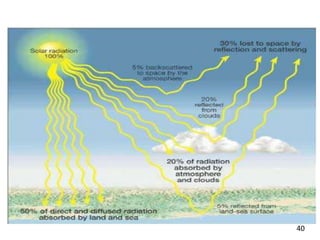
• The heat is absorbed and passed around throughout the
many different parts of our planet. Remember that almost
all of the heat on Earth was originally created by the Sun.
This electromagnetic energy travels towards the Earth at
light speed in the form of ultraviolet radiation, visible light,
and infrared radiation. When this energy reaches the Earth,
immediately 30% of it bounces off, being reflected back out
into space. The ability to reflect the light and radiation of
the Sun is known as an object’s albedo. Because the Earth
reflects 30% of the light that hits it, it is said that the Earth
has an albedo of 30. In contrast, our moon has an albedo of
11. This means that if you were standing on the Moon
looking up at the Earth, our planet would appear almost 3
times brighter than looking at the Moon from Earth.
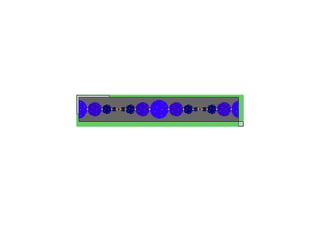
• Because 30% of the electromagnetic energy from the Sun
has been reflected away, only 70% remains to interact with
the Earth and warm it up. 20% of the energy from the Sun is
absorbed by the atmosphere as a whole heating it up. This
leaves 50% of the Sun’s energy to heat both the surface of
the Earth as well as the oceans, lakes and streams.
Balance In Predator And Prey
Population
Predation
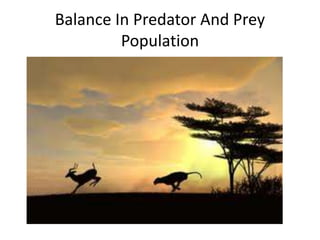
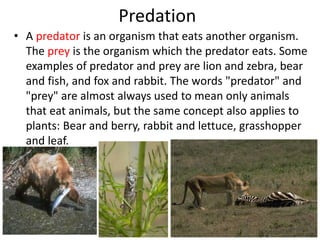
• A predator is an organism that eats another organism.
The prey is the organism which the predator eats. Some
examples of predator and prey are lion and zebra, bear
and fish, and fox and rabbit. The words "predator" and
"prey" are almost always used to mean only animals
that eat animals, but the same concept also applies to
plants: Bear and berry, rabbit and lettuce, grasshopper
and leaf.
Balance In Predator And Prey
Population
• Predator and prey evolve together. The prey is part of the
predator's environment, and the predator dies if it does not
get food, so it evolves whatever is necessary in order to eat
the prey: speed, stealth, camouflage (to hide while
approaching the prey), a good sense of smell, sight, or
hearing (to find the prey), immunity to the prey's poison,
poison (to kill the prey) the right kind of mouth parts or
digestive system, etc. Likewise, the predator is part of the
prey's environment, and the prey dies if it is eaten by the
predator, so it evolves whatever is necessary to avoid being
eaten: speed, camouflage (to hide from the predator), a
good sense of smell, sight, or hearing (to detect the
predator), thorns, poison (to spray when approached or
bitten), etc.
• Ecosystems are complex. And predators are a necessary and beneficial
part of natural systems. If we remove them from the picture, there are
consequences.
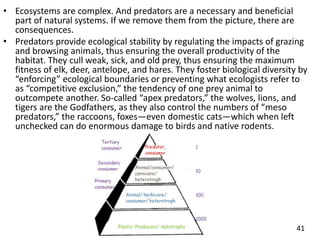
• Predators provide ecological stability by regulating the impacts of grazing
and browsing animals, thus ensuring the overall productivity of the
habitat. They cull weak, sick, and old prey, thus ensuring the maximum
fitness of elk, deer, antelope, and hares. They foster biological diversity by
“enforcing” ecological boundaries or preventing what ecologists refer to
as “competitive exclusion,” the tendency of one prey animal to
outcompete another. So-called “apex predators,” the wolves, lions, and
tigers are the Godfathers, as they also control the numbers of “meso
predators,” the raccoons, foxes—even domestic cats—which when left
unchecked can do enormous damage to birds and native rodents.
41
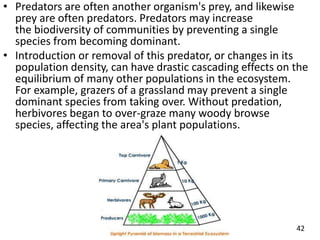
• Predators are often another organism's prey, and likewise
prey are often predators. Predators may increase
the biodiversity of communities by preventing a single
species from becoming dominant.
• Introduction or removal of this predator, or changes in its
population density, can have drastic cascading effects on the
equilibrium of many other populations in the ecosystem.
For example, grazers of a grassland may prevent a single
dominant species from taking over. Without predation,
herbivores began to over-graze many woody browse
species, affecting the area's plant populations.
42
•If a predator overhunts its prey, the prey population will lower to
numbers that are too scarce for the predators to find. This will cause
the predator population to dip, decreasing the predation pressure on
the prey population. The decrease in predators will allow the small
number of prey left to slowly increase their population to somewhere
around their previous abundance, which will allow the predator
population to increase in response to the greater availability of
resources. If a predator hunts its prey species to numbers too low to
sustain the population in the short term, they can cause not only the
extinction or extirpation of the prey but also the extinction of their
own species, a phenomenon known as co extinction.
• An alternative prey species would help to lift some of the predation
pressure from the initial prey species, giving the population a chance
to recover, however it does not guarantee that the initial prey species
will be able to recover as the initial prey population may have been
hunted to below sustainable numbers or to complete extinction.
References
• Images:
1. https://lh4.ggpht.com/o1QdRYfikiKcGlVvBdzqQuVFt_o0Pq3ZvmuGuVLj6RAf1-
5Q7ALBavTxQaP7FqUXj5WY0A=s93
2. https://lh5.ggpht.com/ZMM4Or8oOY5P7UWLRXLHIXKERVz69HzfVDKMZXYlJMcDutAktAXWJypxs
6hTIHkM-HkhEwE=s101
3. https://lh5.ggpht.com/MHMd6uM2BunX1zCNUtYWW4rPHsVFs_-T6cd4vpeHYoTvKWZxq0-
LiHP8Z_wJ04LficdwqN0=s113
4. https://lh4.ggpht.com/cwj1dUvO5cKsF4boo5nkOwWhuNarmliLj19l8_5FDK9lnLpzQMhxVJ38K1nx
uJEoDuXIEw=s170
5. https://lh3.ggpht.com/-
m8QpdiAOCTTjqEN3iBLp64VyC2tFGOGrJN_OTiWCbccFdX6EXY9sxy4gcQpz7TqwX-PDQ=s113
6. https://www.google.im/search?sa=G&q=environmental+science&tbm=isch&tbs=simg:CAQSYxph
CxCo1NgEGgAMCxCwjKcIGjwKOggCEhS1FvAhqBauFu4hzhfZDMYWzRXAFhogmACHcJ06WDDBf1
miVFjC1W3aURWfrBW6C4i2unhIH2AMCxCOrv4IGgoKCAgBEgR4M0EcDA&ei=t96kVLnuBMbkuQS
njICYCg&ved=0CBkQwg4oAA&biw=1198&bih=606
7. https://lh3.ggpht.com/jQME8EY-
YIYlSeGqF_PmpSvyO8WTTZGjWKbRFX3ay8Z8glZBBsCOLybWQKXDjgm0An8n=s85
8. https://lh6.ggpht.com/ZpzkHd6HZLGjISa6woIafSpBJA9zXkVaKLFQj-
nBdQ52h6MeYYjpy4oWOkMTTJGyQd5qjg=s170
9. https://lh5.ggpht.com/gEuWfOet370MkEnp4uBVxDQatvapbTcg6Gkkw3ueARbqleWN3t8D7PE3z9
XWWpH58hKsZvM=s170
10. https://lh5.ggpht.com/kFjXQcbqfRqqqjVKW__aHiNTZwo7iKGnO3-
xm2R_Iw1CEPlPqp7eNkGTcrIBgUqnDOAxbw=s85
11. https://www.google.im/search?sa=G&q=earliest+life+forms&tbm=isch&tbs=simg:CAQSZxplCxCo1NgEGgQIAAgD
DAsQsIynCBo8CjoIAhIUzyH-
J6oU_1BOwCM0h4ibKCuIn_1ycaIGZ_1sSok6jnKzEbFnJrSKiUdQwOnllaTzCtDgYz3nwmKDAsQjq7-CBoKCggIARIE-
Oq25gw&ei=iN-kVKTCHIifugTT94CYCg&ved=0CBkQwg4oAA&biw=1198&bih=606
12. https://lh6.ggpht.com/ornrploCQByzkcMVop1iiAcybL6kRdxO1bFB6QtbMnqeNJL_SynmvT_j_7kkd_FltYTlQjI=s15
1
13. https://lh5.ggpht.com/5-
wy4LF12SXjCx2BWusJuhlLztJZS3uz9ZWNuju8PSmwvGIbKD6gTBS41xx9aCUQQ8FCkMI=s151
14. https://lh4.ggpht.com/ZYmidiXIltqBAfQodooFsmiwf9sCSb8T-XfnZAqkiAjnhVidmTY68uHgwzxffRvsKEf1pw=s150
15. https://lh6.ggpht.com/eJM_hiuDOeYKzECsQm8ewGGsG1EpowxkDTgA73MdYz-
Hmu7ROsmVG72V76AOY_KPeKhnhg=s107
16. https://lh3.ggpht.com/FNUsrIhj05ZxacOliH9Sp2dJyLJu-z31x_Oi3LEzy75eaaCQkdcJ4wnvZjpxCg5LIfd8Ww=s168
17. https://lh5.ggpht.com/_t4wtTkeH7gQ2f-
spt_Jnc29AXOp3akfj10dYOeNcfRX18I1mxwS8KtdBbDi6W94RR2Emy4=s85
18. https://lh6.ggpht.com/_N77xeXcMw5JsTPOzOqKjMJpYgRT6wFeguTrk8tUnNIHajNY7mlXcrg3z-
6RIQfYXc57qw=s170
19. https://lh4.ggpht.com/b7CrAcv4bVTrRocMBZTJptEOMO5fkMJIn09AFVJYvQwG0m0oIp3aeJWJACUDZO9F5cGyCg
=s85
20. https://lh3.ggpht.com/GAGUYY2yRGJnZY4k3gVwuvOyaPcRZqPHOLqnS6MJcNILYcFmLrAqrLqITUvEIZtwwZejbA=s
85
21. https://lh6.ggpht.com/6jDjmSSDErwBRqGKLUWIPIxi8JoqslruanRSMIX2srIfXEpDTs9_iOHgPOpSCW1i9oVO0Cg=s1
22
22. https://lh4.ggpht.com/AU-kD_uPxGy_S34YjT-
ii7mGneeRCzQDZK4cr8KO0H1Vng3_jqNE1wlGAQ2CpnAfmFrUlg=s85
23. https://lh3.ggpht.com/ZTzasSTykGyQesFeAdxmpARO-g7SUWiHoovpYxNR_AcKiyNFOX41wWcZEGT05jQd_m-
4Ow=s160
24. https://lh5.ggpht.com/SW2ybxbfECIHh8gzguKY4Ar5-
PGuZp_WzJ3QNKUNMR219J3AuBOJtn8mUxGGCnNXlbGBWVg=s88
25. https://lh5.ggpht.com/mCAkQKdYpqHYcXO6ArJD8XYx2PBbnzHHqT0kkitCKqKzvk4lY0BXcWx3W7aDIfrTyKtvrw=s8
5
26. https://lh3.ggpht.com/XEmBZ1Jc2lb8zn3ZK_q3V5W6OS1hgtvslFSIonyITmefdNf19dPRWXaF7LUjhOqoEv2YjA=s85
27. https://lh3.ggpht.com/FPoIvsMz8jbg1VOQiJRfgTyCUmvFuA2ekO6qlPUutVbA_qflPXLmIzKaKGerYPozfRkBk-0=s170
28. https://lh3.ggpht.com/dXwJpxDxIbMiZU72UnfITuy8gU2lOJf55PfChMY-1lyuVZ7B33bbUOj1WaCmxcvOjKYloQ=s110
29. https://lh6.ggpht.com/Qsk2ZFTTr39zid-w-SIb-5Cm1SVfWOSgdy9Nlu6mxyS0nU2sZlbB1SNHDvP3tJUK3hQU5w=s152
30. https://lh5.ggpht.com/QnttBVNF1RrQNuciWWXdZJrG2pcCUdgU9B7uUmlFrXrPKbPY19XmN4sDKumMS0ICVxqEanE=s
85
31. https://lh4.ggpht.com/MaAD0aj-xHaEhhvLjIdLZkbNuPFFgc1tup-BMBh0rIGHJSdkxDpBbh4VFtIdodgq7H9m=s85
32. https://lh3.ggpht.com/j2Nvrgrzxsr73B1m335BJPIqaWr6It9qycb6PRMd7f3x7zwRsZ8tv3cvi1w87jAlKK3a7Q=s85
33. https://lh5.ggpht.com/8cDjNOx7WV3pWDrrqVbp-y2y5y5io6jDzSBaQ_RrNTUNmvdcFe7EcaJZ8X8e6MSE7vk2jA=s85
34. https://lh6.ggpht.com/c-6bw3DCoLlFeB9tHW_RfZ53qiheU6XB_Xvg7F6x0gVY-MlKMHh3TqTbW8JDpByX_5Toqg=s85
35. https://lh6.ggpht.com/KgHW-8GA_gIglkFd7driq8PXmaxlV4tgqoKebqnYtFgyelh95NyovtsiD-M5e9R_ZpOKBbo=s85
36. https://lh6.ggpht.com/ZVD3vMSJAZIHEMd6lSePUK1gBzxV5ARr2zFG07aYrxsjVKGZ_VmpnTG-uUYWiAY_5szLPw=s85
37. https://lh4.ggpht.com/uEEbv5iT3wglplgK557g-vyvEWTa9SDf7_Mbhap-lXqJiskCR_TB9i_goh0vG-nm-zViOA=s150
38. https://lh3.ggpht.com/4BGkWzDAXrVe48pYz0GXuez9RbrTF7e5dm7KMVkcaZQM2nhnOmWka8J8w4b3hA_w-
PSPCcI=s95
39. https://lh5.ggpht.com/tN2RVmDzs6bBIo6fb96YRQxEbt70swuBsgpaXmpBQeQVT3Bai3jhry5bGuxWHSVI_II0FQ=s114
40. https://lh3.ggpht.com/1Ulqb618Gd-Srg9lpZrk9ZA9alOUiJKnrKDcKLDxA9Li8_rivhYgnchIQkkLiXs2fK6pGQg=s97
41. https://lh6.ggpht.com/zQZOMfjB7JAlGNy3xWI4HSCy62q2DzyXBbUrMXYYPO_1-t2rbR6qaN19eetjRpXRgwSdpw=s91
42. https://lh5.ggpht.com/zKTFsjLgLZgmftx8hRgBEj1bjjOhOjEN2G430d3WGBkP-ibYGwmanus5-6M55MeTxSNNqA=s100
Books/Resources:
Environmental Studies by R. Rajgopalan
Environment and Ecology by Dr. Gourkrishna Dasmohapatra
www.space.com/56-our-solar-system-facts-formation-and-discovery.html
www.fair-center.eu/public/what...at.../evolution-of-the-universe.html

B sc micro, biotech, biochem i es u 1

  • 1.
    The Multidisciplinary Nature OfEnvironmental Studies Environment science Unit-1
  • 2.
    What is Environment? Environmentis sum total of water, air and land interrelationships among themselves and also with the human being, other living organisms and property”. Scope of Environmental Science Environmental science is a multidisciplinary science whose basic aspects have a direct relevance to every section of the society. Its main aspects are: • Conservation of nature and natural resources. • Conservation of biological diversity. • Control of environmental pollution. • Stabilization of human population and environment. • Social issues in relation to development and environment. • Development of non-polluting renewable energy system and providing new dimension to nation’s security.
  • 3.
  • 4.
    Importance of EnvironmentScience Environment belongs to all the living beings and thus is, important for all. Issues in ES: • Global warming, • Depletion of ozone layer, • Dwindling forest, • Energy resources, • Loss of global biodiversity
  • 5.
    What is EnvironmentalScience? The study of how humans interact with their environment Our environment is everything that surrounds us, both natural and man-made. 2
  • 6.
    Environment: the totalof our surroundings • All the things around us with which we interact: • Living things • Animals, plants, forests, fungi, etc. • Nonliving things • Continents, oceans, clouds, soil, rocks • Our built environment • Buildings, human-created living centers • Social relationships and institutions 3
  • 7.
    Natural resources: vitalto human survival • Renewable resources: – Perpetually available: sunlight, wind, wave energy – Renew themselves over short periods: timber, water, soil • These can be destroyed • Nonrenewable resources: can be depleted – Oil, coal, minerals Natural resources = substances and energy sources needed for survival 4
  • 8.
    • “…the earthenables our people to survive, the environment must be respected and maintained. As long as the earth remains healthy, the people remain healthy.” (Long and Fox, 1996) 5
  • 9.
    Environmental science: howdoes the natural world work? Environment  impacts  Humans •It has an applied goal: developing solutions to environmental problems • An interdisciplinary field –Natural sciences: information about the world –Social sciences: values and human behavior, politics, economy, etc. 6
  • 10.
    Environmental science isnot environmentalism •Environmental science • The pursuit of knowledge about the natural world • Scientists try to remain objective •Environmentalism • A social movement dedicated to protecting the natural world
  • 11.
  • 12.
    Cosmology • Cosmology: Thestudy of the origin, present structure, evolution, and destiny of the universe • Two basic models – Steady state – Evolutionary
  • 13.
    Three Theories aboutthe Origin of the Universe • Big Bang Theory – Edwin Hubble • Steady State Theory – Herman Bondi, Fred Hoyle and Thomas Gold • Oscillating Universe Theory – Fred Hoyle
  • 14.
    1. The BigBang Theory • The universe started from very hot and dense fire ball also known as YLEM that explodes. Bringing streams of gases containing proton, neutron, and electron to immerse in the vast ocean of radiation. After the explosion, the ylem cooled and contract giving birth to the universe. • The universe that exist today is a product of continuous expansion and contraction. The expansion still continues and the distance between galaxies continue to increase.
  • 15.
    Big Bang Image •Just released-2008: Scientists have revealed image showing earliest moments of infant universe (next slide)…
  • 17.
  • 18.
    Two Evidences Supportingthe BBT • 1. The Law of Conservation of Matter and Energy • Matter or energy is neither created nor destroyed it can only be transformed into another form. • 2. The Law of the Expanding Universe. • Edwin Hubble and Milton Humason were able to determine at which galaxies are moving away from each other. • 55 km per million parsec = the rate by which galaxies are moving.
  • 19.
    Big Bang Events •The infant universe rapidly expanded (inflation) • One-millionth of a second: Four forces emerge (gravity, electromagnetism, strong and weak) • In the first few seconds electrons, protons, and neutrons formed • Within minutes, the first hydrogen formed. Hydrogen was the original element. Some helium and other trace elements were also created • 300,000 years: Cosmic Background Radiation emerges • 300 million years later, matter sprung from energy (decoupled) forming stars and galaxies • The universe has been expanding ever since • The universe consists of 74% hydrogen, 24% helium, and 2% trace elements • The velocity of the universe’s expansion is increasing due to dark energy
  • 20.
  • 21.
    Open or ClosedUniverse • Two variations of the Big Bang exist, the open and closed universe • The determinant for closure is the amount of matter in the universe • The gravity exerted by matter can halt the universe’s expansion • This is one reason why dark matter is an important topic
  • 22.
    Open Universe? • OpenUniverse: The universe will expand outward forever. Eventually the universe will fade away into a cold, dark void – Flat Universe: Universe will neither expand forever or collapse. Eventually expansion will stop (critical density)
  • 23.
    Steps in theOpen Universe A. Big Bang explosion took place B. Galaxies formed C. Galaxies are still receding D. Original hydrogen used up, the resulting cold, black universe will continue expanding indefinitely Diagrams courtesy Moché, Astronomy, a Self-Teaching Guide, Wiley (1993)
  • 24.
    Closed Universe? • ClosedUniverse: In the closed universe, the universe will eventually stop expanding and begin to contract. The universe will fall back together into a Big Crunch – Oscillating Universe: Idea that a new universe is created after each Big Bang and Crunch. The universe may expand and contract eternally creating new universes each time
  • 25.
    Steps in theClosed Universe
  • 26.
    Steps… A. Big Bangoccurred B. Galaxies formed and continued to recede C. We live in an expanding universe; galaxies are racing away from one another today D. Galaxies will stop E. The universe will contract; galaxies will fall back inward F. Matter will be crunched together again (Big Crunch)
  • 27.
    Our Universe isExpanding • In the 1920’s, Edwin Hubble discovered that galaxies were moving away from us when he observed the red shift in light wavelengths emitted by galaxies. • This is known as Hubble’s law which states that the further away a galaxy is, the greater it’s red shift and the faster it is moving away from us. This led to the calculation of the point where the Big Bang started. • Today with the Hubble Space Telescope scientists have observed that most of the galaxies are moving away from us and this means that our universe must be moving outwards and expanding.
  • 28.
    • Vesto Slipher= He studied the spectrum of light emitted by 15 nearby galaxies and noticed that the wavelength of the spectrum shifted to the red indicating that it is moving away.
  • 29.
    2. Steady StateTheory • This theory proposes that the Universe is the same everywhere and for all time, both in the past and in the future. But calculations suggest that the universe is still expanding, so in order to maintain this constant state, matter must constantly be created out of nothing. • A steady-state universe has no beginning or end in time; and from any point within it the view on the grand scale--i.e., the average density and arrangement of galaxies--is the same
  • 30.
    Evidence Supporting theSST • Robert Dicke – the sky is filled with radiation that was formed during the birth of the universe. • Wilson and Penzias – detected the presence of radiation in the form of radio sounds.
  • 31.
    3. Oscillating UniverseTheory • Most astronomers agree that the Universe is expanding. • Some believe that at some stage in the future, the Universe will stop expanding and begin to contract. • This is what is meant by oscillating which is the forward and backwards motion of the expansion and contraction of the Universe.
  • 33.
  • 34.
    Theories About thePossible Fate of the Universe • 1. Open Universe • 2. Close Universe • 3. Flat Universe
  • 35.
    Theories About thePossible Fate of the Universe • 1. Open Universe • 2. Close Universe • 3. Flat Universe • Big Bang theory • Oscillating Universe • Steady State
  • 36.
    FATE OF THEUNIVERSE
  • 37.
    Design of theUniverse • Galaxy - basic unit the universe is made of. • Galaxy is made up of billions of stars.
  • 38.
    Evolution of theuniverse • The very earliest universe was so hot, or energetic, that initially no (matter) particles existed or could exist (except perhaps in the most fleeting sense), and the forces we see around us today were believed to be merged into one unified force. Space-time itself expanded during an inflationary epoch due to the immensity of the energies involved. Gradually the immense energies cooled – still to a temperature inconceivably hot compared to any we see around us now, but sufficiently to allow forces to gradually undergo symmetry breaking, a kind of repeated condensation from one status quo to another, leading finally to the separation of the strong force from the electroweak force and the first particles.
  • 39.
    Expanding Universe • Anymodel of the universe must explain its expansion • The universe appears to be expanding • The light from distant galaxies appears to be red shifted due to this expansion • Hubble’s Law: The further away a galaxy is, the greater its redshift is and the faster it is flying away from us
  • 40.
    We are notthe center • Galaxies appear to be flying away from our position • Observers in other parts of the universe would make similar observations • Our corner of space isn’t special, and the laws of nature are the same everywhere in the universe
  • 41.
    The universe isexpanding 8
  • 42.
    The Hubble lawdescribes the continuing expansion of space 9
  • 43.
    The Milky WayGalaxy 43 100,000 light years across 1,000 light years thick 200 billion stars You are here 10
  • 44.
    The Moon Forms Varioustheories have been proposed to explain how the Moon formed. The most widely accepted scenario begins shortly after the Earth formed about 4.6 billion years ago. At this time, an object about the size of Mars struck the Earth. This early planet, which has been named Theia, was partially absorbed into the Earth, but a large amount of debris was also sprayed out into space. Gravity pulled the debris into orbit around our planet and, as the numerous fragments collided, they began to clump together. The Moon was formed as these clumps grew larger and larger. Rock samples gathered by the astronauts gave us a better understanding of the Moon and provided evidence used to support the so-called "giant impact hypothesis" described above. Image: Artwork showing the massive collision between the Earth and another planet that may have formed the Moon (credit: Richard Bizley/SPL)
  • 45.
    The late heavy Bombardment ends About4 to 3.8 billion years ago a period of intensecomet and asteroid bombardment is thought to have peppered all the planets including the Earth. Many of the numerous craters found on the Moon and other bodies in the Solar System record this event. One theory holds that a gravitational surge caused by the orbital interaction of Jupiter and Saturn sentNeptune careening into the ring of comets in the outer Solar System. The disrupted comets were sent in all directions and collided with the planets. These water-rich objects may have provided much of the water in the Earth's oceans. The record of this event is all but lost on the Earth because our planet's tectonic plate system and active erosion ensure that the surface is constantly renewed. Image: Artwork depicting the Late Heavy Bombardment (credit: Chris Butler/SPL)
  • 46.
    Early Life: Oxygenenters the atmosphere Exactly when the first life on Earth - the ancestors of modern bacteria - began is a subject of debate, but evidence suggests it could be as much as 3.5 billion years ago. Early bacterial life introduced oxygen to the atmosphere. As the first free oxygen was released through photosynthesis by cyanobacteria, it was initially soaked up by iron dissolved in the oceans and formed red coloured iron oxide, which settled to the ocean floor. Over time, distinctive sedimentary rocks called banded iron formations were created by these iron oxide deposits. Once the iron in the oceans was used up, the iron oxide stopped being deposited and oxygen was able to start building up in the atmosphere about 2.4 billion years ago. Image: Stromatolites in Shark Bay, Western Australia. Stromatolites, which are formed by microscopic bacteria, are rare on Earth today but were much more common in the ancient Earth's seas. (credit: L Newman & A Flowers/SPL) 11
  • 47.
    Snowball Earth Snowball Earthdescribes a theory that for millions of years the Earth was almost entirely or wholly covered in ice, stretching from the poles to the tropics. This freezing happened over 650 million years ago in the Pre-Cambrian, though it's now thought that there may have been more than one of these global glaciations. They varied in duration and extent but during a full-on snowball event, life could only cling on in ice-free refuges, or where sunlight managed to penetrate through the ice to allow photosynthesis. 12
  • 48.
    Life became morediverse and abundant in the seas during the Cambrian time period, which started about 545 million years ago. Fossils in Pre-Cambrian rocks are of simple life forms such as bacteria, with more complex soft-bodied creatures appearing towards the beginning of the Cambrian. Cambrian rocks show large numbers of many different types animals, many with hard shells. This important shift is often described as an "explosion", but new evidence suggests that it may have been a more gradual change. Part of the difficulty is that the fossil record is not complete - some life forms were more likely to be fossilised than others, and the conditions that allow fossilisation to occur were also not constant. Image: Trilobite fossils. Trilobites appeared on Earth during the Cambrian period. (credit: Sinclair Stammers/SPL) 13
  • 49.
    MajorMassExtinction Following the "explosion"of life during the Cambrian geological time period, the fossil record suggests that life has become increasingly diverse through time. However, this general trend is punctuated by periods of time when large numbers of organisms became extinct. The largest five of these events are called major mass extinctions. Climate change, volcanoes and asteroid impacts have all been suggested as causes of these events. The event that wiped out the dinosaurs about 65 million years ago is one of the "big five" and experts now favor the theory that it was one or more asteroid impacts that killed off these famous creatures and many other organisms. The first known major mass extinction, the Ordovician-Silurian event, happened about 450-440 million years ago. Image: Artwork depicting the asteroid impact that may have wiped out the dinosaurs (credit: Mark Garlick/SPL)
  • 50.
    Pangaea begins Pangaea (sometimesspelled Pangea), the most recent of a series of supercontinents on Earth, formed about 270 million years ago and broke apart about 200 million years ago. At this time most of the dry land on Earth was joined into one huge landmass that covered nearly a third of the planet's surface. The giant ocean that surrounded the continent is known as Panthalassa. The movement of Earth's tectonic plates formed Pangaea and ultimately broke it apart. Pangaea existed during the Permian and Triassic geological time periods, which were times of great change. The Permian mass extinction, which wiped out an estimated 96% species about 248 million years ago, was a major event during this time.
  • 51.
    About 2.6 millionyears ago at the start of Pleistocene epoch, large ice sheets up to several kilometers thick began to appear in the northern hemisphere. These ice sheets would advance during cooler glacial periods and retreat during warmer interglacial. We are living during an interglacial period called the Holocene that started about 11,500 years ago. Ice ages are powerful evidence of the natural climate change that has occurred on the Earth in the geological past. In the 21st century the effect that humans are having on this natural cycle is an area of active scientific investigation. Image: Artist's impression of a herd of woolly mammoths, creatures that lived during the last glacial period and went extinct about 10,000 years ago (credit: Christian Darkin/SPL)
  • 52.
    Future Earth What willhappen to the Earth? We tend to worry about issues like climate change that can have an impact over periods of time comparable to an average human lifetime. For the Earth, however, the biggest changes generally happen over hundreds of millions or billions of years. Supercontinents come and go, mass extinction wipe out almost all life, and changes in the surrounding Solar System have an impact. It is ultimately the Sun that will decide Earth's fate. Billions of years from now, as our aging star begins to runs out of hydrogen fuel, it will change into a red giant and expand out into the inner Solar System as far out as the Earth's orbit. Image: A swollen Sun looms over a dying Earth in this artist's depiction of our planet billions of years from now (credit: Detlev Van Ravenswaay/SPL)
  • 53.
  • 54.
    Our solar system •Most of the material in the cloud that formed our sun ended up in the sun – Chemical elements in sun similar to elements in universe • Some material ended up in the nebular disk around the sun – Formed planets, moon, asteroids, comets • This material was different in chemical composition – Elements that were contained in dust and ice formed planets • Gasses not retained by sun were largely lost – Exception is some of the large, gassy outer planets
  • 55.
  • 56.
    The Sun • Thesun is the biggest, brightest, and hottest object in the solar system. • The sun is an ordinary star. • The sun is made of about 70% hydrogen and 28% helium. 15
  • 57.
    Mercury • Mercury issolid and is covered with craters. • Mercury has almost no atmosphere. • Mercury is the eighth largest planet. 16
  • 58.
    Venus • Venus isthe sixth largest planet. It’s about three-fourths the size of earth. • The surface is rocky and very hot. The atmosphere completely hides the surface and traps the heat. 17
  • 59.
    Earth • Earth isthe fifth largest planet and the third from the sun. • Liquid covers 71 percent of the Earth’s surface. • The Earth has one moon. 18
  • 60.
  • 61.
    Mars • Mars isthe fourth planet from the sun. • Mars has a thin atmosphere that contains mostly carbon dioxide. • Mars has two small moons. 20
  • 62.
  • 63.
  • 64.
    Jupiter’s Red Spot •The Great Red Spot, a huge storm of swirling gas that has lasted for hundreds of years. • Jupiter does not have a solid surface. The planet is a ball of liquid surrounded by gas. 22
  • 65.
    Moons of Jupiter Jupiterhas four large Galilean moons, twelve smaller named moons and twenty-three more recently discovered but not named moons. We’ll take a look at the four large Galilean moons which were first observed by Galileo in 1610.
  • 66.
    Io – Io isthe fifth moon of Jupiter. It’s the third largest of Jupiter’s moons. – Io has hundreds of volcanic calderas. Some of the volcanoes are active. 23
  • 67.
    Europa • Europa isthe sixth of Jupiter’s moons and is the fourth largest. • It is slightly smaller than the Earth’s moon. • The surface strongly resembles images of sea ice on Earth. There may be a liquid water sea under the crust. • Europa is one of the five known moons in the solar system to have an atmosphere. 24
  • 68.
    Ganymede • Ganymede isthe seventh and largest of Jupiter’s known satellites. • Ganymede has extensive cratering and an icy crust. 25
  • 69.
    Callisto • Callisto isthe eighth of Jupiter’s known satellites and the second largest. • Callisto has the oldest, most cratered surface of any body yet observed in the solar system. 26
  • 70.
    Saturn • Saturn isthe second largest planet and the sixth from the sun. • Saturn is made of materials that are lighter than water. If you could fit Saturn in a lake, it would float! 27
  • 71.
    Rings of Saturn •Saturn’s rings are not solid; they are composed of small countless particles. • The rings are very thin. Though they’re 250,000km or more in diameter, they’re less than one kilometer thick. 28
  • 72.
    Uranus • Uranus isthe third largest planet and the seventh from the sun. • Uranus is one of the giant gas planets. • Uranus is blue-green because of the methane in its atmosphere. 29
  • 73.
    Neptune • Neptune isthe fourth largest planet and the eight from the sun. • Because of the orbits, from 1979 to 1999, Neptune was the ninth planet. • Like Uranus, the methane gives Neptune its color. 30
  • 74.
    Pluto • Pluto isthe smallest planet and usually the farthest from the sun. • Pluto is the only planet that has not been visited by a spacecraft. 31
  • 75.
    Early Earth andthe Origin of Life
  • 76.
    Some major episodes inthe history of life. 32
  • 77.
    Clock analogy for somekey events in evolutionary history 33
  • 78.
    1. The earthwas formed ~4.5 billion years ago 2. It took ~500 million years for the crust to solidify. 3. The oldest fossils of microorganisms • 3.5 billion years old, • embedded in rocks in western Australia Prokaryotes dominated from 3.5 to 2 billion years ago. - During this time, the first divergence occurred: Bacteria and Archae
  • 79.
    The Nature ofLife • Life – During last 4 by adapted to many environments and physico- chemical conditions – Most organisms live at 1 atm and 0-40oC; Some Bacteria can live up to 1400 atm or -18 to 104oC – Unicellular Organisms vs Non Living Molecules (Amino acids, RNA (ribonucleic acid) • reproduction • growth via nutrients and energy • responds to outside stimuli • Share same genetic code • chemical uniformity – C, O, H, N, P >> nucleic acids, proteins, carbohydrates, fats
  • 80.
    The Nature ofLife • Prokaryote vs. Eukaryote – small (1-10 um) vs large (10-100um) – No nucleus vs Nucleus – DNA in nucleoid vs Membrane bounded nucleus containing chromosomes made of DNA, RNA – Cell division direct (binary fission) vs mitosis and miosis – Rare multicellular forms vs Multicellular organism with extensive development of tissues
  • 81.
    Building Blocks: Patternshared by all life • All Life: DNA => RNA => Protein • DNA architect plans for building (instructions to build proteins in the ribosome) transcribes information into RNA (Blueprint) • RNA messenger translates blueprint into proteins in the ribosomes • Genes code for specific proteins (enzymes) • Enzymes are proteins that control all chemical reactions • Order of nitrogenous bases (read in groups of 3) {A, T, C, G} determines the type of proteins made • Each group of 3 codes for a specific amino acid
  • 82.
    DNA: Our GeneticCode Spiral double helix of sugars and phosphate linked together by nitrogenous bases such as Thymine, Cytosine, Adenine and Guanine. A Gene is a portion of the DNA molecule that includes approximately 1500 base pairs and a Chromosome contains many genes34
  • 83.
    The Origin ofLife • 19th Century Ideas – life created supernaturally • cannot be proven scientifically – continually being formed by spontaneous generation of nonliving matter • untenable by numerous experiments • 20th Century – life generated spontaneously and evolved through different steps
  • 84.
    The Origin ofLife • Origin of life is NOT an event • Origin of life is a continuous process • Stages – inorganic production of key simple organic molecules – production of more complex molecules that can synthesize more of the same molecule – development of a genetic code of self-replicating molecules (RNA,DNA,proteins) – production of the first cell by separation of these codes from the outer world by a membrane • Ocean environment by 4.0 by- fossils evident at 3.8by
  • 85.
    The Origin ofLife • Many complex organic molecules must have formed before an organism produced • The process of life took many steps over the first 600 my • Probability theory would dictate that at least one random event would have produced a result • This process cannot occur on Earth today because the simple organism would be destroyed by oxidation or predation
  • 86.
    Steps in theOrigin of Life • Aerobic vs. Anaerobic – oxygen poisons living cells so early life was anaerobic • Lack of free Oxygen >> No Ozone layer – UV radiation kills cells so life had to originate at depth – Water depths of 10m or more • Models – non-oxidizing secondary atmosphere rich in the constituent chemicals for life--H2O, CO2, N – Energy in the form of UV radiation & Hot springs
  • 87.
    Steps in Originof Life • Before the first cell>>Chemical Evolution – production of significant molecules necessary for life • Phosphoric acid crucial to cell chemistry>> phosphoric acid can bond molecules and promote long chain molecule formation • Amino acids formed first since they do not form if oxygen present – probably formed on clay surfaces since they are attractive and absorptive, also protection from UV • Larger Molecules – amino acids are linked together by dehydration synthesis (water loss), clays have potential to absorb water, thus amino acids could be linked on clay surfaces
  • 88.
    The origin oflife • First cells may have originated by chemical evolution involving 4 steps: a. Abiotic (Non-biological) synthesis of small organic molecules (monomers)  C + H = organic molecule b. Monomers joined together to form polymers (proteins, nucleic acids) c. Origin of self-replicating molecules (inheritance of traits)  proteins and polynucleic acids d. Packaging of these organic molecules into protobionts.  Aggregates of abiotically produced molecules that maintain an internal chemical environment and exhibit some of the properties associated with life (i.e. metabolism, excitability).
  • 89.
    2. Evidence thatsupports the four-stage hypothesis for the origin of life a. Oparin and Haldane in the 1920s  Abiotic synthesis of organic molecules is testable in the laboratory Hypothesis: Conditions on primitive earth favored chemical reactions that synthesized organic compounds from inorganic precursors. These conditions were different from what is now present and include: - Reducing environment (no oxygen, but instead H2O, CH4, NH4, and H2) = lots of free electrons that could be used to reduce carbon and produce organic molecules. - Energy from lots of lightning, UV radiation (no O2 to block UV rays from the sun) and volcanic activity (heat).
  • 90.
    Experimental Studies • A.I. Oparin- 1930s – Produced sugars and fatty acids from the constituents of an early atmosphere • Urey and Miller- 1953 – Production of cyanide, formaldehyde and 4 different amino acids from water vapor, methane, hydrogen and ammonia and electrical sparks • Subsequent Experiments – Production of 18 of the 20 known amino acids and extremely simple forms of DNA from gases rich in water vapor, CO2, and nitrogen and UV radiation – S.W. Fox (1959) produced protein-like (protenoids) chains from a mixture of 18 amino acids at 70oC in the presence of phosphoric acid
  • 91.
    Miller and Ureyin 1953 Tested the Oparin-Haldane hypothesis by creating conditions in which there was an - Atmosphere above warmed sea water that contained H2O, H2, CH4, and NH3 and - Electrodes that simulated lightning. - From this setup, they obtained organic compounds such as amino acids that were collected in cooled water.
  • 92.
  • 93.
    The Environment forLife • Volcanic Hot Springs • Oceanic hydrothermal vent system • Deep (below the level of UV penetration) • Clays and/or Zeolites as templates • Similarity with present day chemosynthetic heterotrophic organisms 36
  • 94.
    The First Cells •All cells use the same genetic code • Archaeobacteria- most primitive – Heterotrophs: obtain energy from surroundings by some chemical reaction – Obtain energy by converting CO2 and H2 to CH4 or by the reduction of sulfur compounds • Eubacteria – 10 Phyla, including cyanobacteria (Autotrophs: manufacture their own food source) • First Cells poorly developed metabolic systems – absorbed nutrients directly – fermentation
  • 95.
    Life • Prokaryota – Appear3.8-3.6 by – no nucleus – single loop chromosome with all genes – reproduction-binary fission • Eukaryota – Single cell appear 2 by – Multicellular appear as trace fossils 1by and as body fossils 700my – Nucleus with 2 pairs of chromosomes (2 copies of all genes) – Asexual and SEXUAL reproduction>> more combinations
  • 96.
    RNA was probablythe first hereditary material Today, genetic information is usually stored as DNA, but some organisms such as viruses use RNA to store info.
  • 97.
    Atmosphere Of ThePrimitive Earth • First Atmosphere • Composition - Probably H2, He • These gases are relatively rare on Earth compared to other places in the universe and were probably lost to space early in Earth's history because – Earth's gravity is not strong enough to hold lighter gases – Earth still did not have a differentiated core (solid inner/liquid outer core) which creates Earth's magnetic field (magnetosphere = Van Allen Belt) which deflects solar winds. • Once the core differentiated the heavier gases could be retained
  • 99.
    Second Atmosphere • Producedby volcanic out gassing. Gases produced were probably similar to those created by modern volcanoes (H2O, CO2, SO2, CO, S2, Cl2, N2, H2) and NH3 (ammonia) and CH4 (methane) • No free O2 at this time (not found in volcanic gases). • Ocean Formation - As the Earth cooled, H2O produced by out gassing could exist as liquid in the Early Archean, allowing oceans to form. – Evidence - pillow basalts, deep marine seds in greenstone belts. 37
  • 100.
    Addition of O2to the Atmosphere • Today, the atmosphere is ~21% free oxygen. How did oxygen reach these levels in the atmosphere? Revisit the oxygen cycle: Oxygen Production – Photochemical dissociation - breakup of water molecules by ultraviolet • Produced O2 levels approx. 1-2% current levels • At these levels O3 (Ozone) can form to shield Earth surface from UV – Photosynthesis - CO2 + H2O + sunlight = organic compounds + O2 - produced by cyanobacteria, and eventually higher plants - supplied the rest of O2 to atmosphere. • Oxygen Consumers – Chemical Weathering - through oxidation of surface materials (early consumer) – Animal Respiration (much later) – Burning of Fossil Fuels (much, much later)
  • 101.
    Abiotic component • Inecology and biology, abiotic components or abiotic factors are those non- living chemical and physical parts of the environment that affect ecosystems. • In biology, abiotic factors can include water, light, radiation, temperature, humidity, atmosphere, and soil. The macroscopic climate often influences each of the above. Pressure and sound waves may also be considered in the context of marine or sub-terrestrial environments
  • 102.
    • Light • Lightenergy (sunlight) is the primary source of energy in nearly all ecosystems. It is the energy that is used by green plants (which contain chlorophyll) during the process of photosynthesis; a process during which plants manufacture organic substances by combining inorganic substances. Visible light is of the greatest importance to plants because it is necessary for photosynthesis. • Water • Plant and animal habitats vary from entirely aquatic environments to very dry deserts. Water is essential for life and all organisms depend on it to survive
  • 103.
    • Atmospheric gases: •The most important gases used by plants and animals are oxygen, carbon dioxide and nitrogen. • Oxygen: Oxygen is used by all living organisms during respiration. • Carbon Dioxide: Carbon dioxide is used by green plants during photosynthesis. • Nitrogen: Nitrogen is made available to plants by certain bacteria and through the action of lightning.
  • 104.
  • 105.
    Environmental balance • Thebalance of nature is a theory that proposes that ecological systems are usually in a stable equilibrium (homeostasis), which is to say that a small change in some particular parameter (the size of a particular population, for example) will be corrected by some negative feedback that will bring the parameter back to its original "point of balance" with the rest of the system. • It may apply where populations depend on each other, for example in predator/prey systems.
  • 106.
    Earth's major components 2. Earth'sLife–Support System 38
  • 107.
    The Biosphere • Theportion of the earth where living organisms exist – If the earth were an apple, the biosphere would be no thicker than the skin
  • 108.
    The Biosphere • Ecosystem:a place where plants and animals are dependent upon one another for survival – Destroying one portion upsets the system
  • 109.
    Atmosphere • The troposphere –Surface to 17 km (11 miles) up – Contains most of the oxygen and nitrogen • The stratosphere – 17 to 48 km up – Contains most of the O3 – Screens out all UV-C – Screens out most UV-B – Screens out some UV-A
  • 110.
    The Atmosphere • Effectsof air pollution – Difficulty breathing – Global warming – Ozone depletion – Acid rain chemicals in air pollution mix with precipitation
  • 111.
    Hydrosphere • All thewater on the earth – Liquid water • Surface • underground – Ice • Polar ice • Icebergs • Ice in frozen soil – Water vapor in the atmosphere
  • 112.
    The Hydrosphere • Watermanagement – Conservation: careful use of resources so they are not wasted – Irrigation: collecting water and distributing it to crops – Avoid polluting water supply
  • 113.
    Lithosphere • Crust andupper mantle – Contains all fossil fuels – Contains all usable minerals – Contains all nutrients for plant life
  • 114.
    The Lithosphere • Topsoil –Carried away by wind – Erosion – Deforestation – Water washes away soil • Can be avoided by terracing • Crop rotation • fertilizers
  • 115.
    Balance in oxygenand carbon dioxide in air Carbon-Oxygen Cycle • Involves the processes of respiration and photosynthesis. • In respiration, oxygen and glucose are combined releasing energy and producing water and carbon dioxide. • In photosynthesis water and carbon dioxide along with the energy from the sun are combined to produce glucose (containing energy) and oxygen. • Each process compliments the other and the ecosystem maintains its balanced communities.
  • 116.
  • 117.
    THERMAL: HEAT BALANCEOF EARTH • Thermal balance occurs when the sum of all the different types of heat flow into and out of a building is zero. That is, the building is losing as much heat as it gains so it can be said to be in equilibrium. • Here the building is the earth.
  • 118.
    The Heat Budget •Incoming heat being absorbed by the Earth, and outgoing heat escaping the Earth in the form of radiation are both perfectly balanced. If they were not balanced, then Earth would be getting either progressively warmer or progressively cooler with each passing year. This balance between incoming and outgoing heat is known as Earth’s heat budget. • While on average, Earth’s heat budget is balanced, the interactions that take place as heat and electromagnetic radiation interact with Earth and its many objects, oceans, and atmosphere are complex. Over all they balance out, however, some places are hotter or cooler day in and day out.
  • 119.
  • 120.
    • The heatis absorbed and passed around throughout the many different parts of our planet. Remember that almost all of the heat on Earth was originally created by the Sun. This electromagnetic energy travels towards the Earth at light speed in the form of ultraviolet radiation, visible light, and infrared radiation. When this energy reaches the Earth, immediately 30% of it bounces off, being reflected back out into space. The ability to reflect the light and radiation of the Sun is known as an object’s albedo. Because the Earth reflects 30% of the light that hits it, it is said that the Earth has an albedo of 30. In contrast, our moon has an albedo of 11. This means that if you were standing on the Moon looking up at the Earth, our planet would appear almost 3 times brighter than looking at the Moon from Earth. • Because 30% of the electromagnetic energy from the Sun has been reflected away, only 70% remains to interact with the Earth and warm it up. 20% of the energy from the Sun is absorbed by the atmosphere as a whole heating it up. This leaves 50% of the Sun’s energy to heat both the surface of the Earth as well as the oceans, lakes and streams.
  • 121.
    Balance In PredatorAnd Prey Population
  • 122.
    Predation • A predatoris an organism that eats another organism. The prey is the organism which the predator eats. Some examples of predator and prey are lion and zebra, bear and fish, and fox and rabbit. The words "predator" and "prey" are almost always used to mean only animals that eat animals, but the same concept also applies to plants: Bear and berry, rabbit and lettuce, grasshopper and leaf.
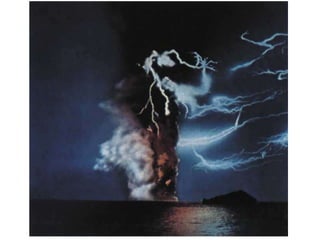
  • 123.
    Balance In PredatorAnd Prey Population • Predator and prey evolve together. The prey is part of the predator's environment, and the predator dies if it does not get food, so it evolves whatever is necessary in order to eat the prey: speed, stealth, camouflage (to hide while approaching the prey), a good sense of smell, sight, or hearing (to find the prey), immunity to the prey's poison, poison (to kill the prey) the right kind of mouth parts or digestive system, etc. Likewise, the predator is part of the prey's environment, and the prey dies if it is eaten by the predator, so it evolves whatever is necessary to avoid being eaten: speed, camouflage (to hide from the predator), a good sense of smell, sight, or hearing (to detect the predator), thorns, poison (to spray when approached or bitten), etc.
  • 124.
    • Ecosystems arecomplex. And predators are a necessary and beneficial part of natural systems. If we remove them from the picture, there are consequences. • Predators provide ecological stability by regulating the impacts of grazing and browsing animals, thus ensuring the overall productivity of the habitat. They cull weak, sick, and old prey, thus ensuring the maximum fitness of elk, deer, antelope, and hares. They foster biological diversity by “enforcing” ecological boundaries or preventing what ecologists refer to as “competitive exclusion,” the tendency of one prey animal to outcompete another. So-called “apex predators,” the wolves, lions, and tigers are the Godfathers, as they also control the numbers of “meso predators,” the raccoons, foxes—even domestic cats—which when left unchecked can do enormous damage to birds and native rodents. 41
  • 125.
    • Predators areoften another organism's prey, and likewise prey are often predators. Predators may increase the biodiversity of communities by preventing a single species from becoming dominant. • Introduction or removal of this predator, or changes in its population density, can have drastic cascading effects on the equilibrium of many other populations in the ecosystem. For example, grazers of a grassland may prevent a single dominant species from taking over. Without predation, herbivores began to over-graze many woody browse species, affecting the area's plant populations. 42
  • 126.
    •If a predatoroverhunts its prey, the prey population will lower to numbers that are too scarce for the predators to find. This will cause the predator population to dip, decreasing the predation pressure on the prey population. The decrease in predators will allow the small number of prey left to slowly increase their population to somewhere around their previous abundance, which will allow the predator population to increase in response to the greater availability of resources. If a predator hunts its prey species to numbers too low to sustain the population in the short term, they can cause not only the extinction or extirpation of the prey but also the extinction of their own species, a phenomenon known as co extinction. • An alternative prey species would help to lift some of the predation pressure from the initial prey species, giving the population a chance to recover, however it does not guarantee that the initial prey species will be able to recover as the initial prey population may have been hunted to below sustainable numbers or to complete extinction.
  • 127.
    References • Images: 1. https://lh4.ggpht.com/o1QdRYfikiKcGlVvBdzqQuVFt_o0Pq3ZvmuGuVLj6RAf1- 5Q7ALBavTxQaP7FqUXj5WY0A=s93 2.https://lh5.ggpht.com/ZMM4Or8oOY5P7UWLRXLHIXKERVz69HzfVDKMZXYlJMcDutAktAXWJypxs 6hTIHkM-HkhEwE=s101 3. https://lh5.ggpht.com/MHMd6uM2BunX1zCNUtYWW4rPHsVFs_-T6cd4vpeHYoTvKWZxq0- LiHP8Z_wJ04LficdwqN0=s113 4. https://lh4.ggpht.com/cwj1dUvO5cKsF4boo5nkOwWhuNarmliLj19l8_5FDK9lnLpzQMhxVJ38K1nx uJEoDuXIEw=s170 5. https://lh3.ggpht.com/- m8QpdiAOCTTjqEN3iBLp64VyC2tFGOGrJN_OTiWCbccFdX6EXY9sxy4gcQpz7TqwX-PDQ=s113 6. https://www.google.im/search?sa=G&q=environmental+science&tbm=isch&tbs=simg:CAQSYxph CxCo1NgEGgAMCxCwjKcIGjwKOggCEhS1FvAhqBauFu4hzhfZDMYWzRXAFhogmACHcJ06WDDBf1 miVFjC1W3aURWfrBW6C4i2unhIH2AMCxCOrv4IGgoKCAgBEgR4M0EcDA&ei=t96kVLnuBMbkuQS njICYCg&ved=0CBkQwg4oAA&biw=1198&bih=606 7. https://lh3.ggpht.com/jQME8EY- YIYlSeGqF_PmpSvyO8WTTZGjWKbRFX3ay8Z8glZBBsCOLybWQKXDjgm0An8n=s85 8. https://lh6.ggpht.com/ZpzkHd6HZLGjISa6woIafSpBJA9zXkVaKLFQj- nBdQ52h6MeYYjpy4oWOkMTTJGyQd5qjg=s170 9. https://lh5.ggpht.com/gEuWfOet370MkEnp4uBVxDQatvapbTcg6Gkkw3ueARbqleWN3t8D7PE3z9 XWWpH58hKsZvM=s170 10. https://lh5.ggpht.com/kFjXQcbqfRqqqjVKW__aHiNTZwo7iKGnO3- xm2R_Iw1CEPlPqp7eNkGTcrIBgUqnDOAxbw=s85
  • 128.
    11. https://www.google.im/search?sa=G&q=earliest+life+forms&tbm=isch&tbs=simg:CAQSZxplCxCo1NgEGgQIAAgD DAsQsIynCBo8CjoIAhIUzyH- J6oU_1BOwCM0h4ibKCuIn_1ycaIGZ_1sSok6jnKzEbFnJrSKiUdQwOnllaTzCtDgYz3nwmKDAsQjq7-CBoKCggIARIE- Oq25gw&ei=iN-kVKTCHIifugTT94CYCg&ved=0CBkQwg4oAA&biw=1198&bih=606 12. https://lh6.ggpht.com/ornrploCQByzkcMVop1iiAcybL6kRdxO1bFB6QtbMnqeNJL_SynmvT_j_7kkd_FltYTlQjI=s15 1 13.https://lh5.ggpht.com/5- wy4LF12SXjCx2BWusJuhlLztJZS3uz9ZWNuju8PSmwvGIbKD6gTBS41xx9aCUQQ8FCkMI=s151 14. https://lh4.ggpht.com/ZYmidiXIltqBAfQodooFsmiwf9sCSb8T-XfnZAqkiAjnhVidmTY68uHgwzxffRvsKEf1pw=s150 15. https://lh6.ggpht.com/eJM_hiuDOeYKzECsQm8ewGGsG1EpowxkDTgA73MdYz- Hmu7ROsmVG72V76AOY_KPeKhnhg=s107 16. https://lh3.ggpht.com/FNUsrIhj05ZxacOliH9Sp2dJyLJu-z31x_Oi3LEzy75eaaCQkdcJ4wnvZjpxCg5LIfd8Ww=s168 17. https://lh5.ggpht.com/_t4wtTkeH7gQ2f- spt_Jnc29AXOp3akfj10dYOeNcfRX18I1mxwS8KtdBbDi6W94RR2Emy4=s85 18. https://lh6.ggpht.com/_N77xeXcMw5JsTPOzOqKjMJpYgRT6wFeguTrk8tUnNIHajNY7mlXcrg3z- 6RIQfYXc57qw=s170 19. https://lh4.ggpht.com/b7CrAcv4bVTrRocMBZTJptEOMO5fkMJIn09AFVJYvQwG0m0oIp3aeJWJACUDZO9F5cGyCg =s85 20. https://lh3.ggpht.com/GAGUYY2yRGJnZY4k3gVwuvOyaPcRZqPHOLqnS6MJcNILYcFmLrAqrLqITUvEIZtwwZejbA=s 85 21. https://lh6.ggpht.com/6jDjmSSDErwBRqGKLUWIPIxi8JoqslruanRSMIX2srIfXEpDTs9_iOHgPOpSCW1i9oVO0Cg=s1 22 22. https://lh4.ggpht.com/AU-kD_uPxGy_S34YjT- ii7mGneeRCzQDZK4cr8KO0H1Vng3_jqNE1wlGAQ2CpnAfmFrUlg=s85 23. https://lh3.ggpht.com/ZTzasSTykGyQesFeAdxmpARO-g7SUWiHoovpYxNR_AcKiyNFOX41wWcZEGT05jQd_m- 4Ow=s160 24. https://lh5.ggpht.com/SW2ybxbfECIHh8gzguKY4Ar5- PGuZp_WzJ3QNKUNMR219J3AuBOJtn8mUxGGCnNXlbGBWVg=s88 25. https://lh5.ggpht.com/mCAkQKdYpqHYcXO6ArJD8XYx2PBbnzHHqT0kkitCKqKzvk4lY0BXcWx3W7aDIfrTyKtvrw=s8 5
  • 129.
    26. https://lh3.ggpht.com/XEmBZ1Jc2lb8zn3ZK_q3V5W6OS1hgtvslFSIonyITmefdNf19dPRWXaF7LUjhOqoEv2YjA=s85 27. https://lh3.ggpht.com/FPoIvsMz8jbg1VOQiJRfgTyCUmvFuA2ekO6qlPUutVbA_qflPXLmIzKaKGerYPozfRkBk-0=s170 28.https://lh3.ggpht.com/dXwJpxDxIbMiZU72UnfITuy8gU2lOJf55PfChMY-1lyuVZ7B33bbUOj1WaCmxcvOjKYloQ=s110 29. https://lh6.ggpht.com/Qsk2ZFTTr39zid-w-SIb-5Cm1SVfWOSgdy9Nlu6mxyS0nU2sZlbB1SNHDvP3tJUK3hQU5w=s152 30. https://lh5.ggpht.com/QnttBVNF1RrQNuciWWXdZJrG2pcCUdgU9B7uUmlFrXrPKbPY19XmN4sDKumMS0ICVxqEanE=s 85 31. https://lh4.ggpht.com/MaAD0aj-xHaEhhvLjIdLZkbNuPFFgc1tup-BMBh0rIGHJSdkxDpBbh4VFtIdodgq7H9m=s85 32. https://lh3.ggpht.com/j2Nvrgrzxsr73B1m335BJPIqaWr6It9qycb6PRMd7f3x7zwRsZ8tv3cvi1w87jAlKK3a7Q=s85 33. https://lh5.ggpht.com/8cDjNOx7WV3pWDrrqVbp-y2y5y5io6jDzSBaQ_RrNTUNmvdcFe7EcaJZ8X8e6MSE7vk2jA=s85 34. https://lh6.ggpht.com/c-6bw3DCoLlFeB9tHW_RfZ53qiheU6XB_Xvg7F6x0gVY-MlKMHh3TqTbW8JDpByX_5Toqg=s85 35. https://lh6.ggpht.com/KgHW-8GA_gIglkFd7driq8PXmaxlV4tgqoKebqnYtFgyelh95NyovtsiD-M5e9R_ZpOKBbo=s85 36. https://lh6.ggpht.com/ZVD3vMSJAZIHEMd6lSePUK1gBzxV5ARr2zFG07aYrxsjVKGZ_VmpnTG-uUYWiAY_5szLPw=s85 37. https://lh4.ggpht.com/uEEbv5iT3wglplgK557g-vyvEWTa9SDf7_Mbhap-lXqJiskCR_TB9i_goh0vG-nm-zViOA=s150 38. https://lh3.ggpht.com/4BGkWzDAXrVe48pYz0GXuez9RbrTF7e5dm7KMVkcaZQM2nhnOmWka8J8w4b3hA_w- PSPCcI=s95 39. https://lh5.ggpht.com/tN2RVmDzs6bBIo6fb96YRQxEbt70swuBsgpaXmpBQeQVT3Bai3jhry5bGuxWHSVI_II0FQ=s114 40. https://lh3.ggpht.com/1Ulqb618Gd-Srg9lpZrk9ZA9alOUiJKnrKDcKLDxA9Li8_rivhYgnchIQkkLiXs2fK6pGQg=s97 41. https://lh6.ggpht.com/zQZOMfjB7JAlGNy3xWI4HSCy62q2DzyXBbUrMXYYPO_1-t2rbR6qaN19eetjRpXRgwSdpw=s91 42. https://lh5.ggpht.com/zKTFsjLgLZgmftx8hRgBEj1bjjOhOjEN2G430d3WGBkP-ibYGwmanus5-6M55MeTxSNNqA=s100 Books/Resources: Environmental Studies by R. Rajgopalan Environment and Ecology by Dr. Gourkrishna Dasmohapatra www.space.com/56-our-solar-system-facts-formation-and-discovery.html www.fair-center.eu/public/what...at.../evolution-of-the-universe.html