The Natural Step… towards global 
sustainability 
•An international non-profit organization, founded in 1989 in 
Sweden by Dr. Karl-Henrik Robèrt… 
based on the laws of thermodynamics 
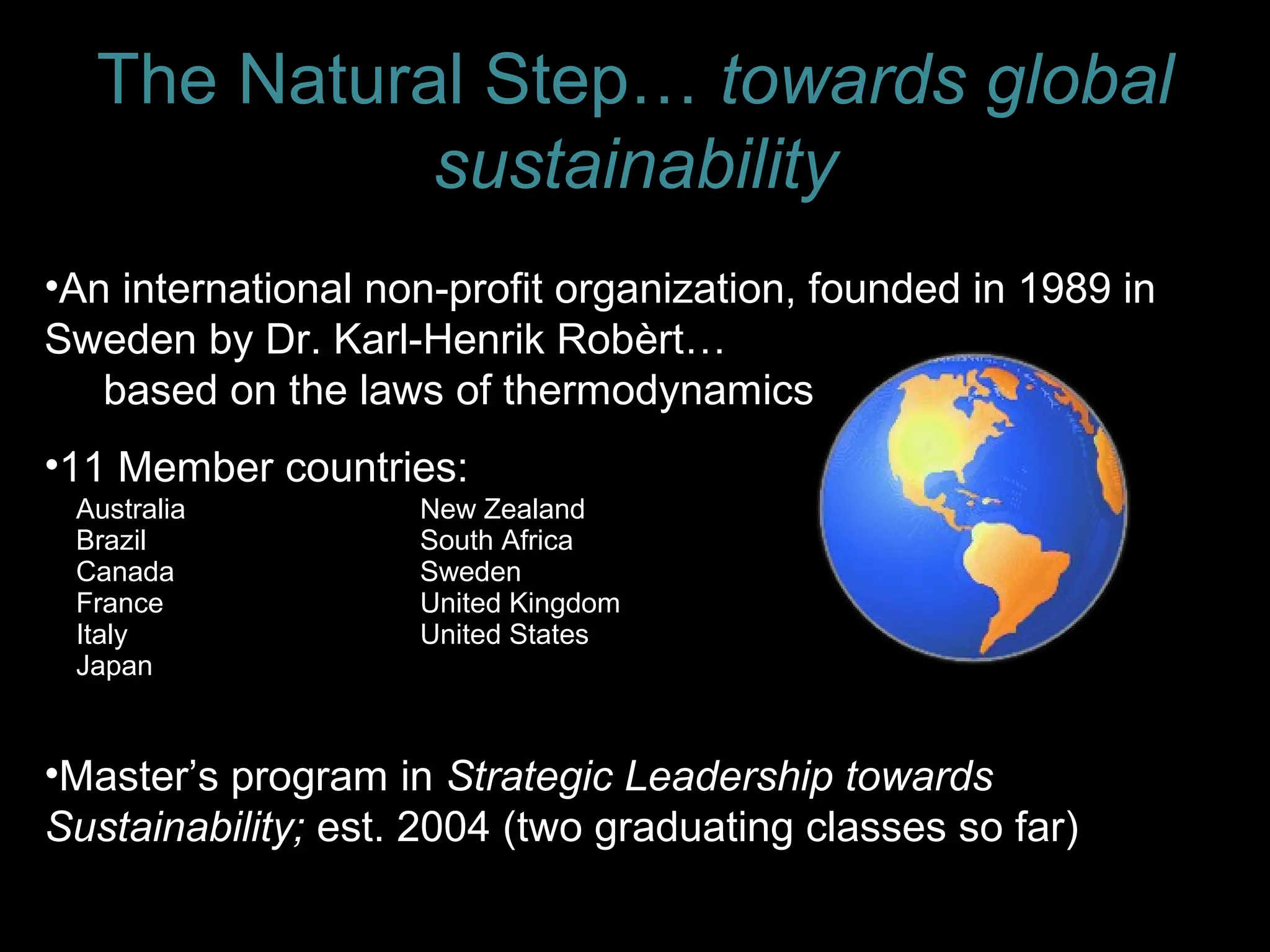
•11 Member countries: 
Australia 
Brazil 
Canada 
France 
Italy 
Japan 
New Zealand 
South Africa 
Sweden 
United Kingdom 
United States 
•Master’s program in Strategic Leadership towards 
Sustainability; est. 2004 (two graduating classes so far)
Basic Principles for Sustainability… 
A sustainable society can’t be subject to 
systematically increasing… 
I…Concentrations of substances extracted from 
the earth’s crust in nature; 
II…Concentrations of substances produced by 
society in nature; 
III…Degradation of nature by physical means. 
And, in that society, 
IV…humans retain the ability to meet their needs 
worldwide.
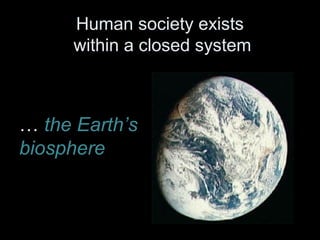
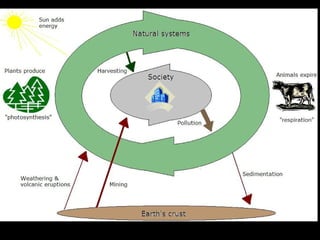
Human society exists 
within a closed system 
… the Earth’s 
biosphere
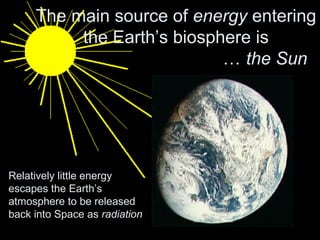
The main source of energy entering 
the Earth’s biosphere is 
… the Sun 
Relatively little energy 
escapes the Earth’s 
atmosphere to be released 
back into Space as radiation
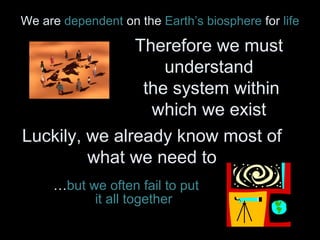
We are dependent on the Earth’s biosphere for life 
Therefore we must 
understand 
the system within 
which we exist 
Luckily, we already know most of 
what we need to 
…but we often fail to put 
it all together
A few basic Laws of Science 
tell us that… 
• Nothing disappears (Conservation Law) 
• Everything disperses (Law of Entropy) 
• Quality is in the concentration of energy 
and matter (purity and resources) 
• Plant cells are able to create organized 
material using the Sun’s energy through 
photosynthesis 
• Humans are a social species
What this basic science can tell us: 
• Nothing disappears (Conservation Law) 
i.e., 
Pollution and toxic substances will increase 
in the biosphere if they continue to be 
created at a rate quicker than they are 
broken down
What this basic science can tell us: 
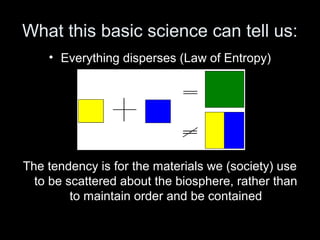
• Everything disperses (Law of Entropy) 
i.e., 
The tendency is for the materials we (society) use 
to be scattered about the biosphere, rather than 
to maintain order and be contained
What this basic science can tell us: 
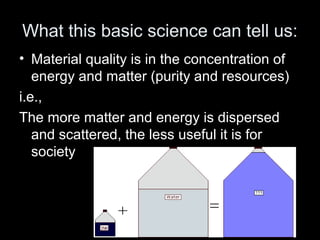
• Material quality is in the concentration of 
energy and matter (purity and resources) 
i.e., 
The more matter and energy is dispersed 
and scattered, the less useful it is for 
society
What this basic science can tell us: 
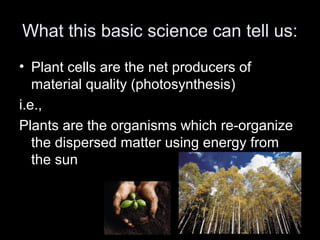
• Plant cells are the net producers of 
material quality (photosynthesis) 
i.e., 
Plants are the organisms which re-organize 
the dispersed matter using energy from 
the sun
What this basic science can tell us: 
• Humans are a social species 
i.e., 
There must be trust and community spirit for 
society to persist
However, in today’s society we 
systematically… 
• Continue to create and emit toxic chemicals into 
the biosphere; 
• Use energy stored in the carbon bonds of fossil 
fuels (a finite resource), which results in 
emission of GHGs; 
• Dilute clean water and air with pollutants; 
• Degrade natural, growing plant communities. 
• …and the gap between the poor and rich, 
disenfranchised and powerful grows
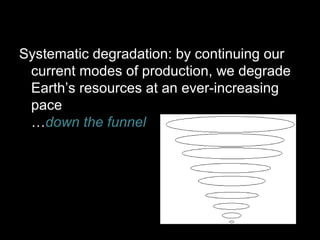
Systematic degradation: by continuing our 
current modes of production, we degrade 
Earth’s resources at an ever-increasing 
pace 
…down the funnel
Four System Conditions for 
Sustainable Development: 
A sustainable society won’t be subject to 
systematically increasing… 
I…Concentrations of substances extracted from 
the earth’s crust in nature; 
II…Concentrations of substances produced by 
society in nature; 
III…Degradation of nature by physical means. 
And, in that society, 
IV…humans retain the ability to meet their needs 
worldwide.
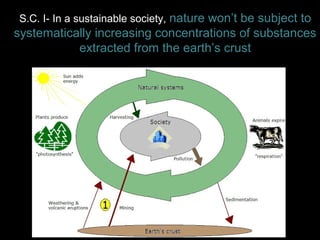
S.C. I- In a sustainable society, nature won’t be subject to 
systematically increasing concentrations of substances 
extracted from the earth’s crust
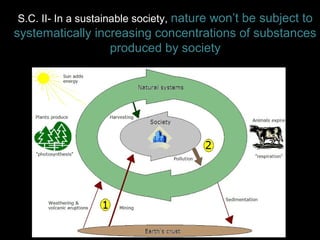
S.C. II- In a sustainable society, nature won’t be subject to 
systematically increasing concentrations of substances 
produced by society
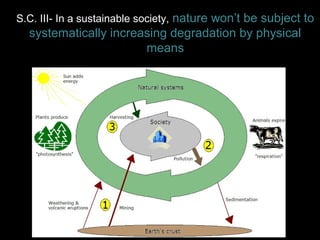
S.C. III- In a sustainable society, nature won’t be subject to 
systematically increasing degradation by physical 
means
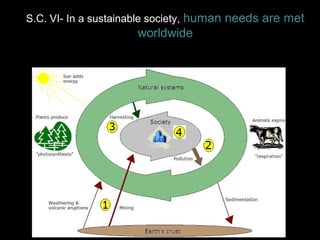
S.C. VI- In a sustainable society, human needs are met 
worldwide
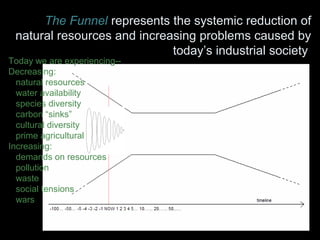
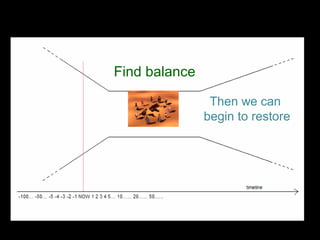
The Funnel represents the systemic reduction of 
natural resources and increasing problems caused by 
today’s industrial society 
Today we are experiencing-- 
Decreasing: 
natural resources 
water availability 
species diversity 
carbon “sinks” 
cultural diversity 
prime agricultural land 
Increasing: 
demands on resources 
pollution 
waste 
social tensions 
wars
Find balance 
Then we can 
begin to restore
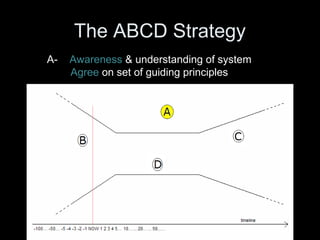
The ABCD Strategy 
A- Awareness & understanding of system 
Agree on set of guiding principles
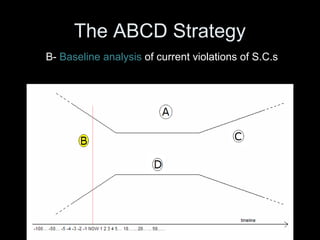
The ABCD Strategy 
B- Baseline analysis of current violations of S.C.s
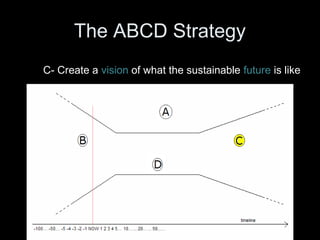
The ABCD Strategy 
C- Create a vision of what the sustainable future is like
The ABCD Strategy 
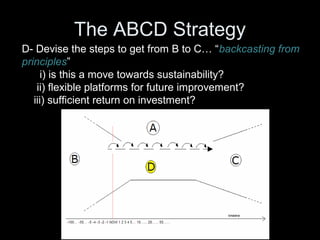
D- Devise the steps to get from B to C… “backcasting from 
principles” 
i) is this a move towards sustainability? 
ii) flexible platforms for future improvement? 
iii) sufficient return on investment?
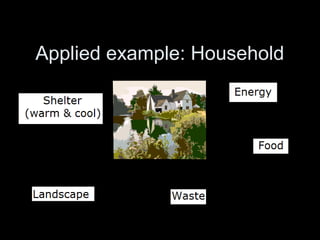
Applied example: Household
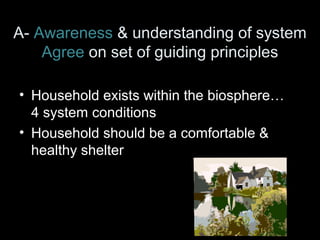
A- Awareness & understanding of system 
Agree on set of guiding principles 
• Household exists within the biosphere… 
4 system conditions 
• Household should be a comfortable & 
healthy shelter
B- Baseline of current practices 
• S.C. I- fossil fuels; cars and appliances; 
batteries; techno gadgets; etc. 
• S.C. II- paints; textiles; fertilizers; cleaners; 
garbage; etc. 
• S.C. III- wood flooring; food; water; sprawl; 
etc. 
• S.C. IV- food & consumerism; footprint; 
etc.
C- Create a vision for the future 
• S.C. I- Insulate home; drive less; phase out battery 
operated gadgets; purchase low-E appliances; purchase 
renewable energy; install PV/geo-thermal system; etc. 
• 
S.C. II- Purchase non-toxic paints, textiles, cleaners,etc.; 
recycle; purchases- think “upstream” & “downstream” 
• 
S.C. III- Purchase sustainably harvested materials; 
rainwater harvesting & grey water; urban renewal; etc. 
• 
S.C. IV- Purchase “fair trade”; reduce your “ecological 
footprint”; volunteer in community, etc.
D- Devise the strategy to get from 
B to C… “backcasting from principles” 
i) is this a move towards sustainability? 
ii) flexible platforms for future improvement? 
iii) sufficient return on investment? 
Set an agenda for 
actions listed in C
ABCD 2007

ABCD 2007

  • 1.
    The Natural Step…towards global sustainability •An international non-profit organization, founded in 1989 in Sweden by Dr. Karl-Henrik Robèrt… based on the laws of thermodynamics •11 Member countries: Australia Brazil Canada France Italy Japan New Zealand South Africa Sweden United Kingdom United States •Master’s program in Strategic Leadership towards Sustainability; est. 2004 (two graduating classes so far)
  • 2.
    Basic Principles forSustainability… A sustainable society can’t be subject to systematically increasing… I…Concentrations of substances extracted from the earth’s crust in nature; II…Concentrations of substances produced by society in nature; III…Degradation of nature by physical means. And, in that society, IV…humans retain the ability to meet their needs worldwide.
  • 3.
    Human society exists within a closed system … the Earth’s biosphere
  • 4.
    The main sourceof energy entering the Earth’s biosphere is … the Sun Relatively little energy escapes the Earth’s atmosphere to be released back into Space as radiation
  • 5.
    We are dependenton the Earth’s biosphere for life Therefore we must understand the system within which we exist Luckily, we already know most of what we need to …but we often fail to put it all together
  • 6.
    A few basicLaws of Science tell us that… • Nothing disappears (Conservation Law) • Everything disperses (Law of Entropy) • Quality is in the concentration of energy and matter (purity and resources) • Plant cells are able to create organized material using the Sun’s energy through photosynthesis • Humans are a social species
  • 7.
    What this basicscience can tell us: • Nothing disappears (Conservation Law) i.e., Pollution and toxic substances will increase in the biosphere if they continue to be created at a rate quicker than they are broken down
  • 8.
    What this basicscience can tell us: • Everything disperses (Law of Entropy) i.e., The tendency is for the materials we (society) use to be scattered about the biosphere, rather than to maintain order and be contained
  • 9.
    What this basicscience can tell us: • Material quality is in the concentration of energy and matter (purity and resources) i.e., The more matter and energy is dispersed and scattered, the less useful it is for society
  • 10.
    What this basicscience can tell us: • Plant cells are the net producers of material quality (photosynthesis) i.e., Plants are the organisms which re-organize the dispersed matter using energy from the sun
  • 11.
    What this basicscience can tell us: • Humans are a social species i.e., There must be trust and community spirit for society to persist
  • 12.
    However, in today’ssociety we systematically… • Continue to create and emit toxic chemicals into the biosphere; • Use energy stored in the carbon bonds of fossil fuels (a finite resource), which results in emission of GHGs; • Dilute clean water and air with pollutants; • Degrade natural, growing plant communities. • …and the gap between the poor and rich, disenfranchised and powerful grows
  • 13.
    Systematic degradation: bycontinuing our current modes of production, we degrade Earth’s resources at an ever-increasing pace …down the funnel
  • 15.
    Four System Conditionsfor Sustainable Development: A sustainable society won’t be subject to systematically increasing… I…Concentrations of substances extracted from the earth’s crust in nature; II…Concentrations of substances produced by society in nature; III…Degradation of nature by physical means. And, in that society, IV…humans retain the ability to meet their needs worldwide.
  • 16.
    S.C. I- Ina sustainable society, nature won’t be subject to systematically increasing concentrations of substances extracted from the earth’s crust
  • 17.
    S.C. II- Ina sustainable society, nature won’t be subject to systematically increasing concentrations of substances produced by society
  • 18.
    S.C. III- Ina sustainable society, nature won’t be subject to systematically increasing degradation by physical means
  • 19.
    S.C. VI- Ina sustainable society, human needs are met worldwide
  • 20.
    The Funnel representsthe systemic reduction of natural resources and increasing problems caused by today’s industrial society Today we are experiencing-- Decreasing: natural resources water availability species diversity carbon “sinks” cultural diversity prime agricultural land Increasing: demands on resources pollution waste social tensions wars
  • 21.
    Find balance Thenwe can begin to restore
  • 22.
    The ABCD Strategy A- Awareness & understanding of system Agree on set of guiding principles
  • 23.
    The ABCD Strategy B- Baseline analysis of current violations of S.C.s
  • 24.
    The ABCD Strategy C- Create a vision of what the sustainable future is like
  • 25.
    The ABCD Strategy D- Devise the steps to get from B to C… “backcasting from principles” i) is this a move towards sustainability? ii) flexible platforms for future improvement? iii) sufficient return on investment?
  • 26.
  • 27.
    A- Awareness &understanding of system Agree on set of guiding principles • Household exists within the biosphere… 4 system conditions • Household should be a comfortable & healthy shelter
  • 28.
    B- Baseline ofcurrent practices • S.C. I- fossil fuels; cars and appliances; batteries; techno gadgets; etc. • S.C. II- paints; textiles; fertilizers; cleaners; garbage; etc. • S.C. III- wood flooring; food; water; sprawl; etc. • S.C. IV- food & consumerism; footprint; etc.
  • 29.
    C- Create avision for the future • S.C. I- Insulate home; drive less; phase out battery operated gadgets; purchase low-E appliances; purchase renewable energy; install PV/geo-thermal system; etc. • S.C. II- Purchase non-toxic paints, textiles, cleaners,etc.; recycle; purchases- think “upstream” & “downstream” • S.C. III- Purchase sustainably harvested materials; rainwater harvesting & grey water; urban renewal; etc. • S.C. IV- Purchase “fair trade”; reduce your “ecological footprint”; volunteer in community, etc.
  • 30.
    D- Devise thestrategy to get from B to C… “backcasting from principles” i) is this a move towards sustainability? ii) flexible platforms for future improvement? iii) sufficient return on investment? Set an agenda for actions listed in C