ENVIRONMENTAL SCIENCE &ENVIRONMENTAL SCIENCE &
ENGINEERINGENGINEERING
GE2211
Prepared by
Jhansirani.R AP/ECE
UNIT IUNIT I
ENVIRONMENT, ECOSYSTEM &ENVIRONMENT, ECOSYSTEM &
BIODIVERSITYBIODIVERSITY
Definition, scope and importance of environment
Need for public awareness
Concept of an ecosystem
Structure and function of ecosystem
Producers, consumers and decomposers
Energy flow in the ecosystem
Ecological succession
Food chains, food webs and ecological pyramids
Jhansirani.R AP/ECE
Introduction, types, characteristics features,
structure and function of the
◦ (a) forest ecosystem
◦ (b) grassland ecosystem
◦ (c) desert ecosystem
◦ (d) aquatic ecosystem (ponds, streams, lakes, rivers,
oceans, estuaries)
Introduction to bio diversity definition.
Genetic, species and ecosystem diversity
Biogeographical classification of India
Value of biodiversity: consumptive use,
productive use, social ethical, aesthetic and
option values.
Jhansirani.R AP/ECE
Bio diversity at global, national and local levels
India as a mega diversity nation
Hot spots of biodiversity
Threats to biodiversity: habitat loss, poaching of
wildlife, man wildlife conflicts
Endangered and endemic species of India
Conversation of biodiversity: In-situ and ex-situ
conservation of biodiversity.
 Field study of common plants, insects, birds
 Field study of simple ecosystem pond, river, hill
slopes, etc..,
Jhansirani.R AP/ECE
INTRODUCTIONINTRODUCTION
Environment means “ to encircle or
surroundings”
All the biological and non-biological entities
around us is called as environment
DEFINITION
Environment is defined as “sum total of
water, air and land and the inter-relationships
that exist among them and with the human
beings, other living organisms and materials”
Jhansirani.R AP/ECE
Environmental science
It is the study of the environment, its biotic and
abiotic components and their interrelationship.
Jhansirani.R AP/ECE
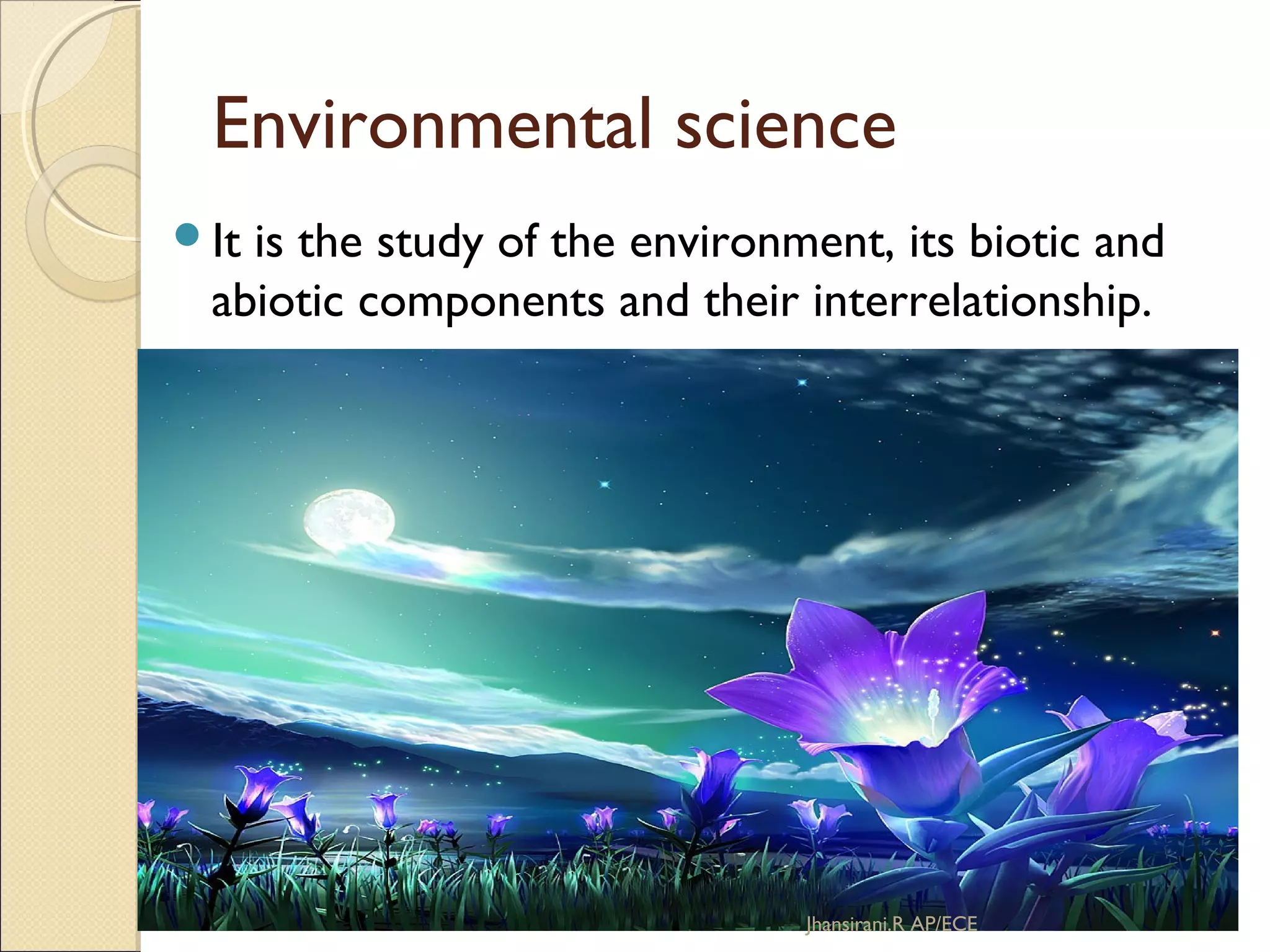
Environmental engineering
It is the application of engineering
principles to the protection and
enhancement of the quality of the
environment and to the enhancement and
protection of public health and welfare.
Jhansirani.R AP/ECE
Environmental studies or Environmental
education
The process of
educating the
people for
preserving quality
environment.
Jhansirani.R AP/ECE
Types of environment
Natural environment
Man made environment
Jhansirani.R AP/ECE
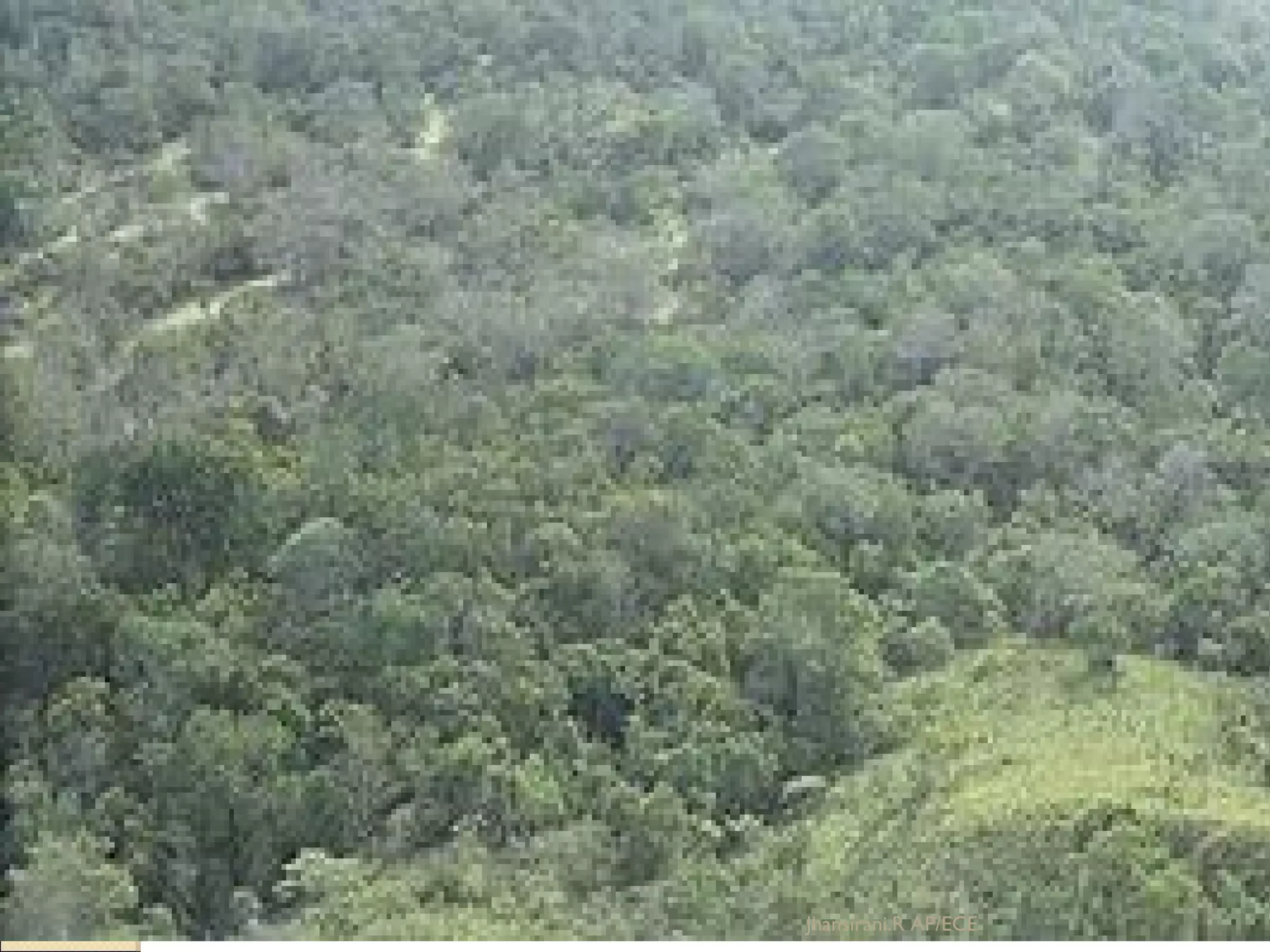
Natural environment
Natural environment is characterized by
natural components. All biotic (living) and
abiotic components (non living) are created
through natural process.
Eg: soil, water, air, trees, radiations, etc.,
Jhansirani.R AP/ECE
Man made environment
Man modifies the environment using modern
technologies according to his needs to a great
extent.
Eg: house, road, schools, railway lines, parks, etc.,
Jhansirani.R AP/ECE
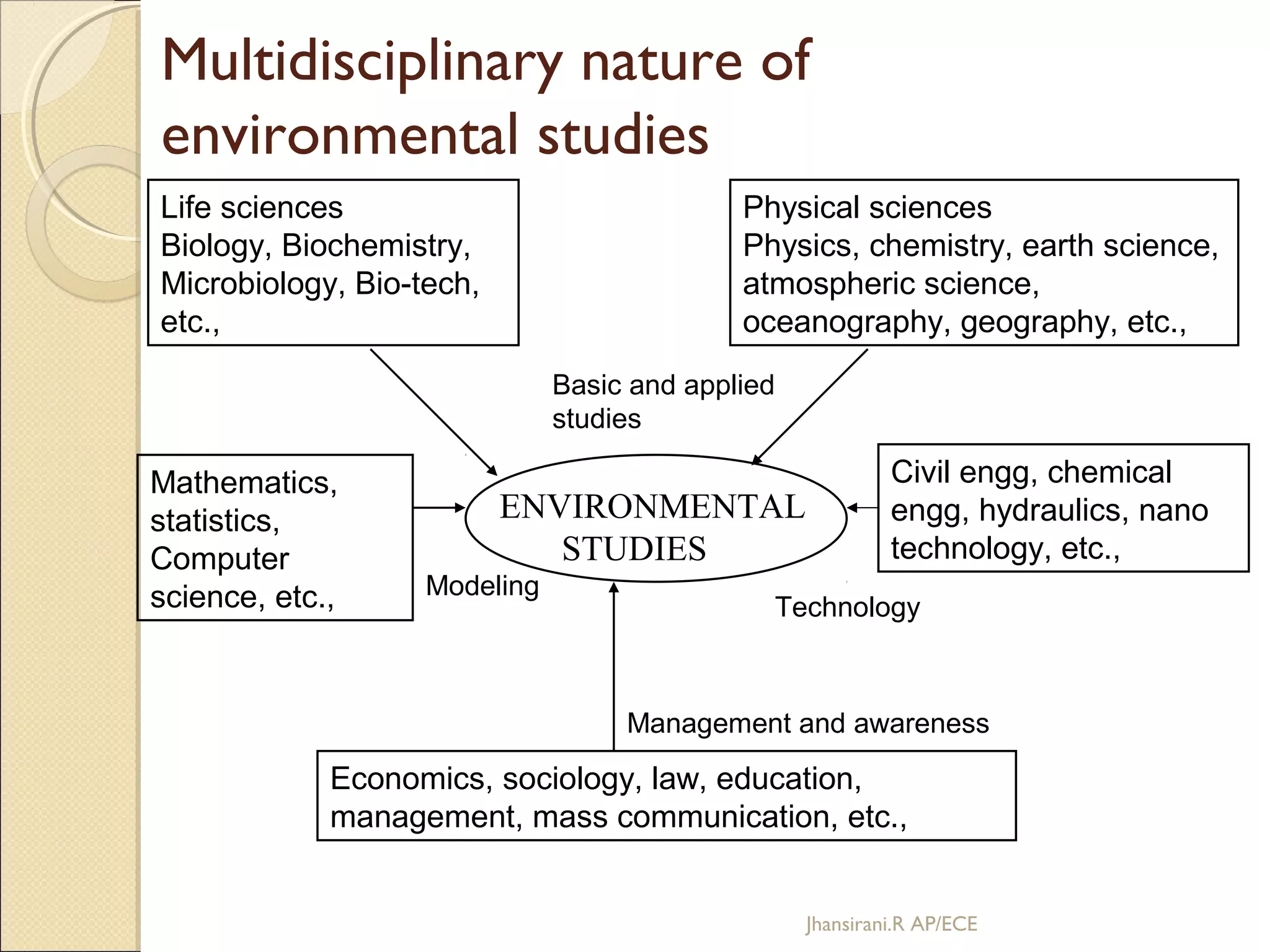
Multidisciplinary nature of
environmental studies
ENVIRONMENTAL
STUDIES
Life sciences
Biology, Biochemistry,
Microbiology, Bio-tech,
etc.,
Mathematics,
statistics,
Computer
science, etc.,
Physical sciences
Physics, chemistry, earth science,
atmospheric science,
oceanography, geography, etc.,
Civil engg, chemical
engg, hydraulics, nano
technology, etc.,
Economics, sociology, law, education,
management, mass communication, etc.,
Basic and applied
studies
Modeling
Management and awareness
Technology
Jhansirani.R AP/ECE
Multidisciplinary nature of environmental studies
Life science:
 Botany
 Zoology
 Microbiology
 Genetics
 Biochemistry
Helps in understanding biotic components & its
interactions.
 Genetics
 Bio-technology
Used for finding solutions to environmental
problems.
Jhansirani.R AP/ECE
Multidisciplinary nature of environmental studies
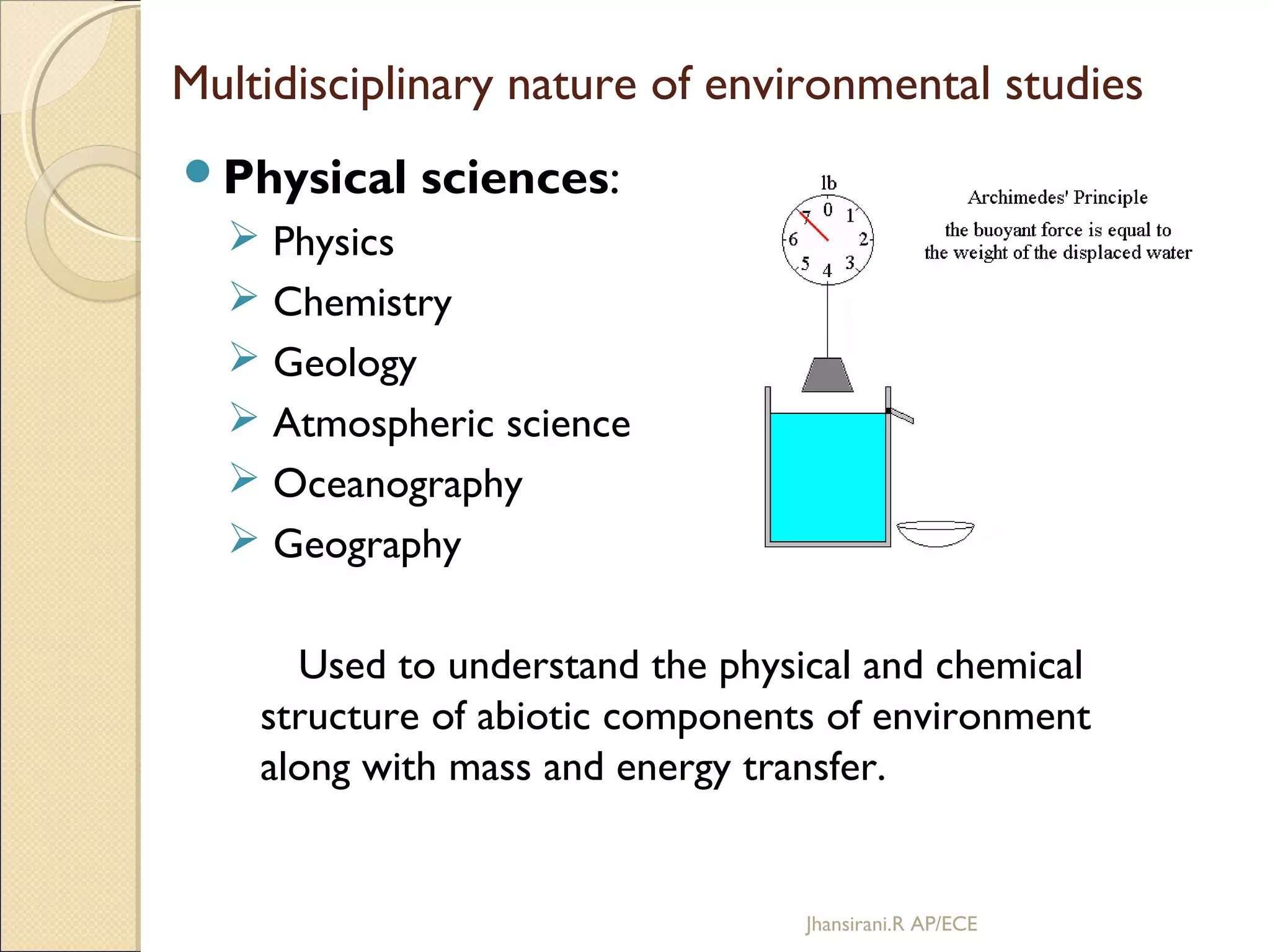
Physical sciences:
 Physics
 Chemistry
 Geology
 Atmospheric science
 Oceanography
 Geography
Used to understand the physical and chemical
structure of abiotic components of environment
along with mass and energy transfer.
Jhansirani.R AP/ECE
Multidisciplinary nature of environmental studies
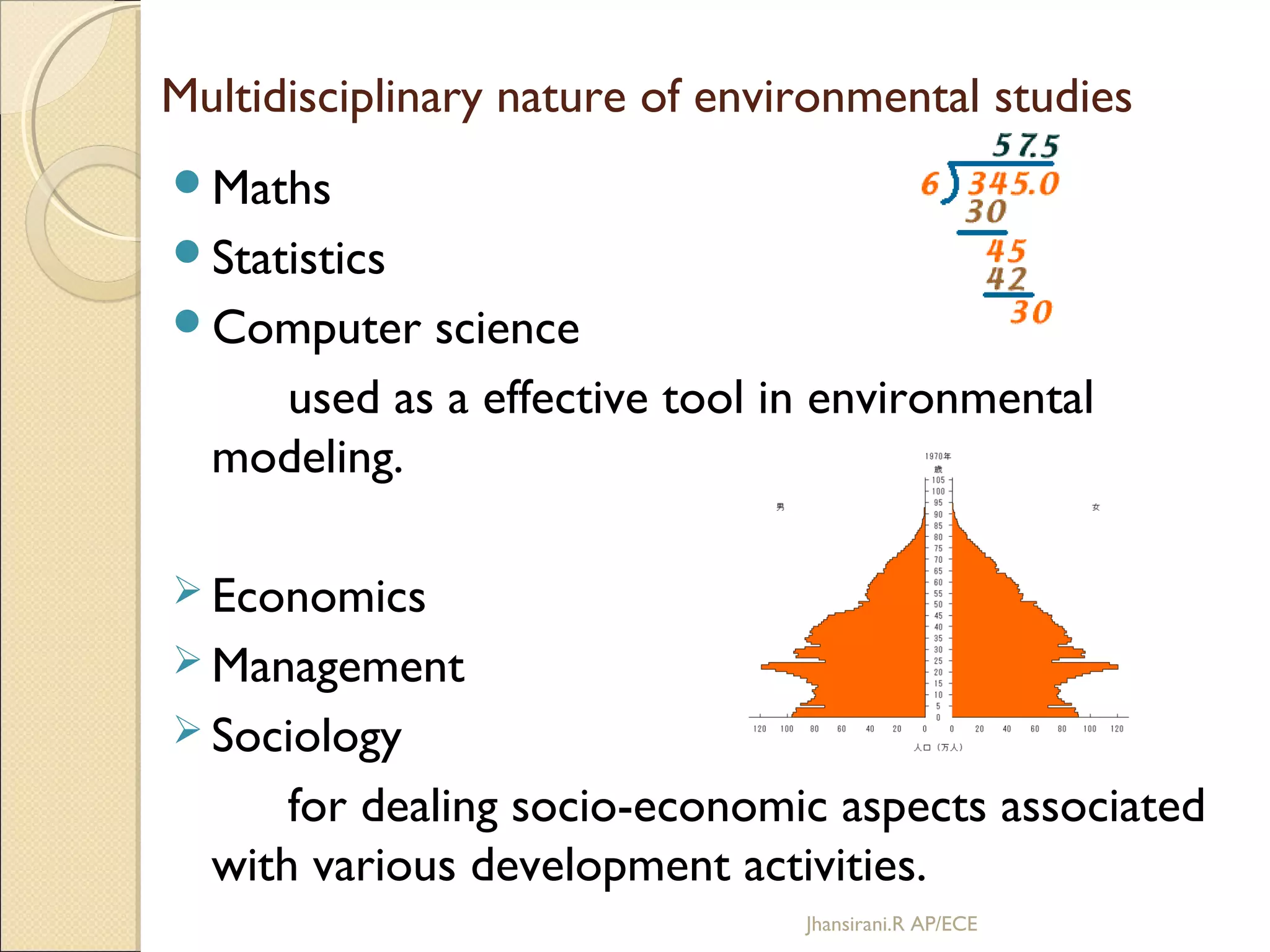
Maths
Statistics
Computer science
used as a effective tool in environmental
modeling.
 Economics
 Management
 Sociology
for dealing socio-economic aspects associated
with various development activities.
Jhansirani.R AP/ECE
 Laws
provides guidelines and legal measures for
effective management and protection of
environment.
Civil engineering
Hydraulics
Chemical engineering
Nano technology
provides technical solutions to environmental
pollution control and waste treatment for
protection of environment.
Multidisciplinary nature of environmental studies
Jhansirani.R AP/ECE
Environmental education
Mass communication
used in disseminating environmental
awareness.
Multidisciplinary nature of environmental
studies
Jhansirani.R AP/ECE
ScopeScope
EVS has wide scope in large number of areas and
aspects which may be summarized as follows
Natural resources their conservation & management
Ecology & Biodiversity
Environmental pollution and control
Social issue in relation to development and
environment
Human population and environment
These aspects of environmental studies have direct
relevance to every section of the society.
Jhansirani.R AP/ECE
ScopeScope
Many career options have emerged in this
field that are broadly categorized as
Research & development (R&D) in environment
Green advocacy
Green marketing
Green media
Environment consultancy
Jhansirani.R AP/ECE
Research & development in environmentResearch & development in environment
Environmental scientists
Examines environmental problems in a
scientific manner
Carry out R&D activities for developing
cleaner technology and promoting
sustainable development.
Trained manpower is needed to deal
with environmental issues
Jhansirani.R AP/ECE
Research & development in environmentResearch & development in environment
Environmental management & environmental
engineering are emerging as new career for
environmental protection & management
Pollution control laws being more stringent,
industries are finding it difficult to dispose waste
To avoid litigation companies are trying to adopt
green technologies which would reduce pollution
Cleaning up of the wastes produced is another
potential market Jhansirani.R AP/ECE
Green advocacyGreen advocacy
Increasing emphasis on implementing various
acts and laws related to environment, need for
environmental lawyers has emerged who
should be able to plead the cases related to
Water pollution
Air pollution
Forest
Wildlife etc.,
Jhansirani.R AP/ECE
Green marketingGreen marketing
Quality of the product is ensured with
ISO mark
Marketing goods that are eco friendly has
ecomark or ISO 14000 certification.
Jhansirani.R AP/ECE
Green mediaGreen media
Environmental awareness can be spread
amongst masses through mass media like
Television
Radio
Newspaper
Magazines
Hoardings
Advertisements etc.,
Jhansirani.R AP/ECE
Environment consultancyEnvironment consultancy
Many non-government organizations
(NGO), industries and government
bodies are engaging environmental
consultants for systematically studying
and tackling environment related
problems.
Jhansirani.R AP/ECE
Importance of environmentImportance of environment
Any person will be affected by
environment and also he will affect the
environment by his deeds
Air, water, food, and land are all
contaminated by the industrial activities,
because of the lack of self discipline
Jhansirani.R AP/ECE
Global Vs local nature ofGlobal Vs local nature of
environmentenvironment
Environment is global as well as local in nature
Global issues
Global warming
Depletion of ozone layer
Dwindling forests
Energy resources
Loss of global biodiversity etc.,
Affects the mankind globally for that we have to
think and plan globally.
Jhansirani.R AP/ECE
Global Vs local nature of environmentGlobal Vs local nature of environment
Local issues
Impact of mining or hydro-electric project in an area
Problems of disposal and management of solid waste
River or lake pollution
Soil erosion
Water logging
Salinization of soil
Fluorosis problem in local population
Arsenic pollution of ground water etc.,
for this we need to think and act locally.
* It is very important to make everyone environmentally
educated.
Jhansirani.R AP/ECE
Individualistic nature ofIndividualistic nature of
environmentenvironment
Environment studies is very important since it
deals with most important problems of life where
each individual matters like,
Safe and clean drinking water
Hygienic living conditions
Clean and fresh air
Fertile land
Healthy food
Sustainable development
If we want to live in a clean, healthy, aesthetically
beautiful, safe and secure environment for a long time
and wish to hand over a clean and safe earth to our
future it is most essential to understand the basics of
environment. Jhansirani.R AP/ECE
Need for public awarenessNeed for public awareness
Goal of sustainable development cannot be
achieved by any government until the public has
a participatory role in it.
Public participation is possible only when the
public is aware about the ecological and
environmental issues.
E.g.: A drive by the government to ban the
littering of polythene cannot be successful until
the public understands the environmental
implications of the same.
Jhansirani.R AP/ECE
Need for public awarenessNeed for public awareness
The public has to be made aware that by
littering polythene, we are not only damaging
the environment, but posing serious threat to
our health.
A Chinese proverb
◦ “ If you plan for one year, plant rice, if you
plan for 10 years, plant trees and if you plan
for 100 years, educate people”
Jhansirani.R AP/ECE
Contemporary Indian environmentalistsContemporary Indian environmentalists
Justice – Kuldeep Singh – Green judge
M.C. Mehta – Green advocate
Contributed to environment
In 1991, supreme court of our country issued
directives to make all curriculum environment
oriented.
This directive was, in fact, in response to a public
interest litigation (PIL) filed by M.C. Mehta Vs union
of India (1998) that prompted the apex court to
give a mandate for creating environmental
awareness among all citizens of India. Based on the
judgment, environmental studies is being taught as a
compulsory course to all students.Jhansirani.R AP/ECE
Concept of Eco markConcept of Eco mark
In order to increase consumer awareness about
environment, the government of India has
introduced a scheme of eco-labeling of consumer
products as ‘ eco mark’ in 1991.
Earthen pitcher is a symbol of eco friendly and
our traditional heritage.
Eco mark is awarded to the product that is made,
used and disposed off in a harmless manner.
To disseminate environmental awareness
 Eco clubs for children's
 Eco task force for army men
Have been launched by the government.
Jhansirani.R AP/ECE
To sum up, it is essential to create environmental
awareness because:
 Environment belongs to all and participation of
masses is a must for successful implementation of
environmental protection plans.
 Living in a technologically developing society, our
lifestyles and attitudes have become self oriented.
Environmental awareness is needed to change the
mindset of modern society for an earth oriented
approach
 There is a need to make the public
environmentally aware of the serious health
impacts of environmental pollution and their right
to live in a clean and healthy environment.
Jhansirani.R AP/ECE
There is a urgent need to create awareness among
people that we have no other option but to follow
sustainability principles. Only then life of mankind
on this earth would be secure and our future
generation would be safe.
“ what’s the use of a beautiful house if you
don’t have a decent planet to put it on?”
Even if we begin today, the restoration is expected
in the next 40-50 years.
Jhansirani.R AP/ECE

Intrroduction to environmental studies amtd

  • 1.
    ENVIRONMENTAL SCIENCE &ENVIRONMENTALSCIENCE & ENGINEERINGENGINEERING GE2211 Prepared by Jhansirani.R AP/ECE
  • 2.
    UNIT IUNIT I ENVIRONMENT,ECOSYSTEM &ENVIRONMENT, ECOSYSTEM & BIODIVERSITYBIODIVERSITY Definition, scope and importance of environment Need for public awareness Concept of an ecosystem Structure and function of ecosystem Producers, consumers and decomposers Energy flow in the ecosystem Ecological succession Food chains, food webs and ecological pyramids Jhansirani.R AP/ECE
  • 3.
    Introduction, types, characteristicsfeatures, structure and function of the ◦ (a) forest ecosystem ◦ (b) grassland ecosystem ◦ (c) desert ecosystem ◦ (d) aquatic ecosystem (ponds, streams, lakes, rivers, oceans, estuaries) Introduction to bio diversity definition. Genetic, species and ecosystem diversity Biogeographical classification of India Value of biodiversity: consumptive use, productive use, social ethical, aesthetic and option values. Jhansirani.R AP/ECE
  • 4.
    Bio diversity atglobal, national and local levels India as a mega diversity nation Hot spots of biodiversity Threats to biodiversity: habitat loss, poaching of wildlife, man wildlife conflicts Endangered and endemic species of India Conversation of biodiversity: In-situ and ex-situ conservation of biodiversity.  Field study of common plants, insects, birds  Field study of simple ecosystem pond, river, hill slopes, etc.., Jhansirani.R AP/ECE
  • 5.
    INTRODUCTIONINTRODUCTION Environment means “to encircle or surroundings” All the biological and non-biological entities around us is called as environment DEFINITION Environment is defined as “sum total of water, air and land and the inter-relationships that exist among them and with the human beings, other living organisms and materials” Jhansirani.R AP/ECE
  • 6.
    Environmental science It isthe study of the environment, its biotic and abiotic components and their interrelationship. Jhansirani.R AP/ECE
  • 7.
    Environmental engineering It isthe application of engineering principles to the protection and enhancement of the quality of the environment and to the enhancement and protection of public health and welfare. Jhansirani.R AP/ECE
  • 8.
    Environmental studies orEnvironmental education The process of educating the people for preserving quality environment. Jhansirani.R AP/ECE
  • 9.
    Types of environment Naturalenvironment Man made environment Jhansirani.R AP/ECE
  • 10.
    Natural environment Natural environmentis characterized by natural components. All biotic (living) and abiotic components (non living) are created through natural process. Eg: soil, water, air, trees, radiations, etc., Jhansirani.R AP/ECE
  • 11.
    Man made environment Manmodifies the environment using modern technologies according to his needs to a great extent. Eg: house, road, schools, railway lines, parks, etc., Jhansirani.R AP/ECE
  • 12.
    Multidisciplinary nature of environmentalstudies ENVIRONMENTAL STUDIES Life sciences Biology, Biochemistry, Microbiology, Bio-tech, etc., Mathematics, statistics, Computer science, etc., Physical sciences Physics, chemistry, earth science, atmospheric science, oceanography, geography, etc., Civil engg, chemical engg, hydraulics, nano technology, etc., Economics, sociology, law, education, management, mass communication, etc., Basic and applied studies Modeling Management and awareness Technology Jhansirani.R AP/ECE
  • 13.
    Multidisciplinary nature ofenvironmental studies Life science:  Botany  Zoology  Microbiology  Genetics  Biochemistry Helps in understanding biotic components & its interactions.  Genetics  Bio-technology Used for finding solutions to environmental problems. Jhansirani.R AP/ECE
  • 14.
    Multidisciplinary nature ofenvironmental studies Physical sciences:  Physics  Chemistry  Geology  Atmospheric science  Oceanography  Geography Used to understand the physical and chemical structure of abiotic components of environment along with mass and energy transfer. Jhansirani.R AP/ECE
  • 15.
    Multidisciplinary nature ofenvironmental studies Maths Statistics Computer science used as a effective tool in environmental modeling.  Economics  Management  Sociology for dealing socio-economic aspects associated with various development activities. Jhansirani.R AP/ECE
  • 16.
     Laws provides guidelinesand legal measures for effective management and protection of environment. Civil engineering Hydraulics Chemical engineering Nano technology provides technical solutions to environmental pollution control and waste treatment for protection of environment. Multidisciplinary nature of environmental studies Jhansirani.R AP/ECE
  • 17.
    Environmental education Mass communication usedin disseminating environmental awareness. Multidisciplinary nature of environmental studies Jhansirani.R AP/ECE
  • 18.
    ScopeScope EVS has widescope in large number of areas and aspects which may be summarized as follows Natural resources their conservation & management Ecology & Biodiversity Environmental pollution and control Social issue in relation to development and environment Human population and environment These aspects of environmental studies have direct relevance to every section of the society. Jhansirani.R AP/ECE
  • 19.
    ScopeScope Many career optionshave emerged in this field that are broadly categorized as Research & development (R&D) in environment Green advocacy Green marketing Green media Environment consultancy Jhansirani.R AP/ECE
  • 20.
    Research & developmentin environmentResearch & development in environment Environmental scientists Examines environmental problems in a scientific manner Carry out R&D activities for developing cleaner technology and promoting sustainable development. Trained manpower is needed to deal with environmental issues Jhansirani.R AP/ECE
  • 21.
    Research & developmentin environmentResearch & development in environment Environmental management & environmental engineering are emerging as new career for environmental protection & management Pollution control laws being more stringent, industries are finding it difficult to dispose waste To avoid litigation companies are trying to adopt green technologies which would reduce pollution Cleaning up of the wastes produced is another potential market Jhansirani.R AP/ECE
  • 22.
    Green advocacyGreen advocacy Increasingemphasis on implementing various acts and laws related to environment, need for environmental lawyers has emerged who should be able to plead the cases related to Water pollution Air pollution Forest Wildlife etc., Jhansirani.R AP/ECE
  • 23.
    Green marketingGreen marketing Qualityof the product is ensured with ISO mark Marketing goods that are eco friendly has ecomark or ISO 14000 certification. Jhansirani.R AP/ECE
  • 24.
    Green mediaGreen media Environmentalawareness can be spread amongst masses through mass media like Television Radio Newspaper Magazines Hoardings Advertisements etc., Jhansirani.R AP/ECE
  • 25.
    Environment consultancyEnvironment consultancy Manynon-government organizations (NGO), industries and government bodies are engaging environmental consultants for systematically studying and tackling environment related problems. Jhansirani.R AP/ECE
  • 26.
    Importance of environmentImportanceof environment Any person will be affected by environment and also he will affect the environment by his deeds Air, water, food, and land are all contaminated by the industrial activities, because of the lack of self discipline Jhansirani.R AP/ECE
  • 27.
    Global Vs localnature ofGlobal Vs local nature of environmentenvironment Environment is global as well as local in nature Global issues Global warming Depletion of ozone layer Dwindling forests Energy resources Loss of global biodiversity etc., Affects the mankind globally for that we have to think and plan globally. Jhansirani.R AP/ECE
  • 28.
    Global Vs localnature of environmentGlobal Vs local nature of environment Local issues Impact of mining or hydro-electric project in an area Problems of disposal and management of solid waste River or lake pollution Soil erosion Water logging Salinization of soil Fluorosis problem in local population Arsenic pollution of ground water etc., for this we need to think and act locally. * It is very important to make everyone environmentally educated. Jhansirani.R AP/ECE
  • 29.
    Individualistic nature ofIndividualisticnature of environmentenvironment Environment studies is very important since it deals with most important problems of life where each individual matters like, Safe and clean drinking water Hygienic living conditions Clean and fresh air Fertile land Healthy food Sustainable development If we want to live in a clean, healthy, aesthetically beautiful, safe and secure environment for a long time and wish to hand over a clean and safe earth to our future it is most essential to understand the basics of environment. Jhansirani.R AP/ECE
  • 30.
    Need for publicawarenessNeed for public awareness Goal of sustainable development cannot be achieved by any government until the public has a participatory role in it. Public participation is possible only when the public is aware about the ecological and environmental issues. E.g.: A drive by the government to ban the littering of polythene cannot be successful until the public understands the environmental implications of the same. Jhansirani.R AP/ECE
  • 31.
    Need for publicawarenessNeed for public awareness The public has to be made aware that by littering polythene, we are not only damaging the environment, but posing serious threat to our health. A Chinese proverb ◦ “ If you plan for one year, plant rice, if you plan for 10 years, plant trees and if you plan for 100 years, educate people” Jhansirani.R AP/ECE
  • 32.
    Contemporary Indian environmentalistsContemporaryIndian environmentalists Justice – Kuldeep Singh – Green judge M.C. Mehta – Green advocate Contributed to environment In 1991, supreme court of our country issued directives to make all curriculum environment oriented. This directive was, in fact, in response to a public interest litigation (PIL) filed by M.C. Mehta Vs union of India (1998) that prompted the apex court to give a mandate for creating environmental awareness among all citizens of India. Based on the judgment, environmental studies is being taught as a compulsory course to all students.Jhansirani.R AP/ECE
  • 33.
    Concept of EcomarkConcept of Eco mark In order to increase consumer awareness about environment, the government of India has introduced a scheme of eco-labeling of consumer products as ‘ eco mark’ in 1991. Earthen pitcher is a symbol of eco friendly and our traditional heritage. Eco mark is awarded to the product that is made, used and disposed off in a harmless manner. To disseminate environmental awareness  Eco clubs for children's  Eco task force for army men Have been launched by the government. Jhansirani.R AP/ECE
  • 34.
    To sum up,it is essential to create environmental awareness because:  Environment belongs to all and participation of masses is a must for successful implementation of environmental protection plans.  Living in a technologically developing society, our lifestyles and attitudes have become self oriented. Environmental awareness is needed to change the mindset of modern society for an earth oriented approach  There is a need to make the public environmentally aware of the serious health impacts of environmental pollution and their right to live in a clean and healthy environment. Jhansirani.R AP/ECE
  • 35.
    There is aurgent need to create awareness among people that we have no other option but to follow sustainability principles. Only then life of mankind on this earth would be secure and our future generation would be safe. “ what’s the use of a beautiful house if you don’t have a decent planet to put it on?” Even if we begin today, the restoration is expected in the next 40-50 years. Jhansirani.R AP/ECE