ENVIRONMENTAL SCIENCE 13e
CHAPTER 1:
Environmental Problems,
Their Causes, and
Sustainability
Core Case Study:
It’s All About Sustainability (1)
• “The ability of the earth’s various natural systems
and human cultural systems and economies to
survive and adapt to changing environmental
conditions indefinitely."
• United Nations Millennium Ecosystem
Assessment:
– Human actions of put long-term sustainability in doubt
• Life on earth for 3.5 billion years
– Survived many catastrophes
– Humans have caused major changes in the last 500
years
– Humans are smart, but are they wise?
Core Case Study:
It’s All About Sustainability (2)
• Sustainability depends on three key
principles
• 1. Solar energy
– Warms earth
– Provides energy for plants to make food for
other organisms
– Powers winds
– Powers the hydrologic cycle – which
includes flowing water
– Provides energy: wind and moving water can
be turned into electricity
Core Case Study:
It’s All About Sustainability (3)
• 2. Biodiversity (biological diversity)
– Large variety of species
– Many ecosystems
• Deserts
• Forests
• Oceans
• Grasslands
– Species and systems renew soil and
purify air and water.
Core Case Study:
It’s All About Sustainability (4)
• 3. Chemical Cycling
–Natural processes recycle nutrients
–Recycling is necessary because there is
a fixed supply of these nutrients on
earth
–Nutrients cycle from living organisms to
the nonliving environment and back
–Chemical cycles are necessary to
sustain life
Fig. 1-1, p. 5
Fig. 1-1, p. 5
Solar Energy
Biodiversity
Chemical Cycling
Solutions
• Understand our environment
• Practice sustainability
1-1 What Is an Environmentally
Sustainable Society?
• Concept 1-1A Our lives and economies
depend on energy from the sun and
natural resources and natural services
(natural capital) provided by the earth.
• Concept 1-1B Living sustainably means
living off earth’s natural income without
depleting or degrading the natural capital
that supplies it.
Studying Connections in Nature
• Environment
• Environmental Science
• Ecology
• Organisms
• Species
• Ecosystem
• Environmentalism
Living More Sustainably
• Sustainability – central theme
• Natural capital
–Natural resources
–Natural services
–Photosynthesis
• Powered by solar energy
• Human activities degrade natural
capital
Natural Resources
• Materials
–Renewable
• Air, water, soil, plants
–Nonrenewable
• Minerals, oil, coal
Natural Services
• Functions of nature
–Purification of air, water
–Nutrient cycling
• From the environment to organisms
and back to the environment
Fig. 1-2, p. 7
Fig. 1-2, p. 7
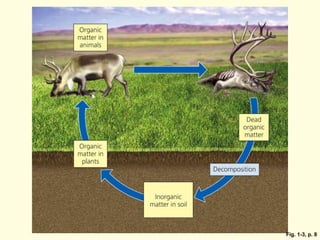
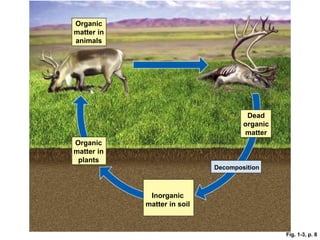
Fig. 1-3, p. 8
Dead
organic
matter
Organic
matter in
animals
Organic
matter in
plants
Inorganic
matter in soil
Decomposition
Fig. 1-3, p. 8
Environmental Sustainability
• Trade-offs (compromises)
• Sound science
• Individuals matter
–Ideas
–Technology
–Political pressure
–Economic pressure
Sustainable Living from Natural
Capital
• Environmentally sustainable
society
• Financial capital and financial income
• Natural capital and natural income
• Living sustainably: living on natural
income only
1-2 How Are Our Ecological
Footprints Affecting the Earth?
• Concept 1-2 As our ecological
footprints grow, we deplete and
degrade more of the earth’s natural
capital.
Natural Resources (1)
• Perpetual – renewed continuously
– Solar energy
• Renewable – days to centuries
– Water
– Air
– Grasslands
– Forest
– Soils
– Fish populations
Natural Resources (2)
• Sustainable yield
–Highest use while maintaining
supply
• Environmental degradation
–Use exceeds natural replacement
rate
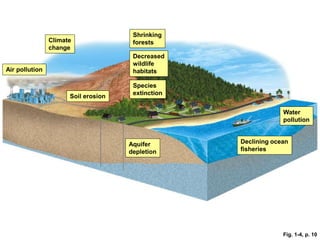
Fig. 1-4, p. 10
Fig. 1-4, p. 10
Water
pollution
Air pollution
Shrinking
forests
Climate
change
Soil erosion
Aquifer
depletion
Decreased
wildlife
habitats
Species
extinction
Declining ocean
fisheries
Tragedy of the Commons
• Environmental degradation of openly
shared renewable resources
• Users focus on their own selfish, short-
term gain
• Works when only a small number of users
• Big part of why humans now live
unsustainably
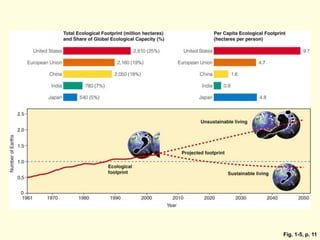
Ecological Footprint (1)
• Ecological footprint
– The amount of biologically productive land
and water needed to indefinitely supply the
people in a given area with renewable
resources
– Also includes the land and water necessary to
absorb and recycle wastes and pollution
• Per capita ecological footprint
– Average ecological footprint of an individual in
a given area
Ecological Footprint (2)
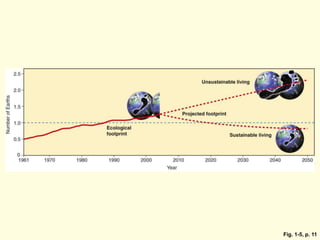
• Ecological deficit
–Total ecological footprint greater than
biological capacity for resource renewal
and absorption of wastes and pollution
–2008 study: at least 30% global excess
–88% for high-income countries
–Humans currently need 1.3 earths
Fig. 1-5, p. 11
Fig. 1-5, p. 11
Stepped Art
Nonrenewable Resources
• Nonrenewable – fixed quantities
–Energy (fossil fuels)
–Metallic minerals
–Nonmetallic minerals
• Recycling
• Reuse
Fig. 1-5, p. 11
Developed Countries Have
Higher Impacts
• Developed countries
–United States, Japan, New
Zealand, most of Europe, some
others
–19% world population
–Use 88% of world’s resources
–Create 75% of world’s pollution
Supplement 3, Fig. 5, p. S9
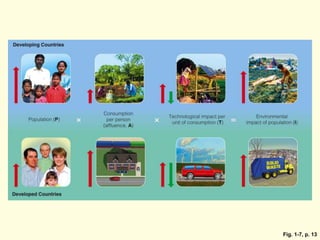
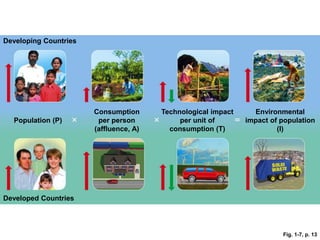
IPAT Environmental Impact
Model
• Determines impact of a country or
regions
• I = P x A x T
• I = environmental impact
• P = population size
• A = affluence of population
• T = technology influence
Fig. 1-7, p. 13
Fig. 1-7, p. 13
Environmental
impact of population
(I)
Developing Countries
Population (P)
Developed Countries
Consumption
per person
(affluence, A)
Technological impact
per unit of
consumption (T)
Developing Countries
• 81% world population
• Middle income: Brazil, China, India
• Least developed: Haiti, Nigeria,
Nicaragua
• Use far fewer resources per capita
than developed countries
• Smaller per capita ecological footprint
1-3 What Is Pollution and What
Can We Do about It?
• Concept 1-3 Preventing pollution is
more effective and less costly than
cleaning up pollution.
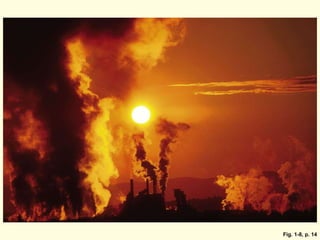
Pollution
• What is pollution?
• Point sources
• Nonpoint sources
• Unwanted effects of pollution
Fig. 1-8, p. 14
Solutions to Pollution
• Pollution prevention
– Prevent pollutants from entering the
environment
• Pollution cleanup
– After pollutants released into environment
– Temporary fix only
– Often results in different pollution: burning
garbage
– Dispersed pollutants usually too costly to
clean up effectively
1-4 Why Do We Have
Environmental Problems?
• Major causes of environmental
problems are population growth,
wasteful and unsustainable resource
use, and exclusion of harmful
environmental costs from the market
prices of goods and services.
Causes of Environmental
Problems
• Exponential population growth
• Wasteful and unsustainable resource
use
• Poverty
• Failure to include environmental costs
of goods and services in market
prices
Fig. 1-9, p. 15
Fig. 1-9, p. 15
Population
growth
Unsustainable
resource use
Poverty Excluding
environmental
costs from
market prices
Causes of Environmental Problems
Stepped Art
Causes of Environmental Problems
Excluding
environmental
costs from
market prices
Poverty
Unsustainable
resource use
Population
growth
Fig. 1-9, p. 15
Fig. 1-10, p. 16
Fig. 1-1, p. 1
Hunting
and gathering
Agricultural revolution
Industrial revolution
Black Death—the Plague
Industrial
revolution
Fig. 1-10, p. 16
?
2-5 million
years
13
12
11
10
9
8
7
6
5
4
3
2
1
0
8000 6000 4000 2000 2000 2100
B.C. A.D.
Fig. 1-11, p. 16
Fig. 1-12, p. 17
Fig. 1-12, p. 17
Number of people
(% of world's population)
0.93 billion (14%)
1 billion (15%)
1 billion (15%)
1.1 billion (16%)
2 billion (29%)
2 billion (29%)
2.5 billion (37%)
Enough food
for good health
Adequate
housing
Adequate
health care
Clean drinking
water
Electricity
Enough fuel for
heating and cooking
Adequate
sanitation facilities
Lack of
access to
Fig. 1-13, p. 17
Environmental Effects of
Affluence
• Harmful effects
– High per-capita consumption and waste of
resources – large ecological footprints
– Advertising – more makes you happy
– Affluenza
• Beneficial effects
– Concern for environmental quality
– Provide money for environmental causes
– Reduced population growth
Evaluating Full Cost of
Resources Use
• Prices do not include the value of natural
capital and harmful environmental costs
• Examples
– Clear-cutting + habitat loss
– Commercial fishing + depletion of fish stocks
• Tax breaks
• Subsidies
Different Environmental Views
• Environmental worldview
• Environmental ethics
• Planetary management worldview
• Stewardship worldview
• Environmental wisdom worldview
1-5 How Can we Live More
Sustainably? Three Big Ideas
• We can live more sustainably by
relying more on solar energy,
preserving biodiversity, and not
disrupting the earth’s natural chemical
recycling processes.
Three Big Ideas for
Sustainability
• Rely more on renewable energy from
the sun
• Protect biodiversity
• Do not disrupt earth’s natural
chemical cycles
Animation: Levels of organization
Animation: Two views of
economics
Animation: Resources depletion
and degradation interaction
Animation: Exponential growth
Animation: Capture-recapture
method
Animation: Life history patterns
Video: Cahuachi Excavation
PLAY
VIDEO
Video: Easter Island
PLAY
VIDEO

chapter1.ppt

  • 1.
    ENVIRONMENTAL SCIENCE 13e CHAPTER1: Environmental Problems, Their Causes, and Sustainability
  • 2.
    Core Case Study: It’sAll About Sustainability (1) • “The ability of the earth’s various natural systems and human cultural systems and economies to survive and adapt to changing environmental conditions indefinitely." • United Nations Millennium Ecosystem Assessment: – Human actions of put long-term sustainability in doubt • Life on earth for 3.5 billion years – Survived many catastrophes – Humans have caused major changes in the last 500 years – Humans are smart, but are they wise?
  • 3.
    Core Case Study: It’sAll About Sustainability (2) • Sustainability depends on three key principles • 1. Solar energy – Warms earth – Provides energy for plants to make food for other organisms – Powers winds – Powers the hydrologic cycle – which includes flowing water – Provides energy: wind and moving water can be turned into electricity
  • 4.
    Core Case Study: It’sAll About Sustainability (3) • 2. Biodiversity (biological diversity) – Large variety of species – Many ecosystems • Deserts • Forests • Oceans • Grasslands – Species and systems renew soil and purify air and water.
  • 5.
    Core Case Study: It’sAll About Sustainability (4) • 3. Chemical Cycling –Natural processes recycle nutrients –Recycling is necessary because there is a fixed supply of these nutrients on earth –Nutrients cycle from living organisms to the nonliving environment and back –Chemical cycles are necessary to sustain life
  • 6.
  • 7.
    Fig. 1-1, p.5 Solar Energy Biodiversity Chemical Cycling
  • 8.
    Solutions • Understand ourenvironment • Practice sustainability
  • 9.
    1-1 What Isan Environmentally Sustainable Society? • Concept 1-1A Our lives and economies depend on energy from the sun and natural resources and natural services (natural capital) provided by the earth. • Concept 1-1B Living sustainably means living off earth’s natural income without depleting or degrading the natural capital that supplies it.
  • 10.
    Studying Connections inNature • Environment • Environmental Science • Ecology • Organisms • Species • Ecosystem • Environmentalism
  • 11.
    Living More Sustainably •Sustainability – central theme • Natural capital –Natural resources –Natural services –Photosynthesis • Powered by solar energy • Human activities degrade natural capital
  • 12.
    Natural Resources • Materials –Renewable •Air, water, soil, plants –Nonrenewable • Minerals, oil, coal
  • 13.
    Natural Services • Functionsof nature –Purification of air, water –Nutrient cycling • From the environment to organisms and back to the environment
  • 14.
  • 15.
  • 16.
  • 17.
  • 18.
    Environmental Sustainability • Trade-offs(compromises) • Sound science • Individuals matter –Ideas –Technology –Political pressure –Economic pressure
  • 19.
    Sustainable Living fromNatural Capital • Environmentally sustainable society • Financial capital and financial income • Natural capital and natural income • Living sustainably: living on natural income only
  • 20.
    1-2 How AreOur Ecological Footprints Affecting the Earth? • Concept 1-2 As our ecological footprints grow, we deplete and degrade more of the earth’s natural capital.
  • 21.
    Natural Resources (1) •Perpetual – renewed continuously – Solar energy • Renewable – days to centuries – Water – Air – Grasslands – Forest – Soils – Fish populations
  • 22.
    Natural Resources (2) •Sustainable yield –Highest use while maintaining supply • Environmental degradation –Use exceeds natural replacement rate
  • 23.
  • 24.
    Fig. 1-4, p.10 Water pollution Air pollution Shrinking forests Climate change Soil erosion Aquifer depletion Decreased wildlife habitats Species extinction Declining ocean fisheries
  • 25.
    Tragedy of theCommons • Environmental degradation of openly shared renewable resources • Users focus on their own selfish, short- term gain • Works when only a small number of users • Big part of why humans now live unsustainably
  • 26.
    Ecological Footprint (1) •Ecological footprint – The amount of biologically productive land and water needed to indefinitely supply the people in a given area with renewable resources – Also includes the land and water necessary to absorb and recycle wastes and pollution • Per capita ecological footprint – Average ecological footprint of an individual in a given area
  • 27.
    Ecological Footprint (2) •Ecological deficit –Total ecological footprint greater than biological capacity for resource renewal and absorption of wastes and pollution –2008 study: at least 30% global excess –88% for high-income countries –Humans currently need 1.3 earths
  • 28.
  • 29.
    Fig. 1-5, p.11 Stepped Art
  • 30.
    Nonrenewable Resources • Nonrenewable– fixed quantities –Energy (fossil fuels) –Metallic minerals –Nonmetallic minerals • Recycling • Reuse
  • 31.
  • 32.
    Developed Countries Have HigherImpacts • Developed countries –United States, Japan, New Zealand, most of Europe, some others –19% world population –Use 88% of world’s resources –Create 75% of world’s pollution
  • 33.
  • 34.
    IPAT Environmental Impact Model •Determines impact of a country or regions • I = P x A x T • I = environmental impact • P = population size • A = affluence of population • T = technology influence
  • 35.
  • 36.
    Fig. 1-7, p.13 Environmental impact of population (I) Developing Countries Population (P) Developed Countries Consumption per person (affluence, A) Technological impact per unit of consumption (T)
  • 37.
    Developing Countries • 81%world population • Middle income: Brazil, China, India • Least developed: Haiti, Nigeria, Nicaragua • Use far fewer resources per capita than developed countries • Smaller per capita ecological footprint
  • 38.
    1-3 What IsPollution and What Can We Do about It? • Concept 1-3 Preventing pollution is more effective and less costly than cleaning up pollution.
  • 39.
    Pollution • What ispollution? • Point sources • Nonpoint sources • Unwanted effects of pollution
  • 40.
  • 41.
    Solutions to Pollution •Pollution prevention – Prevent pollutants from entering the environment • Pollution cleanup – After pollutants released into environment – Temporary fix only – Often results in different pollution: burning garbage – Dispersed pollutants usually too costly to clean up effectively
  • 42.
    1-4 Why DoWe Have Environmental Problems? • Major causes of environmental problems are population growth, wasteful and unsustainable resource use, and exclusion of harmful environmental costs from the market prices of goods and services.
  • 43.
    Causes of Environmental Problems •Exponential population growth • Wasteful and unsustainable resource use • Poverty • Failure to include environmental costs of goods and services in market prices
  • 44.
  • 45.
    Fig. 1-9, p.15 Population growth Unsustainable resource use Poverty Excluding environmental costs from market prices Causes of Environmental Problems
  • 46.
    Stepped Art Causes ofEnvironmental Problems Excluding environmental costs from market prices Poverty Unsustainable resource use Population growth Fig. 1-9, p. 15
  • 47.
  • 48.
    Fig. 1-1, p.1 Hunting and gathering Agricultural revolution Industrial revolution Black Death—the Plague Industrial revolution Fig. 1-10, p. 16 ? 2-5 million years 13 12 11 10 9 8 7 6 5 4 3 2 1 0 8000 6000 4000 2000 2000 2100 B.C. A.D.
  • 49.
  • 50.
  • 51.
    Fig. 1-12, p.17 Number of people (% of world's population) 0.93 billion (14%) 1 billion (15%) 1 billion (15%) 1.1 billion (16%) 2 billion (29%) 2 billion (29%) 2.5 billion (37%) Enough food for good health Adequate housing Adequate health care Clean drinking water Electricity Enough fuel for heating and cooking Adequate sanitation facilities Lack of access to
  • 52.
  • 53.
    Environmental Effects of Affluence •Harmful effects – High per-capita consumption and waste of resources – large ecological footprints – Advertising – more makes you happy – Affluenza • Beneficial effects – Concern for environmental quality – Provide money for environmental causes – Reduced population growth
  • 54.
    Evaluating Full Costof Resources Use • Prices do not include the value of natural capital and harmful environmental costs • Examples – Clear-cutting + habitat loss – Commercial fishing + depletion of fish stocks • Tax breaks • Subsidies
  • 55.
    Different Environmental Views •Environmental worldview • Environmental ethics • Planetary management worldview • Stewardship worldview • Environmental wisdom worldview
  • 56.
    1-5 How Canwe Live More Sustainably? Three Big Ideas • We can live more sustainably by relying more on solar energy, preserving biodiversity, and not disrupting the earth’s natural chemical recycling processes.
  • 57.
    Three Big Ideasfor Sustainability • Rely more on renewable energy from the sun • Protect biodiversity • Do not disrupt earth’s natural chemical cycles
  • 58.
  • 59.
  • 60.
    Animation: Resources depletion anddegradation interaction
  • 61.
  • 62.
  • 63.
  • 64.
  • 65.