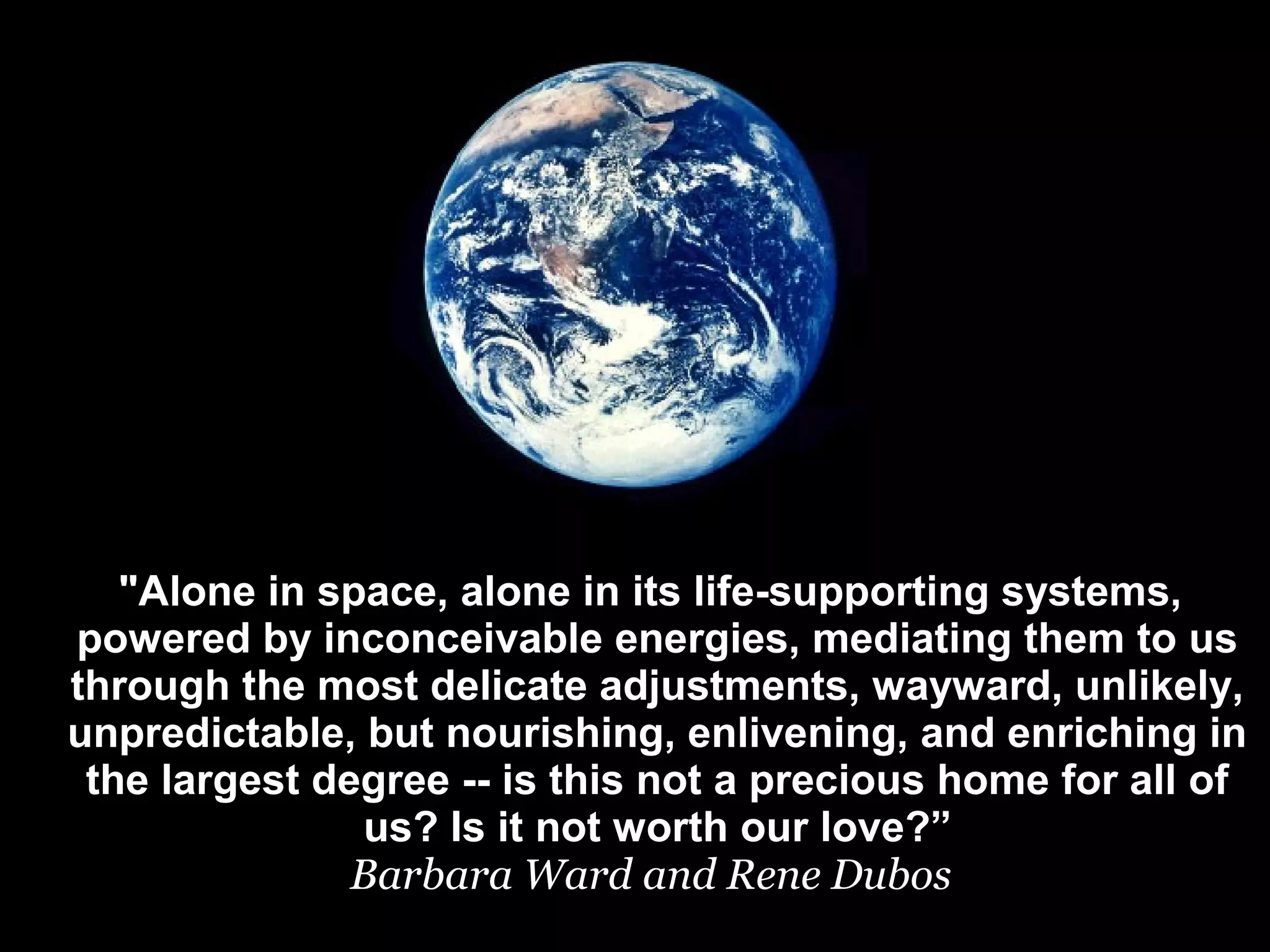
"Alone in space, alone in its life-supporting systems,
powered by inconceivable energies, mediating them to us
through the most delicate adjustments, wayward, unlikely,
unpredictable, but nourishing, enlivening, and enriching in
the largest degree -- is this not a precious home for all of
us? Is it not worth our love?”
Barbara Ward and Rene Dubos
Class Business
Absent students
Popsicle stick
File folder tab
Please get ready for first
lecture
Environmental Problems,
Their Causes, and
Sustainability
Ch. 1
Miller and Spoolman 16th ed.
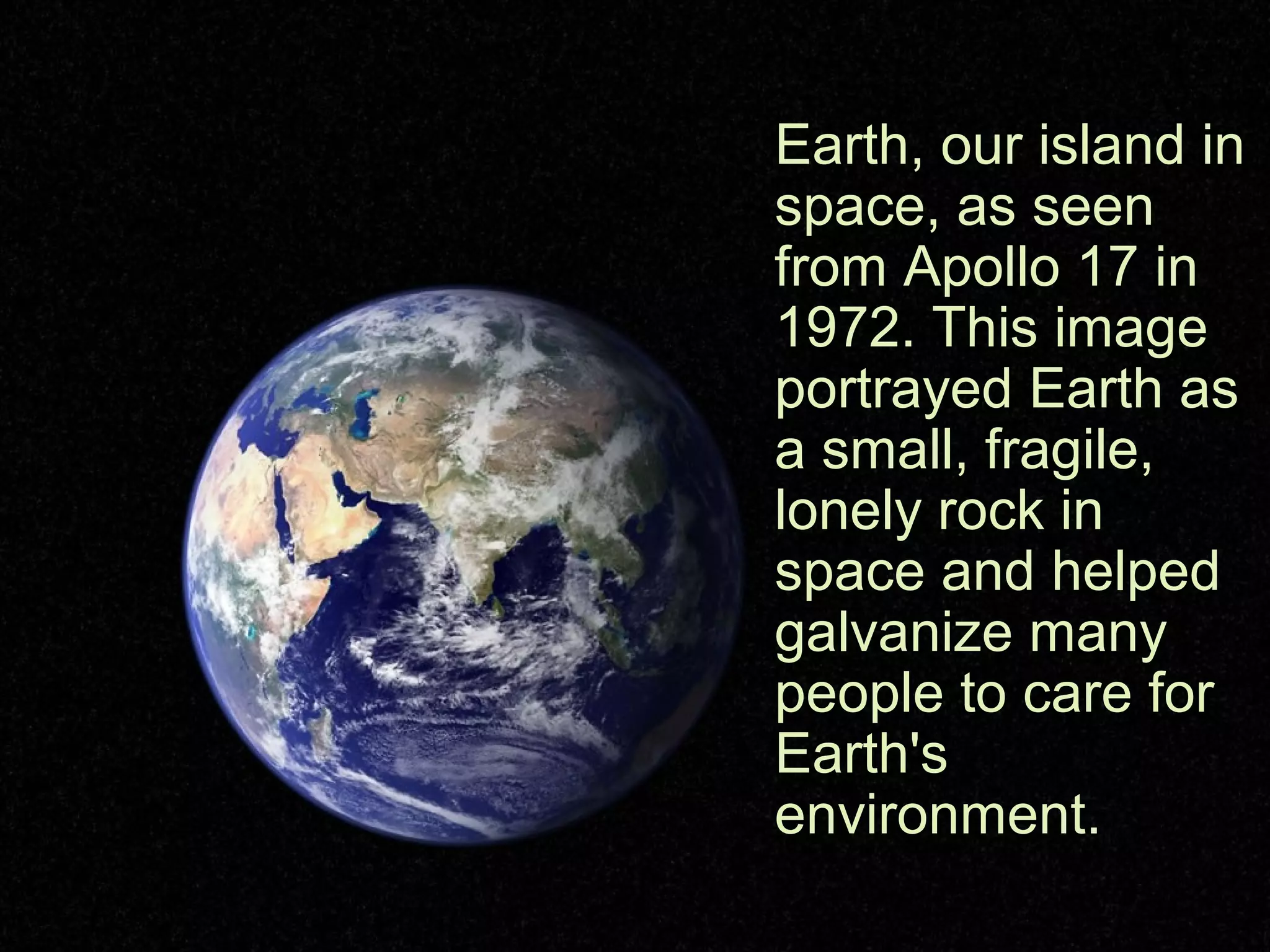
Earth, our island in
space, as seen
from Apollo 17 in
1972. This image
portrayed Earth as
a small, fragile,
lonely rock in
space and helped
galvanize many
people to care for
Earth's
environment.
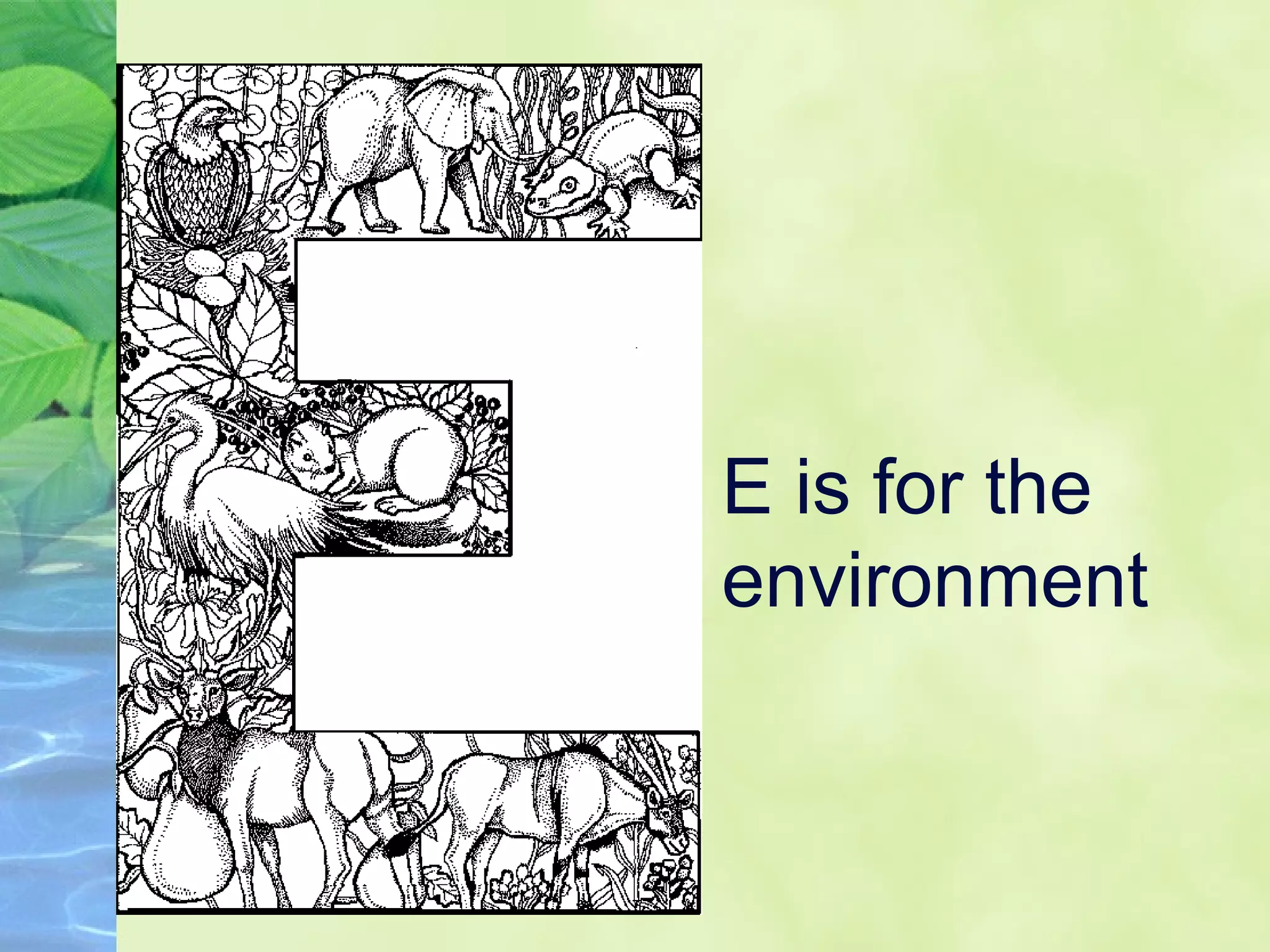
E is for the
environment
To aid in your note taking
1. Your notebook should be interesting
to look at
Feel free to paste in and color the picture,
if you so choose :)
Vocabulary is in red
Super-important-don’t-miss-this
concepts are underlined
General
Overview
There are four major themes of your book:
Sustainability
Human impact
Solutions
Trade offs
The questions we will ask are:
How can we maintain or improve the environment and
our society?
What are we doing to damage these two?
What are some ways we can repair and prevent
problems?
What will we have to sacrifice for the greatest good?
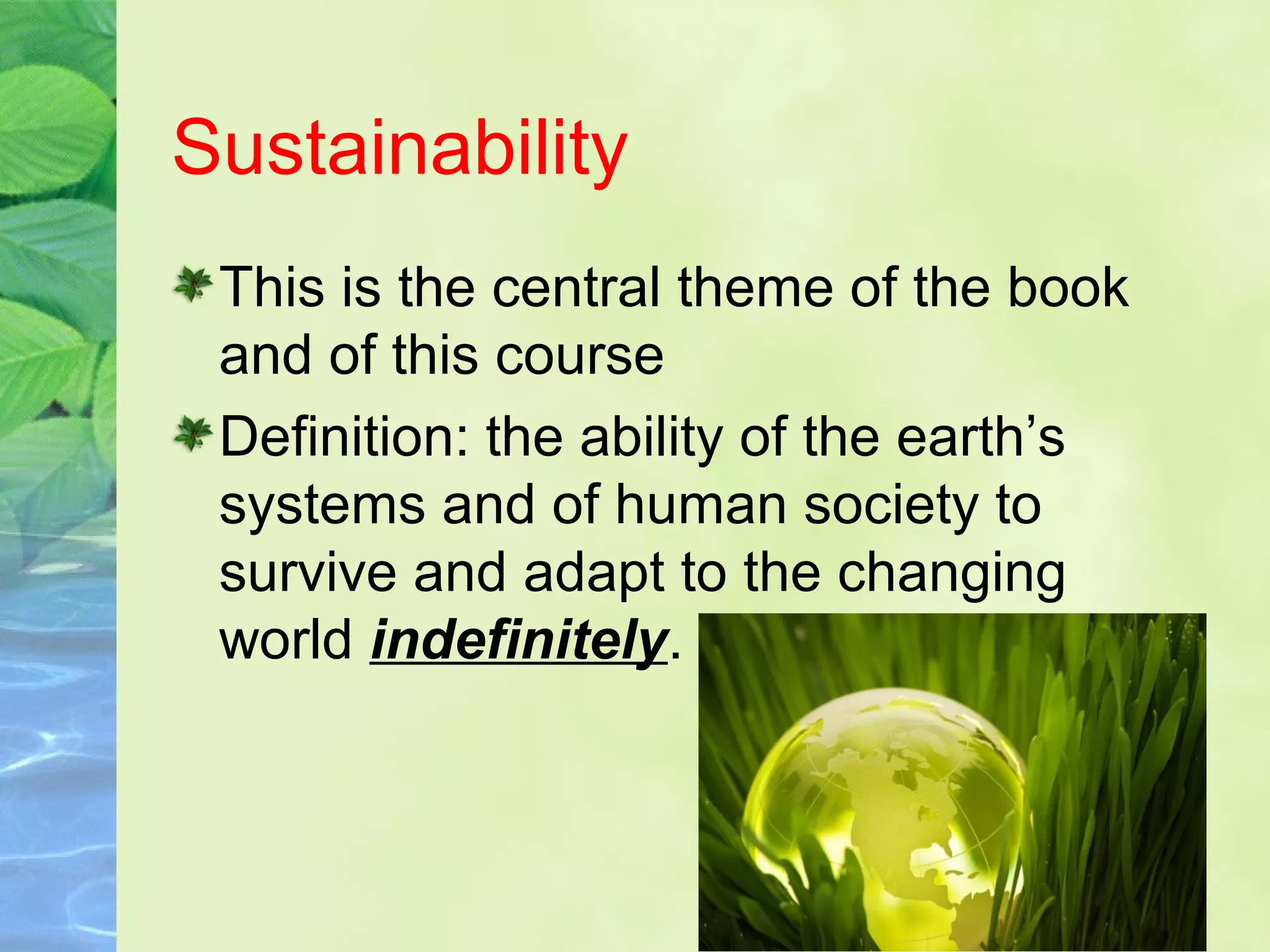
Sustainability
This is the central theme of the book
and of this course
Definition: the ability of the earth’s
systems and of human society to
survive and adapt to the changing
world indefinitely.
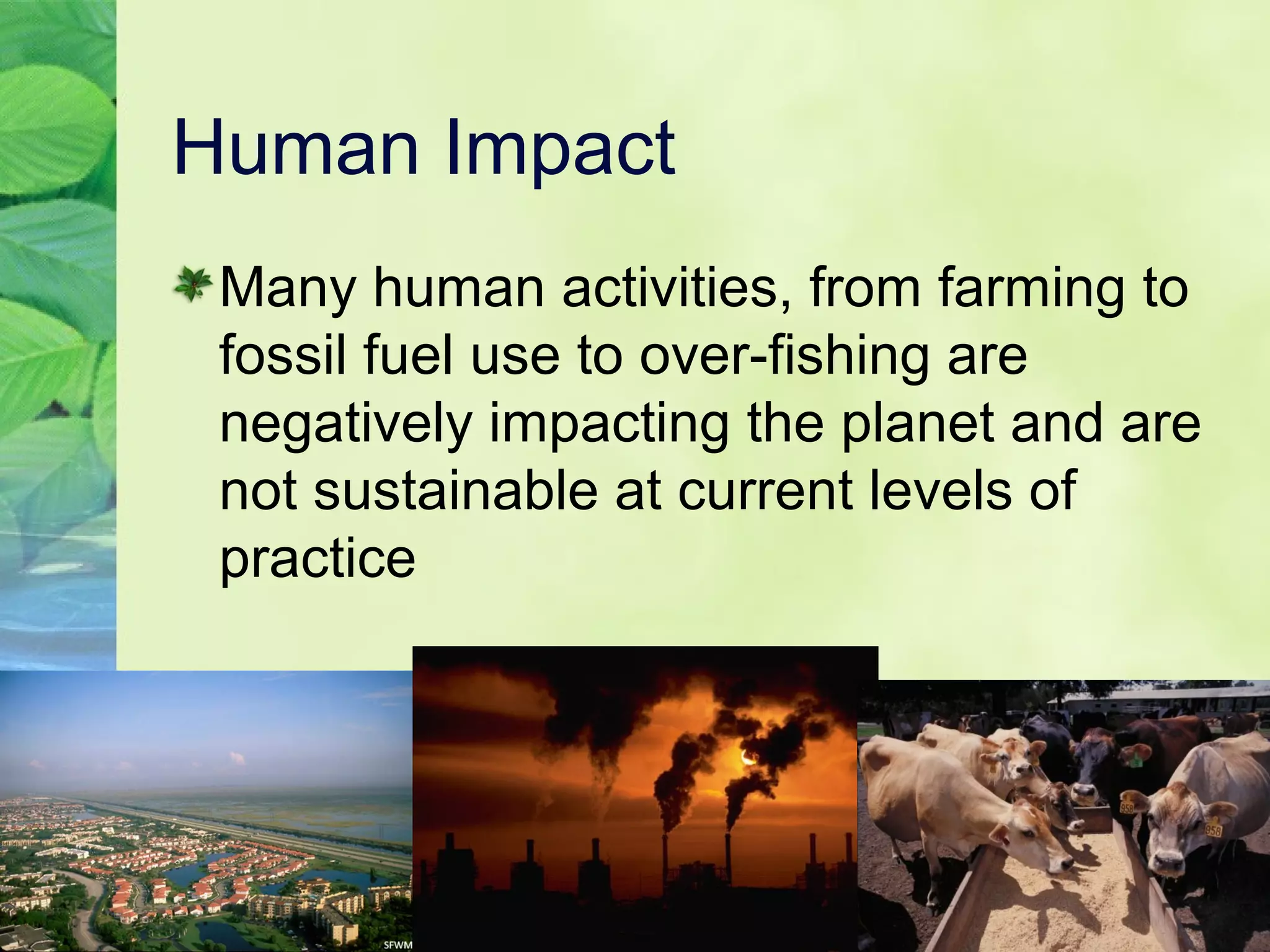
Human Impact
Many human activities, from farming to
fossil fuel use to over-fishing are
negatively impacting the planet and are
not sustainable at current levels of
practice
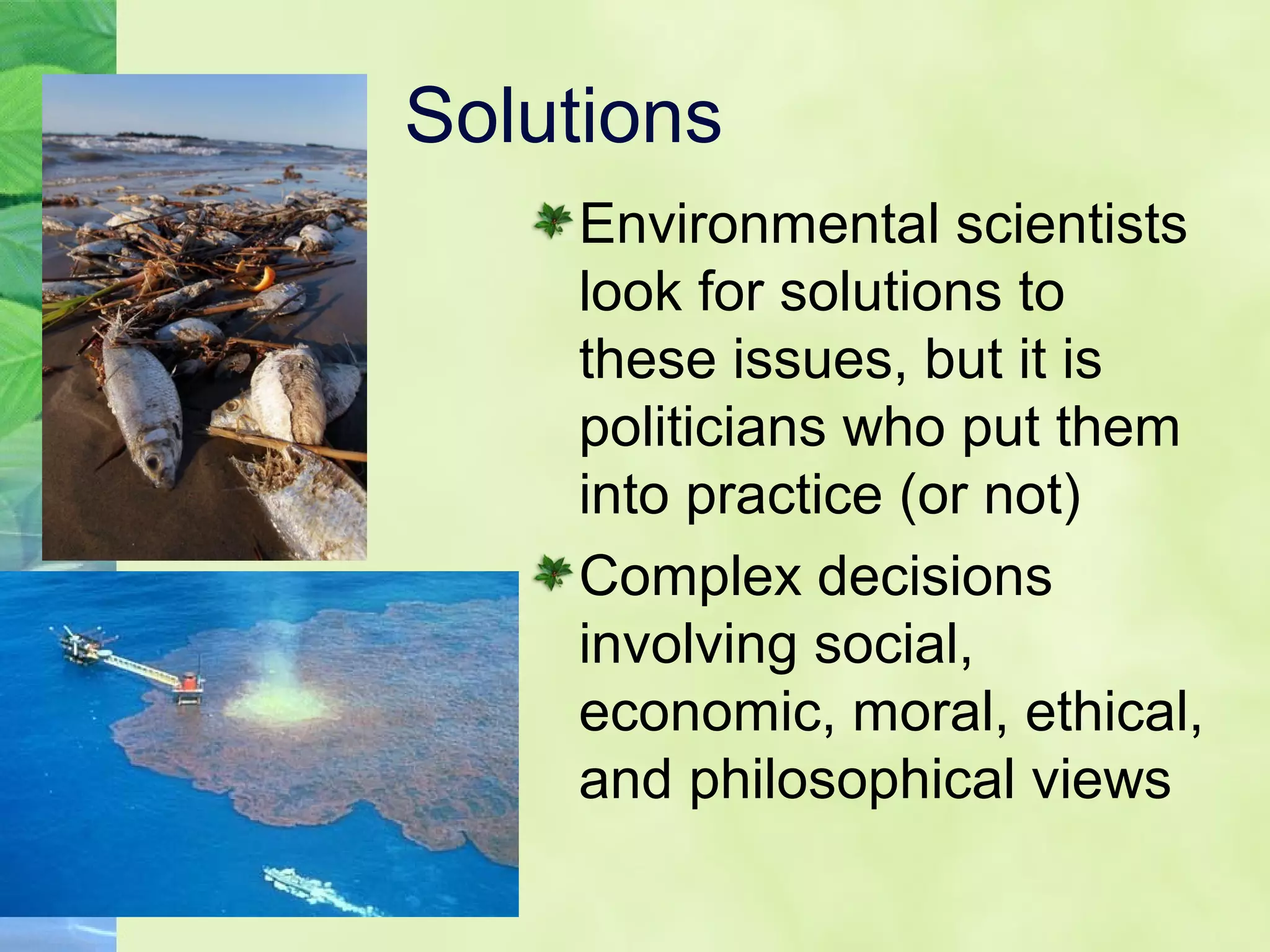
Solutions
Environmental scientists
look for solutions to
these issues, but it is
politicians who put them
into practice (or not)
Complex decisions
involving social,
economic, moral, ethical,
and philosophical views
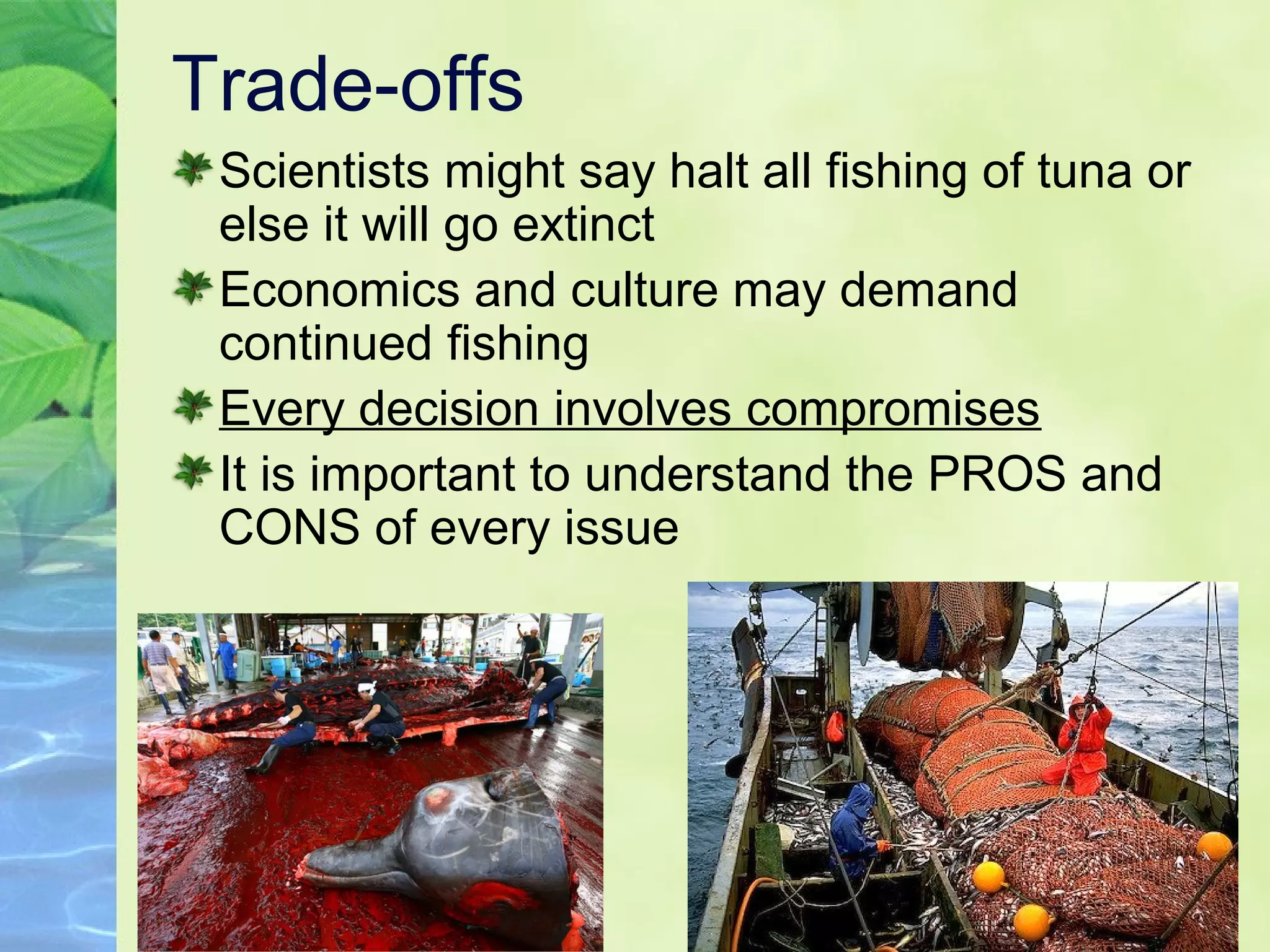
Trade-offs
Scientists might say halt all fishing of tuna or
else it will go extinct
Economics and culture may demand
continued fishing
Every decision involves compromises
It is important to understand the PROS and
CONS of every issue
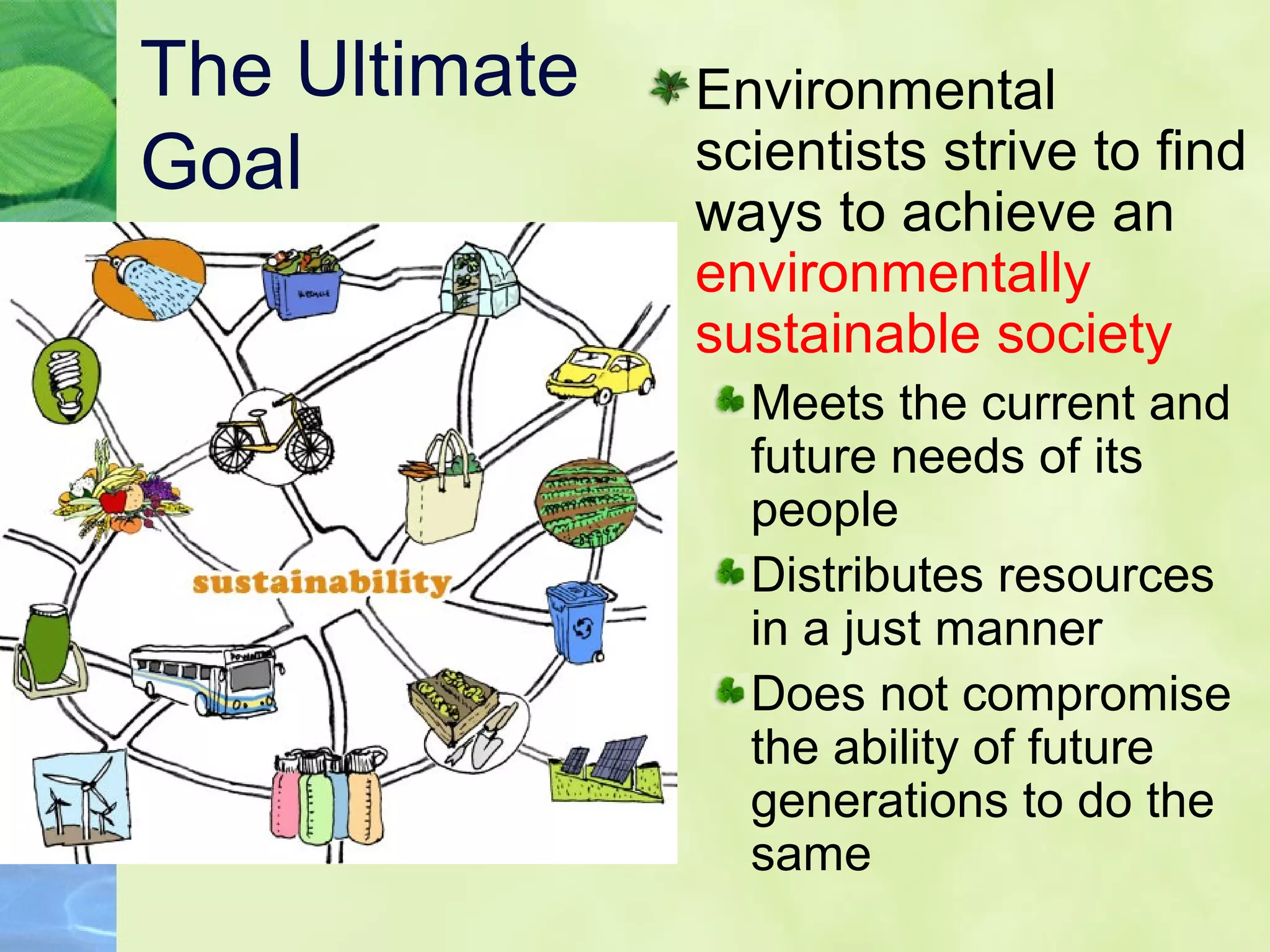
The Ultimate
Goal
Environmental
scientists strive to find
ways to achieve an
environmentally
sustainable society
Meets the current and
future needs of its
people
Distributes resources
in a just manner
Does not compromise
the ability of future
generations to do the
same
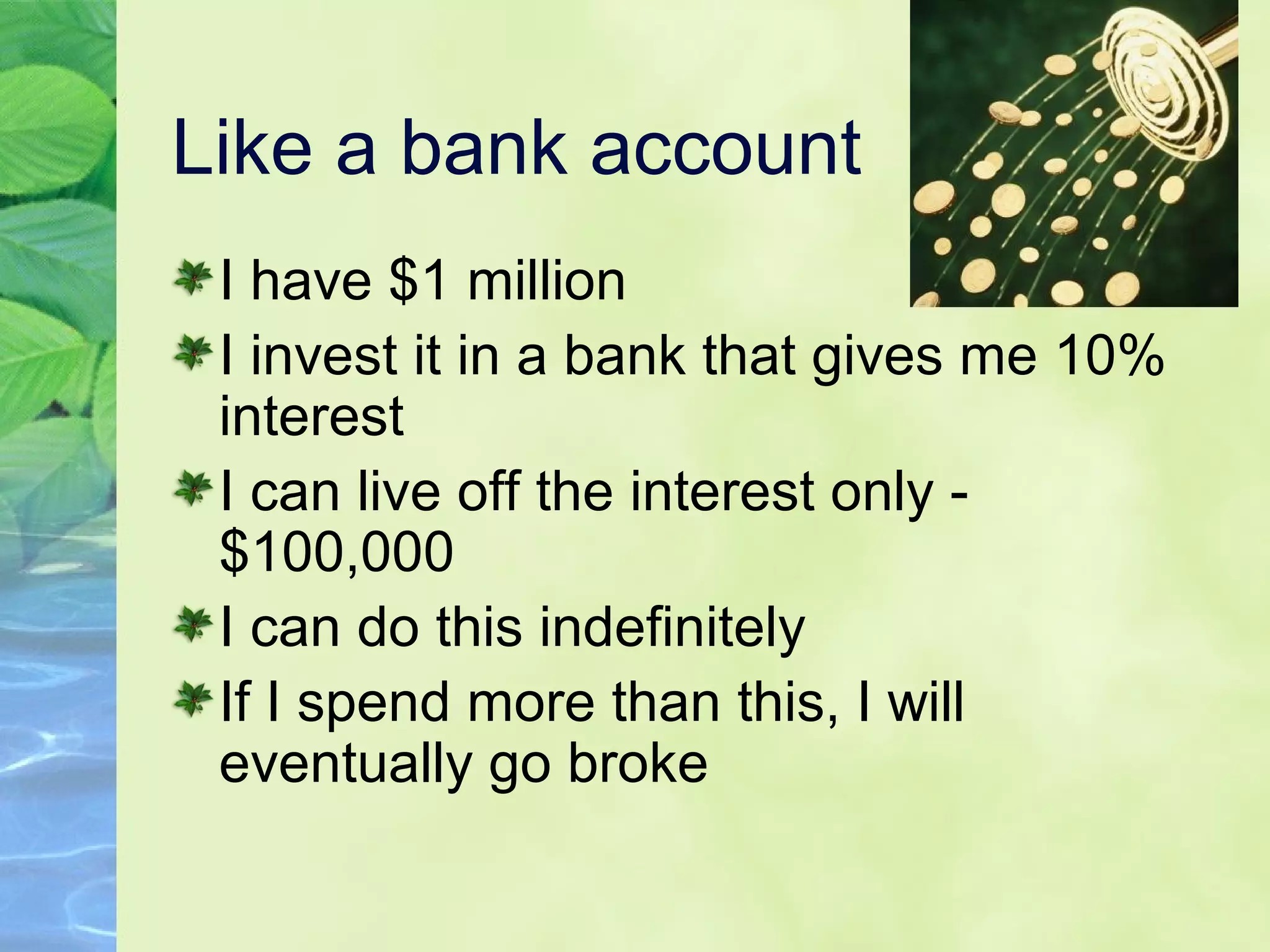
Like a bank account
I have $1 million
I invest it in a bank that gives me 10%
interest
I can live off the interest only -
$100,000
I can do this indefinitely
If I spend more than this, I will
eventually go broke
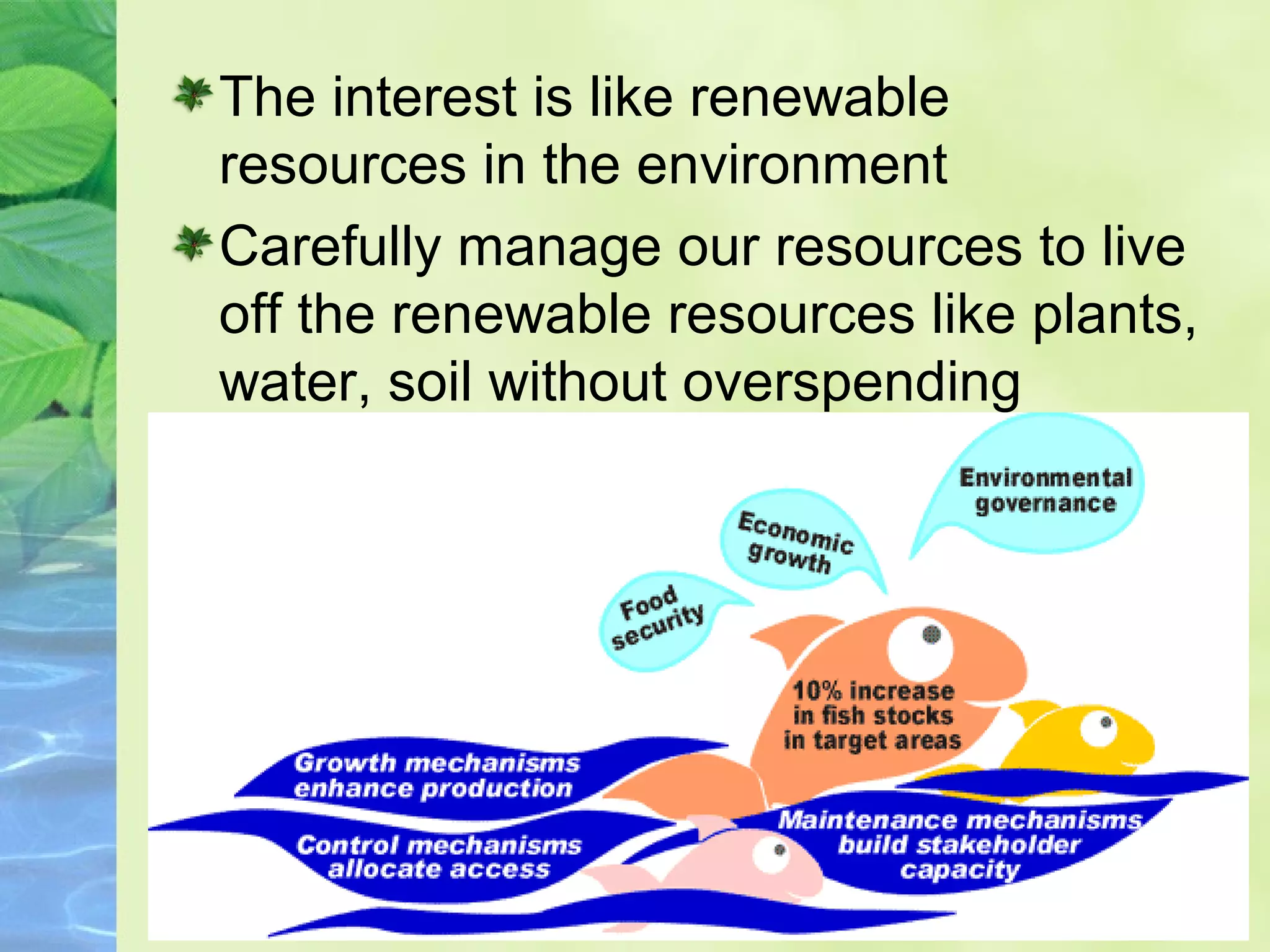
The interest is like renewable
resources in the environment
Carefully manage our resources to live
off the renewable resources like plants,
water, soil without overspending
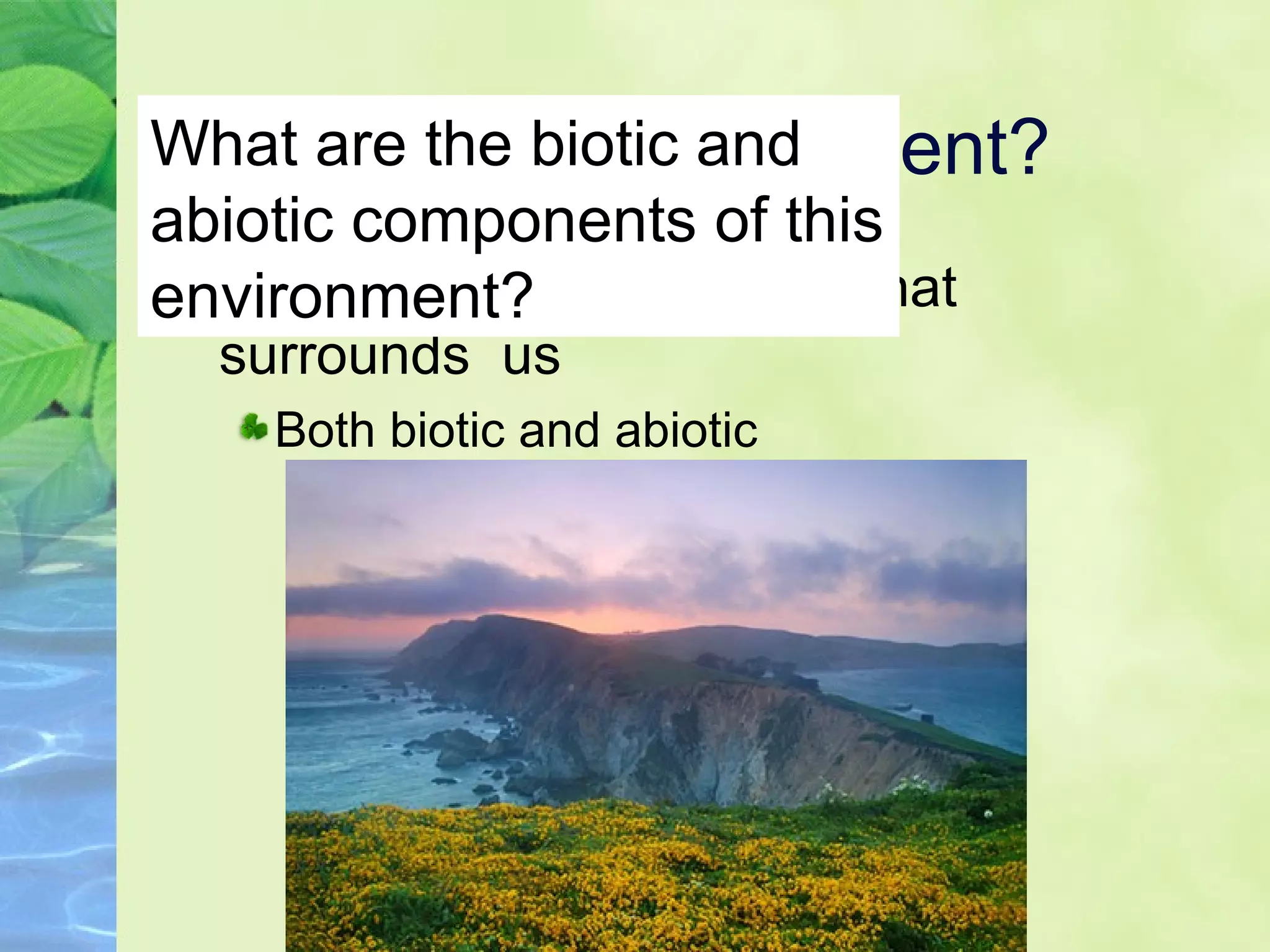
What is the environment?
Environment - everything that
surrounds us
Both biotic and abiotic
What are the biotic and
abiotic components of this
environment?
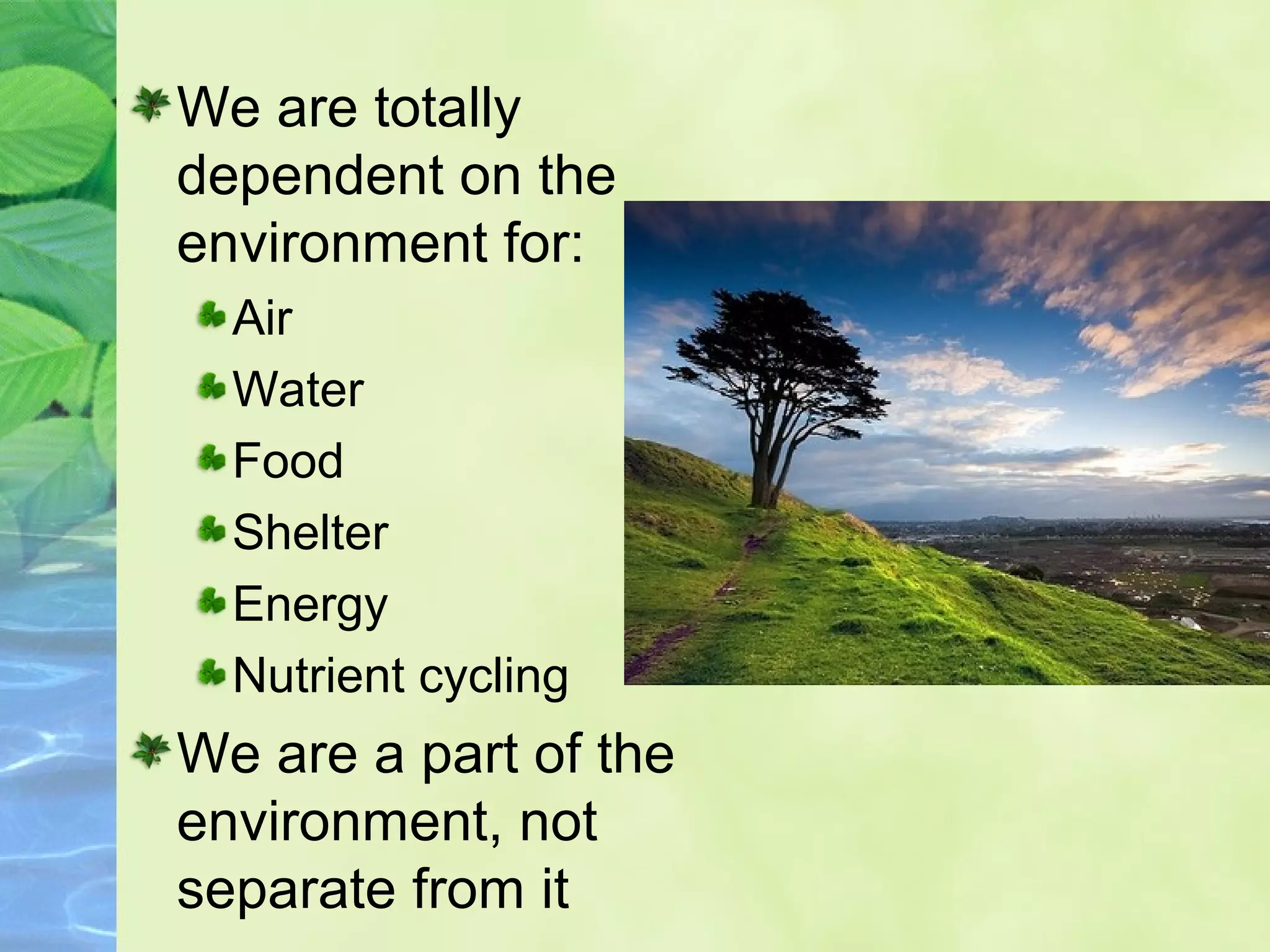
We are totally
dependent on the
environment for:
Air
Water
Food
Shelter
Energy
Nutrient cycling
We are a part of the
environment, not
separate from it
What are
we trying to
sustain?
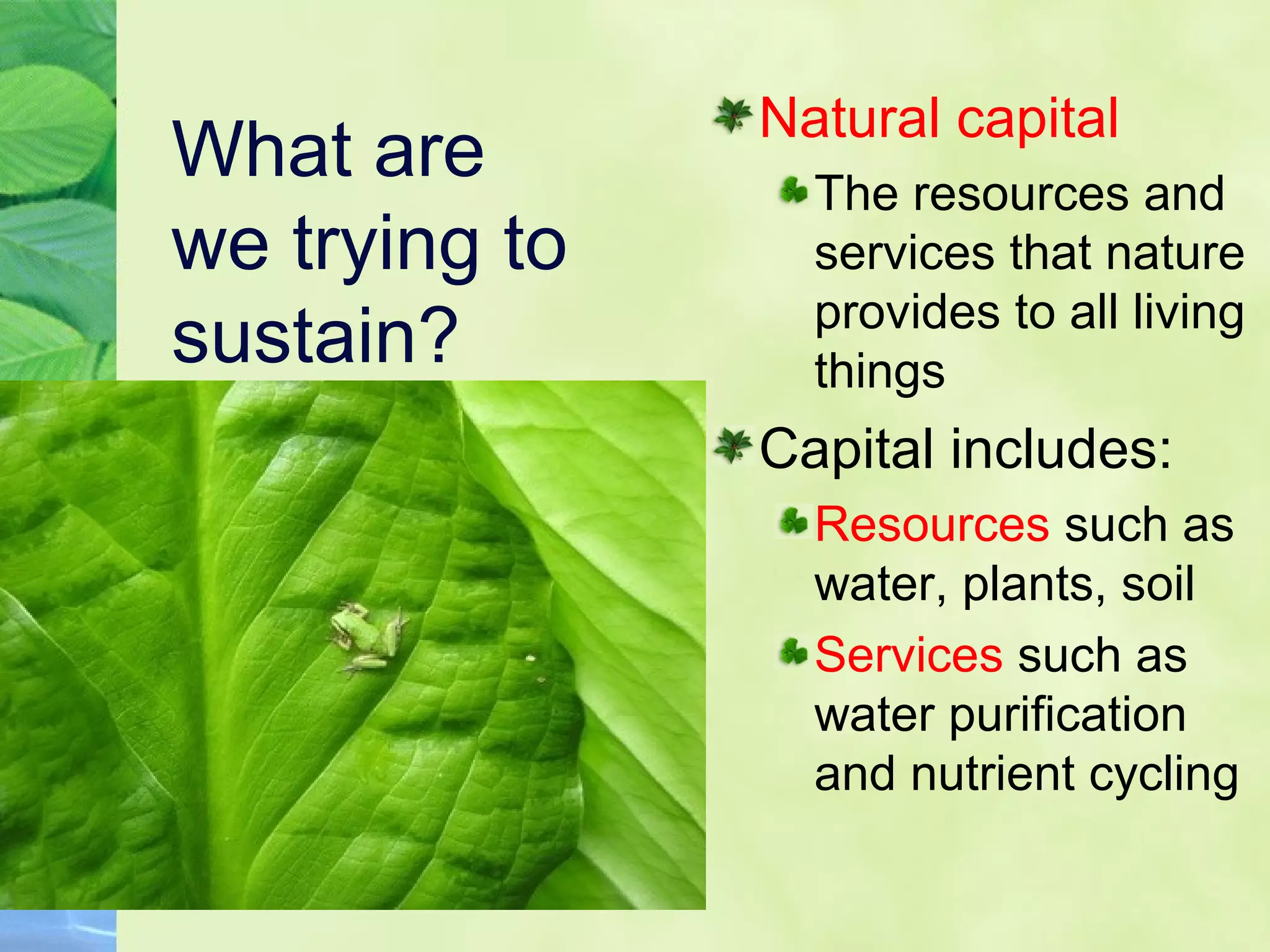
Natural capital
The resources and
services that nature
provides to all living
things
Capital includes:
Resources such as
water, plants, soil
Services such as
water purification
and nutrient cycling
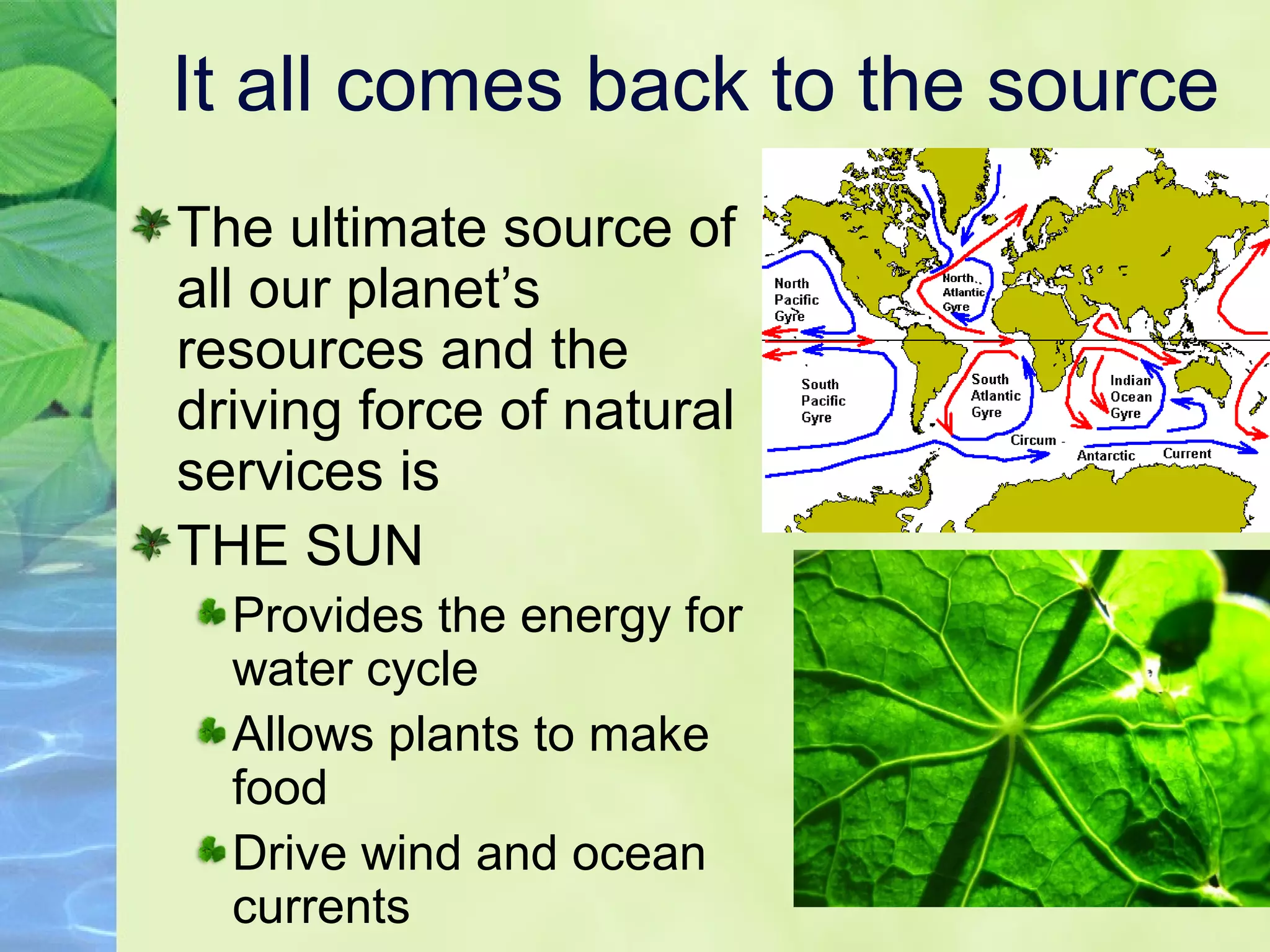
It all comes back to the source
The ultimate source of
all our planet’s
resources and the
driving force of natural
services is
THE SUN
Provides the energy for
water cycle
Allows plants to make
food
Drive wind and ocean
currents
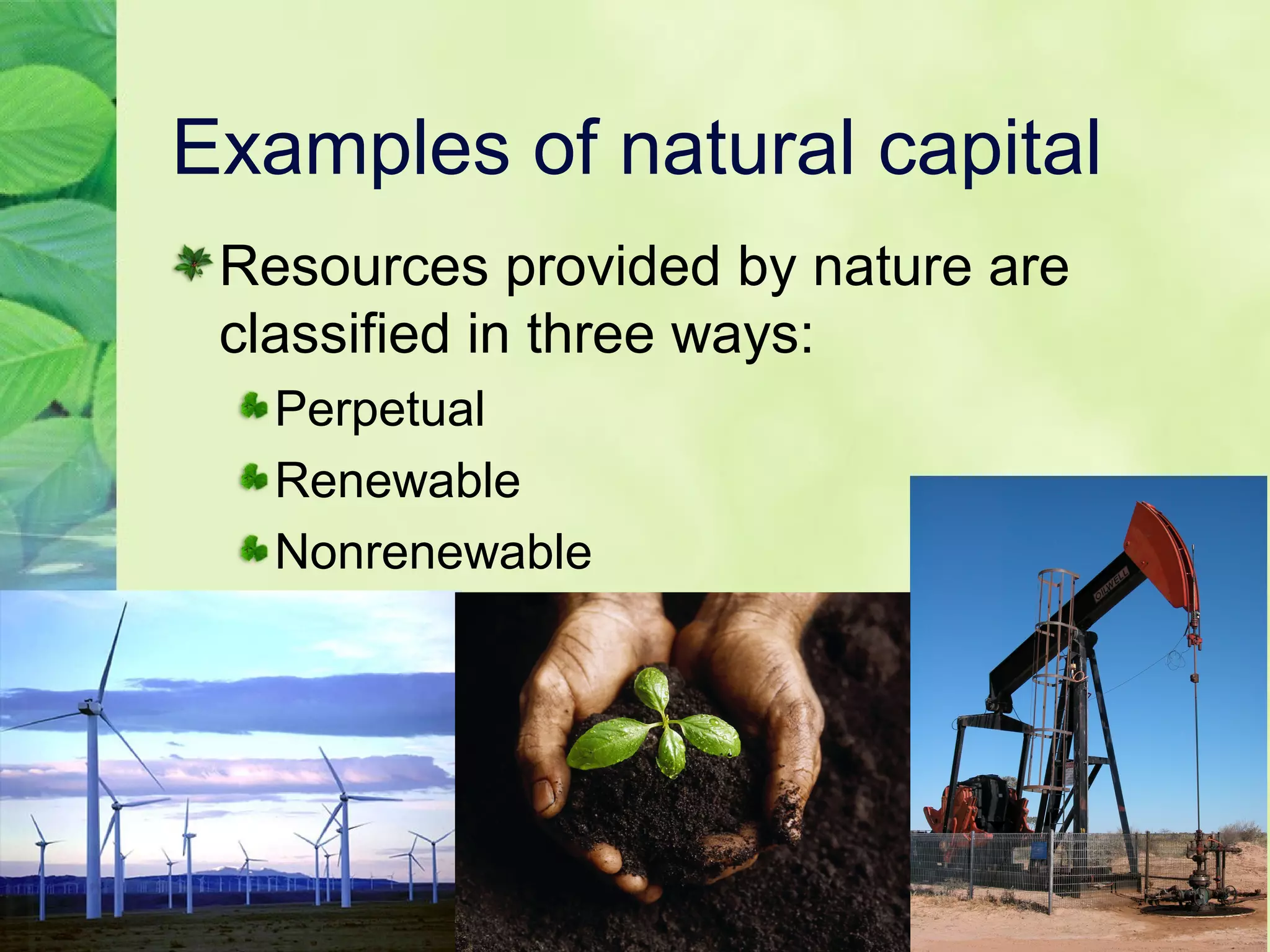
Examples of natural capital
Resources provided by nature are
classified in three ways:
Perpetual
Renewable
Nonrenewable
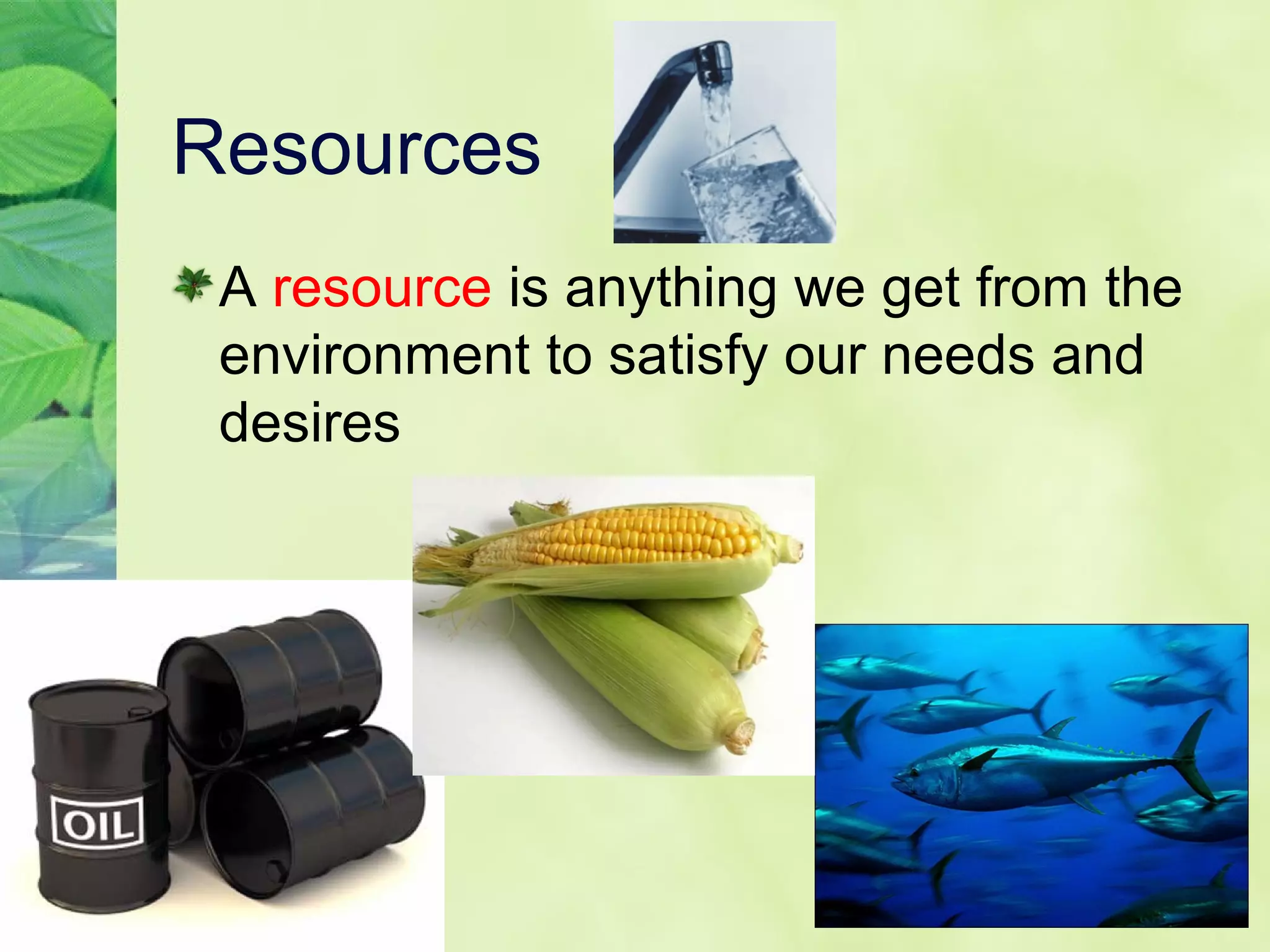
Resources
A resource is anything we get from the
environment to satisfy our needs and
desires
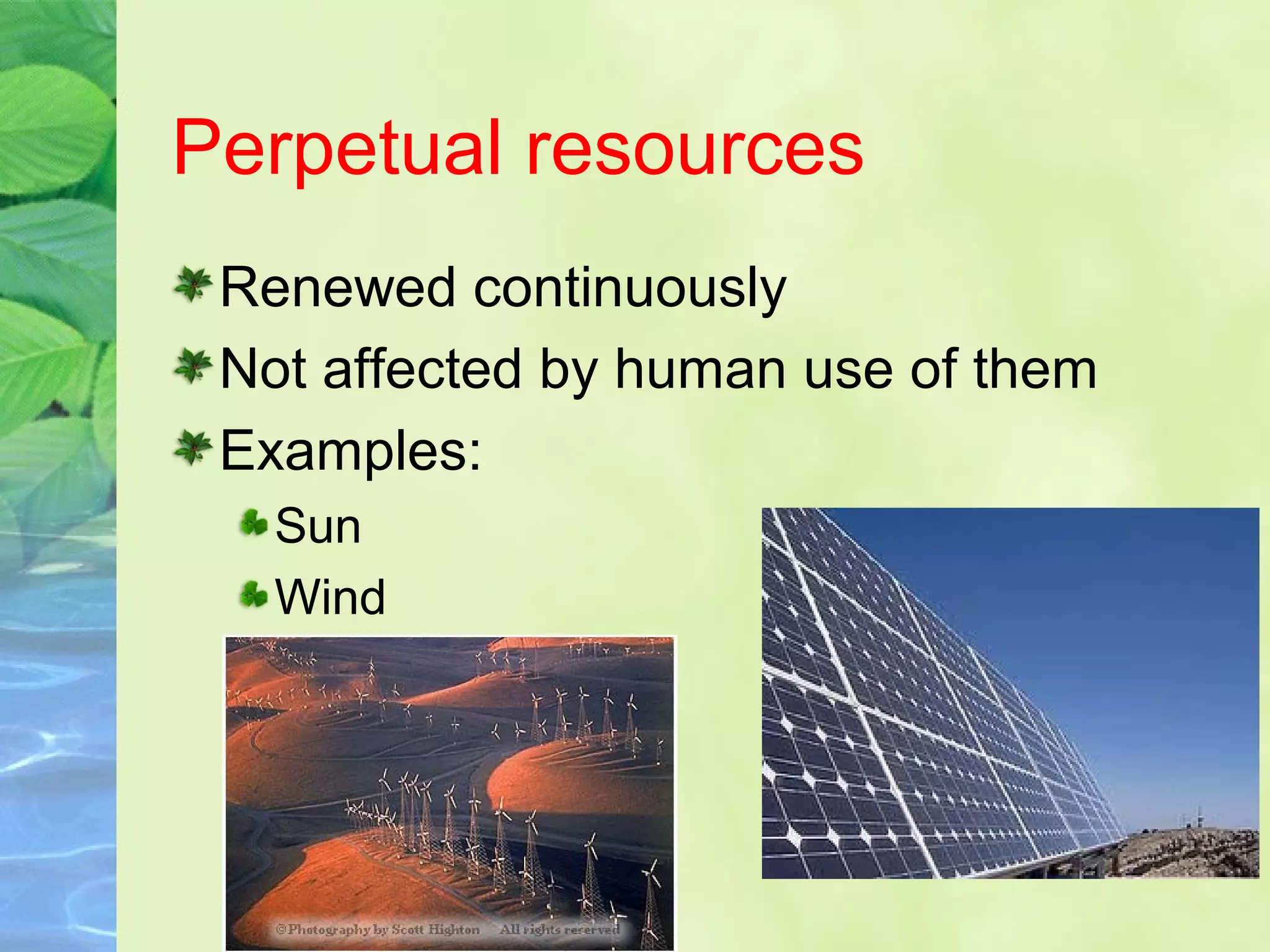
Perpetual resources
Renewed continuously
Not affected by human use of them
Examples:
Sun
Wind
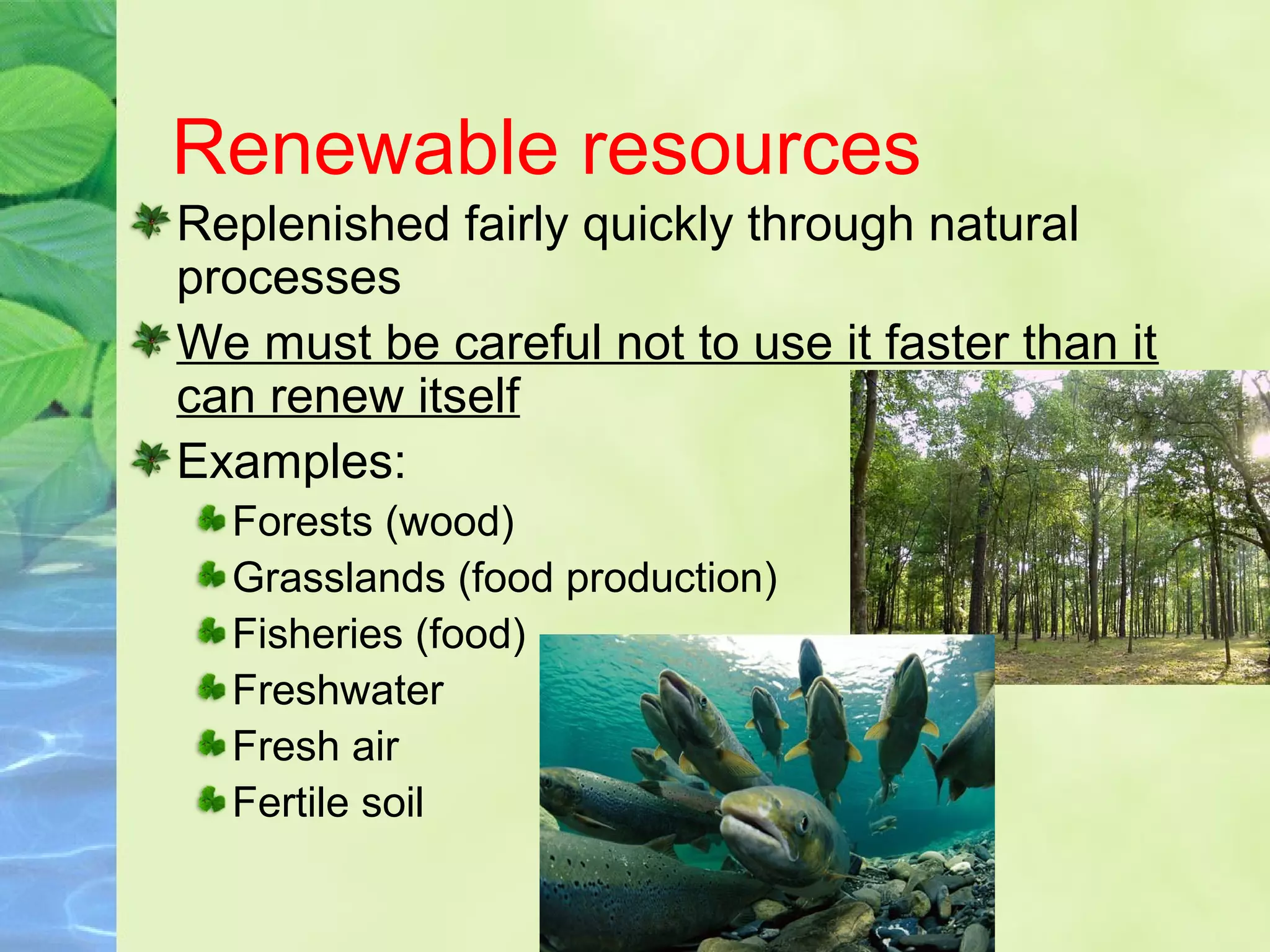
Renewable resources
Replenished fairly quickly through natural
processes
We must be careful not to use it faster than it
can renew itself
Examples:
Forests (wood)
Grasslands (food production)
Fisheries (food)
Freshwater
Fresh air
Fertile soil
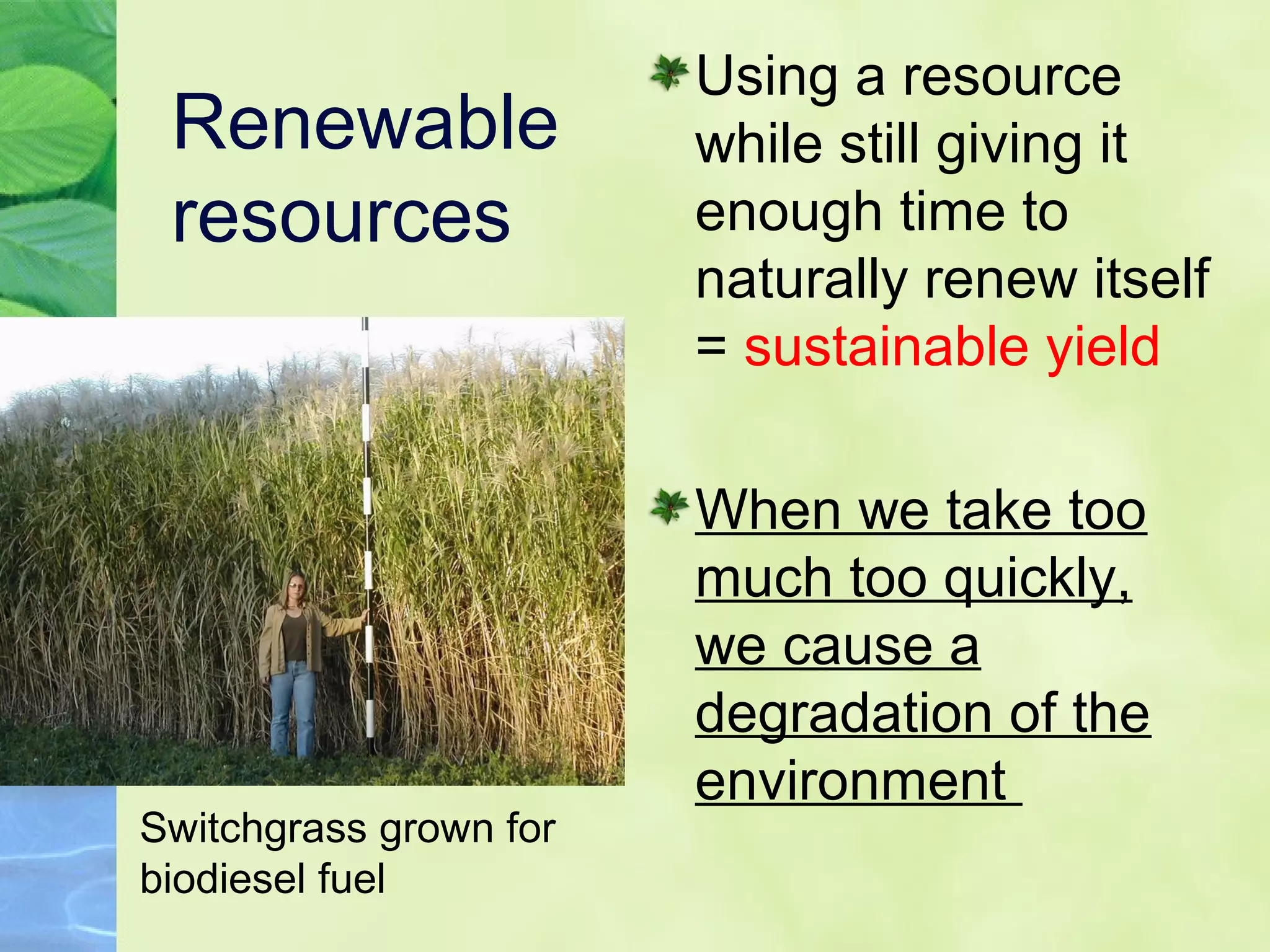
Renewable
resources
Using a resource
while still giving it
enough time to
naturally renew itself
= sustainable yield
When we take too
much too quickly,
we cause a
degradation of the
environment
Switchgrass grown for
biodiesel fuel
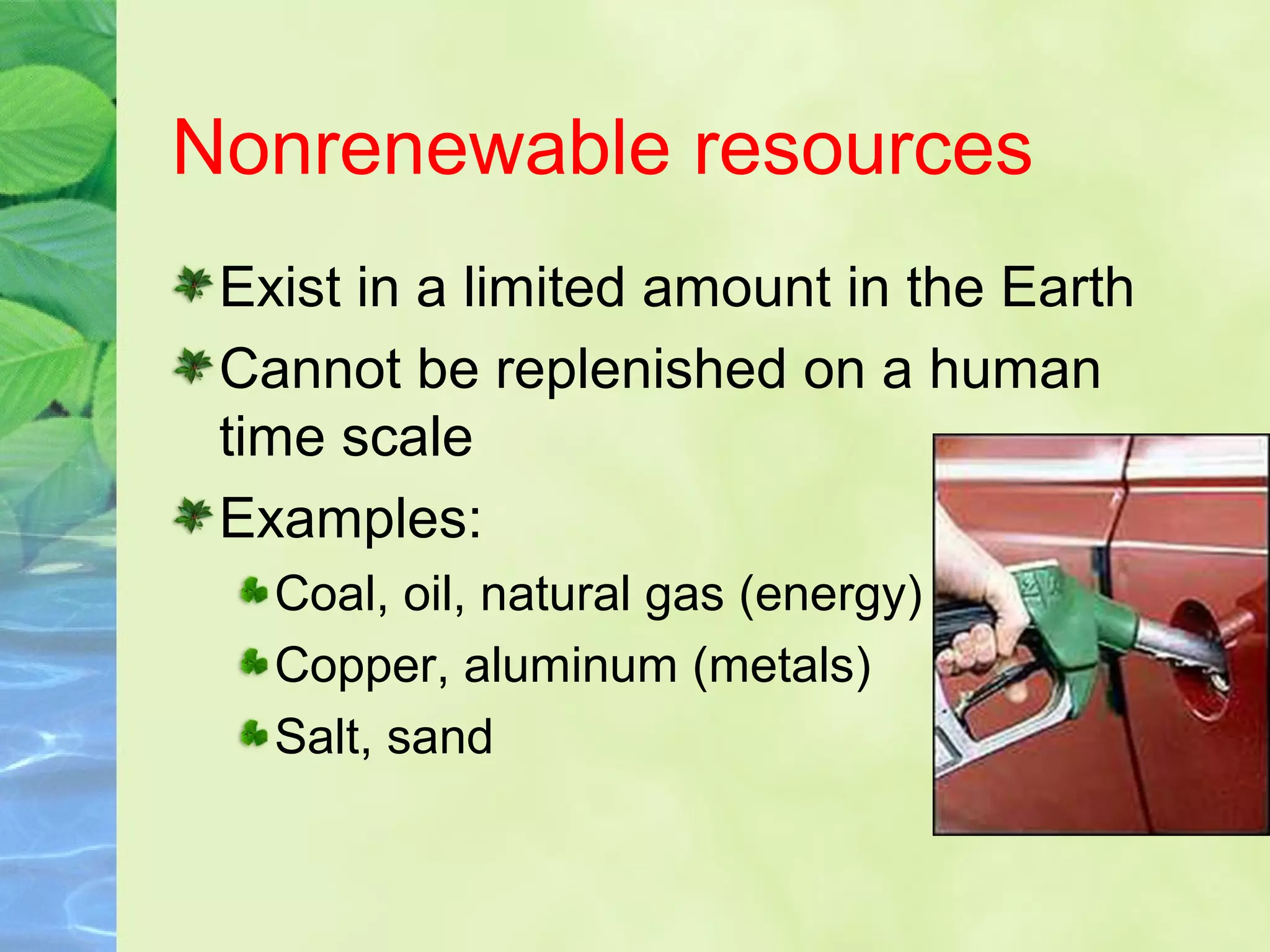
Nonrenewable resources
Exist in a limited amount in the Earth
Cannot be replenished on a human
time scale
Examples:
Coal, oil, natural gas (energy)
Copper, aluminum (metals)
Salt, sand
Think-Pair-Share
Think about your day so far…
What resources have you used…
What category are they in
Perpetual
Renewable
Nonrenewable
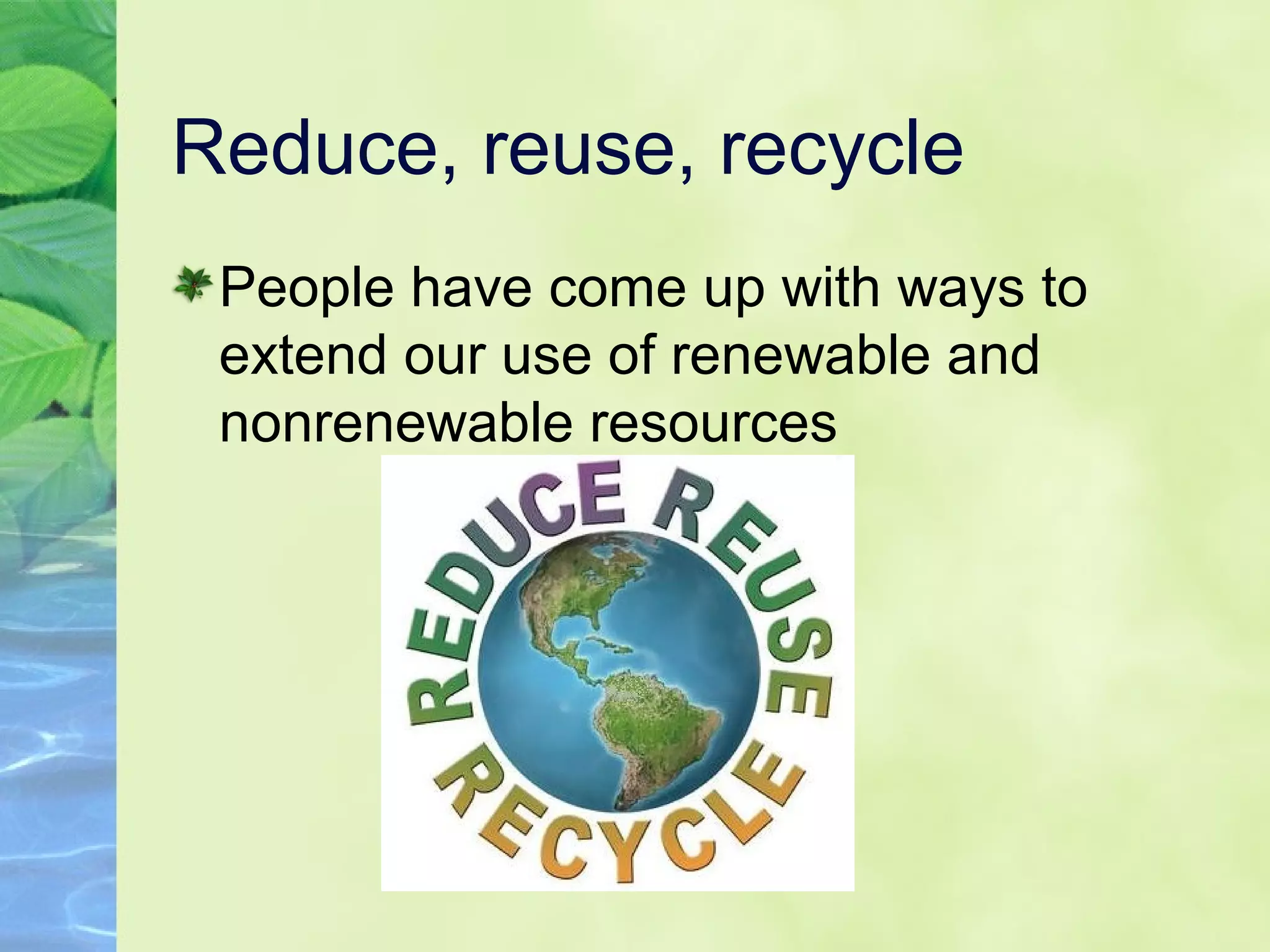
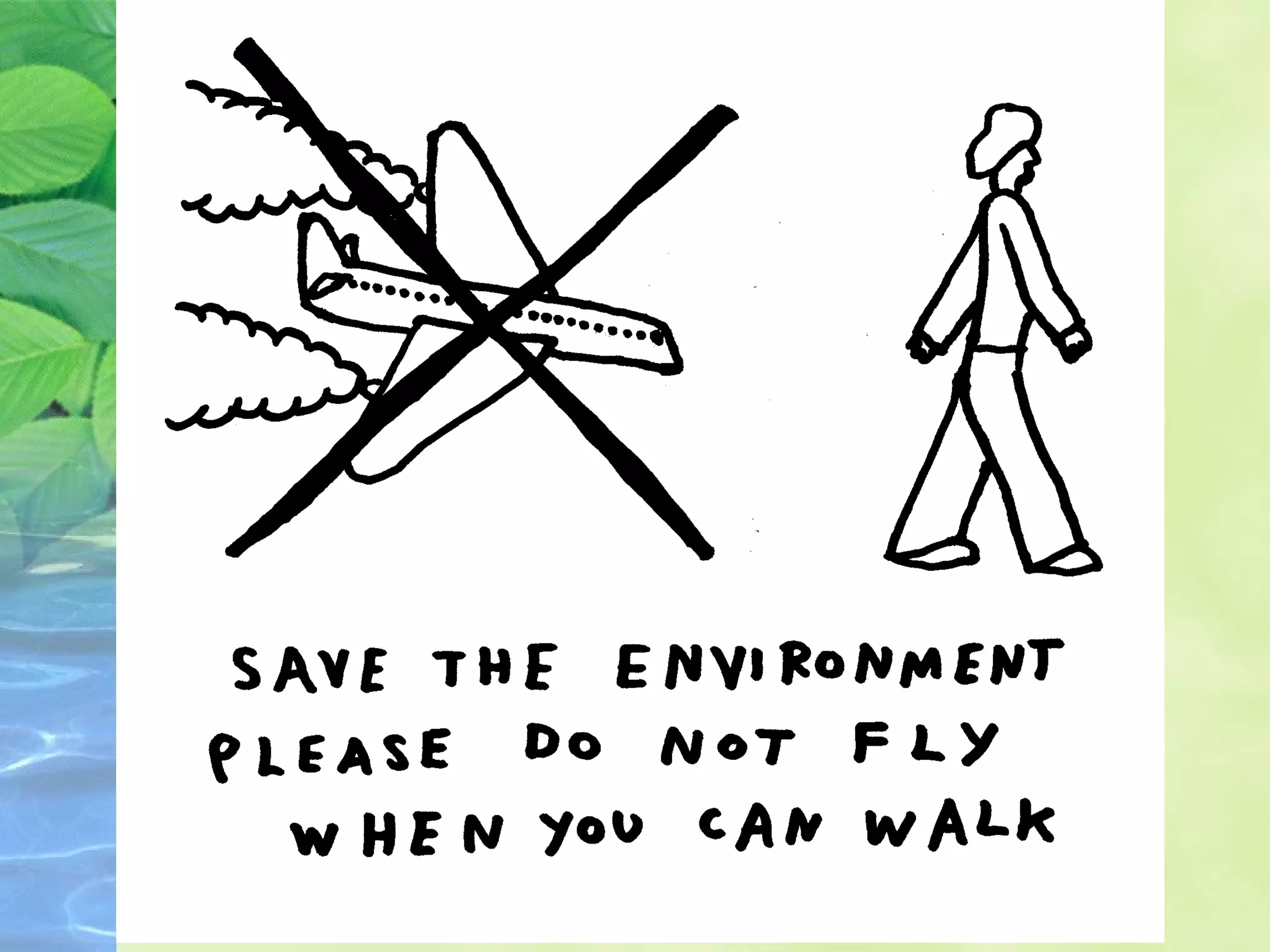
Reduce, reuse, recycle
People have come up with ways to
extend our use of renewable and
nonrenewable resources
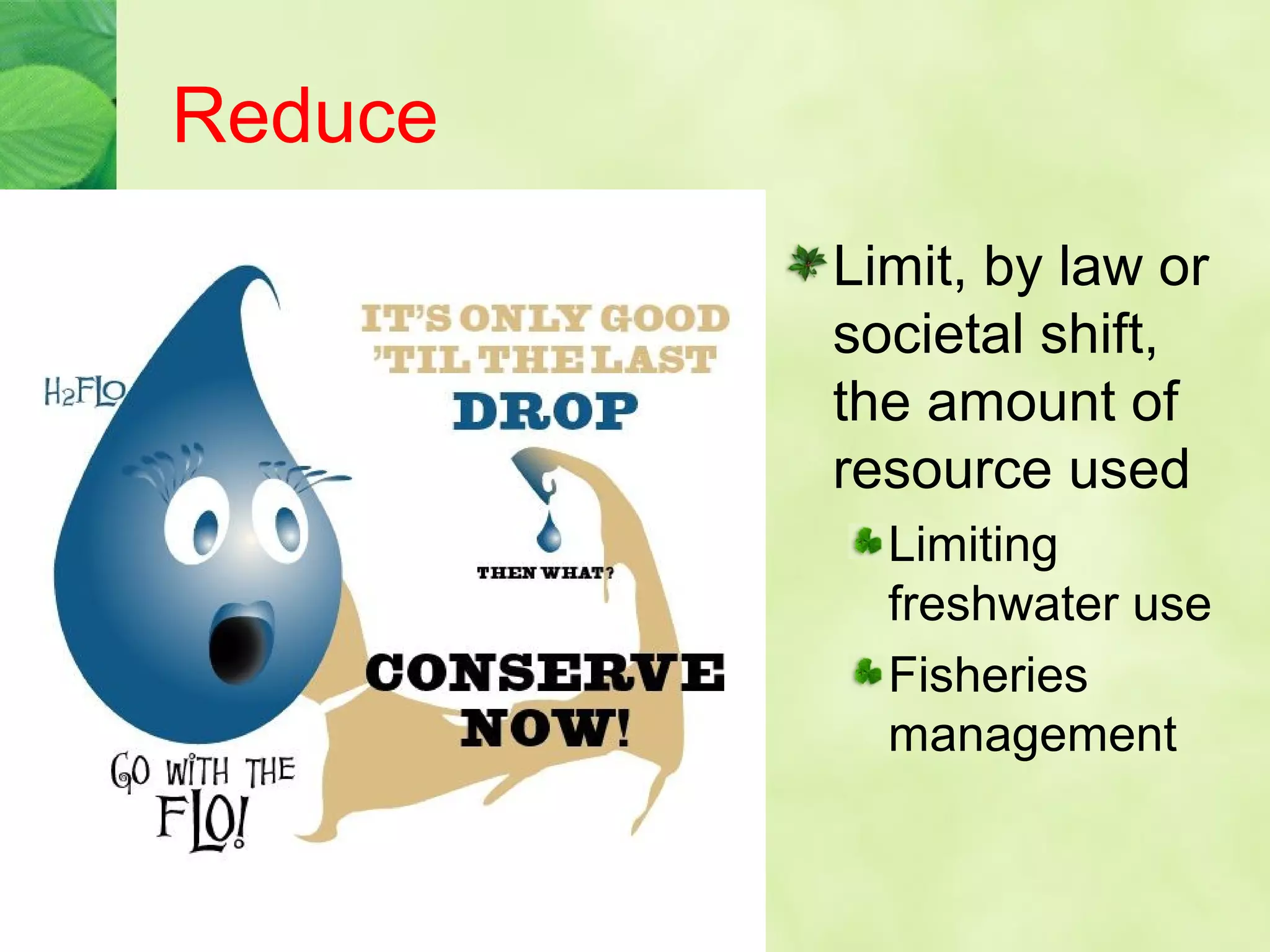
Reduce
Limit, by law or
societal shift,
the amount of
resource used
Limiting
freshwater use
Fisheries
management
Reuse
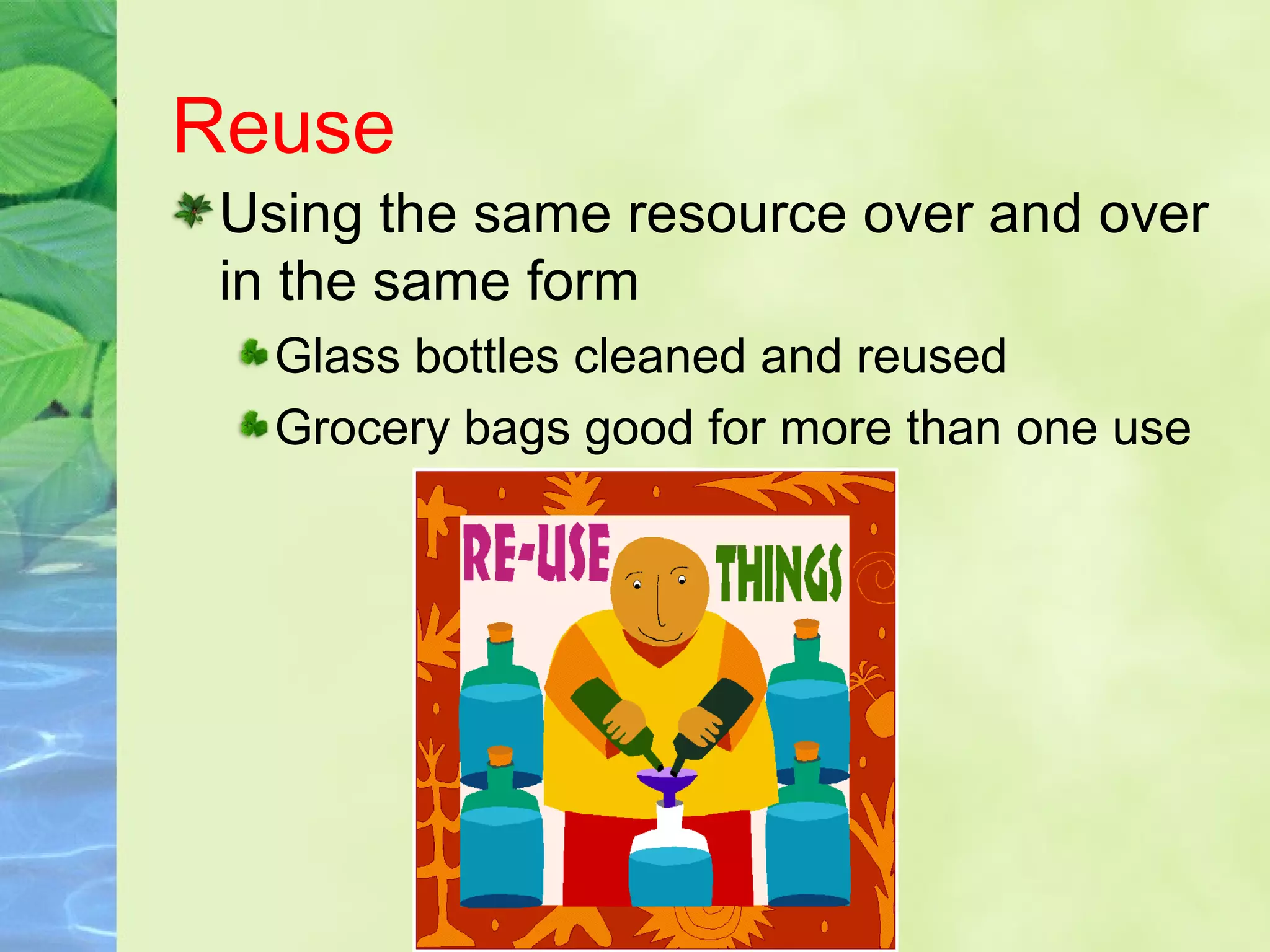
Using the same resource over and over
in the same form
Glass bottles cleaned and reused
Grocery bags good for more than one use
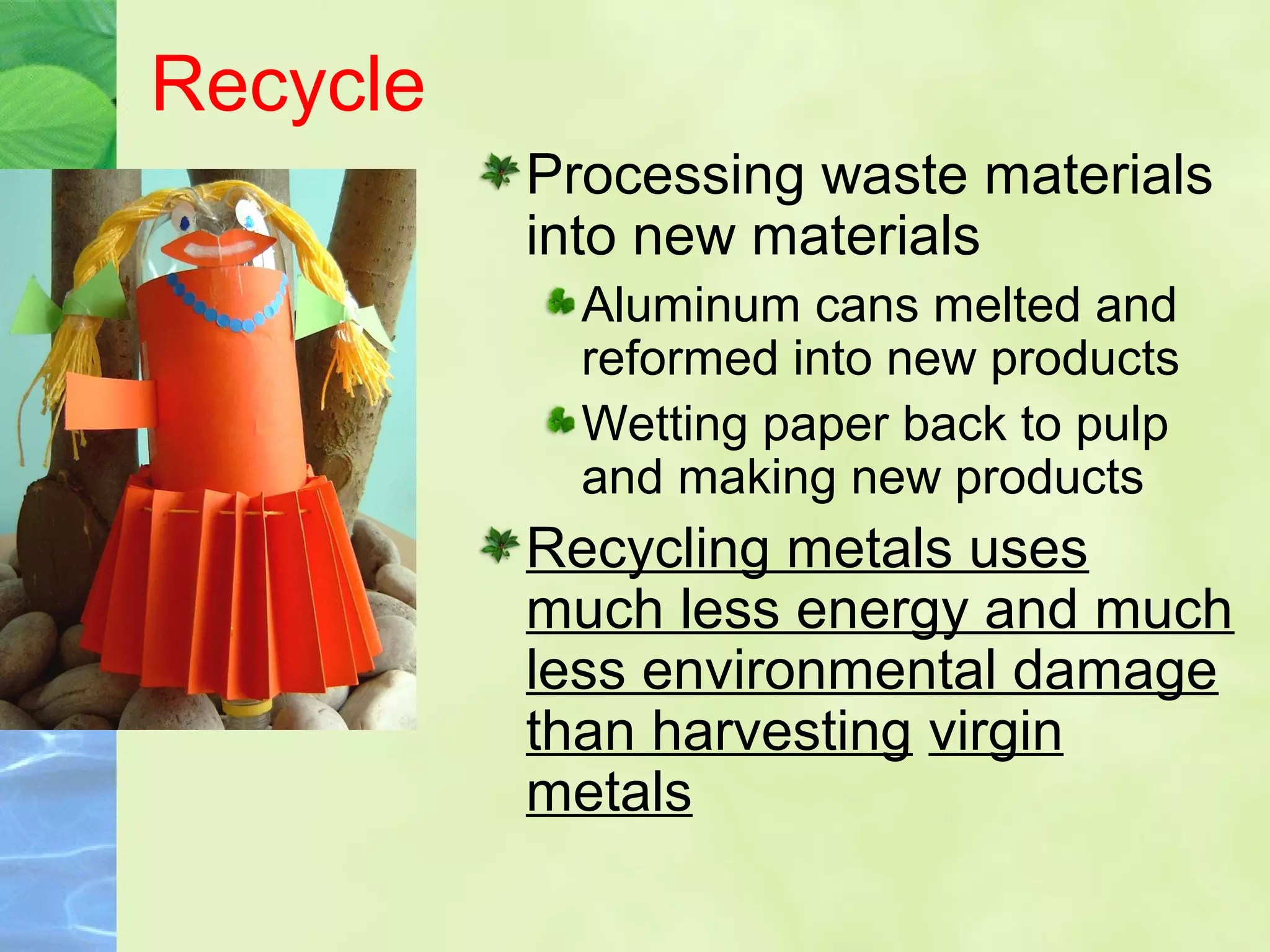
Recycle
Processing waste materials
into new materials
Aluminum cans melted and
reformed into new products
Wetting paper back to pulp
and making new products
Recycling metals uses
much less energy and much
less environmental damage
than harvesting virgin
metals
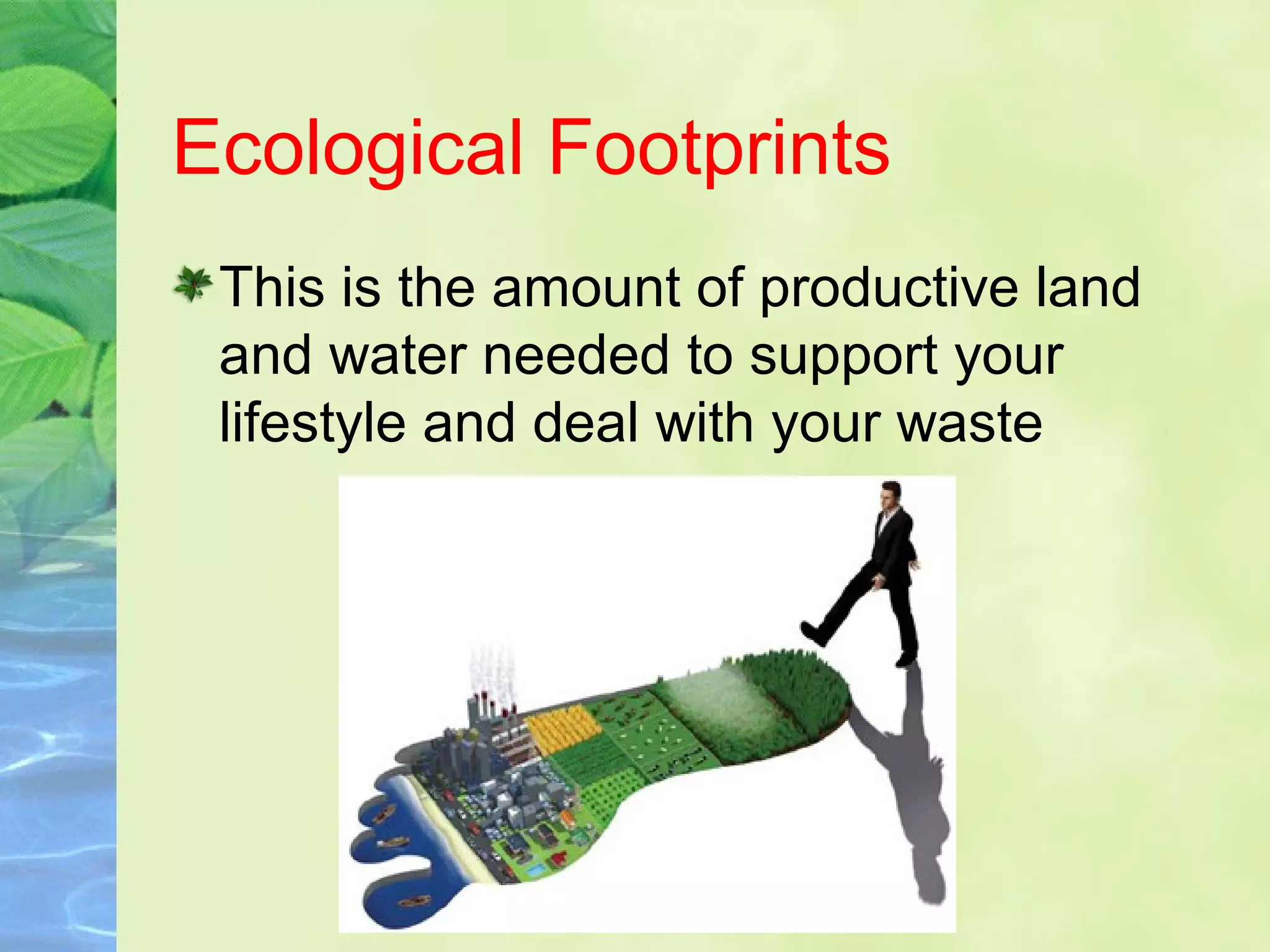
Ecological Footprints
This is the amount of productive land
and water needed to support your
lifestyle and deal with your waste
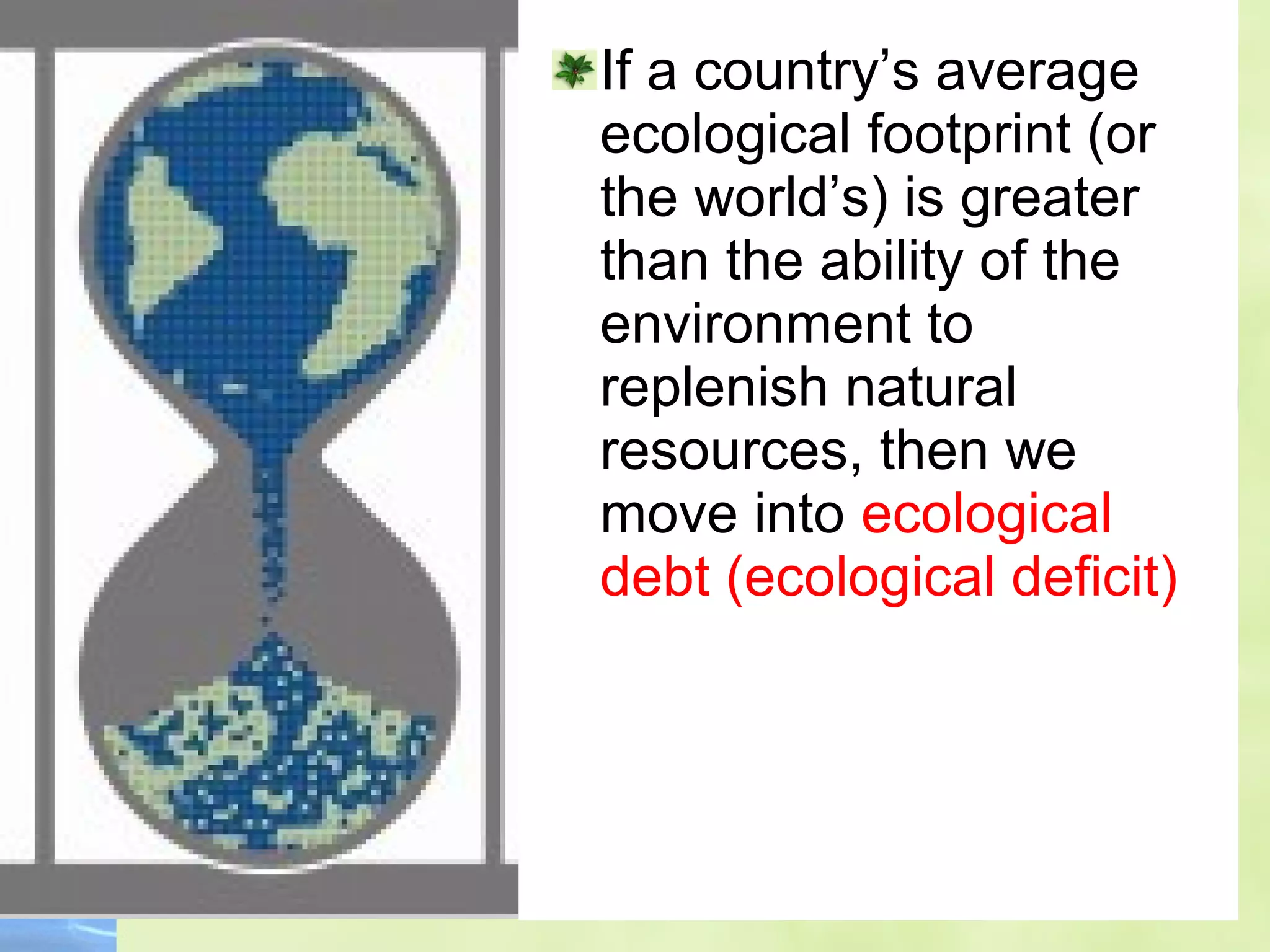
If a country’s average
ecological footprint (or
the world’s) is greater
than the ability of the
environment to
replenish natural
resources, then we
move into ecological
debt (ecological deficit)
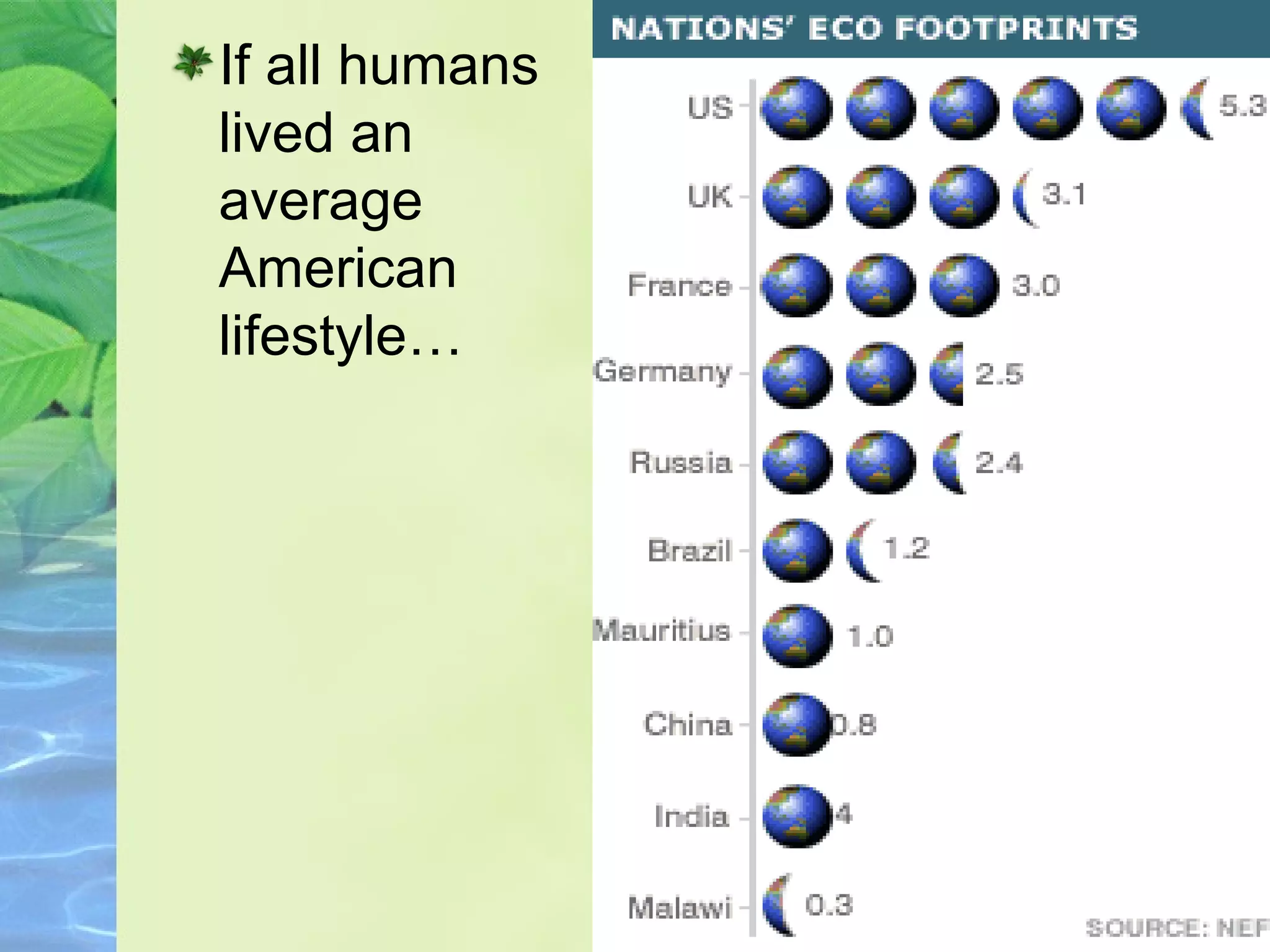
If all humans
lived an
average
American
lifestyle…
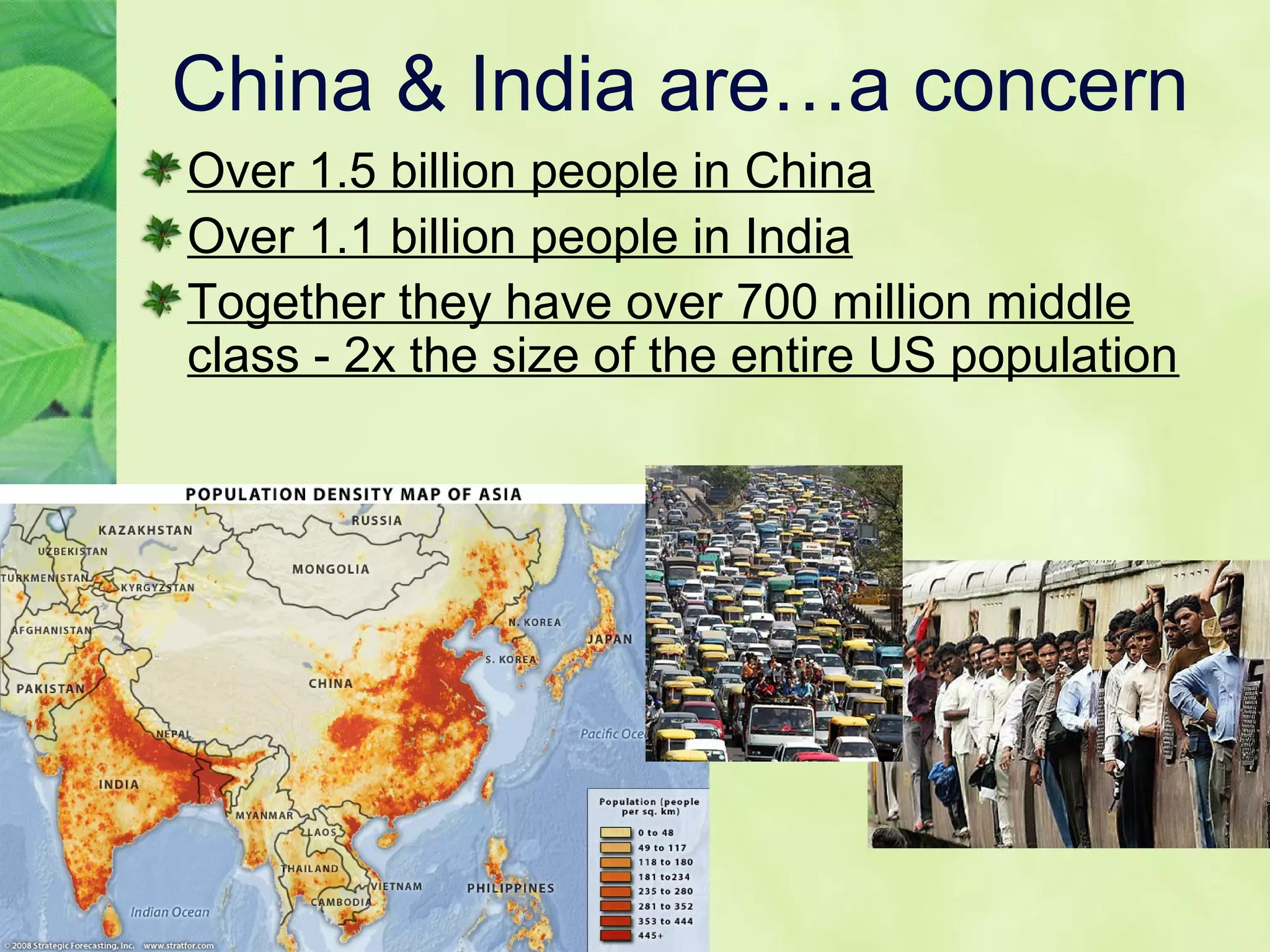
China & India are…a concern
Over 1.5 billion people in China
Over 1.1 billion people in India
Together they have over 700 million middle
class - 2x the size of the entire US population
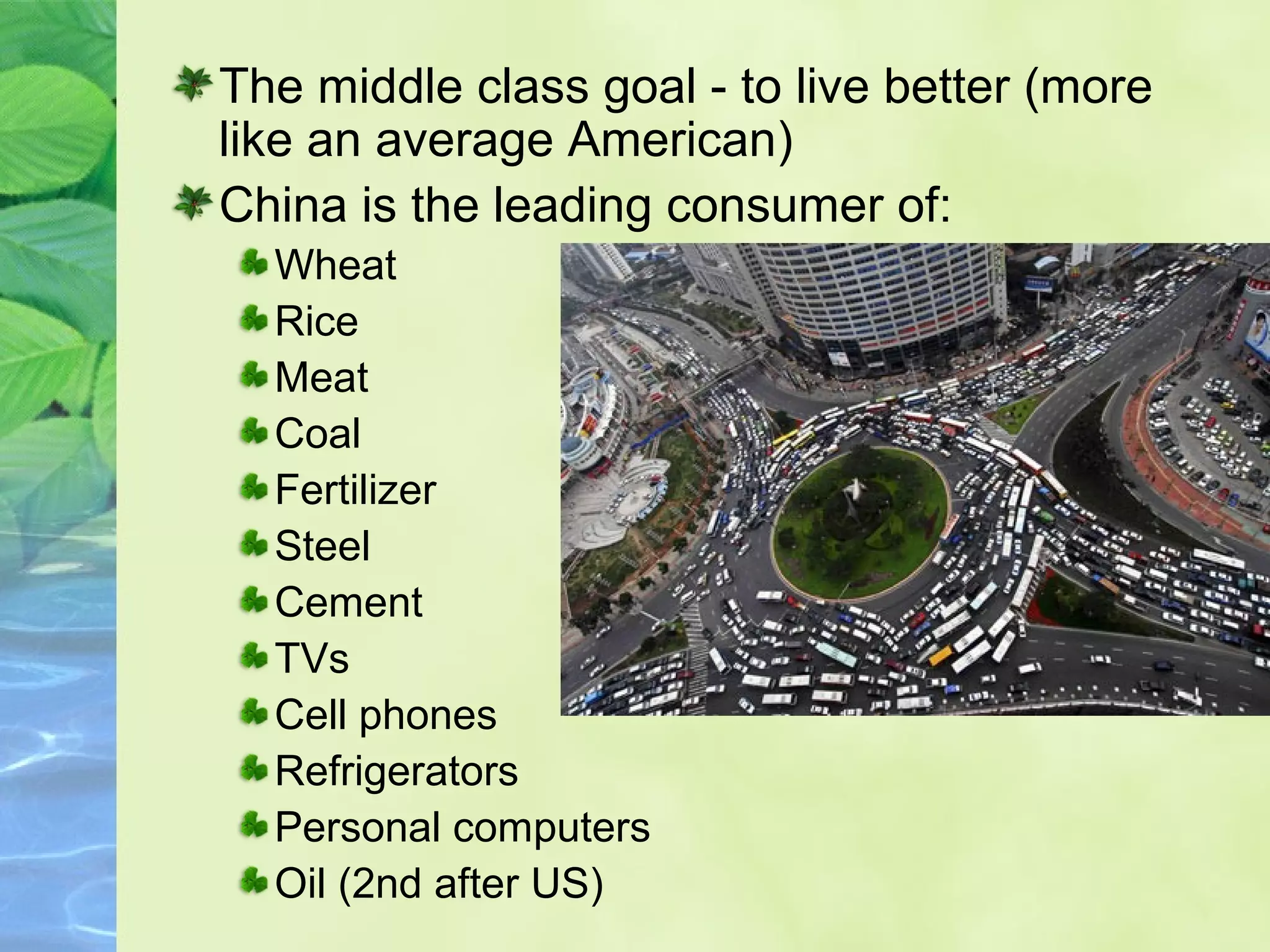
The middle class goal - to live better (more
like an average American)
China is the leading consumer of:
Wheat
Rice
Meat
Coal
Fertilizer
Steel
Cement
TVs
Cell phones
Refrigerators
Personal computers
Oil (2nd after US)
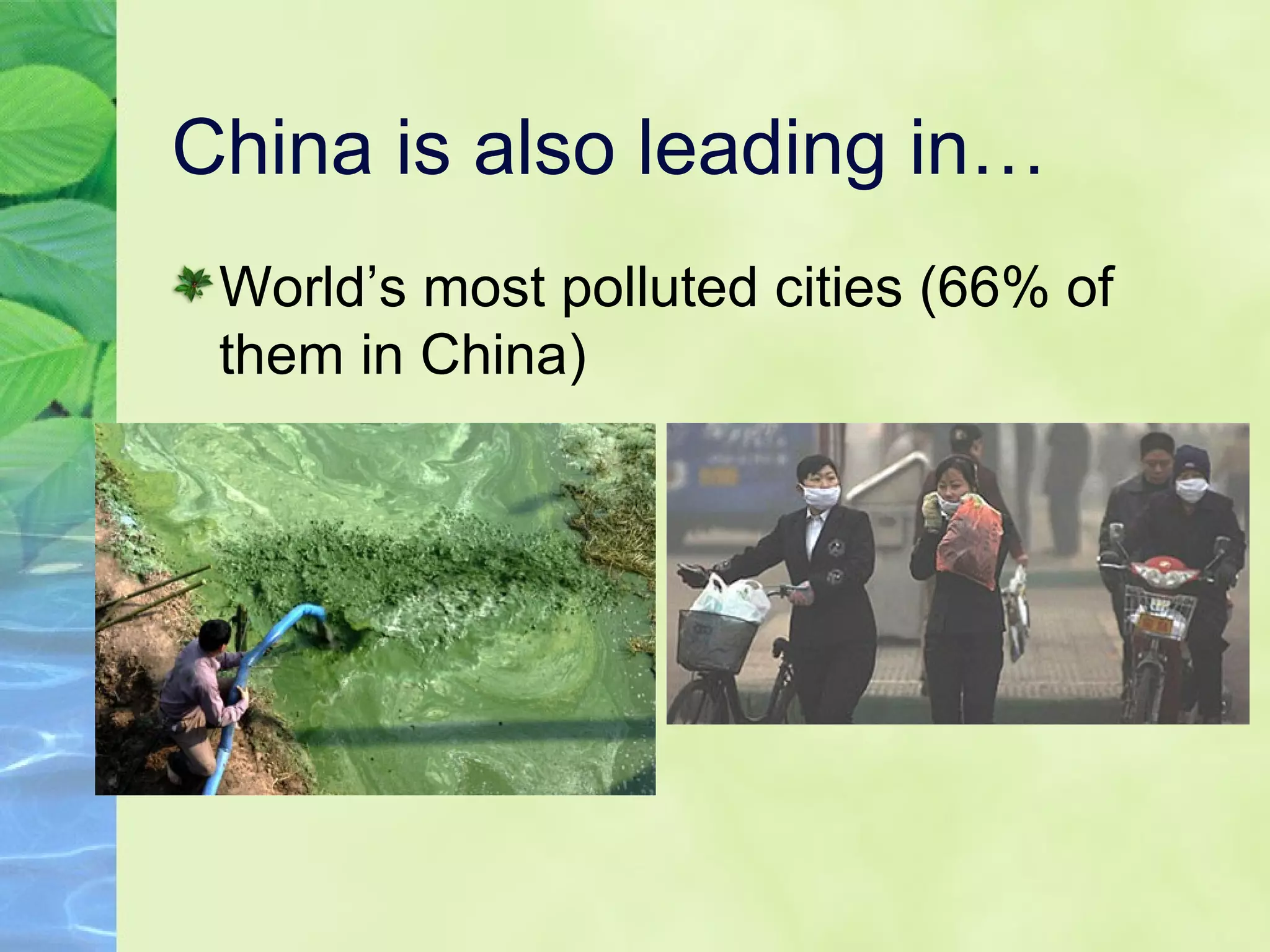
China is also leading in…
World’s most polluted cities (66% of
them in China)
Food for Thought…
Should China and India be forced
(through UN sanctions) to reduce their
environmental impact?
USA developed…lives the richest
lifestyle…was not hampered by any
restrictions…
USA doesn’t want to restrict itself if
China and India won’t…
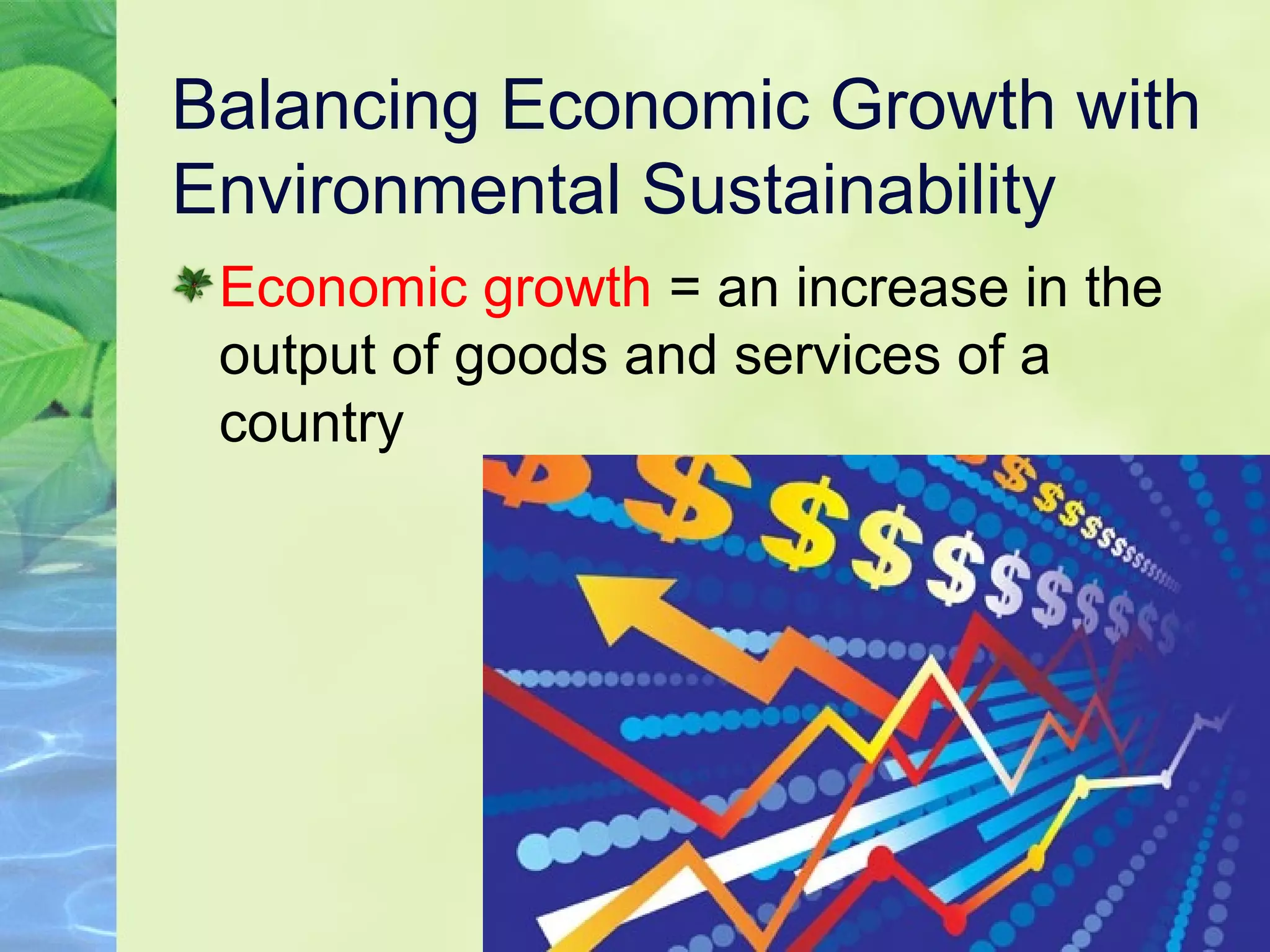
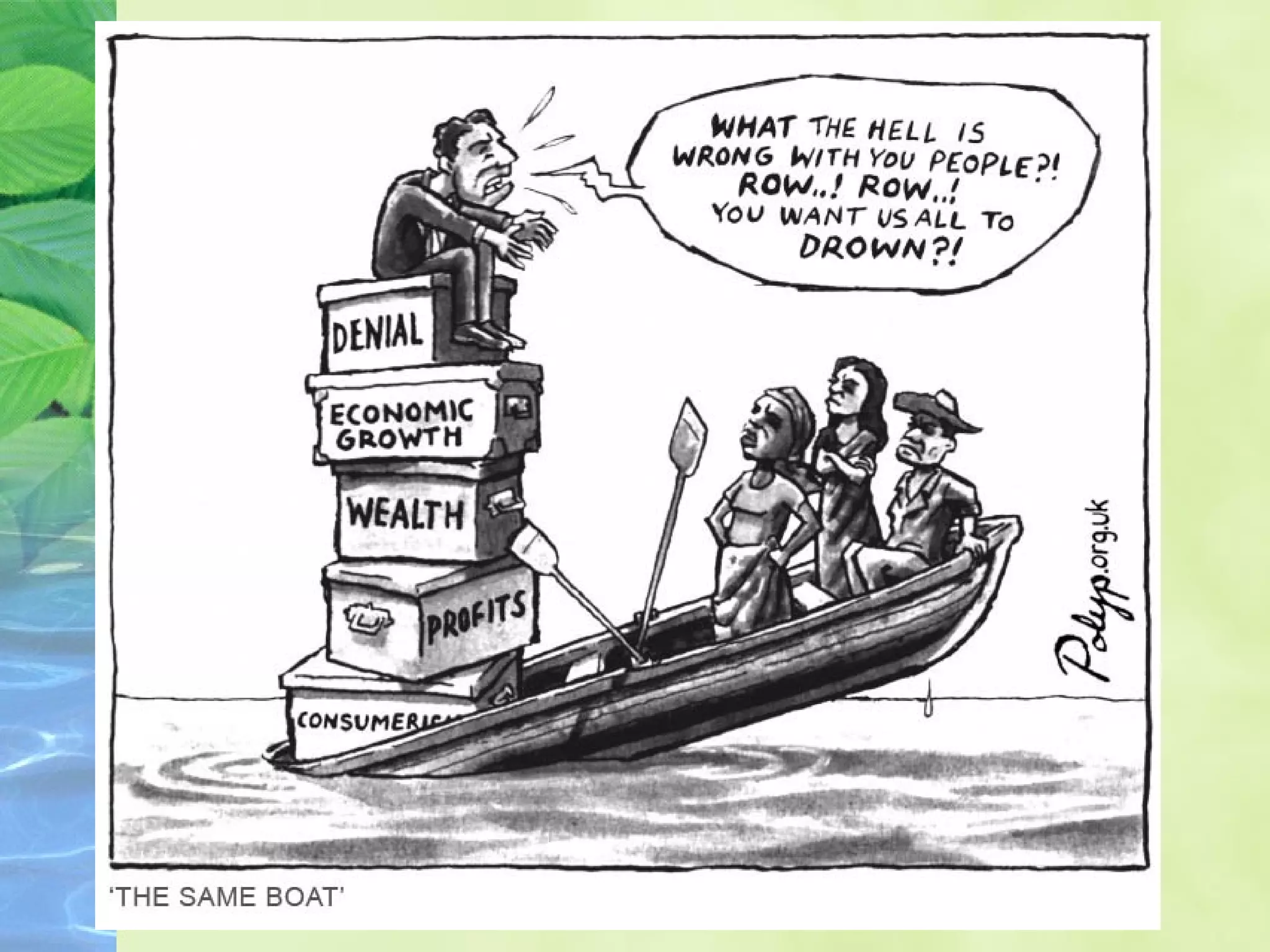
Balancing Economic Growth with
Environmental Sustainability
Economic growth = an increase in the
output of goods and services of a
country
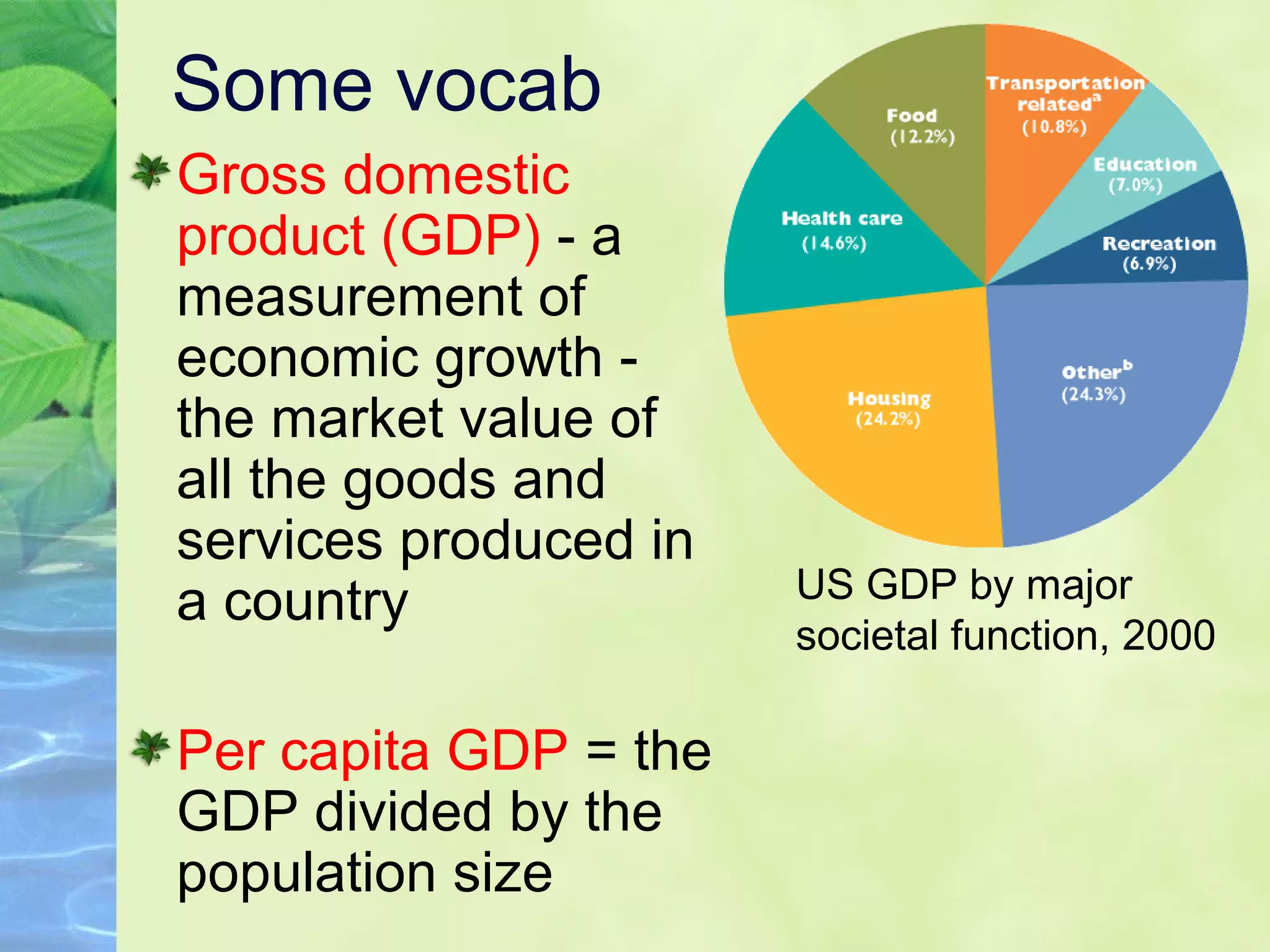
Some vocab
Gross domestic
product (GDP) - a
measurement of
economic growth -
the market value of
all the goods and
services produced in
a country
Per capita GDP = the
GDP divided by the
population size
US GDP by major
societal function, 2000
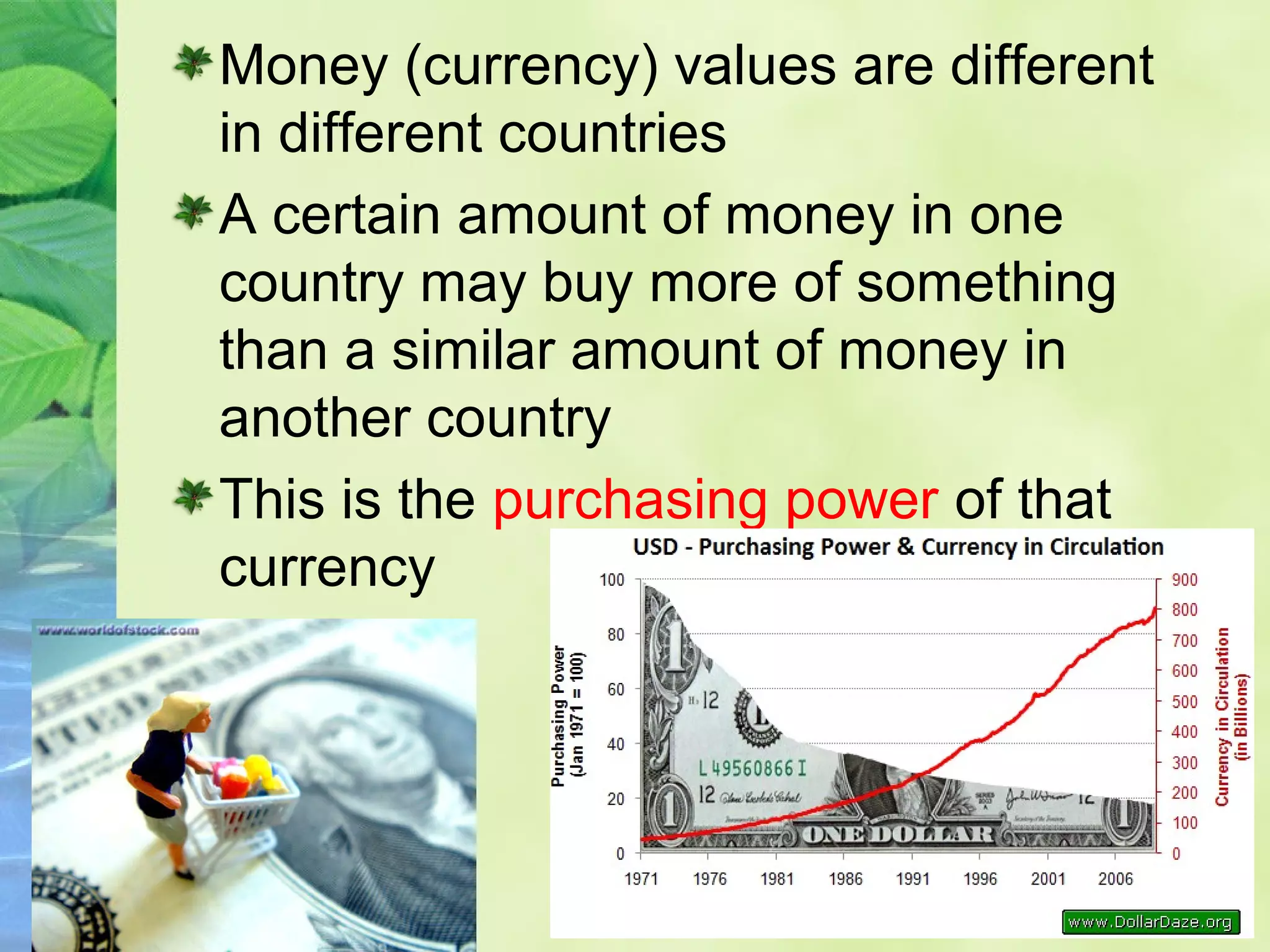
Money (currency) values are different
in different countries
A certain amount of money in one
country may buy more of something
than a similar amount of money in
another country
This is the purchasing power of that
currency
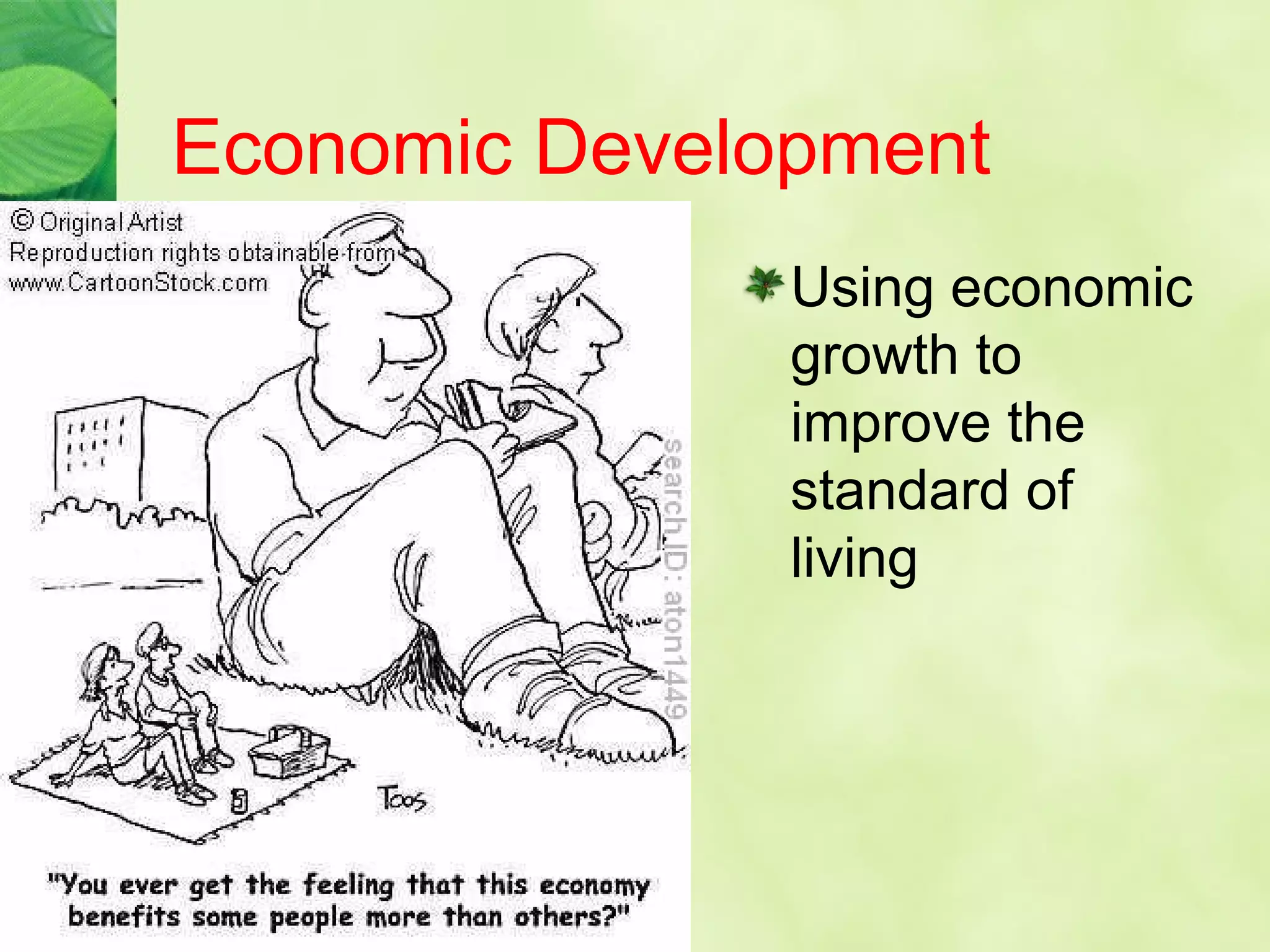
Economic Development
Using economic
growth to
improve the
standard of
living
Developed vs. Developing
Nations
Developed
US
Canada
Japan
Australia
Italy
England
France
Highly industrialized
High GDP
Developing
Most of Africa
Most of Asia
Most of Latin America
China
India
Brazil
Turkey
Thailand
Mexico
Highly agricultural
Low GDP
What is the
difference
between these
two groups?
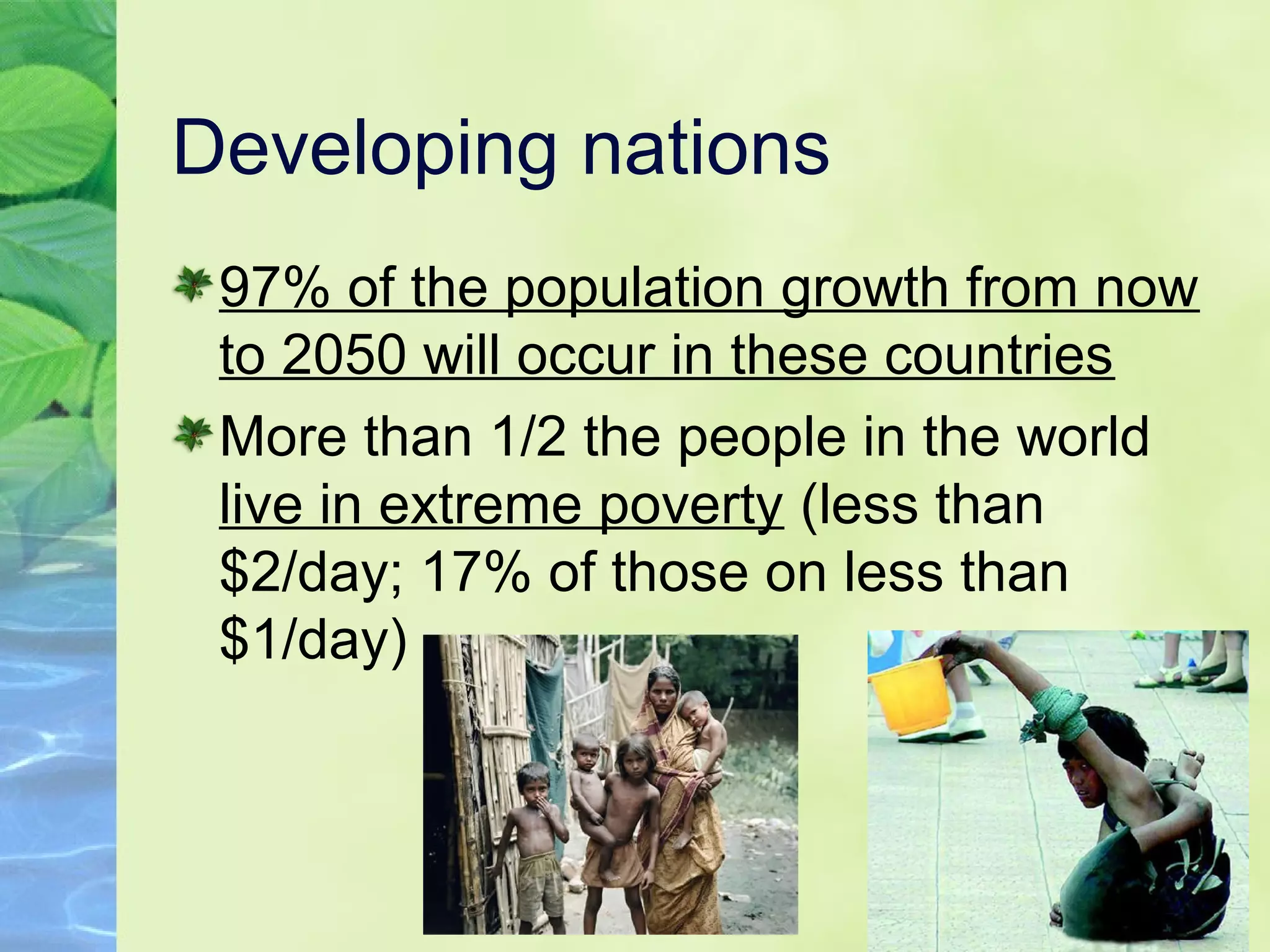
Developing nations
97% of the population growth from now
to 2050 will occur in these countries
More than 1/2 the people in the world
live in extreme poverty (less than
$2/day; 17% of those on less than
$1/day)
APES Ch. 1, part 1

APES Ch. 1, part 1

  • 1.
    "Alone in space,alone in its life-supporting systems, powered by inconceivable energies, mediating them to us through the most delicate adjustments, wayward, unlikely, unpredictable, but nourishing, enlivening, and enriching in the largest degree -- is this not a precious home for all of us? Is it not worth our love?” Barbara Ward and Rene Dubos
  • 2.
    Class Business Absent students Popsiclestick File folder tab Please get ready for first lecture
  • 3.
    Environmental Problems, Their Causes,and Sustainability Ch. 1 Miller and Spoolman 16th ed.
  • 4.
    Earth, our islandin space, as seen from Apollo 17 in 1972. This image portrayed Earth as a small, fragile, lonely rock in space and helped galvanize many people to care for Earth's environment.
  • 5.
    E is forthe environment
  • 6.
    To aid inyour note taking 1. Your notebook should be interesting to look at Feel free to paste in and color the picture, if you so choose :) Vocabulary is in red Super-important-don’t-miss-this concepts are underlined
  • 7.
    General Overview There are fourmajor themes of your book: Sustainability Human impact Solutions Trade offs The questions we will ask are: How can we maintain or improve the environment and our society? What are we doing to damage these two? What are some ways we can repair and prevent problems? What will we have to sacrifice for the greatest good?
  • 8.
    Sustainability This is thecentral theme of the book and of this course Definition: the ability of the earth’s systems and of human society to survive and adapt to the changing world indefinitely.
  • 9.
    Human Impact Many humanactivities, from farming to fossil fuel use to over-fishing are negatively impacting the planet and are not sustainable at current levels of practice
  • 10.
    Solutions Environmental scientists look forsolutions to these issues, but it is politicians who put them into practice (or not) Complex decisions involving social, economic, moral, ethical, and philosophical views
  • 11.
    Trade-offs Scientists might sayhalt all fishing of tuna or else it will go extinct Economics and culture may demand continued fishing Every decision involves compromises It is important to understand the PROS and CONS of every issue
  • 12.
    The Ultimate Goal Environmental scientists striveto find ways to achieve an environmentally sustainable society Meets the current and future needs of its people Distributes resources in a just manner Does not compromise the ability of future generations to do the same
  • 13.
    Like a bankaccount I have $1 million I invest it in a bank that gives me 10% interest I can live off the interest only - $100,000 I can do this indefinitely If I spend more than this, I will eventually go broke
  • 14.
    The interest islike renewable resources in the environment Carefully manage our resources to live off the renewable resources like plants, water, soil without overspending
  • 15.
    What is theenvironment? Environment - everything that surrounds us Both biotic and abiotic What are the biotic and abiotic components of this environment?
  • 16.
    We are totally dependenton the environment for: Air Water Food Shelter Energy Nutrient cycling We are a part of the environment, not separate from it
  • 17.
    What are we tryingto sustain? Natural capital The resources and services that nature provides to all living things Capital includes: Resources such as water, plants, soil Services such as water purification and nutrient cycling
  • 18.
    It all comesback to the source The ultimate source of all our planet’s resources and the driving force of natural services is THE SUN Provides the energy for water cycle Allows plants to make food Drive wind and ocean currents
  • 19.
    Examples of naturalcapital Resources provided by nature are classified in three ways: Perpetual Renewable Nonrenewable
  • 20.
    Resources A resource isanything we get from the environment to satisfy our needs and desires
  • 22.
    Perpetual resources Renewed continuously Notaffected by human use of them Examples: Sun Wind
  • 23.
    Renewable resources Replenished fairlyquickly through natural processes We must be careful not to use it faster than it can renew itself Examples: Forests (wood) Grasslands (food production) Fisheries (food) Freshwater Fresh air Fertile soil
  • 24.
    Renewable resources Using a resource whilestill giving it enough time to naturally renew itself = sustainable yield When we take too much too quickly, we cause a degradation of the environment Switchgrass grown for biodiesel fuel
  • 25.
    Nonrenewable resources Exist ina limited amount in the Earth Cannot be replenished on a human time scale Examples: Coal, oil, natural gas (energy) Copper, aluminum (metals) Salt, sand
  • 26.
    Think-Pair-Share Think about yourday so far… What resources have you used… What category are they in Perpetual Renewable Nonrenewable
  • 27.
    Reduce, reuse, recycle Peoplehave come up with ways to extend our use of renewable and nonrenewable resources
  • 28.
    Reduce Limit, by lawor societal shift, the amount of resource used Limiting freshwater use Fisheries management
  • 29.
    Reuse Using the sameresource over and over in the same form Glass bottles cleaned and reused Grocery bags good for more than one use
  • 30.
    Recycle Processing waste materials intonew materials Aluminum cans melted and reformed into new products Wetting paper back to pulp and making new products Recycling metals uses much less energy and much less environmental damage than harvesting virgin metals
  • 32.
    Ecological Footprints This isthe amount of productive land and water needed to support your lifestyle and deal with your waste
  • 33.
    If a country’saverage ecological footprint (or the world’s) is greater than the ability of the environment to replenish natural resources, then we move into ecological debt (ecological deficit)
  • 34.
    If all humans livedan average American lifestyle…
  • 35.
    China & Indiaare…a concern Over 1.5 billion people in China Over 1.1 billion people in India Together they have over 700 million middle class - 2x the size of the entire US population
  • 36.
    The middle classgoal - to live better (more like an average American) China is the leading consumer of: Wheat Rice Meat Coal Fertilizer Steel Cement TVs Cell phones Refrigerators Personal computers Oil (2nd after US)
  • 37.
    China is alsoleading in… World’s most polluted cities (66% of them in China)
  • 38.
    Food for Thought… ShouldChina and India be forced (through UN sanctions) to reduce their environmental impact? USA developed…lives the richest lifestyle…was not hampered by any restrictions… USA doesn’t want to restrict itself if China and India won’t…
  • 39.
    Balancing Economic Growthwith Environmental Sustainability Economic growth = an increase in the output of goods and services of a country
  • 41.
    Some vocab Gross domestic product(GDP) - a measurement of economic growth - the market value of all the goods and services produced in a country Per capita GDP = the GDP divided by the population size US GDP by major societal function, 2000
  • 42.
    Money (currency) valuesare different in different countries A certain amount of money in one country may buy more of something than a similar amount of money in another country This is the purchasing power of that currency
  • 43.
    Economic Development Using economic growthto improve the standard of living
  • 44.
    Developed vs. Developing Nations Developed US Canada Japan Australia Italy England France Highlyindustrialized High GDP Developing Most of Africa Most of Asia Most of Latin America China India Brazil Turkey Thailand Mexico Highly agricultural Low GDP What is the difference between these two groups?
  • 45.
    Developing nations 97% ofthe population growth from now to 2050 will occur in these countries More than 1/2 the people in the world live in extreme poverty (less than $2/day; 17% of those on less than $1/day)

Editor's Notes

  • #14 $2 million/year you will last 7 years, even with the interest $110,000/year, you will last 18 years, even with the interest