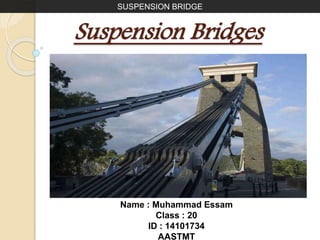
Suspension Bridges
Name : Muhammad Essam
Class : 20
ID : 14101734
AASTMT
SUSPENSION BRIDGE
Types Of Suspension Bridges …
SUSPENSION BRIDGE
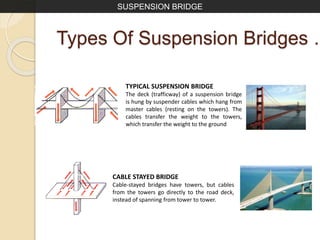
TYPICAL SUSPENSION BRIDGE
The deck (trafficway) of a suspension bridge
is hung by suspender cables which hang from
master cables (resting on the towers). The
cables transfer the weight to the towers,
which transfer the weight to the ground
CABLE STAYED BRIDGE
Cable-stayed bridges have towers, but cables
from the towers go directly to the road deck,
instead of spanning from tower to tower.
COMPONENTS OF
SUSPENSION BRIDGES :
SUSPENSION BRIDGE
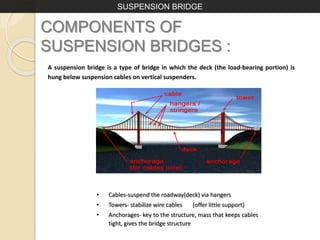
A suspension bridge is a type of bridge in which the deck (the load-bearing portion) is
hung below suspension cables on vertical suspenders.
• Cables-suspend the roadway(deck) via hangers
• Towers- stabilize wire cables (offer little support)
• Anchorages- key to the structure, mass that keeps cables
tight, gives the bridge structure
SUSPENSION BRIDGE
COMPONENTS OF
SUSPENSION
BRIDGES :WITH ANCHORAGE WITHOUT ANCHORAGE
IN CASE OF CABLE STAYED BRIDGE CABLES DIRECTLY CONNECT THE TOWER WITH THE
DECK THEY MAY BE OF TWO TYPES DEPENDING ON THE FIXING OF THE CABLES
HISTORY:
SUSPENSION BRIDGE
Thousands of years ago people
strung twisted vines attached to
trees to cross over rivers and it
gets many modified forms over
the time.
The Tibetan saint and bridge-builder Thangtong
Gyalpo originated the use of iron chains in his version of
early suspension bridges. In 1433, Gyalpo built eight
bridges in eastern Bhutan. Gyalpo's iron chain bridges
did not include a suspended deck bridge which is the
standard on all modern suspension bridges today.
Instead, both the railing and the walking layer of
Gyalpo's bridges used wires.
SUSPENSION BRIDGE
The first design for a bridge resembling the
modern suspension bridge is attributed
to Venetian engineer Fausto Veranzio,
whose 1595 book Machinae Novae included
drawings both for a timber and rope
suspension bridge cable-stayed bridge using
iron chains
HISTORY:
However, the first suspension bridge
actually built was by American
engineer James Finley at Jacob's Creek, in,
Pennsylvania, in 1801. Finley's bridge was
the first to incorporate all of the necessary
components of a suspension bridge
SUSPENSION BRIDGE
HISTORY:
Dry burg bridge-1817-UK Union bridge-1820 UK
Clifton bridge-1864 UK
SUSPENSION BRIDGE
LOADS
Three kinds of forces operate on any bridge: the dead load, the live load, and the dynamic load.
DEAD LOAD LIVE LOAD DYNAMIC LOAD
Dead load refers to the
weight of the bridge itself.
Like any other structure, a
bridge has a tendency to
collapse simply because of
the gravitational forces
acting on the materials of
which the bridge is made.
Live load refers to traffic
that moves across the
bridge as well as normal
environmental factors
such as changes in
temperature,
precipitation, and winds
Dynamic load refers to
environmental factors that go
beyond normal weather
conditions, factors such as
sudden gusts of wind and
earthquakes. All three factors
must be taken into consideration
when building a bridge.
SUSPENSION BRIDGE
THE MAIN FORCES IN A SUSPENSION
BRIDGE OF ANY TYPE ARE TENSION IN THE
CABLES AND COMPRESSION IN THE
PILLARS.
LOADS
SUSPENSION BRIDGE
CONSTRUCTION SEQUENCE
1.TOWERS
SUSPENSION BRIDGE
CONSTRUCTION SEQUENCE
2.SADDLES
Large devices called saddles, which will carry the main suspension cables, are positioned
atop the towers. Typically of cast steel, they can also be manufactured using riveted forms,
and are equipped with rollers to allow the main cables to shift under construction and
normal loads.
SUSPENSION BRIDGE
CONSTRUCTION SEQUENCE
3.ANCHORAGE
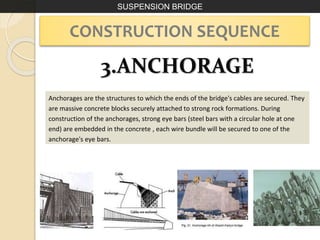
Anchorages are the structures to which the ends of the bridge's cables are secured. They
are massive concrete blocks securely attached to strong rock formations. During
construction of the anchorages, strong eye bars (steel bars with a circular hole at one
end) are embedded in the concrete , each wire bundle will be secured to one of the
anchorage's eye bars.
SUSPENSION BRIDGE
CONSTRUCTION SEQUENCE
4.CATWALKS
Temporary suspended walkways, called catwalks, are then
erected using a set of guide wires hoisted into place via
winches positioned atop the towers. These catwalks follow
the curve set by bridge designers for the main cables.
Typical catwalks are usually between eight and ten feet
wide, and are constructed using wire grate and wood slats.
Gantries are placed upon the catwalks, which will support
the main cable spinning reels.
SUSPENSION BRIDGE
CONSTRUCTION SEQUENCE
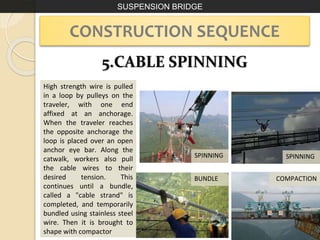
5.CABLE SPINNING
High strength wire is pulled
in a loop by pulleys on the
traveler, with one end
affixed at an anchorage.
When the traveler reaches
the opposite anchorage the
loop is placed over an open
anchor eye bar. Along the
catwalk, workers also pull
the cable wires to their
desired tension. This
continues until a bundle,
called a "cable strand" is
completed, and temporarily
bundled using stainless steel
wire. Then it is brought to
shape with compactor
SPINNING SPINNING
BUNDLE COMPACTION
SUSPENSION BRIDGE
CONSTRUCTION SEQUENCE
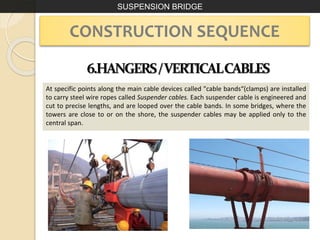
6.HANGERS/VERTICALCABLES
At specific points along the main cable devices called "cable bands“(clamps) are installed
to carry steel wire ropes called Suspender cables. Each suspender cable is engineered and
cut to precise lengths, and are looped over the cable bands. In some bridges, where the
towers are close to or on the shore, the suspender cables may be applied only to the
central span.
SUSPENSION BRIDGE
CONSTRUCTION SEQUENCE
7.DECK
After vertical cables are attached to the main support cable, the deck structure can be
started. The structure must be built in both directions from the support towers at the correct
rate in order to keep the forces on the towers balanced at all times. In one technique, a
moving crane that rolls atop the main suspension cable lifts deck sections into place, where
workers attach them to previously placed sections and to the vertical cables that hang from
the main suspension cables, extending the completed length. Alternatively, the crane may
rest directly on the deck and move forward as each section is placed.
Upon completion of the deck the added load will pull the main cables into an arc
mathematically described as a parabola, while the arc of the deck will be as the designer
intended
SUSPENSION BRIDGE
CONSTRUCTION SEQUENCE
CASE OF CABLE STAYED BRIDGE
Stage 1: The pylon above the main piers
are erected.
Stage 2: A balanced free cantilever is
initiated by using derrick cranes which
operate on the deck to lift up the girder
segments. These are transported to the
site on
barges.
Stage 3: As the cantilevers grow, the stay
cables are installed and tensioned to their
initial forces to carry the weight of the
newly erected segment.
Stage 4: The bridge is closed at mid span
and the additional loading is applied.
SUSPENSION BRIDGES…
THROUGHOUT THE WORLD
SUSPENSION BRIDGE
AKASHI KAIKYŌ BRIDGE - JAPAN
1991 M – SPAN
XIHOUMEN BRIDGE - CHINA
1650 M – SPAN
GOLDEN GATE BRIDGE – US
1280 M – SPAN
SIDU RIVER BRIDGE – CHINA
(1222 M SPAN)
BRIDGE TO RUSSKY ISLAND
RUSSIA - 1104 M SPAN
SUTONG BRIDGE - CHINA
1088 M SPAN
SUSPENSION BRIDGE

Susppension bridges

  • 1.
    Suspension Bridges Name :Muhammad Essam Class : 20 ID : 14101734 AASTMT SUSPENSION BRIDGE
  • 2.
    Types Of SuspensionBridges … SUSPENSION BRIDGE TYPICAL SUSPENSION BRIDGE The deck (trafficway) of a suspension bridge is hung by suspender cables which hang from master cables (resting on the towers). The cables transfer the weight to the towers, which transfer the weight to the ground CABLE STAYED BRIDGE Cable-stayed bridges have towers, but cables from the towers go directly to the road deck, instead of spanning from tower to tower.
  • 3.
    COMPONENTS OF SUSPENSION BRIDGES: SUSPENSION BRIDGE A suspension bridge is a type of bridge in which the deck (the load-bearing portion) is hung below suspension cables on vertical suspenders. • Cables-suspend the roadway(deck) via hangers • Towers- stabilize wire cables (offer little support) • Anchorages- key to the structure, mass that keeps cables tight, gives the bridge structure
  • 4.
    SUSPENSION BRIDGE COMPONENTS OF SUSPENSION BRIDGES:WITH ANCHORAGE WITHOUT ANCHORAGE IN CASE OF CABLE STAYED BRIDGE CABLES DIRECTLY CONNECT THE TOWER WITH THE DECK THEY MAY BE OF TWO TYPES DEPENDING ON THE FIXING OF THE CABLES
  • 5.
    HISTORY: SUSPENSION BRIDGE Thousands ofyears ago people strung twisted vines attached to trees to cross over rivers and it gets many modified forms over the time. The Tibetan saint and bridge-builder Thangtong Gyalpo originated the use of iron chains in his version of early suspension bridges. In 1433, Gyalpo built eight bridges in eastern Bhutan. Gyalpo's iron chain bridges did not include a suspended deck bridge which is the standard on all modern suspension bridges today. Instead, both the railing and the walking layer of Gyalpo's bridges used wires.
  • 6.
    SUSPENSION BRIDGE The firstdesign for a bridge resembling the modern suspension bridge is attributed to Venetian engineer Fausto Veranzio, whose 1595 book Machinae Novae included drawings both for a timber and rope suspension bridge cable-stayed bridge using iron chains HISTORY: However, the first suspension bridge actually built was by American engineer James Finley at Jacob's Creek, in, Pennsylvania, in 1801. Finley's bridge was the first to incorporate all of the necessary components of a suspension bridge
  • 7.
    SUSPENSION BRIDGE HISTORY: Dry burgbridge-1817-UK Union bridge-1820 UK Clifton bridge-1864 UK
  • 8.
    SUSPENSION BRIDGE LOADS Three kindsof forces operate on any bridge: the dead load, the live load, and the dynamic load. DEAD LOAD LIVE LOAD DYNAMIC LOAD Dead load refers to the weight of the bridge itself. Like any other structure, a bridge has a tendency to collapse simply because of the gravitational forces acting on the materials of which the bridge is made. Live load refers to traffic that moves across the bridge as well as normal environmental factors such as changes in temperature, precipitation, and winds Dynamic load refers to environmental factors that go beyond normal weather conditions, factors such as sudden gusts of wind and earthquakes. All three factors must be taken into consideration when building a bridge.
  • 9.
    SUSPENSION BRIDGE THE MAINFORCES IN A SUSPENSION BRIDGE OF ANY TYPE ARE TENSION IN THE CABLES AND COMPRESSION IN THE PILLARS. LOADS
  • 10.
  • 11.
    SUSPENSION BRIDGE CONSTRUCTION SEQUENCE 2.SADDLES Largedevices called saddles, which will carry the main suspension cables, are positioned atop the towers. Typically of cast steel, they can also be manufactured using riveted forms, and are equipped with rollers to allow the main cables to shift under construction and normal loads.
  • 12.
    SUSPENSION BRIDGE CONSTRUCTION SEQUENCE 3.ANCHORAGE Anchoragesare the structures to which the ends of the bridge's cables are secured. They are massive concrete blocks securely attached to strong rock formations. During construction of the anchorages, strong eye bars (steel bars with a circular hole at one end) are embedded in the concrete , each wire bundle will be secured to one of the anchorage's eye bars.
  • 13.
    SUSPENSION BRIDGE CONSTRUCTION SEQUENCE 4.CATWALKS Temporarysuspended walkways, called catwalks, are then erected using a set of guide wires hoisted into place via winches positioned atop the towers. These catwalks follow the curve set by bridge designers for the main cables. Typical catwalks are usually between eight and ten feet wide, and are constructed using wire grate and wood slats. Gantries are placed upon the catwalks, which will support the main cable spinning reels.
  • 14.
    SUSPENSION BRIDGE CONSTRUCTION SEQUENCE 5.CABLESPINNING High strength wire is pulled in a loop by pulleys on the traveler, with one end affixed at an anchorage. When the traveler reaches the opposite anchorage the loop is placed over an open anchor eye bar. Along the catwalk, workers also pull the cable wires to their desired tension. This continues until a bundle, called a "cable strand" is completed, and temporarily bundled using stainless steel wire. Then it is brought to shape with compactor SPINNING SPINNING BUNDLE COMPACTION
  • 15.
    SUSPENSION BRIDGE CONSTRUCTION SEQUENCE 6.HANGERS/VERTICALCABLES Atspecific points along the main cable devices called "cable bands“(clamps) are installed to carry steel wire ropes called Suspender cables. Each suspender cable is engineered and cut to precise lengths, and are looped over the cable bands. In some bridges, where the towers are close to or on the shore, the suspender cables may be applied only to the central span.
  • 16.
    SUSPENSION BRIDGE CONSTRUCTION SEQUENCE 7.DECK Aftervertical cables are attached to the main support cable, the deck structure can be started. The structure must be built in both directions from the support towers at the correct rate in order to keep the forces on the towers balanced at all times. In one technique, a moving crane that rolls atop the main suspension cable lifts deck sections into place, where workers attach them to previously placed sections and to the vertical cables that hang from the main suspension cables, extending the completed length. Alternatively, the crane may rest directly on the deck and move forward as each section is placed. Upon completion of the deck the added load will pull the main cables into an arc mathematically described as a parabola, while the arc of the deck will be as the designer intended
  • 17.
    SUSPENSION BRIDGE CONSTRUCTION SEQUENCE CASEOF CABLE STAYED BRIDGE Stage 1: The pylon above the main piers are erected. Stage 2: A balanced free cantilever is initiated by using derrick cranes which operate on the deck to lift up the girder segments. These are transported to the site on barges. Stage 3: As the cantilevers grow, the stay cables are installed and tensioned to their initial forces to carry the weight of the newly erected segment. Stage 4: The bridge is closed at mid span and the additional loading is applied.
  • 18.
    SUSPENSION BRIDGES… THROUGHOUT THEWORLD SUSPENSION BRIDGE AKASHI KAIKYŌ BRIDGE - JAPAN 1991 M – SPAN XIHOUMEN BRIDGE - CHINA 1650 M – SPAN GOLDEN GATE BRIDGE – US 1280 M – SPAN SIDU RIVER BRIDGE – CHINA (1222 M SPAN) BRIDGE TO RUSSKY ISLAND RUSSIA - 1104 M SPAN SUTONG BRIDGE - CHINA 1088 M SPAN
  • 19.

Editor's Notes

  • #2 Name : Muhammad Essam Kotb ID : 14101734 AASTMT