BY ABHIJEET B. BHOSALE
Info & history of Golden Gate
Bridge
 A suspension bridge spanning across Golden Gate, opening

into the san Francisco
 a link to the city of San Francisco by connecting the
northern tip of the San Francisco Peninsula to Marin
County as part of US Highway 101 and California State
Highway 1
 Built by Joseph Strauss
 Second longest suspension bridge in US
Principal of long suspension bridge
 the deck is always suspended by hangers, each attached to

the main cable, which in turn is anchored into the ground
at its ends.
 Suspension bridge usually has a slender deck which carries
bending only (no compression).
 In order to suspend something of uniform weight ‘for An
equation was developed to prove the cable deformed into a
parabola and the horizontal component force in the cable
was a constant value.
H=wl*l/8f
Construction
 Challenges
1. The bridge in this location should withstand brutal

winds, tide, and fog.
2. It is also located less than 13km from the epicenter of the
most catastrophic earthquake in history.
 Components
1. The anchorages - the massive blocks that grip the bridge's
supporting cables.
2. The north pier, which supports the tower, was built easily
on a bedrock ledge 6m below the water.
3. But on the southern San Francisco side, Strauss had to
build his pier in the open ocean, 30m below the surface.
4. Steel frame and steel cables
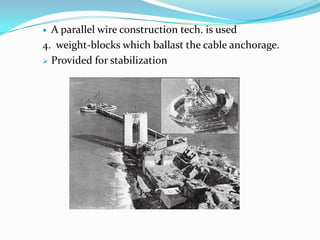
A parallel wire construction tech. is used
4. weight-blocks which ballast the cable anchorage.
 Provided for stabilization

5. Pier: The pier, made up of 147,600 tons of concrete, was
built in 37m of open water. This was achieved by the
concrete fender that in itself is a marvel of construction; it
is 108m long and 56m wide at the centre line of the bridge.
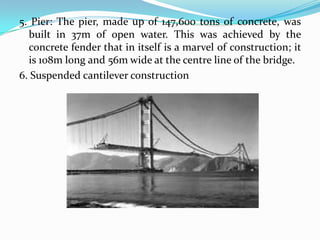
6. Suspended cantilever construction
Design Issue & Structure details
 Leon S. Moisseiff was named one of the consulting

engineers proposed a bridge far more efficient and
beautiful
 In addition to the suspension bridge the approaches
include a steel arch bridge, two concrete anchorages, two
steel truss viaducts and three concrete pylons.
 The Golden Gate followed this design below the roadbed,
but modified it above the deck to big open rectangles
without cross-members, framing the blue sky and
producing a lighter look.
 The bridge’s cable design
Structure details: 1. San Francisco (south) Approach Viaduct
2. San Francisco (south) Anchorage Housing and
Pylons S1 and S2
3. Fort Point Arch
4. Main Suspension Bridge
5. Marin (north) Approach Viaduct
6. Marin (north) Anchorage Housing and Pylons N1 and N2
 Total length of Bridge including approaches: = 2,737 m
 Length of suspension span including main span and side spans:
= 1,966 m
 Length of main span portion of suspended structure (distance
between towers): = 1,280 m
 Length of one side span: = 343
 Width of Bridge: = 27 m
 Clearance above mean higher high water: = 67 m
Asthetics
 Fulfillment of function The bridge fulfilled a high degree








of simplicity, which make the bridge beautiful.
Proportions:conveys a decent impression of balance
between its mass and voids, and between light and shadow
Order:The appearance of the bridge looks like a mirror
image of two similar towers with cables.
Integrating into the Environment
Texture:It has rough finishing for piers and
abutments, which makes sense for bridge design.
Colour :This colour brings a big contrast with the sky and
sea
Complexity :
Loading

 The most important types of loadings we need to consider on the bridge are:

1. Dead load,
2. Super-imposed dead load,
3. Live Traffic,
4. Wind,
5. Temperature
There are five combinations of load:
1. All permanent load + primary live loads (vertical
traffic loads)
2. Combination 1 + wind, and if erection considered, temporary erection loads.
3. Combination 1 + temperature, and if erection considered, temporary loads
4. All permanent loads + secondary live loads and associated primary live loads
5. All permanent loads + loads due to friction at support.
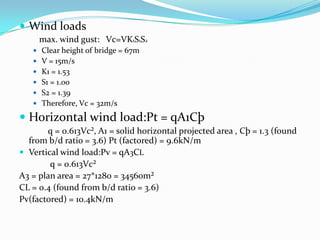
 Wind loads
max. wind gust: Vc=VK1S1S2
 Clear height of bridge = 67m
 V = 15m/s
 K1 = 1.53

 S1 = 1.00
 S2 = 1.39
 Therefore, Vc = 32m/s

 Horizontal wind load:Pt = qA1Cþ
q = 0.613Vc², A1 = solid horizontal projected area , Cþ = 1.3 (found
from b/d ratio = 3.6) Pt (factored) = 9.6kN/m
 Vertical wind load:Pv = qA3CL
q = 0.613Vc²
A3 = plan area = 27*1280 = 34560m²
CL = 0.4 (found from b/d ratio = 3.6)
Pv(factored) = 10.4kN/m
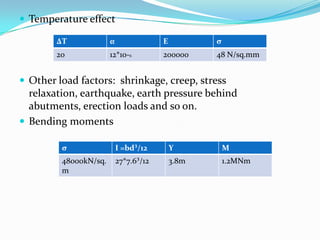
 Temperature effect
∆T

α

E

σ

20

12*10-6

200000

48 N/sq.mm

 Other load factors: shrinkage, creep, stress

relaxation, earthquake, earth pressure behind
abutments, erection loads and so on.
 Bending moments
σ

I =bd³/12

Y

M

48000kN/sq.
m

27*7.6³/12

3.8m

1.2MNm
Serviceability
 In addition to traffic loading, the Golden Gate Bridge

must withstand the following environments:
1. Earthquakes, primary originating on the San Andreas and
Hayward faults.
2. Wind of up to 70 miles per hour.
3. Strong ocean current.
4. Temperature stresses.
Creep effect
 Although the Golden Gate Bridge is regarded as a steel

frame and steel cable structure, large amount of concrete is
used on the bridge; including the anchorages, paving,
pylons, piers, approaches and so on.
 To minimize this effect, an antiseismic stop device for
girder structures of Golden Gate Bridge, is used.
Potential weakness and improvement of the
Golden Gate Bridge
 In 1989, the epicenter of the Loma Prieta earthquake was

too strong to damage the Golden Gate Bridge.
 After the earthquake,a restrainer retrofit project was
necessary in order to increase its earthquake resistance, as
scientific organizations say that there is a 62% probability
of at least one magnitude 6.7 or greater quake capable of
causing widespread damage, impacting the San Francisco
Bay within the next 30 years.
Improvement of bridge
 Phase 1 would retrofit the Marin (north) Approach Viaduct
 Phase 2 would retrofit the San Francisco (south) Approach

Viaduct, San Francisco (south) Anchorage Housing, Fort
Point Arch, and Pylons S1 and S2
 Phase 3 would Main Suspension Bridge and Marin (north)

Anchorage Housing

Golden gate bridge

  • 1.
  • 2.
    Info & historyof Golden Gate Bridge  A suspension bridge spanning across Golden Gate, opening into the san Francisco  a link to the city of San Francisco by connecting the northern tip of the San Francisco Peninsula to Marin County as part of US Highway 101 and California State Highway 1  Built by Joseph Strauss  Second longest suspension bridge in US
  • 3.
    Principal of longsuspension bridge  the deck is always suspended by hangers, each attached to the main cable, which in turn is anchored into the ground at its ends.  Suspension bridge usually has a slender deck which carries bending only (no compression).  In order to suspend something of uniform weight ‘for An equation was developed to prove the cable deformed into a parabola and the horizontal component force in the cable was a constant value. H=wl*l/8f
  • 4.
    Construction  Challenges 1. Thebridge in this location should withstand brutal winds, tide, and fog. 2. It is also located less than 13km from the epicenter of the most catastrophic earthquake in history.  Components 1. The anchorages - the massive blocks that grip the bridge's supporting cables. 2. The north pier, which supports the tower, was built easily on a bedrock ledge 6m below the water. 3. But on the southern San Francisco side, Strauss had to build his pier in the open ocean, 30m below the surface. 4. Steel frame and steel cables
  • 5.
    A parallel wireconstruction tech. is used 4. weight-blocks which ballast the cable anchorage.  Provided for stabilization 
  • 6.
    5. Pier: Thepier, made up of 147,600 tons of concrete, was built in 37m of open water. This was achieved by the concrete fender that in itself is a marvel of construction; it is 108m long and 56m wide at the centre line of the bridge. 6. Suspended cantilever construction
  • 7.
    Design Issue &Structure details  Leon S. Moisseiff was named one of the consulting engineers proposed a bridge far more efficient and beautiful  In addition to the suspension bridge the approaches include a steel arch bridge, two concrete anchorages, two steel truss viaducts and three concrete pylons.  The Golden Gate followed this design below the roadbed, but modified it above the deck to big open rectangles without cross-members, framing the blue sky and producing a lighter look.  The bridge’s cable design
  • 8.
    Structure details: 1.San Francisco (south) Approach Viaduct 2. San Francisco (south) Anchorage Housing and Pylons S1 and S2 3. Fort Point Arch 4. Main Suspension Bridge 5. Marin (north) Approach Viaduct 6. Marin (north) Anchorage Housing and Pylons N1 and N2  Total length of Bridge including approaches: = 2,737 m  Length of suspension span including main span and side spans: = 1,966 m  Length of main span portion of suspended structure (distance between towers): = 1,280 m  Length of one side span: = 343  Width of Bridge: = 27 m  Clearance above mean higher high water: = 67 m
  • 9.
    Asthetics  Fulfillment offunction The bridge fulfilled a high degree       of simplicity, which make the bridge beautiful. Proportions:conveys a decent impression of balance between its mass and voids, and between light and shadow Order:The appearance of the bridge looks like a mirror image of two similar towers with cables. Integrating into the Environment Texture:It has rough finishing for piers and abutments, which makes sense for bridge design. Colour :This colour brings a big contrast with the sky and sea Complexity :
  • 10.
    Loading  The mostimportant types of loadings we need to consider on the bridge are: 1. Dead load, 2. Super-imposed dead load, 3. Live Traffic, 4. Wind, 5. Temperature There are five combinations of load: 1. All permanent load + primary live loads (vertical traffic loads) 2. Combination 1 + wind, and if erection considered, temporary erection loads. 3. Combination 1 + temperature, and if erection considered, temporary loads 4. All permanent loads + secondary live loads and associated primary live loads 5. All permanent loads + loads due to friction at support.
  • 11.
     Wind loads max.wind gust: Vc=VK1S1S2  Clear height of bridge = 67m  V = 15m/s  K1 = 1.53  S1 = 1.00  S2 = 1.39  Therefore, Vc = 32m/s  Horizontal wind load:Pt = qA1Cþ q = 0.613Vc², A1 = solid horizontal projected area , Cþ = 1.3 (found from b/d ratio = 3.6) Pt (factored) = 9.6kN/m  Vertical wind load:Pv = qA3CL q = 0.613Vc² A3 = plan area = 27*1280 = 34560m² CL = 0.4 (found from b/d ratio = 3.6) Pv(factored) = 10.4kN/m
  • 12.
     Temperature effect ∆T α E σ 20 12*10-6 200000 48N/sq.mm  Other load factors: shrinkage, creep, stress relaxation, earthquake, earth pressure behind abutments, erection loads and so on.  Bending moments σ I =bd³/12 Y M 48000kN/sq. m 27*7.6³/12 3.8m 1.2MNm
  • 13.
    Serviceability  In additionto traffic loading, the Golden Gate Bridge must withstand the following environments: 1. Earthquakes, primary originating on the San Andreas and Hayward faults. 2. Wind of up to 70 miles per hour. 3. Strong ocean current. 4. Temperature stresses.
  • 14.
    Creep effect  Althoughthe Golden Gate Bridge is regarded as a steel frame and steel cable structure, large amount of concrete is used on the bridge; including the anchorages, paving, pylons, piers, approaches and so on.  To minimize this effect, an antiseismic stop device for girder structures of Golden Gate Bridge, is used.
  • 15.
    Potential weakness andimprovement of the Golden Gate Bridge  In 1989, the epicenter of the Loma Prieta earthquake was too strong to damage the Golden Gate Bridge.  After the earthquake,a restrainer retrofit project was necessary in order to increase its earthquake resistance, as scientific organizations say that there is a 62% probability of at least one magnitude 6.7 or greater quake capable of causing widespread damage, impacting the San Francisco Bay within the next 30 years.
  • 16.
    Improvement of bridge Phase 1 would retrofit the Marin (north) Approach Viaduct  Phase 2 would retrofit the San Francisco (south) Approach Viaduct, San Francisco (south) Anchorage Housing, Fort Point Arch, and Pylons S1 and S2  Phase 3 would Main Suspension Bridge and Marin (north) Anchorage Housing