Suspension Bridge.
Presented by:
1. Shrafat Hussain
2. Syed Shehyar Uddin
3. Syed Ahsan Bashir
4. Taha Ahmed Tariq
5. Tahir Abbas Arian
Subject: structural analysis
Class: BS CIVIL ENGINEERING TECHNOLOGY Semester 4th
1
Bridge is a structure built to span a valley,
road, river, body of water, or any other
physical obstacle.
Designs of bridges will vary depending on the
function of the bridge and the nature of the
area where the bridge is to be constructed.
2
PRESENTATION BY:HEMANTKUMAR
SUSPENDERS
ANCHORAGE
DIP/SAG
MAIN SPANDECK
PINNED
SUPPORT
PYLON
PAVEMENT
FIXED
SUPPORT
SUSPENSION
CABLE
3
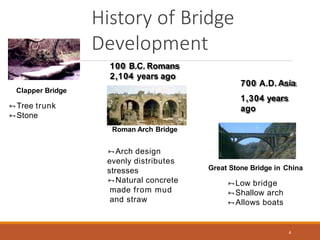
700 A.D. Asia
1,304 years
ago
100 B.C. Romans
2,104 years ago
Clapper Bridge
Tree trunk
Stone
Arch design
evenly distributes
stresses
Natural concrete
made from mud
and straw
Roman Arch Bridge
History of Bridge
Development
4
Great Stone Bridge in China
Low bridge
Shallow arch
Allows boats
History of Bridge
Development
5
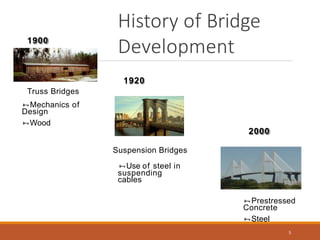
Mechanics of
Design
Wood
Suspension Bridges
Use of steel in
suspending
cables
1900
1920
Truss Bridges
Prestressed
Concrete
Steel
2000
There are six main types of bridges:
1. beam bridges
2. cantilever bridges
3. arch bridges
4. suspension bridges
5. cable-stayed bridges and
6. truss bridges
6
Suspension Bridge:
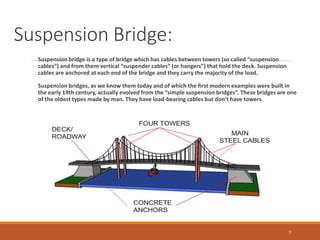
Suspension bridge is a type of bridge which has cables between towers (so called “suspension
cables”) and from them vertical “suspender cables” (or hangers”) that hold the deck. Suspension
cables are anchored at each end of the bridge and they carry the majority of the load.
Suspension bridges, as we know them today and of which the first modern examples were built in
the early 19th century, actually evolved from the “simple suspension bridges”. These bridges are one
of the oldest types made by man. They have load-bearing cables but don’t have towers.
7
Types of Suspension
Bridges
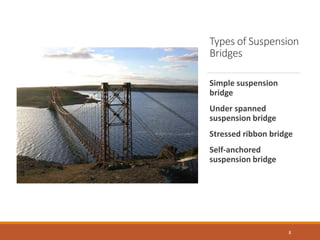
Simple suspension
bridge
Under spanned
suspension bridge
Stressed ribbon bridge
Self-anchored
suspension bridge
8
1. Simple suspension bridge
a bridge that has no towers nor piers and is suspended on the cables that
are anchored at their ends and nothing else. It is also known as a rope
bridge, swing bridge, suspended bridge, hanging bridge and catenary
bridge and is the oldest variant of the suspended bridge. The deck of this
bridge follows is arched downwards and upwards and has additional ropes
at a higher level which form the handrail.
2. Underspanned suspension bridge:
a type of bridge that was developed in the early 19th century and which has
deck that is raised on posts above the main cables which are, at their ends,
anchored. It is a very rare design in practice because its deck is not too
stable. Some of the bridges built like this are Pont des Bergues (built in
1834), are James Smith’s Micklewood Bridge at Doune in Scotland (it was
probably the first one built like this and had chains instead of cables which
also makes it chain bridge). Hammersmith Bridge has parts of the roadway
built in this manner.
9
3. Stressed ribbon bridge:
a modern, improved variant of a classical simple suspension bridge. It has a
rigid deck which lays on suspension cables which are in turn embedded in
the deck. Deck follows a catenary arc between supports and is stressed in
traction, which adds to its stiffness and prevents swaying and bouncing like
at simple suspended bridge. This bridge is usually made of concrete
reinforced by steel tensioned cables and can carry vehicle traffic. Concrete
plates are premade and placed to form the initial structure.
4. Self-anchored suspension bridge:
has its main cables attached to the ends of the deck rather than ground like
standard suspended bridge which allows for construction on elevated piers,
or in areas of unstable soils where anchors would be loosen over time. This
method of building appeared in mi-19th century and was designed by
Austrian engineer Josef Langer in 1859. American engineer Charles Bender
patented this method in United States in 1867
10
SUSPENSIONBRIDGE
11
CONSTRUCTIONSEQUENCE
1. TOWERS`
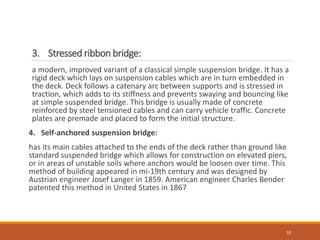
The piers are then extended above water level, where they are capped with pedestal bases for the
towers. From where towers of single or multiple columns are erected using high-strength reinforced
concrete, stonework, or steel. Concrete is used most frequently in modern suspension bridge
construction due to the high cost ofsteel.
SUSPENSIONBRIDGE
12
CONSTRUCTIONSEQUENCE`
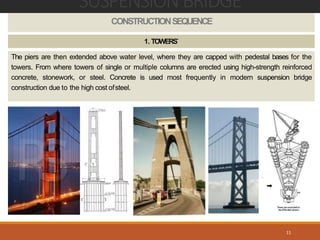
2. SADDLES
Large devices called saddles, which will carry the main
suspension cables, are positioned atop the towers. Typically of
cast steel, they can also be manufactured using riveted
forms, and are equipped with rollers to allow the main cables
to shiftunder construction and normal loads.
3.ANCHORAGE
Anchorages are the structures to which the ends of the bridge's cables are secured. They are massive
concrete blocks securely attached to strong rock formations. During construction of the anchorages,
strong eye bars (steel bars with a circular hole at one end) are embedded in the concrete.— each wire
bundle will be securedto one of the anchorage's eye bars.
SUSPENSIONBRIDGE
13
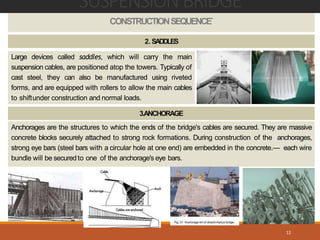
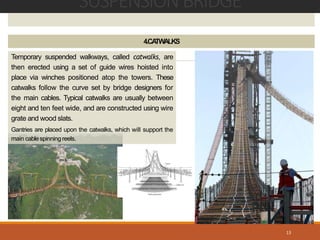
4.CATWALKS
Temporary suspended walkways, called catwalks, are
then erected using a set of guide wires hoisted into
place via winches positioned atop the towers. These
catwalks follow the curve set by bridge designers for
the main cables. Typical catwalks are usually between
eight and ten feet wide, and are constructed using wire
grate and wood slats.
Gantries are placed upon the catwalks, which will support the
main cablespinning reels.
SUSPENSIONBRIDGE
14
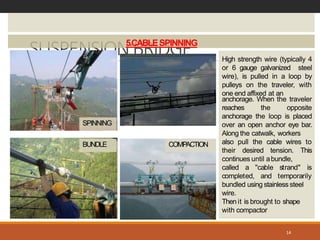
5.CABLESPINNING
High strength wire (typically 4
or 6 gauge galvanized steel
wire), is pulled in a loop by
pulleys on the traveler, with
one end affixed at an
anchorage. When the traveler
reaches the opposite
anchorage the loop is placed
over an open anchor eye bar.
Along the catwalk, workers
also pull the cable wires to
their desired tension. This
continues until abundle,
called a
completed,
"cable strand" is
and temporarily
bundled using stainless steel
wire.
Then it is brought to shape
with compactor
SPINNING
BUNDLE COMPACTION
SUSPENSIONBRIDGE
15
7.DECK
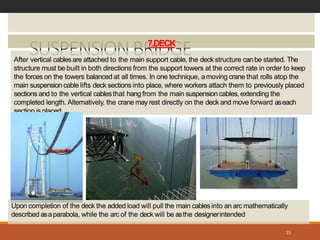
After vertical cablesare attached to the main support cable, the deck structure canbe started. The
structure must be built in both directions from the support towers at the correct rate in order to keep
the forces on the towers balanced at all times. In one technique, amoving crane that rolls atop the
main suspension cable lifts deck sections into place, where workers attach them to previously placed
sections and to the vertical cablesthat hang from the main suspension cables, extending the
completed length. Alternatively, the crane may rest directly on the deck and move forward aseach
section isplaced.
Upon completion of the deck the added load will pull the main cablesinto an arc mathematically
described asaparabola, while the arc of the deck will be asthe designerintended
ADVANTAGE
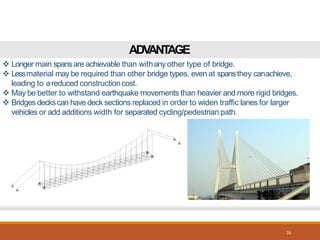
 Longer main spansare achievable than withany other type of bridge.
 Lessmaterial may be required than other bridge types, even at spansthey canachieve,
leading to areduced constructioncost.
 May be better to withstand earthquake movements than heavier and more rigid bridges.
 Bridges deckscan have deck sections replaced in order to widen traffic lanes for larger
vehicles or add additions width for separated cycling/pedestrian path.
16
DISADVANTAGES
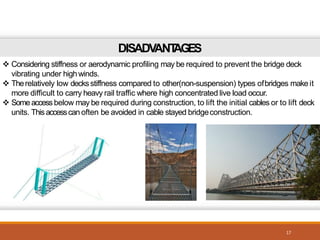
 Considering stiffness or aerodynamic profiling may be required to prevent the bridge deck
vibrating under highwinds.
 Therelatively low decksstiffness compared to other(non-suspension) types ofbridges makeit
more difficult to carry heavy rail traffic where high concentrated live load occur.
 Someaccess below may be required during construction, to lift the initial cables or to lift deck
units. Thisaccesscan often be avoided in cable stayed bridgeconstruction.
17
THANK
YOU!
18
Respected Teacher and dear Class mates

Suspension bridge

  • 1.
    Suspension Bridge. Presented by: 1.Shrafat Hussain 2. Syed Shehyar Uddin 3. Syed Ahsan Bashir 4. Taha Ahmed Tariq 5. Tahir Abbas Arian Subject: structural analysis Class: BS CIVIL ENGINEERING TECHNOLOGY Semester 4th 1
  • 2.
    Bridge is astructure built to span a valley, road, river, body of water, or any other physical obstacle. Designs of bridges will vary depending on the function of the bridge and the nature of the area where the bridge is to be constructed. 2
  • 3.
  • 4.
    700 A.D. Asia 1,304years ago 100 B.C. Romans 2,104 years ago Clapper Bridge Tree trunk Stone Arch design evenly distributes stresses Natural concrete made from mud and straw Roman Arch Bridge History of Bridge Development 4 Great Stone Bridge in China Low bridge Shallow arch Allows boats
  • 5.
    History of Bridge Development 5 Mechanicsof Design Wood Suspension Bridges Use of steel in suspending cables 1900 1920 Truss Bridges Prestressed Concrete Steel 2000
  • 6.
    There are sixmain types of bridges: 1. beam bridges 2. cantilever bridges 3. arch bridges 4. suspension bridges 5. cable-stayed bridges and 6. truss bridges 6
  • 7.
    Suspension Bridge: Suspension bridgeis a type of bridge which has cables between towers (so called “suspension cables”) and from them vertical “suspender cables” (or hangers”) that hold the deck. Suspension cables are anchored at each end of the bridge and they carry the majority of the load. Suspension bridges, as we know them today and of which the first modern examples were built in the early 19th century, actually evolved from the “simple suspension bridges”. These bridges are one of the oldest types made by man. They have load-bearing cables but don’t have towers. 7
  • 8.
    Types of Suspension Bridges Simplesuspension bridge Under spanned suspension bridge Stressed ribbon bridge Self-anchored suspension bridge 8
  • 9.
    1. Simple suspensionbridge a bridge that has no towers nor piers and is suspended on the cables that are anchored at their ends and nothing else. It is also known as a rope bridge, swing bridge, suspended bridge, hanging bridge and catenary bridge and is the oldest variant of the suspended bridge. The deck of this bridge follows is arched downwards and upwards and has additional ropes at a higher level which form the handrail. 2. Underspanned suspension bridge: a type of bridge that was developed in the early 19th century and which has deck that is raised on posts above the main cables which are, at their ends, anchored. It is a very rare design in practice because its deck is not too stable. Some of the bridges built like this are Pont des Bergues (built in 1834), are James Smith’s Micklewood Bridge at Doune in Scotland (it was probably the first one built like this and had chains instead of cables which also makes it chain bridge). Hammersmith Bridge has parts of the roadway built in this manner. 9
  • 10.
    3. Stressed ribbonbridge: a modern, improved variant of a classical simple suspension bridge. It has a rigid deck which lays on suspension cables which are in turn embedded in the deck. Deck follows a catenary arc between supports and is stressed in traction, which adds to its stiffness and prevents swaying and bouncing like at simple suspended bridge. This bridge is usually made of concrete reinforced by steel tensioned cables and can carry vehicle traffic. Concrete plates are premade and placed to form the initial structure. 4. Self-anchored suspension bridge: has its main cables attached to the ends of the deck rather than ground like standard suspended bridge which allows for construction on elevated piers, or in areas of unstable soils where anchors would be loosen over time. This method of building appeared in mi-19th century and was designed by Austrian engineer Josef Langer in 1859. American engineer Charles Bender patented this method in United States in 1867 10
  • 11.
    SUSPENSIONBRIDGE 11 CONSTRUCTIONSEQUENCE 1. TOWERS` The piersare then extended above water level, where they are capped with pedestal bases for the towers. From where towers of single or multiple columns are erected using high-strength reinforced concrete, stonework, or steel. Concrete is used most frequently in modern suspension bridge construction due to the high cost ofsteel.
  • 12.
    SUSPENSIONBRIDGE 12 CONSTRUCTIONSEQUENCE` 2. SADDLES Large devicescalled saddles, which will carry the main suspension cables, are positioned atop the towers. Typically of cast steel, they can also be manufactured using riveted forms, and are equipped with rollers to allow the main cables to shiftunder construction and normal loads. 3.ANCHORAGE Anchorages are the structures to which the ends of the bridge's cables are secured. They are massive concrete blocks securely attached to strong rock formations. During construction of the anchorages, strong eye bars (steel bars with a circular hole at one end) are embedded in the concrete.— each wire bundle will be securedto one of the anchorage's eye bars.
  • 13.
    SUSPENSIONBRIDGE 13 4.CATWALKS Temporary suspended walkways,called catwalks, are then erected using a set of guide wires hoisted into place via winches positioned atop the towers. These catwalks follow the curve set by bridge designers for the main cables. Typical catwalks are usually between eight and ten feet wide, and are constructed using wire grate and wood slats. Gantries are placed upon the catwalks, which will support the main cablespinning reels.
  • 14.
    SUSPENSIONBRIDGE 14 5.CABLESPINNING High strength wire(typically 4 or 6 gauge galvanized steel wire), is pulled in a loop by pulleys on the traveler, with one end affixed at an anchorage. When the traveler reaches the opposite anchorage the loop is placed over an open anchor eye bar. Along the catwalk, workers also pull the cable wires to their desired tension. This continues until abundle, called a completed, "cable strand" is and temporarily bundled using stainless steel wire. Then it is brought to shape with compactor SPINNING BUNDLE COMPACTION
  • 15.
    SUSPENSIONBRIDGE 15 7.DECK After vertical cablesareattached to the main support cable, the deck structure canbe started. The structure must be built in both directions from the support towers at the correct rate in order to keep the forces on the towers balanced at all times. In one technique, amoving crane that rolls atop the main suspension cable lifts deck sections into place, where workers attach them to previously placed sections and to the vertical cablesthat hang from the main suspension cables, extending the completed length. Alternatively, the crane may rest directly on the deck and move forward aseach section isplaced. Upon completion of the deck the added load will pull the main cablesinto an arc mathematically described asaparabola, while the arc of the deck will be asthe designerintended
  • 16.
    ADVANTAGE  Longer mainspansare achievable than withany other type of bridge.  Lessmaterial may be required than other bridge types, even at spansthey canachieve, leading to areduced constructioncost.  May be better to withstand earthquake movements than heavier and more rigid bridges.  Bridges deckscan have deck sections replaced in order to widen traffic lanes for larger vehicles or add additions width for separated cycling/pedestrian path. 16
  • 17.
    DISADVANTAGES  Considering stiffnessor aerodynamic profiling may be required to prevent the bridge deck vibrating under highwinds.  Therelatively low decksstiffness compared to other(non-suspension) types ofbridges makeit more difficult to carry heavy rail traffic where high concentrated live load occur.  Someaccess below may be required during construction, to lift the initial cables or to lift deck units. Thisaccesscan often be avoided in cable stayed bridgeconstruction. 17
  • 18.