Surrealism
 By Catherine Morris
   Nicole Kariotis
    Ema Sugiura
What is Surrealism?
 Definition: A 20th-century avant-garde
 movement in art and literature that sought to
 release the creative potential of the
 unconscious mind.

 Our Definition: A combination of dreams and
 reality all meshed into one.
The Beginning
• Founded in 1924


• Influenced by well known psychologist
 Sigmund Freud

• Started as a literary movement but soon
 expanded into paintings and eventually
 photography
Components
• Developed out of Dada


• Believed, by its founder, to be revolutionary


• Centered around the imagination and how
 you use it to see certain things
• Isn't always suppose to make sense to the
 viewer (shouldn't be taken literally)

• Formed political expression and action
The Politics
• had a fierce hatred of authority and religion


• ideas early on about revolutionary anarchism


• Dada (which influenced Surrealism) was a reaction
  to the WWI

• Some surrealists were members of the Communist
  part

• Others were Libertarian


• Much sexism and homophobia
Key Characteristics
• Explored the unconsciousness and dreaming
 as a form of reality

• Sexuality and violence


• Pushed boundaries of socially accepted
 behaviors and of art
• Emphasized the irrational and the mysterious


• Expressed sexual drives, anger, and fear


• True wants, needs, and desires
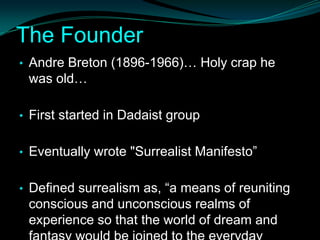
The Founder
• Andre Breton (1896-1966)… Holy crap he
 was old…

• First started in Dadaist group


• Eventually wrote "Surrealist Manifesto”


• Defined surrealism as, “a means of reuniting
 conscious and unconscious realms of
 experience so that the world of dream and
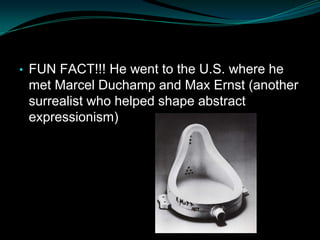
• FUN FACT!!! He went to the U.S. where he
 met Marcel Duchamp and Max Ernst (another
 surrealist who helped shape abstract
 expressionism)
Hierohymus Bosch
• Eccentric painter of religious visions who
 dealt in particular with the torments of hell

• Surrealism was affected by his wildly erotic
 and sadistic images
Sigmund Freud
• A well known psychologist who inspired most
 surrealist artists

• Founder of the psychoanalytic theory,
 oedipus theory, and the theory of the
 subconscious

• Surrealism strongly followed his theory of the
 subconscious. Artists used this as a
 technique when painting… letting their minds
Psychoanalytic Theory
• Psychoanalysis: Freud's theory of
    personality, our thoughts, and actions to
    unconscious motives and conflicts.

•   The unconscious usually consists of mostly
    unacceptable thoughts, wishes, feelings, and
    memories.
Joan Miro
• Spanish


• Studied at La Lonja of Fine Arts


• Works before 1920 were influenced by
 cubism and fauvism
Continued….
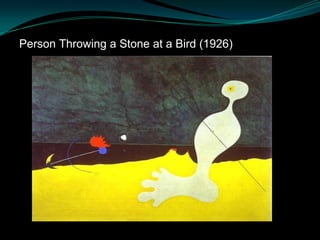
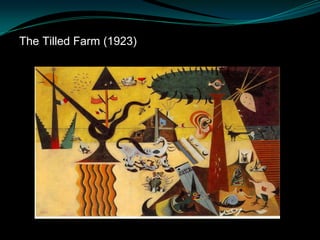
• Automatic painting: would not control his
 paintbrush, but instead had his subconscious
 control it.

• Patches of color look like they've been set
 down randomly
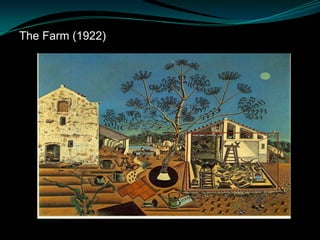
The Farm (1922)
Person Throwing a Stone at a Bird (1926)
The Tilled Farm (1923)
Rene Magritte
• Belgian
•   studied at Academie Royale from 1916 to
    1918

•   his mom committed suicide when he was 13.
    she suffered from depression and threw
    herself off of a bridge - this obviously took its
    toll on him as you can see in many of his
    paintings
•   portrays realistic images but places them in
    surreal places

•   was recognized by critics for his talent but
    still wasn't completely accepted because of
    his unrealistic placement of objects in his
    paintings
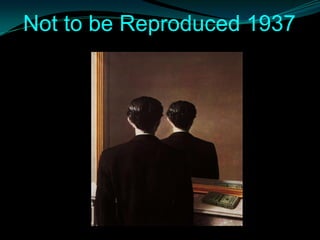
Not to be Reproduced 1937
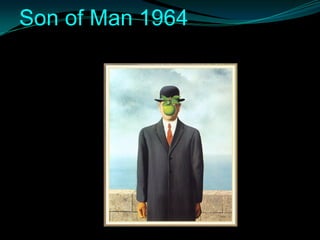
Son of Man 1964
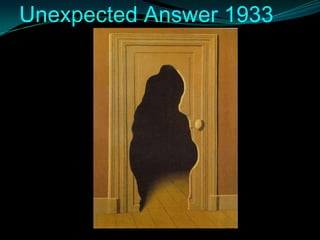
Unexpected Answer 1933
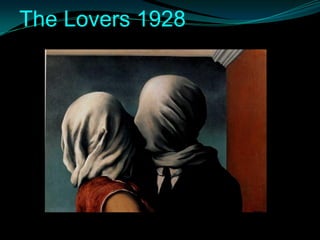
The Lovers 1928
Salvadore Dali
• Spanish


• Born into middle class family


• Studied at the Academia de San Fernano
 (school of fine arts)
• Became close friends with Pepin Bello, Luis
 Bunel, and Frederico Garcia Leroca.

• Experimented with cubism at this time.
Continued…
• Paintings highlighted double images and
 visual illusions

• Mixes fantasies with reality
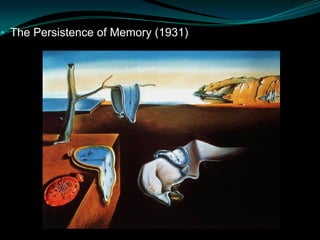
• The Persistence of Memory (1931)
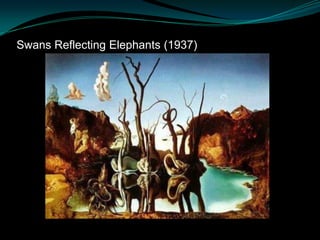
Swans Reflecting Elephants (1937)
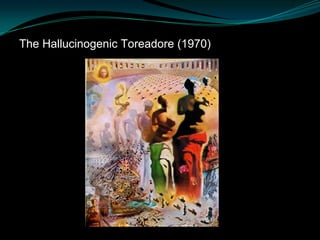
The Hallucinogenic Toreadore (1970)
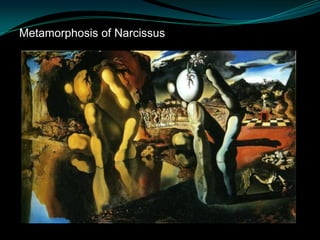
Metamorphosis of Narcissus
Metamorphosis ofNarcissus
Poem
Narcissus,
in his immobility
absorbed by his reflection with the digestive slowness
 of carnivorous plants,
becomes invisible.
There remains of him only the hallucinatingly white
 oval of his head,
his head again more tender,
his head, chrysalis of hidden biological designs,
his head held up by the tips of the water's fingers,
at the tips of his fingers
of the insensate hand,
of the terrible hand,
of the mortal hand
of his own reflection.
When that head splits
when that head splits
when that head bursts,
it will be the flower,
the new Narcissus,
Gala - my new Narcissus
Technique
•   Early 1930s, Dali created "Paranoid-critical
    Transformation Method"

•   Method used to help artist tap into their
    subconscious and self induce a paranoid
    state

•   Helped artists understand world and reality
    in order to view it in more unique ways
•   Created "hand painted dream photographs"

•   Used optical illusions and juxtapositioning
    images

•   painted what he witnessed
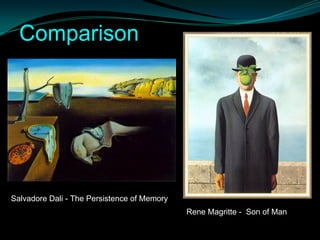
Comparison


Salvadore Dali - The Persistence of Memory
                                             Rene Magritte - Son of Man
Summary
•   Surrealism is a combination of the
    subconscious and reality.

•   Many of these paintings have very deep
    meanings to the artists

•   Most of the paintings in this movement were
    inspired by Sigmund Freud and his theories

Surrealism 3

  • 1.
    Surrealism By CatherineMorris Nicole Kariotis Ema Sugiura
  • 2.
    What is Surrealism? Definition: A 20th-century avant-garde movement in art and literature that sought to release the creative potential of the unconscious mind. Our Definition: A combination of dreams and reality all meshed into one.
  • 3.
    The Beginning • Foundedin 1924 • Influenced by well known psychologist Sigmund Freud • Started as a literary movement but soon expanded into paintings and eventually photography
  • 4.
    Components • Developed outof Dada • Believed, by its founder, to be revolutionary • Centered around the imagination and how you use it to see certain things
  • 5.
    • Isn't alwayssuppose to make sense to the viewer (shouldn't be taken literally) • Formed political expression and action
  • 6.
    The Politics • hada fierce hatred of authority and religion • ideas early on about revolutionary anarchism • Dada (which influenced Surrealism) was a reaction to the WWI • Some surrealists were members of the Communist part • Others were Libertarian • Much sexism and homophobia
  • 7.
    Key Characteristics • Exploredthe unconsciousness and dreaming as a form of reality • Sexuality and violence • Pushed boundaries of socially accepted behaviors and of art
  • 8.
    • Emphasized theirrational and the mysterious • Expressed sexual drives, anger, and fear • True wants, needs, and desires
  • 9.
    The Founder • AndreBreton (1896-1966)… Holy crap he was old… • First started in Dadaist group • Eventually wrote "Surrealist Manifesto” • Defined surrealism as, “a means of reuniting conscious and unconscious realms of experience so that the world of dream and
  • 10.
    • FUN FACT!!!He went to the U.S. where he met Marcel Duchamp and Max Ernst (another surrealist who helped shape abstract expressionism)
  • 11.
    Hierohymus Bosch • Eccentricpainter of religious visions who dealt in particular with the torments of hell • Surrealism was affected by his wildly erotic and sadistic images
  • 12.
    Sigmund Freud • Awell known psychologist who inspired most surrealist artists • Founder of the psychoanalytic theory, oedipus theory, and the theory of the subconscious • Surrealism strongly followed his theory of the subconscious. Artists used this as a technique when painting… letting their minds
  • 13.
    Psychoanalytic Theory • Psychoanalysis:Freud's theory of personality, our thoughts, and actions to unconscious motives and conflicts. • The unconscious usually consists of mostly unacceptable thoughts, wishes, feelings, and memories.
  • 14.
    Joan Miro • Spanish •Studied at La Lonja of Fine Arts • Works before 1920 were influenced by cubism and fauvism
  • 15.
    Continued…. • Automatic painting:would not control his paintbrush, but instead had his subconscious control it. • Patches of color look like they've been set down randomly
  • 16.
  • 17.
    Person Throwing aStone at a Bird (1926)
  • 18.
  • 19.
    Rene Magritte • Belgian • studied at Academie Royale from 1916 to 1918 • his mom committed suicide when he was 13. she suffered from depression and threw herself off of a bridge - this obviously took its toll on him as you can see in many of his paintings
  • 20.
    portrays realistic images but places them in surreal places • was recognized by critics for his talent but still wasn't completely accepted because of his unrealistic placement of objects in his paintings
  • 21.
    Not to beReproduced 1937
  • 22.
  • 23.
  • 24.
  • 25.
    Salvadore Dali • Spanish •Born into middle class family • Studied at the Academia de San Fernano (school of fine arts)
  • 26.
    • Became closefriends with Pepin Bello, Luis Bunel, and Frederico Garcia Leroca. • Experimented with cubism at this time.
  • 27.
    Continued… • Paintings highlighteddouble images and visual illusions • Mixes fantasies with reality
  • 28.
    • The Persistenceof Memory (1931)
  • 29.
  • 30.
  • 31.
  • 32.
    Metamorphosis ofNarcissus Poem Narcissus, in hisimmobility absorbed by his reflection with the digestive slowness of carnivorous plants, becomes invisible. There remains of him only the hallucinatingly white oval of his head, his head again more tender, his head, chrysalis of hidden biological designs, his head held up by the tips of the water's fingers, at the tips of his fingers
  • 33.
    of the insensatehand, of the terrible hand, of the mortal hand of his own reflection. When that head splits when that head splits when that head bursts, it will be the flower, the new Narcissus, Gala - my new Narcissus
  • 34.
    Technique • Early 1930s, Dali created "Paranoid-critical Transformation Method" • Method used to help artist tap into their subconscious and self induce a paranoid state • Helped artists understand world and reality in order to view it in more unique ways
  • 35.
    Created "hand painted dream photographs" • Used optical illusions and juxtapositioning images • painted what he witnessed
  • 36.
    Comparison Salvadore Dali -The Persistence of Memory Rene Magritte - Son of Man
  • 37.
    Summary • Surrealism is a combination of the subconscious and reality. • Many of these paintings have very deep meanings to the artists • Most of the paintings in this movement were inspired by Sigmund Freud and his theories