
Surrealism
1924
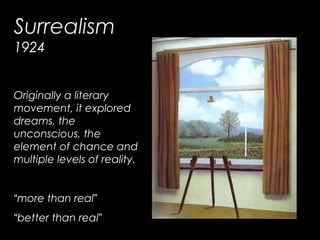
Surrealism
1924
Originally a literary
movement, it explored
dreams, the
unconscious, the
element of chance and
multiple levels of reality.
“more than real”
“better than real”
Sigmund Freud
(1856-1939)
•The father of psychoanalysis
•In 1900, Freud published
The Interpretation of Dreams, and introduced
the wider public to the notion of the
unconscious mind
•theorized that forgetfulness or slips of the
tongue (now called "Freudian slips") were not
accidental at all, but it was the "dynamic
unconscious" revealing something
meaningful.
•He said “Dreams are often most profound
when they seem the most crazy.”
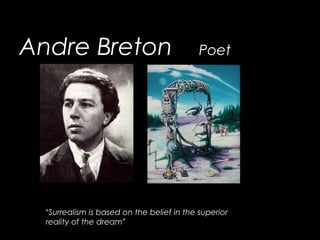
Andre Breton Poet
“Surrealism is based on the belief in the superior
reality of the dream”
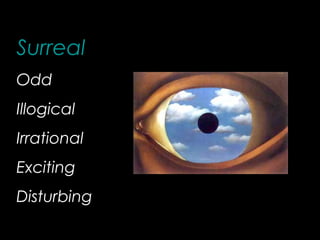
Surreal
Odd
Illogical
Irrational
Exciting
Disturbing
•Reaction to chaos of WWI
•Influence of Freud: Dreams and
subconscious
•Impossible scale
•Reversal of natural laws
•Double images
•Juxtaposition
Characteristics of Surrealism
Where?
France, Germany,
Catalunya, Belgium
Artists
Max Ernst
Salvador Dali
Joan Miro
Man Ray
Rene Magritte
Salvador Dali (Spanish, 1904–1989)
The Metamorphosis of Narcissus, 1937, Salvador Dali
Salvador Dali
Persistence of Memory 1931
Salvador Dali
Apparition
Rene Magritte (Belgian)
Rene Magritte
René Magritte
Les valeurs personnelles
(Personal Values)
1952
René Magritte
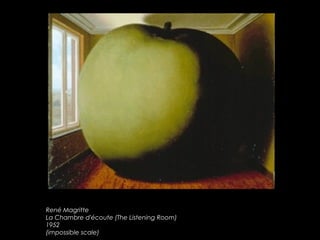
La Chambre d'écoute (The Listening Room)
1952
(impossible scale)
“Carte Blanche,” Rene Magritte
Rene Magritte
Carte Blanche
and dream interpretation in Surrealism is further emphasized by Sigmund Freud's contribut
Rene Magritte
Ceci n’est pas une pipe
Rene Magritte
(Reversal of Natural Laws)
Ideas for your Surrealist Collage
and Painting
a) change the normal scale of objects
(ex: a car the size of a living room or bugs the size of people)
b) turn the accepted order of things upside down
(ex: dogs walking people instead of people walking dogs)
c) mix internal and external space
(ex: trees growing in a kitchen, seeing the inside and outside of
an object at the same time)
d) transform one object into another
(ex: a car turning into a fish, an animal turning into a person)
Student Example- Alicia
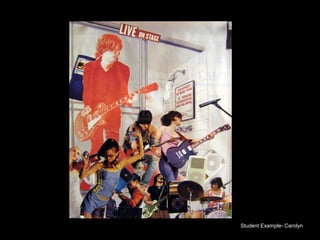
Student Example- Carolyn
Student Example- Lynne
Student Example- Jackie
Student Example- Lisa
Student Example- Christina
Student Example- Alicia
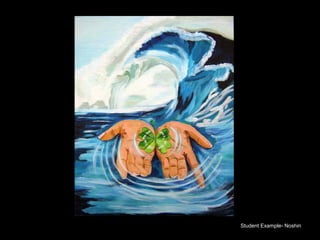
Student Example- Noshin
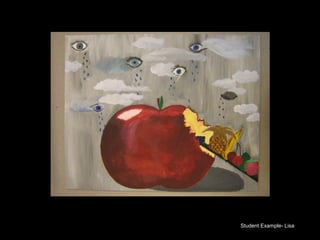
Student Example- Lisa
Student Example- Renee
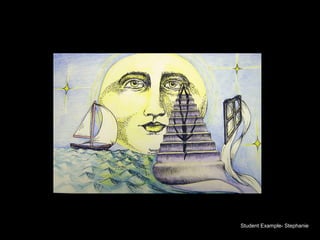
Student Example- Stephanie
Start with a well thought-out creative idea.
Throwing two random things together doesn’t
necessarily qualify as surreal.
Use QUALITY photographic images from
magazines- not cartoons or illustrations or other
artworks.
Avoid images from popular culture such as
famous people, name brands and retail products
that will distract the viewer.
Cut and glue carefully so all images have smooth
edges and there is no visible glue.
Consider background, middle ground and
foreground.

Surreal collage green