A guide to your Personal Study Essay
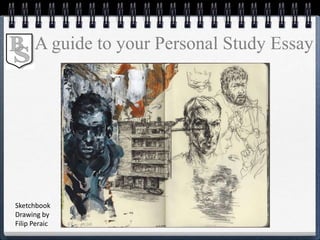
Sketchbook
Drawing by
Filip Peraic
The Topic should be something that you
are genuinely interested in!
The purpose of your Personal Study is to
teach you something: to help you develop as
an artist and to strengthen your
understanding of art-related issues. The most
successful Personal Studies communicate ‘a
strong sense of involvement through personal
enthusiasm and a commitment to sustain the
investigation’.
Simply speaking, when you are passionate
about a topic, you are more likely to do well. Artwork by Pat Perry
The focus of your personal study should be
process and materials (the way an Artist or group
of Artists use/s media) or subject or theme (the
way an artist approaches a topic, usually with
reference to composition and technique ).
In other words, your Personal Study should
involve the analysis of specific pieces of art; it
should NOT be the life story of an artist or the
documentation of a broad period of Art history
(unless this somehow includes sufficient focus
on specific artworks).
Focus …
In order to produce a high quality Personal Study,
you need to have a clear, well-articulated focus.
This gives you something to organise your project
around and encourages you to write with
coherence and structure (a lack of direction is a
common weakness in low achieving Personal
Studies). Completing an entire project around the
analysis of one or two artworks, for example, is
limiting, while attempting to analyse Abstract Art
in its entirety (without any connection to a
specific artist) sets up an enormous, daunting task
which you cannot do justice to in the time given.
Topic …
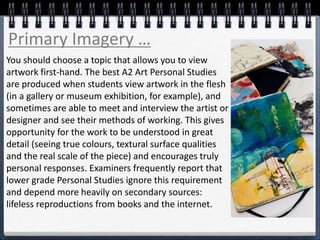
You should choose a topic that allows you to view
artwork first-hand. The best A2 Art Personal Studies
are produced when students view artwork in the flesh
(in a gallery or museum exhibition, for example), and
sometimes are able to meet and interview the artist or
designer and see their methods of working. This gives
opportunity for the work to be understood in great
detail (seeing true colours, textural surface qualities
and the real scale of the piece) and encourages truly
personal responses. Examiners frequently report that
lower grade Personal Studies ignore this requirement
and depend more heavily on secondary sources:
lifeless reproductions from books and the internet.
Primary Imagery …
Studying the work of a mainstream or critically acclaimed
artist alongside a local artist can be beneficial, especially if
the local artist is less established. This gives you the best of
both worlds (the enthusiasm and first-hand contact from a
local artist, plus the insight that comes from studying
historical, contemporary and/or international artists who
work in another cultural context). You may, for example,
choose to focus on two artists who paint the same subject
in a different way, or to discuss the influence of a famous
artist on a local painter. It should be noted that the
examiners understand that many students will not be able
to see all of the artworks they study in the flesh, so
supporting first-hand study with those viewed in
reproduction is absolutely acceptable.
Contrasting and Comparing Artists …
While the Personal Study is centered around
your own personal responses, drawing on the
opinions of educated critics can provide insight
and a depth of understanding: grounding and/
or challenging your own views. Before deciding
on a Personal Study topic, check to see if there
are existing articles, books or online reviews
about the artists/topics in question. This also
helps to verify that the artist topics you have
selected have standing in the art community and
therefore are likely to be an appropriate.
Reference material…
Word your title so that it captures the essence
of your personal study and indicates a
well-chosen focus.
For example:
‘The Portraiture of [artist name]:
An Appreciation of Light and
Colour’
is more appropriate than
‘Portraiture in Art’
Your Title …
Before writing the Personal Study, you should
plan the content, order and structure of your
study thoroughly. This should include headings
and subheadings of material discussed and
rough diagrams indicating how this will be
supported by images. The proposed structure
should then be checked and approved.
Whilst the structure of each Personal Study
will differ, depending on the topic chosen,
every study should follow the basic format
(the next few slides explain this format).
Structure the Personal Study in a logical and clear manner
Introduction. This is where you outline
the purpose, focus or mission of your
study. This may include question/s that
are going to be answered; themes to
explore; issues you hope to address etc.
It should set the scene for the project
and may include reasons for selecting a
topic and an indication of how / why the
topic is of personal relevance or interest
to you. It is important that the intentions
of the project are clearly set out in this
section.
Introduction …
This is the main part of the Personal Study. It is
usually organised into sections (which may be
formal chapters, or simply different areas of a
visual study). These may have individual
headings and sometimes sub-headings. This
means that the examiner is able to see
immediately that the criteria have been
covered. The sections should be ordered
logically and address the focus of the project;
they should NOT ramble haphazardly from one
issue to the next
Body …
This is where you
summarise key points
from the project, arrive
at final findings and
make considered
personal judgments
about what has been
learnt.
Conclusion…
This should list any resources that you
have used in your project, including
books, websites, articles and videos.
It might also include sources of first-
hand information, such as museums,
galleries or websites, as well as
acknowledgements, thanking the
artist for their time.
Bibliography/References/Acknowledgements

Personal study essay guide

  • 1.
    A guide toyour Personal Study Essay Sketchbook Drawing by Filip Peraic
  • 2.
    The Topic shouldbe something that you are genuinely interested in! The purpose of your Personal Study is to teach you something: to help you develop as an artist and to strengthen your understanding of art-related issues. The most successful Personal Studies communicate ‘a strong sense of involvement through personal enthusiasm and a commitment to sustain the investigation’. Simply speaking, when you are passionate about a topic, you are more likely to do well. Artwork by Pat Perry
  • 3.
    The focus ofyour personal study should be process and materials (the way an Artist or group of Artists use/s media) or subject or theme (the way an artist approaches a topic, usually with reference to composition and technique ). In other words, your Personal Study should involve the analysis of specific pieces of art; it should NOT be the life story of an artist or the documentation of a broad period of Art history (unless this somehow includes sufficient focus on specific artworks). Focus …
  • 4.
    In order toproduce a high quality Personal Study, you need to have a clear, well-articulated focus. This gives you something to organise your project around and encourages you to write with coherence and structure (a lack of direction is a common weakness in low achieving Personal Studies). Completing an entire project around the analysis of one or two artworks, for example, is limiting, while attempting to analyse Abstract Art in its entirety (without any connection to a specific artist) sets up an enormous, daunting task which you cannot do justice to in the time given. Topic …
  • 5.
    You should choosea topic that allows you to view artwork first-hand. The best A2 Art Personal Studies are produced when students view artwork in the flesh (in a gallery or museum exhibition, for example), and sometimes are able to meet and interview the artist or designer and see their methods of working. This gives opportunity for the work to be understood in great detail (seeing true colours, textural surface qualities and the real scale of the piece) and encourages truly personal responses. Examiners frequently report that lower grade Personal Studies ignore this requirement and depend more heavily on secondary sources: lifeless reproductions from books and the internet. Primary Imagery …
  • 6.
    Studying the workof a mainstream or critically acclaimed artist alongside a local artist can be beneficial, especially if the local artist is less established. This gives you the best of both worlds (the enthusiasm and first-hand contact from a local artist, plus the insight that comes from studying historical, contemporary and/or international artists who work in another cultural context). You may, for example, choose to focus on two artists who paint the same subject in a different way, or to discuss the influence of a famous artist on a local painter. It should be noted that the examiners understand that many students will not be able to see all of the artworks they study in the flesh, so supporting first-hand study with those viewed in reproduction is absolutely acceptable. Contrasting and Comparing Artists …
  • 7.
    While the PersonalStudy is centered around your own personal responses, drawing on the opinions of educated critics can provide insight and a depth of understanding: grounding and/ or challenging your own views. Before deciding on a Personal Study topic, check to see if there are existing articles, books or online reviews about the artists/topics in question. This also helps to verify that the artist topics you have selected have standing in the art community and therefore are likely to be an appropriate. Reference material…
  • 8.
    Word your titleso that it captures the essence of your personal study and indicates a well-chosen focus. For example: ‘The Portraiture of [artist name]: An Appreciation of Light and Colour’ is more appropriate than ‘Portraiture in Art’ Your Title …
  • 9.
    Before writing thePersonal Study, you should plan the content, order and structure of your study thoroughly. This should include headings and subheadings of material discussed and rough diagrams indicating how this will be supported by images. The proposed structure should then be checked and approved. Whilst the structure of each Personal Study will differ, depending on the topic chosen, every study should follow the basic format (the next few slides explain this format). Structure the Personal Study in a logical and clear manner
  • 10.
    Introduction. This iswhere you outline the purpose, focus or mission of your study. This may include question/s that are going to be answered; themes to explore; issues you hope to address etc. It should set the scene for the project and may include reasons for selecting a topic and an indication of how / why the topic is of personal relevance or interest to you. It is important that the intentions of the project are clearly set out in this section. Introduction …
  • 11.
    This is themain part of the Personal Study. It is usually organised into sections (which may be formal chapters, or simply different areas of a visual study). These may have individual headings and sometimes sub-headings. This means that the examiner is able to see immediately that the criteria have been covered. The sections should be ordered logically and address the focus of the project; they should NOT ramble haphazardly from one issue to the next Body …
  • 12.
    This is whereyou summarise key points from the project, arrive at final findings and make considered personal judgments about what has been learnt. Conclusion…
  • 13.
    This should listany resources that you have used in your project, including books, websites, articles and videos. It might also include sources of first- hand information, such as museums, galleries or websites, as well as acknowledgements, thanking the artist for their time. Bibliography/References/Acknowledgements