AP	StudioArt
2020-2021
Prof Robson
The Cambridge School of Dallas
Examples of over 40 of my student portfolios:
https://www.slideshare.net/BrendaRobson/
SUMMER	HOMEWORK
1. Look at https://brendarobson.com/?s=concentration+help
After looking at the portfolio requirements write down 50 ideas in your sketchbook. Then
narrow it to 25. Then narrow it to 15, 10 until you have 5 solid ideas.
2. Creating a website using Blogger (send me the URL)
4. Make a Pinterest folder titled your name/AP art and share it with me so that we can both
edit
5. Make a Dropbox folder titled your name/AP Art and share it with me so that we can both
edit.
Failure to do this will cause you to be taken out of AP and put in Art 3.
Prof Robson
Welcome to AP Art andDesign
In this course you will complete an exam made up of the following components:
Sustained Investigation: 15 pieces designed during this course.
Commentary: 1200 word defense of your work.
Selected Works: 5 of your best works of art ever with a list of ideas, materials,
and processes for each. These will be mounted and mailed to the College Board.
We will follow along with this presentation in your
sketchbook at
the beginning of the year
Hint: Make your notes visually appealing….this
may be useful to you later
Assignment 1. What is a Sustained Investigation?
The sustained investigation is where YOU get to explore a concept of interest to
you. It can be broad or narrow. It can be personal or more conceptual. You are
the only limit of your ideas.
● Write down a list of concepts. (5 minimum) 15 minutes
○ Use the list you created during the summer or start fresh
○ Feel free to talk to table mates about potential ideas
● Ideas to avoid:
○ Too broad like “emotions”
○ Too narrow like “scissors”
○ Too meta like “existentialism in the modern world”
Generating an Essential Question
An essential question is key in creating a theme or subject of investigation.
Find something you like and then turn it into a question
-Example:Still lifes with flowers.
Essential question: How can I explore flowers through still life compositions?
-Example: Portraits
Essential question: How can I explore portraits in a meaningful way?
“How can I use (insert material, technique, research, experience here)
to explore/express my feelings (about/for/against) said topic?”
Then, to flesh out the question:
Do this in your sketchbook with three different ideas:
Write your idea:
Make it a question:
Create your “whys”
A successful sustained investigation will address why this subject appealed to you
in the first place.
Pick an essential question you listed above and then ask Why?
Answer the following whys: You should have four answers per bullet 30 minutes.
Use a friend in a question and answer session if it helps to talk out your ideas.
● Why does this appeal to you, how do you show that? (think of elements and
principles here)
● Why do you want to use a certain media?
● Why do you want to show a certain viewpoint?
● Why is your concept important?
Example of Why:
● Why does this appeal to you, how do you show that
○ I like the colors of nature
○ I like the textures of bees
○ I like the shapes of bees and flowers and pollen (dots)
○ I like the lines in flowers and organic structures
● Why do you want to use a certain media?
○ I like watercolor washes to show bright color
○ I like graphite to show contrast and value
○ I like colored pencil to show detail
○ I want to explore digital design with radial patterns
● Why do you want to show a certain viewpoint?
○ I like that different angles of bees show their different body segments.
○ I want the items suspended in air to add thread.
○ I want to show different perspectives (Close up vs far away)
○ I want to focus on the bees themselves
● Why is your concept important?
○ Bees make food
○ Bees pollinate flowers
○ Bees make it so we can survive
○ Bees are cute
When why’s don’t work
Ask yourself these questions:
Did any of your ideas not produce 16 bullets?
Yes?
Then those ideas won’t work. Toss them out! You will work on this concept for 18
weeks if you can’t come up with 16 interesting things about it you certainly can’t
make 12-15 interesting works of art about it.
Did any of your ideas produce 16 or more bullets?
Yes?
YOU HAVE A WINNER! Use that idea to develop into a sustained investigation!
A few reminders
Before continuing remember the following:
NO PLAGIARIZED IMAGES. You must take all reference photos or modify
existing images past recognition.
Be original that means no pinteresting projects. Pinterest can be great for
inspiration but do not copy from anything posted there.
No logos can be present-they are copyrighted
You can use photography, collage, found objects etc., for 2D only.
For drawing you can only use painting, drawing, painted photographs, etc.
Anything that makes a “mark” such as sewing on a photo
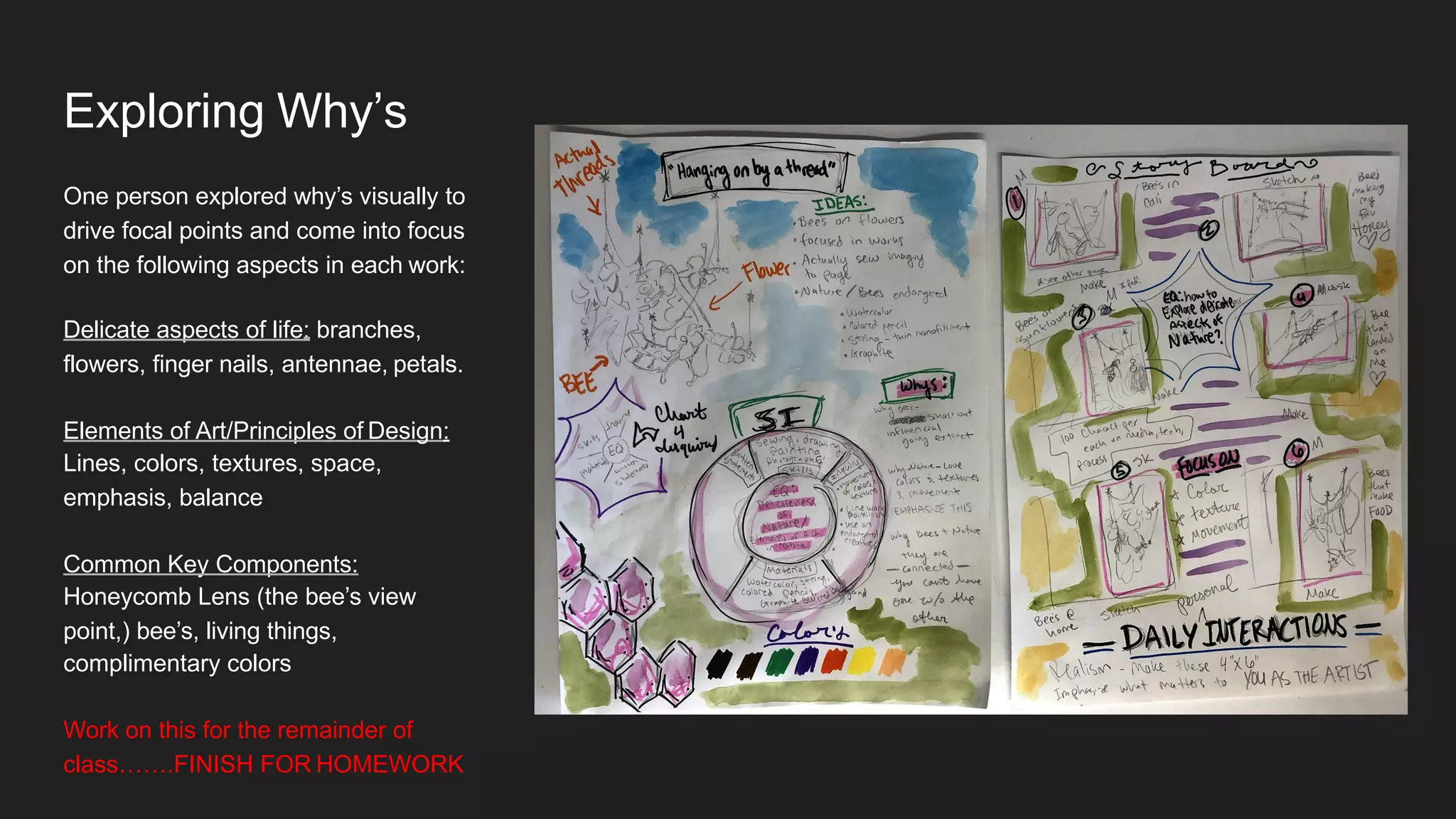
Exploring Why’s
One person explored why’s visually to
drive focal points and come into focus
on the following aspects in each work:
Delicate aspects of life: branches,
flowers, finger nails, antennae, petals.
Elements of Art/Principles of Design:
Lines, colors, textures, space,
emphasis, balance
Common Key Components:
Honeycomb Lens (the bee’s view
point,) bee’s, living things,
complimentary colors
Work on this for the remainder of
class…….FINISH FOR HOMEWORK
Creating a mind map….
Using your successful why to create a mind map and storyboard of 12 finished
pieces. You will need 2 pages of storyboard thumbnails with 6 sketches on each.
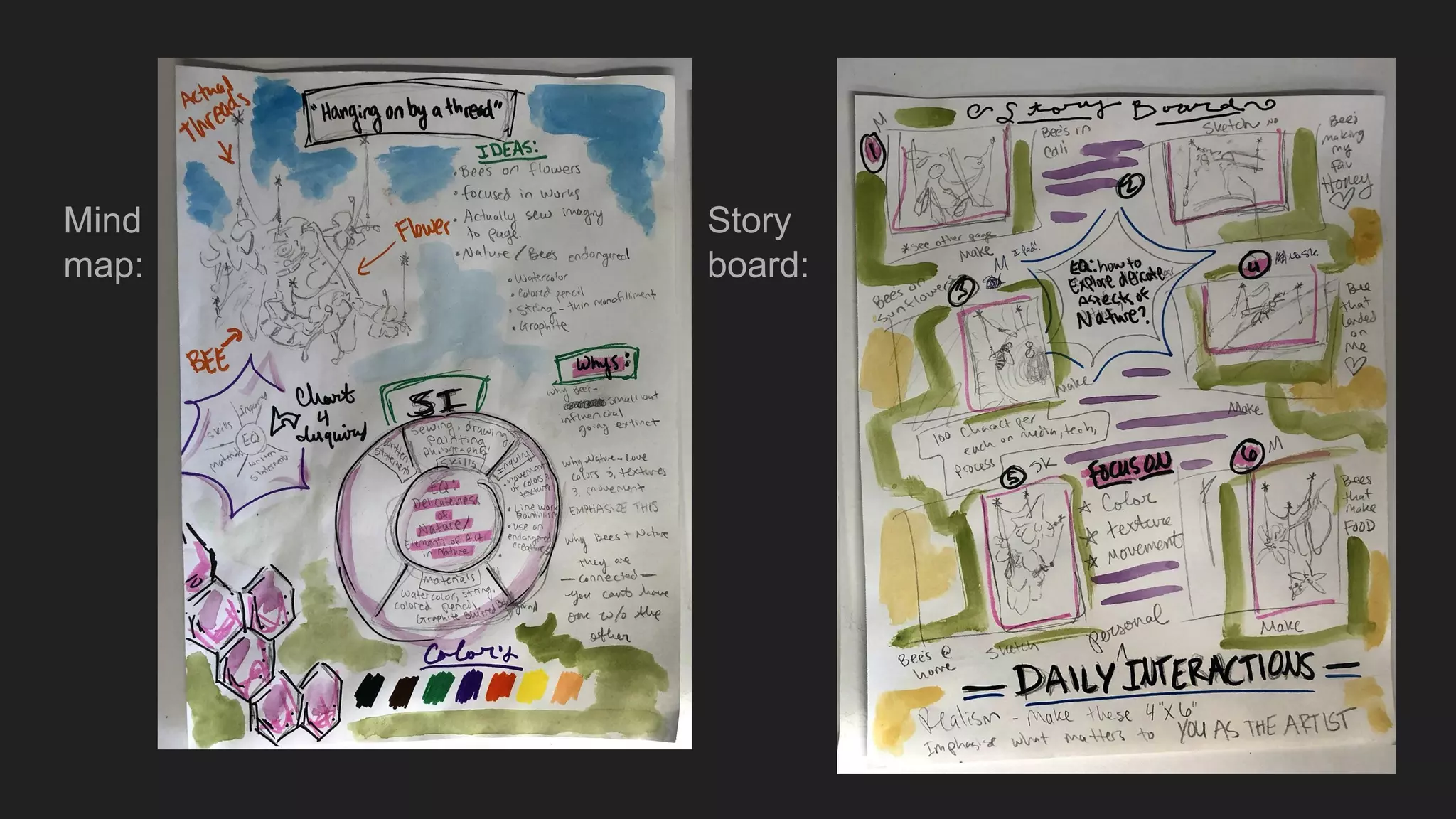
Mind map: Should address the answers to your whys, should explore concept
sketches, potential media, potential color schemes, skills, and materials. You can
work in a circle as shown on the next slide or a web map or any other form of
graphic organizer that works for you.
Storyboard: Complete 12 thumbnails of your main works to focus on. Take notes,
add color, test media, etc but build a sequential outline that explores your essential
question and that can be explained in your commentary
Mind
map:
Story
board:
Writing an essential question statement:
Using your essential question and why’s write a paragraph explaining your
concept. Do this for one or more successful concepts.
See the next slide for how to do this:
My	Essential Question:
“How can I show the intricate qualities of nature?”
I had several photographs I had taken of bees on various items such as flowers, fruit,
and my hand. Why were these appealing? I liked the colors, the textures, and the
interconnected aspects of the bees to the items they were resting on. Flowers need to
be pollinated for there to be fruit and more plants, humans need fruit and plants to be
able to survive. We are all connected and yet even the biggest living thing in this chain
relies on the smallest, the bee, for survival. I chose to focus on colors and textures
within the works themselves. I used literal string to tie the bees to the objects they
sustain. I made the string small and fragile to show how delicate this balance amongst
life truly is. Each piece has a translucent honeycomb structure in the foreground.
These honeycombs represent the bee’s view. As bees are endangered I ended the
investigation with a piece devoid of color and who’s strings have been broken to show
what will happen if we ignore this intricate balance we call life.
You did it!
Congratulations! You have now planned your sustained investigation for your
Advanced Placement Art and Design portfolio! Wooo!
Look at rest of the presentation to see how your finished product will look. We will
review this together in class tomorrow.
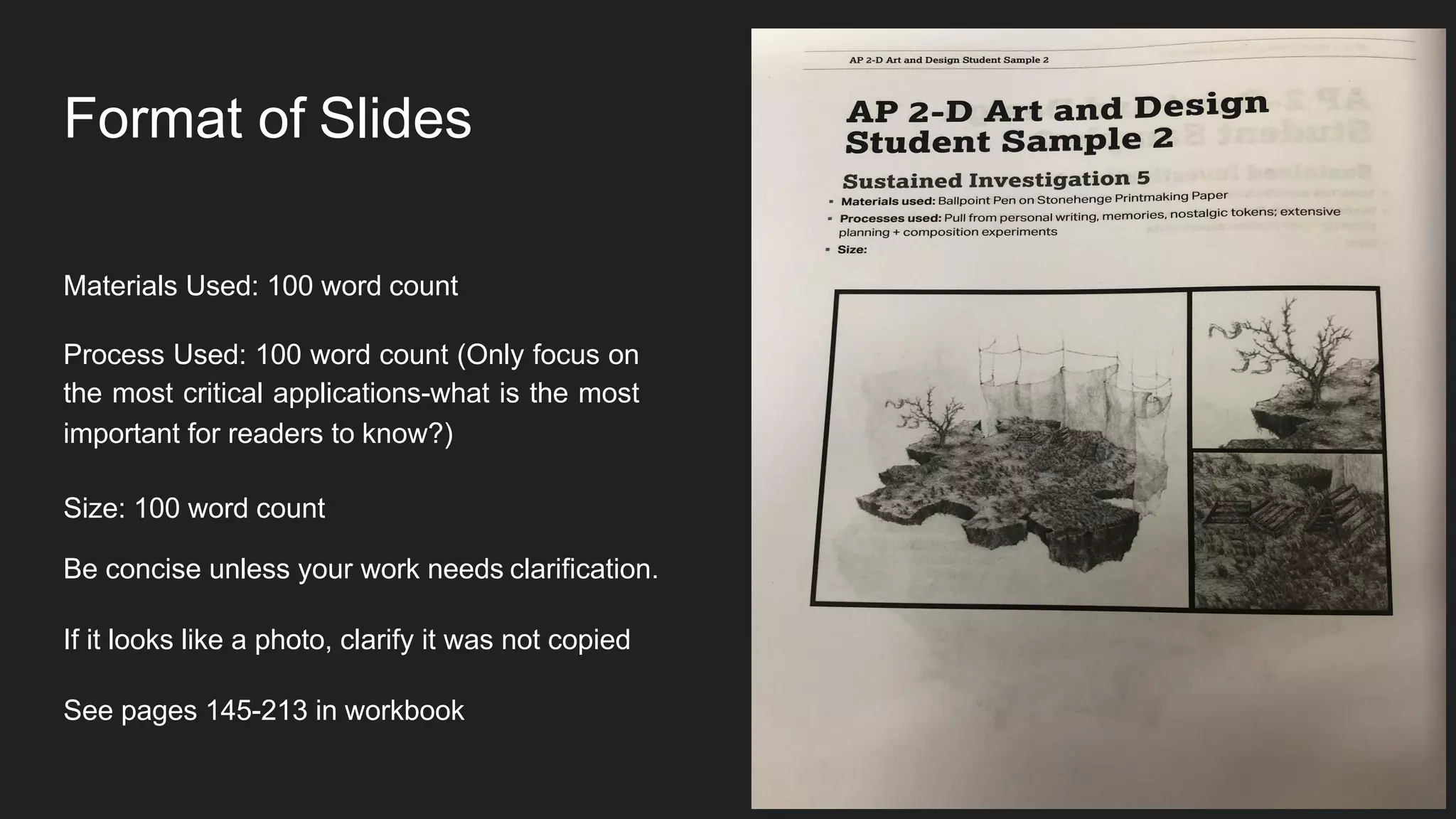
Format of Slides
Materials Used: 100 word count
Process Used: 100 word count (Only focus on
the most critical applications-what is the most
important for readers to know?)
Size: 100 word count
Be concise unless your work needs clarification.
If it looks like a photo, clarify it was not copied
See pages 145-213 in workbook
Image:
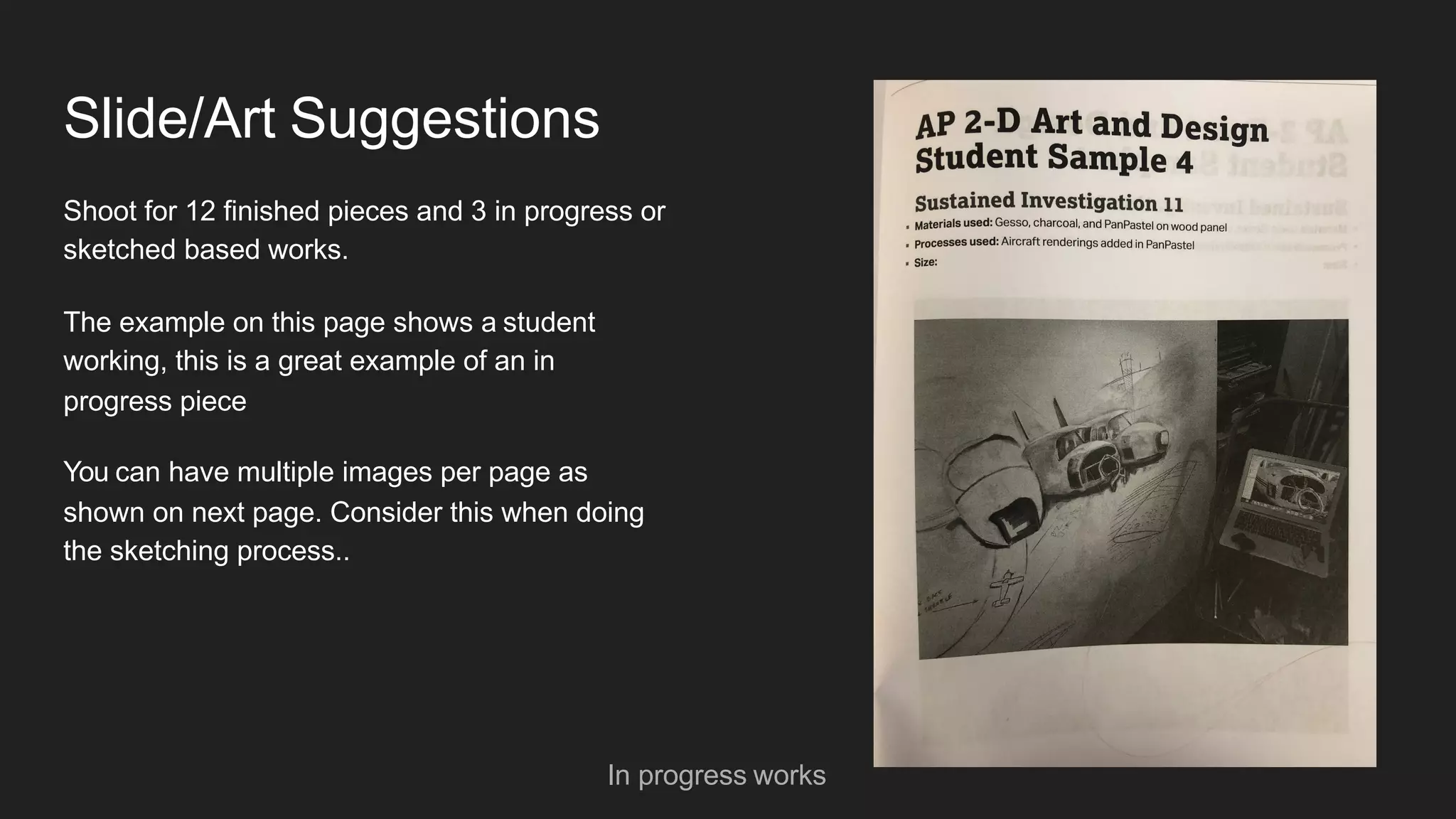
Slide/Art Suggestions
Shoot for 12 finished pieces and 3 in progress or
sketched based works.
The example on this page shows a student
working, this is a great example of an in
progress piece
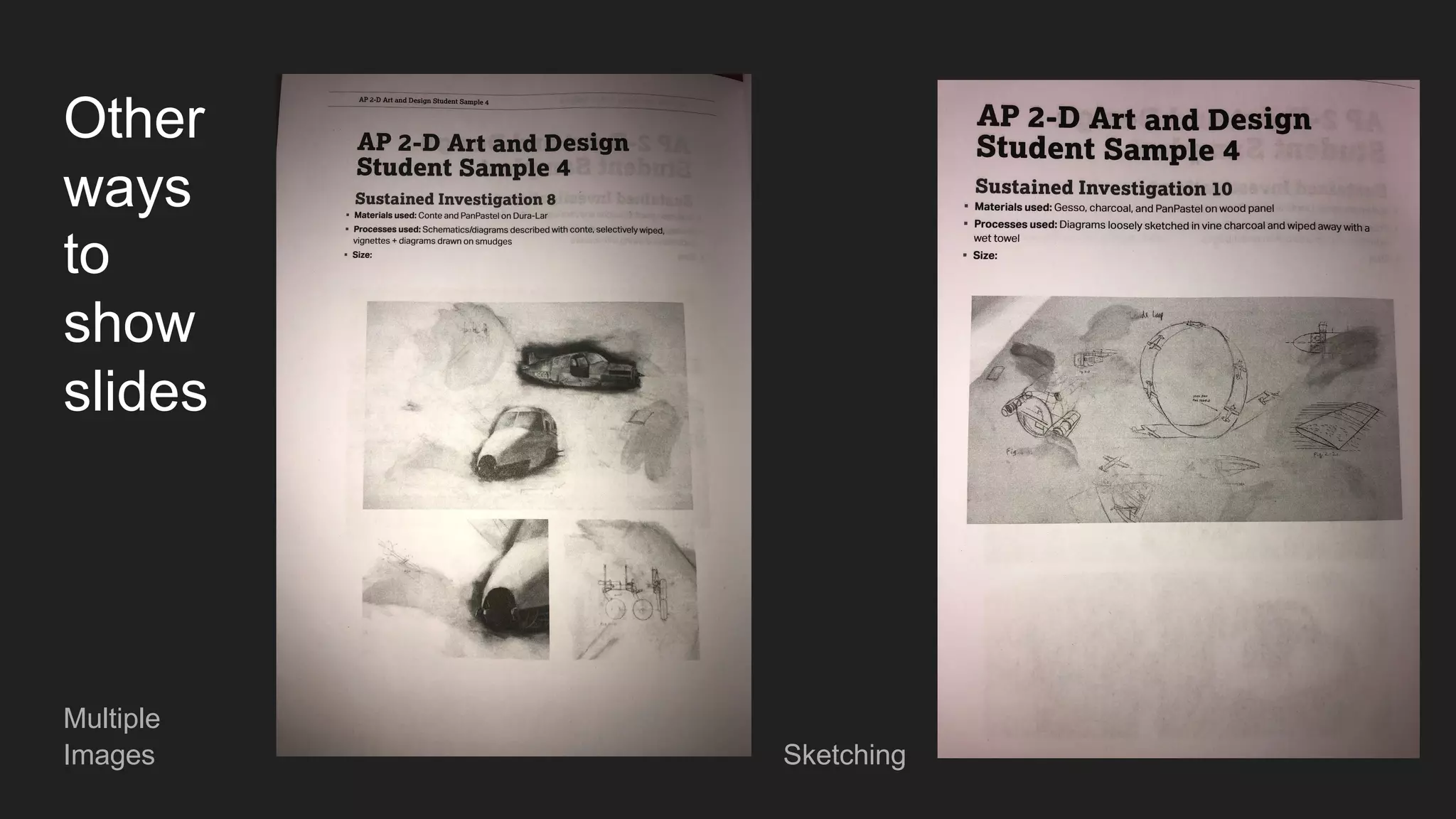
You can have multiple images per page as
shown on next page. Consider this when doing
the sketching process..
In progress works
Other
ways
to
show
slides
Multiple
Images Sketching
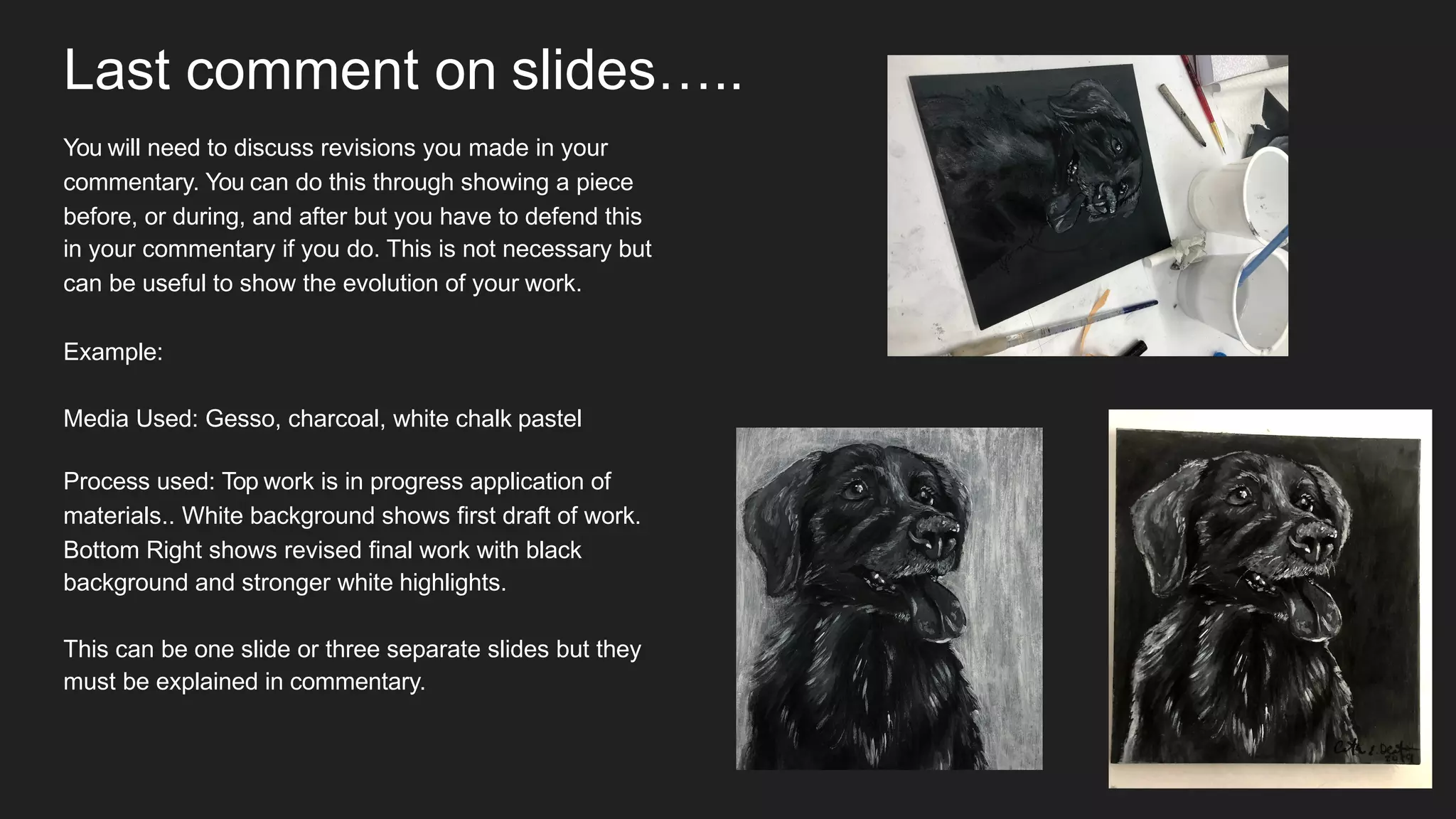
Last comment on slides…..
You will need to discuss revisions you made in your
commentary. You can do this through showing a piece
before, or during, and after but you have to defend this
in your commentary if you do. This is not necessary but
can be useful to show the evolution of your work.
Example:
Media Used: Gesso, charcoal, white chalk pastel
Process used: Top work is in progress application of
materials.. White background shows first draft of work.
Bottom Right shows revised final work with black
background and stronger white highlights.
This can be one slide or three separate slides but they
must be explained in commentary.
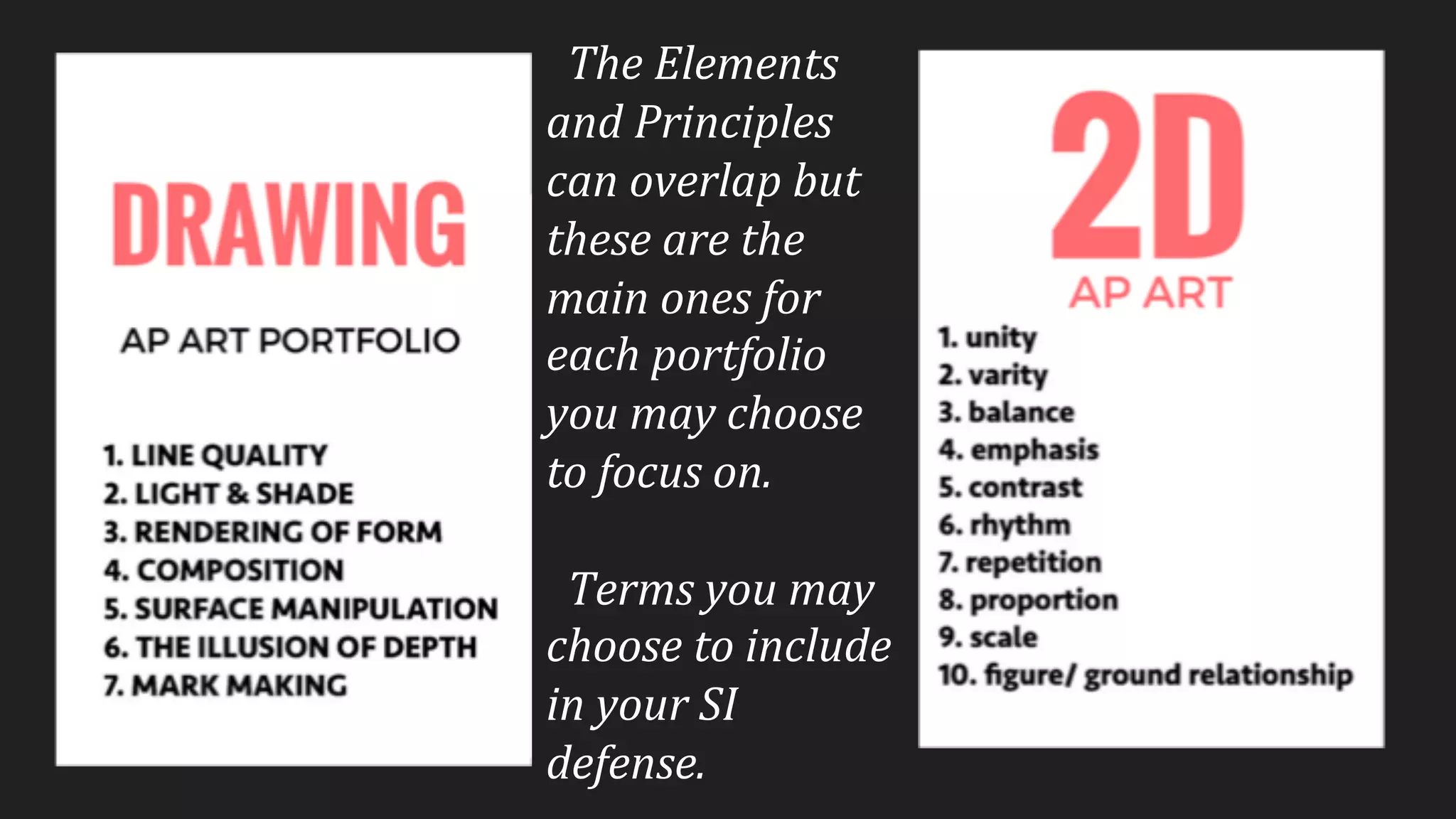
The	Elements	
and	Principles	
can	overlap	but	
these	are	the	
main	ones	for	
each	portfolio	
you	may	choose	
to	focus	on.
Terms	you	may	
choose	to	include	
in	your	SI	
defense.
Example of mini SI
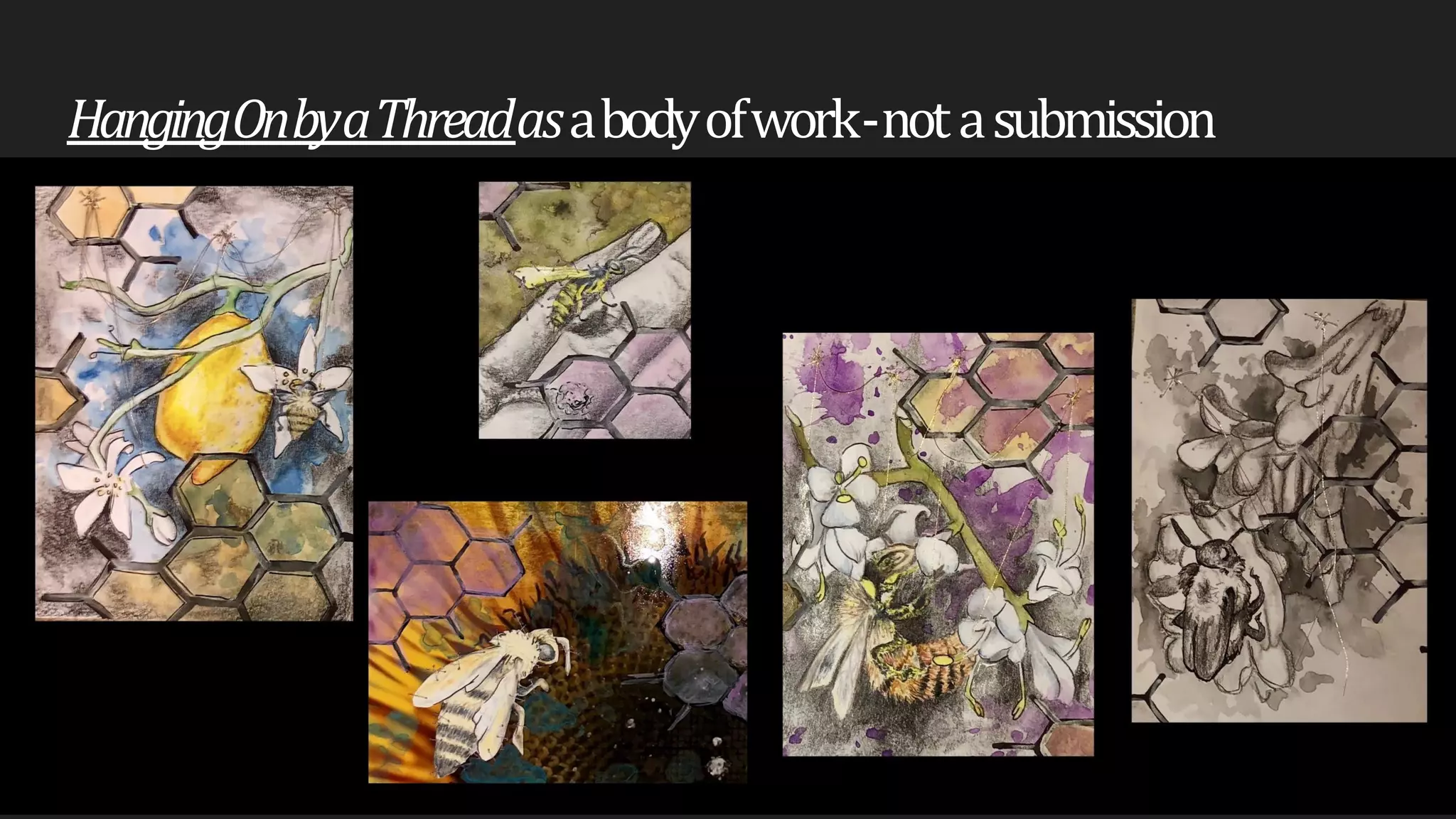
Hanging	by	a	Thread	by	Catherine	E. Deaton
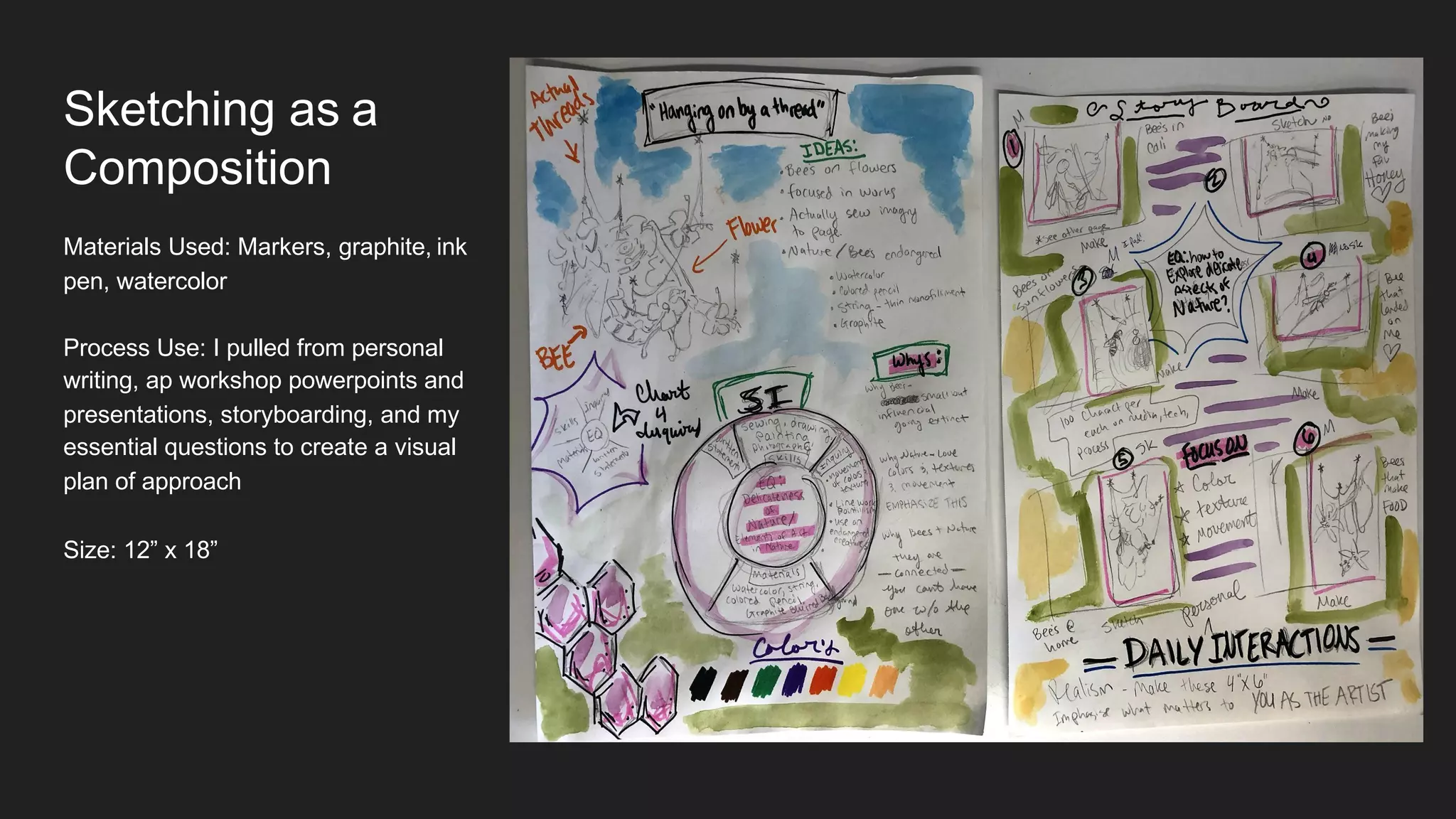
Sketching as a
Composition
Materials Used: Markers, graphite, ink
pen, watercolor
Process Use: I pulled from personal
writing, ap workshop powerpoints and
presentations, storyboarding, and my
essential questions to create a visual
plan of approach
Size: 12” x 18”
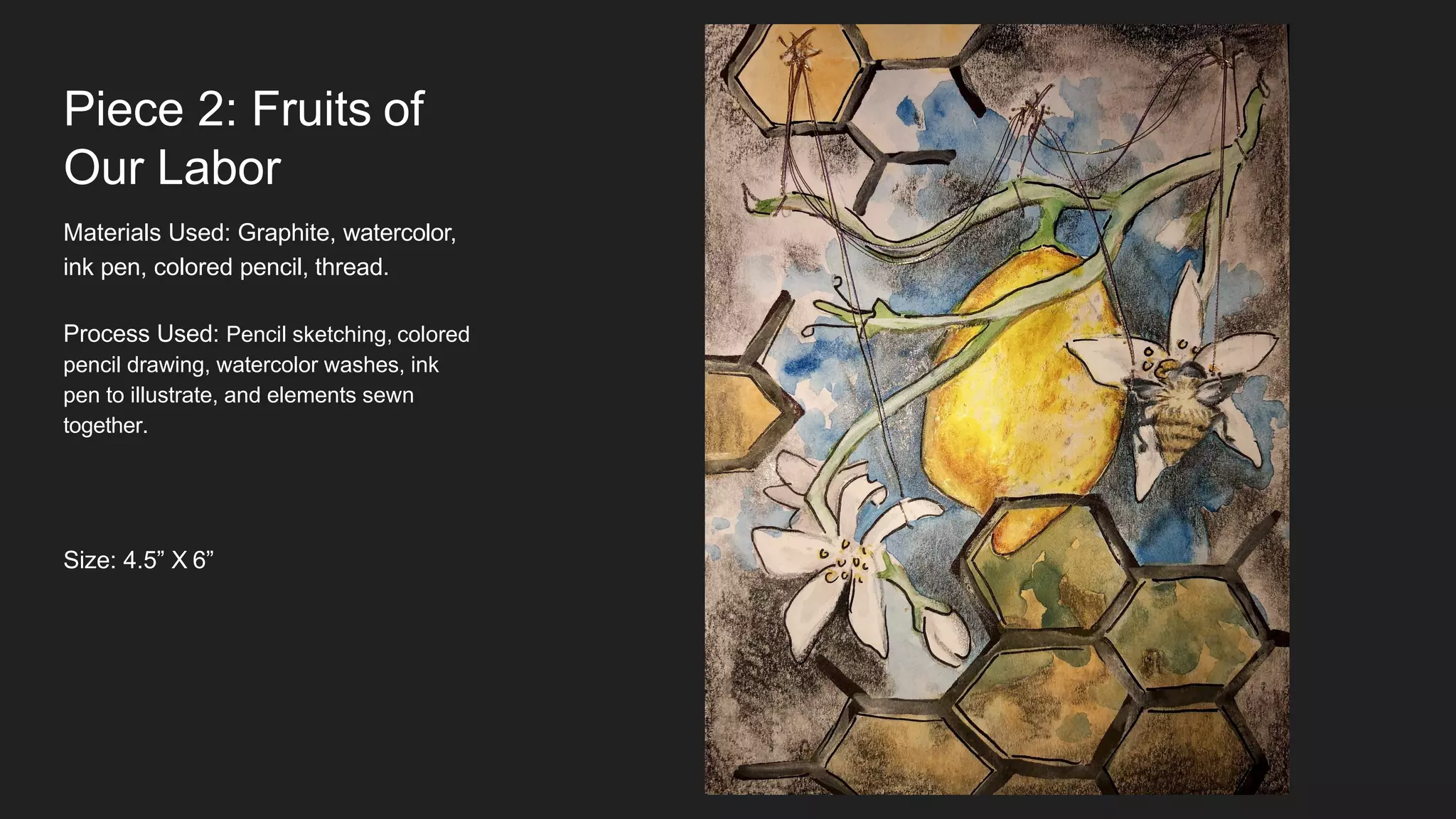
Piece 2: Fruits of
Our Labor
Materials Used: Graphite, watercolor,
ink pen, colored pencil, thread.
Process Used: Pencil sketching, colored
pencil drawing, watercolor washes, ink
pen to illustrate, and elements sewn
together.
Size: 4.5” X 6”
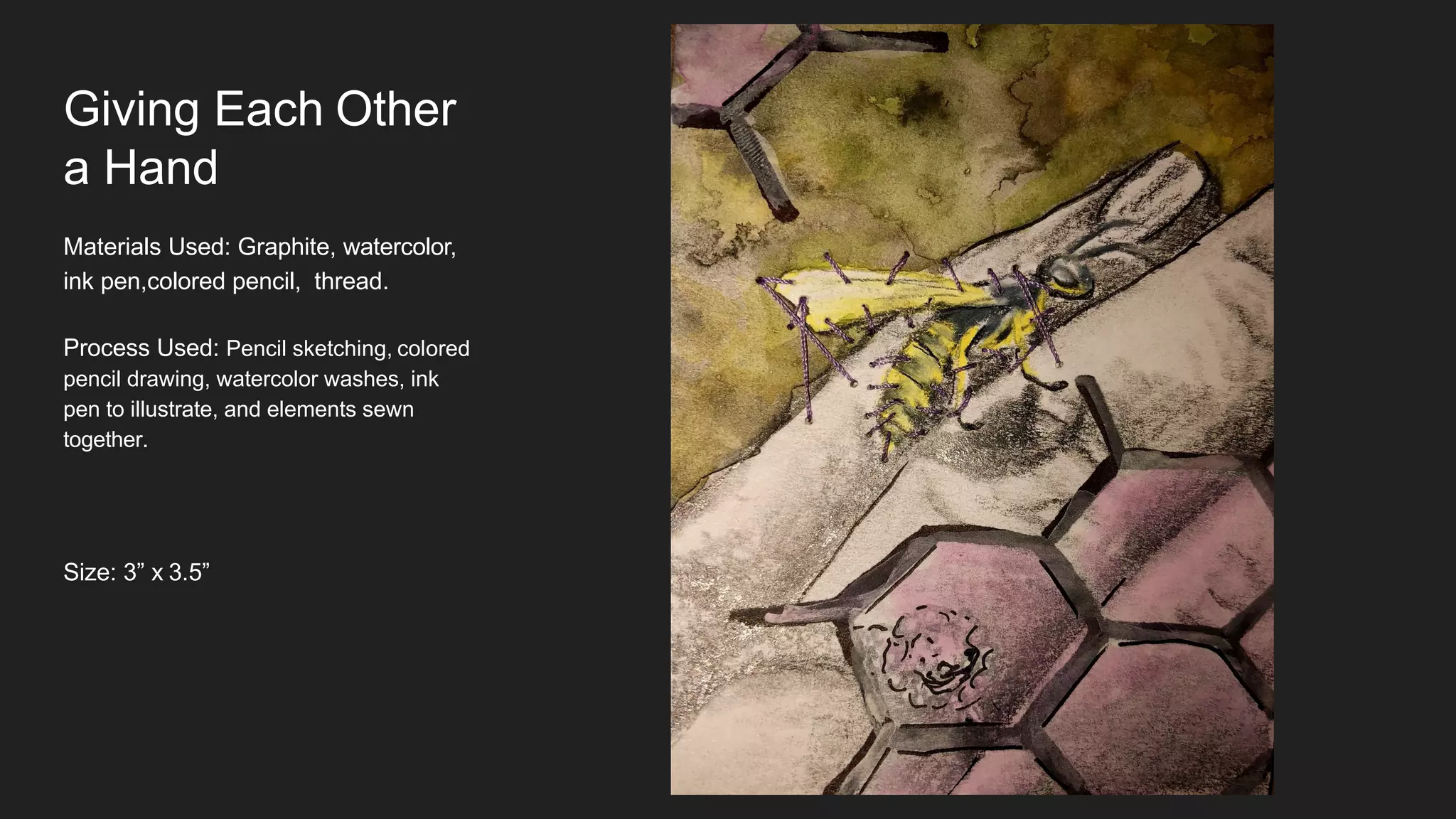
Giving Each Other
a Hand
Materials Used: Graphite, watercolor,
ink pen,colored pencil, thread.
Process Used: Pencil sketching, colored
pencil drawing, watercolor washes, ink
pen to illustrate, and elements sewn
together.
Size: 3” x 3.5”
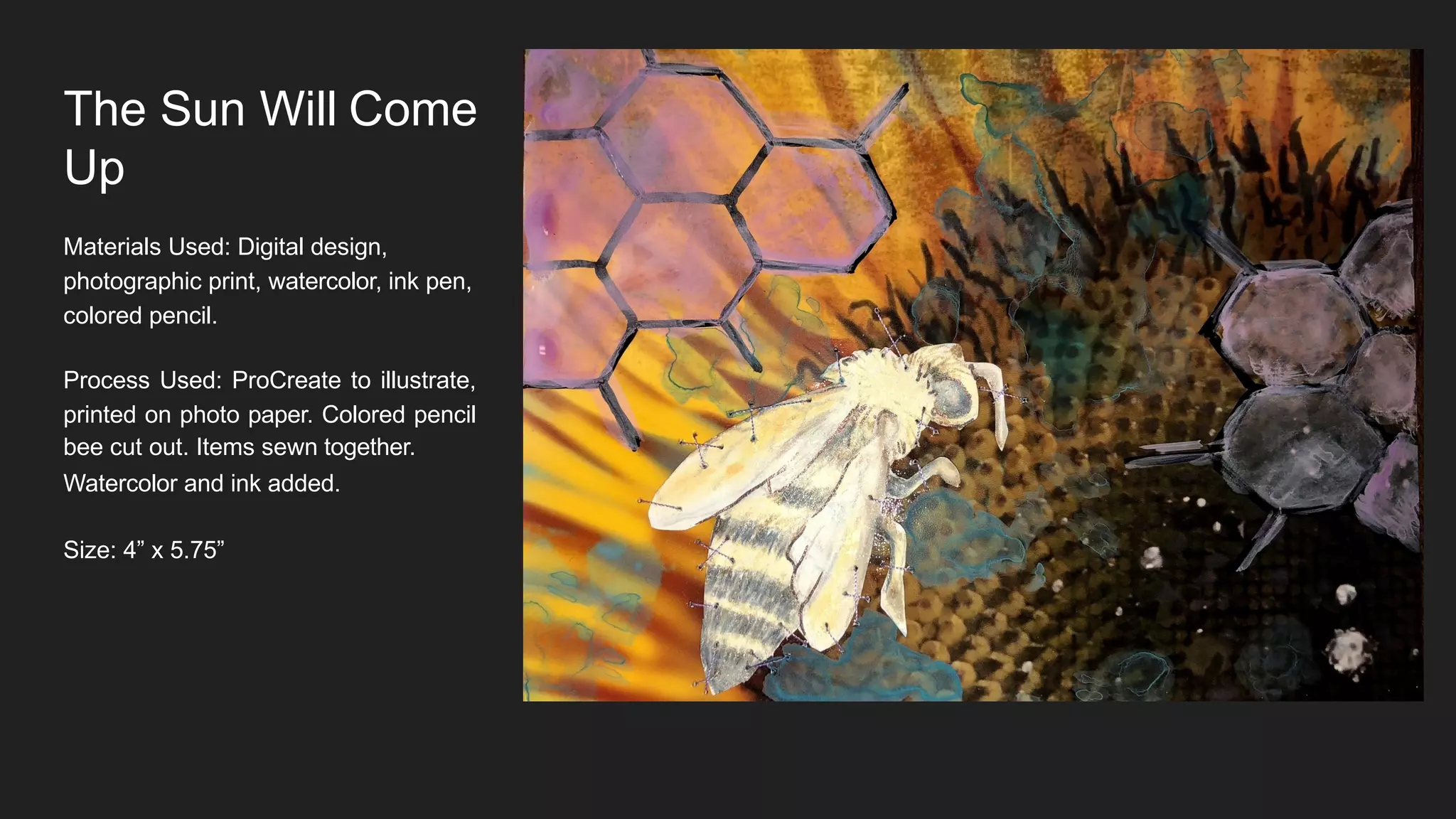
The Sun Will Come
Up
Materials Used: Digital design,
photographic print, watercolor, ink pen,
colored pencil.
Process Used: ProCreate to illustrate,
printed on photo paper. Colored pencil
bee cut out. Items sewn together.
Watercolor and ink added.
Size: 4” x 5.75”
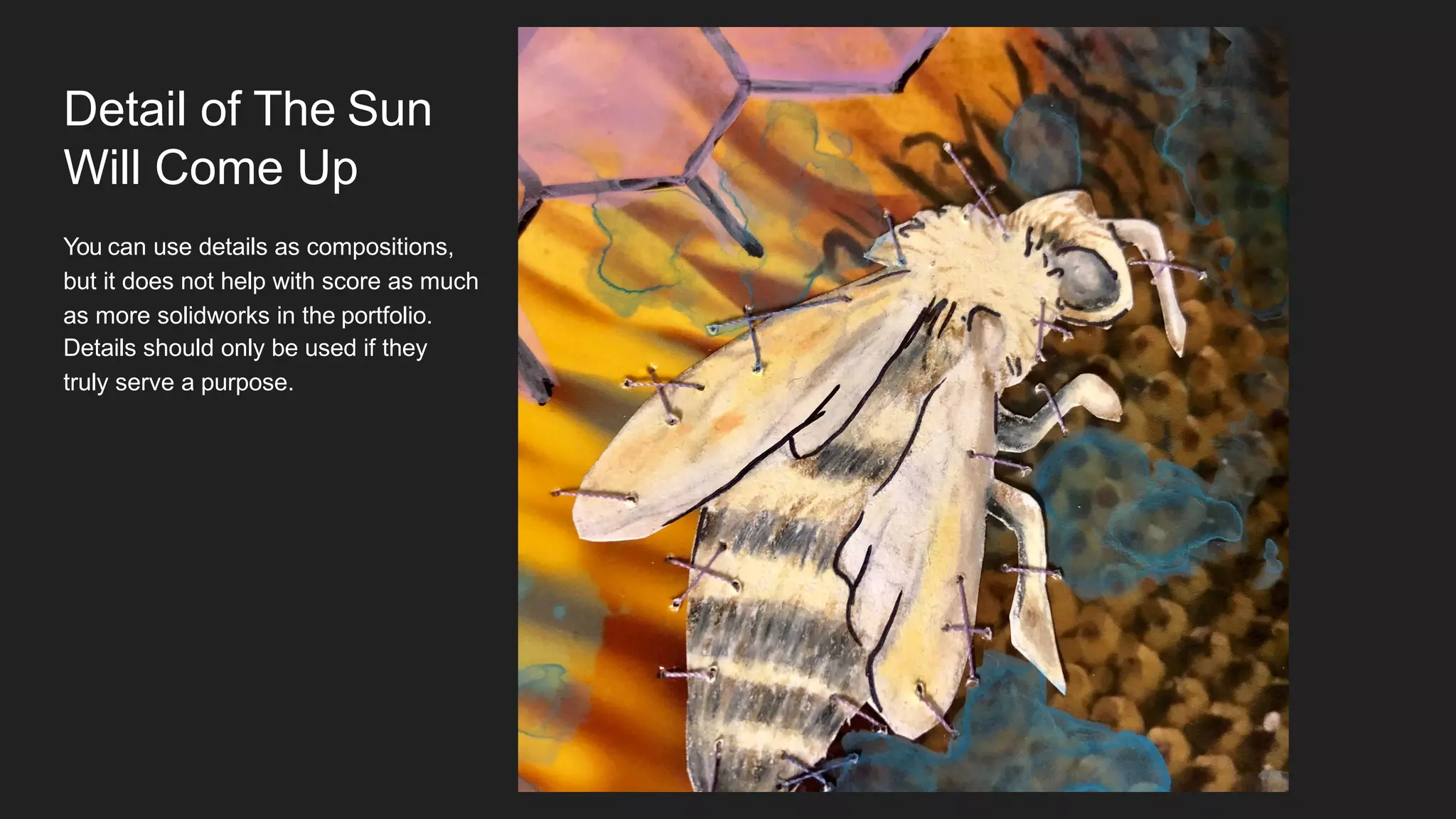
Detail of The Sun
Will Come Up
You can use details as compositions,
but it does not help with score as much
as more solidworks in the portfolio.
Details should only be used if they
truly serve a purpose.
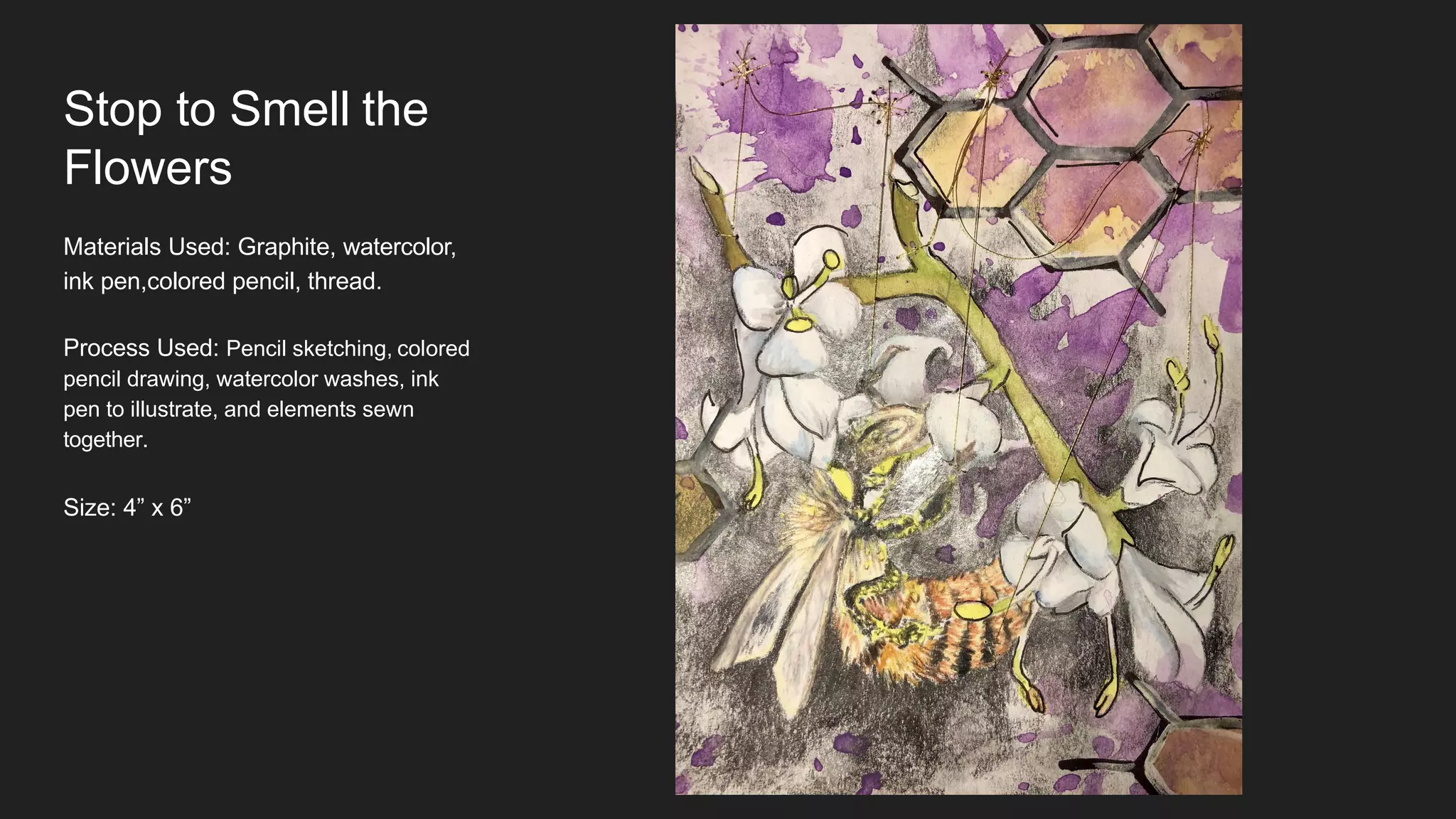
Stop to Smell the
Flowers
Materials Used: Graphite, watercolor,
ink pen,colored pencil, thread.
Process Used: Pencil sketching, colored
pencil drawing, watercolor washes, ink
pen to illustrate, and elements sewn
together.
Size: 4” x 6”
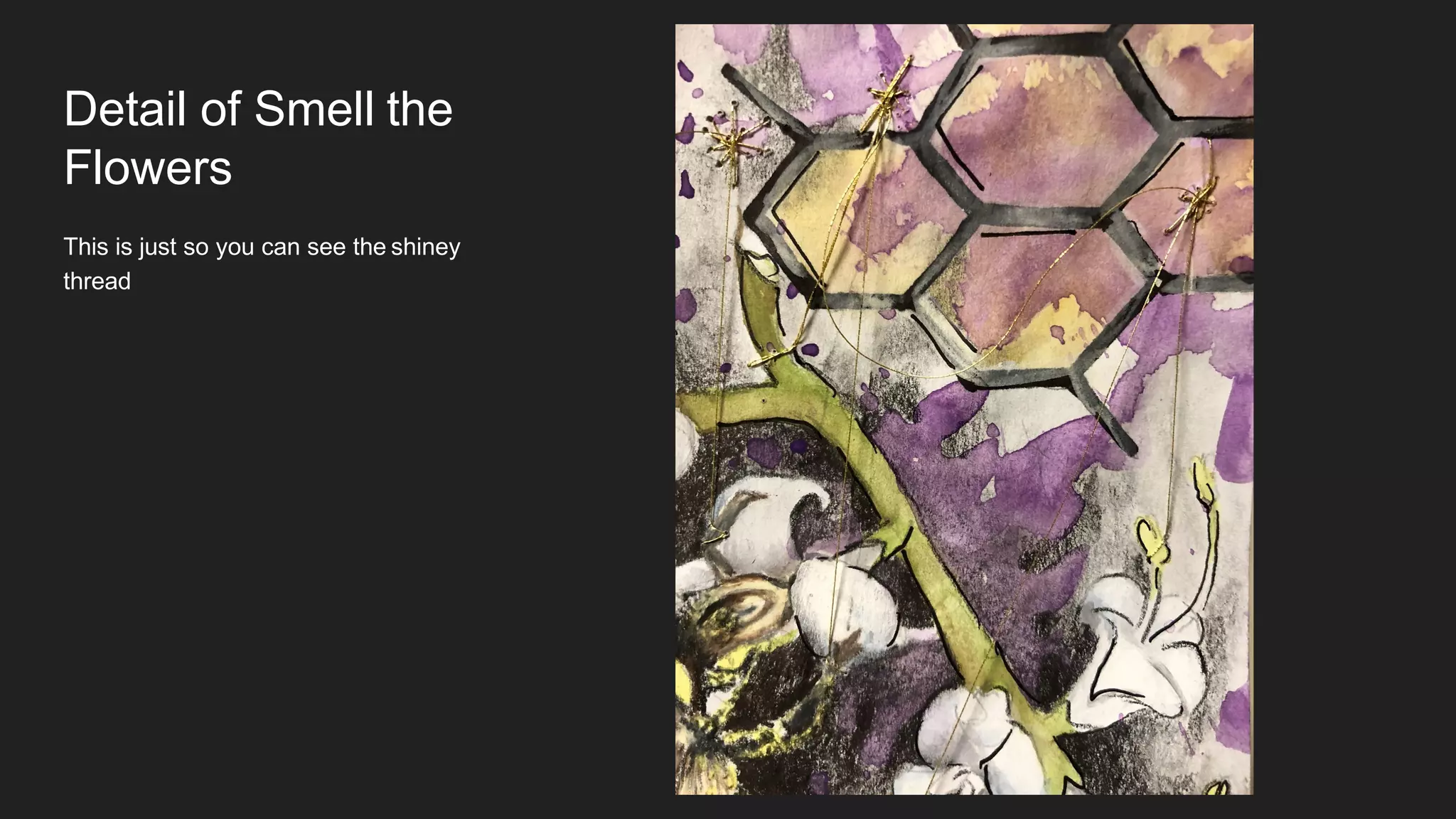
Detail of Smell the
Flowers
This is just so you can see the shiney
thread
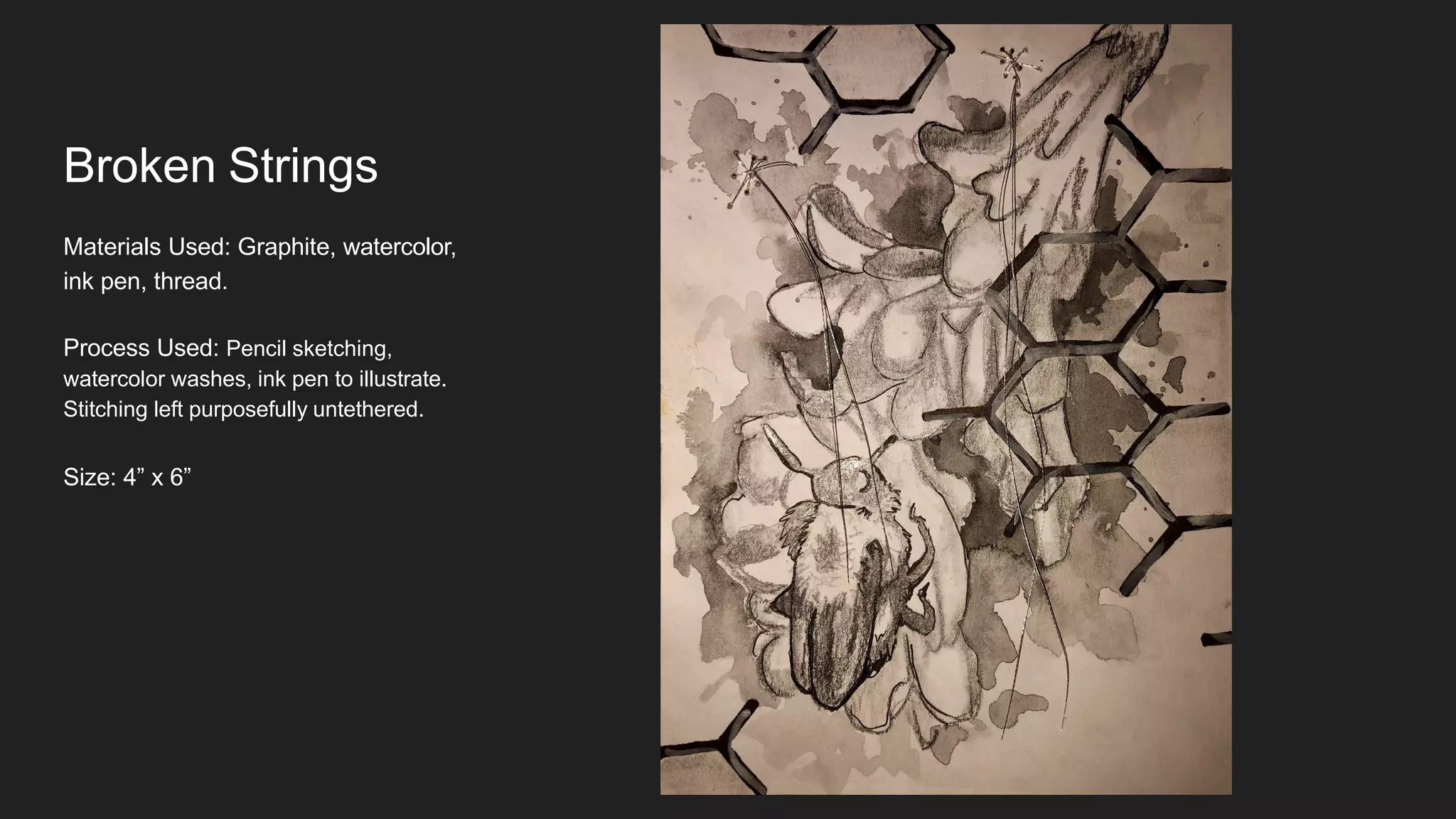
Broken Strings
Materials Used: Graphite, watercolor,
ink pen, thread.
Process Used: Pencil sketching,
watercolor washes, ink pen to illustrate.
Stitching left purposefully untethered.
Size: 4” x 6”
Hanging	On	by	a	Thread	as	a	bodyof	work-not	asubmission
Now it’s time to make art!
Once you have completed your work you can begin
writing your commentary!
Commentary Suggestions
1. BE CLEAR AND CONCISE
2. Part 1: State your identified inquiry (essential question.) That’s it.
3. Part 2: write evidence of HOW you identify inquiry in the works
(addressed you whys), discuss revisions, relationships between
materials and processes, and skill.
4. Stay focused, say only what is necessary to get the point across. FOCUS ON
THE INVESTIGATION OF YOUR QUESTION.
5. Put in one sentence of how you experimented. If applicable put in a sentence
about revisions made.
6. Use shortcuts (so & instead of and, single space between sentences, etc)
7. YOU CAN ONLY USE 1200 WORDS total on both prompts together
See page 146 in workbook
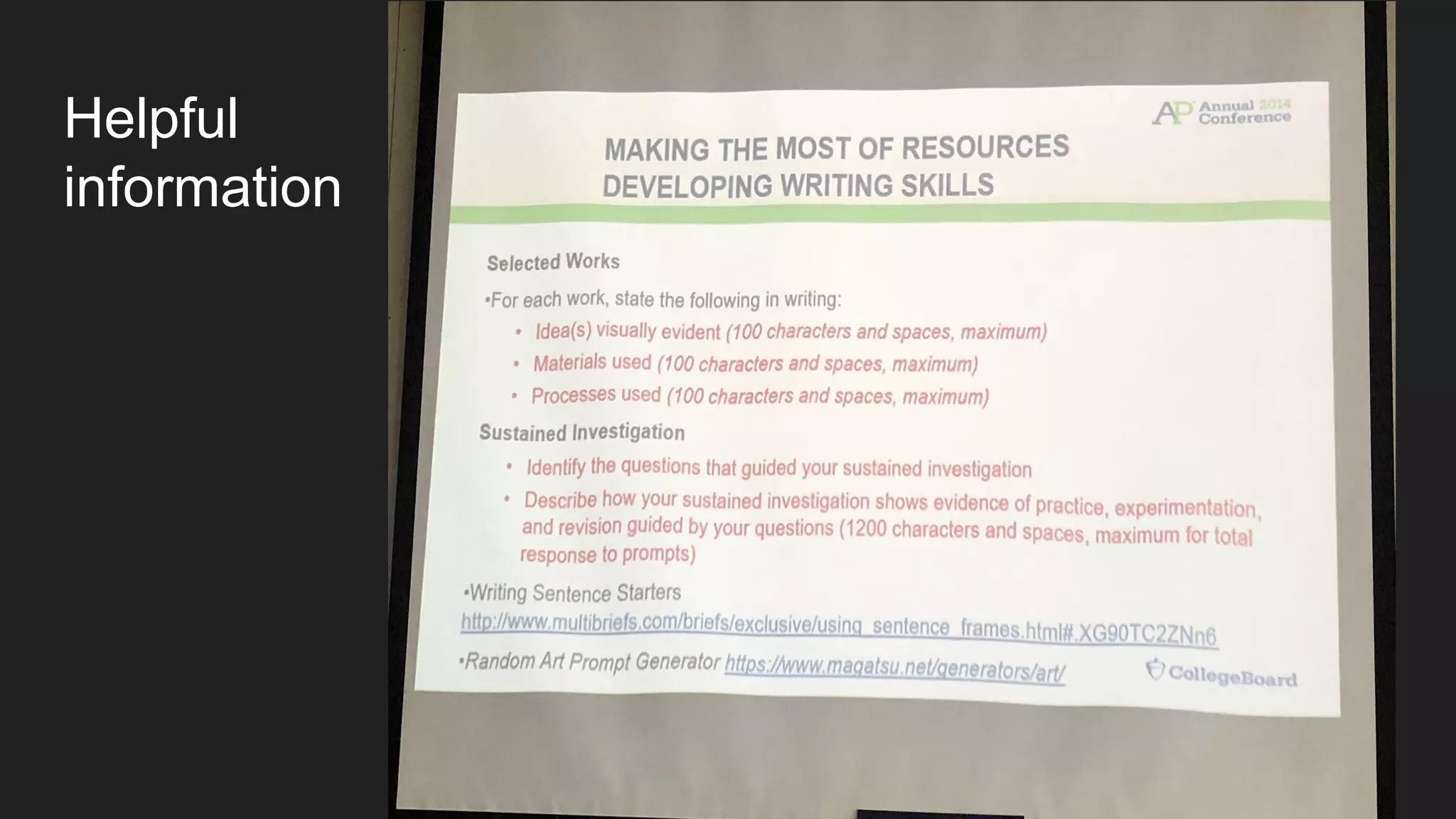
Helpful
information
Essential	Question	Example:	Commentary	Part1
I investigated the concept of the delicate balance between bees and life itself. I illustrated
fruit, flowers, and people interacting with bees. I used thread to sew the bees to the objects
they sustain. The string is small and fragile to show how delicate this balance amongst life
is. I ended the investigation with a piece devoid of color and who’s strings have been
broken to show what will happen if we lose this balance in life.
I took this directly from my essential question statement we wrote earlier.
Example	Essential	Question:	Commentary	Part2
My work reflects living items sewn to illustrations of bees to show their interconnectedness. Piece 1
shows the bees’ role in producing food. Blues and yellows emphasize the fruit as a focal point. Piece
2 used zoomed in perspectives to focus on the bee who has landed on a hand. The bee is stitched to the
hand to show how humanity and bees are inseparable. In Piece 3 I explored digital forms of art
production. Using an iPad I experimented with making radial patterns and repeated designs in a
layered format to show depth and texture. Piece 4 explored emphasis. Large scaling and the use of
complimentary colors create emphasis on the bee covered in pollen. All pieces include translucent
honeycomb structures in the foreground to add line, shape, texture, and color to symbolize the bees’
perspective as a silent participant. Piece 5 was originally in color but was revised as a lifeless
investigation of a monochromatic work depicting what we have to lose if the bees go extinct: life
itself.
Next Slide shows this process in an actual portfolio
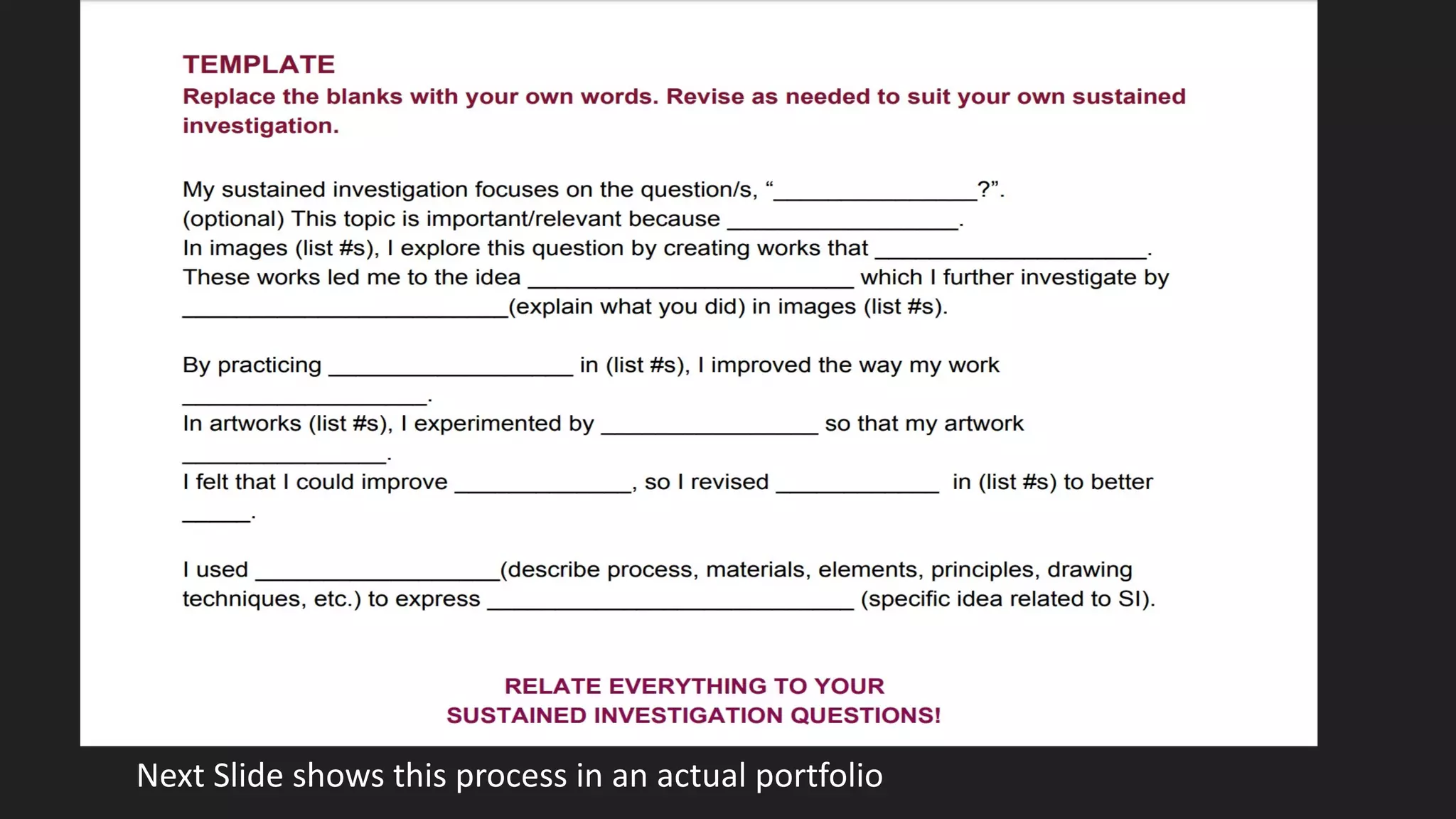
Monica Campa SI example: https://www.slideshare.net/BrendaRobson/monica-23307428
My sustained investigation focuses on the questions/s, How can I visually portray and Understand
people in my life through the enneagram?
This topic is important/relevant because I am drawn to this subject as I wish to look past the
superficial characteristics of people and instead perceive the motivations behind their personalities.
In Images (list #s) I explore this question by creating works that depict the overlooked mystery
behind the nine personality types.
These works led me to the idea of conducting interviews in order to discover their personality types
which I further investigate by arranging photo shoots to depict their main traits, inner conflicts and
behavioral driving forces. (explain what you did) in images (list #s).
By practicing __________ in (lists #s), I improved the way my work ____________.
In artworks (list the #s), I experimented by ________ so that my artwork __________.
I felt that I could improve________, so I revised ________in (list #s) to better _______
I used__________) describe process, materials, elements, principles of design, photographic
techniques or drawing techniques, etc. unique to you) to express ______________ (specific idea
related to SI).
RELATE EVERYTHING TO YOUR SUSTAINED INVESTIGATION QUESTIONS
The checklist shows EXACTLY the 3 areas you will be judged on. Make sure this is proven in your
portfolio set up and statement.
Selected Works
This part is easy. Simply pick the 5 best works of art you have ever created. We
will attach these to matt board and mail them to the college board.
Common Question:
1. Can they be my concentration works? YES
2. Can they be from other art classes? YES
3. Can they be sketches or from my altered book? YES
These should be the best of the best of the best but can come from any point in
your life.
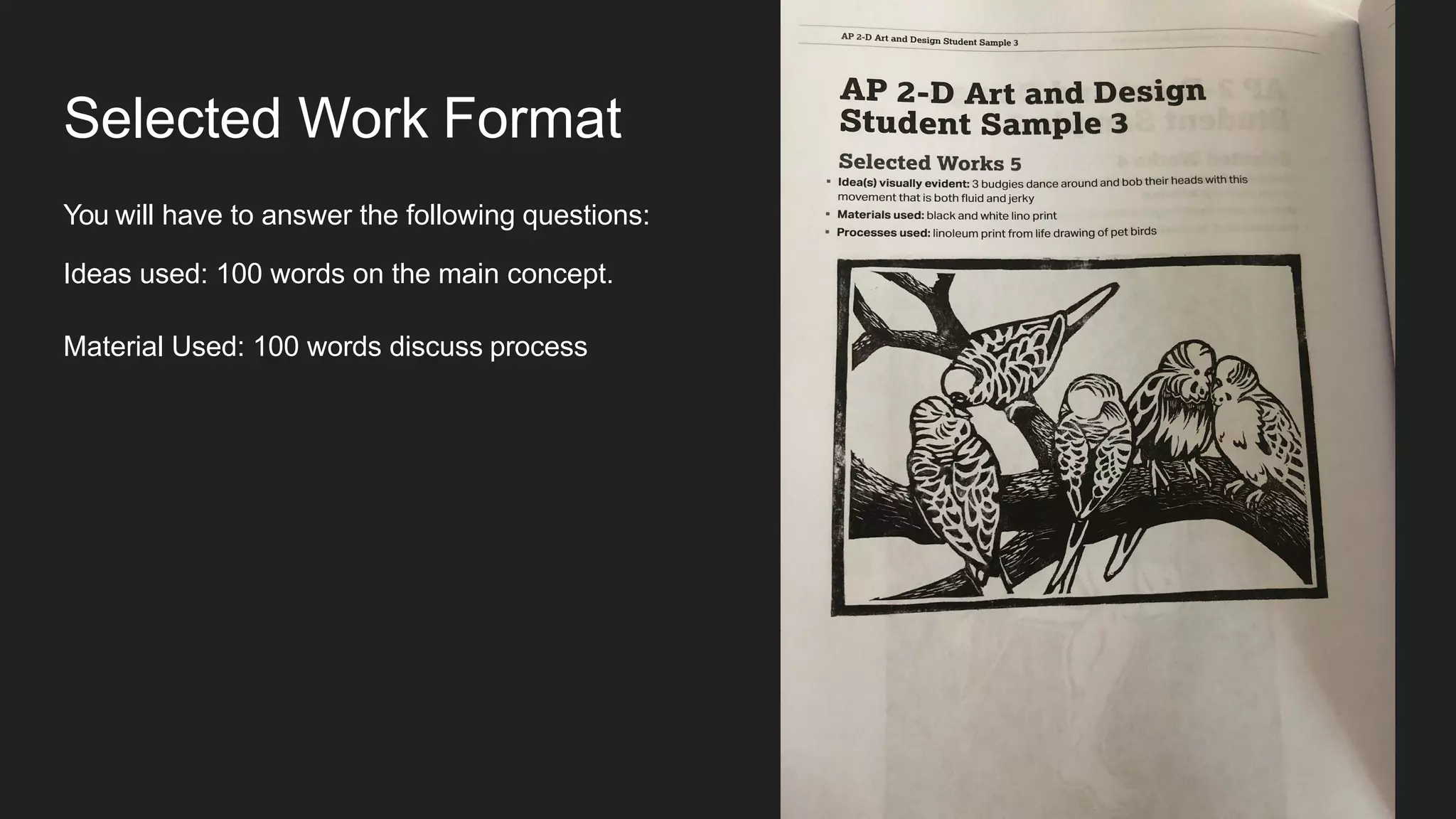
Selected Work Format
You will have to answer the following questions:
Ideas used: 100 words on the main concept.
Material Used: 100 words discuss process
Final word on Selected Works
These pieces will be considered separately and then a score will be assessed as
an all encompassing view.
It not necessary to write, but your work will be assessed on whether you identified
processes and ideas.
Skill will trump writing but write anyway to cover all your bases.
Aaaaaand that’s it! YOU’RE DONE!
Make sure digital images and writing are edited and uploaded. Wait until May to
submit.
Final	PPT	for	the	art	show
Rubric:
Title Slide with your correct portfolio and name
Slide with title Quality Pieces
All 5 Quality Pieces
Slide with the title Sustained Investigation with a simple paragraph or the whole statement
that you will upload on the college board site. (You can use 2 slides if you like)
All 15 SI Pieces with sizes, etc. Photography doesn't need sizes or materials (unless
photoshop was used)
An ending slide with advice for next year's AP students.

Ap studio art 2021-2022 introduction

  • 1.
    AP StudioArt 2020-2021 Prof Robson The CambridgeSchool of Dallas Examples of over 40 of my student portfolios: https://www.slideshare.net/BrendaRobson/
  • 2.
    SUMMER HOMEWORK 1. Look athttps://brendarobson.com/?s=concentration+help After looking at the portfolio requirements write down 50 ideas in your sketchbook. Then narrow it to 25. Then narrow it to 15, 10 until you have 5 solid ideas. 2. Creating a website using Blogger (send me the URL) 4. Make a Pinterest folder titled your name/AP art and share it with me so that we can both edit 5. Make a Dropbox folder titled your name/AP Art and share it with me so that we can both edit. Failure to do this will cause you to be taken out of AP and put in Art 3. Prof Robson
  • 3.
    Welcome to APArt andDesign In this course you will complete an exam made up of the following components: Sustained Investigation: 15 pieces designed during this course. Commentary: 1200 word defense of your work. Selected Works: 5 of your best works of art ever with a list of ideas, materials, and processes for each. These will be mounted and mailed to the College Board.
  • 4.
    We will followalong with this presentation in your sketchbook at the beginning of the year Hint: Make your notes visually appealing….this may be useful to you later
  • 5.
    Assignment 1. Whatis a Sustained Investigation? The sustained investigation is where YOU get to explore a concept of interest to you. It can be broad or narrow. It can be personal or more conceptual. You are the only limit of your ideas. ● Write down a list of concepts. (5 minimum) 15 minutes ○ Use the list you created during the summer or start fresh ○ Feel free to talk to table mates about potential ideas ● Ideas to avoid: ○ Too broad like “emotions” ○ Too narrow like “scissors” ○ Too meta like “existentialism in the modern world”
  • 6.
    Generating an EssentialQuestion An essential question is key in creating a theme or subject of investigation. Find something you like and then turn it into a question -Example:Still lifes with flowers. Essential question: How can I explore flowers through still life compositions? -Example: Portraits Essential question: How can I explore portraits in a meaningful way? “How can I use (insert material, technique, research, experience here) to explore/express my feelings (about/for/against) said topic?” Then, to flesh out the question:
  • 7.
    Do this inyour sketchbook with three different ideas: Write your idea: Make it a question:
  • 8.
    Create your “whys” Asuccessful sustained investigation will address why this subject appealed to you in the first place. Pick an essential question you listed above and then ask Why? Answer the following whys: You should have four answers per bullet 30 minutes. Use a friend in a question and answer session if it helps to talk out your ideas. ● Why does this appeal to you, how do you show that? (think of elements and principles here) ● Why do you want to use a certain media? ● Why do you want to show a certain viewpoint? ● Why is your concept important?
  • 9.
    Example of Why: ●Why does this appeal to you, how do you show that ○ I like the colors of nature ○ I like the textures of bees ○ I like the shapes of bees and flowers and pollen (dots) ○ I like the lines in flowers and organic structures ● Why do you want to use a certain media? ○ I like watercolor washes to show bright color ○ I like graphite to show contrast and value ○ I like colored pencil to show detail ○ I want to explore digital design with radial patterns ● Why do you want to show a certain viewpoint? ○ I like that different angles of bees show their different body segments. ○ I want the items suspended in air to add thread. ○ I want to show different perspectives (Close up vs far away) ○ I want to focus on the bees themselves ● Why is your concept important? ○ Bees make food ○ Bees pollinate flowers ○ Bees make it so we can survive ○ Bees are cute
  • 10.
    When why’s don’twork Ask yourself these questions: Did any of your ideas not produce 16 bullets? Yes? Then those ideas won’t work. Toss them out! You will work on this concept for 18 weeks if you can’t come up with 16 interesting things about it you certainly can’t make 12-15 interesting works of art about it. Did any of your ideas produce 16 or more bullets? Yes? YOU HAVE A WINNER! Use that idea to develop into a sustained investigation!
  • 11.
    A few reminders Beforecontinuing remember the following: NO PLAGIARIZED IMAGES. You must take all reference photos or modify existing images past recognition. Be original that means no pinteresting projects. Pinterest can be great for inspiration but do not copy from anything posted there. No logos can be present-they are copyrighted You can use photography, collage, found objects etc., for 2D only. For drawing you can only use painting, drawing, painted photographs, etc. Anything that makes a “mark” such as sewing on a photo
  • 12.
    Exploring Why’s One personexplored why’s visually to drive focal points and come into focus on the following aspects in each work: Delicate aspects of life: branches, flowers, finger nails, antennae, petals. Elements of Art/Principles of Design: Lines, colors, textures, space, emphasis, balance Common Key Components: Honeycomb Lens (the bee’s view point,) bee’s, living things, complimentary colors Work on this for the remainder of class…….FINISH FOR HOMEWORK
  • 13.
    Creating a mindmap…. Using your successful why to create a mind map and storyboard of 12 finished pieces. You will need 2 pages of storyboard thumbnails with 6 sketches on each. Mind map: Should address the answers to your whys, should explore concept sketches, potential media, potential color schemes, skills, and materials. You can work in a circle as shown on the next slide or a web map or any other form of graphic organizer that works for you. Storyboard: Complete 12 thumbnails of your main works to focus on. Take notes, add color, test media, etc but build a sequential outline that explores your essential question and that can be explained in your commentary
  • 14.
  • 15.
    Writing an essentialquestion statement: Using your essential question and why’s write a paragraph explaining your concept. Do this for one or more successful concepts. See the next slide for how to do this:
  • 16.
    My Essential Question: “How canI show the intricate qualities of nature?” I had several photographs I had taken of bees on various items such as flowers, fruit, and my hand. Why were these appealing? I liked the colors, the textures, and the interconnected aspects of the bees to the items they were resting on. Flowers need to be pollinated for there to be fruit and more plants, humans need fruit and plants to be able to survive. We are all connected and yet even the biggest living thing in this chain relies on the smallest, the bee, for survival. I chose to focus on colors and textures within the works themselves. I used literal string to tie the bees to the objects they sustain. I made the string small and fragile to show how delicate this balance amongst life truly is. Each piece has a translucent honeycomb structure in the foreground. These honeycombs represent the bee’s view. As bees are endangered I ended the investigation with a piece devoid of color and who’s strings have been broken to show what will happen if we ignore this intricate balance we call life.
  • 17.
    You did it! Congratulations!You have now planned your sustained investigation for your Advanced Placement Art and Design portfolio! Wooo! Look at rest of the presentation to see how your finished product will look. We will review this together in class tomorrow.
  • 18.
    Format of Slides MaterialsUsed: 100 word count Process Used: 100 word count (Only focus on the most critical applications-what is the most important for readers to know?) Size: 100 word count Be concise unless your work needs clarification. If it looks like a photo, clarify it was not copied See pages 145-213 in workbook Image:
  • 19.
    Slide/Art Suggestions Shoot for12 finished pieces and 3 in progress or sketched based works. The example on this page shows a student working, this is a great example of an in progress piece You can have multiple images per page as shown on next page. Consider this when doing the sketching process.. In progress works
  • 20.
  • 21.
    Last comment onslides….. You will need to discuss revisions you made in your commentary. You can do this through showing a piece before, or during, and after but you have to defend this in your commentary if you do. This is not necessary but can be useful to show the evolution of your work. Example: Media Used: Gesso, charcoal, white chalk pastel Process used: Top work is in progress application of materials.. White background shows first draft of work. Bottom Right shows revised final work with black background and stronger white highlights. This can be one slide or three separate slides but they must be explained in commentary.
  • 22.
  • 23.
    Example of miniSI Hanging by a Thread by Catherine E. Deaton
  • 24.
    Sketching as a Composition MaterialsUsed: Markers, graphite, ink pen, watercolor Process Use: I pulled from personal writing, ap workshop powerpoints and presentations, storyboarding, and my essential questions to create a visual plan of approach Size: 12” x 18”
  • 25.
    Piece 2: Fruitsof Our Labor Materials Used: Graphite, watercolor, ink pen, colored pencil, thread. Process Used: Pencil sketching, colored pencil drawing, watercolor washes, ink pen to illustrate, and elements sewn together. Size: 4.5” X 6”
  • 26.
    Giving Each Other aHand Materials Used: Graphite, watercolor, ink pen,colored pencil, thread. Process Used: Pencil sketching, colored pencil drawing, watercolor washes, ink pen to illustrate, and elements sewn together. Size: 3” x 3.5”
  • 27.
    The Sun WillCome Up Materials Used: Digital design, photographic print, watercolor, ink pen, colored pencil. Process Used: ProCreate to illustrate, printed on photo paper. Colored pencil bee cut out. Items sewn together. Watercolor and ink added. Size: 4” x 5.75”
  • 28.
    Detail of TheSun Will Come Up You can use details as compositions, but it does not help with score as much as more solidworks in the portfolio. Details should only be used if they truly serve a purpose.
  • 29.
    Stop to Smellthe Flowers Materials Used: Graphite, watercolor, ink pen,colored pencil, thread. Process Used: Pencil sketching, colored pencil drawing, watercolor washes, ink pen to illustrate, and elements sewn together. Size: 4” x 6”
  • 30.
    Detail of Smellthe Flowers This is just so you can see the shiney thread
  • 31.
    Broken Strings Materials Used:Graphite, watercolor, ink pen, thread. Process Used: Pencil sketching, watercolor washes, ink pen to illustrate. Stitching left purposefully untethered. Size: 4” x 6”
  • 32.
  • 33.
    Now it’s timeto make art! Once you have completed your work you can begin writing your commentary!
  • 34.
    Commentary Suggestions 1. BECLEAR AND CONCISE 2. Part 1: State your identified inquiry (essential question.) That’s it. 3. Part 2: write evidence of HOW you identify inquiry in the works (addressed you whys), discuss revisions, relationships between materials and processes, and skill. 4. Stay focused, say only what is necessary to get the point across. FOCUS ON THE INVESTIGATION OF YOUR QUESTION. 5. Put in one sentence of how you experimented. If applicable put in a sentence about revisions made. 6. Use shortcuts (so & instead of and, single space between sentences, etc) 7. YOU CAN ONLY USE 1200 WORDS total on both prompts together See page 146 in workbook
  • 35.
  • 36.
    Essential Question Example: Commentary Part1 I investigated theconcept of the delicate balance between bees and life itself. I illustrated fruit, flowers, and people interacting with bees. I used thread to sew the bees to the objects they sustain. The string is small and fragile to show how delicate this balance amongst life is. I ended the investigation with a piece devoid of color and who’s strings have been broken to show what will happen if we lose this balance in life. I took this directly from my essential question statement we wrote earlier.
  • 37.
    Example Essential Question: Commentary Part2 My work reflectsliving items sewn to illustrations of bees to show their interconnectedness. Piece 1 shows the bees’ role in producing food. Blues and yellows emphasize the fruit as a focal point. Piece 2 used zoomed in perspectives to focus on the bee who has landed on a hand. The bee is stitched to the hand to show how humanity and bees are inseparable. In Piece 3 I explored digital forms of art production. Using an iPad I experimented with making radial patterns and repeated designs in a layered format to show depth and texture. Piece 4 explored emphasis. Large scaling and the use of complimentary colors create emphasis on the bee covered in pollen. All pieces include translucent honeycomb structures in the foreground to add line, shape, texture, and color to symbolize the bees’ perspective as a silent participant. Piece 5 was originally in color but was revised as a lifeless investigation of a monochromatic work depicting what we have to lose if the bees go extinct: life itself.
  • 38.
    Next Slide showsthis process in an actual portfolio
  • 39.
    Monica Campa SIexample: https://www.slideshare.net/BrendaRobson/monica-23307428 My sustained investigation focuses on the questions/s, How can I visually portray and Understand people in my life through the enneagram? This topic is important/relevant because I am drawn to this subject as I wish to look past the superficial characteristics of people and instead perceive the motivations behind their personalities. In Images (list #s) I explore this question by creating works that depict the overlooked mystery behind the nine personality types. These works led me to the idea of conducting interviews in order to discover their personality types which I further investigate by arranging photo shoots to depict their main traits, inner conflicts and behavioral driving forces. (explain what you did) in images (list #s). By practicing __________ in (lists #s), I improved the way my work ____________. In artworks (list the #s), I experimented by ________ so that my artwork __________. I felt that I could improve________, so I revised ________in (list #s) to better _______ I used__________) describe process, materials, elements, principles of design, photographic techniques or drawing techniques, etc. unique to you) to express ______________ (specific idea related to SI). RELATE EVERYTHING TO YOUR SUSTAINED INVESTIGATION QUESTIONS The checklist shows EXACTLY the 3 areas you will be judged on. Make sure this is proven in your portfolio set up and statement.
  • 40.
    Selected Works This partis easy. Simply pick the 5 best works of art you have ever created. We will attach these to matt board and mail them to the college board. Common Question: 1. Can they be my concentration works? YES 2. Can they be from other art classes? YES 3. Can they be sketches or from my altered book? YES These should be the best of the best of the best but can come from any point in your life.
  • 41.
    Selected Work Format Youwill have to answer the following questions: Ideas used: 100 words on the main concept. Material Used: 100 words discuss process
  • 42.
    Final word onSelected Works These pieces will be considered separately and then a score will be assessed as an all encompassing view. It not necessary to write, but your work will be assessed on whether you identified processes and ideas. Skill will trump writing but write anyway to cover all your bases.
  • 43.
    Aaaaaand that’s it!YOU’RE DONE! Make sure digital images and writing are edited and uploaded. Wait until May to submit.
  • 44.
    Final PPT for the art show Rubric: Title Slide withyour correct portfolio and name Slide with title Quality Pieces All 5 Quality Pieces Slide with the title Sustained Investigation with a simple paragraph or the whole statement that you will upload on the college board site. (You can use 2 slides if you like) All 15 SI Pieces with sizes, etc. Photography doesn't need sizes or materials (unless photoshop was used) An ending slide with advice for next year's AP students.