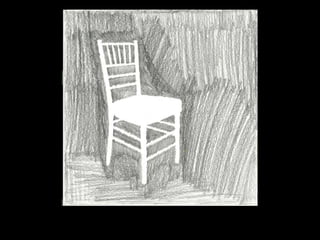
Negative Space_Drawing 1
Thomas Green
The second basic component skill of drawing, the perception of negative spaces,
is new learning for most students, and it can also be great fun. In a sense, you
will be seeing and drawing what is not there in order to portray what is there.
Green drawing1 negativespace

Green drawing1 negativespace

  • 1.
  • 2.
    The second basiccomponent skill of drawing, the perception of negative spaces, is new learning for most students, and it can also be great fun. In a sense, you will be seeing and drawing what is not there in order to portray what is there.

Editor's Notes

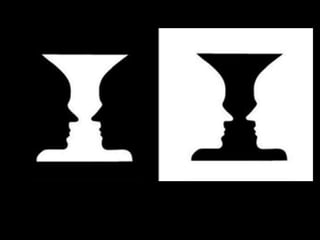
  • #4 When we talk about figure ground and figure ground reversal in the image above, we might remember the figure is the object or subject matter of the image and the ground is the background. I asked you to start by drawing the faces, and then midway through, I asked that you try and draw the vase, causing confusion.
  • #5 Two terms traditionally used in art are negative spaces and positive forms. In drawing, negative spaces are real. They are not just “the empty parts. Imagine that Bugs Bunny is running at top speed down a long hallway, at the end of which is a closed door. He smashes through the door, leaving a Bugs Bunny–shaped hole in the door. What is left of the door is negative space. Note that the door has an outside edge. This edge is the outside edge of the negative space (its format). The hole in the door is—was—the positive form.
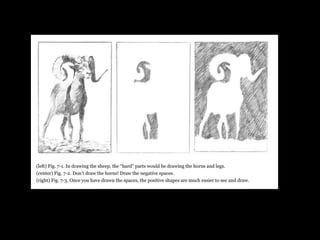
  • #6 For the person just learning to draw, they are perhaps more important, because negative spaces make drawing difficult things easy. In the bighorn sheep,, the sheep is the positive form and the sky and ground are negative spaces. The first drawing is focused on the sheep, the second and third on the negative spaces. A difficult” parts would include drawing the horns, which are foreshortened and curve off into space in unexpected ways and the arrangement of the legs in the foreshortened view of the animal. What to do? Don’t draw the horns or the legs at all. Close one eye, focus on the negative spaces of the horns and the legs, draw those (see Figure 7-2), and you get the horns and legs—for free
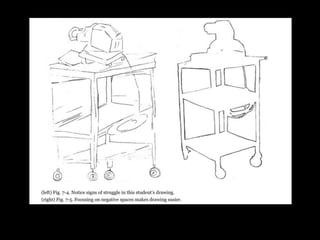
  • #7 People experienced in drawing will often shift when they come to difficult parts of drawing. It helps place things in space and render those seemingly impossible and difficult to understand areas. In the drawing on the left, the student couldn’t recall what his mind was telling him object “should” look like. But, when he decided to draw the negative space, he didn’t have symbols to distract and the final product is much better.
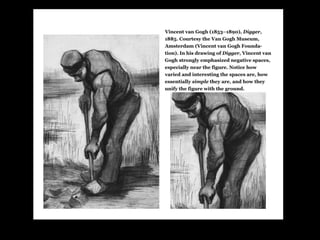
  • #8 Another factor in drawing the negative space is it’s ability to unify a composition. Most often, when we are drawing, we are focused solely on the positive space and placing objects on the paper, but by filling out the negative space, we become more aware of the picture plane, and unify the compositions.
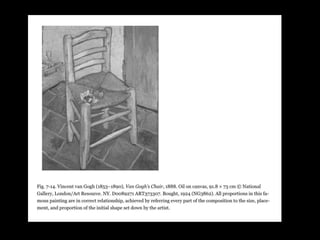
  • #9 Over the weekend, Please continue with some practice drawings of negative space. Give yourself about an hour to complete these drawings. Choose a chair, or possibly a plant, or other organic forms, and try and take up most of the page in the sketchbook.
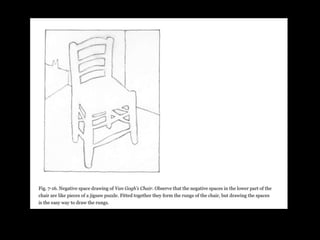
  • #10 Pay attention as to how the negative space relates to the edge of the picture plane. You may leave your drawings completely white with the negative shapes drawn in,
  • #11 or you may shade in the negative spaces leaving a shadowy look.