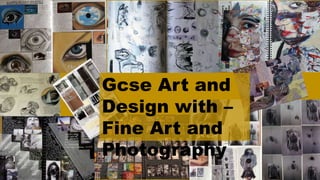
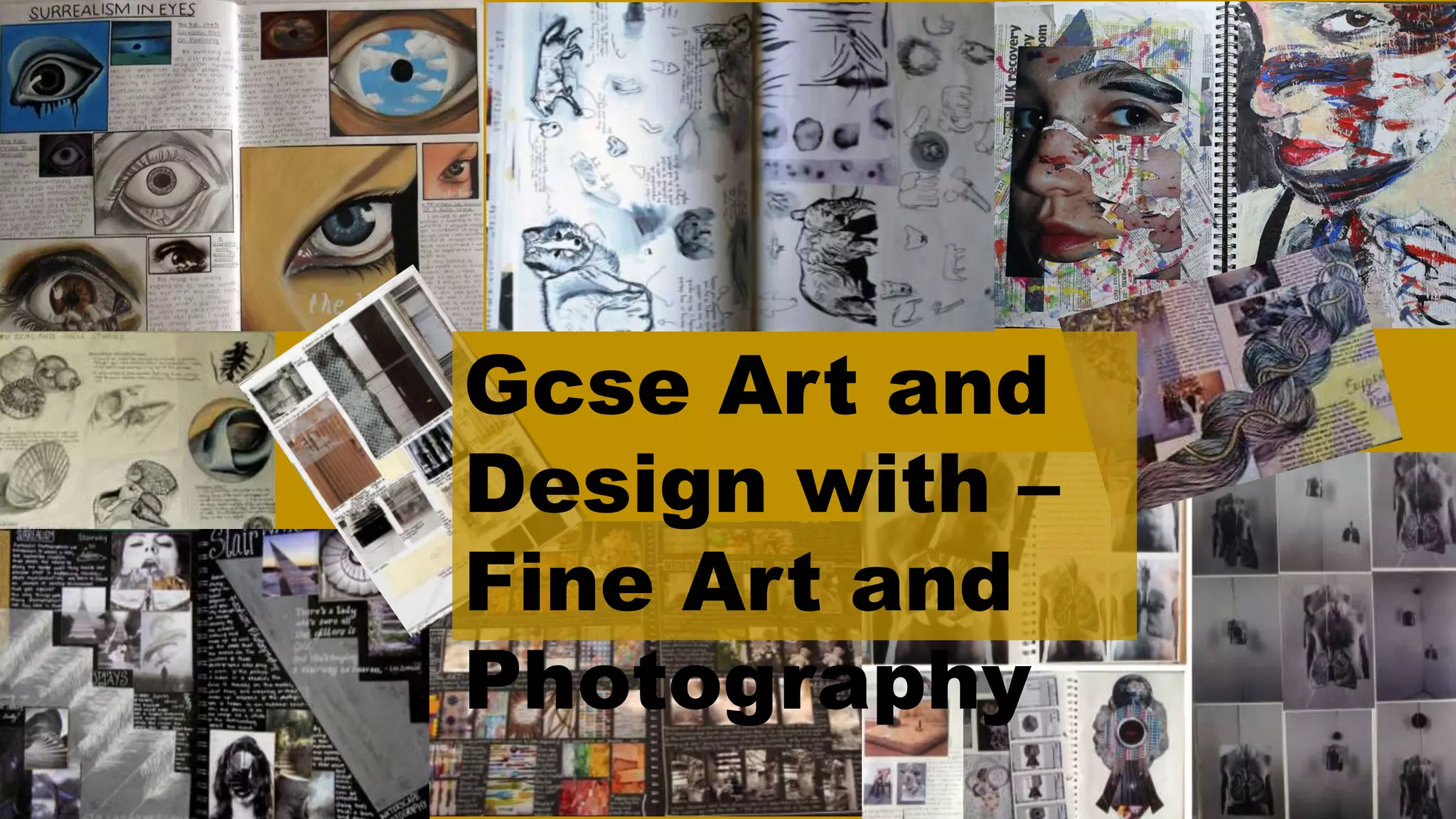
Gcse Art and
Design with –
Fine Art and
Photography
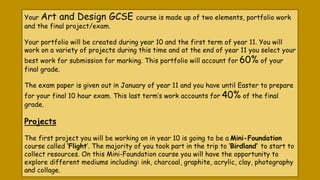
Your Art and Design GCSE course is made up of two elements, portfolio work
and the final project/exam.
Your portfolio will be created during year 10 and the first term of year 11. You will
work on a variety of projects during this time and at the end of year 11 you select your
best work for submission for marking. This portfolio will account for 60% of your
final grade.
The exam paper is given out in January of year 11 and you have until Easter to prepare
for your final 10 hour exam. This last term’s work accounts for 40% of the final
grade.
Projects
The first project you will be working on in year 10 is going to be a Mini-Foundation
course called ‘Flight’. The majority of you took part in the trip to ‘Birdland’ to start to
collect resources. On this Mini-Foundation course you will have the opportunity to
explore different mediums including: ink, charcoal, graphite, acrylic, clay, photography
and collage.
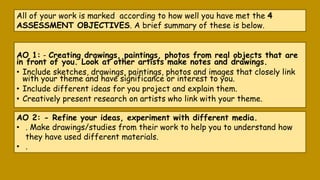
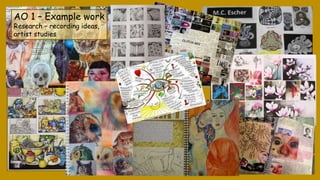
AO 1: - Creating drawings, paintings, photos from real objects that are
in front of you. Look at other artists make notes and drawings.
• Include sketches, drawings, paintings, photos and images that closely link
with your theme and have significance or interest to you.
• Include different ideas for you project and explain them.
• Creatively present research on artists who link with your theme.
All of your work is marked according to how well you have met the 4
ASSESSMENT OBJECTIVES. A brief summary of these is below.
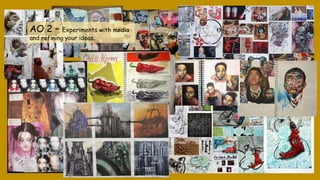
AO 2: - Refine your ideas, experiment with different media.
• . Make drawings/studies from their work to help you to understand how
they have used different materials.
• .
AO 1 – Example work
Research – recording ideas,
artist studies
AO 2 – Experiments with media
and refining your ideas.
AO 3: - Practical Development - record and present ideas
• Experiment with different processes, materials and techniques.
• Which processes work and what do you want to keep? – include study
sketches, photos etc. to create different ideas for your project.
• Record any changes that you make to your ideas in your sketchbook.
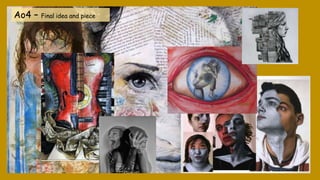
AO 4: - Realising intentions (creating your final piece)
• Include evidence in your sketchbook that shows that you have experimented
with different materials and techniques.
• Include evidence of how your ideas have developed from the start of your
projects to the end, with evidence of how it has helped you to look at other’s
work.
• Produce a finished main piece of work that brings together the whole unit of
work.
• Include an evaluation of your project and final piece.
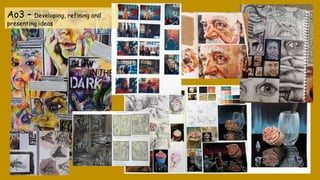
Ao3 – Developing, refining and
presenting ideas
Ao4 – Final idea and piece
ANNOTATING YOUR WORK!
Essential! Think about:
•WHAT have you done?
•HOW have you done it?
•WHAT inspired you?
•WHY was it successful – or not?
•WHAT else could you have done or
changed?
How your work is marked.
•Each AO is marked out of 20. At the start of
Year 10 your marks might seem quite low. This
is because we mark using the GCSE standards
from the first week of the course. By the end
of the first term, most students start to get C
grades (10 or 11 out of 20) for some of the
AOs. Here is how we mark your work:
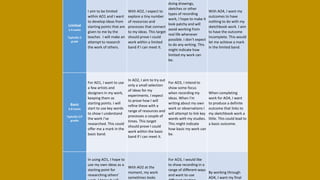
Limited
1-4 marks
Typically G
grade
I aim to be limited
within AO1 and I want
to develop ideas from
starting points that are
given to me by the
teacher. I will make an
attempt to research
the work of others.
With AO2, I expect to
explore a tiny number
of resources and
processes that connect
to my ideas. This target
should prove I could
work within a limited
band if I can meet it.
doing drawings,
sketches or other
types of recording
work, I hope to make it
look patchy and will
avoid working from
real life whenever
possible. I don’t expect
to do any writing. This
might indicate how
limited my work can
be.
With AO4, I want my
outcomes to have
nothing to do with my
sketchbook work. I aim
to have the outcome
incomplete. This would
let me achieve a mark
in the limited band.
Basic
5-8 marks
Typically E/F
grades
For AO1, I want to use
a few artists and
designers in my work,
keeping them as
starting points. I will
start to use key words
to show I understand
the work I’ve
researched. This could
offer me a mark in the
basic band.
In AO2, I aim to try out
only a small selection
of ideas for my
experiments. I expect
to prove how I will
refine these with a
range of resources and
processes a couple of
times. This target
should prove I could
work within the basic
band if I can meet it.
For AO3, I intend to
show some focus
when recording my
ideas. When I’m
writing about my own
work or observations I
will attempt to link key
words with my studies.
This might indicate
how basic my work can
be.
When completing
work for AO4, I want
to produce a definite
outcome that links to
my sketchbook work a
little. This could lead to
a basic outcome.
In using AO1, I hope to
use my own ideas as a
starting point for
researching others’
With AO2 at the
moment, my work
sometimes looks
For AO3, I would like
to show recording in a
range of different ways
and want to use
By working through
AO4, I want my final
It is really useful if you look at the list of
equipment that you will need and start to build up
a collection.
By week 3 of year 10 you will need an A3
sketchbook and pencils, pens and watercolours.
Every week you will be expected to carry out
homework tasks and attend an afterschool catch
up club if needed.
Good luck!

Gcse course1

  • 1.
    Gcse Art and Designwith – Fine Art and Photography
  • 2.
    Your Art andDesign GCSE course is made up of two elements, portfolio work and the final project/exam. Your portfolio will be created during year 10 and the first term of year 11. You will work on a variety of projects during this time and at the end of year 11 you select your best work for submission for marking. This portfolio will account for 60% of your final grade. The exam paper is given out in January of year 11 and you have until Easter to prepare for your final 10 hour exam. This last term’s work accounts for 40% of the final grade. Projects The first project you will be working on in year 10 is going to be a Mini-Foundation course called ‘Flight’. The majority of you took part in the trip to ‘Birdland’ to start to collect resources. On this Mini-Foundation course you will have the opportunity to explore different mediums including: ink, charcoal, graphite, acrylic, clay, photography and collage.
  • 3.
    AO 1: -Creating drawings, paintings, photos from real objects that are in front of you. Look at other artists make notes and drawings. • Include sketches, drawings, paintings, photos and images that closely link with your theme and have significance or interest to you. • Include different ideas for you project and explain them. • Creatively present research on artists who link with your theme. All of your work is marked according to how well you have met the 4 ASSESSMENT OBJECTIVES. A brief summary of these is below. AO 2: - Refine your ideas, experiment with different media. • . Make drawings/studies from their work to help you to understand how they have used different materials. • .
  • 4.
    AO 1 –Example work Research – recording ideas, artist studies
  • 5.
    AO 2 –Experiments with media and refining your ideas.
  • 6.
    AO 3: -Practical Development - record and present ideas • Experiment with different processes, materials and techniques. • Which processes work and what do you want to keep? – include study sketches, photos etc. to create different ideas for your project. • Record any changes that you make to your ideas in your sketchbook. AO 4: - Realising intentions (creating your final piece) • Include evidence in your sketchbook that shows that you have experimented with different materials and techniques. • Include evidence of how your ideas have developed from the start of your projects to the end, with evidence of how it has helped you to look at other’s work. • Produce a finished main piece of work that brings together the whole unit of work. • Include an evaluation of your project and final piece.
  • 7.
    Ao3 – Developing,refining and presenting ideas
  • 8.
    Ao4 – Finalidea and piece
  • 9.
    ANNOTATING YOUR WORK! Essential!Think about: •WHAT have you done? •HOW have you done it? •WHAT inspired you? •WHY was it successful – or not? •WHAT else could you have done or changed?
  • 10.
    How your workis marked. •Each AO is marked out of 20. At the start of Year 10 your marks might seem quite low. This is because we mark using the GCSE standards from the first week of the course. By the end of the first term, most students start to get C grades (10 or 11 out of 20) for some of the AOs. Here is how we mark your work:
  • 11.
    Limited 1-4 marks Typically G grade Iaim to be limited within AO1 and I want to develop ideas from starting points that are given to me by the teacher. I will make an attempt to research the work of others. With AO2, I expect to explore a tiny number of resources and processes that connect to my ideas. This target should prove I could work within a limited band if I can meet it. doing drawings, sketches or other types of recording work, I hope to make it look patchy and will avoid working from real life whenever possible. I don’t expect to do any writing. This might indicate how limited my work can be. With AO4, I want my outcomes to have nothing to do with my sketchbook work. I aim to have the outcome incomplete. This would let me achieve a mark in the limited band. Basic 5-8 marks Typically E/F grades For AO1, I want to use a few artists and designers in my work, keeping them as starting points. I will start to use key words to show I understand the work I’ve researched. This could offer me a mark in the basic band. In AO2, I aim to try out only a small selection of ideas for my experiments. I expect to prove how I will refine these with a range of resources and processes a couple of times. This target should prove I could work within the basic band if I can meet it. For AO3, I intend to show some focus when recording my ideas. When I’m writing about my own work or observations I will attempt to link key words with my studies. This might indicate how basic my work can be. When completing work for AO4, I want to produce a definite outcome that links to my sketchbook work a little. This could lead to a basic outcome. In using AO1, I hope to use my own ideas as a starting point for researching others’ With AO2 at the moment, my work sometimes looks For AO3, I would like to show recording in a range of different ways and want to use By working through AO4, I want my final
  • 12.
    It is reallyuseful if you look at the list of equipment that you will need and start to build up a collection. By week 3 of year 10 you will need an A3 sketchbook and pencils, pens and watercolours. Every week you will be expected to carry out homework tasks and attend an afterschool catch up club if needed. Good luck!