Gesture Drawing
Thomas_Green
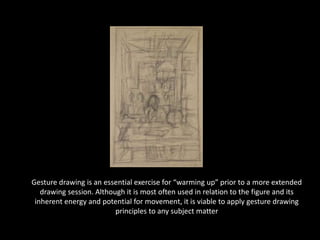
Gesture drawing is an essential exercise for “warming up” prior to a more extended
drawing session. Although it is most often used in relation to the figure and its
inherent energy and potential for movement, it is viable to apply gesture drawing
principles to any subject matter
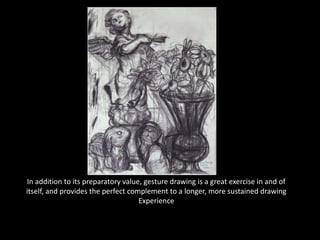
In addition to its preparatory value, gesture drawing is a great exercise in and of
itself, and provides the perfect complement to a longer, more sustained drawing
Experience
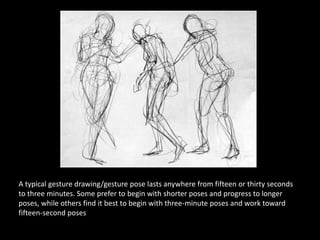
A typical gesture drawing/gesture pose lasts anywhere from fifteen or thirty seconds
to three minutes. Some prefer to begin with shorter poses and progress to longer
poses, while others find it best to begin with three-minute poses and work toward
fifteen-second poses
• Spend some time just looking at the pose before
beginning to draw.
• Spend the majority of time looking at the model or
still life rather than at the drawing
• The movement of your hand should duplicate the
movement of your eyes as you scan the figure for
proportion and general disposition
Seeing Is the Key
• Establish general scale and proportion purely through
visual observation. A formal use of the sighting stick and
the sighting process is inappropriate in gesture drawing
because of the limited time involved.
• Stand at arm’s length from the drawing surface in a
position allowing a broad view of both the model and the
drawing surface. Keep the drawing surface at a height
that is most comfortable for you
Seeing Is the Key
Keep It Simple
• Details are unimportant in gesture drawing and
should not be of concern.
• Try to be economical with marks—don’t overwork
the gestures. Let gesture drawing be a statement of
essentials or essence.
• Define the general characteristics—movement,
direction,
Pick up the pace!!!
The figure or object and its position should be suggested in its
entirety within the first few seconds of drawing. This is
accomplished by recording the largest and most apparent axis
lines first.
• Think energy and immediacy. Gesture drawing is a record of
the energy and movement that goes into making the mark
• Use the entire arm and wrist and shoulder to draw; use your
whole body. Stand up when doing gesture drawings to enable
fluid and rapid drawing
Work from the inside out
• Have an awareness of underlying structure, which acts as the
armature for the object
• Indicate general points of articulation, such as extenuating
arms, protruding edges, or intersections of these “arms” and
“legs” with the main structure of the object or figure.
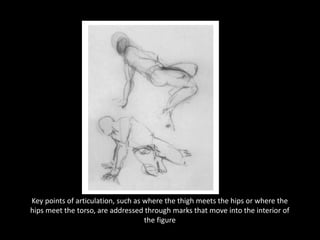
Key points of articulation, such as where the thigh meets the hips or where the
hips meet the torso, are addressed through marks that move into the interior of
the figure

Gesture drawing

  • 1.
  • 2.
    Gesture drawing isan essential exercise for “warming up” prior to a more extended drawing session. Although it is most often used in relation to the figure and its inherent energy and potential for movement, it is viable to apply gesture drawing principles to any subject matter
  • 3.
    In addition toits preparatory value, gesture drawing is a great exercise in and of itself, and provides the perfect complement to a longer, more sustained drawing Experience
  • 4.
    A typical gesturedrawing/gesture pose lasts anywhere from fifteen or thirty seconds to three minutes. Some prefer to begin with shorter poses and progress to longer poses, while others find it best to begin with three-minute poses and work toward fifteen-second poses
  • 5.
    • Spend sometime just looking at the pose before beginning to draw. • Spend the majority of time looking at the model or still life rather than at the drawing • The movement of your hand should duplicate the movement of your eyes as you scan the figure for proportion and general disposition Seeing Is the Key
  • 7.
    • Establish generalscale and proportion purely through visual observation. A formal use of the sighting stick and the sighting process is inappropriate in gesture drawing because of the limited time involved. • Stand at arm’s length from the drawing surface in a position allowing a broad view of both the model and the drawing surface. Keep the drawing surface at a height that is most comfortable for you Seeing Is the Key
  • 9.
    Keep It Simple •Details are unimportant in gesture drawing and should not be of concern. • Try to be economical with marks—don’t overwork the gestures. Let gesture drawing be a statement of essentials or essence. • Define the general characteristics—movement, direction,
  • 11.
    Pick up thepace!!! The figure or object and its position should be suggested in its entirety within the first few seconds of drawing. This is accomplished by recording the largest and most apparent axis lines first. • Think energy and immediacy. Gesture drawing is a record of the energy and movement that goes into making the mark • Use the entire arm and wrist and shoulder to draw; use your whole body. Stand up when doing gesture drawings to enable fluid and rapid drawing
  • 13.
    Work from theinside out • Have an awareness of underlying structure, which acts as the armature for the object • Indicate general points of articulation, such as extenuating arms, protruding edges, or intersections of these “arms” and “legs” with the main structure of the object or figure.
  • 14.
    Key points ofarticulation, such as where the thigh meets the hips or where the hips meet the torso, are addressed through marks that move into the interior of the figure

Editor's Notes

  • #4 The generalized nature of information gathered in a gesture drawing helps the process of working from general to specific, and helps in experience in making rapid observations of overall figurative placement and proportion of things within the picture plane
  • #5 hold your drawing implement loosely so that they can utilize their entire arm. Often the tendency is to grip the tool in the same way one would if writing, and you really want to be able to get your body into the motion. This is for warming up and laying down the basics. Don’t sweat the details until later on.
  • #7 You can be very loose and in starting out…. Let’s work large.
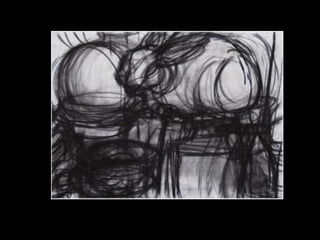
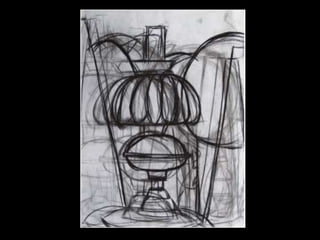
  • #11 No shading or other elements are added in this drawing. The student is rapidly drawing the essentials to get an idea of where things are located and the bigger picture. Later, this drawing could be wiped away and details added in for a more “finished” look. Completing a lot of gesture drawings with help you to start establishing the essentials to objects and where they go in space.
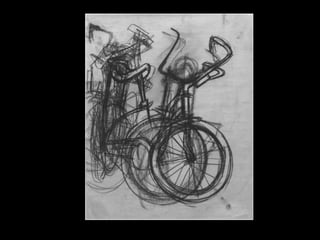
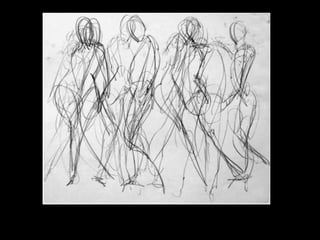
  • #13 Notice how rapidly the markmaking in this example appear. Marks are fast and relying on general axis to place the figures in the picture plane. Measuring and guidelines to angles and axis are guestimated at a quick rate.