
Surrealism & Salvador Dalí
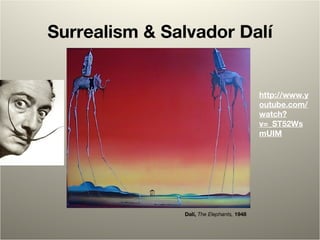
Dalí, The Elephants, 1948
http://www.y
outube.com/
watch?
v=_ST52Ws
mUIM
Surrealism
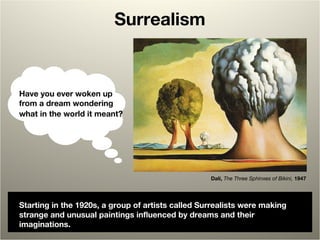
Starting in the 1920s, a group of artists called Surrealists were making
strange and unusual paintings influenced by dreams and their
imaginations.
Dalí, The Three Sphinxes of Bikini, 1947
Have you ever woken up
from a dream wondering
what in the world it meant?
Magritte, Fair Captive, 1945
Like dreams, these paintings mixed pieces of the real world with bizarre,
fantastic elements that could only come from a person’s mind.
Magritte, Human Condition, 1935
Ernst, Oedipus Rex, 1922
These artistic works often did not make logical sense and left
viewers wondering what in the world they meant.
Salvador Dalí
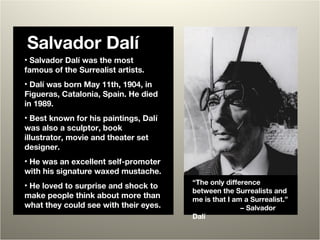
“The only difference
between the Surrealists and
me is that I am a Surrealist.”
– Salvador
Dalí
• Salvador Dalí was the most
famous of the Surrealist artists.
• Dalí was born May 11th, 1904, in
Figueras, Catalonia, Spain. He died
in 1989.
• Best known for his paintings, Dalí
was also a sculptor, book
illustrator, movie and theater set
designer.
• He was an excellent self-promoter
with his signature waxed mustache.
• He loved to surprise and shock to
make people think about more than
what they could see with their eyes.
Dali was influenced by many artists from different periods in art
including classical painters like the Dutch master Johannes Vermeer.
• Precise realism and the ominous, swirling light in many of Dalí’s paintings
were strongly influenced by the works of Vermeer.
• How does Dalí’s sky make you feel?
Dalí, Average Pagan Landscape, 1937Vermeer, View of Delft, circa 1660 - 1661
Dalí, Weaning of Furniture-Nutrition, 1934
What makes it Surreal?
PRECISE REALISM a launching point into fantasy.
LAWS OF NATURE REVERSED objects are living & living things become objects.
JUXTOPOSITION objects placed side by side for striking comparison or contrast.
DISLOCATION objects are placed where they aren’t usually placed.
SYMBOLISM reoccurring objects represent Dalí’s ideas, memories or dreams.
Dalí, Weaning of Furniture-Nutrition, 1934
What makes it Surreal?
PRECISE REALISM almost photo-realistic painting of objects and landscape.
LAWS OF NATURE REVERSED the woman is an object. A shadow of a bottle on a dresser is a
hole.
JUXTAPOSITION woman and objects are bigger than the boats. Tiny dresser next to the big
dresser.
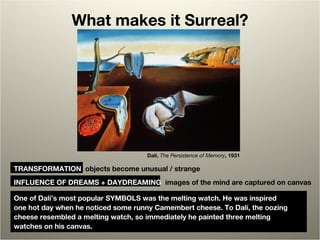
What makes it Surreal?
Dalí, The Persistence of Memory, 1931
One of Dalí’s most popular SYMBOLS was the melting watch. He was inspired
one hot day when he noticed some runny Camembert cheese. To Dalí, the oozing
cheese resembled a melting watch, so immediately he painted three melting
watches on his canvas.
TRANSFORMATION objects become unusual / strange
INFLUENCE OF DREAMS + DAYDREAMING images of the mind are captured on canvas
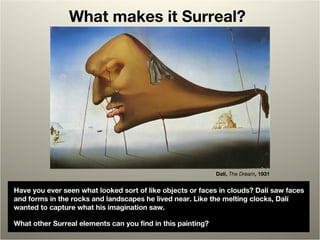
What makes it Surreal?
Dalí, The Dream, 1931
Have you ever seen what looked sort of like objects or faces in clouds? Dalí saw faces
and forms in the rocks and landscapes he lived near. Like the melting clocks, Dalí
wanted to capture what his imagination saw.
What other Surreal elements can you find in this painting?
What makes it Surreal?
HIDDEN + DOUBLE IMAGES Dalí used hidden and double images (images
that exist as two different things at the same time) to challenge his viewers
sense of reality, creating feelings of danger and delight.
What do you see?
Dalí, Old Age, Adolescence, Infancy (The Three Ages),1940
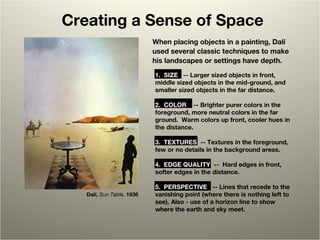
Creating a Sense of Space
Dalí, Sun Table, 1936
When placing objects in a painting, Dalí
used several classic techniques to make
his landscapes or settings have depth.
1. SIZE  -- Larger sized objects in front,   
middle sized objects in the mid-ground, and
smaller sized objects in the far distance.
2. COLOR  -- Brighter purer colors in the 
foreground, more neutral colors in the far
ground. Warm colors up front, cooler hues in 
the distance.
3. TEXTURES  -- Textures in the foreground, 
few or no details in the background areas.  
4. EDGE QUALITY  -- Hard edges in front,   
softer edges in the distance.
5. PERSPECTIVE  -- Lines that recede to the 
vanishing point (where there is nothing left to
see). Also - use of a horizon line to show
where the earth and sky meet.
I Can…
 Create a CONTOUR LINE
drawing of my shoe that
demonstrates line, texture, and
detail.
Create a SURREALIST image
for my shoe that JUXTAPOSES
my shoe with a dream-like
background.
Create a sense of SPACE
using SIZE, COLOR, and
PERSPECTIVE.
Foreground,
Midground,
background.
Create VALUE using color
pencils.
Please mark: Foreground, Midground,
Horizon Line and Background 
Romanian Artist Ghica Popa
Romanian Artist/Illustrator
Ghica Popa
http://ghicapopa.com/In-my-shoes
Dali Museum / Video
“Get Surreal with Salvador Dali” video by the Dali Museum, St.
Petersburg, Florida
http://www.youtube.com/watch?v=_ST52WsmUIM
Dali Museum / Educational Resources / Key Works
http://www.thedali.org/education/docz/KeyWorks.pdf
Dali Museum / Educational Resources / Teacher Guide
http://www.thedali.org/education/docz/TeacherGuide.pdf
Dali Museum / Educational Resources / “The Surreal Deal” Lesson Plan
2
http://thedali.org/education/docz/LessonPlan2-TheSurrealDeal.pdf
Publication (available in the Duniway Library / Teacher Resources )
Dali, Gilles Néret, Thunder Bay Press, 1997
Carol Jensen’s Water Color World
http://caroljessen.blogspot.com/2012/01/receding-space.html
Instructional Resources + Credits
“Have no fear of perfection - you'll never reach it.”
– Salvador Dalí

5 surrealism dali

  • 1.
    Surrealism & SalvadorDalí Dalí, The Elephants, 1948 http://www.y outube.com/ watch? v=_ST52Ws mUIM
  • 2.
    Surrealism Starting in the1920s, a group of artists called Surrealists were making strange and unusual paintings influenced by dreams and their imaginations. Dalí, The Three Sphinxes of Bikini, 1947 Have you ever woken up from a dream wondering what in the world it meant?
  • 3.
    Magritte, Fair Captive,1945 Like dreams, these paintings mixed pieces of the real world with bizarre, fantastic elements that could only come from a person’s mind.
  • 4.
  • 5.
    Ernst, Oedipus Rex,1922 These artistic works often did not make logical sense and left viewers wondering what in the world they meant.
  • 6.
    Salvador Dalí “The onlydifference between the Surrealists and me is that I am a Surrealist.” – Salvador Dalí • Salvador Dalí was the most famous of the Surrealist artists. • Dalí was born May 11th, 1904, in Figueras, Catalonia, Spain. He died in 1989. • Best known for his paintings, Dalí was also a sculptor, book illustrator, movie and theater set designer. • He was an excellent self-promoter with his signature waxed mustache. • He loved to surprise and shock to make people think about more than what they could see with their eyes.
  • 7.
    Dali was influencedby many artists from different periods in art including classical painters like the Dutch master Johannes Vermeer. • Precise realism and the ominous, swirling light in many of Dalí’s paintings were strongly influenced by the works of Vermeer. • How does Dalí’s sky make you feel? Dalí, Average Pagan Landscape, 1937Vermeer, View of Delft, circa 1660 - 1661
  • 8.
    Dalí, Weaning ofFurniture-Nutrition, 1934 What makes it Surreal? PRECISE REALISM a launching point into fantasy. LAWS OF NATURE REVERSED objects are living & living things become objects. JUXTOPOSITION objects placed side by side for striking comparison or contrast. DISLOCATION objects are placed where they aren’t usually placed. SYMBOLISM reoccurring objects represent Dalí’s ideas, memories or dreams.
  • 9.
    Dalí, Weaning ofFurniture-Nutrition, 1934 What makes it Surreal? PRECISE REALISM almost photo-realistic painting of objects and landscape. LAWS OF NATURE REVERSED the woman is an object. A shadow of a bottle on a dresser is a hole. JUXTAPOSITION woman and objects are bigger than the boats. Tiny dresser next to the big dresser.
  • 10.
    What makes itSurreal? Dalí, The Persistence of Memory, 1931 One of Dalí’s most popular SYMBOLS was the melting watch. He was inspired one hot day when he noticed some runny Camembert cheese. To Dalí, the oozing cheese resembled a melting watch, so immediately he painted three melting watches on his canvas. TRANSFORMATION objects become unusual / strange INFLUENCE OF DREAMS + DAYDREAMING images of the mind are captured on canvas
  • 11.
    What makes itSurreal? Dalí, The Dream, 1931 Have you ever seen what looked sort of like objects or faces in clouds? Dalí saw faces and forms in the rocks and landscapes he lived near. Like the melting clocks, Dalí wanted to capture what his imagination saw. What other Surreal elements can you find in this painting?
  • 12.
    What makes itSurreal? HIDDEN + DOUBLE IMAGES Dalí used hidden and double images (images that exist as two different things at the same time) to challenge his viewers sense of reality, creating feelings of danger and delight. What do you see? Dalí, Old Age, Adolescence, Infancy (The Three Ages),1940
  • 13.
    Creating a Senseof Space Dalí, Sun Table, 1936 When placing objects in a painting, Dalí used several classic techniques to make his landscapes or settings have depth. 1. SIZE  -- Larger sized objects in front,    middle sized objects in the mid-ground, and smaller sized objects in the far distance. 2. COLOR  -- Brighter purer colors in the  foreground, more neutral colors in the far ground. Warm colors up front, cooler hues in  the distance. 3. TEXTURES  -- Textures in the foreground,  few or no details in the background areas.   4. EDGE QUALITY  -- Hard edges in front,    softer edges in the distance. 5. PERSPECTIVE  -- Lines that recede to the  vanishing point (where there is nothing left to see). Also - use of a horizon line to show where the earth and sky meet.
  • 14.
    I Can…  Createa CONTOUR LINE drawing of my shoe that demonstrates line, texture, and detail. Create a SURREALIST image for my shoe that JUXTAPOSES my shoe with a dream-like background. Create a sense of SPACE using SIZE, COLOR, and PERSPECTIVE. Foreground, Midground, background. Create VALUE using color pencils.
  • 16.
    Please mark: Foreground,Midground, Horizon Line and Background 
  • 19.
  • 20.
  • 21.
    Dali Museum /Video “Get Surreal with Salvador Dali” video by the Dali Museum, St. Petersburg, Florida http://www.youtube.com/watch?v=_ST52WsmUIM Dali Museum / Educational Resources / Key Works http://www.thedali.org/education/docz/KeyWorks.pdf Dali Museum / Educational Resources / Teacher Guide http://www.thedali.org/education/docz/TeacherGuide.pdf Dali Museum / Educational Resources / “The Surreal Deal” Lesson Plan 2 http://thedali.org/education/docz/LessonPlan2-TheSurrealDeal.pdf Publication (available in the Duniway Library / Teacher Resources ) Dali, Gilles Néret, Thunder Bay Press, 1997 Carol Jensen’s Water Color World http://caroljessen.blogspot.com/2012/01/receding-space.html Instructional Resources + Credits “Have no fear of perfection - you'll never reach it.” – Salvador Dalí