• It isrecording of actual and factual
truths and its effects in particular
profession for further improvement in
the practise of that profession.
• The word ‘auditing’ has been derived
from latin word ‘audire’ which means
‘to hear’
What Is Audit ?
4.
• It issystematic critical analysis of the quality
of surgical care, including the procedures
used , treatment, complications, the use of
resources, resulting outcomes and the
quality of life for the patients.
What Is Surgical
Audit ?
5.
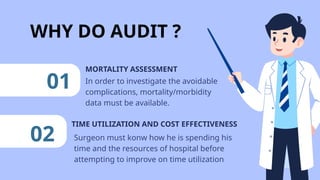
WHY DO AUDIT?
TIME UTILIZATION AND COST EFFECTIVENESS
01 In order to investigate the avoidable
complications, mortality/morbidity
data must be available.
MORTALITY ASSESSMENT
02 Surgeon must konw how he is spending his
time and the resources of hospital before
attempting to improve on time utilization
6.
WHY DO AUDIT?
QUALITY OF SERVICES
03 Monitoring the performance of the
surgeons is an essential outcome of
audit.
MONITORING PERFORMANCE
04 Assessment of patient’s stay in the hospital
might bring to light the misuse or inefficient
use of services
7.
WHY DO AUDIT?
05
ASSESSMENT OF NEVER TECHNIQUES
04 Whether addition of newer surgical techniques
has improved health care can be determined.
KNOWLEDGE OF PATIENTS SATISFACTION
The patient’s view of health care
delivery can be assessed.
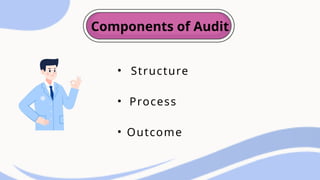
Structure- What isin Place
The people,their training,their knowledge,
the way they are led,the equipment,
their organization,the way they are paid.
10.
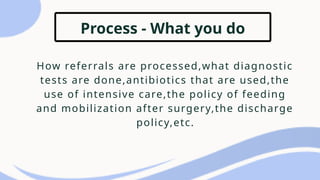
Process - Whatyou do
How referrals are processed,what diagnostic
tests are done,antibiotics that are used,the
use of intensive care,the policy of feeding
and mobilization after surgery,the discharge
policy,etc.
11.
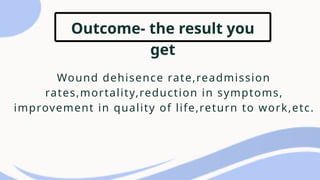
Outcome- the resultyou
get
Wound dehisence rate,readmission
rates,mortality,reduction in symptoms,
improvement in quality of life,return to work,etc.
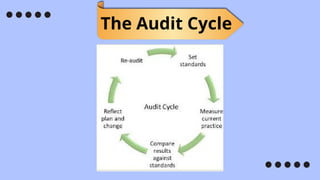
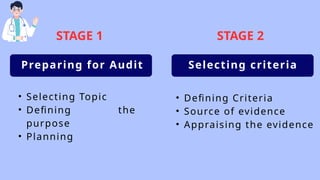
STAGE 1 STAGE2
Preparing for Audit Selecting criteria
• Selecting Topic
• Defining the
purpose
• Planning
• Defining Criteria
• Source of evidence
• Appraising the evidence
14.
STAGE 3 STAGE4
Measuring Level Of
Performance
Making Improvements
• Planning data collection
• Methods of data
collection
• Handling data
• Identifying barriers to
change
• Implementing changes
• External relationship
What is Research?
A systematic investigation undertaken to
discover facts or relationships and reach
conclusions using scientifically sound
methods.
18.
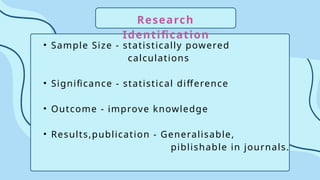
Research
Identification
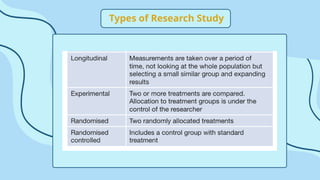
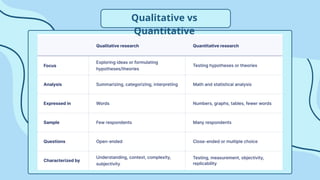
• Purpose -to provide new knowledge in order
to set or change standards
• Methods- randomised trials
• Data Analysis - Extensive statistical analysis
• Ethical and Trust approval - always required








![ppt on SURGICAL AUDIT [Autosaved].pptx](https://cdn.slidesharecdn.com/ss_thumbnails/surgicalauditautosaved-241217181929-e3ed86a9-thumbnail.jpg?width=640&height=640&fit=bounds)


