WELCOME
Presented By
Dr. Mansurul Islam
Asst. Reg. SU-II
Department of Surgery, ShSMCH
Surgical Audit
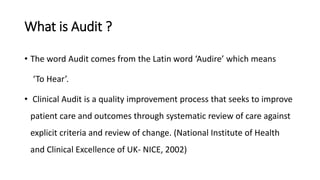
What is Audit ?
• The word Audit comes from the Latin word ‘Audire’ which means
‘To Hear’.
• Clinical Audit is a quality improvement process that seeks to improve
patient care and outcomes through systematic review of care against
explicit criteria and review of change. (National Institute of Health
and Clinical Excellence of UK- NICE, 2002)
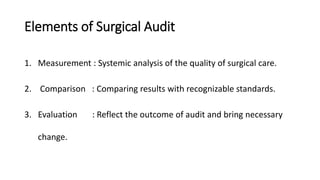
Elements of Surgical Audit
1. Measurement : Systemic analysis of the quality of surgical care.
2. Comparison : Comparing results with recognizable standards.
3. Evaluation : Reflect the outcome of audit and bring necessary
change.
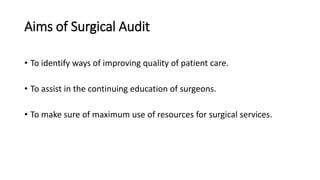
Aims of Surgical Audit
• To identify ways of improving quality of patient care.
• To assist in the continuing education of surgeons.
• To make sure of maximum use of resources for surgical services.
Advantages of Surgical Audit
• Identifies bad practice.
• Reduces unnecessary investigations and medications.
• Decrease length of admission.
• Allows continues refinement of treatment modalities.
• Allows objective assessment of quality of care.
• Improves resource allocation.
• Improves education and training.
• Legal safeguard.
Surgical audit

Surgical audit

  • 1.
  • 2.
    Presented By Dr. MansurulIslam Asst. Reg. SU-II Department of Surgery, ShSMCH Surgical Audit
  • 3.
    What is Audit? • The word Audit comes from the Latin word ‘Audire’ which means ‘To Hear’. • Clinical Audit is a quality improvement process that seeks to improve patient care and outcomes through systematic review of care against explicit criteria and review of change. (National Institute of Health and Clinical Excellence of UK- NICE, 2002)
  • 4.
    Elements of SurgicalAudit 1. Measurement : Systemic analysis of the quality of surgical care. 2. Comparison : Comparing results with recognizable standards. 3. Evaluation : Reflect the outcome of audit and bring necessary change.
  • 6.
    Aims of SurgicalAudit • To identify ways of improving quality of patient care. • To assist in the continuing education of surgeons. • To make sure of maximum use of resources for surgical services.
  • 7.
    Advantages of SurgicalAudit • Identifies bad practice. • Reduces unnecessary investigations and medications. • Decrease length of admission. • Allows continues refinement of treatment modalities. • Allows objective assessment of quality of care. • Improves resource allocation. • Improves education and training. • Legal safeguard.