Supply Chain Management:
IT in the Supply chain

     Rajendran Ananda Krishnan


                 https://www.facebook.com/ialwaysthinkprettythings
Topics to be covered
 IT in the Supply chain
 IT Framework
 Customer Relationship Management
 Internal Supply Chain Management
 Supplier Relationship Management
 Transaction Management
 Future of IT


                    https://www.facebook.com/ialwaysthink
                    prettythings
Role of IT in SC
 IT   consists of tools used for the purpose of :
 ◦ 1. Gathering of Information
 ◦ 2. Analysis of Information
 ◦ 3. Execute upon information to increase the
   performance of SC

  IT consists of Hard ware, Soft ware and people
  throughout a SC, that gather, analyze and
  execute upon Information.
  Eyes, ears, sometimes- brain for decision
  making
                                https://www.facebook.com/ialwaysthink
                                prettythings
Characteristics of Information
  Information must have the following characteristics,
   while making decisions in SC
1) Must be accurate – Without information that gives a
   true picture of the state of the supply chain, it is very
   difficult to make good decisions.
2) Accessible in a timely manner – To make good
    decisions, a manager needs to have up-to-date
    information that is easily accessible.
3) Must be of right kind – Companies must think about
    what information should be recorded so that valuable
    resources are not wasted collecting meaningless
    data while important data goes unrecorded.
Decisions are about each of the supply chain drivers::
    1) Facility      2) Inventory         3)Transportation
    4) Sourcing      5) Pricing
                                      https://www.facebook.com/ialwaysthink
                                      prettythings
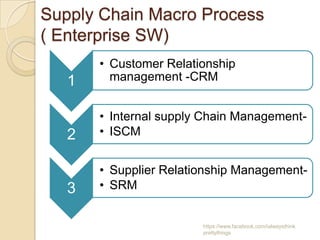
Supply Chain Macro Process
( Enterprise SW)
       • Customer Relationship
   1     management -CRM


       • Internal supply Chain Management-
   2   • ISCM


       • Supplier Relationship Management-
   3   • SRM


                        https://www.facebook.com/ialwaysthink
                        prettythings
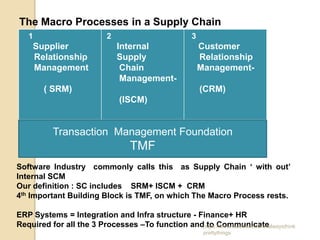
The Macro Processes in a Supply Chain
   1                       2                          3
     Supplier                  Internal                   Customer
     Relationship              Supply                     Relationship
     Management                 Chain                     Management-
                                Management-
        ( SRM)                                            (CRM)
                               (ISCM)


           Transaction Management Foundation
                                  TMF
Software Industry commonly calls this as Supply Chain ‘ with out’
Internal SCM
Our definition : SC includes SRM+ ISCM + CRM
4th Important Building Block is TMF, on which The Macro Process rests.

ERP Systems = Integration and Infra structure - Finance+ HR
Required for all the 3 Processes –To function andhttps://www.facebook.com/ialwaysthink
                                                  to Communicate
                                                           prettythings
The Supply Chain Macro Processes
 Customer relationship management –
  Processes that focus on downstream
  interactions between the enterprise and its
  customers.
 Internal supply chain management-
  Processes that focus on internal
  operations within the enterprise.
 Supplier relationship management –
  Processes that focus on upstream
  interactions between the enterprise and its
  suppliers.               https://www.facebook.com/ialwaysthink
                           prettythings
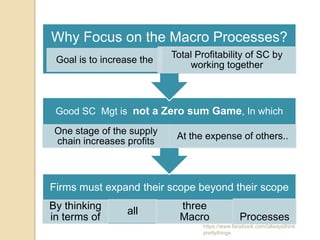
Why Focus on the Macro Processes?
                           Total Profitability of SC by
 Goal is to increase the
                               working together


 Good SC Mgt is not a Zero sum Game, In which

 One stage of the supply
                            At the expense of others..
 chain increases profits


Firms must expand their scope beyond their scope
By thinking      all         three
in terms of                  Macro               Processes
                                   https://www.facebook.com/ialwaysthink
                                   prettythings
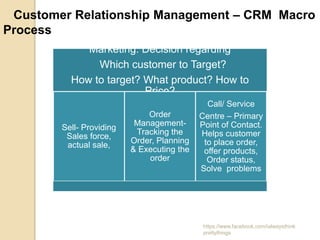
Customer Relationship Management – CRM Macro
Process
             Marketing: Decision regarding
               Which customer to Target?
          How to target? What product? How to
                         Price?
                                              Call/ Service
                              Order         Centre – Primary
                           Management-      Point of Contact.
        Sell- Providing
                           Tracking the     Helps customer
         Sales force,
                          Order, Planning    to place order,
         actual sale,
                          & Executing the    offer products,
                              order           Order status,
                                            Solve problems


                                             https://www.facebook.com/ialwaysthink
                                             prettythings
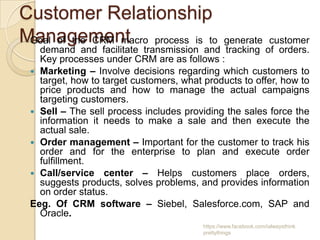
Customer Relationship
Management process is to
 Goal of the CRM macro                       generate customer
   demand and facilitate transmission and tracking of orders.
   Key processes under CRM are as follows :
  Marketing – Involve decisions regarding which customers to
   target, how to target customers, what products to offer, how to
   price products and how to manage the actual campaigns
   targeting customers.
  Sell – The sell process includes providing the sales force the
   information it needs to make a sale and then execute the
   actual sale.
  Order management – Important for the customer to track his
   order and for the enterprise to plan and execute order
   fulfillment.
  Call/service center – Helps customers place orders,
   suggests products, solves problems, and provides information
   on order status.
 Eeg. Of CRM software – Siebel, Salesforce.com, SAP and
   Oracle.
                                         https://www.facebook.com/ialwaysthink
                                         prettythings
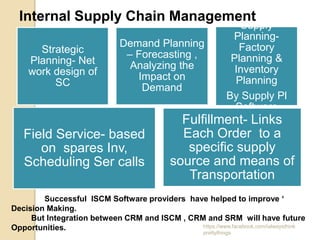
Internal Supply Chain Management
                                                                   Supply
                                                                 Planning-
                              Demand Planning                      Factory
      Strategic                – Forecasting ,
    Planning- Net                                                Planning &
                                Analyzing the                     Inventory
    work design of               Impact on
         SC                                                       Planning
                                  Demand
                                                                By Supply Pl
                                                                  Software
                                               Fulfillment- Links
   Field Service- based                        Each Order to a
      on spares Inv,                            specific supply
   Scheduling Ser calls                      source and means of
                                                Transportation
        Successful ISCM Software providers have helped to improve ‘
Decision Making.
     But Integration between CRM and ISCM , CRM and SRM will have future
Opportunities.                                 https://www.facebook.com/ialwaysthink
                                                      prettythings
Internal Supply Chain
Management
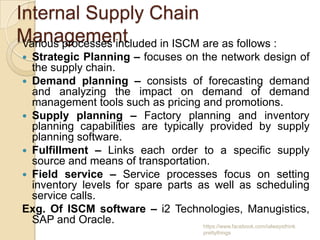
 Various processes included in ISCM are as follows :
  Strategic Planning – focuses on the network design of
   the supply chain.
  Demand planning – consists of forecasting demand
   and analyzing the impact on demand of demand
   management tools such as pricing and promotions.
  Supply planning – Factory planning and inventory
   planning capabilities are typically provided by supply
   planning software.
  Fulfillment – Links each order to a specific supply
   source and means of transportation.
  Field service – Service processes focus on setting
   inventory levels for spare parts as well as scheduling
   service calls.
 Exg. Of ISCM software – i2 Technologies, Manugistics,
   SAP and Oracle.                    https://www.facebook.com/ialwaysthink
                                               prettythings
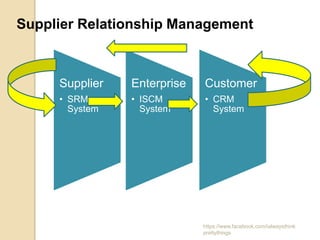
Supplier Relationship Management


     Supplier   Enterprise   Customer
     • SRM      • ISCM       • CRM
       System     System       System


                             https://www.facebook.com/ialwaysthink
                             prettythings
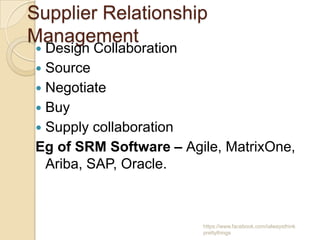
Supplier Relationship
Management
 Design Collaboration
 Source
 Negotiate
 Buy
 Supply collaboration
Eg of SRM Software – Agile, MatrixOne,
  Ariba, SAP, Oracle.


                        https://www.facebook.com/ialwaysthink
                        prettythings
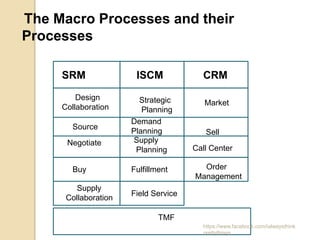
The Macro Processes and their
Processes

     SRM               ISCM             CRM

         Design         Strategic        Market
     Collaboration       Planning
                      Demand
       Source                             Sell
                      Planning           Sell
      Negotiate       Supply
                       Planning       Call Center

       Buy            Fulfillment       Order
                                      Management
         Supply
                      Field Service
      Collaboration

                              TMF
                                        https://www.facebook.com/ialwaysthink
                                        prettythings
Transaction Management Foundation
(TMF)
   During early 1990s, ERP systems were
   popular. SAP continued as the market leader,
   but other powerful ERP players included
   Oracle, Peoplesoft, JD Edwards and Baan.
  Little focus was on 3 Macro processes, and
   soft ware application on ‘improved decision
   making’
  Automation       and     Building     Transaction
   Management were given importance.
  Automation of simple transaction and
    Integration of store and view of data process
   excelled in ‘division and enterprise level’.
                                 https://www.facebook.com/ialwaysthink
                                 prettythings
Now and Future
 During 1990s, ERP companies became
  largest enterprises due to huge demand –
  they included SAP, ORACLE, PEOPLE
  SOFT, JD EDWARS and BAAN.
 Real value of ‘Transaction Management
  Foundation’(TMF) was realized when
  decision making with in Supply Chain was
  improved.
 Firms focused on decision making on these
  3 Macro Processes- Realignment of ERP
  into CRM, ISCM and CRM. This is the trend
  NOW and in FUTURE.       https://www.facebook.com/ialwaysthink
                           prettythings
FUTURE OF IT
Two potential paths, for companies to enter
  the market:
 1. Through Superior Functionality –
  specific for a particular Industry- with ease
  of use.
 2. Through Integrated Product linking 3
  Macro Processes
 Difficult for start-up companies, Large
  companies with tremendous resources
  can take this path, obviously Microsoft.
                            https://www.facebook.com/ialwaysthink
                            prettythings
RFID Technology
 Radio-frequency identification (RFID) is the use of a wireless
  non-contact system that uses radio-frequency electromagnetic
  fields to transfer data from a tag attached to an object, for the
  purposes of automatic identification and tracking. The tag
  contains electronically stored information which can be read
  from up to several meters (yards) away. Unlike a bar code, the
  tag does not need to be within line of sight of the reader and
  may be embedded in the tracked object.
 RFID tags are used in many industries. An RFID tag attached to
  an automobile during production can be used to track its
  progress through the assembly line. Pharmaceuticals can be
  tracked through warehouses. Livestock and pets may have tags
  injected, allowing positive identification of the animal. RFID
  identity cards can give employees access to locked areas of a
  building, and RF transponders mounted in automobiles can be
  used to bill motorists for access to toll roads or parking.


                                          https://www.facebook.com/ialwaysthink
                                          prettythings
https://www.facebook.com/ialwaysthink
prettythings

Supply Chain Management and IT

  • 1.
    Supply Chain Management: ITin the Supply chain Rajendran Ananda Krishnan https://www.facebook.com/ialwaysthinkprettythings
  • 2.
    Topics to becovered  IT in the Supply chain  IT Framework  Customer Relationship Management  Internal Supply Chain Management  Supplier Relationship Management  Transaction Management  Future of IT https://www.facebook.com/ialwaysthink prettythings
  • 3.
    Role of ITin SC  IT consists of tools used for the purpose of : ◦ 1. Gathering of Information ◦ 2. Analysis of Information ◦ 3. Execute upon information to increase the performance of SC  IT consists of Hard ware, Soft ware and people throughout a SC, that gather, analyze and execute upon Information.  Eyes, ears, sometimes- brain for decision making https://www.facebook.com/ialwaysthink prettythings
  • 4.
    Characteristics of Information  Information must have the following characteristics, while making decisions in SC 1) Must be accurate – Without information that gives a true picture of the state of the supply chain, it is very difficult to make good decisions. 2) Accessible in a timely manner – To make good decisions, a manager needs to have up-to-date information that is easily accessible. 3) Must be of right kind – Companies must think about what information should be recorded so that valuable resources are not wasted collecting meaningless data while important data goes unrecorded. Decisions are about each of the supply chain drivers:: 1) Facility 2) Inventory 3)Transportation 4) Sourcing 5) Pricing https://www.facebook.com/ialwaysthink prettythings
  • 5.
    Supply Chain MacroProcess ( Enterprise SW) • Customer Relationship 1 management -CRM • Internal supply Chain Management- 2 • ISCM • Supplier Relationship Management- 3 • SRM https://www.facebook.com/ialwaysthink prettythings
  • 6.
    The Macro Processesin a Supply Chain 1 2 3 Supplier Internal Customer Relationship Supply Relationship Management Chain Management- Management- ( SRM) (CRM) (ISCM) Transaction Management Foundation TMF Software Industry commonly calls this as Supply Chain ‘ with out’ Internal SCM Our definition : SC includes SRM+ ISCM + CRM 4th Important Building Block is TMF, on which The Macro Process rests. ERP Systems = Integration and Infra structure - Finance+ HR Required for all the 3 Processes –To function andhttps://www.facebook.com/ialwaysthink to Communicate prettythings
  • 7.
    The Supply ChainMacro Processes  Customer relationship management – Processes that focus on downstream interactions between the enterprise and its customers.  Internal supply chain management- Processes that focus on internal operations within the enterprise.  Supplier relationship management – Processes that focus on upstream interactions between the enterprise and its suppliers. https://www.facebook.com/ialwaysthink prettythings
  • 8.
    Why Focus onthe Macro Processes? Total Profitability of SC by Goal is to increase the working together Good SC Mgt is not a Zero sum Game, In which One stage of the supply At the expense of others.. chain increases profits Firms must expand their scope beyond their scope By thinking all three in terms of Macro Processes https://www.facebook.com/ialwaysthink prettythings
  • 9.
    Customer Relationship Management– CRM Macro Process Marketing: Decision regarding Which customer to Target? How to target? What product? How to Price? Call/ Service Order Centre – Primary Management- Point of Contact. Sell- Providing Tracking the Helps customer Sales force, Order, Planning to place order, actual sale, & Executing the offer products, order Order status, Solve problems https://www.facebook.com/ialwaysthink prettythings
  • 10.
    Customer Relationship Management processis to Goal of the CRM macro generate customer demand and facilitate transmission and tracking of orders. Key processes under CRM are as follows :  Marketing – Involve decisions regarding which customers to target, how to target customers, what products to offer, how to price products and how to manage the actual campaigns targeting customers.  Sell – The sell process includes providing the sales force the information it needs to make a sale and then execute the actual sale.  Order management – Important for the customer to track his order and for the enterprise to plan and execute order fulfillment.  Call/service center – Helps customers place orders, suggests products, solves problems, and provides information on order status. Eeg. Of CRM software – Siebel, Salesforce.com, SAP and Oracle. https://www.facebook.com/ialwaysthink prettythings
  • 11.
    Internal Supply ChainManagement Supply Planning- Demand Planning Factory Strategic – Forecasting , Planning- Net Planning & Analyzing the Inventory work design of Impact on SC Planning Demand By Supply Pl Software Fulfillment- Links Field Service- based Each Order to a on spares Inv, specific supply Scheduling Ser calls source and means of Transportation Successful ISCM Software providers have helped to improve ‘ Decision Making. But Integration between CRM and ISCM , CRM and SRM will have future Opportunities. https://www.facebook.com/ialwaysthink prettythings
  • 12.
    Internal Supply Chain Management Various processes included in ISCM are as follows :  Strategic Planning – focuses on the network design of the supply chain.  Demand planning – consists of forecasting demand and analyzing the impact on demand of demand management tools such as pricing and promotions.  Supply planning – Factory planning and inventory planning capabilities are typically provided by supply planning software.  Fulfillment – Links each order to a specific supply source and means of transportation.  Field service – Service processes focus on setting inventory levels for spare parts as well as scheduling service calls. Exg. Of ISCM software – i2 Technologies, Manugistics, SAP and Oracle. https://www.facebook.com/ialwaysthink prettythings
  • 13.
    Supplier Relationship Management Supplier Enterprise Customer • SRM • ISCM • CRM System System System https://www.facebook.com/ialwaysthink prettythings
  • 14.
    Supplier Relationship Management  DesignCollaboration  Source  Negotiate  Buy  Supply collaboration Eg of SRM Software – Agile, MatrixOne, Ariba, SAP, Oracle. https://www.facebook.com/ialwaysthink prettythings
  • 15.
    The Macro Processesand their Processes SRM ISCM CRM Design Strategic Market Collaboration Planning Demand Source Sell Planning Sell Negotiate Supply Planning Call Center Buy Fulfillment Order Management Supply Field Service Collaboration TMF https://www.facebook.com/ialwaysthink prettythings
  • 16.
    Transaction Management Foundation (TMF)  During early 1990s, ERP systems were popular. SAP continued as the market leader, but other powerful ERP players included Oracle, Peoplesoft, JD Edwards and Baan.  Little focus was on 3 Macro processes, and soft ware application on ‘improved decision making’  Automation and Building Transaction Management were given importance.  Automation of simple transaction and Integration of store and view of data process excelled in ‘division and enterprise level’. https://www.facebook.com/ialwaysthink prettythings
  • 17.
    Now and Future During 1990s, ERP companies became largest enterprises due to huge demand – they included SAP, ORACLE, PEOPLE SOFT, JD EDWARS and BAAN.  Real value of ‘Transaction Management Foundation’(TMF) was realized when decision making with in Supply Chain was improved.  Firms focused on decision making on these 3 Macro Processes- Realignment of ERP into CRM, ISCM and CRM. This is the trend NOW and in FUTURE. https://www.facebook.com/ialwaysthink prettythings
  • 18.
    FUTURE OF IT Twopotential paths, for companies to enter the market:  1. Through Superior Functionality – specific for a particular Industry- with ease of use.  2. Through Integrated Product linking 3 Macro Processes  Difficult for start-up companies, Large companies with tremendous resources can take this path, obviously Microsoft. https://www.facebook.com/ialwaysthink prettythings
  • 19.
    RFID Technology  Radio-frequencyidentification (RFID) is the use of a wireless non-contact system that uses radio-frequency electromagnetic fields to transfer data from a tag attached to an object, for the purposes of automatic identification and tracking. The tag contains electronically stored information which can be read from up to several meters (yards) away. Unlike a bar code, the tag does not need to be within line of sight of the reader and may be embedded in the tracked object.  RFID tags are used in many industries. An RFID tag attached to an automobile during production can be used to track its progress through the assembly line. Pharmaceuticals can be tracked through warehouses. Livestock and pets may have tags injected, allowing positive identification of the animal. RFID identity cards can give employees access to locked areas of a building, and RF transponders mounted in automobiles can be used to bill motorists for access to toll roads or parking. https://www.facebook.com/ialwaysthink prettythings
  • 20.

Editor's Notes