Manu Singh – 25
Emergence of Air Freight
 Air freight was once reserved for emergencies and critical







products.
Now air cargo is a way to reduce inventory costs and
improve customer service.
Today’s modern aircraft can carry thousands of pounds of
cargo just about anywhere in the world within 24 hours.
Typical air freight commodities include- high value
products, time sensitive shipments, medical supplies and
critical parts.
Inventory carrying costs, which include insurance, risk of
product obsolescence, finance costs, etc can account for as
much as 25% of the value of the goods.
INTRODUCTION
 Air transport is a vital component of many

international logistics networks, essential to managing and
controlling the flow of goods, energy, information and
other resources like products, services, and people, from
the source of production to the marketplace.
 Using aircrafts and ware housing services for the transport
of goods quickly from point of origin to point of
consumption for satisfying the requirements of customers.
 It involves the integration of
information, transportation, inventory, warehousing, mate
rial handling, and packaging.
 The operating responsibility of logistics is the geographical
repositioning of raw materials, work in process, and
finished inventories where required at the lowest cost
possible.
 Larger cargo airlines tend to use new or recently built aircraft to carry

their freight, but many use older aircraft, like the Boeing 707, Boeing
727, Douglas DC-8, DC-10, MD-11, Boeing 747, and the Ilyushin Il-76.
 Some of the world largest international scheduled freight tonnekilometers flown are
Korean Air 8.164 million
Lufthansa Cargo 8.028 million
Singapore Airlines Cargo 7.143 million
Cathay Pacific 5.876 million
China Airlines 5.642 million
FedEx Express 5.595 million
Eva Airways 5.477 million
Air France 5.384 million
British Airways 4.771 million
Cargolux 4.670 million
ADVANTAGES
 Faster delivery of information
 Tighter control over cargo– less chances of

theft, pilferages, and damage.
 Perishable goods can be transported to longer
distances.
 Air-freight insurance premium charges are lesser.
DISADVANTAGES
 It is relatively more expensive mode of transport.
 It is not suitable for transporting heavy and bulky






goods.
It is affected by adverse weather conditions.
It is not suitable for short distance travel.
In case of accidents, it results in heavy losses of goods,
property and life.
Airlines do not accept goods mentioned in IATA’s
Dangerous Goods Regulation(DGR) like explosives,
certain chemicals, etc
IATA
 The International Air Transport Association (IATA) is

an international industry trade group of airlines headquartered
in Montreal, Quebec, Canada
 IATA is present in 150 countries and represents some 240
airlines comprising 84% of scheduled international air traffic.
 IATA's mission is to represent, lead, and serve the airline
industry To promote safe, regular and economical air transport for the

benefit of the peoples of the world, to foster air commerce, and to
study the problems connected therewith;
 To provide means for collaboration among the air transport
enterprises engaged directly or indirectly in international air
transport service;
 To cooperate with the newly created International Civil Aviation
Organization (ICAO - the specialised United Nations agency for
civil aviation) and other international organisations
Unit Load Devices
 With the increasing number of wide-bodied aircraft now in

operation, Unit Load Devices (ULDs) have become a key
element of high efficiency in air transport. Having the right
equipment to do the job is a concern in any industry and is no
different when it comes to ULDs in the airline industry.
 IATA's ULD Panel develops
specifications, recommendations, and guidelines on the
manufacture, registration, handling, maintenance and control of
ULDs. It includes:
 Specifications and other technical material relating to the

construction and maintenance of Unit Load Devices.
 Guidelines and Recommended Practices relating to handling of
ULDs and associated equipment.
 Specifications and other technical material relating to the
fabrication, use and maintenance of cargo restraint equipment.
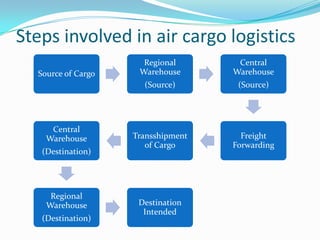
Steps involved in air cargo logistics

Central
Warehouse
(Destination)

Regional
Warehouse
(Destination)

Central
Warehouse

(Source)

Source of Cargo

Regional
Warehouse

(Source)

Transshipment
of Cargo

Freight
Forwarding

Destination
Intended
Players Involved

 Shipper (or Consignor) – the one who requests service in transporting the

cargo (source node of the supply chain)
 Freight forwarder (or forwarder) –the forwarder typically arranges for the

transportation of cargo from the shipper’s warehouse, delivers (or has a
contractor deliver) it to the departing airport, prepares the necessary
paperwork, picks up at the arriving airport, and delivers (or contracts for the
delivery) to the consignee.
 Carrier – The firm who provides the air delivery of cargo from the origin

airport to the destination airport. There are primarily two classes of carriers:
cargo carriers that primarily carry cargo and freight (e.g. FedEx, DHL), and
combination carriers that carry both passengers and cargo that is stored in
the bellies of aircraft (e.g. Korean Air, Lufthansa, Delta).
 Ground Handler – An agent at an airport that physically handles the freight;

this usually refers to whenever freight is
loaded, unloaded, transferred, stored, retrieved, broken down, or
consolidated.
 Consignee – The receiving party that the goods are sent to (sink node of the
Import Process
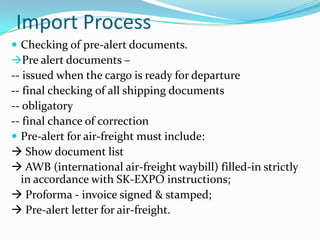
 Checking of pre-alert documents.
Pre alert documents –

-- issued when the cargo is ready for departure
-- final checking of all shipping documents
-- obligatory
-- final chance of correction
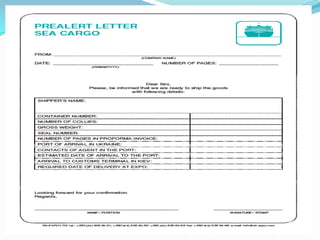
 Pre-alert for air-freight must include:
 Show document list
 AWB (international air-freight waybill) filled-in strictly
in accordance with SK-EXPO instructions;
 Proforma - invoice signed & stamped;
 Pre-alert letter for air-freight.
• Documentation Department
• ICE GATE – under bill of entry (electronic declaration)

regulations 2011 Indian customs electronic data interchange gateway, an ecommerce portal of the central board of excise & customs.
 A unique number is assigned to the bill of entry.
 Bill of entry – declaration by importer/exporter of ::
Exact nature
Precise quality
Value of goods examines by custom/authority
• CHA- advance noting of bill of entry
• Shipment arrived
• Status updated on web/call by airline
 CHA – customer house agent , licensed toact as an agent for
transactions related with entry/departure or import/export of
goods and conveyance at CFS.
 IGM generated by custom in EDI
 IGM – import general manifest, to be filled correctly by the
carrier of goods i.e. airlines.
 Personal inspection by airline handling staff
 Cargo forwarding towards import W/H.
 Finalized IGM with updated flight number and R number.
R number – Symbolizes the cargo location in W/H and
necessary for custom clearance.
• CHA – passing of documents
- payment of applicable duty
- Physical inspection with original TR6 challan
- payment of AAI charges.
TR6 challan – Document for the payment of service tax.
 CHA – prepare N form and applicable octroi payment at

the gate
Octroi is local tax collected by state
government/munciple.
Application for exemption in respect of articles imported
for immediate export (within 7 days or 168 hours after
issuing N form)
 EDI – electronic data interchange between computer
networks
 Export consideration –
 Documents received from shipper/CHA
 Best suitable/preffered carrier option is opted.
 MAWB is allotted & forwarded to carrier.
MAWB – Mater air way bill
It is issued by a carrier
Non negotiable
Covers transport of cargo from airport to airport
It is an 11 digit number
First 3 digits are airline prefix, next 7 are running numbers

with one number for each consignment
Last digit is check digit
The seven digits running numbers are divided by 7. The
remainder becomes the check digit.
Example: Serial Number 8114074 divided by 7 is 1159153,
remainder 3. Therefore the serial number plus check digit
is Air Waybills are issued in sets of different colors.
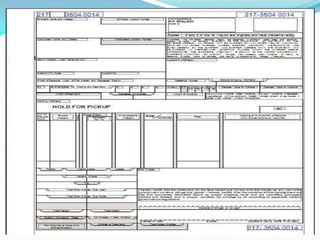
-- The first three copies are classified as originals.
-- The first original, blue in color, is the shipper’s copy.
-- The second, colored blue is retained by the issuing carrier.
-- The third, colored orange, is the consignee’s copy.
-- A yellow copy acts as the delivery receipt or proof of delivery.
The other copies are all white.
 Carting orders are collected from carriers office located at air
cargo complex.
 Carting orders – final declaration given by the custom
department to either load or export the cargo after import
clearance.
 At last EGM is allotted with the physical departure of
shipment.
EGM- export general manifest
- statutory declaration for every shipment leaving indian
air/water territory with the intentions of carrying cargo
is bound to deliver EGM.
Process Flow : An Overview
 While shippers may deliver their cargo directly to the airport, the








majority of cargo is handled through a freight forwarder.
Shipper sends cargo details to forwarder and ask for the
quotation and according to that shipper sends the confirmation
of airline and forwarder books the airline.
Generally the forwarder first reserves space, then confirms and
picks up the freight only after receiving confirmation from the
carrier.
In most instances, the forwarder will pick the freight up from the
shipper or the shipper’s warehouse.
Simultaneously, all the documents received from the shipper will
send to CHA for custom clearance.
Along with the allotted MAWB no. the booking will be
forwarded to the shipper.
 The cargo is usually temporarily stored in a warehouse facility








at the airport as it waits to be loaded.
On arrival of the shipment at cargo complex, On the basis of
nature of cargo the CHA arranges for examination of the
shipment. After examination and report is generated the
assessment will be done by the customs.
After assessment is completed and Let Export Order given by
the customs; the shipment along with the destination set/
exporter’s copy of the shipping bill will be handed over to the
selected carriers counter/ person present at cargo complex.
On receipt of the cargo and documents the airline handling
staff arranges to move the cleared shipment to respective
airlines shed / allotted area for cooling of the shipment.
As per planned schedule the shipment will be moved from
shed to ramp for loading the shipment in air craft.
 The cargo is then retrieved prior to arrival and loaded

via a unit loading device (or ULD) and secured.
 On physical departure of shipment the customs will
allot EGM to particular flight which will be used in
generation of E.P. copies.
Prior to Arrival of the shipment
 After checking the pre alert documents received from

overseas forward the documents to documentation
department.
 On the basis of pre alert documents and CAN the CHA
can arrange for advance noting of the bill of entry.
On arrival of the shipment
 Airline will update the status of arrival of the shipment on web or







over a phone. On the basis of manifestation the IGM will be
generated by Customs in EDI.
On physical arrival of the flight airline’s handling staff will
inspect the flight in person.
After the flight check in is over the cargo will be forwarded to the
Import W/H (called as forwarding).
In mean time IGM will be finalised along with updated flight no.
and the ‘R’ No will be allotted.
In mean time the CHA arranges to pass the documents along
with the assessment.
After assessment is over CHA make the payment of applicable
duty as the case may be.
Along with the original copy TR6 challan the CHA conducts the
physical examination of the shipment which has arrived in the
Import W/H.
 After examination is over and report is generated the

documents are forwarded for Out of Charge depending upon
the nature/ value of the shipment.
 CHA arrange for payment of applicable Stamp Duty and AAI
(W/H) charges against the subject shipment. On receipt of out
of charge and payment of applicable charges the shipment will
be available for delivery.
 CHA prepares ‘N” form or make applicable Octroi payment at
the gate of Air cargo complex and the shipment will be moved
from W/H.
 From the airport, a forwarder typically will deliver the cargo in

the reversed order from where the forwarder delivered the
cargo to the airport.
 The air cargo process is driven by the freight forwarder, the

carrier, and the process flow.
Transshipment- Process
I) Transshipment of cargo from a
gateway airport to an inland airport
Steps involved:
 Import the cargo
 File application and avail for transshipment permit
 Transport to transshipment warehouse of the domestic







carrier under the Customs preventive escort.
Acknowledgement of goods by the customs officer
Execution of bond with the domestic carrier
Preparation of EGMs by domestic carrier on receipt of
goods
Copies of EGMs sent to customs at the destination airport
Checking at the destination airport with reference to EGM
Final clearance
ii) Transshipment of cargo received at an
airport in India from an airport abroad to an
airport abroad.
Steps involved:
 Receipt of cargo to be transshipped at an airport
 Storage of transshipment cargo under Customs

supervision by the concerned airline
 Cargo transfer manifest is required to be presented in
triplicate to the Customs.
 Loading of cargo in the aircraft is undertaken under
the Customs supervision
iii) Movement of export cargo from an inland airport to
an airport abroad through an Intermediate airport in
India
 Filing shipping bills
 Assessment of goods at the domestic airport
 Safety Assurance by furnishing bonds at domestic airport
 The domestic carrier is to carry cargo only under E.G.M. duly certified by the









Custom.
At the gateway airport, transportation of the cargo received to the
transshipment warehouse.
The domestic carrier presents the EGM copies to the officer in-charge of
warehouse.
Storage of goods in transshipment warehouse
Filing cargo transfer manifest to the Customs by the domestic carrier
Transportation of goods in closed trucks under Customs supervision to the
warehouse of foreign airlines
Reconciliation of records by officer in-charge on the basis of EGM submitted
Endorsement evidencing receipt of cargo and subsequent export on the
copies of EGM brought by domestic carrier from the originating airport.
Air Freight- Services and Pricing
 Domestic:
 Same Day
 Overnight
 Second Day
 Deferred (3-5 business days)
 Time Definite
 International Services:
 Consolidation Service
 Direct Service
 Door to Airport
 Door to Door
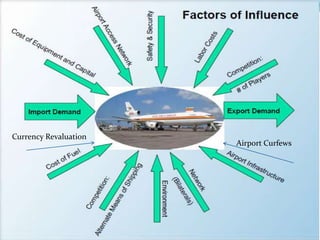
Currency Revaluation

Airport Curfews
THANK YOU

Global logistics

  • 1.
  • 2.
    Emergence of AirFreight  Air freight was once reserved for emergencies and critical     products. Now air cargo is a way to reduce inventory costs and improve customer service. Today’s modern aircraft can carry thousands of pounds of cargo just about anywhere in the world within 24 hours. Typical air freight commodities include- high value products, time sensitive shipments, medical supplies and critical parts. Inventory carrying costs, which include insurance, risk of product obsolescence, finance costs, etc can account for as much as 25% of the value of the goods.
  • 3.
    INTRODUCTION  Air transportis a vital component of many international logistics networks, essential to managing and controlling the flow of goods, energy, information and other resources like products, services, and people, from the source of production to the marketplace.  Using aircrafts and ware housing services for the transport of goods quickly from point of origin to point of consumption for satisfying the requirements of customers.  It involves the integration of information, transportation, inventory, warehousing, mate rial handling, and packaging.  The operating responsibility of logistics is the geographical repositioning of raw materials, work in process, and finished inventories where required at the lowest cost possible.
  • 4.
     Larger cargoairlines tend to use new or recently built aircraft to carry their freight, but many use older aircraft, like the Boeing 707, Boeing 727, Douglas DC-8, DC-10, MD-11, Boeing 747, and the Ilyushin Il-76.  Some of the world largest international scheduled freight tonnekilometers flown are Korean Air 8.164 million Lufthansa Cargo 8.028 million Singapore Airlines Cargo 7.143 million Cathay Pacific 5.876 million China Airlines 5.642 million FedEx Express 5.595 million Eva Airways 5.477 million Air France 5.384 million British Airways 4.771 million Cargolux 4.670 million
  • 5.
    ADVANTAGES  Faster deliveryof information  Tighter control over cargo– less chances of theft, pilferages, and damage.  Perishable goods can be transported to longer distances.  Air-freight insurance premium charges are lesser.
  • 6.
    DISADVANTAGES  It isrelatively more expensive mode of transport.  It is not suitable for transporting heavy and bulky     goods. It is affected by adverse weather conditions. It is not suitable for short distance travel. In case of accidents, it results in heavy losses of goods, property and life. Airlines do not accept goods mentioned in IATA’s Dangerous Goods Regulation(DGR) like explosives, certain chemicals, etc
  • 7.
    IATA  The InternationalAir Transport Association (IATA) is an international industry trade group of airlines headquartered in Montreal, Quebec, Canada  IATA is present in 150 countries and represents some 240 airlines comprising 84% of scheduled international air traffic.  IATA's mission is to represent, lead, and serve the airline industry To promote safe, regular and economical air transport for the benefit of the peoples of the world, to foster air commerce, and to study the problems connected therewith;  To provide means for collaboration among the air transport enterprises engaged directly or indirectly in international air transport service;  To cooperate with the newly created International Civil Aviation Organization (ICAO - the specialised United Nations agency for civil aviation) and other international organisations
  • 8.
    Unit Load Devices With the increasing number of wide-bodied aircraft now in operation, Unit Load Devices (ULDs) have become a key element of high efficiency in air transport. Having the right equipment to do the job is a concern in any industry and is no different when it comes to ULDs in the airline industry.  IATA's ULD Panel develops specifications, recommendations, and guidelines on the manufacture, registration, handling, maintenance and control of ULDs. It includes:  Specifications and other technical material relating to the construction and maintenance of Unit Load Devices.  Guidelines and Recommended Practices relating to handling of ULDs and associated equipment.  Specifications and other technical material relating to the fabrication, use and maintenance of cargo restraint equipment.
  • 9.
    Steps involved inair cargo logistics Central Warehouse (Destination) Regional Warehouse (Destination) Central Warehouse (Source) Source of Cargo Regional Warehouse (Source) Transshipment of Cargo Freight Forwarding Destination Intended
  • 10.
    Players Involved  Shipper(or Consignor) – the one who requests service in transporting the cargo (source node of the supply chain)  Freight forwarder (or forwarder) –the forwarder typically arranges for the transportation of cargo from the shipper’s warehouse, delivers (or has a contractor deliver) it to the departing airport, prepares the necessary paperwork, picks up at the arriving airport, and delivers (or contracts for the delivery) to the consignee.  Carrier – The firm who provides the air delivery of cargo from the origin airport to the destination airport. There are primarily two classes of carriers: cargo carriers that primarily carry cargo and freight (e.g. FedEx, DHL), and combination carriers that carry both passengers and cargo that is stored in the bellies of aircraft (e.g. Korean Air, Lufthansa, Delta).  Ground Handler – An agent at an airport that physically handles the freight; this usually refers to whenever freight is loaded, unloaded, transferred, stored, retrieved, broken down, or consolidated.  Consignee – The receiving party that the goods are sent to (sink node of the
  • 11.
    Import Process  Checkingof pre-alert documents. Pre alert documents – -- issued when the cargo is ready for departure -- final checking of all shipping documents -- obligatory -- final chance of correction  Pre-alert for air-freight must include:  Show document list  AWB (international air-freight waybill) filled-in strictly in accordance with SK-EXPO instructions;  Proforma - invoice signed & stamped;  Pre-alert letter for air-freight.
  • 13.
    • Documentation Department •ICE GATE – under bill of entry (electronic declaration) regulations 2011 Indian customs electronic data interchange gateway, an ecommerce portal of the central board of excise & customs.  A unique number is assigned to the bill of entry.  Bill of entry – declaration by importer/exporter of :: Exact nature Precise quality Value of goods examines by custom/authority • CHA- advance noting of bill of entry • Shipment arrived • Status updated on web/call by airline
  • 14.
     CHA –customer house agent , licensed toact as an agent for transactions related with entry/departure or import/export of goods and conveyance at CFS.  IGM generated by custom in EDI  IGM – import general manifest, to be filled correctly by the carrier of goods i.e. airlines.  Personal inspection by airline handling staff  Cargo forwarding towards import W/H.  Finalized IGM with updated flight number and R number. R number – Symbolizes the cargo location in W/H and necessary for custom clearance. • CHA – passing of documents - payment of applicable duty - Physical inspection with original TR6 challan - payment of AAI charges.
  • 15.
    TR6 challan –Document for the payment of service tax.  CHA – prepare N form and applicable octroi payment at the gate Octroi is local tax collected by state government/munciple. Application for exemption in respect of articles imported for immediate export (within 7 days or 168 hours after issuing N form)  EDI – electronic data interchange between computer networks  Export consideration –  Documents received from shipper/CHA  Best suitable/preffered carrier option is opted.
  • 16.
     MAWB isallotted & forwarded to carrier. MAWB – Mater air way bill It is issued by a carrier Non negotiable Covers transport of cargo from airport to airport It is an 11 digit number First 3 digits are airline prefix, next 7 are running numbers with one number for each consignment Last digit is check digit The seven digits running numbers are divided by 7. The remainder becomes the check digit. Example: Serial Number 8114074 divided by 7 is 1159153, remainder 3. Therefore the serial number plus check digit is Air Waybills are issued in sets of different colors.
  • 18.
    -- The firstthree copies are classified as originals. -- The first original, blue in color, is the shipper’s copy. -- The second, colored blue is retained by the issuing carrier. -- The third, colored orange, is the consignee’s copy. -- A yellow copy acts as the delivery receipt or proof of delivery. The other copies are all white.  Carting orders are collected from carriers office located at air cargo complex.  Carting orders – final declaration given by the custom department to either load or export the cargo after import clearance.  At last EGM is allotted with the physical departure of shipment. EGM- export general manifest - statutory declaration for every shipment leaving indian air/water territory with the intentions of carrying cargo is bound to deliver EGM.
  • 19.
    Process Flow :An Overview  While shippers may deliver their cargo directly to the airport, the      majority of cargo is handled through a freight forwarder. Shipper sends cargo details to forwarder and ask for the quotation and according to that shipper sends the confirmation of airline and forwarder books the airline. Generally the forwarder first reserves space, then confirms and picks up the freight only after receiving confirmation from the carrier. In most instances, the forwarder will pick the freight up from the shipper or the shipper’s warehouse. Simultaneously, all the documents received from the shipper will send to CHA for custom clearance. Along with the allotted MAWB no. the booking will be forwarded to the shipper.
  • 20.
     The cargois usually temporarily stored in a warehouse facility     at the airport as it waits to be loaded. On arrival of the shipment at cargo complex, On the basis of nature of cargo the CHA arranges for examination of the shipment. After examination and report is generated the assessment will be done by the customs. After assessment is completed and Let Export Order given by the customs; the shipment along with the destination set/ exporter’s copy of the shipping bill will be handed over to the selected carriers counter/ person present at cargo complex. On receipt of the cargo and documents the airline handling staff arranges to move the cleared shipment to respective airlines shed / allotted area for cooling of the shipment. As per planned schedule the shipment will be moved from shed to ramp for loading the shipment in air craft.
  • 21.
     The cargois then retrieved prior to arrival and loaded via a unit loading device (or ULD) and secured.  On physical departure of shipment the customs will allot EGM to particular flight which will be used in generation of E.P. copies.
  • 22.
    Prior to Arrivalof the shipment  After checking the pre alert documents received from overseas forward the documents to documentation department.  On the basis of pre alert documents and CAN the CHA can arrange for advance noting of the bill of entry.
  • 23.
    On arrival ofthe shipment  Airline will update the status of arrival of the shipment on web or       over a phone. On the basis of manifestation the IGM will be generated by Customs in EDI. On physical arrival of the flight airline’s handling staff will inspect the flight in person. After the flight check in is over the cargo will be forwarded to the Import W/H (called as forwarding). In mean time IGM will be finalised along with updated flight no. and the ‘R’ No will be allotted. In mean time the CHA arranges to pass the documents along with the assessment. After assessment is over CHA make the payment of applicable duty as the case may be. Along with the original copy TR6 challan the CHA conducts the physical examination of the shipment which has arrived in the Import W/H.
  • 24.
     After examinationis over and report is generated the documents are forwarded for Out of Charge depending upon the nature/ value of the shipment.  CHA arrange for payment of applicable Stamp Duty and AAI (W/H) charges against the subject shipment. On receipt of out of charge and payment of applicable charges the shipment will be available for delivery.  CHA prepares ‘N” form or make applicable Octroi payment at the gate of Air cargo complex and the shipment will be moved from W/H.  From the airport, a forwarder typically will deliver the cargo in the reversed order from where the forwarder delivered the cargo to the airport.  The air cargo process is driven by the freight forwarder, the carrier, and the process flow.
  • 25.
  • 26.
    I) Transshipment ofcargo from a gateway airport to an inland airport Steps involved:  Import the cargo  File application and avail for transshipment permit  Transport to transshipment warehouse of the domestic       carrier under the Customs preventive escort. Acknowledgement of goods by the customs officer Execution of bond with the domestic carrier Preparation of EGMs by domestic carrier on receipt of goods Copies of EGMs sent to customs at the destination airport Checking at the destination airport with reference to EGM Final clearance
  • 27.
    ii) Transshipment ofcargo received at an airport in India from an airport abroad to an airport abroad. Steps involved:  Receipt of cargo to be transshipped at an airport  Storage of transshipment cargo under Customs supervision by the concerned airline  Cargo transfer manifest is required to be presented in triplicate to the Customs.  Loading of cargo in the aircraft is undertaken under the Customs supervision
  • 28.
    iii) Movement ofexport cargo from an inland airport to an airport abroad through an Intermediate airport in India  Filing shipping bills  Assessment of goods at the domestic airport  Safety Assurance by furnishing bonds at domestic airport  The domestic carrier is to carry cargo only under E.G.M. duly certified by the        Custom. At the gateway airport, transportation of the cargo received to the transshipment warehouse. The domestic carrier presents the EGM copies to the officer in-charge of warehouse. Storage of goods in transshipment warehouse Filing cargo transfer manifest to the Customs by the domestic carrier Transportation of goods in closed trucks under Customs supervision to the warehouse of foreign airlines Reconciliation of records by officer in-charge on the basis of EGM submitted Endorsement evidencing receipt of cargo and subsequent export on the copies of EGM brought by domestic carrier from the originating airport.
  • 29.
    Air Freight- Servicesand Pricing  Domestic:  Same Day  Overnight  Second Day  Deferred (3-5 business days)  Time Definite  International Services:  Consolidation Service  Direct Service  Door to Airport  Door to Door
  • 30.
  • 31.