SCM AND
CRM
A presentation on
CONTENTS
• SCM
• CRM
• ISCRM
• NEED AND IMPORTANCE OF CRM
• COMPONENTS OF CRM
• VARIATIONS
• TYPES
• BENEFITS
• SWOT
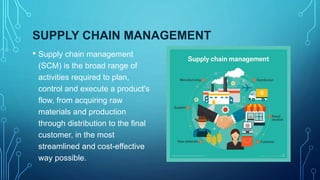
SUPPLY CHAIN MANAGEMENT
• Supply chain management
(SCM) is the broad range of
activities required to plan,
control and execute a product's
flow, from acquiring raw
materials and production
through distribution to the final
customer, in the most
streamlined and cost-effective
way possible.
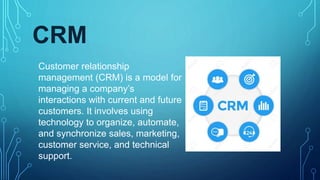
CRM
Customer relationship
management (CRM) is a model for
managing a company’s
interactions with current and future
customers. It involves using
technology to organize, automate,
and synchronize sales, marketing,
customer service, and technical
support.
CUSTOMER RELATIONSHIP MANAGEMENT
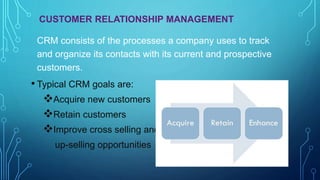
CRM consists of the processes a company uses to track
and organize its contacts with its current and prospective
customers.
• Typical CRM goals are:
Acquire new customers
Retain customers
Improve cross selling and
up-selling opportunities
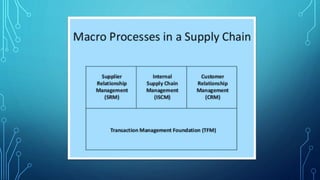
INTEGRATED SUPPLY CHAIN AND
CUSTOMER RELATIONSHIP MANAGEMENT
(ISCRM)
• JDA Chief Technology Officer Scott Hines coined the term ISCRM;
Integrated Supply Chain and Customer Relationship Management.
• Companies so far rarely integrate supply chain management and customer
relationship management.
• By integrating these business processes companies are able to break
through and achieve a number of improvements in their financial and
performance metrics that would have been unachievable using only stand
alone CRM & SCM techniques.
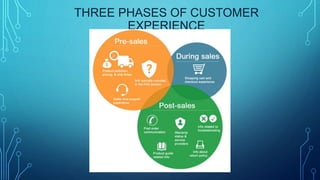
THREE PHASES OF CUSTOMER
EXPERIENCE
NEED AND IMPORTANCE OF CRM
• Better service to customers
For example, ICICI Bank maintains a list of priority customers and provides them
with additional facilities and special offers such as free tickets to concerts, movies,
and so on. Some banks, such as Syrian Catholic Bank provide personalized
services to their important customers.
• Customization of market offerings
• Reduction in the customer defection rate
• Increase and improvement in long-term relationships
• Increase in customer equity
• Competitive advantage
• Building and maintaining corporate image
• Higher return on investment
PURPOSE OF CRM
• “The focus is on creating value for the customer and the
company over the longer term”.
• When customer value the customer service that they
receive from suppliers, they are less likely to look to
alternative suppliers for their needs.
• CRM enables organizations to gain ‘competitive advantage’
over competitors that supply similar products or services.
• “Customer relationship management focuses on
strategically significant markets. Not all customers are
equally important”.
• Therefore, relationships should be built with customers that
are likely to provide value for services.
• Building relationships with customers that will provide little
value could result in a loss of time, staff and financial
resources.
COMPONENTS OF CRM
• Marketing automation
• Sales force automation
• Contact center automation
• Geo-location technology, or location-based services
• Workflow automation
• Lead management
• Human resource management
• Analytics
• AI in CRM
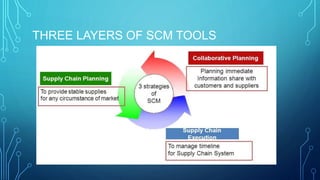
THREE LAYERS OF SCM TOOLS
• SAP
• Oracle
• JDA software
• Manhattan Associates
• i2 Technologies
• RedPrairie
• Infor
• Aldata
• Sterling Commerce
• Swisslog
• Epicor
• Highjump
• Brooks Software (Applied
materials)
• Microsoft
• Click Commerce
• QAD
• ILOG
• CDC Software
• IBS
• IFS
Some software companies that provide
supply chain planning, collaboration
and execution solutions:
VARIATIONS OF CRM
Sales force automation
• SFA uses software to streamline the sales process.
• The core of SFA is a contact management system
for tracking and recording every stage in the sales
process for each prospective client, from initial
contact to final disposition.
• Many SFA applications also include insights into
opportunities, territories, sales forecasts and
workflow automation.
Marketing
• CRM systems for marketing track and measure
campaigns over multiple channels, such as
email, search, social media, telephone and
direct mail.
• These systems track clicks, responses, leads,
deals, and revenue.
Appointments
• Appointment CRMs automatically provide
suitable appointment times to customers via e-
mail or the web, which are then synchronized
with the representative or agent's calendar.
Customer service and support
• CRMs can be used to create, assign and
manage requests made by customers, such as
call center software which help direct
customers to agents. CRM software can also
be used to identify and reward loyal customers.
Social media
• Some CRMs coordinate with social media sites
like Twitter, LinkedIn, Facebook and Google
Plus to track and communicate with customers
who share opinions and experiences about
their company, products and services.
Small business
• For small businesses a CRM may simply
consist of a contact manager system which
integrates emails, documents, jobs, faxes,
and scheduling for individual accounts.
BENEFITS
• Reduced costs, because the right things are being done.
• Increased customer satisfaction, because they are getting exactly
what they want (i.e.. meeting and exceeding expectations)
• Ensuring that the focus of the organisation is external.
• Growth in numbers of customers.
• Maximisation of opportunities (e.g.. increased services, referrals, etc.)
• Increased access to a source of market and competitor information.
• Highlighting poor operational processes.
• Long term profitability and sustainability.
THE SEVEN ‘R’S OF CRM’S CONTRIBUTION TO
SUPPLY CHAIN
Good customer relationships are
the result of
• The right product
• For the right customer
• In the right place
• At the right time
• In the right quantity
• In the right condition and
• At the right cost
US supermarket Walmart and
Target both use CRM to run
sales promotions aimed at
specific customer groups, using
these business analytics.
TYPES OF CRM TECHNOLOGY
The four main vendors of CRM systems
are Salesforce, Microsoft, SAP and Oracle.
On-premises CRM
• This system puts the onus of administration, control, security and
maintenance of the database and information on the company using
the CRM software.
• Yearly subscriptions.
Cloud-based CRM
• With cloud-based CRM - also known as SaaS (software as a service)
or
on-demand CRM
• Data is stored on an external, remote network that employees can
access anytime, anywhere there is an internet connection.
Open source CRM
• An Open source CRM system make source code available to the
public, enabling companies to make alterations at no cost to the
company employing the system. Open source CRM systems also
enable the addition and customization of data links on social media
channels, assisting companies looking to improve social
CRM practices.
• Open Source CRM platforms such as OroCRM, SuiteCRM and
SugarCRM offer alternatives to the proprietary platforms from
Salesforce, Microsoft and other vendors.
SWOT ANALYSIS OF CRM
STRENGTH
• Identifies best customers
• Holds all customer information
• Increases sales efficiency
• Ensures customer satisfaction
WEAKNESS
• Overload of information
• Does not arrive with information already entered•
• Lack of cultural preparation
OPPURTUNITIES
• Ability to please customer
• Increase sales base
• Improve relationship with customer
THREATS
• Loss of personal interaction
• Over automation
• Poor integration with back office systems
REFERENCES
• Amit Sinha, Herbery Kotzab, Supply chain management
• Nasrollah Moghaddam Charkari, Neda Abdolvan,2015
https://www.researchgate.net/publication/267238558_A_Proposed_Model_in_Integrating
_SCM_CRM_ERP
• Neil Kokemuller, https://yourbusiness.azcentral.com/supply-chain-management-vs-
customer-relationship-management-7884.html
• Alok Kumar Rai, 2011, “CRM Concept & Cases”, Prentice Hall of India Private Limited.
pp 83-87
• Michael J. A. Berry, Gordon S. Linoff, “Mastering Data Mining: The Art And Science Of
CRM”
• Ramaswamy , Patrica 13, “Harvard Business Review On CRM”
• Anonymous, 2013, https://www.logisticsbureau.com/crm-and-the-supply-chain
THANK YOU

SCM AND CRM

  • 1.
  • 2.
    CONTENTS • SCM • CRM •ISCRM • NEED AND IMPORTANCE OF CRM • COMPONENTS OF CRM • VARIATIONS • TYPES • BENEFITS • SWOT
  • 3.
    SUPPLY CHAIN MANAGEMENT •Supply chain management (SCM) is the broad range of activities required to plan, control and execute a product's flow, from acquiring raw materials and production through distribution to the final customer, in the most streamlined and cost-effective way possible.
  • 6.
    CRM Customer relationship management (CRM)is a model for managing a company’s interactions with current and future customers. It involves using technology to organize, automate, and synchronize sales, marketing, customer service, and technical support.
  • 7.
    CUSTOMER RELATIONSHIP MANAGEMENT CRMconsists of the processes a company uses to track and organize its contacts with its current and prospective customers. • Typical CRM goals are: Acquire new customers Retain customers Improve cross selling and up-selling opportunities
  • 9.
    INTEGRATED SUPPLY CHAINAND CUSTOMER RELATIONSHIP MANAGEMENT (ISCRM) • JDA Chief Technology Officer Scott Hines coined the term ISCRM; Integrated Supply Chain and Customer Relationship Management. • Companies so far rarely integrate supply chain management and customer relationship management. • By integrating these business processes companies are able to break through and achieve a number of improvements in their financial and performance metrics that would have been unachievable using only stand alone CRM & SCM techniques.
  • 10.
    THREE PHASES OFCUSTOMER EXPERIENCE
  • 11.
    NEED AND IMPORTANCEOF CRM • Better service to customers For example, ICICI Bank maintains a list of priority customers and provides them with additional facilities and special offers such as free tickets to concerts, movies, and so on. Some banks, such as Syrian Catholic Bank provide personalized services to their important customers. • Customization of market offerings • Reduction in the customer defection rate • Increase and improvement in long-term relationships • Increase in customer equity • Competitive advantage • Building and maintaining corporate image • Higher return on investment
  • 12.
    PURPOSE OF CRM •“The focus is on creating value for the customer and the company over the longer term”. • When customer value the customer service that they receive from suppliers, they are less likely to look to alternative suppliers for their needs. • CRM enables organizations to gain ‘competitive advantage’ over competitors that supply similar products or services.
  • 13.
    • “Customer relationshipmanagement focuses on strategically significant markets. Not all customers are equally important”. • Therefore, relationships should be built with customers that are likely to provide value for services. • Building relationships with customers that will provide little value could result in a loss of time, staff and financial resources.
  • 14.
    COMPONENTS OF CRM •Marketing automation • Sales force automation • Contact center automation • Geo-location technology, or location-based services • Workflow automation • Lead management • Human resource management • Analytics • AI in CRM
  • 15.
    THREE LAYERS OFSCM TOOLS
  • 16.
    • SAP • Oracle •JDA software • Manhattan Associates • i2 Technologies • RedPrairie • Infor • Aldata • Sterling Commerce • Swisslog • Epicor • Highjump • Brooks Software (Applied materials) • Microsoft • Click Commerce • QAD • ILOG • CDC Software • IBS • IFS Some software companies that provide supply chain planning, collaboration and execution solutions:
  • 17.
    VARIATIONS OF CRM Salesforce automation • SFA uses software to streamline the sales process. • The core of SFA is a contact management system for tracking and recording every stage in the sales process for each prospective client, from initial contact to final disposition. • Many SFA applications also include insights into opportunities, territories, sales forecasts and workflow automation.
  • 18.
    Marketing • CRM systemsfor marketing track and measure campaigns over multiple channels, such as email, search, social media, telephone and direct mail. • These systems track clicks, responses, leads, deals, and revenue. Appointments • Appointment CRMs automatically provide suitable appointment times to customers via e- mail or the web, which are then synchronized with the representative or agent's calendar.
  • 19.
    Customer service andsupport • CRMs can be used to create, assign and manage requests made by customers, such as call center software which help direct customers to agents. CRM software can also be used to identify and reward loyal customers. Social media • Some CRMs coordinate with social media sites like Twitter, LinkedIn, Facebook and Google Plus to track and communicate with customers who share opinions and experiences about their company, products and services.
  • 20.
    Small business • Forsmall businesses a CRM may simply consist of a contact manager system which integrates emails, documents, jobs, faxes, and scheduling for individual accounts.
  • 21.
    BENEFITS • Reduced costs,because the right things are being done. • Increased customer satisfaction, because they are getting exactly what they want (i.e.. meeting and exceeding expectations) • Ensuring that the focus of the organisation is external. • Growth in numbers of customers. • Maximisation of opportunities (e.g.. increased services, referrals, etc.) • Increased access to a source of market and competitor information. • Highlighting poor operational processes. • Long term profitability and sustainability.
  • 22.
    THE SEVEN ‘R’SOF CRM’S CONTRIBUTION TO SUPPLY CHAIN Good customer relationships are the result of • The right product • For the right customer • In the right place • At the right time • In the right quantity • In the right condition and • At the right cost US supermarket Walmart and Target both use CRM to run sales promotions aimed at specific customer groups, using these business analytics.
  • 23.
    TYPES OF CRMTECHNOLOGY The four main vendors of CRM systems are Salesforce, Microsoft, SAP and Oracle. On-premises CRM • This system puts the onus of administration, control, security and maintenance of the database and information on the company using the CRM software. • Yearly subscriptions.
  • 24.
    Cloud-based CRM • Withcloud-based CRM - also known as SaaS (software as a service) or on-demand CRM • Data is stored on an external, remote network that employees can access anytime, anywhere there is an internet connection.
  • 25.
    Open source CRM •An Open source CRM system make source code available to the public, enabling companies to make alterations at no cost to the company employing the system. Open source CRM systems also enable the addition and customization of data links on social media channels, assisting companies looking to improve social CRM practices. • Open Source CRM platforms such as OroCRM, SuiteCRM and SugarCRM offer alternatives to the proprietary platforms from Salesforce, Microsoft and other vendors.
  • 26.
    SWOT ANALYSIS OFCRM STRENGTH • Identifies best customers • Holds all customer information • Increases sales efficiency • Ensures customer satisfaction
  • 27.
    WEAKNESS • Overload ofinformation • Does not arrive with information already entered• • Lack of cultural preparation OPPURTUNITIES • Ability to please customer • Increase sales base • Improve relationship with customer
  • 28.
    THREATS • Loss ofpersonal interaction • Over automation • Poor integration with back office systems
  • 29.
    REFERENCES • Amit Sinha,Herbery Kotzab, Supply chain management • Nasrollah Moghaddam Charkari, Neda Abdolvan,2015 https://www.researchgate.net/publication/267238558_A_Proposed_Model_in_Integrating _SCM_CRM_ERP • Neil Kokemuller, https://yourbusiness.azcentral.com/supply-chain-management-vs- customer-relationship-management-7884.html • Alok Kumar Rai, 2011, “CRM Concept & Cases”, Prentice Hall of India Private Limited. pp 83-87 • Michael J. A. Berry, Gordon S. Linoff, “Mastering Data Mining: The Art And Science Of CRM” • Ramaswamy , Patrica 13, “Harvard Business Review On CRM” • Anonymous, 2013, https://www.logisticsbureau.com/crm-and-the-supply-chain
  • 30.