Supply Chain Dynamics and Coordination DSC 335 Zhibin Yang, Assistant Professor Decision Sciences
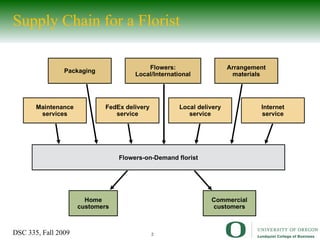
Supply Chain for a Florist Flowers-on-Demand florist Home customers Commercial customers Packaging Flowers:  Local/International Arrangement materials FedEx delivery service Local delivery service Internet service Maintenance services
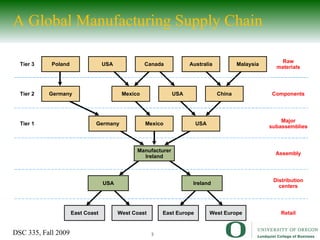
A Global Manufacturing Supply Chain East Coast West Coast East Europe West Europe Retail USA Ireland Distribution centers Manufacturer Ireland Assembly Germany Mexico USA Tier 1 Major subassemblies Germany Mexico USA China Tier 2 Components Poland USA Canada Australia Malaysia Tier 3 Raw materials
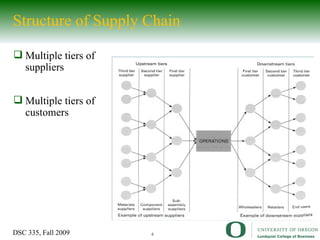
Structure of Supply Chain Multiple tiers of suppliers Multiple tiers of customers
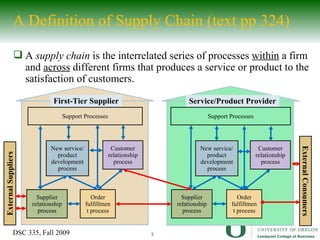
A Definition of Supply Chain (text pp 324) A  supply chain  is the interrelated series of processes  within  a firm and  across  different firms that produces a service or product to the satisfaction of customers. External Suppliers External Consumers Support Processes Supplier relationship process New service/ product development process Order fulfillment process Customer relationship process Service/Product Provider Support Processes Supplier relationship process New service/ product development process Order fulfillment process Customer relationship process First-Tier Supplier
Outline  Supply chain dynamics – bullwhip effect Causes of bullwhip effect Solutions to bullwhip effect Supply chain coordination Supply chain design
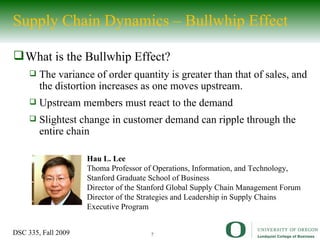
Supply Chain Dynamics – Bullwhip Effect What is the Bullwhip Effect? The variance of order quantity is greater than that of sales, and the distortion increases as one moves upstream. Upstream members must react to the demand  Slightest change in customer demand can ripple through the entire chain Hau L. Lee Thoma Professor of Operations, Information, and Technology, Stanford Graduate School of Business Director of the Stanford Global Supply Chain Management Forum Director of the Strategies and Leadership in Supply Chains Executive Program
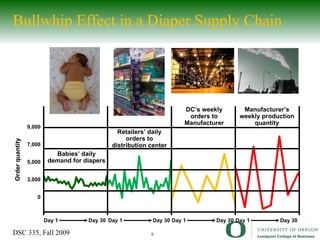
Bullwhip Effect in a Diaper Supply Chain  Babies’ daily demand for diapers  Retailers’ daily orders to distribution center DC’s weekly orders to Manufacturer Manufacturer’s weekly production quantity 9,000 7,000 5,000 3,000 0 Order quantity Day 1 Day 30 Day 1 Day 30 Day 1 Day 30 Day 1 Day 30
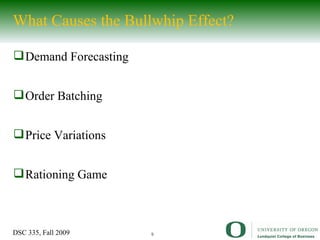
What Causes the Bullwhip Effect? Demand Forecasting Order Batching Price Variations  Rationing Game
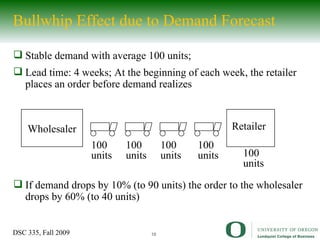
Bullwhip Effect due to Demand Forecast Stable demand with average 100 units;  Lead time: 4 weeks; At the beginning of each week, the retailer places an order before demand realizes If demand drops by 10% (to 90 units) the order to the wholesaler drops by 60% (to 40 units) Wholesaler Retailer 100 units 100 units 100 units 100 units 100 units
(cont’d) Demand Forecasting Contributing factors Lag in information flow Lack of information flow Counter Measures Shorten lead time Better information Current Practice / State-of-the-Art EDI and Cross docking Sharing sell-thru data required by contracts (e.g., HP, Apple, IBM) VMI (P&G and Wal-Mart) Quick Response
Bullwhip Effect due to Order Batching Contributing factors Ordering costs Sales quotas Transportation discounts  MRP systems Counter Measures EDI & Computer Assisted Ordering (CAO) Discounted on Assorted Truckload, consolidated by 3rd party logistics Regular delivery appointment
Bullwhip Effect due to Price Variations Contributing factors Promotions  or  quantity discounts  cause retailers to place larger orders to build up inventory Retailers order less in the following weeks, because consumer demand is unaffected by promotion/discount Counter Measures Everyday low price No discount to retailers Direct discounts to consumers through coupons This is related to our case study #3
Bullwhip Effect due to Rationing Game How rationing causes bullwhip effect Limited production capacity during peak season Supplier / Manufacturer will ration the supply to satisfy retailers’ orders; Retailers receive less than what they order Retailers inflate their orders, in anticipation of discounting in their quantities Manufacturer observes very large volume and schedule production to meet this inflated demand signal
(cont’d) When Is Rationing Game Most Likely? At supplier’s end Tight capacity (real or perceived) At retailer’s end Anticipate demand peaks Competition with other retailers for same product
Solutions for Battling Bullwhip Effect Vendor Managed Inventory (VMI) Vendors take control of inventory management at the retailers Quick Response (QR) Vendors receive POS data from retailers, and use this information to synchronize their production and inventory activities.
Vendor Managed Inventory (VMI) How does it work? The vendor (supplier) receives inventory and point-of-sales (POS)  data  from the retailers and calculates how much to ship to retailers.  The vendor places orders for supply.  VMI projects Dillard Department Stores, JCPenney and Wal-Mart Sales increases of 20 to 25% 30% inventory turnover improvements
VMI Success at Wal-Mart P&G collects demand and inventory information on a daily basis, from every Wal-Mart store P&G automatically makes a shipment to Wal-Mart when inventory falls below the threshold Because of the speed of this system, Wal-Mart pays P&G after the product passes over the scanners as the customer goes through the checkout lane
VMI Failure at Spartan Stores Spartan Stores, a grocery / drug store chain in Grand Rapids, MI (owned by an MSU alum?) Spartan Stores shut down its VMI effort about one year after its inception. Why? Buyers didn’t trust the suppliers enough carefully monitor inventories intervene at slightest hint of trouble Suppliers didn’t do much to allay buyers’ fears didn’t do as effective a job as buyers
Quick Response The supplier receives  POS data  from retailers, and use this information to synchronize their production and inventory activities.  The retailer prepares individual orders, but the POS data is used by the supplier to improve  forecasting and scheduling .
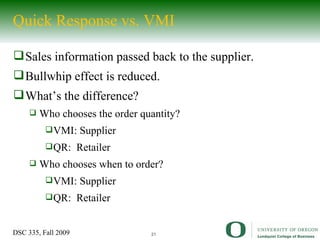
Quick Response vs. VMI Sales information passed back to the supplier. Bullwhip effect is reduced. What’s the difference? Who chooses the order quantity? VMI: Supplier QR:  Retailer Who chooses when to order? VMI: Supplier QR:  Retailer
More on Battling the Bullwhip Effect Lead time reduction Better information system Better forecasting Better information system Strategic partnering Information sharing Risk sharing Product Transshipment Flexible delivery (3 rd  party logistics, truckload assortment discounts)
Outline  Supply chain dynamics – bullwhip effect Supply chain coordination Coordinating self-interested members to improve the total supply chain performance Supply chain design
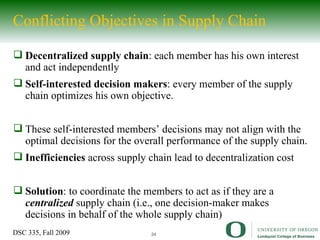
Conflicting Objectives in Supply Chain Decentralized supply chain : each member has his own interest and act independently Self-interested decision makers : every member of the supply chain optimizes his own objective. These self-interested members’ decisions may not align with the optimal decisions for the overall performance of the supply chain. Inefficiencies  across supply chain lead to decentralization cost Solution : to coordinate the members to act as if they are a  centralized  supply chain (i.e., one decision-maker makes decisions in behalf of the whole supply chain)

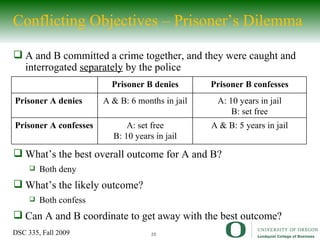
Conflicting Objectives – Prisoner’s Dilemma A and B committed a crime together, and they were caught and interrogated  separately  by the police What’s the best overall outcome for A and B? Both deny What’s the likely outcome? Both confess Can A and B coordinate to get away with the best outcome? Prisoner B denies Prisoner B confesses Prisoner A denies A & B: 6 months in jail A: 10 years in jail B: set free Prisoner A confesses A: set free B: 10 years in jail A & B: 5 years in jail
Supply Chain Coordination Our goal: to attain performance of  centralized  supply chain with  decentralized  decision making How do we do that? A  contract  is agreed by and announced to all members  before  they make decisions Each member independently decides and acts The contract is executed We say a  decentralized  SC is  coordinated  by a contract, if  The total profit of  decentralized  SC equals the total profit of  centralized  SC, and  All members are better off under this contract, compared to the case without such a contract (uncoordinated case)
Coordination Issues in Operations Can SC performance be improved by centralized decision making? – usually, yes! Do all SC members improve their individual performance under centralized decision making? –  may be NOT.  Can centralization be achieved without centralized control?  That is, does there exists a  coordinating contract  that induces all SC members to act as if they were in a centralized SC? May NOT. We need to design supply contract smartly.
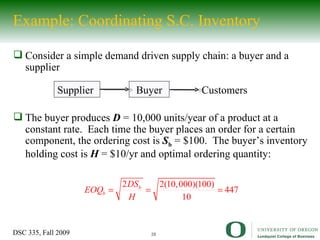
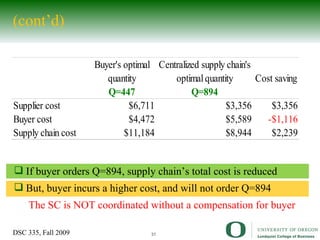
Example: Coordinating S.C. Inventory Consider a simple demand driven supply chain: a buyer and a supplier The buyer produces  D  = 10,000 units/year of a product at a constant rate.  Each time the buyer places an order for a certain component, the ordering cost is  S b  = $100.  The buyer’s inventory holding cost is  H  = $10/yr and optimal ordering quantity: Buyer Supplier Customers
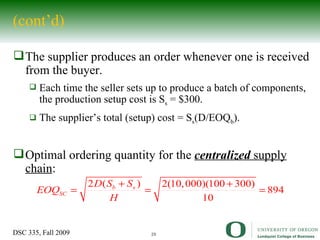
(cont’d) The supplier produces an order whenever one is received from the buyer.  Each time the seller sets up to produce a batch of components, the production setup cost is S s  = $300. The supplier’s total (setup) cost = S s (D/EOQ b ). Optimal ordering quantity for the  centralized  supply chain :
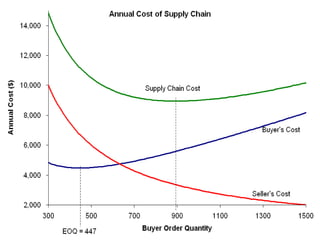
(cont’d) If buyer orders Q=894, supply chain’s total cost is reduced But, buyer incurs a higher cost, and will not order Q=894 The SC is NOT coordinated without a compensation for buyer
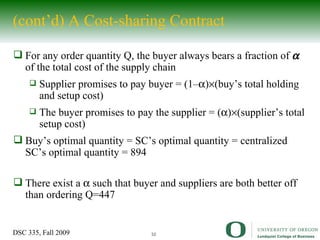
(cont’d) A Cost-sharing Contract For any order quantity Q, the buyer always bears a fraction of    of the total cost of the supply chain Supplier promises to pay buyer = (1–  )  (buy’s total holding and setup cost) The buyer promises to pay the supplier = (  )  (supplier’s total setup cost) Buy’s optimal quantity = SC’s optimal quantity = centralized SC’s optimal quantity = 894 There exist a    such that buyer and suppliers are both better off than ordering Q=447
Factors that Affect Coordination of SC Cooperation among self-interested agents require: extensive information sharing capabilities, trust among players, permission and coordination efforts by the controller, revealing truth about cost parameters. Mechanisms such as pricing, auctions, contracts, or incentive rules are worth investigating.
Outline  Supply chain dynamics – bullwhip effect Supply chain coordination Supply chain design Matching the type of product with the type of supply chain
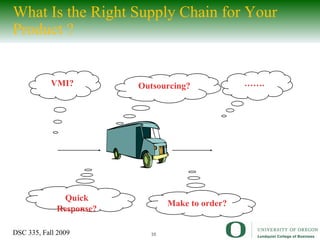
What Is the Right Supply Chain for Your Product ? Outsourcing? VMI? Quick Response? Make to order? …… .
Rule of Supply Chain Design To match  product  characteristics with  supply chain  characteristics
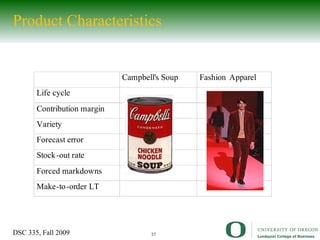
Product Characteristics
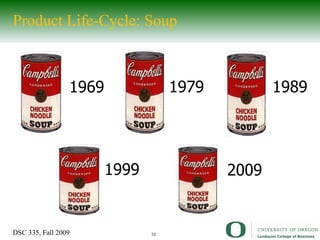
Product Life-Cycle: Soup 1969 1999 1989 1979 2009
Product Life-Cycle: Fashion Fall Winter Spring
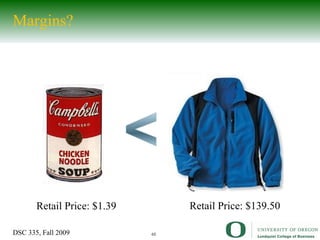
Margins? Retail Price: $139.50 Retail Price: $1.39
Variety? New Design? Differed in color, size, style, etc., 95% new Unchanged over years, only 5%
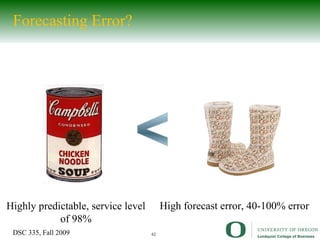
Forecasting Error? High forecast error, 40-100% error Highly predictable, service level of 98%
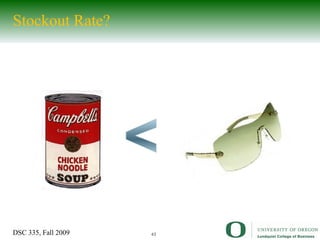
Stockout Rate?
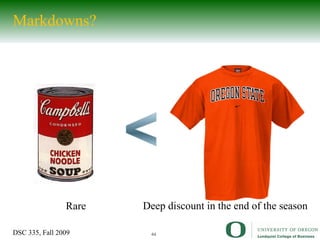
Markdowns? Deep discount in the end of the season Rare
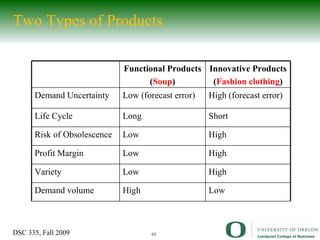
Two Types of Products Functional Products ( Soup ) Innovative Products ( Fashion clothing ) Demand Uncertainty Low (forecast error) High (forecast error) Life Cycle Long Short Risk of Obsolescence Low High Profit Margin Low High Variety Low High Demand volume High Low
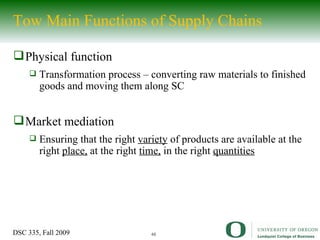
Tow Main Functions of Supply Chains Physical function Transformation process – converting raw materials to finished goods and moving them along SC Market mediation Ensuring that the right  variety  of products are available at the right  place,  at the right  time,  in the right  quantities
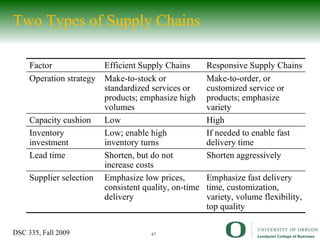
Two Types of Supply Chains Factor Efficient Supply Chains Responsive Supply Chains Operation strategy Make-to-stock or standardized services or products; emphasize high volumes Make-to-order, or customized service or products; emphasize variety Capacity cushion Low High Inventory investment Low; enable high inventory turns If needed to enable fast delivery time Lead time Shorten, but do not increase costs Shorten aggressively Supplier selection Emphasize low prices, consistent quality, on-time delivery Emphasize fast delivery time, customization, variety, volume flexibility, top quality
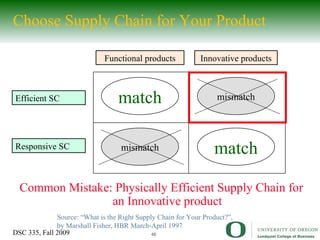
Choose Supply Chain for Your Product Common Mistake: Physically Efficient Supply Chain for an Innovative product mismatch match mismatch match Source: “What is the Right Supply Chain for Your Product?”, by Marshall Fisher, HBR March-April 1997 Functional products Innovative products Responsive SC Efficient SC
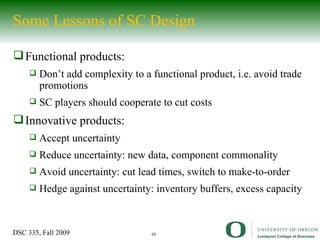
Some Lessons of SC Design Functional products: Don’t add complexity to a functional product, i.e. avoid trade promotions SC players should cooperate to cut costs Innovative products: Accept uncertainty Reduce uncertainty: new data, component commonality Avoid uncertainty: cut lead times, switch to make-to-order Hedge against uncertainty: inventory buffers, excess capacity

Supply chain management 091116162848 Phpapp01

  • 1.
    Supply Chain Dynamicsand Coordination DSC 335 Zhibin Yang, Assistant Professor Decision Sciences
  • 2.
    Supply Chain fora Florist Flowers-on-Demand florist Home customers Commercial customers Packaging Flowers: Local/International Arrangement materials FedEx delivery service Local delivery service Internet service Maintenance services
  • 3.
    A Global ManufacturingSupply Chain East Coast West Coast East Europe West Europe Retail USA Ireland Distribution centers Manufacturer Ireland Assembly Germany Mexico USA Tier 1 Major subassemblies Germany Mexico USA China Tier 2 Components Poland USA Canada Australia Malaysia Tier 3 Raw materials
  • 4.
    Structure of SupplyChain Multiple tiers of suppliers Multiple tiers of customers
  • 5.
    A Definition ofSupply Chain (text pp 324) A supply chain is the interrelated series of processes within a firm and across different firms that produces a service or product to the satisfaction of customers. External Suppliers External Consumers Support Processes Supplier relationship process New service/ product development process Order fulfillment process Customer relationship process Service/Product Provider Support Processes Supplier relationship process New service/ product development process Order fulfillment process Customer relationship process First-Tier Supplier
  • 6.
    Outline Supplychain dynamics – bullwhip effect Causes of bullwhip effect Solutions to bullwhip effect Supply chain coordination Supply chain design
  • 7.
    Supply Chain Dynamics– Bullwhip Effect What is the Bullwhip Effect? The variance of order quantity is greater than that of sales, and the distortion increases as one moves upstream. Upstream members must react to the demand Slightest change in customer demand can ripple through the entire chain Hau L. Lee Thoma Professor of Operations, Information, and Technology, Stanford Graduate School of Business Director of the Stanford Global Supply Chain Management Forum Director of the Strategies and Leadership in Supply Chains Executive Program
  • 8.
    Bullwhip Effect ina Diaper Supply Chain Babies’ daily demand for diapers Retailers’ daily orders to distribution center DC’s weekly orders to Manufacturer Manufacturer’s weekly production quantity 9,000 7,000 5,000 3,000 0 Order quantity Day 1 Day 30 Day 1 Day 30 Day 1 Day 30 Day 1 Day 30
  • 9.
    What Causes theBullwhip Effect? Demand Forecasting Order Batching Price Variations Rationing Game
  • 10.
    Bullwhip Effect dueto Demand Forecast Stable demand with average 100 units; Lead time: 4 weeks; At the beginning of each week, the retailer places an order before demand realizes If demand drops by 10% (to 90 units) the order to the wholesaler drops by 60% (to 40 units) Wholesaler Retailer 100 units 100 units 100 units 100 units 100 units
  • 11.
    (cont’d) Demand ForecastingContributing factors Lag in information flow Lack of information flow Counter Measures Shorten lead time Better information Current Practice / State-of-the-Art EDI and Cross docking Sharing sell-thru data required by contracts (e.g., HP, Apple, IBM) VMI (P&G and Wal-Mart) Quick Response
  • 12.
    Bullwhip Effect dueto Order Batching Contributing factors Ordering costs Sales quotas Transportation discounts MRP systems Counter Measures EDI & Computer Assisted Ordering (CAO) Discounted on Assorted Truckload, consolidated by 3rd party logistics Regular delivery appointment
  • 13.
    Bullwhip Effect dueto Price Variations Contributing factors Promotions or quantity discounts cause retailers to place larger orders to build up inventory Retailers order less in the following weeks, because consumer demand is unaffected by promotion/discount Counter Measures Everyday low price No discount to retailers Direct discounts to consumers through coupons This is related to our case study #3
  • 14.
    Bullwhip Effect dueto Rationing Game How rationing causes bullwhip effect Limited production capacity during peak season Supplier / Manufacturer will ration the supply to satisfy retailers’ orders; Retailers receive less than what they order Retailers inflate their orders, in anticipation of discounting in their quantities Manufacturer observes very large volume and schedule production to meet this inflated demand signal
  • 15.
    (cont’d) When IsRationing Game Most Likely? At supplier’s end Tight capacity (real or perceived) At retailer’s end Anticipate demand peaks Competition with other retailers for same product
  • 16.
    Solutions for BattlingBullwhip Effect Vendor Managed Inventory (VMI) Vendors take control of inventory management at the retailers Quick Response (QR) Vendors receive POS data from retailers, and use this information to synchronize their production and inventory activities.
  • 17.
    Vendor Managed Inventory(VMI) How does it work? The vendor (supplier) receives inventory and point-of-sales (POS) data from the retailers and calculates how much to ship to retailers. The vendor places orders for supply. VMI projects Dillard Department Stores, JCPenney and Wal-Mart Sales increases of 20 to 25% 30% inventory turnover improvements
  • 18.
    VMI Success atWal-Mart P&G collects demand and inventory information on a daily basis, from every Wal-Mart store P&G automatically makes a shipment to Wal-Mart when inventory falls below the threshold Because of the speed of this system, Wal-Mart pays P&G after the product passes over the scanners as the customer goes through the checkout lane
  • 19.
    VMI Failure atSpartan Stores Spartan Stores, a grocery / drug store chain in Grand Rapids, MI (owned by an MSU alum?) Spartan Stores shut down its VMI effort about one year after its inception. Why? Buyers didn’t trust the suppliers enough carefully monitor inventories intervene at slightest hint of trouble Suppliers didn’t do much to allay buyers’ fears didn’t do as effective a job as buyers
  • 20.
    Quick Response Thesupplier receives POS data from retailers, and use this information to synchronize their production and inventory activities. The retailer prepares individual orders, but the POS data is used by the supplier to improve forecasting and scheduling .
  • 21.
    Quick Response vs.VMI Sales information passed back to the supplier. Bullwhip effect is reduced. What’s the difference? Who chooses the order quantity? VMI: Supplier QR: Retailer Who chooses when to order? VMI: Supplier QR: Retailer
  • 22.
    More on Battlingthe Bullwhip Effect Lead time reduction Better information system Better forecasting Better information system Strategic partnering Information sharing Risk sharing Product Transshipment Flexible delivery (3 rd party logistics, truckload assortment discounts)
  • 23.
    Outline Supplychain dynamics – bullwhip effect Supply chain coordination Coordinating self-interested members to improve the total supply chain performance Supply chain design
  • 24.
    Conflicting Objectives inSupply Chain Decentralized supply chain : each member has his own interest and act independently Self-interested decision makers : every member of the supply chain optimizes his own objective. These self-interested members’ decisions may not align with the optimal decisions for the overall performance of the supply chain. Inefficiencies across supply chain lead to decentralization cost Solution : to coordinate the members to act as if they are a centralized supply chain (i.e., one decision-maker makes decisions in behalf of the whole supply chain)
  • 25.
    Conflicting Objectives –Prisoner’s Dilemma A and B committed a crime together, and they were caught and interrogated separately by the police What’s the best overall outcome for A and B? Both deny What’s the likely outcome? Both confess Can A and B coordinate to get away with the best outcome? Prisoner B denies Prisoner B confesses Prisoner A denies A & B: 6 months in jail A: 10 years in jail B: set free Prisoner A confesses A: set free B: 10 years in jail A & B: 5 years in jail
  • 26.
    Supply Chain CoordinationOur goal: to attain performance of centralized supply chain with decentralized decision making How do we do that? A contract is agreed by and announced to all members before they make decisions Each member independently decides and acts The contract is executed We say a decentralized SC is coordinated by a contract, if The total profit of decentralized SC equals the total profit of centralized SC, and All members are better off under this contract, compared to the case without such a contract (uncoordinated case)
  • 27.
    Coordination Issues inOperations Can SC performance be improved by centralized decision making? – usually, yes! Do all SC members improve their individual performance under centralized decision making? – may be NOT. Can centralization be achieved without centralized control? That is, does there exists a coordinating contract that induces all SC members to act as if they were in a centralized SC? May NOT. We need to design supply contract smartly.
  • 28.
    Example: Coordinating S.C.Inventory Consider a simple demand driven supply chain: a buyer and a supplier The buyer produces D = 10,000 units/year of a product at a constant rate. Each time the buyer places an order for a certain component, the ordering cost is S b = $100. The buyer’s inventory holding cost is H = $10/yr and optimal ordering quantity: Buyer Supplier Customers
  • 29.
    (cont’d) The supplierproduces an order whenever one is received from the buyer. Each time the seller sets up to produce a batch of components, the production setup cost is S s = $300. The supplier’s total (setup) cost = S s (D/EOQ b ). Optimal ordering quantity for the centralized supply chain :
  • 31.
    (cont’d) If buyerorders Q=894, supply chain’s total cost is reduced But, buyer incurs a higher cost, and will not order Q=894 The SC is NOT coordinated without a compensation for buyer
  • 32.
    (cont’d) A Cost-sharingContract For any order quantity Q, the buyer always bears a fraction of  of the total cost of the supply chain Supplier promises to pay buyer = (1–  )  (buy’s total holding and setup cost) The buyer promises to pay the supplier = (  )  (supplier’s total setup cost) Buy’s optimal quantity = SC’s optimal quantity = centralized SC’s optimal quantity = 894 There exist a  such that buyer and suppliers are both better off than ordering Q=447
  • 33.
    Factors that AffectCoordination of SC Cooperation among self-interested agents require: extensive information sharing capabilities, trust among players, permission and coordination efforts by the controller, revealing truth about cost parameters. Mechanisms such as pricing, auctions, contracts, or incentive rules are worth investigating.
  • 34.
    Outline Supplychain dynamics – bullwhip effect Supply chain coordination Supply chain design Matching the type of product with the type of supply chain
  • 35.
    What Is theRight Supply Chain for Your Product ? Outsourcing? VMI? Quick Response? Make to order? …… .
  • 36.
    Rule of SupplyChain Design To match product characteristics with supply chain characteristics
  • 37.
  • 38.
    Product Life-Cycle: Soup1969 1999 1989 1979 2009
  • 39.
    Product Life-Cycle: FashionFall Winter Spring
  • 40.
    Margins? Retail Price:$139.50 Retail Price: $1.39
  • 41.
    Variety? New Design?Differed in color, size, style, etc., 95% new Unchanged over years, only 5%
  • 42.
    Forecasting Error? Highforecast error, 40-100% error Highly predictable, service level of 98%
  • 43.
  • 44.
    Markdowns? Deep discountin the end of the season Rare
  • 45.
    Two Types ofProducts Functional Products ( Soup ) Innovative Products ( Fashion clothing ) Demand Uncertainty Low (forecast error) High (forecast error) Life Cycle Long Short Risk of Obsolescence Low High Profit Margin Low High Variety Low High Demand volume High Low
  • 46.
    Tow Main Functionsof Supply Chains Physical function Transformation process – converting raw materials to finished goods and moving them along SC Market mediation Ensuring that the right variety of products are available at the right place, at the right time, in the right quantities
  • 47.
    Two Types ofSupply Chains Factor Efficient Supply Chains Responsive Supply Chains Operation strategy Make-to-stock or standardized services or products; emphasize high volumes Make-to-order, or customized service or products; emphasize variety Capacity cushion Low High Inventory investment Low; enable high inventory turns If needed to enable fast delivery time Lead time Shorten, but do not increase costs Shorten aggressively Supplier selection Emphasize low prices, consistent quality, on-time delivery Emphasize fast delivery time, customization, variety, volume flexibility, top quality
  • 48.
    Choose Supply Chainfor Your Product Common Mistake: Physically Efficient Supply Chain for an Innovative product mismatch match mismatch match Source: “What is the Right Supply Chain for Your Product?”, by Marshall Fisher, HBR March-April 1997 Functional products Innovative products Responsive SC Efficient SC
  • 49.
    Some Lessons ofSC Design Functional products: Don’t add complexity to a functional product, i.e. avoid trade promotions SC players should cooperate to cut costs Innovative products: Accept uncertainty Reduce uncertainty: new data, component commonality Avoid uncertainty: cut lead times, switch to make-to-order Hedge against uncertainty: inventory buffers, excess capacity

Editor's Notes