Module 4
Supply Chain Coordination: Lack of supply chain coordination and the
Bullwhip effect, an obstacle to coordination, managerial levers, building
partnerships and trust, continuous replenishment and vendor-managed
inventories, collaborative planning, forecasting, and replenishment,
Demand-driven supply chain.
Lack of Supply Chain Coordination
• Supply chain coordination – all stages of the chain take
actions that are aligned and increase the total supply
chain surplus
• Requires that each stage share information and take into
account the effects of its actions on the other stages
• Lack of coordination results when:
– Objectives of different stages conflict
– Information moving between stages is delayed or distorted
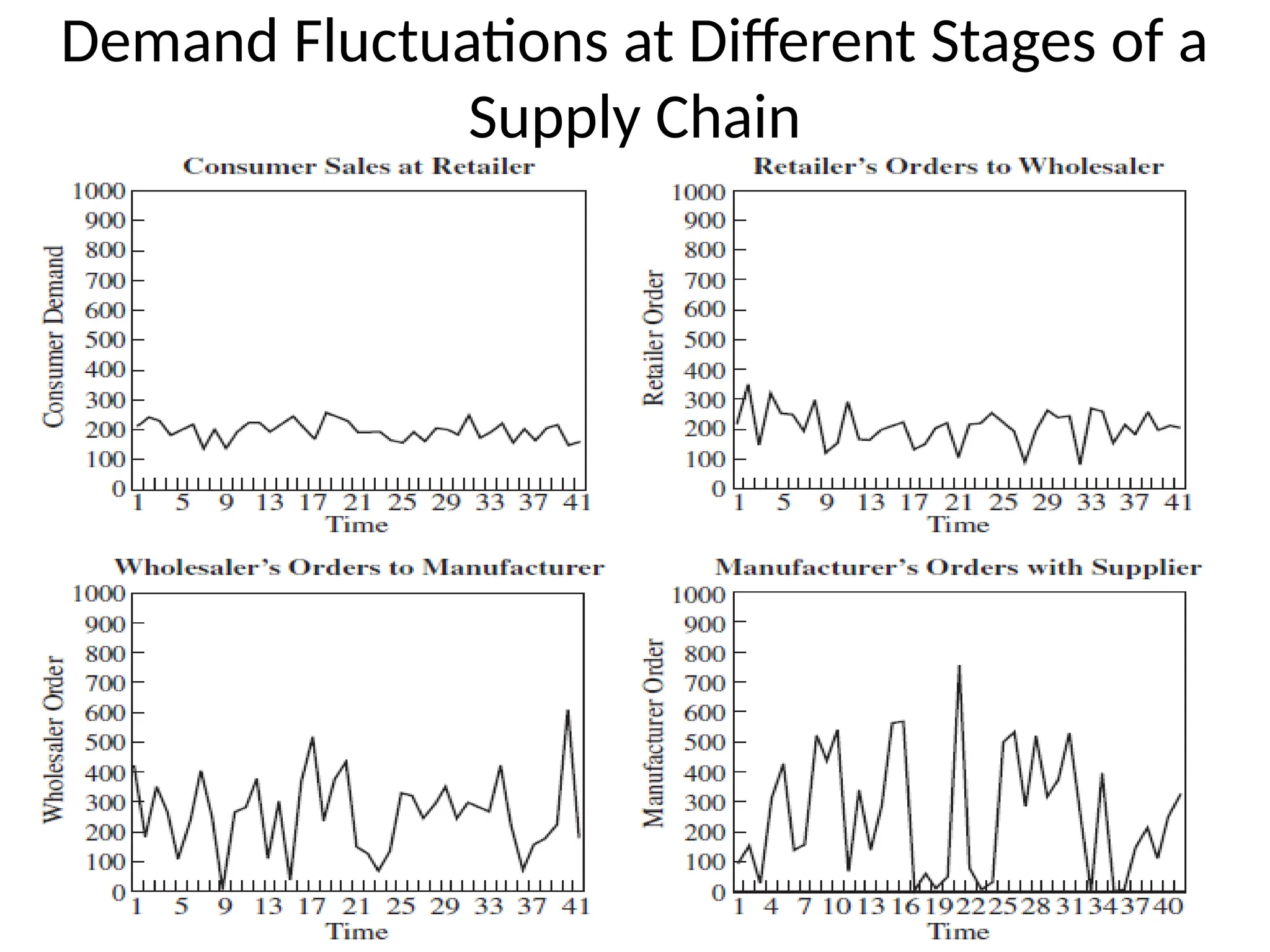
Bullwhip Effect
• Fluctuations in orders increase as they move up the
supply chain from retailers to wholesalers to
manufacturers to suppliers
• Distorts demand information within the supply
chain
• Results from a loss of supply chain coordination
Demand Fluctuations at Different Stages of a
Supply Chain
THE EFFECT ON PERFORMANCE OF LACK OF
COORDINATION
• Supply chain lacks coordination
if each stage optimizes only its
local objective
• Reduces total profits
• Performance measures include:
– Manufacturing cost
– Inventory cost
– Replenishment lead time
– Transportation cost
– Labor cost for shipping and
receiving
– Level of product availability
– Relationships across the supply
chain
The Effect on Performance
Performance Measure Impact of the Lack of Coordination
Manufacturing cost Increases
Inventory cost Increases
Replenishment lead time Increases
Transportation cost Increases
Labor cost for shipping and receiving Increases
Level of product availability Decreases
Profitability Decreases
Obstacles to Coordination
in a Supply Chain
• Incentive Obstacles
– Occur when incentives offered to different stages or
participants in a supply chain lead to actions that
increase variability and reduce total supply chain profits
• Local optimization within functions or stages of a supply chain
• Sales force incentives
Obstacles to Coordination
in a Supply Chain
• Information Processing Obstacles
– When demand information is distorted as it moves
between different stages of the supply chain, leading
to increased variability in orders within the supply
chain
• Forecasting based on orders, not customer demand
• Lack of information sharing
Obstacles to Coordination
in a Supply Chain
• Operational Obstacles
– Occur when placing and filling orders lead to an
increase in variability
• Ordering in large lots
• Large replenishment lead times
• Rationing and shortage gaming
Obstacles to Coordination
in a Supply Chain
• Pricing Obstacles
– When pricing policies for a product lead to an
increase in the variability of orders placed
• Lot-size-based Quantity Discounts
• Price fluctuations due to trade promotions
Obstacles to Coordination
in a Supply Chain
• Behavioral Obstacles
– Problems in learning within organizations that contribute
to information distortion
• Each stage of the supply chain views its actions locally and is unable to see the impact
of its actions on other stages
• Different stages of the supply chain react to the current local situation rather than
trying to identify the root causes
• Different stages of the supply chain blame one another for the fluctuations
• No stage of the supply chain learns from its actions over time
• A lack of trust among supply chain partners causes them to be opportunistic at the
expense of overall supply chain performance
Managerial Levers to
Achieve Coordination
• Aligning goals and incentives:
– Align goals and incentives so that every participant in supply
chain activities works to maximize total supply chain profits
– Align goals across the supply chain
– Align incentives across functions
– Pricing for coordination
– Alter sales force incentives from sell-in (to the retailer) to
sell-through (by the retailer)
Managerial Levers to
Achieve Coordination
• Improving Information Visibility and Accuracy
– Sharing point-of-sale data.
– Implementing collaborative forecasting and planning
– Designing single-stage control of replenishment
– Continuous replenishment programs (CRP)
– Vendor managed inventory (VMI)
Managerial Levers to
Achieve Coordination
• Improving operational performance
– Reducing replenishment lead time
– Reducing lot sizes
– Rationing based on past sales and sharing
information to limit gaming
Managerial Levers to
Achieve Coordination
• Designing pricing strategies to stabilize orders:
– Encouraging retailers to order in smaller lots and reduce
forward buying
– Moving from lot size-based to volume-based quantity
discounts
– Stabilizing pricing
– Building strategic partnerships and trust
Managerial Levers to
Achieve Coordination
• Building strategic partnerships and trust:
– Building trust and strategic partnerships within the supply chain
makes it easier for managers to achieve coordination.
– Sharing accurate and trusted information throughout the supply
chain improves the matching of supply and demand and
reduces costs.
– A better relationship between stages in the supply chain lowers
transaction costs and eliminates duplicated effort.
Managerial Levers to
Achieve Coordination
• Building strategic partnerships and trust:
– Trust allows for eliminating forecasting and
inspection efforts, leading to improved coordination.
– Retailers that trust their suppliers are less likely to
develop alternate sources and experience increased
sales.
Managerial Levers to
Achieve Coordination
• Building strategic partnerships and trust:
– Trust enables a more responsive supply chain at lower costs.
– Actions such as information sharing, incentive changes,
operational improvements, and stable pricing contribute to
building trust.
– Growing cooperation and trust in the supply chain requires
clear roles and decision rights, effective contracts, and
conflict resolution mechanisms.
Continuous Replenishment and Vendor-
Managed Inventories
• Continuous Replenishment and Vendor-
Managed Inventories (VMI) are two supply chain
management strategies that aim to optimize
inventory levels and improve overall efficiency
between suppliers and retailers.
Continuous Replenishment and Vendor-
Managed Inventories
• Assigning replenishment responsibility to a single entity in
the supply chain helps reduce information distortion.
• Continuous replenishment programs (CRP) involve regular
replenishment based on actual inventory withdrawals or
Point-of-Sale (POS) data.
• Vendor-managed inventory (VMI) shifts replenishment
decisions to the manufacturer or supplier, with inventory
often owned by the supplier until sold.
Continuous Replenishment
• Continuous Replenishment:
– Continuous Replenishment is a strategy in which inventory
levels are continuously monitored and replenished based on
consumer demand.
– Instead of relying on traditional inventory forecasting methods,
continuous replenishment uses real-time data to trigger
automatic reordering and restocking.
– The goal is to maintain optimal inventory levels by minimizing
stockouts while avoiding excess inventory.
Continuous Replenishment
• Objective:
– Maintain optimal inventory levels by responding to real-time demand
• Benefits:
– Minimize stockouts and excess inventory
– Improve product availability
– Reduce the need for emergency orders or rush shipments
• Key Features:
– Real-time monitoring of inventory levels
– Automatic reordering triggered by actual consumer demand
• Collaboration between suppliers and retailers
Vendor-Managed Inventories
• VMI requires retailers to share demand information,
improve manufacturer forecasts, and align production with
customer demand.
• Successful implementations of VMI include Kmart, Fred
Meyer, Campbell Soup, Frito-Lay, and Procter & Gamble.
• One drawback of VMI is the potential for higher inventories
due to competing products and substitution effects.
Vendor-Managed Inventories
• Retailers can define a category leader among
suppliers or take the role themselves to optimize
replenishment decisions.
• Wal-Mart follows the practice of assigning a
category leader for products, setting targeted
availability levels, and having the leader manage
replenishment.
Vendor-Managed Inventories
• Objective: The supplier takes responsibility for
managing the retailer's inventory levels
• Benefits:
– Better visibility into demand patterns
– Improved production planning and inventory management
– Reduced inventory carrying costs and stockouts
– Enhanced customer satisfaction
Vendor-Managed Inventories
• Key Features:
– Supplier access to retailer's sales and inventory data
– Supplier-initiated replenishment based on agreed-
upon metrics
• Collaborative relationship between suppliers and
retailers
Comparison of Continuous Replenishment
and VMI
• Similarities:
– Aim to optimize inventory levels
– Improve supply chain efficiency
• Differences:
– Continuous Replenishment: Real-time monitoring and
automatic reordering
– VMI: Supplier-managed inventory based on the retailer's data
Implementation Considerations
• Factors to consider when implementing
Continuous Replenishment or VMI:
– Data sharing and collaboration
– Technology infrastructure and integration
– Performance metrics and agreements
Collaborative Planning, Forecasting, and
Replenishment (CPFR)
A business practice that combines the intelligence of multiple
partners in planning and fulfilling customer demand.
Collaborative Planning, Forecasting, and
Replenishment (CPFR)
• Collaborative Planning, Forecasting, and Replenishment (CPFR) is a
business framework and process that facilitates collaboration and
information sharing between trading partners within a supply chain.
• It aims to enhance the efficiency and effectiveness of supply chain
management by improving communication, demand forecasting, and
inventory replenishment processes.
• CPFR is a joint effort between suppliers and retailers to synchronize
their planning and operations to meet consumer demand better while
minimizing excess inventory and stockouts.
Collaborative Planning, Forecasting, and
Replenishment (CPFR)
• Collaborative Planning: Trading partners work together to develop a
shared understanding of the market and customer demand. They
collaborate on sales and inventory data, historical sales information,
and promotions to create a unified demand forecast.
• Forecasting: The process of predicting future demand for products
based on historical data, market trends, and other relevant factors.
By pooling data and expertise, suppliers and retailers can generate
more accurate and reliable forecasts.
Collaborative Planning, Forecasting, and
Replenishment (CPFR)
• Replenishment: CPFR helps manage inventory levels more
effectively once the demand forecast is established. Suppliers and
retailers can coordinate replenishment activities to ensure that
products are available in the right quantities at the right time.
• Order Generation: CPFR enables automated or semi-automated
order generation based on the agreed-upon demand forecast and
inventory targets. This reduces the need for manual intervention
and minimizes errors.
Collaborative Planning, Forecasting, and
Replenishment (CPFR)
• Execution: Suppliers and retailers work together to execute the
replenishment process efficiently after generating orders. This involves
tracking shipments, monitoring inventory levels, and ensuring timely
deliveries.
• Performance Measurement: CPFR involves evaluating the
effectiveness of the collaboration and replenishment efforts. Key
performance indicators (KPIs) are used to assess the accuracy of
forecasts, inventory turnover, customer service levels, and other
relevant metrics.
Demand-driven Supply Chain
• A demand-driven supply chain is a strategic approach to management
that emphasizes responding to customer demand as the primary
driver for decision-making throughout the entire supply chain process.
• The traditional supply chain model relies on forecasts and inventory
planning based on historical data and market projections.
• In contrast, a demand-driven supply chain seeks to align production,
distribution, and inventory levels with real-time customer demand to
achieve better efficiency, reduced costs, and improved customer
satisfaction.
Principles and Characteristics of a
demand-driven supply chain
• Customer-Centric Approach
• Real-Time Visibility
• Collaboration and
Communication
• Lean Inventory Management
• Demand Sensing and Shaping
• Rapid Response and Flexibility
• Postponement Strategies
• Performance Metrics
• Continuous Improvement
Benefits of a demand-driven supply chain
• Increased supply chain flexibility
• Reduced inventory costs
• Improved customer service
• Better overall alignment with market demand.

Supply Chain Management SCM Module Four 04

  • 1.
    Module 4 Supply ChainCoordination: Lack of supply chain coordination and the Bullwhip effect, an obstacle to coordination, managerial levers, building partnerships and trust, continuous replenishment and vendor-managed inventories, collaborative planning, forecasting, and replenishment, Demand-driven supply chain.
  • 2.
    Lack of SupplyChain Coordination • Supply chain coordination – all stages of the chain take actions that are aligned and increase the total supply chain surplus • Requires that each stage share information and take into account the effects of its actions on the other stages • Lack of coordination results when: – Objectives of different stages conflict – Information moving between stages is delayed or distorted
  • 3.
    Bullwhip Effect • Fluctuationsin orders increase as they move up the supply chain from retailers to wholesalers to manufacturers to suppliers • Distorts demand information within the supply chain • Results from a loss of supply chain coordination
  • 4.
    Demand Fluctuations atDifferent Stages of a Supply Chain
  • 5.
    THE EFFECT ONPERFORMANCE OF LACK OF COORDINATION • Supply chain lacks coordination if each stage optimizes only its local objective • Reduces total profits • Performance measures include: – Manufacturing cost – Inventory cost – Replenishment lead time – Transportation cost – Labor cost for shipping and receiving – Level of product availability – Relationships across the supply chain
  • 6.
    The Effect onPerformance Performance Measure Impact of the Lack of Coordination Manufacturing cost Increases Inventory cost Increases Replenishment lead time Increases Transportation cost Increases Labor cost for shipping and receiving Increases Level of product availability Decreases Profitability Decreases
  • 7.
    Obstacles to Coordination ina Supply Chain • Incentive Obstacles – Occur when incentives offered to different stages or participants in a supply chain lead to actions that increase variability and reduce total supply chain profits • Local optimization within functions or stages of a supply chain • Sales force incentives
  • 8.
    Obstacles to Coordination ina Supply Chain • Information Processing Obstacles – When demand information is distorted as it moves between different stages of the supply chain, leading to increased variability in orders within the supply chain • Forecasting based on orders, not customer demand • Lack of information sharing
  • 9.
    Obstacles to Coordination ina Supply Chain • Operational Obstacles – Occur when placing and filling orders lead to an increase in variability • Ordering in large lots • Large replenishment lead times • Rationing and shortage gaming
  • 10.
    Obstacles to Coordination ina Supply Chain • Pricing Obstacles – When pricing policies for a product lead to an increase in the variability of orders placed • Lot-size-based Quantity Discounts • Price fluctuations due to trade promotions
  • 11.
    Obstacles to Coordination ina Supply Chain • Behavioral Obstacles – Problems in learning within organizations that contribute to information distortion • Each stage of the supply chain views its actions locally and is unable to see the impact of its actions on other stages • Different stages of the supply chain react to the current local situation rather than trying to identify the root causes • Different stages of the supply chain blame one another for the fluctuations • No stage of the supply chain learns from its actions over time • A lack of trust among supply chain partners causes them to be opportunistic at the expense of overall supply chain performance
  • 12.
    Managerial Levers to AchieveCoordination • Aligning goals and incentives: – Align goals and incentives so that every participant in supply chain activities works to maximize total supply chain profits – Align goals across the supply chain – Align incentives across functions – Pricing for coordination – Alter sales force incentives from sell-in (to the retailer) to sell-through (by the retailer)
  • 13.
    Managerial Levers to AchieveCoordination • Improving Information Visibility and Accuracy – Sharing point-of-sale data. – Implementing collaborative forecasting and planning – Designing single-stage control of replenishment – Continuous replenishment programs (CRP) – Vendor managed inventory (VMI)
  • 14.
    Managerial Levers to AchieveCoordination • Improving operational performance – Reducing replenishment lead time – Reducing lot sizes – Rationing based on past sales and sharing information to limit gaming
  • 15.
    Managerial Levers to AchieveCoordination • Designing pricing strategies to stabilize orders: – Encouraging retailers to order in smaller lots and reduce forward buying – Moving from lot size-based to volume-based quantity discounts – Stabilizing pricing – Building strategic partnerships and trust
  • 16.
    Managerial Levers to AchieveCoordination • Building strategic partnerships and trust: – Building trust and strategic partnerships within the supply chain makes it easier for managers to achieve coordination. – Sharing accurate and trusted information throughout the supply chain improves the matching of supply and demand and reduces costs. – A better relationship between stages in the supply chain lowers transaction costs and eliminates duplicated effort.
  • 17.
    Managerial Levers to AchieveCoordination • Building strategic partnerships and trust: – Trust allows for eliminating forecasting and inspection efforts, leading to improved coordination. – Retailers that trust their suppliers are less likely to develop alternate sources and experience increased sales.
  • 18.
    Managerial Levers to AchieveCoordination • Building strategic partnerships and trust: – Trust enables a more responsive supply chain at lower costs. – Actions such as information sharing, incentive changes, operational improvements, and stable pricing contribute to building trust. – Growing cooperation and trust in the supply chain requires clear roles and decision rights, effective contracts, and conflict resolution mechanisms.
  • 19.
    Continuous Replenishment andVendor- Managed Inventories • Continuous Replenishment and Vendor- Managed Inventories (VMI) are two supply chain management strategies that aim to optimize inventory levels and improve overall efficiency between suppliers and retailers.
  • 20.
    Continuous Replenishment andVendor- Managed Inventories • Assigning replenishment responsibility to a single entity in the supply chain helps reduce information distortion. • Continuous replenishment programs (CRP) involve regular replenishment based on actual inventory withdrawals or Point-of-Sale (POS) data. • Vendor-managed inventory (VMI) shifts replenishment decisions to the manufacturer or supplier, with inventory often owned by the supplier until sold.
  • 21.
    Continuous Replenishment • ContinuousReplenishment: – Continuous Replenishment is a strategy in which inventory levels are continuously monitored and replenished based on consumer demand. – Instead of relying on traditional inventory forecasting methods, continuous replenishment uses real-time data to trigger automatic reordering and restocking. – The goal is to maintain optimal inventory levels by minimizing stockouts while avoiding excess inventory.
  • 22.
    Continuous Replenishment • Objective: –Maintain optimal inventory levels by responding to real-time demand • Benefits: – Minimize stockouts and excess inventory – Improve product availability – Reduce the need for emergency orders or rush shipments • Key Features: – Real-time monitoring of inventory levels – Automatic reordering triggered by actual consumer demand • Collaboration between suppliers and retailers
  • 23.
  • 24.
    Vendor-Managed Inventories • VMIrequires retailers to share demand information, improve manufacturer forecasts, and align production with customer demand. • Successful implementations of VMI include Kmart, Fred Meyer, Campbell Soup, Frito-Lay, and Procter & Gamble. • One drawback of VMI is the potential for higher inventories due to competing products and substitution effects.
  • 25.
    Vendor-Managed Inventories • Retailerscan define a category leader among suppliers or take the role themselves to optimize replenishment decisions. • Wal-Mart follows the practice of assigning a category leader for products, setting targeted availability levels, and having the leader manage replenishment.
  • 26.
    Vendor-Managed Inventories • Objective:The supplier takes responsibility for managing the retailer's inventory levels • Benefits: – Better visibility into demand patterns – Improved production planning and inventory management – Reduced inventory carrying costs and stockouts – Enhanced customer satisfaction
  • 27.
    Vendor-Managed Inventories • KeyFeatures: – Supplier access to retailer's sales and inventory data – Supplier-initiated replenishment based on agreed- upon metrics • Collaborative relationship between suppliers and retailers
  • 28.
    Comparison of ContinuousReplenishment and VMI • Similarities: – Aim to optimize inventory levels – Improve supply chain efficiency • Differences: – Continuous Replenishment: Real-time monitoring and automatic reordering – VMI: Supplier-managed inventory based on the retailer's data
  • 29.
    Implementation Considerations • Factorsto consider when implementing Continuous Replenishment or VMI: – Data sharing and collaboration – Technology infrastructure and integration – Performance metrics and agreements
  • 30.
    Collaborative Planning, Forecasting,and Replenishment (CPFR) A business practice that combines the intelligence of multiple partners in planning and fulfilling customer demand.
  • 31.
    Collaborative Planning, Forecasting,and Replenishment (CPFR) • Collaborative Planning, Forecasting, and Replenishment (CPFR) is a business framework and process that facilitates collaboration and information sharing between trading partners within a supply chain. • It aims to enhance the efficiency and effectiveness of supply chain management by improving communication, demand forecasting, and inventory replenishment processes. • CPFR is a joint effort between suppliers and retailers to synchronize their planning and operations to meet consumer demand better while minimizing excess inventory and stockouts.
  • 32.
    Collaborative Planning, Forecasting,and Replenishment (CPFR) • Collaborative Planning: Trading partners work together to develop a shared understanding of the market and customer demand. They collaborate on sales and inventory data, historical sales information, and promotions to create a unified demand forecast. • Forecasting: The process of predicting future demand for products based on historical data, market trends, and other relevant factors. By pooling data and expertise, suppliers and retailers can generate more accurate and reliable forecasts.
  • 33.
    Collaborative Planning, Forecasting,and Replenishment (CPFR) • Replenishment: CPFR helps manage inventory levels more effectively once the demand forecast is established. Suppliers and retailers can coordinate replenishment activities to ensure that products are available in the right quantities at the right time. • Order Generation: CPFR enables automated or semi-automated order generation based on the agreed-upon demand forecast and inventory targets. This reduces the need for manual intervention and minimizes errors.
  • 34.
    Collaborative Planning, Forecasting,and Replenishment (CPFR) • Execution: Suppliers and retailers work together to execute the replenishment process efficiently after generating orders. This involves tracking shipments, monitoring inventory levels, and ensuring timely deliveries. • Performance Measurement: CPFR involves evaluating the effectiveness of the collaboration and replenishment efforts. Key performance indicators (KPIs) are used to assess the accuracy of forecasts, inventory turnover, customer service levels, and other relevant metrics.
  • 35.
    Demand-driven Supply Chain •A demand-driven supply chain is a strategic approach to management that emphasizes responding to customer demand as the primary driver for decision-making throughout the entire supply chain process. • The traditional supply chain model relies on forecasts and inventory planning based on historical data and market projections. • In contrast, a demand-driven supply chain seeks to align production, distribution, and inventory levels with real-time customer demand to achieve better efficiency, reduced costs, and improved customer satisfaction.
  • 36.
    Principles and Characteristicsof a demand-driven supply chain • Customer-Centric Approach • Real-Time Visibility • Collaboration and Communication • Lean Inventory Management • Demand Sensing and Shaping • Rapid Response and Flexibility • Postponement Strategies • Performance Metrics • Continuous Improvement
  • 37.
    Benefits of ademand-driven supply chain • Increased supply chain flexibility • Reduced inventory costs • Improved customer service • Better overall alignment with market demand.