Zaid Ali Alsagoff [email_address]   Module 6: Decision Making
 
Should You Ask? Sir, why is my coursework marks so low? I deserve higher marks. Hehehe!
Which Mobile Phone should I buy?  What are the things you consider before making a decision?
What should I wear for class (or work) today? What are the things you consider before making a decision?
Module 6: Decision Making 3. Decision  Making Process Decision  Making 4. Decision Making Tools What is  Decision Making? 2. Barriers to Good Decision Making
What is Decision Making? "No sensible decision can be made any longer without taking into account not only the world as it is, but the world as it will be. . ."   -   Isaac Asimov
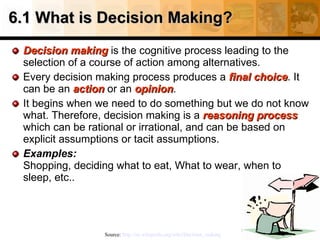
6.1 What is Decision Making? Decision making  is the cognitive process leading to the selection of a course of action among alternatives.  Every decision making process produces a  final choice . It can be an  action  or an  opinion .  It begins when we need to do something but we do not know what. Therefore, decision making is a  reasoning process  which can be rational or irrational, and can be based on explicit assumptions or tacit assumptions.  Examples:   Shopping, deciding what to eat, What to wear, when to sleep, etc.. Source:  http://en.wikipedia.org/wiki/Decision_making
Barriers to Good Decision Making “ Successful leaders have the courage to take action while others hesitate.”   -  John C. Maxwell
6.2 Barriers to Good Decision Making Hasty  - Making quick decisions without having much thought. Narrow  -  Decision making is based on very limited information.  Scattered  - Our thoughts in making decisions are disconnected or disorganized. Fuzzy  -  Sometimes, the lack of clarity on important aspects of a decision causes us to overlook certain important considerations.  For an explanation of the logical processes behind some of these barriers refer to   Module 4 ( Fallacies ) and Module 1 (Section -  Barriers to Critical Thinking ).
Decision Making Process “  Making good decisions is a crucial skill at every level.   ” -  Peter Drucker
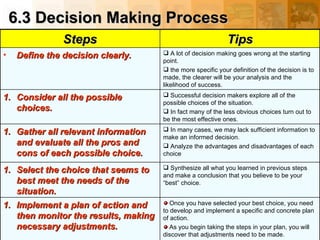
6.3 Decision Making Process Once you have selected your best choice, you need to develop and implement a specific and concrete plan of action. As you begin taking the steps in your plan, you will discover that adjustments need to be made.  Implement a plan of action and then monitor the results, making necessary adjustments. Synthesize all what you learned in previous steps and make a conclusion that you believe to be your “best” choice. Select the choice that seems to best meet the needs of the situation. In many cases, we may lack sufficient information to make an informed decision. Analyze the advantages and disadvantages of each choice Gather all relevant information and evaluate all the pros and cons of each possible choice. Successful decision makers explore all of the possible choices of the situation. In fact many of the less obvious choices turn out to be the most effective ones. Consider all the possible choices. A lot of decision making goes wrong at the starting point. the more specific your definition of the decision is to made, the clearer will be your analysis and the likelihood of success.  Define the decision clearly. Tips Steps
Decision Making Tools “ Because I'm thinking in a broader way, I feel like I am able to make better decisions.” - Takafumi Horie
6.4 Decision Making Tools Tools to facilitate better decisions: CoRT (Module 2) SWOT ANALYSIS (Next) SIX THINKING HATS (Module 7)  DECISION MATRIX FORCE FIELD ANALYSIS ISHIKAWA DIAGRAM MIND MAPPING SOCRATIC QUESTIONING More     MyCoted  +  Mind Tools  +  Creativity Web   I can study these tools on my own. Click!
SWOT Analysis T hreats O pportunities W eaknesses S trengths
6.4.1 SWOT Analysis SWOT  analysis is a great technique for identifying your  S trengths  and  W eaknesses  and study any  O pportunities  and  T hreats  you face. It is also a powerful  strategic planning tool  used to evaluate a project or in a business venture or in any other situation of an organization or individual requiring a decision in pursuit of an objective.  It involves monitoring the marketing environment  internal  and  external  to the organization or individual.  Source:  http:// en.wikipedia.org/wiki/SWOT_Analysis
6.4.1 SWOT Analysis – Strategic Use Orienting SWOTs to An Objective  -  If SWOT analysis does not start with defining a desired end state or objective, it runs the risk of being useless.  If a clear objective has been identified, SWOT analysis can be used to help in the pursuit of that objective. In this case, SWOTs are: Source:  http:// en.wikipedia.org/wiki/SWOT_Analysis   T hreats External  conditions that are harmful to achieving the objective. O pportunities External  conditions that are helpful to achieving the objective. W eaknesses Attributes of the organization that are harmful to achieving the objective. S trengths Attributes of the organization that are helpful to achieving the objective.
6.4.1 SWOT Analysis – Creative Use Creative Use of SWOTs  –  If the objective seems attainable, the SWOTs are used as inputs to the creative generation of possible strategies, by asking (usually in groups) and answering each of the following four questions, many times: Source:  http:// en.wikipedia.org/wiki/SWOT_Analysis   T hreats How can we  D efend against  each Threat? O pportunities How can we  E xploit each Opportunity? W eaknesses How can we  S top each Weakness? S trengths How can we  U se each Strength?
6.4.1 SWOT Analysis – Internal and External Factors The aim of any SWOT analysis is to identify the key  internal  and  external  factors that are important to achieving the objective. SWOT analysis groups key pieces of information into two main categories: Source:  http:// en.wikipedia.org/wiki/SWOT_Analysis   Internal Factors      Organization External Factors      External Environment S trengths W eaknesses O pportunities T hreats
6.4.1 SWOT Analysis – Errors to Be Avoided Conducting a SWOT analysis  before  defining and agreeing upon an objective (a desired end state). SWOTs should not exist in the abstract. They can exist only with reference to an objective.  Opportunities external to the company are often confused with strengths internal to the company. They should be kept separate. SWOTs are sometimes confused with possible strategies. SWOTs are descriptions of conditions, while possible strategies define actions.  Source:  http:// en.wikipedia.org/wiki/SWOT_Analysis
Group Activity Break into groups of  4 – 6. Identify a potential product/service to invest in (e.g. buying a car), or business project/venture to pursue. Do a  SWOT analysis to identify the key  internal  and  external  factors that are important to consider  (refer to the template).  Assess the findings, and make a decision. Example:  Imagine you want to assess whether to study at UNITAR or not. Do a SWOT analysis, assess and then make a decision.     Identify a potential product/service/project/venture to invest or pursue. 5 min Group presentation & discussion. 15 min The Group leader must submit their findings in hard-copy or soft-copy format to the lecturer before or during the next class.  Document your SWOT analysis findings in the template provided.  5 min Do a SWOT analysis, assess, and then make a decision. 15 min
Summary Define the decision clearly.  Consider all the possible choices.  Gather all relevant information and evaluate all the pros and cons of each possible choice.  Select the choice that seems to best meet the needs of the situation.  Implement a plan of action and then monitor the results, making necessary adjustments. 6.3 Decision Making Process Hasty, Narrow, Scattered  and  Fuzzy  decision making. 6.2 Barriers to Good Decision Making CoRT  SWOT Analysis Six Thinking Hats  Decision Matrix Etc. 6.4 Decision Making Tools Decision making is the cognitive process leading to the selection of a course of action among alternatives.  6.1 What is Decision Making?
Any Questions?
The End
References O n l i n e   R e s o u r c e s Courseware - Module 4: Decision Making   http://cw.unitar.edu.my/ugb2013/c4/index.htm   Decision Making:   http://en.wikipedia.org/wiki/Decision_making   SWOT Analysis:   http://en.wikipedia.org/wiki/SWOT_Analysis   SWOT Tutorial:   http://www.nelh.nhs.uk/folio/mchip/swot.pps   SWOT Templates:   http://www.businessballs.com/swotanalysisfreetemplate.htm   Teacher in Bad Mood:   http://www.sbac.edu/~tpl/clipart/Signs%20and%20Symbols/danger%2002.jpg   Punk:   http://www.rarepunk.com/images/punkrocker2.jpg   Siti Nurhaliza:   http://i31.photobucket.com/albums/c369/bukaninsanbiasa/ctmelayumerah.jpg   Angry Teacher:   http://www.webweaver.nu/clipart/img/education/angry-teacher.gif
Contact Details Zaid Ali Alsagoff UNIVERSITI TUN ABDUL RAZAK  16-5, Jalan SS 6/12 47301 Kelana Jaya Selangor Darul Ehsan Malaysia E-mail:   [email_address]     Tel:  603-7627 7238  Fax:  603-7627 7246

Decision Making4860

  • 1.
    Zaid Ali Alsagoff[email_address] Module 6: Decision Making
  • 2.
  • 3.
    Should You Ask?Sir, why is my coursework marks so low? I deserve higher marks. Hehehe!
  • 4.
    Which Mobile Phoneshould I buy? What are the things you consider before making a decision?
  • 5.
    What should Iwear for class (or work) today? What are the things you consider before making a decision?
  • 6.
    Module 6: DecisionMaking 3. Decision Making Process Decision Making 4. Decision Making Tools What is Decision Making? 2. Barriers to Good Decision Making
  • 7.
    What is DecisionMaking? "No sensible decision can be made any longer without taking into account not only the world as it is, but the world as it will be. . ." -  Isaac Asimov
  • 8.
    6.1 What isDecision Making? Decision making is the cognitive process leading to the selection of a course of action among alternatives. Every decision making process produces a final choice . It can be an action or an opinion . It begins when we need to do something but we do not know what. Therefore, decision making is a reasoning process which can be rational or irrational, and can be based on explicit assumptions or tacit assumptions. Examples: Shopping, deciding what to eat, What to wear, when to sleep, etc.. Source: http://en.wikipedia.org/wiki/Decision_making
  • 9.
    Barriers to GoodDecision Making “ Successful leaders have the courage to take action while others hesitate.” - John C. Maxwell
  • 10.
    6.2 Barriers toGood Decision Making Hasty - Making quick decisions without having much thought. Narrow - Decision making is based on very limited information. Scattered - Our thoughts in making decisions are disconnected or disorganized. Fuzzy - Sometimes, the lack of clarity on important aspects of a decision causes us to overlook certain important considerations. For an explanation of the logical processes behind some of these barriers refer to Module 4 ( Fallacies ) and Module 1 (Section - Barriers to Critical Thinking ).
  • 11.
    Decision Making Process“ Making good decisions is a crucial skill at every level. ” - Peter Drucker
  • 12.
    6.3 Decision MakingProcess Once you have selected your best choice, you need to develop and implement a specific and concrete plan of action. As you begin taking the steps in your plan, you will discover that adjustments need to be made. Implement a plan of action and then monitor the results, making necessary adjustments. Synthesize all what you learned in previous steps and make a conclusion that you believe to be your “best” choice. Select the choice that seems to best meet the needs of the situation. In many cases, we may lack sufficient information to make an informed decision. Analyze the advantages and disadvantages of each choice Gather all relevant information and evaluate all the pros and cons of each possible choice. Successful decision makers explore all of the possible choices of the situation. In fact many of the less obvious choices turn out to be the most effective ones. Consider all the possible choices. A lot of decision making goes wrong at the starting point. the more specific your definition of the decision is to made, the clearer will be your analysis and the likelihood of success. Define the decision clearly. Tips Steps
  • 13.
    Decision Making Tools“ Because I'm thinking in a broader way, I feel like I am able to make better decisions.” - Takafumi Horie
  • 14.
    6.4 Decision MakingTools Tools to facilitate better decisions: CoRT (Module 2) SWOT ANALYSIS (Next) SIX THINKING HATS (Module 7) DECISION MATRIX FORCE FIELD ANALYSIS ISHIKAWA DIAGRAM MIND MAPPING SOCRATIC QUESTIONING More  MyCoted + Mind Tools + Creativity Web I can study these tools on my own. Click!
  • 15.
    SWOT Analysis Threats O pportunities W eaknesses S trengths
  • 16.
    6.4.1 SWOT AnalysisSWOT analysis is a great technique for identifying your S trengths and W eaknesses and study any O pportunities and T hreats you face. It is also a powerful strategic planning tool used to evaluate a project or in a business venture or in any other situation of an organization or individual requiring a decision in pursuit of an objective. It involves monitoring the marketing environment internal and external to the organization or individual. Source: http:// en.wikipedia.org/wiki/SWOT_Analysis
  • 17.
    6.4.1 SWOT Analysis– Strategic Use Orienting SWOTs to An Objective - If SWOT analysis does not start with defining a desired end state or objective, it runs the risk of being useless. If a clear objective has been identified, SWOT analysis can be used to help in the pursuit of that objective. In this case, SWOTs are: Source: http:// en.wikipedia.org/wiki/SWOT_Analysis T hreats External conditions that are harmful to achieving the objective. O pportunities External conditions that are helpful to achieving the objective. W eaknesses Attributes of the organization that are harmful to achieving the objective. S trengths Attributes of the organization that are helpful to achieving the objective.
  • 18.
    6.4.1 SWOT Analysis– Creative Use Creative Use of SWOTs – If the objective seems attainable, the SWOTs are used as inputs to the creative generation of possible strategies, by asking (usually in groups) and answering each of the following four questions, many times: Source: http:// en.wikipedia.org/wiki/SWOT_Analysis T hreats How can we D efend against each Threat? O pportunities How can we E xploit each Opportunity? W eaknesses How can we S top each Weakness? S trengths How can we U se each Strength?
  • 19.
    6.4.1 SWOT Analysis– Internal and External Factors The aim of any SWOT analysis is to identify the key internal and external factors that are important to achieving the objective. SWOT analysis groups key pieces of information into two main categories: Source: http:// en.wikipedia.org/wiki/SWOT_Analysis Internal Factors  Organization External Factors  External Environment S trengths W eaknesses O pportunities T hreats
  • 20.
    6.4.1 SWOT Analysis– Errors to Be Avoided Conducting a SWOT analysis before defining and agreeing upon an objective (a desired end state). SWOTs should not exist in the abstract. They can exist only with reference to an objective. Opportunities external to the company are often confused with strengths internal to the company. They should be kept separate. SWOTs are sometimes confused with possible strategies. SWOTs are descriptions of conditions, while possible strategies define actions. Source: http:// en.wikipedia.org/wiki/SWOT_Analysis
  • 21.
    Group Activity Breakinto groups of 4 – 6. Identify a potential product/service to invest in (e.g. buying a car), or business project/venture to pursue. Do a SWOT analysis to identify the key internal and external factors that are important to consider (refer to the template). Assess the findings, and make a decision. Example: Imagine you want to assess whether to study at UNITAR or not. Do a SWOT analysis, assess and then make a decision.  Identify a potential product/service/project/venture to invest or pursue. 5 min Group presentation & discussion. 15 min The Group leader must submit their findings in hard-copy or soft-copy format to the lecturer before or during the next class. Document your SWOT analysis findings in the template provided. 5 min Do a SWOT analysis, assess, and then make a decision. 15 min
  • 22.
    Summary Define thedecision clearly. Consider all the possible choices. Gather all relevant information and evaluate all the pros and cons of each possible choice. Select the choice that seems to best meet the needs of the situation. Implement a plan of action and then monitor the results, making necessary adjustments. 6.3 Decision Making Process Hasty, Narrow, Scattered and Fuzzy decision making. 6.2 Barriers to Good Decision Making CoRT SWOT Analysis Six Thinking Hats Decision Matrix Etc. 6.4 Decision Making Tools Decision making is the cognitive process leading to the selection of a course of action among alternatives. 6.1 What is Decision Making?
  • 23.
  • 24.
  • 25.
    References O nl i n e R e s o u r c e s Courseware - Module 4: Decision Making http://cw.unitar.edu.my/ugb2013/c4/index.htm Decision Making: http://en.wikipedia.org/wiki/Decision_making SWOT Analysis: http://en.wikipedia.org/wiki/SWOT_Analysis SWOT Tutorial: http://www.nelh.nhs.uk/folio/mchip/swot.pps SWOT Templates: http://www.businessballs.com/swotanalysisfreetemplate.htm Teacher in Bad Mood: http://www.sbac.edu/~tpl/clipart/Signs%20and%20Symbols/danger%2002.jpg Punk: http://www.rarepunk.com/images/punkrocker2.jpg Siti Nurhaliza: http://i31.photobucket.com/albums/c369/bukaninsanbiasa/ctmelayumerah.jpg Angry Teacher: http://www.webweaver.nu/clipart/img/education/angry-teacher.gif
  • 26.
    Contact Details ZaidAli Alsagoff UNIVERSITI TUN ABDUL RAZAK 16-5, Jalan SS 6/12 47301 Kelana Jaya Selangor Darul Ehsan Malaysia E-mail: [email_address]   Tel: 603-7627 7238 Fax: 603-7627 7246

Editor's Notes

  • #20 The internal factors may be viewed as strengths or weaknesses depending upon their impact on the organization's objectives. The external factors may include macroeconomic matters, technological change, legislation, and socio-cultural changes, as well as changes in the marketplace or competitive position. The results are often presented in the form of a matrix.